Yes, EVA totes are washable, but not in a washing machine. Closed-cell ethylene-vinyl acetate absorbs effectively no water, so the whole cleaning routine is three minutes at a hose: rinse inside and out at normal tap pressure, tip the bag upside down so the perforations drain, and stand it open in shade for about 60 minutes. Sand falls through holes of nine to twelve millimetres rather than being trapped, sunscreen comes off with warm water and mild detergent, and nothing else is normally required. Machine washing is the one thing that ruins these bags, because flexing the body against itself can crease it permanently.
What Washable Means for a Molded Body
Washable means something different for a molded tote than it does for a fabric bag. There is no fabric to launder, no lining to protect and no seam to stress, so the objective is not to clean fibres but to remove what is sitting on a non-absorbent surface. Everything on an EVA tote is on the surface or caught in the perforations, and both are accessible to running water. That is why the routine is short and why products are unnecessary in most cases.
It also means the usual washing instincts are wrong. Longer is not better, hotter is not better, and agitation is actively harmful. A molded body needs water moving across it, not flexing against itself, and the difference between a bag that looks new after four seasons and one that looks tired after one is almost always whether it was machine washed at some point.
| Method | Safe for EVA | Why | Time required |
|---|---|---|---|
| Hose or tap rinse | Yes | Removes surface contamination without flexing the body | About 3 minutes |
| Sink or basin rinse | Yes | Ideal for small and kids sizes | 1 to 2 minutes |
| Warm water with mild detergent | Yes | Lifts sunscreen and food oils | 2 to 4 minutes |
| Soft cloth or sponge | Yes | Safe abrasion for stubborn residue | As needed |
| Pressure washer | No | Cuts the surface layer and can deform thin walls | Not applicable |
| Washing machine | No | Flexing creases the body permanently | Not applicable |
| Dishwasher | No | Water exceeds 60 degrees and cycles are long | Not applicable |
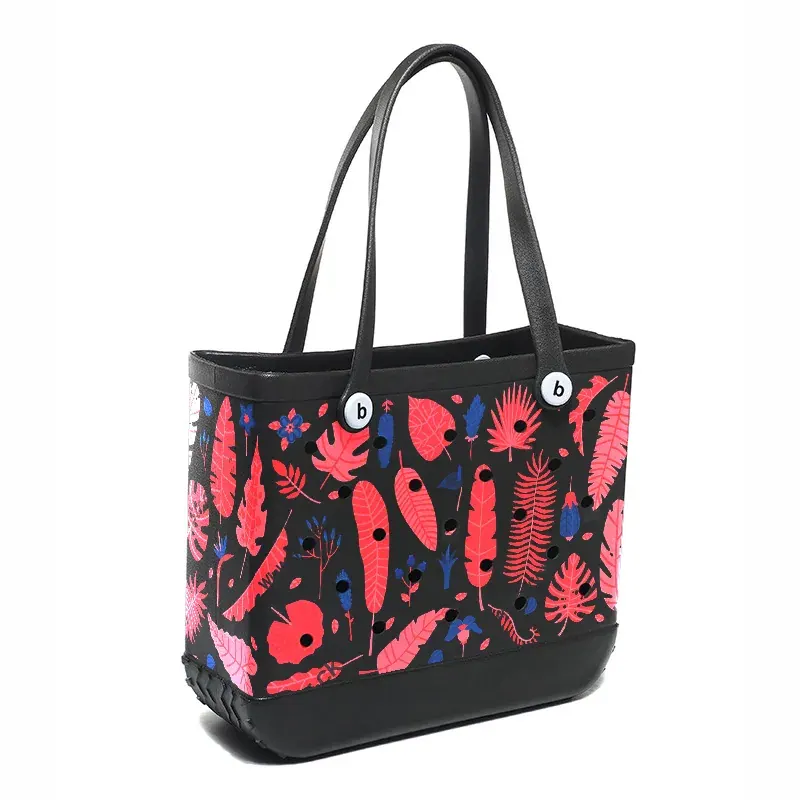
The Three-Minute Rinse Routine
This is the whole routine for ordinary use, and it works because the material cannot hold anything. Nothing needs to soak, nothing needs to be scrubbed, and no product is required unless something oily was spilled.
- Tip out loose contents and shake the bag upside down once, which removes most dry sand through the perforations.
- Rinse the interior at normal tap pressure, working from the base upward so grit is pushed out through the holes rather than into the corners.
- Rinse the exterior, including the base rails and the handle roots, where sand and salt collect invisibly.
- Turn the bag upside down and let it drain for about thirty seconds; a fully perforated body empties in four to seven seconds after a dunk.
- Stand it open in shade with the mouth facing down if possible, and leave it for about an hour before storing.
Two habits make the routine faster still. Rinse at the beach or pool rather than at home, so sand is removed where it fell instead of being carried into a car and a hallway. And keep a small wet pouch inside for swimsuits, because the perforations drain water but they do not separate wet fabric from dry items, and a wet swimsuit is the usual source of any odour people attribute to the bag.
Removing Sunscreen, Food, Salt and Other Stubborn Marks
Four substances account for almost everything that a plain rinse will not remove, and each has a short method. None of them requires a specialist cleaner, and all four respond to warm water and mild detergent provided they are dealt with reasonably promptly.
| Substance | Method | Approximate time | What to avoid |
|---|---|---|---|
| Sunscreen residue | Warm water, mild detergent, soft cloth, then rinse well | 2 to 3 minutes | Solvent cleaners, which dull the surface |
| Food oils and spills | Detergent wash, rinse, air dry open | 3 to 4 minutes | Hot water above 60 degrees |
| Salt crust after sea use | Fresh water rinse, paying attention to the base rails | 1 to 2 minutes | Leaving it to crystallise, which stiffens trims |
| Grass or mud | Hose from the inside outward, then detergent if needed | 2 to 5 minutes | Scrubbing before the mud is loosened |
| Print or ink transfer | Mild detergent, gentle rubbing, repeat rather than scrub | 5 to 10 minutes | Abrasives, which permanently mark the skin layer |
The one rule that covers all five is to repeat rather than escalate. Two gentle passes remove more than one aggressive one, because aggressive cleaning damages the surface layer and leaves a dull patch that collects dirt faster than the surrounding material did. Cleaning product choice also matters for households with children: the safer chemical guidance published by the United States Environmental Protection Agency is the reference for choosing a mild detergent over a solvent-based one.
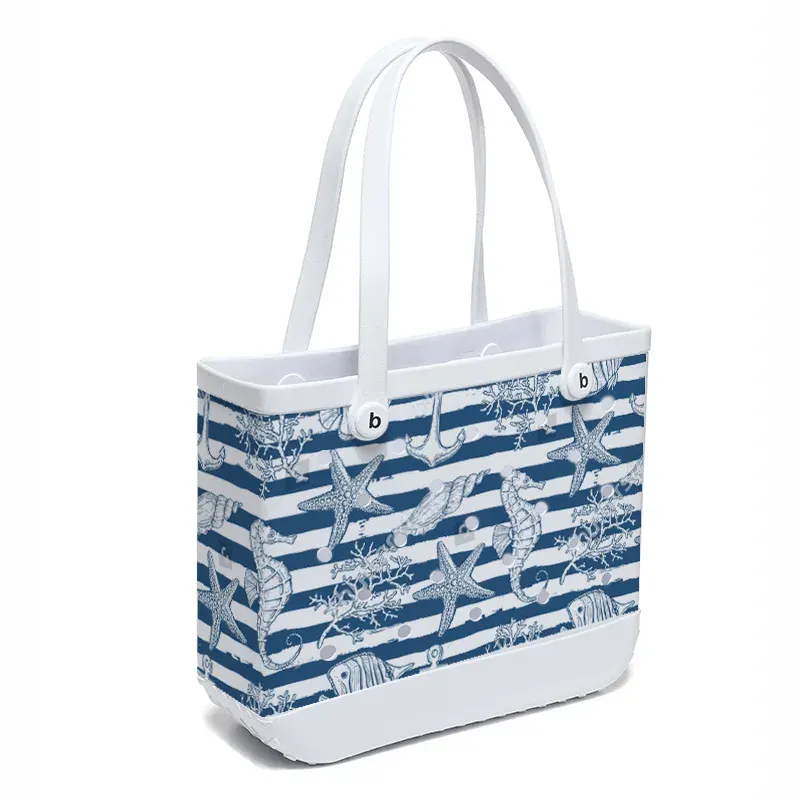
Sand Removal: Shake, Rinse, Drain
Sand is the reason the perforations exist, and removing it is mostly a matter of sequence. Shake the dry bag first, because dry sand passes through holes of nine to twelve millimetres freely and damp sand does not. Rinse second, which re-mobilises anything bridging the holes. Drain third by standing the bag upside down. Working in that order removes almost all of it; reversing the order wets the sand first and makes the job harder.
Hole diameter is the specification that decides how well this works, and it is worth checking on a bag that seems to hold sand. Below eight millimetres, damp sand bridges the opening and stays behind regardless of how hard the bag is shaken. Between ten and twelve, sand and grit pass cleanly. Above fourteen, sand passes but so do lip balm and small toys. If a bag consistently holds sand after a shake and a rinse, the holes are too small and no technique will fully compensate.
Why the Washing Machine Is Prohibited
This is the question behind most searches on the topic, and the answer is unambiguous. A washing machine flexes a rigid body against itself and against the drum for a full cycle, and ethylene-vinyl acetate at four to eight millimetres does not recover from that. The result is a permanent crease, usually across the base or up a wall, which weakens the section and makes the bag sit unevenly afterwards. It can also deform the rim so the mouth no longer stands open.
Three related prohibitions follow from the same physics. Water above sixty degrees risks heat deformation, which rules out dishwashers and hot fills. Spin cycles concentrate force at the handle roots, which is where these bags fail anyway. And detergent concentrates and fabric softener leave a residue on a non-absorbent surface that attracts dirt rather than removing it, so even the chemistry is working against the material.
Heat, Solvents and the Four Things That Damage Them
Four things ruin molded totes, and all four are avoidable without any special care routine. Knowing them is more useful than any cleaning product, because three of the four do their damage while the bag is being stored rather than while it is being cleaned.
- Machine washing, which flexes the body against itself and can crease it permanently within a single cycle.
- Heat above sixty degrees, which includes dishwashers, hot water fills and prolonged direct sun on a dark colourway.
- Solvent cleaners, including acetone and citrus degreasers, which attack the skin layer and leave a dull patch that collects dirt.
- Sustained point loading in storage, such as hanging a large body by one handle for months, which slowly deforms the rim.
Direct sun deserves the most attention because it is the one that happens by accident. Surface temperature on a dark body left in summer sun can pass sixty degrees within an hour, and a large dark panel has more room to creep than a small one. Storing the bag in shade, or choosing a lighter colourway in hot climates, adds seasons to both its shape and its colour without any change to the cleaning routine.
Drying and Storage Between Uses
Drying is the step people skip, and it is the one that matters most for anything used around water. A perforated body dries far faster than a fabric bag because the holes ventilate the whole interior rather than only the top, but it still needs air moving through it. Standing the bag open in shade is sufficient; closing it, or stacking it inside another bag, is not.
| Condition | Approximate dry time | Why the difference | Recommended action |
|---|---|---|---|
| Fully perforated body, open, shaded, breezy | 30 to 45 minutes | Air moves through holes on every face | Stand mouth down and open |
| Fully perforated body, open, still indoor air | 60 to 90 minutes | No airflow through the interior | Place near an open window or fan |
| Semi-perforated body, open | 2 to 3 hours | Upper wall is solid and does not ventilate | Wipe the solid panels, then air dry |
| Closed or stacked inside another bag | Several hours or overnight | No air exchange at all | Always store open |
| Wet fabric items left inside | Indefinite until removed | Fabric holds water the body cannot | Use a wet pouch and empty it |
The hygiene reason for drying properly is worth stating plainly. Damp swim kit left in a closed bag carries bacteria and chlorine by-products between sessions, and the guidance on healthy swimming published by the United States Centers for Disease Control and Prevention is explicit about drying swim items rather than storing them wet. A body that drains and air-dries in an hour removes that step from the routine instead of adding one.
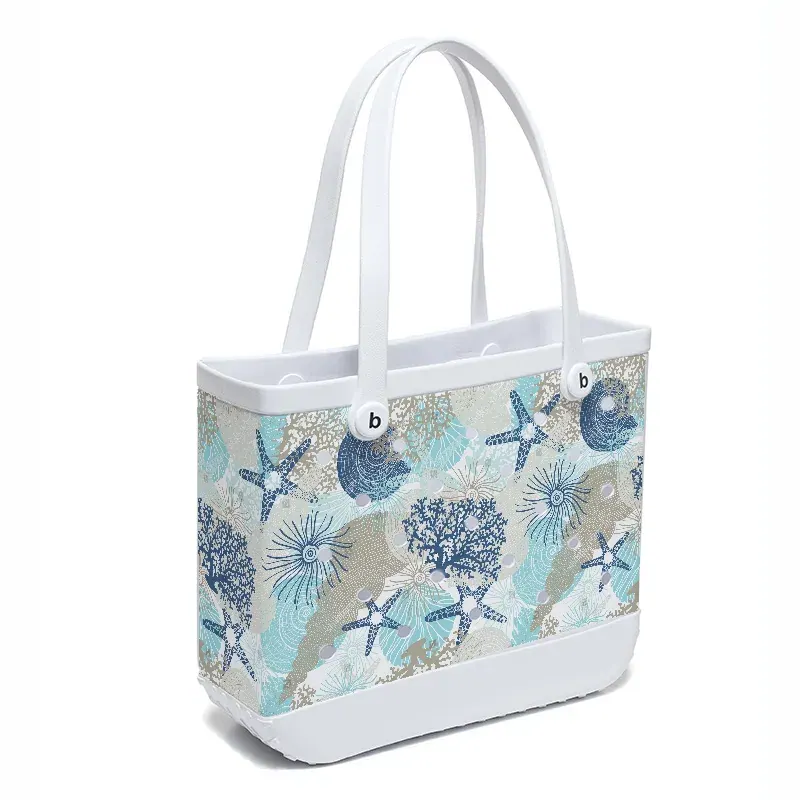
Odour and Mildew: What EVA Cannot Do
A molded tote cannot develop mildew in the way a fabric bag can, because there is no structure to hold water and no organic fibre to feed on. When one of these bags smells, the source is almost always something inside it rather than the bag. Three culprits account for nearly all cases: a wet swimsuit or towel left in the base, sunscreen that has gone rancid in a corner, or standing water in a body that was stored upright rather than drained.
The fix follows the cause. Empty the bag and dry it, wash it with mild detergent if residue is present, and store it upside down so any water that enters drains rather than pools. If an odour persists after that, the source is a fabric item or an insert rather than the body, and it should be washed or replaced. Deodorisers and disinfectant sprays are unnecessary and several are solvent-based, which puts them on the prohibited list.
Cleaning Time and Method by Size
Size changes the practicalities more than the method. A small body fits in a sink or a shower tray, can be turned under a tap with one hand and dries in well under an hour, which is why small sizes are cleaned far more often and stay looking newer. A large body needs a hose or an outdoor tap, has more surface to cover, and takes longer to drain because there is more enclosed volume above the perforated base.
| Size | Where to rinse | Water volume per rinse | Dry time | Frequency in regular use |
|---|---|---|---|---|
| Mini and kids | Sink or basin | 5 to 8 litres | 20 to 40 minutes | After most uses |
| Small, 10 to 14 litres | Sink, shower tray or tap | 10 to 15 litres | 30 to 60 minutes | After most uses |
| Medium, 18 litres | Outdoor tap or hose | 15 to 20 litres | 45 to 90 minutes | Weekly in season |
| Large, 29 to 32 litres | Hose, from the inside outward | 20 to 30 litres | 60 to 120 minutes | Weekly in season |
| Extra large, 38 litres and above | Hose, ideally two passes | 30 to 40 litres | 90 to 150 minutes | Fortnightly in season |
The practical advice that follows from the table is to buy the size you will actually maintain. A family who will not carry a 32 litre body to an outdoor tap once a week is better served by a medium size that gets rinsed properly than by a large one that gets rinsed twice a season, because the bag that is cleaned stays presentable and the one that is not ends up stored out of sight.
Cleaning Charms, Inserts and Straps
Accessories need their own short routine because they are not the same material as the body. Pressed-in silicone or EVA charms collect sunscreen and sand around their stems, and the fix is to pop them out, wash them in warm water with mild detergent, dry them and reseat them, which takes about a minute each. Leaving them in place means the area around each hole stays grimy, and it is the most common reason a bag looks dirty when the body itself is clean.
Inserts and organisers are usually sewn fabric, so they behave like a fabric bag: they absorb water, they need a wash cycle and they take hours to dry. That is the trade-off for the organisation they provide, and it is worth emptying and drying them between uses rather than leaving them inside a wet body. Straps should be rinsed separately and dried before storage, because webbing holds water against the rim and any metal hardware left damp will corrode near salt water within a season.
If It Has Already Been Machine Washed
It happens often enough to be worth addressing, and the outcome depends on how far the cycle went. A short cool cycle may leave the body apparently undamaged; inspect the base, the walls and the rim for a crease before assuming it survived. A long or warm cycle is more likely to have creased the body or deformed the rim, and the damage is permanent because ethylene-vinyl acetate does not recover from that kind of flexing.
- Dry it fully first. A damp body hides creases that become obvious once the surface is dry.
- Set it on a flat floor and look for a corner that no longer sits level, which indicates base deformation.
- Check the mouth: if it no longer stands open on its own, the rim has lost shape and the bag will be awkward to load.
- Inspect the handle roots from underneath for whitening or cracking, which indicates the section was stressed.
- If the damage is only a crease in a wall, the bag is still usable for garden and utility duty even if it no longer presents well.
Seasonal Deep Clean and End-of-Summer Storage
Once or twice a year the routine is worth extending, and it still takes under fifteen minutes. Hose the body thoroughly, wash with mild detergent and a soft cloth, rinse until no detergent remains, drain upside down, and dry completely in shade. Inspect the three areas that fail: the handle roots for cracking, the base rails for wear, and the rim for deformation. Finding a cracked handle root at the end of a season is better than finding it at the start of the next one.
- Store dry, open and upside down, hung by both handles if possible rather than by one.
- Keep it out of direct sun and away from heat sources; a garage that reaches high summer temperatures is a poor choice for a dark colourway.
- Do not stack heavy items inside it over winter, since sustained load on a molded base can creep the shape.
- Remove charms and inserts before storage, and store them separately so hole edges are not stressed.
- Photograph the bag and its condition at the end of the season; it makes any warranty or replacement conversation straightforward.
Material and physical test references for molded articles are published by ASTM International, which is where the temperature and load limits quoted in this guide come from. Consumers never need the standard numbers, but a buyer comparing two products should ask which method a claim was tested under, because a limit without a method is not a specification.
Programme Notes
The perforated construction that makes this routine possible is explained in the perforated EVA tote range, the moulded rubber alternative is covered in the rubber beach tote range, and long-term care by season is set out in the EVA tote care guide. QUANZHOU JUNYUAN BAGS has run waterproof bag programmes since 2014 with a founding team in this trade since 2004, covering injection-molded EVA work alongside sewn and welded ranges.
Monthly output runs at 200,000 units verified by SGS, operations follow BSCI and ISO 9001, materials are screened for REACH and California Prop 65, and every bulk shipment is inspected at AQL 2.5 before release. Programme minimums begin at 500 pieces per design and colour, with sampling at 6 to 10 working days and bulk at 35 to 50 days from approved sample and deposit. Send your target size, perforation preference, colourway count, quantity and destination market to service@junyuanbags.com, and ask for care-label artwork at the same time if the goods are for retail.
People Also Ask
Can you put an EVA tote in the washing machine?
No. A full cycle flexes the body against itself and can crease it permanently, and it can also deform the rim.
How do you clean an EVA tote?
Hose it inside and out at tap pressure, tip it to drain, and stand it open in shade for about an hour. Use mild detergent only for oils.
What is the fastest way to dry an EVA tote after swimming?
Rinse it, stand it open with the mouth facing down in a breezy shaded spot, and it is dry in 30 to 45 minutes.
Does sand come out of an EVA tote?
Yes, through holes of nine to twelve millimetres. Shake it dry first, then rinse, then drain, in that order.
Can EVA totes get mouldy?
The body cannot, because closed-cell material holds no water and has no organic fibre. Odour comes from wet items left inside.
Is hot water safe for cleaning an EVA tote?
Only up to about sixty degrees. Above that the shape can creep, which rules out dishwashers and hot fills.
Frequently Asked Questions
Q1. Are EVA totes machine washable?
No. Machine washing flexes the body against itself, which can crease it permanently and deform the rim so the mouth no longer stands open.
Q2. What is the correct way to wash an EVA tote?
Rinse inside and out at normal tap pressure, tip it upside down to drain, and stand it open in shade for about an hour.
Q3. Can I use detergent on an EVA tote?
Yes, a mild one with warm water and a soft cloth for sunscreen or food residue. Rinse thoroughly afterwards and avoid solvents.
Q4. How do I get sand out of the perforations?
Shake the dry bag first, rinse second, drain third. Dry sand passes holes of nine to twelve millimetres, damp sand does not.
Q5. How long does an EVA tote take to dry?
Roughly 30 to 45 minutes open in a breeze and 60 to 90 minutes in still air. Always store it open.
Q6. Can an EVA tote go in the dishwasher?
No. Dishwasher water exceeds sixty degrees and cycles are long, both of which risk deforming the body.
Q7. Will an EVA tote go mouldy?
No. Closed-cell material absorbs no water and has no organic fibre, so the body cannot support mould. Odour comes from items left inside.
Q8. What removes sunscreen from EVA?
Warm water, mild detergent and a soft cloth, then a thorough rinse. Repeat gently rather than scrubbing hard.
Q9. Are solvent cleaners safe on EVA?
No. Acetone and citrus degreasers attack the surface layer and leave a dull patch that collects dirt faster than the surrounding area.
Q10. Can I leave an EVA tote in the sun to dry?
In shade is better. A dark body in direct summer sun passes sixty degrees at the surface within an hour, which can creep the shape.
Q11. How should I store an EVA tote over winter?
Dry, open and upside down, hung by both handles, out of direct sun and away from heat sources, with charms and inserts removed.