A 15 to 25 litre daypack is correct for any trip with resupply inside 24 hours; a 55 to 75 litre expedition pack is correct once the gap between resupply points exceeds two days or the load passes 12 kilograms. A daypack weighs 0.5 to 1.0 kilogram empty and carries 3 to 6 kilograms comfortably on straps alone, while an expedition body weighs 2.0 to 3.0 kilograms and needs a padded hip belt transferring 70 to 80 percent of load to the pelvis. Waterproof ratings track size in the opposite direction: small welded bodies routinely reach IPX6 to IPX7, while large bodies with 1,200 to 2,000 millimetre closures usually settle at IPX4 to IPX5. Programme entry is 500 pcs per design and colour, samples in 6 to 10 working days, bulk in 35 to 50 days.
Volume Is a Proxy for Resupply Interval
Capacity is not really about how much a person owns; it is about how long that person must carry everything between refills. A daypack sized at 15 to 25 litres covers a 6 to 12 hour window with food, water, a shell, and a small first aid kit. An expedition body sized at 55 to 75 litres covers three to ten days without a shop, which means shelter, sleep system, cooking kit, and clothing for two temperature extremes.
That is why the most useful question at the point of purchase is not how big but how often. If food and water are available every 12 hours, 20 litres is generous. If the next water source is 30 kilometres away and the next shop is four days away, nothing under 55 litres is realistic. Buying capacity for the worst day of a trip rather than the average day is the single most common sizing mistake in this category.
Weight follows volume with brutal consistency. Every extra litre of usable space invites roughly 0.3 to 0.5 kilograms of cargo, so a hiker who upgrades from 25 to 65 litres without changing habits typically ends up carrying 12 to 20 kilograms more than before. The bag did not get heavier in any meaningful sense; the owner simply filled the space that was offered.
| Parameter | Daypack 15 to 25 L | Expedition 55 to 75 L | Why it matters |
|---|---|---|---|
| Empty weight | 0.5 to 1.0 kg | 2.0 to 3.0 kg | Dead weight on every kilometre |
| Comfortable load | 3 to 6 kg | 15 to 25 kg | Harness class changes |
| Resupply interval covered | Under 24 hours | 3 to 10 days | The real sizing variable |
| Typical trip length | Single day | 3 nights to multi-week | Packing list follows |
| Body dimensions | 450 by 280 by 180 mm | 750 by 400 by 320 mm | Door, bus and aircraft clearance |
Harness Engineering Above and Below 10 Kilograms
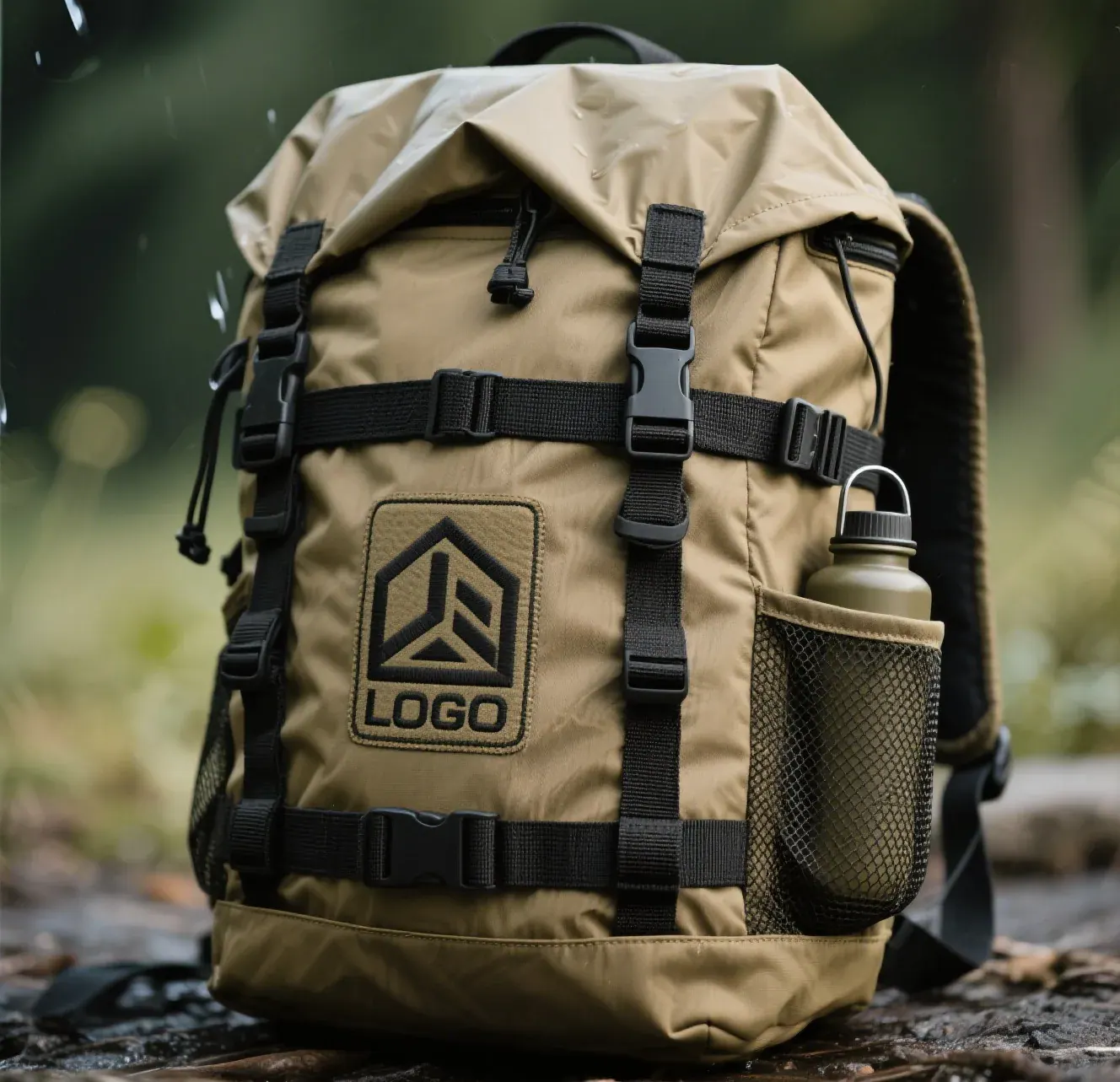
Ten kilograms is the engineering divide. Below it, shoulders carry the load adequately with 8 to 12 millimetres of strap foam and a sternum strap. Above it, the pelvis must take the majority, which requires a padded hip belt of 80 to 120 millimetres width, a frame sheet or alloy stays, and load lifter straps set at 20 to 45 degrees above the shoulder line. In a properly fitted expedition harness the hip belt takes 70 to 80 percent of total weight.
Fit is measured, not guessed. Torso length from the seventh vertebra to the iliac crest commonly spans 400 to 550 millimetres, and harness sizes map to that range. A 50 millimetre mismatch transfers several kilograms back onto the shoulders and produces neck pain within the first hour, which is why expedition packs are sold in two or three harness sizes while daypacks are usually sold in one.
Stability differs as well. A 20 litre load sits close to the spine and barely moves, so a simple unpadded belt is enough. A 20 kilogram load swings with every step, and an expedition pack needs a rigid frame to convert that swing into vertical load through the hips. This is the mechanical reason a heavy load in a frameless pack feels far worse than the same weight in a framed one, even when the scale reads identically.
| Harness element | Daypack requirement | Expedition requirement | Check |
|---|---|---|---|
| Hip belt width | 25 to 40 mm, unpadded | 80 to 120 mm, padded | Measure at the widest point |
| Frame | None or a thin sheet | Alloy stays or moulded sheet | Twist test under load |
| Load lifter angle | Not needed | 20 to 45 degrees | Visual at the shoulder |
| Torso adjustment | One size | Two or three sizes | Measure 400 to 550 mm |
| Sternum strap | Recommended | Required | Set 20 to 40 mm below the collar |
Waterproof Performance Runs Opposite to Size
Big packs are harder to seal. A 65 litre expedition body needs a main opening of 1,200 to 2,000 millimetres, usually as a curved zipper with two lower corners where tension concentrates. Sealing that path to immersion standard is expensive, so most expedition packs ship as a water resistant shell plus a rain cover and settle at IPX4 to IPX5 in practice. Their contents stay dry because the owner adds a liner, not because the bag is submersible.
A 20 litre daypack has a different geometry entirely. Its mouth may be 400 to 700 millimetres, and with a roll top and welded seams it reaches IPX6 to IPX7 economically. The published ingress definitions come from IEC 60529, and buyers should specify the rating for the assembled pack packed to its intended level, because a nearly full pack has less trapped air and a shorter effective fold.
The practical consequence is a layered strategy on long trips. Expedition users pair a water resistant outer body with one or two internal dry liners of 8 to 20 litres, keeping sleep system and electronics in the sealed layer and everything else in the shell. That combination costs 18 to 45 USD extra and delivers better real-world protection than hoping one giant welded body exists at a sane price.
| Protection element | Daypack 20 L | Expedition 65 L | Practical result |
|---|---|---|---|
| Main closure path | 400 to 700 mm | 1,200 to 2,000 mm | Long paths seal poorly |
| Typical tested rating | IPX6 to IPX7 | IPX4 to IPX5 | Two to three code steps |
| Standard defence | Welded body itself | Shell plus liner plus cover | Layers replace one rating |
| Liner requirement | Usually none | 8 to 20 L liner per compartment | Budget 18 to 45 USD |
| Drying time after soaking | 2 to 4 hours | 6 to 12 hours | Big bodies restrict airflow |
Packing Lists and Real Weights
Numbers settle the argument faster than adjectives. A daypack list runs: 2 litres of water at 2.2 kilograms, lunch at 0.6, a shell at 0.5, a first aid kit at 0.35, a phone and small items at 0.4. That is 4.05 kilograms in about 12 litres, comfortably inside daypack territory and well below the 10 kilogram harness divide.
An expedition list for five days runs: tent 1.8 to 2.5, sleeping bag 1.0 to 1.8, pad 0.4 to 0.8, stove and fuel 0.6 to 1.0, food at 0.6 to 0.9 kilograms per day plus packaging, water 2 to 4, clothing 2.5 to 4, and shared group kit 1 to 2. Totals land between 13 and 22 kilograms before the pack itself, which is precisely why the expedition class exists.
- Weigh the full packing list on a bathroom scale before choosing a volume class.
- Keep the carried load under 20 percent of body weight for multi-day trips, under 10 percent for day trips.
- Place heavy items within 50 millimetres of the spine and between the shoulder blades and the hip line.
- Put the sleep system and electronics in a sealed liner regardless of the shell rating.
- Recheck strap tension after the first 3 kilometres, because new webbing settles by 3 to 5 percent.
Seasonal variation then pushes the numbers around. A summer five day trip may total 12 kilograms, while the same route in shoulder season with a warmer bag, a heavier shell, and gloves reaches 17 to 19. Buyers specifying a range should size for the shoulder season, because a pack that is slightly too large compresses well whereas one that is slightly too small simply fails.
Exposure, Cold and Consequence of Failure
The cost of a wet sleeping bag on a day hike is discomfort; the cost of the same failure four days from a road is hypothermia risk. Cold-weather guidance published by the US Centers for Disease Control and Prevention treats wet clothing and wind as the two accelerants that turn a cold day into a medical event, which is exactly the failure mode an expedition packing system is designed to prevent.
This is why the two classes justify different spending. A daypack buyer can accept IPX5 and a light shell, because shelter is rarely more than a few hours away. An expedition buyer should spend on redundancy: a sealed liner for the sleep system, a cover for the shell, and a pack fabric that keeps its coating after 200 kilometres of abrasion. The extra 25 to 60 USD is cheap insurance measured against a rescue.
Weather planning belongs in the same discussion. Checking monthly rainfall normals before selecting volume and protection level is standard practice; national meteorological services publish those figures by region and month, and seeing whether a route averages 20 or 200 millimetres in the target month should decide how much of the budget goes into water protection.
| Trip scenario | Load | Volume needed | Protection plan |
|---|---|---|---|
| Summer day hike, 8 hours | 4 to 6 kg | 15 to 22 L | IPX6 body, no liner |
| Shoulder season day hike | 5 to 7 kg | 20 to 25 L | IPX6 body plus dry pouch for phone |
| Hut-to-hut, 3 days | 8 to 11 kg | 35 to 45 L | IPX5 shell plus 12 L liner |
| Trek, 5 days, self-supported | 13 to 18 kg | 55 to 65 L | IPX4 shell plus two liners |
| Winter expedition, 7 days | 18 to 25 kg | 65 to 75 L | Shell plus liners plus cover |
Materials, Wear Points and Testing
The two classes fail in different places. Daypacks fail at the roll-top fold line, which flexes roughly 2,500 to 5,000 times per season, and at strap roots where single-shoulder carry concentrates load. Expedition packs fail at base corners dragged over rock, at the top grab handle lifted under 20 kilograms, and at long zippers that accumulate grit over 300 to 800 cycles per trip.
Specification should therefore be class-specific. Daypack: 500D to 800D base, 0.4 to 0.6 millimetre coating, fold life above 5,000 cycles, strap root tested to 20 kilograms static. Expedition: 800D to 1000D base, coating above 220 grams per square metre, grab handle tested to 30 kilograms for 60 seconds, and a buckle salt-fog cycle if the route is coastal. Abrasion and tear procedures published by ASTM International provide the shared method for those claims.
| Test item | Daypack target | Expedition target | Method |
|---|---|---|---|
| Base textile | 500D to 800D | 800D to 1000D | Denier certificate |
| Coating mass | Above 180 g per square metre | Above 220 g per square metre | Weighed swatch |
| Grab handle load | 15 kg for 60 seconds | 30 kg for 60 seconds | Static lift |
| Fold or zipper life | 5,000 to 8,000 cycles | 10,000 to 20,000 cycles | Cycled prototype |
| Seam peel | Above 70 N per 25 mm | Above 40 N per 25 mm | Lot sample pull |
| Abrasion resistance | 3,000 rubs | 6,000 rubs | Abrasion cycle count |
Travel, Transport and Storage Reality
Expedition bodies are awkward away from the trail. A 65 litre pack at roughly 750 by 400 by 320 millimetres will not fit under an aircraft seat, usually exceeds cabin allowances near 45 by 30 by 20 centimetres, and must be checked or carried on. Checked handling adds abrasion, rain exposure on the apron, and a weight limit near 23 kilograms that punishes anyone who filled every litre.
Daypacks travel easily and are frequently carried empty to the trailhead, which is a hidden advantage: a 20 litre welded pack folds to around 1.5 to 3 litres and can live inside the expedition body until needed. Many trekkers therefore run a 65 litre expedition pack plus a 20 litre welded daypack, using the small bag for summit days, town stops, and wet weather excursions from base camp.
Storage is the last practical difference. A daypack hangs on a hook and dries in 2 to 4 hours; an expedition pack needs 6 to 12 hours open and inverted, and should be stored loosely packed with closures undone so the coating is not held under constant fold tension. Buyers stocking both classes should state these care rules on the hangtag, because storage damage is the most common cause of a coating complaint in year two.
Verdict, Sizing Rules and Programme Numbers
Three rules resolve nearly every case. Rule one: if resupply is inside 24 hours and the load stays under 7 kilograms, buy the daypack and specify IPX6. Rule two: if resupply exceeds two days or the load passes 12 kilograms, buy the expedition body and budget for internal liners. Rule three: if the trip includes both a multi-day approach and daily excursions from a base, buy both, with the daypack sized 5 litres above the expected day load.
Volume selection for either class is covered in more detail in the waterproof backpack size and capacity guide, and the two product families most buyers compare are the waterproof hiking backpack range for day to weekend use and the waterproof travel backpack range for long-haul capacity that still passes cabin checks.
QUANZHOU JUNYUAN BAGS develops both volume classes from one material library, starting at 500 pcs per design and colour with samples in 6 to 10 working days and bulk in 35 to 50 days. Materials may be screened against REACH and California Prop 65, release inspection can run at AQL 2.5, and quality systems are maintained to ISO 9001. Delivery can be FOB Xiamen or DDP into more than 100 countries. Harness geometry, liner systems, and closure selection are documented. Briefs may be sent to service@junyuanbags.com.
Seen plainly, this is not a contest between a small bag and a big one. It is a question of how long a person must be self-sufficient and how much weight their skeleton can move comfortably. Answer those two questions with numbers, and the correct volume class becomes obvious before a single product page is opened.
People Also Ask
Is a 20 litre backpack enough for a day hike?
Yes for most summer day hikes. A 12 to 15 litre load of 4 to 6 kilograms covers 2 litres of water, lunch, a shell, and a first aid kit. Choose 22 to 25 litres in shoulder season when gloves and a warmer layer add 1 to 2 kilograms.
When do I need a 65 litre expedition pack?
When resupply is more than two days away or the load passes 12 kilograms. A five day self-supported trek runs 13 to 18 kilograms including shelter, sleep system, stove, and food, which needs 55 to 65 litres with no realistic way to compress it.
Why are large expedition packs less waterproof than small daypacks?
The main closure is 1,200 to 2,000 millimetres with corners where tension concentrates, and sealing that to immersion standard is expensive. Most expedition bodies therefore ship at IPX4 to IPX5 and rely on internal liners of 8 to 20 litres for critical kit.
How heavy should a loaded backpack be?
Keep it under 10 percent of body weight for day trips and under 20 percent for multi-day trips. A 70 kilogram hiker should carry roughly 7 kilograms on a day hike and up to 14 kilograms on a trek, with a hip belt taking 70 to 80 percent above 10 kilograms.
Can one pack do both jobs?
Only in the 35 to 45 litre middle ground, which covers hut-to-hut trips of 8 to 11 kilograms but neither a light summit day nor a self-supported week. Most people who try to force one compromise pack end up buying the second within a year.
How long does each pack take to dry after heavy rain?
A 20 litre welded daypack dries in 2 to 4 hours open and inverted at 20 degrees Celsius. A 65 litre expedition body needs 6 to 12 hours because compartments and linings restrict airflow, which is why liners matter more on long trips.
Frequently Asked Questions
Q1. What is the real difference between a daypack and an expedition pack?
Capacity and harness. A daypack holds 15 to 25 litres and carries 3 to 6 kilograms on straps alone, while an expedition pack holds 55 to 75 litres and carries 15 to 25 kilograms through a padded hip belt that transfers 70 to 80 percent of load to the pelvis.
Q2. How do I choose between 20 litres and 50 litres?
Count the days between resupply. Under 24 hours means 20 litres is enough; over two days means 50 litres or more. Load is the second test: above 12 kilograms the larger body is mandatory regardless of trip length.
Q3. Are large expedition packs waterproof?
Usually water resistant rather than waterproof. Expect IPX4 to IPX5 because long closures are expensive to seal. Protecting a sleep system means adding an 8 to 20 litre sealed liner inside, which costs 18 to 45 USD and works better than any cover.
Q4. What load can a daypack carry comfortably?
3 to 6 kilograms, or up to 7 for short periods. That is about 10 percent of body weight for a 65 kilogram adult, and it needs only 8 to 12 millimetre strap foam plus a sternum strap, with no frame required.
Q5. Do I need a hip belt on a daypack?
A simple 25 to 40 millimetre webbing belt helps stabilise the load but does not need padding. Padding becomes necessary above about 10 kilograms, where a belt of 80 to 120 millimetres should be carrying most of the weight.
Q6. How should I size an expedition pack torso?
Measure from the seventh vertebra to the iliac crest, typically 400 to 550 millimetres, and buy the harness size that matches. A 50 millimetre mismatch shifts several kilograms back onto the shoulders and produces neck pain within the first hour.
Q7. What weight should a five day trek load be?
13 to 18 kilograms before the pack itself, covering shelter 1.8 to 2.5 kilograms, sleep system 1.4 to 2.6, stove and fuel 0.6 to 1.0, food at 0.6 to 0.9 per day, water 2 to 4, and clothing 2.5 to 4.
Q8. Can I take a 65 litre pack as cabin luggage?
Rarely. Cabin allowances sit near 45 by 30 by 20 centimetres, roughly 22 to 40 litres depending on shape, so a 65 litre body is usually checked. That adds abrasion risk, apron rain exposure, and a weight limit near 23 kilograms.
Q9. Should I carry a daypack inside an expedition pack?
Yes for base-camp trips. A 20 litre welded daypack folds to 1.5 to 3 litres, weighs 0.5 to 1.0 kilogram, and serves summit days, town stops, and wet excursions. It also gives you a genuinely IPX6 rated bag at the point where rain matters most.
Q10. What are MOQ, sample and bulk times for either volume class?
Identical: 500 pcs per design and colour, prototype samples in 6 to 10 working days, bulk in 35 to 50 days after sign-off. Book rating and abrasion tests at prototype stage so results arrive before the production window opens.