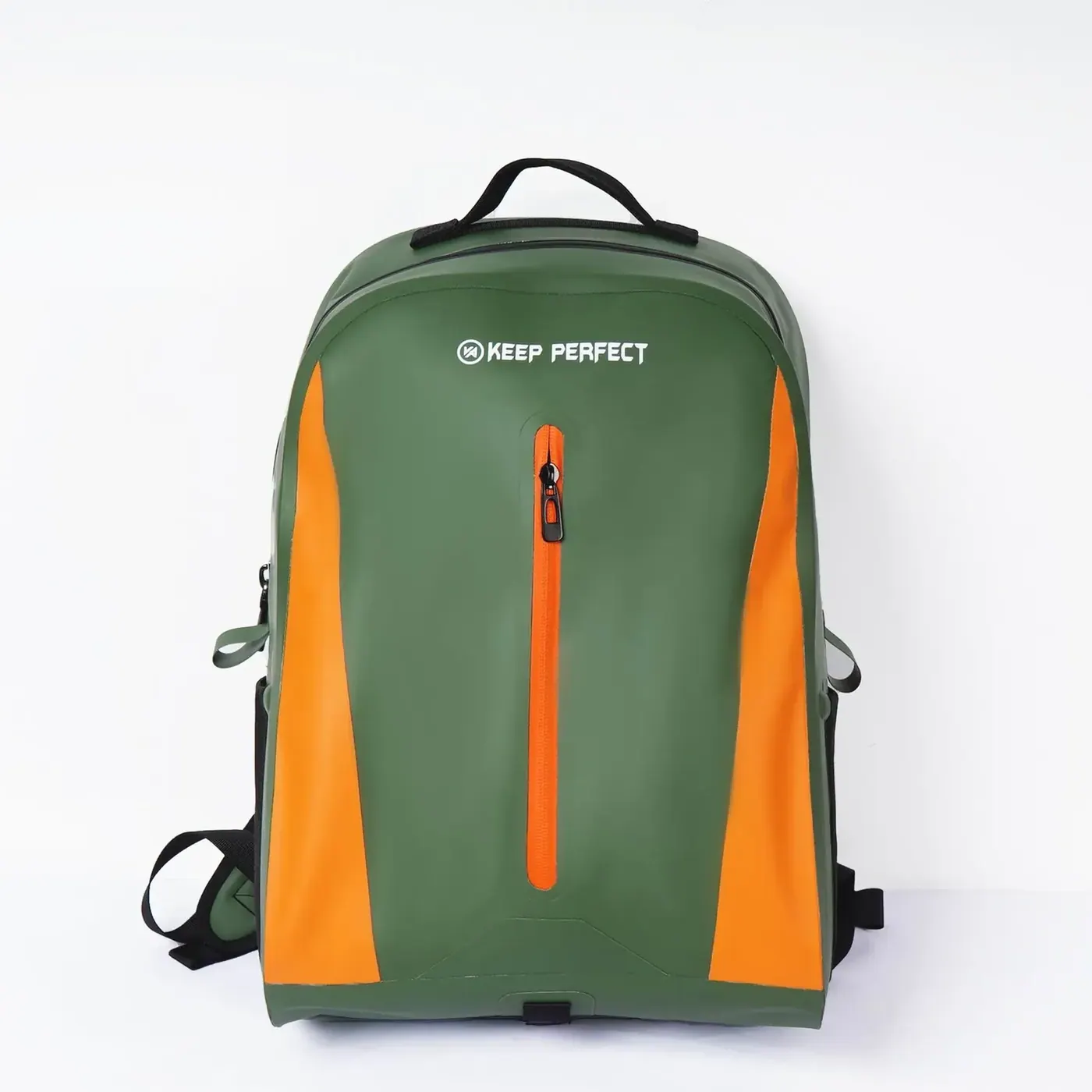
A waterproof commuter backpack is specified for a short, daily, repeatable exposure: a 15-45 minute walk or ride in rain, five days a week, carrying 4-8 kg. That profile calls for 20-28 L of volume at 900 g-1.4 kg empty, IPX4 for covered city routes and IPX5 for exposed walks and bike commutes, a suspended laptop bay with 12-15 mm of foam for 14-16 in devices, and 200 square centimetres or more of retroreflective area for dark winter mornings. Programme terms are 500 pcs per design and colourway, samples in 6-10 working days and bulk in 35-50 days from FOB Xiamen.
The Commute Profile: Short, Daily and Predictable
Commuting is a different engineering problem from hiking because the exposure is short and the repetition is relentless. A pack that survives one 20 minute shower will face roughly 200 such showers a year, and the failures that appear are wear failures rather than barrier failures: zip coating worn off, reflective tape lifting, strap webbing fraying at the anchor. Specification should therefore weight cycle testing as heavily as water testing.
| Commute profile | Duration | Typical load | Rating | Volume |
|---|---|---|---|---|
| Walk with covered sections | 10-20 min | 4-6 kg | IPX4 | 20-24 L |
| Fully exposed city walk | 20-40 min | 5-7 kg | IPX5 | 22-28 L |
| Bus or tram plus walk | 30-45 min | 5-8 kg | IPX4-IPX5 | 24-28 L |
| Bicycle commute | 20-45 min | 5-8 kg | IPX5-IPX6 | 20-26 L |
| Motorcycle or scooter commute | 25-50 min | 6-9 kg | IPX6 | 22-30 L |
| Mixed with gym kit | 30-45 min | 7-9 kg | IPX5 | 26-32 L |
Rainfall intensity matters even on a short walk because the pack is usually the only barrier: the commuter has no shelter and no spare layer for the bag. Moderate rain runs 2.5-7.6 mm per hour under the intensity bands used by the National Weather Service, and a 30 minute walk at that rate loads the shell with about 2-4 mm of water and every seam with a continuous film. Ratings referenced in a commuter tech pack follow IEC 60529 ingress protection, where IPX5 means the pack survives a 6.3 mm nozzle at 12.5 L per minute for three minutes.
Laptop and Document Protection: The Bay Is the Product
For commuter packs, the laptop bay is the reason the pack is bought. A suspended sleeve needs internal clearance 15 mm larger than the device in both dimensions, 12-15 mm of closed-cell foam on the back panel side, and a raised floor of at least 20 mm so the corner never lands on the base seam. A 14 in machine needs about 335 x 240 mm of clearance and a 15.6 in machine about 375 x 260 mm; buyers serving workstation users should consult the waterproof laptop backpack specification.
| Device | Footprint | Bay clearance | Foam | Drop test criterion |
|---|---|---|---|---|
| 13 in ultrabook | 305 x 215 mm | 320 x 230 mm | 10 mm | 80 cm, no case damage |
| 14 in laptop | 320 x 225 mm | 335 x 240 mm | 12 mm | 80 cm, no case damage |
| 15.6 in laptop | 360 x 245 mm | 375 x 260 mm | 12-15 mm | 80 cm, no case damage |
| 16 in laptop | 370 x 255 mm | 385 x 270 mm | 15 mm | 80 cm, no case damage |
| Tablet 11 in | 250 x 175 mm | 265 x 190 mm | 8 mm | 60 cm, no case damage |
Documents and accessories need their own logic, because a commuter unpacks at a desk, not on a trail. A flat document sleeve against the back panel, sized to 300 x 220 mm for A4 and letter folders, prevents curling; a cable pocket with a 25 mm gusset holds a 65 W charger and two cables; and a hard-shell top pocket protects sunglasses and phone screens from key abrasion. Buyers deciding between minimal and heavily compartmented layouts should read one compartment versus organised waterproof backpack.

Organisation That Survives a Daily Routine
Commuters carry the same 12-18 items every day and reach for six of them several times. Pocket layout should therefore be built around frequency, not around the number of features a spec sheet can list. The items that need immediate access are the transit pass, phone, keys, bottle and umbrella; everything else can live in the main body.
- Transit pass or badge pocket on the shoulder strap, 90 x 60 mm, reachable without removing the pack.
- Key clip on a 120 mm lanyard inside the front pocket so keys never fall into the main body.
- Bottle pocket with a 70 mm diameter mouth and a 4 mm drain hole at the base.
- Umbrella sleeve with a welded floor of 80 x 80 mm so a wet umbrella does not soak the lining.
- Cable pocket with a 25 mm gusset and two elastic loops sized for 20 mm and 45 mm chargers.
Pocket count has a cost. Every pocket adds a zip or a seam, and every seam is a potential leak path and a unit-cost item: moving from three pockets to eight typically adds 45-90 g and about 1.2-2.0 USD to FOB price. The practical compromise for a commuter line is six to nine pockets, with only the main compartment and the laptop bay sealed, and the quick-access pockets built with drain holes rather than full sealing.
Mixed loads are the awkward case in commuter design, because the same pack has to carry a laptop on Monday and a wet gym kit or swimming towel on Thursday. The cheap solution is a welded shoe or wet compartment of 5-8 L at the base with a drain hole, separated from the laptop bay by at least 30 mm of foam; the expensive one is a full welded liner with a removable dry bag. For corporate programmes the welded wet compartment is the better value, since it adds 60-110 g and about 1.0-1.8 USD while removing the most common complaint about commuter packs.
- Wet compartment of 5-8 L at the base, welded floor, 4 mm drain hole.
- Keep the wet compartment on the opposite side from the laptop bay to avoid pressure contact.
- A removable 8-10 L liner suits staff who alternate between office days and gym days.
Fit Across a Workforce: One Size or Three
Corporate and uniform programmes fail on fit far more often than on specification. A single commuter size covers a torso band of roughly 40-45 cm, which maps to about 165-180 cm in height, and outside that band the harness either rides on the neck or slips off the shoulders. Offering two sizes, or one size with a genuinely adjustable harness, is usually cheaper than absorbing the return rate on a single-size programme.
| Wearer height | Torso length | Harness requirement | Recommended volume |
|---|---|---|---|
| 155-165 cm | 38-42 cm | Short harness, 55 mm straps | 18-22 L |
| 165-180 cm | 42-47 cm | Standard harness, 60 mm straps | 22-28 L |
| 180-190 cm | 47-52 cm | Long harness, 65-70 mm straps | 26-32 L |
| Over 190 cm | 52 cm plus | Extended harness, 70 mm straps | 28-34 L |
| Over winter coat | Add 3-5 cm | 200 mm strap adjustment | Add 2-4 L |
Three measurements belong in every commuter tech pack: harness adjustment range, strap width at the shoulder, and the vertical position of the sternum strap relative to the collar. A 200 mm adjustment range with 60-70 mm padded straps and 80 mm of sternum travel covers the great majority of a mixed workforce at a single tooling cost. Where a programme serves a predominantly female workforce, a narrower strap spacing of 140-160 mm at the neck and a shorter harness are the two changes that matter; the shell and the waterproof rating do not change at all.
- State harness adjustment range in the tech pack: 200 mm covers a 25 cm height spread.
- Specify strap width at the shoulder: 55-60 mm for light loads, 65-70 mm above 8 kg.
- Add 3-5 cm of harness length and 2-4 L of volume for winter-coat markets.
- Keep shell fabric, closure and rating identical across sizes so only harness tooling varies.
Visibility, Fit and the Winter Morning
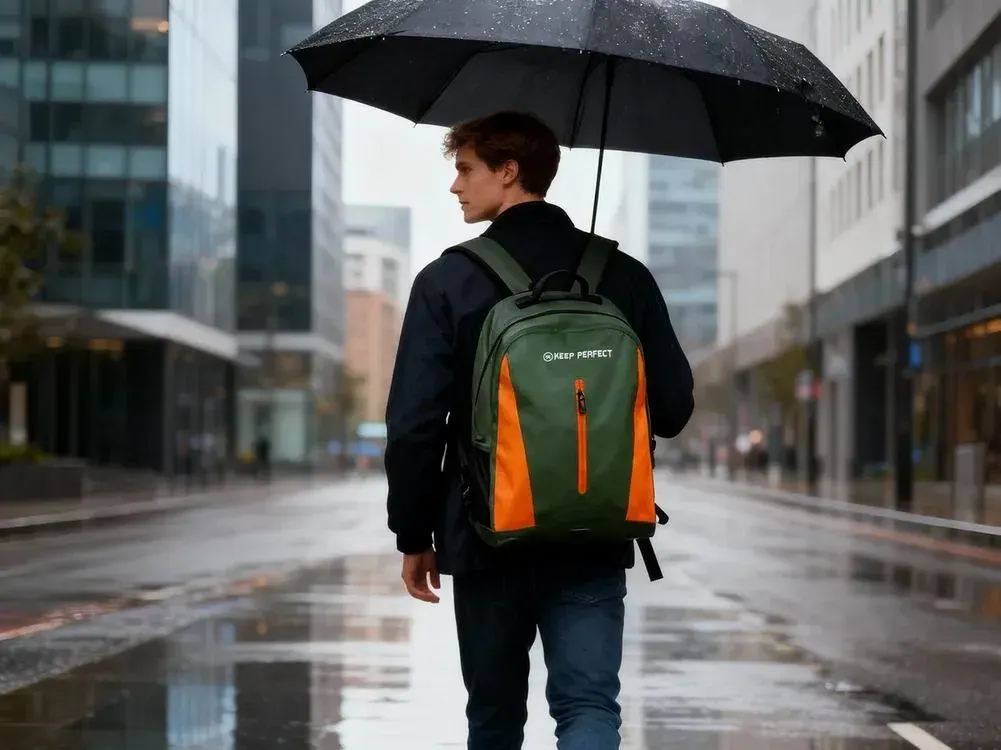
Dark commutes are a safety specification, not a styling note. Retroreflective area of 200 square centimetres or more, split between the front panel and both shoulder straps, makes a wearer visible at 60-80 m to dipped headlights; below 100 square centimetres the pack is effectively invisible until close range. Fluorescent panels help at dusk but do nothing after dark, so the two should be specified together rather than as alternatives.
| Feature | Specification | Effect | Failure if omitted |
|---|---|---|---|
| Retroreflective area | 200 cm2 minimum, front and straps | Visible at 60-80 m to headlights | Pack invisible past 20-30 m |
| Fluorescent panel | 150-250 cm2, yellow or orange | Conspicuous at dusk and in rain | Grey pack disappears in fog |
| Light loop | 25 mm webbing loop plus clip | Rear light mount at 400-600 mm height | Light clipped to fabric and lost |
| Sternum strap | 80 mm vertical adjustment | Straps stay on shoulders under a coat | Straps slide off a winter coat |
| Harness width | Shoulder straps 55-70 mm padded | Comfortable at 6-8 kg over 30 min | Shoulder pressure at 8 kg |
Fit over winter clothing is the detail that separates a returned pack from a reordered one. Shoulder straps need 200 mm of adjustment range so the pack fits over a T-shirt in September and a padded coat in January, and the harness should sit 40-60 mm below the collar rather than against the neck. Cyclists and riders comparing pack formats can weigh the trade-offs in waterproof cycling backpack and waterproof bike to work backpack.
Durability: Cycle Testing Be Laboratory Ratings
A commuter pack is opened 15-30 times a day, set down on pavement, and shoved under a desk or into a locker. Cycle and abrasion testing therefore predict field life far better than a water rating, and a sensible specification sets pass criteria for the zip, the strap anchors and the base panel before discussing IPX levels at all.
| Check | Method | Pass criterion | Typical field life |
|---|---|---|---|
| Main zip cycling | 1,000 open and close cycles | No tooth separation, coating intact | 2-3 years daily use |
| Base abrasion | Martindale, ISO 12947-2 | 25,000 cycles before base shows | 18-30 months |
| Strap anchor pull | 800 N on 25 mm webbing | Bar-tack intact, no tear | 3-5 years |
| Loaded drop | 80 cm, 8 kg, three orientations | No seam opening | Handles daily knocks |
| Reflective adhesion | 20 wash cycles plus flex test | Under 10 percent area loss | 2-4 years |
| Colour fastness to rubbing | AATCC 8 crockmeter | Grade 4 wet and dry | Avoids dye transfer |
Two materials choices pay back disproportionately on commuter lines. A #10 coated main zip costs about 0.6-1.0 USD more than a #8 and roughly doubles cycle life before coating wear, which matters when the pack is opened thousands of times a year. A double-layer base panel, or 1000D reinforcement over a 500D shell, costs 0.8-1.5 USD and removes most of the abrasion returns that otherwise appear at month nine on a daily-use programme.
Materials, Compliance and Care
Commuter packs sit against clothing for an hour or more a day, which makes chemical compliance a front-line requirement rather than a back-office document. Materials are screened against REACH and California Prop 65 on every programme; the Prop 65 list and its warning requirements are administered by the California Office of Environmental Health Hazard Assessment. PFAS-free durable water repellent is available for EU-bound and public-sector tenders, and needs to be named at quotation stage so the first sample is finished and tested correctly rather than swapped later.
| Component | Commuter specification | Why | Alternative |
|---|---|---|---|
| Shell | 500D polyester, TPU film 0.35 mm | 5,000 mm head at 285 g/m2 | 840D for courier and field use |
| Lining | 210D recycled PET, PFAS-free DWR | Light colour for visibility inside | 420D for heavy daily loads |
| Foam | Closed-cell EVA, 12-15 mm | Device protection at low weight | Open-cell foam for comfort zones |
| Webbing | 25 mm polyester, 800 N | Bar-tacked anchors | 38 mm for loads above 10 kg |
| Hardware | Acetal buckles, coated zips | Quiet, glove-friendly, corrosion-safe | Metal hardware for premium lines |
Care instructions should be written for a person with a desk job, not for an outdoor user. Weekly wipe-down of the welded interior with a damp cloth, a fresh-water rinse if the pack took road salt, and a full dry with the mouth open overnight after any soaking are enough. Machine washing, solvents and radiators all shorten film life and should be named explicitly on the care label.
Programme Terms for a Commuter Line
Commuter programmes are the most stable reorder category in the range because corporate and retail buyers repeat the same specification annually. Cost is driven by pocket count, zip gauge and laptop bay construction rather than by volume alone, and the bands below are the figures used for budgeting before a sampling round.
| Commuter style | Volume | FOB Xiamen band | MOQ | Sample time | Bulk time |
|---|---|---|---|---|---|
| Minimal roll-top | 20-24 L | USD 12.0-17.5 | 500 pcs | 6-8 working days | 35-42 days |
| Organised office pack | 24-28 L | USD 15.5-21.0 | 500 pcs | 6-9 working days | 36-45 days |
| Laptop-first build | 26-30 L | USD 18.0-25.0 | 500 pcs | 7-9 working days | 38-46 days |
| Rider or bicycle commuter | 22-28 L | USD 17.5-24.0 | 500 pcs | 7-10 working days | 38-48 days |
Release is gated on an AQL 2.5 inspection and the report travels with the packing list, while packing runs one piece per polybag and 10-20 per export carton, on boxes of about 62 x 42 x 36 cm capped at 15 kg gross. Category context sits in the waterproof backpack guide, rainy-day detail in waterproof backpack for a rainy commute, and the background on the range.
- The opening quantity is 500 pcs per design and colourway; sampling needs 6-10 working days and the bulk calendar 35-50 days before goods leave Xiamen.
- REACH and Prop 65 screening runs on every material lot, with declarations filed against each shipment.
- Send volume, device size and pocket count to service@junyuanbags.com for a costed quotation.
People Also Ask
Is a waterproof commuter backpack worth it compared with a rain cover?
For daily use, yes. A cover is roughly 200 g of extra kit, gets left at home, and still lets the straps and back panel soak through, while a welded or roll-top shell seals the load permanently. Covers remain sensible only on a pack already owned and rated below IPX4.
What size commuter backpack do I need for a 15.6 inch laptop?
Choose a pack of 24-28 L with a bay offering about 375 x 260 mm of internal clearance and 12-15 mm of foam. Anything smaller forces the device against the base seam, and anything larger adds bulk that catches on turnstiles and crowded carriages.
Can I cycle to work with a waterproof commuter backpack?
Yes, provided the harness is stable: a sternum strap plus a webbing hip belt stops the pack shifting at 20-30 km/h, and 200 square centimetres of retroreflective area keeps you visible. Above 30 km/h or on longer rides, panniers remove the load from your back entirely.
How do I stop my shirt getting wet from a waterproof backpack?
You cannot fully, because a sealed shell cannot pass vapour. Reduce it with a suspended back panel using 6-10 mm spacer mesh and vertical channels, wear a wicking base layer, and keep the load under 6 kg so the panel stays off your back on climbs.
Do commuter backpacks need reflective panels?
Yes if the commute runs before sunrise or after sunset. Specify 200 square centimetres or more of retroreflective material split between the front panel and shoulder straps; fluorescent panels help at dusk but stop working after dark, so both are needed.
How long should a commuter backpack last?
Two to four years of daily use for a 500D shell with a #10 zip and bar-tacked strap anchors. The usual first failure is zip coating wear or reflective tape lifting, both of which can be pushed out by specifying a heavier zip gauge and welded reflective tape.
Frequently Asked Questions
Q1. What IPX rating should a waterproof commuter backpack have?
IPX4 for routes with covered sections and short walks, IPX5 as the default for exposed city walking and bus or tram commutes, and IPX6 if the commute includes a bicycle, scooter or motorcycle leg. Going higher adds weight and cost with no practical benefit for a 20-40 minute exposure.
Q2. How many litres should a commuter backpack be?
20-28 L covers a laptop, charger, documents, lunch and a light layer at 4-8 kg. Below 20 L the pack will not take a 15.6 in device plus a folder comfortably, and above 30 L it becomes awkward on crowded transit and under a desk.
Q3. Will a waterproof commuter backpack protect a laptop in heavy rain?
Yes, provided the bay is suspended with 12-15 mm of foam plus 20 mm of empty space below it, and the main closure is a roll-top or a coated zip with a storm gutter. Verify with an 80 cm drop test at 8 kg and a 10 minute shower test before approving the sample.
Q4. Can I charge a phone from a battery inside a waterproof pack?
Yes, with a cable port. Specify a welded grommet or a coated pass-through sized for a 12 mm connector, positioned high on the panel so it never sits in standing water, and keep the power bank in an internal sleeve rather than an external pocket.
Q5. Are waterproof commuter backpacks comfortable in summer?
They are warmer than an uncoated pack because the shell cannot breathe. Fit a floating rear panel with 6-10 mm spacer mesh and upright channels, which keeps contact area down and lets air move between the panel and your shirt.
Q6. What colours and finishes work best for a work pack?
Black, charcoal and navy dominate corporate and retail commuter lines because they read as professional and hide urban grime. Add visibility with retroreflective piping and a fluorescent zip pull rather than a bright shell, which limits the buyer market.
Q7. How much weight can a commuter pack carry comfortably?
Up to 8 kg on a padded harness with a webbing hip belt, and 10-12 kg if the belt is moulded with a 12 mm foam core. Above 12 kg the pack should be a travel or hiking build with load lifters, since shoulder-only carry becomes uncomfortable after 30 minutes.
Q8. Do I need a hip belt on a commuter backpack?
A webbing belt is worth having above 6 kg and costs almost nothing in weight or price; a moulded belt is only justified above 10 kg. Detachable or stowable belts suit commuters who do not want straps hanging in a meeting.
Q9. How do I clean a waterproof commuter backpack?
Wipe the interior weekly with a damp cloth, wash off road salt or heavy grime with fresh water kept below 40 degrees Celsius, and use pH-neutral soap on stains. Never machine wash, never use solvents, and dry with the mouth open away from radiators and direct sun.
Q10. What MOQ applies to a commuter backpack order?
500 pcs per design and colourway, with samples in 6-10 working days and bulk in 35-50 days from FOB Xiamen. Pocket count and zip gauge move the unit price more than volume below 3,000 pcs, so simplify the layout before chasing a price break.
Q11. Can commuter backpacks be made PFAS-free?
Yes. PFAS-free durable water repellent matched with a TPU barrier film achieves the same hydrostatic head in laboratory testing and is increasingly required for EU and public-sector tenders. Flag it in the brief before costing so the first sample is built and tested with that finish.
Q12. Are the materials compliant with REACH and Prop 65?
Materials on every programme are screened against REACH and California Prop 65, with declarations filed per shipment and per material lot. Buyers selling into California should confirm warning-label obligations with their own counsel, since responsibility for the label rests with the seller.
Q13. Will reflective tape survive washing and daily use?
Welded or heat-transferred reflective tape rated for 20 wash cycles plus flex testing retains 90 percent of its area over two to four years. Sewn-on tape is cheaper but starts lifting at the stitch line, so specify welded application on any pack sold as a visibility product.