A rain commute waterproof backpack should hold 22 to 28 litres, protect a 14- to 16-inch laptop in a suspended sleeve, use welded seams with an IPX5 or IPX6 closure, and remain comfortable with a 5 to 9 kg weekday load. For most office journeys, a three-turn roll-top gives the most dependable seal, while a covered water-resistant zip trades one IPX level for 3 to 5 seconds faster access. Buyers should specify 420D to 600D TPU-laminated fabric, at least 20 mm clearance beneath the device sleeve, reflective area visible from 120 metres, and a separate 2 to 4 L wet zone. These numbers address the actual commute: 20 to 60 minutes outdoors, repeated openings at stations, wind-driven rain, a damp coat, and electronics that cannot tolerate even a small leak.
Start With the Real Rain Exposure, Not a Weather Icon
A weather app reduces rain to a symbol, but a backpack experiences duration, angle, wind and handling. A 10-minute walk through 2 mm per hour is light exposure; a 35-minute transfer in 15 mm per hour with a 30 km per hour crosswind pushes water into zip ends, strap roots and the fold at the top. The pack is also opened under a shelter, set on a wet platform and pressed against a soaked coat. A useful brief therefore records the longest outdoor leg, not the total journey, and adds 15 minutes for delayed buses or missed connections.
| Commute exposure | Typical duration | Rain intensity | Minimum protection | Main risk |
|---|---|---|---|---|
| Door to car or covered stop | 5 to 10 min | Up to 5 mm/h | IPX4, covered zip | Wet handles and base |
| Walk plus rail transfer | 15 to 35 min | 5 to 15 mm/h | IPX5, welded body | Zip ends and shoulder roots |
| Full walking commute | 30 to 60 min | 10 to 25 mm/h | IPX6, three-turn roll | Wind-driven water at the mouth |
| Exposed ferry or platform | 20 to 45 min | Spray plus rain | IPX6, minimal openings | Horizontal spray and pooled water |
| Tropical cloudburst | 10 to 30 min | Over 25 mm/h | IPX6 plus internal sleeve | Overwhelmed drain paths |
IP codes describe controlled water exposure rather than a guarantee for every storm. IPX4 addresses splashing, IPX5 uses a 6.3 mm nozzle at 12.5 litres per minute, and IPX6 raises the jet to 100 litres per minute. The test framework comes from the IEC 60529 ingress protection reference. A rainy-day work pack rarely needs immersion protection, but its stated closure must reach the same level as its welded body. Calling an IPX6 body waterproof while fitting an exposed coil zip creates a system that performs at the lower component level.
Treat the commute as a chain with four transfer points: home to street, street to vehicle, vehicle to workplace and the return trip. Water often enters at a transfer because the user opens the bag before wiping it, or lays it on a bench with 3 to 8 mm of standing water. A stable base, a mouth that opens away from the weather and a one-handed grab handle therefore prevent as many wet laptops as a higher fabric rating.
Choose 22 to 28 Litres Around the Working Load
Capacity should be calculated from objects rather than from an attractive silhouette. A 15-inch laptop sleeve consumes about 3 L once foam and clearance are included; a lunch box takes 3 to 5 L; a compact rain shell takes 1.5 to 2.5 L; a 750 ml bottle consumes roughly 1 L of usable space; and chargers, notebook, headset and small items add 3 to 4 L. The ordinary total is 13 to 18 L before spare room is added. A 22 L pack is enough for a light office day, while 26 to 28 L prevents the roll collar being filled beyond its sealing line.
| Working pattern | Recommended volume | Typical load | Laptop | Reserve space |
|---|---|---|---|---|
| Minimal office carry | 18 to 22 L | 3.5 to 5 kg | 13 to 14 in | 2 to 3 L |
| Laptop, lunch and rain shell | 22 to 26 L | 5 to 7 kg | 14 to 16 in | 4 to 6 L |
| Gym clothes after work | 26 to 30 L | 6 to 9 kg | Up to 16 in | 6 to 8 L |
| Winter layers and boots | 30 to 34 L | 8 to 11 kg | Up to 17 in | 7 to 10 L |
| Short business overnight | 32 to 38 L | 9 to 12 kg | Up to 17 in | 8 to 12 L |
Do not choose volume by the advertised laptop diagonal alone. Two 16-inch devices can differ by 25 mm in width, and a protective case adds another 8 to 15 mm on every side. The useful sleeve dimensions for broad compatibility are about 390 by 280 by 30 mm, with a stretch edge rather than a tight zip. Keep the sleeve 20 to 30 mm above the base and add 8 to 12 mm of closed-cell foam on the outer face. More detailed device geometry is covered in the waterproof laptop backpack specification.
Empty weight also matters on a journey repeated 220 to 250 workdays a year. A useful 24 L pack sits between 850 and 1,250 g. Below 750 g, padding, base structure or coating is usually reduced; above 1,500 g, the commuter carries the equivalent of an extra laptop charger all year. Loaded comfort is best assessed at 7 kg for 60 minutes, with strap slip under 10 mm and no hard edge across the collarbone.
Protect the Laptop With Space, Suspension and a Second Barrier
A waterproof shell does not protect a computer from impact. The device fails when the bag is dropped vertically onto a platform edge, when a bottle leaks inside, or when the sleeve rests directly on a cold wet base. A complete system uses a suspended sleeve, a 20 to 30 mm false bottom, closed-cell foam that does not absorb water, and a raised opening that cannot receive drips from the roll collar. A removable 40 to 60 g inner sleeve adds a second barrier without turning the main compartment into a maze.
| Protection detail | Target value | Test | Failure it prevents |
|---|---|---|---|
| False-bottom clearance | 20 to 30 mm | Vertical inspection and drop | Device corner striking the floor |
| Outer sleeve foam | 8 to 12 mm closed cell | 1 m loaded base drop | Edge and face impact |
| Side clearance | 10 to 15 mm each side | Fit with case installed | Forced zip and pressure marks |
| Sleeve opening height | 80 mm below main mouth | Spray while opened | Drips entering from collar |
| Bottle separation | Welded pocket or external holder | 750 ml leak test | Internal spill around electronics |
| Liner hydrostatic head | At least 3,000 mm | Static column test | Slow seepage after hours |
The safest layout places the laptop against the back, lunch in the centre and the bottle outside. A central heavy object keeps the centre of gravity close to the body, while an external bottle can leak without reaching electronics. If a buyer wants internal bottle storage for a cleaner appearance, the pocket should be a separately welded cup holding at least 1 L for 30 minutes. The protection sequence and drop logic are expanded in the laptop dry-zone guide.
Condensation is different from leakage and deserves its own control. A cold computer brought into a warm office can collect moisture, and a damp coat packed beside it raises the internal relative humidity above 70 percent. Use a wet zone away from the sleeve, leave 10 to 15 mm of air space around the device, and open the pack for 20 to 30 minutes after arrival. Silica packets help during shipping but are not a daily moisture strategy.
Match the Closure to Access Frequency
Commuters open a bag more often than hikers. A transit card, keys, earbuds and phone may be reached 12 to 25 times in one day, while the main compartment may open only four times. For that reason the right design is usually a highly sealed main body plus one small quick-access pocket placed under a flap. Trying to make every pocket equally waterproof increases weight, cost and frustration without improving the survival odds of the laptop.
| Closure format | Useful rating | Opening time | Daily upkeep | Best commute |
|---|---|---|---|---|
| Three-turn roll-top | IPX6 | 6 to 10 s | Wipe fold weekly | Long exposed walk |
| Two-turn roll-top | IPX5 | 5 to 8 s | Check stiffener monthly | Mixed walk and rail |
| Covered coated zip | IPX4 to IPX5 | 2 to 4 s | Clean every 100 cycles | Frequent access |
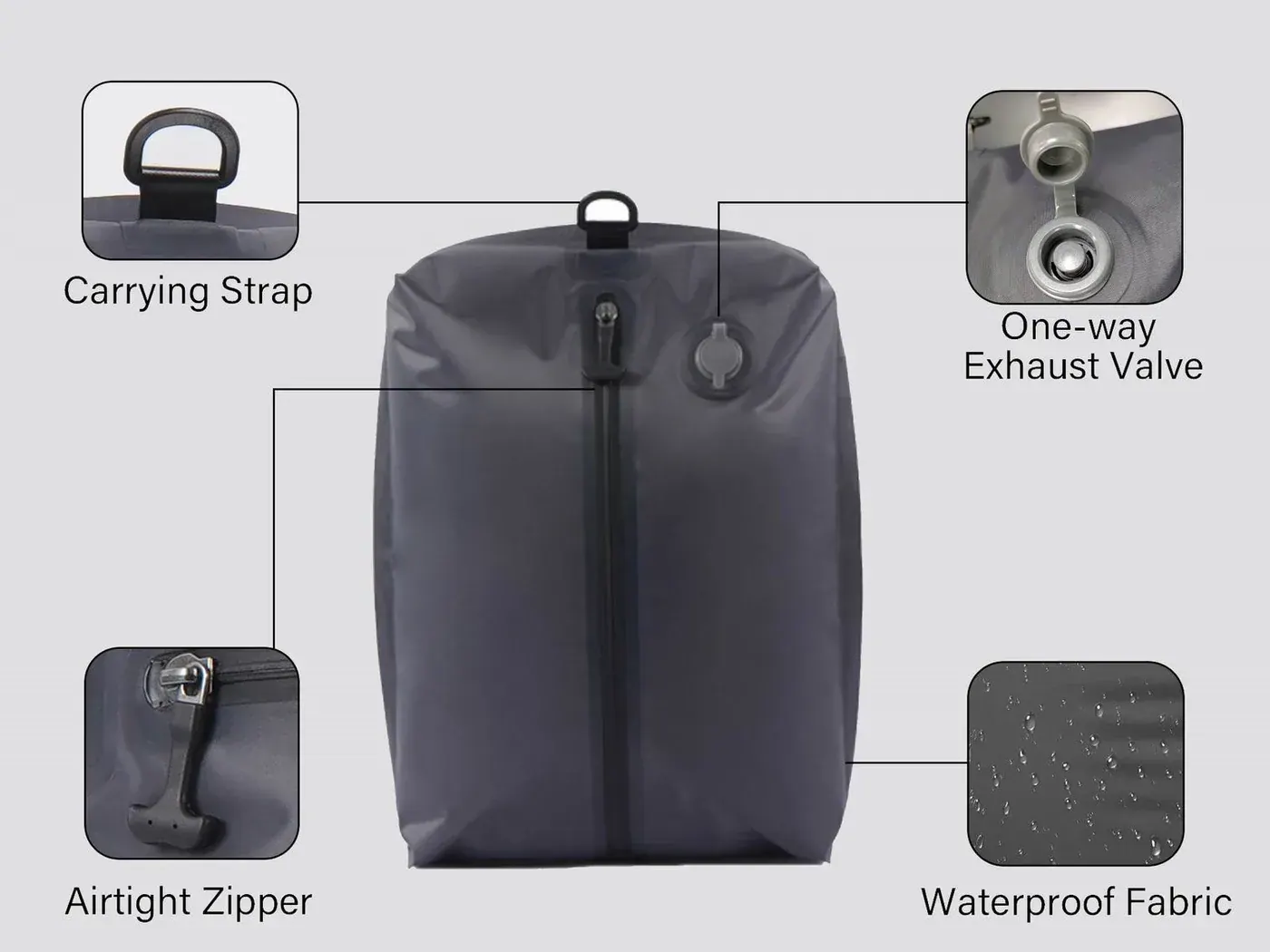
| Airtight zip | IPX7 to IPX8 | 3 to 6 s | Lubricate at stated interval | Boat transfer, rare for office |
| Flap over coil zip | IPX4 | 2 to 3 s | Keep flap flat | Short urban walk |
A roll-top needs a stiffener of roughly 1.2 to 1.6 mm and 140 to 180 mm of free collar above the load. Three loose turns are not the same as three compressed turns. Ask the sample team to mark a maximum fill line inside the collar so users do not pack lunch or a jacket into the sealing zone. The closure alternatives and their maintenance burden can be compared in the waterproof zipper types overview.
A quick pocket should sit high on the front panel, hold no more than 0.8 to 1.2 L and drain away from the main seam. It is for keys and access cards, not electronics during a downpour. A 25 mm storm flap extending 15 mm beyond each end of the zip reduces direct impact, while a small garage stops water collecting at the slider. Label that pocket water resistant so the claim matches the component.
Control Wet Coats, Umbrellas and Shoes
The commuter brings water inside the bag deliberately. A folded umbrella can retain 30 to 80 ml after a ten-minute storm, a rain shell can carry 100 to 250 ml in its face fabric, and gym shoes add moisture and odour even when the weather is dry. If those items share the laptop cavity, the interior can be wet despite a perfect shell. A separate 2 to 4 L wet zone with a welded liner and an 8 mm drain solves the problem without consuming the whole front panel.
| Wet item | Water carried | Storage zone | After-arrival action |
|---|---|---|---|
| Compact umbrella | 30 to 80 ml | External sleeve with drain | Open and dry for 2 to 4 h |
| Rain shell | 100 to 250 ml | 2 to 4 L welded front bay | Hang within 15 min |
| Gym towel | 150 to 350 ml | Removable wet pouch | Wash the same day |
| Shoes | Variable moisture | Ventilated base bay | Remove for 8 to 12 h |
| Reusable cup | Up to 350 ml spill | Upright external pocket | Rinse pocket immediately |
Drainage should be controlled rather than accidental. A grommet at the absolute low point lets a wet umbrella empty while the pack is upright, but it also lets road splash enter if it faces backward near the base. Place it on the side, 20 to 30 mm above the floor, and add a short internal baffle. A removable wet pouch is better for train users who cannot leave water dripping onto a carriage floor.
Wet-dry separation also reduces cleaning. The main body may need a wipe every 10 to 15 commutes, while the wet pouch can be rinsed after every storm. Light grey or pale blue lining makes moisture and loose debris visible; black lining hides both. The pack should dry open at 20 to 25 degrees Celsius for 6 to 10 hours after a soaked journey.
Visibility and Carry Comfort After Dark
A commuter is often outside during the lowest-contrast parts of the day. Reflective detail is effective only when it can be seen from the direction of traffic: shoulder straps for the front, side wings for junctions and a broad rear patch for vehicles approaching from behind. A practical target is 80 to 120 square centimetres split across three faces, using material that remains visible at 120 to 150 metres under headlights. A bright colour without retroreflection is not an equivalent at night.
Comfort needs commuter-specific testing because a coat changes the harness. Shoulder straps of 55 to 65 mm with 8 to 10 mm closed-cell foam work over a shirt, but a smooth strap can slide on a waterproof jacket. Add a textured inner face, a sternum strap adjustable over 120 to 220 mm and a top handle that can hold 30 kg for repeated train boarding. For a 7 kg load, strap pressure should remain even after 60 minutes and the lower edge should not touch the belt line.
- Keep the packed centre of gravity within 50 mm of the back panel by placing the laptop and notebook against the rear wall.
- Use two side compression points so a 26 L pack carrying only 15 L does not sway while walking quickly or climbing stairs.
- Specify a sternum buckle operable with gloves and a 20 to 25 mm webbing tail that does not flap in a 30 km per hour wind.
- Test reflective trim after 20 wet wipe cycles because poorly bonded film can lift at the corners before the shell shows wear.
- Place the top handle above the centre line so the bag hangs upright when lifted from a bus floor or office locker.
Weather context matters when setting colour and trim. Rainfall intensity, visibility and warning data are available from NOAA weather resources, but the design should not depend on a forecast being right. A daily pack is most valuable on the unplanned 20-minute shower, when the owner did not bring a separate cover.
Test the Finished Pack as a System
A fabric certificate is not a finished-pack test. Water follows assembled details: needle holes around the harness, corners where four layers meet, zip garages and the base seam under load. Qualification should use the intended 7 kg office load, including a rigid laptop dummy, because filling changes the collar angle and stretches the back panel. Run the water test before and after a drop sequence to expose seams that pass only while new.
| Acceptance test | Condition | Pass line | Record |
|---|---|---|---|
| Loaded jet | 7 kg, IPX5 flow for 3 min | No mark on indicator paper | Video plus interior map |
| Six-face drop | 1 m onto sealed concrete | No seam lift or device contact | Corner photographs |
| Harness pull | 300 N per strap for 60 s | Under 3 mm movement | Force and displacement |
| Laptop sleeve impact | 7 kg pack, 10 base drops | Dummy has no edge strike | Clearance after test |
| Zip endurance | 2,000 open-close cycles | Smooth pull, coating intact | Force every 250 cycles |
| Colour transfer | Wet rub, 20 cycles | Grey scale 4 or better | Cloth and panel sample |
Textile colour and wet-rub methods are maintained by AATCC. They matter on a commuter pack because a dark wet back panel sits against a pale shirt for 20 to 60 minutes. Requiring grey scale 4 or better after wet rubbing is a measurable way to prevent colour transfer complaints; asking only for colourfast fabric misses printed panels, binding and foam-backed mesh.
For B2B programmes, a sensible commercial checkpoint is 500 pcs per design and colour, samples in 6 to 10 working days and bulk in 35 to 50 days, with AQL 2.5 inspection before shipment. QUANZHOU JUNYUAN BAGS can document the chosen seam, sleeve and closure package. Buyers should freeze the maximum fill line, laptop dummy size and loaded water-test method before approving colour and trim.
Build a 12-Month Care Routine Around Workdays
Daily care should take less than two minutes or it will not happen. On arrival, wipe the collar, remove the umbrella, open the wet zone and stand the pack with the main mouth open. Once a week, inspect the base and zip ends; once a month, rinse road film with fresh water and pH-neutral soap. Do not use bleach, fabric softener, solvent cleaner or a radiator. Heat above about 60 degrees Celsius can distort TPU films and concentrated cleaner can remove surface finish long before the fabric wears.
| Interval | Task | Time | Retirement signal |
|---|---|---|---|
| Every wet commute | Empty wet zone, wipe collar, open to dry | 2 to 5 min | Persistent water under sleeve |
| Weekly | Brush zip ends and inspect base | 3 min | Coating split over 10 mm |
| Monthly | Fresh-water rinse and neutral soap | 10 min | Seam edge lifting over 8 mm |
| Every 3 months | Loaded shower check with paper inside | 15 min | Any repeatable interior spot |
| Every 6 months | Check strap roots and reflective trim | 10 min | Webbing movement over 5 mm |
| After 12 months | Review shell, closure and laptop foam | 15 min | Foam compressed below half depth |
A well-specified commuter pack should deliver three to five years of weekday use, or roughly 700 to 1,200 journeys, when it is dried after storms and not overloaded above 9 kg. The closure normally shows wear first: a roll collar develops a fixed crease, while a coated zip becomes harder to pull. A small seam lift can be repaired early; widespread film chalking, a cracked strap root or water appearing beside the suspended sleeve is a retirement signal. For broader model selection, compare the use cases in the waterproof commuter backpack range and the best waterproof backpacks guide.
People Also Ask
How waterproof should a backpack be for walking to work?
IPX5 is the sensible floor for 15 to 35 minutes of exposed walking, while IPX6 is appropriate for 30 to 60 minutes, wind-driven rain or ferry platforms. The finished pack, including its closure, should be tested with a 7 kg load rather than relying on a fabric certificate.
What size work backpack fits a laptop and lunch?
Choose 22 to 26 litres for a 14- to 16-inch laptop, a 3 to 5 L lunch box, a compact rain shell and daily electronics. Move to 26 to 30 L when gym clothes travel too, but preserve 140 to 180 mm of free roll collar.
Does a roll-top keep office electronics dry?
Yes, when the body is welded, the collar has a stiffener and the mouth closes with three compressed turns. The laptop still needs a sleeve raised 20 to 30 mm above the base because waterproofing does not provide impact protection.
Where should a wet umbrella go in a commuter backpack?
Use an external sleeve or a separate 2 to 4 L welded wet bay with controlled drainage. A folded umbrella can retain 30 to 80 ml, enough to wet a laptop compartment even when the outer shell performs perfectly.
How much reflective trim does a commuter bag need?
A practical target is 80 to 120 square centimetres split across the front-facing straps, side panels and rear face. It should remain visible from about 120 to 150 metres under vehicle headlights after 20 wet wipe cycles.
Why is a waterproof work bag damp inside?
The common causes are a wet coat or umbrella stored with dry items, condensation around a cold laptop, or water dripping through the open mouth. Separate the wet zone, leave air around the device and open the bag for 20 to 30 minutes after arrival.
Frequently Asked Questions
Q1. Is IPX4 enough for a rainy commute?
It is enough for a short 5- to 10-minute walk in light rain, especially with a covered zip. For transfers lasting 15 to 35 minutes, IPX5 is a safer floor; a long exposed walk or wind-driven rain justifies IPX6 and a three-turn roll-top.
Q2. Can a 16-inch laptop fit in a 22 litre backpack?
Yes if the sleeve measures about 390 by 280 by 30 mm and the remaining load is light. Measure the device with its case because protective shells add 8 to 15 mm per side. Suspend the sleeve 20 to 30 mm above the base.
Q3. What fabric is best for a wet commute bag?
A 420D to 600D polyester laminated with 0.30 to 0.40 mm TPU balances sealing, abrasion and weight. It should use welded load-bearing seams and a reinforced base; denier alone does not reveal coating thickness or seam performance.
Q4. How heavy should an empty commuter backpack be?
About 850 to 1,250 g for a 22 to 28 L pack with real laptop padding, a structured base and an IPX5 or IPX6 body. Below 750 g, one of those elements is usually reduced; above 1,500 g, daily carrying becomes needlessly tiring.
Q5. Is a zipped backpack suitable for heavy rain?
A covered coated zip can suit IPX4 to IPX5 exposure and opens in 2 to 4 seconds. For sustained heavy rain, a three-turn roll-top is more dependable because it has no teeth or slider ends, though access takes 6 to 10 seconds.
Q6. How do I stop water entering when I open the bag?
Face the mouth away from the wind, wipe the collar before opening and place the laptop sleeve at least 80 mm below the opening. A small flap-covered pocket can hold access cards so the main compartment stays closed during transfers.
Q7. Should a commuter backpack have a separate shoe compartment?
Only when gym or work shoes travel at least twice a week. Use a ventilated base bay isolated from electronics, and remove the shoes for 8 to 12 hours after arrival. Occasional users can save 80 to 150 g with a removable wet pouch.
Q8. How often should I wash a waterproof commuter backpack?
Wipe it after wet journeys and use a fresh-water rinse with pH-neutral soap about once a month or every 20 to 30 commutes. Avoid bleach, softener, solvents, radiators and tumble drying; dry open at 20 to 25 degrees Celsius.
Q9. How long does a daily waterproof work backpack last?
A sound 420D to 600D TPU pack can deliver three to five years, roughly 700 to 1,200 commutes, if dried after storms and kept below a 9 kg routine load. Inspect the collar, base, zip ends and strap roots every three months.
Q10. What tests should a buyer request for a commuter pack?
Request a loaded IPX5 jet test, six-face drop from 1 m, 300 N harness pulls, 2,000 zip cycles and wet-rub colourfastness at grey scale 4 or better. Repeat the water test after drops because impact can expose a weak seam.
Q11. What are the MOQ and lead time for a rain commute pack?
The standard programme starts at 500 pcs per design and colour. Samples normally take 6 to 10 working days and bulk takes 35 to 50 days, with the laptop dummy, closure method and loaded water test agreed before the colour approval stage.