Choose a single-cavity waterproof backpack when total dryness, easy drying, and low cost decide the job; choose an organized body when the user opens the pack more than 10 times a day and needs separated wet and dry zones. Every added compartment buys convenience with structural risk: one extra external pocket contributes 300 to 900 millimetres of welded seam, and a body that starts at 1.4 metres of seam can grow past 6 metres once six pockets are added. Where each closure is individually 99.5 percent reliable, one closure leaves 99.5 percent system reliability while five leave about 97.5 percent. Organizers also add 120 to 350 grams and consume 5 to 12 percent of nominal volume. Order entry starts at 500 pcs per design and colour, development sampling needs 6 to 10 working days, and bulk lands 35 to 50 days after approval.
Why Every Divider Carries a Water Cost
Water enters a bag at discontinuities, and each new compartment creates at least one. A single-cavity roll-top body may need only three welded runs totalling 1.2 to 2.0 metres plus its closure. Add a front pocket, two side pockets, a lid pocket, an internal divider, and a laptop sleeve, and the same silhouette can cross 6 to 7.5 metres of bonded or stitched joint, with four or five additional closures. Each joint must be executed perfectly every single time.
The arithmetic is unflattering to complexity. Reliability compounds across parts, so a system of five closures each performing at 99.5 percent delivers about 97.5 percent system reliability, while ten closures reach roughly 95.1 percent. Translated into a shipment of 10,000 units at a 1.5 percent defect threshold, that difference can move hundreds of pieces from pass to fail. This is why expedition dry bags have stayed stubbornly simple for decades.
| Configuration | External closures | Approximate seam length | System reliability at 99.5 percent per closure | Typical dry-down time |
|---|---|---|---|---|
| Single cavity roll top | 1 plus closure | 1.2 to 2.0 m | About 99.5 percent | 2 to 4 hours |
| Single cavity plus one external pocket | 2 plus closure | 2.0 to 3.0 m | About 99.0 percent | 3 to 5 hours |
| Travel body with four pockets | 5 plus closure | 4.0 to 5.5 m | About 97.5 percent | 5 to 8 hours |
| Full office organizer | 8 to 10 plus closure | 6.0 to 7.5 m | About 95.1 to 96.0 percent | 7 to 11 hours |
| Modular single cavity with pouches | 1 plus pouch closures | 1.2 to 2.0 m | About 99.5 percent on the shell | 2 to 5 hours |
Note the last row, because it contains the answer most buyers actually want. A single dry chamber holding five or six independent small pouches keeps a single exterior barrier while still separating chargers from snacks. Each pouch is cheap to replace, washable separately, and individually waterproof only where it needs to be.
What Organization Really Costs in Weight and Space
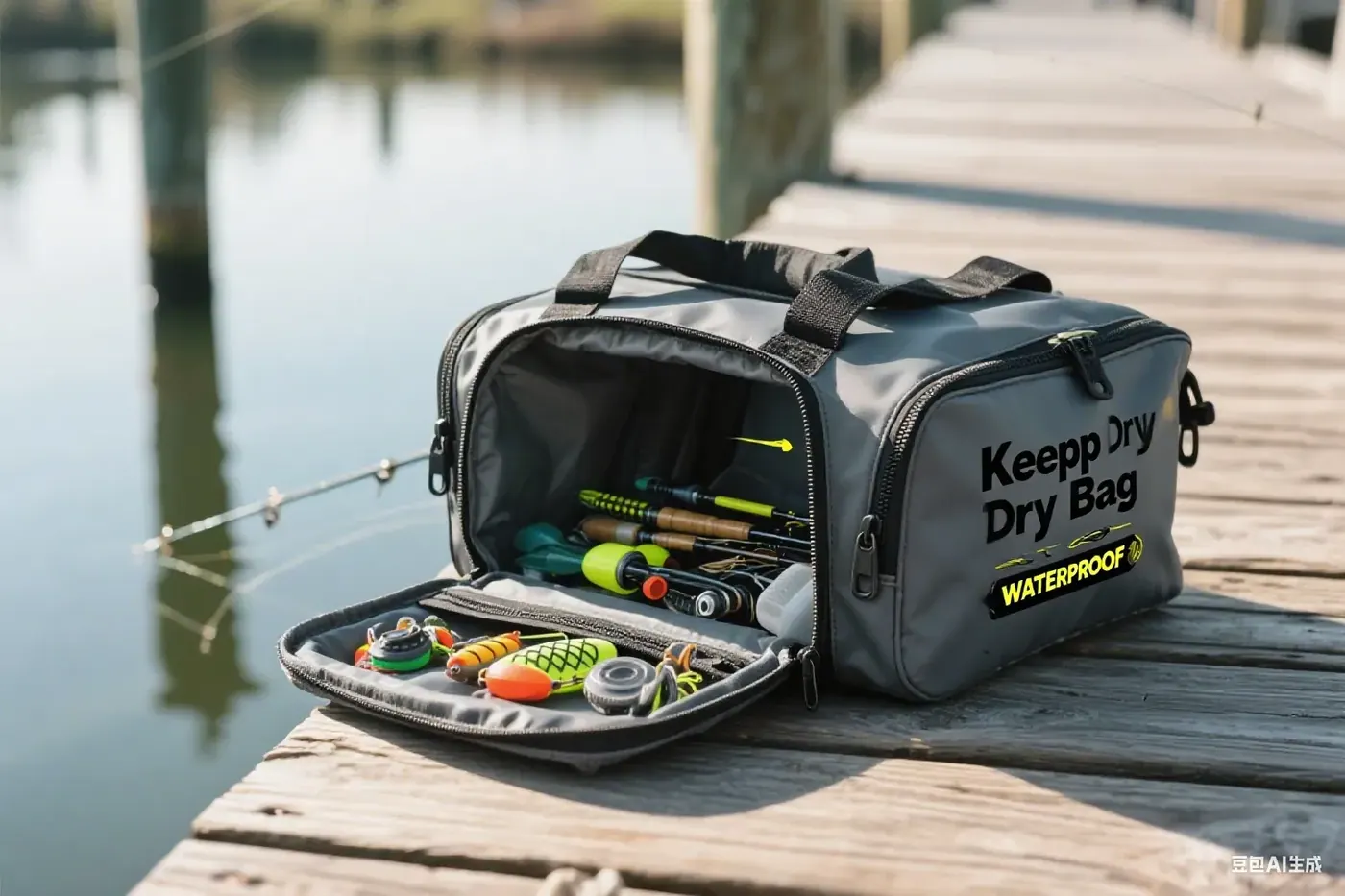
Dividers, panels, elastics, zip chains, and reinforcement tape are components, and components have mass. A modest organizer with three slip pockets and one zipped panel typically adds 120 to 200 grams; a full office layout with a suspended laptop frame, two zip panels, pen loops, and a key clip can reach 280 to 350 grams. In a 25 litre body that is 8 to 14 percent of the total product weight spent on arranging things rather than carrying them.
Volume behaves similarly. Internal panels that lie flat still occupy their own thickness when the cavity is compressed, and structured frames hold space even when empty. Practical measurements on a 30 litre body show usable capacity falling by 5 to 12 percent once a full organizer is installed, which means 1.5 to 3.6 litres disappears. Buyers comparing two 30 litre packs may therefore receive two very different real payloads.
| Organization element | Added mass | Volume consumed | Assembly time | Comment |
|---|---|---|---|---|
| Three open slip pockets | 60 to 110 g | 0.5 to 1.0 L | 4 to 7 minutes | Cheapest separation |
| One zippered mesh panel | 70 to 120 g | 0.3 to 0.6 L | 6 to 10 minutes | Adds a closure |
| Suspended laptop frame | 90 to 160 g | 0.6 to 1.2 L | 8 to 14 minutes | Protects against bending |
| Pen loops and key clip | 15 to 35 g | under 0.1 L | 2 to 4 minutes | High perceived value |
| Removable pouch set | 110 to 260 g | Variable | 0 minutes sewn | User configures it |
Perceived value runs ahead of cost here. A shopper standing in an aisle counts pockets and infers quality, so organizers sell. The design problem is delivering that perception without paying the full water penalty, which is precisely what removable organizers inside a sealed chamber achieve.
Retrieval Time and Daily Friction
The argument for organization is time, and it is legitimate. Field observation of mixed loads shows a named small item can be located in 6 to 15 seconds when it sits in a labelled pocket, versus 25 to 70 seconds when buried in an undivided chamber under two garments and a food bag. Over a 12 hour shift with 30 retrievals, that gap exceeds 15 minutes and usually decides whether someone keeps using the bag.
The counter-argument is that built-in organization only helps when load composition stays predictable. The moment a user carries sleeping gear instead of files, the dedicated pen slots are dead space and the chamber becomes awkward. Pouches adapt; pockets do not. That is why modular interiors dominate expedition, paddling, and photography use, while fixed organizers dominate daily office carry.
- Match pocket depth to item height: a 90 millimetre pocket swallows a 40 millimetre phone and hides it.
- Keep high-frequency items within the top 150 millimetres or in external quick access.
- Label pouch contents externally so search time stays near 6 seconds even in rain.
- Limit each pouch to 2 to 5 litres so one missing item never requires unpacking everything.
There is an accessibility trap worth naming. External quick-access pockets are the most useful and the most dangerous, because any water that enters them can migrate along internal stitching or through shared panels. Solutions exist, including isolated external chambers and drainage eyelets, but each one adds either cost or another joint to control.
Retrieval also interacts with weather in a way specifications rarely capture. Every second a compartment stays open in rain is a second of exposure, so a 6 second pocket retrieval may admit less water than a 40 second rummage through a main chamber even though the pocket adds a closure. Test both conditions together rather than separately: time how long the mouth stays open, then measure ingress with the same load. Products designed for tropical downpours often solve this with storm flaps 30 to 50 millimetres wide, which add little mass and measurably reduce exposure during fumbling.
Cleaning, Drying, and Mould Control
Nobody buys a bag for its cleaning time, yet cleaning is where single-cavity designs quietly win again. A single open chamber can be inverted, wiped, and air-dried in 2 to 4 hours at 20 degrees Celsius with modest airflow. A multi-chamber body with four lined pockets typically needs 5 to 9 hours, because each internal panel restricts air movement and traps humidity at joins.
Damp internals are not merely unpleasant. Persistent humidity above roughly 70 percent supports mould growth on textile within 48 to 72 hours, and odour becomes visible in reviews. This is why products intended for wet sports get minimal internal structure, drainage at external pockets, and smooth film surfaces that shed silt in one rinse.
| Maintenance task | Single cavity | Organized body | Target |
|---|---|---|---|
| Post-trip rinse | 3 to 5 minutes | 8 to 12 minutes | No visible silt |
| Full wash | 8 to 12 minutes | 18 to 30 minutes | Neutral pH cleaner |
| Air dry at 20 degrees Celsius | 2 to 4 hours | 5 to 9 hours | Below 70 percent internal humidity |
| Sand removal from corners | One rinse | Repeat per pocket | Zero grit at joins |
| Odour risk after 48 hours | Low | Moderate to high | No detectable smell |
Salt deserves separate treatment. After coastal use, rinse every external closure with fresh water within 6 hours, because chloride crystals continue drawing contamination into interfaces long after the trip ends. Bulk programmes should include a printed care card; it costs under 0.02 USD and measurably reduces complaint volume.
Hybrid Designs: Where the Industry Has Settled
Most successful products are hybrids rather than purists. Common patterns include a single sealed main chamber with one external protected pocket, a divided wet compartment accessed from the outside, or a removable organizer that lifts out of an otherwise plain body. Each hybrid buys one specific convenience and pays for it once, which is far better than accumulating features.
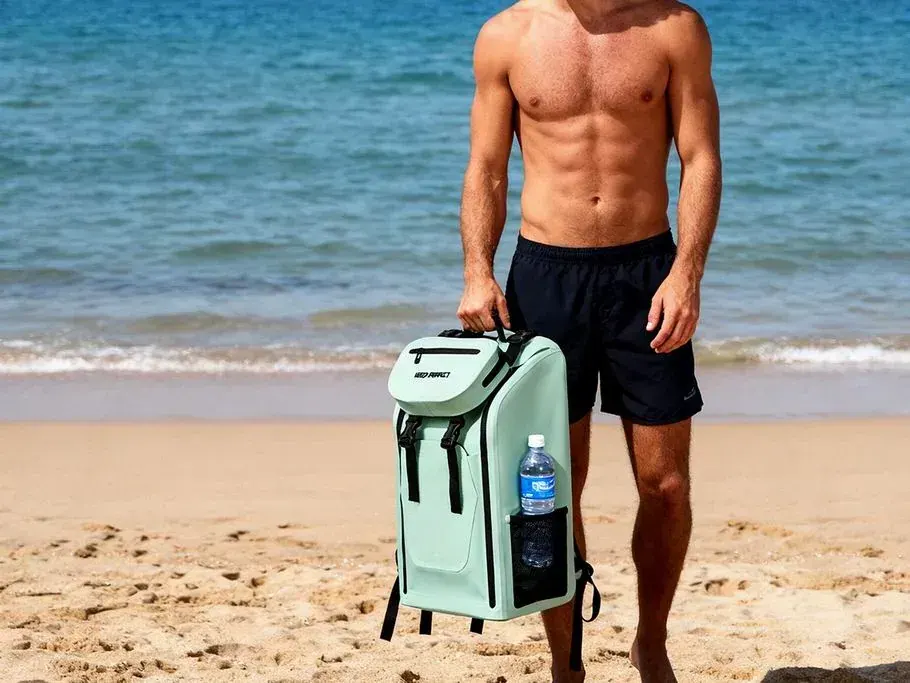
The most defensible hybrid is arguably the isolated external wet zone. Users returning from swimming or paddling want wet items away from dry ones, and placing that zone outside the primary barrier keeps the sealed chamber untouched. The secondary pocket needs drainage and must not share internal stitching with the dry chamber, which is a build detail worth checking before purchase.
| Hybrid pattern | Benefit | Cost | Best for |
|---|---|---|---|
| Sealed chamber plus one external pocket | Hourly item access | One extra closure | Commuting and travel |
| Sealed chamber plus external wet zone | Wet separation without internal risk | 300 to 600 mm extra seam | Paddle, swim, gym |
| Removable organizer insert | Full adaptability | 110 to 260 g carried | Mixed-purpose programme |
| Internal sleeve only | Laptop protection | 90 to 160 g | Office carry |
| Semi-divided lower zone | Separates dirty boots | One internal panel | Hiking and camping |
Testing Organization Choices Before Committing
Two prototypes can be compared convincingly in one day. Fill each with an identical 7 kilogram load distributed across the same ten items, then run four passes: a retrieval trial with five users, a two minute high-intensity spray from four directions, a 30 minute static water trial with the base submerged 50 millimetres, and an eight hour dry-down measurement with a humidity probe inside each chamber.
Record numbers rather than impressions. Count seconds per retrieval, grams of water gained on weighed tissue at six zones, and internal relative humidity at one hour and eight hours. A design that saves 10 seconds per retrieval but adds 4 grams of ingress and five hours of drying is the wrong choice for a boating line and possibly the right one for an office line.
Finally, run a cost and margin check, because organization decisions influence more than performance. Each additional pocket typically adds 1.5 to 4 USD in material and 8 to 15 minutes of assembly labour, which compounds across a run. A four-pocket upgrade may therefore add 6 to 16 USD of landed cost while supporting a retail increase of 25 to 40 USD, which is a healthy exchange provided the reliability maths above still clears your complaint threshold.
Escalation to formal reporting should use recognised procedures so two teams cannot argue about definitions. Seam strength, coating adhesion, and textile tear work is catalogued by ASTM International, while test methods for water repellency and surface behaviour are published by AATCC. Ingress codes themselves come from IEC 60529, which always applies to the finished article rather than to a component.
Scenario Verdicts and Buying Rules
Single-cavity bodies win paddling, sailing, expedition hauling, emergency kits, gym and swim, and any scenario where the load changes character each trip. Organized bodies win daily commuting, camera and device carry, technician work, travel with electronics, and situations where retrieval frequency is high. Mixed scenarios usually reward the hybrid rather than either extreme.
| Scenario | Openings per day | Load variability | Recommended layout | Reason |
|---|---|---|---|---|
| Kayak and sail days | 1 to 4 | High | Single cavity plus pouches | Fewer joints, faster drying |
| Daily office commute | 15 to 30 | Low | Organized with laptop sleeve | Retrieval dominates |
| Emergency go-bag | under 1 | None | Single cavity plus labels | Contents must stay dry for years |
| Field technician | 20 to 40 | Low | Organized external pockets | Tool visibility saves minutes |
| Family beach day | 6 to 12 | High | Single cavity plus wet zone | Sand rinses out faster |
| Photography carry | 10 to 20 | Medium | Removable padded insert | Protection plus adaptability |
Two calm buying rules follow. Rule one: if you cannot name what goes in each pocket, do not buy the pocket. Rule two: if the item inside must stay dry through immersion, keep it inside the single main barrier and put everything else outside it. Buyers wanting labelled compartments can compare layouts in the waterproof travel backpack range, while device-centric layouts sit in the waterproof laptop backpack selection.
Daily planners should also check that the organizer does not fight the harness. Internal structure near the back panel can press ribs into the spine, so any panel within 80 millimetres of the back should be soft, thin, and free of hardware. A hard divider at that distance is the single most common cause of 'comfortable in store, painful in week two' returns.
Programme and Specification Notes
For a compartmental brief, specify each additional pocket in terms of closure count, added seam length in millimetres, width of every bonded joint, the drainage method for external wet zones, the required whole-article ingress level, and an internal humidity target after eight hours of drying. Those six values convert design intent into something a development team can actually build and verify.
For a single-cavity brief, specify seam count, weld width of 15 to 25 millimetres, roll freeboard of 75 to 100 millimetres, and the companion pouch set offered alongside the body. Pouches are typically quoted separately and can be bundled at a modest margin, which lifts average order value without touching the sealed chamber's reliability.
QUANZHOU JUNYUAN BAGS develops both architectures under the same quality gates, starting at 500 pcs per design and colour with samples in 6 to 10 working days and bulk in 35 to 50 days. Materials can be screened for REACH and California Prop 65, goods can be inspected at AQL 2.5, and shipping can be FOB Xiamen or DDP to more than 100 countries. Compartment planning, joint widths, and verification routes are described. Briefs go to service@junyuanbags.com. Fixed organizers also suit daily urban routines covered in the waterproof commuter backpack range.
The final recommendation is boring and robust. Buy the simplest body that still solves your retrieval problem: a single sealed chamber with well-chosen pouches beats eight built-in pockets on dryness, weight, and drying time, and only loses when your pocket contents never change. Difficulty comes from admitting how rarely that is true.
People Also Ask
Does adding pockets make a backpack less waterproof?
Yes, statistically. Each extra compartment brings 300 to 900 millimetres of new seam plus another closure. With each closure individually 99.5 percent reliable, one closure yields about 99.5 percent system reliability while five yield roughly 97.5 percent, which is why expedition dry bags remain simple.
How many litres do internal organizers consume?
Between 5 and 12 percent of nominal capacity on a 30 litre body, equal to 1.5 to 3.6 litres. Structured frames and dividers occupy volume even when empty, so compare usable figures rather than printed capacities when two packs claim identical sizes.
What is the best way to organize a single-cavity dry pack?
Use independent pouches of 2 to 5 litres each, label them externally, keep hourly items in the top 150 millimetres, and pack dense gear within 50 millimetres of the back. This preserves one welded chamber while keeping retrieval near 6 to 15 seconds.
Why do organized backpacks take longer to dry?
Internal panels restrict airflow and trap humidity at joins. A single open chamber usually air-dries in 2 to 4 hours at 20 degrees Celsius, while a four-pocket body may need 5 to 9 hours, and any humidity above 70 percent supports mould growth within 48 to 72 hours.
Is an external wet compartment a good idea?
It is the most defensible hybrid. Placing damp swim or paddle gear in an externally accessed zone keeps the sealed chamber untouched, provided the zone drains and shares no internal stitching with the dry space.
Should I pick fixed organization or removable inserts?
Pick removable inserts when load composition changes between trips, because inserts adapt and pockets do not. Pick fixed organization when the same device and accessory set travels every day and 15 to 30 daily openings make retrieval time the dominant factor.
Frequently Asked Questions
Q1. Which is more waterproof, a single compartment or a divided backpack?
A single compartment. It typically needs only 1.2 to 2.0 metres of welded seam and one closure, whereas a fully divided body can exceed 6 metres and eight closures. Fewer joints and fewer closures mean fewer opportunities for imperfect bonding or an unseated slider.
Q2. How much weight does organization add to a backpack?
A light organizer with three slip pockets adds 120 to 200 grams, while a full office layout with a suspended frame and two zip panels reaches 280 to 350 grams. On a 25 litre pack that represents 8 to 14 percent of total product weight.
Q3. Are removable pouches better than built-in pockets?
For changing loads, yes. Pouches adapt between hiking, paddling, and travel, can be washed individually, and keep the shell seam count at 1.2 to 2.0 metres. Fixed pockets are better only when contents stay identical and retrieval happens 15 to 30 times daily.
Q4. Can an organized pack still reach IPX7?
Yes, provided every joint is engineered for it. Expect 15 to 25 millimetre bonded widths, protected closure entries, and a whole-article certificate under IEC 60529. Verify the assembled result rather than individual component reports, which are commonly offered in place of article testing.
Q5. How long should I let a wet backpack dry?
Single-cavity bodies generally need 2 to 4 hours at 20 degrees Celsius with airflow; organized bodies need 5 to 9 hours. Use a humidity probe and target below 70 percent internal relative humidity, because mould can establish within 48 to 72 hours above that level.
Q6. What is the best layout for daily commuting?
An organized body with a suspended laptop sleeve, one external quick-access pocket, and one slip panel. Keep any pocket under 90 millimetres deep so small items stay visible, and ensure no rigid divider sits within 80 millimetres of the back panel.
Q7. Do external pockets leak into the main chamber?
They can if the panel shares stitching or if water tracks along an internal joint. Look for isolated chambers with independent welds and drainage eyelets, then test by spraying the external pocket alone with tissue placed inside the main body.
Q8. Which layout suits kayaking and sailing?
A single sealed chamber with labelled pouches. Water arrives from every direction, drying time matters after every trip, and fewer external closures reduce both failure points and rinse effort at the end of the day.
Q9. How do I compare two backpacks claiming the same litres?
Measure usable volume with the closure fully configured, organizers installed, and one litre blocks rather than loose water. A 30 litre organized pack and a 30 litre simple pack can differ by 1.5 to 3.6 litres of real payload.
Q10. What should a compartment specification include?
State closure count, added seam length in millimetres, bonded joint width, drainage method for wet zones, target whole-article ingress level, and an eight hour humidity target. Those six values turn design intent into a measurable requirement a development team can verify.