A wholesale EVA beach tote programme lands between USD 13 and 21 per unit FOB Xiamen at 500 pieces per design and colour, and moves toward the bottom of that band once a single order passes 3,000 pieces or repeats an existing colourway. Stocked colourways can ship from as few as 10 pieces for evaluation, but any new size, new perforation pattern or new colour needs tooling and a 500-piece minimum. Sampling takes 6 to 10 working days, bulk takes 35 to 50 days from approved sample and deposit, and a 40-foot high-cube container holds roughly 900 to 1,600 family-size units depending on how far the bodies nest. The three numbers that decide your landed cost are material mass, mould cycle time and packed cube.
What a Wholesale EVA Beach Tote Programme Actually Buys
Buying this category at programme level is not the same transaction as buying bags one at a time. You are buying four things at once: tool time on an injection mould, a quantity of ethylene-vinyl acetate compound, a colour masterbatch matched to a reference, and a volume of container space. Each has its own minimum and its own price behaviour, which is why two quotations for visually similar totes can differ by more than forty percent without either party being unreasonable.
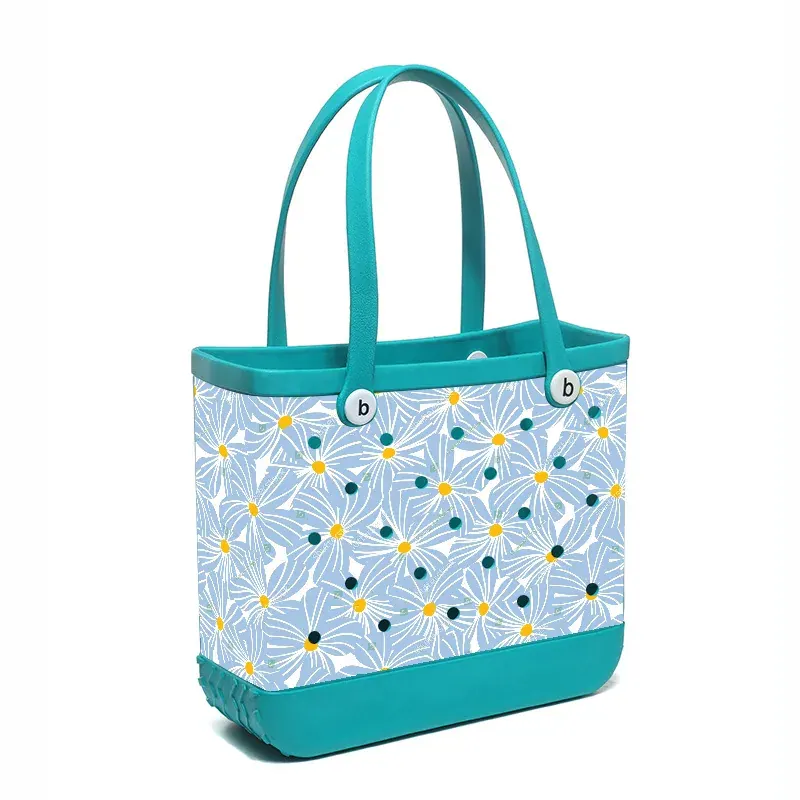
The product itself is simple to describe. A wholesale EVA beach tote is a one-piece injection-molded body with perforated walls, an open top, wall thickness between four and eight millimetres, and no liner, no sewn seam and no fabric layer. Practical sizes run from about 33 by 23 by 14 centimetres for a compact carry to 52 by 33 by 26 centimetres for the largest utility size. Because there is no cut-and-sew stage, unit cost is dominated by physics rather than by labour, and the physics are easy to predict if you know which three numbers to ask for.
| Cost driver | Typical value for a family size | Effect on unit price | How buyers reduce it |
|---|---|---|---|
| Material mass | 1.4 to 1.9 kilograms per unit | Roughly USD 2.20 to 3.10 of the unit price | Thinner walls, smaller footprint, fewer solid panels |
| Mould cycle time | 60 to 140 seconds per shot | Longer cycles raise machine-hour cost per piece | Uniform wall thickness rather than heavy sections |
| Packed cube | 0.028 to 0.055 cubic metres per unit | Changes freight cost per unit by up to 300 percent | Nestable geometry and flat-pack accessory packing |
| Colour masterbatch | 2 to 4 percent of compound mass | USD 0.15 to 0.60 per unit for speciality colours | Standard colourways from the existing library |
| Secondary operations | Printing, charms, inserts, labels | USD 0.30 to 2.40 per unit depending on method | Group decoration into one pass; avoid multi-position prints |
The practical consequence is that a buyer who only asks for a unit price is comparing the wrong number. Two quotations at USD 16 and USD 18 can end up at the same landed cost once cube and duty are added, because the cheaper bag may occupy twenty percent more container space. Ask for the packed carton specification with the price, every time.
Price Bands by Size and Order Quantity
Price in this category tracks mass more closely than it tracks anything else. A family-size body weighing 1.6 kilograms uses roughly 2.3 times the compound of a 0.7 kilogram compact body, so the large size costs materially more before a single minute of machine time or a single centimetre of freight is counted. Quantity then moves the price within each size band, mostly by spreading set-up and colour changeover across more pieces.
| Size band | Outer dimensions | Empty weight | FOB Xiamen at 500 pcs | FOB Xiamen at 3,000 pcs |
|---|---|---|---|---|
| Compact carry | 33 by 23 by 14 centimetres | 0.7 to 0.9 kilograms | USD 13 to 15 | USD 11 to 13 |
| Mid day size | 41 by 27 by 19 centimetres | 1.0 to 1.4 kilograms | USD 15 to 17 | USD 13 to 15 |
| Family size | 48 by 31 by 24 centimetres | 1.4 to 1.9 kilograms | USD 17 to 19 | USD 15 to 17 |
| Utility carry | 52 by 33 by 26 centimetres | 1.8 to 2.4 kilograms | USD 19 to 21 | USD 17 to 19 |
| Mini and kids sizes | 26 by 18 by 12 centimetres | 0.4 to 0.6 kilograms | USD 9 to 11 | USD 8 to 9 |
Three things sit outside those bands and should be quoted separately: new tooling for a size that does not already exist, speciality colourways mixed to a Pantone reference, and decoration priced per position and per colour. Quotations that appear to include everything usually assume the simplest version of each.
MOQ: Where the Floor Sits and Why It Sits There
The standard programme minimum is 500 pieces per design and colour, and the reason is tooling amortisation rather than policy. A mould for a family-size body represents a substantial fixed cost, and at 500 pieces that cost adds somewhere between USD 1.50 and 3.00 to each unit; at 5,000 pieces it becomes a rounding error. Below about 300 pieces the amortisation starts to dominate the quotation, which is why serious programmes rarely start there unless the size already exists.
There is a lower route, and it matters for testing a market. Stocked colourways in existing sizes can ship from as few as 10 pieces, which is the realistic way to run a sell-through test in a handful of stores before committing to production. The trade-off is that you are buying what exists: the size, the perforation diameter and the colourway library are fixed, and decoration options are limited to what can be added without opening a tool.
| Route | Minimum pieces | Price effect | Lead time | Best used for |
|---|---|---|---|---|
| Stocked colourway, existing size | 10 pieces | Plus 15 to 30 percent over programme price | 3 to 7 working days to dispatch | Market tests, photo samples, influencer seeding |
| Existing size, matched colourway | 300 pieces | Plus 8 to 15 percent | 25 to 35 days | First season with a brand colour |
| Existing size, new colourway | 500 pieces | Programme price | 35 to 50 days | Standard private programme |
| New size, new tooling | 500 pieces plus tooling | Programme price plus one-off tool charge | 55 to 80 days including tool build | Differentiated retail lines |
| Full programme with decoration | 500 pieces per design and colour | Programme price plus decoration | 40 to 60 days | Established seasonal reorder |
Colourway mixing is the lever most buyers overlook. Because the minimum applies per design and colour, splitting 500 pieces into two colours means 1,000 pieces unless the two colourways share a tool and a production run. Sharing a tool is common; sharing a run is possible when the colours can be sequenced in a single changeover window. Ask directly rather than assuming.
Lead Time, Stage by Stage
Lead time in this category is dominated by two fixed blocks and one variable one. Sampling runs 6 to 10 working days from a confirmed specification. Bulk production runs 35 to 50 days from approved sample and deposit. The variable block is tooling: if your size already exists it disappears entirely, and if it does not, building and proving a new mould adds 20 to 30 days before the first sample can even be shot.
| Stage | Calendar time | What happens | Gate that must be cleared |
|---|---|---|---|
| Specification and quotation | 2 to 5 working days | Dimensions, wall thickness, perforation and colourway confirmed | Written specification signed off |
| Tooling build, if required | 20 to 30 days | Mould cut, assembled and trialled | First shot dimensionally checked |
| Sampling | 6 to 10 working days | Colour, finish and fit samples produced | Buyer approves sample in writing |
| Deposit and material booking | 1 to 3 days | Compound and masterbatch booked | Deposit received |
| Bulk production | 28 to 38 days | Moulding, de-flashing, decoration, packing | In-line inspection passed |
| Final inspection and release | 3 to 6 days | AQL 2.5 inspection and documentation pack | Report accepted by buyer |
| Sea freight to major ports | 18 to 35 days depending on lane | Consolidation or full container load | Bill of lading issued |
Four actions reliably compress the calendar, and none of them costs money. Confirm the colour reference at quotation stage rather than after sampling, because masterbatch matching is usually the slowest single step. Approve the sample in one pass rather than in two rounds of comments. Book material at deposit rather than at sample approval. And accept a standard carton rather than requesting printed carton artwork late, since carton printing adds a separate print run and its own queue.
- Send a dimensional drawing or a marked-up photograph with the first enquiry; it removes one full round of clarification, typically four to seven days.
- Name the colour system and reference: Pantone, RAL or a physical swatch. Screen colours are not acceptable references for molded parts.
- Decide perforation diameter before sampling. Changing it after approval usually forces a tool modification rather than a setting change.
- Approve packing quantities early. Carton specification is often the last open item and it gates the booking, not the production.
- Ask for the inspection report template at order placement so the AQL 2.5 sample plan is agreed before goods are ready rather than after.
Tooling, Colourways and Packaging Costs
Three optional costs sit behind most quotes and deserve separate line items. Tooling is a one-off charge that varies with size and cavity count; a single-cavity tool for a mid size costs far less than a family-size tool, but it also produces at half the rate, so very large orders sometimes justify two cavities. Colour matching is charged per reference and carries a minimum batch mass, typically enough compound for 300 to 500 units, which is another reason the colourway minimum sits where it does. Packaging ranges from a plain export carton to a printed retail carton, an individual polybag and a hangtag, and the difference across that range is usually USD 0.60 to 1.80 per unit.
- Ask whether the tool is single or multi cavity, and what the quoted cycle time is; both drive the delivery schedule for orders above 5,000 pieces.
- Confirm who owns the tool and whether it is reserved for your programme or shared. This should be written into the order terms.
- Request the standard colourway library before paying for a match: most programmes find three or four usable colours without a surcharge.
- Price the retail carton separately from the polybag. Retail-ready packing usually pays for itself only above about 2,000 units.
- Ask for the packed carton dimensions and the pieces per carton at quotation stage, since this number gates every freight calculation downstream.
Decoration is where programmes most often overspend. A single-colour print on one panel is inexpensive and robust; multi-position prints and gradient artwork raise the reject rate, which lifts the effective price above the quoted decoration charge. Charms and inserts are separate molded or sewn parts with their own tooling or pattern cost, and they are the highest-margin accessory in the category, so they are worth doing properly.
Freight, Cube and Why Rigid Bodies Surprise People
Freight is the line that most often invalidates a comparison between two quotations. A molded tote occupies its own volume whether it is empty or full, and unlike a fabric bag it cannot be compressed, folded or vacuum packed. Some designs nest partially, which recovers between fifteen and thirty percent of the cube; others do not nest at all. That single geometric fact can change the freight cost per unit by a factor of two on the same lane.
| Size band | Pieces per 40-foot high cube | Indicative sea freight per unit | Nesting behaviour | Comment |
|---|---|---|---|---|
| Compact carry | 2,600 to 3,400 pieces | USD 0.85 to 1.30 | Partial nesting to about 40 percent | Most efficient size to ship |
| Mid day size | 1,600 to 2,200 pieces | USD 1.30 to 1.95 | Partial nesting to about 30 percent | Balanced retail proposition |
| Family size | 900 to 1,400 pieces | USD 2.10 to 3.20 | Minimal nesting | Freight is material to margin |
| Utility carry | 700 to 1,100 pieces | USD 2.70 to 4.10 | No useful nesting | Consider regional production for very large volumes |
| Mini and kids sizes | 4,000 to 5,500 pieces | USD 0.55 to 0.90 | Deep nesting to about 55 percent | Excellent container economics |
Two arithmetic checks prevent most freight surprises. Divide total landed freight by piece count rather than by container, because the container price is what gets quoted and the piece count is what determines margin. And model duty on the declared value including freight where the destination uses a CIF basis, since a lower unit price with a larger cube can end up paying more duty than a higher unit price that packs tightly.
Quality Gates Before Goods Leave
Because these bodies are molded rather than sewn, the failure modes are different and the inspection plan should reflect that. There is no seam to split and no stitch density to count, so inspection focuses on dimensional consistency, surface defects, colour consistency across the run and mechanical behaviour under load. Every bulk shipment is inspected at AQL 2.5 before release, and the plan should be agreed with the buyer in advance rather than applied by default.
- Dimensional check on length, width, height and base footprint, with a tolerance agreed in writing, typically plus or minus three millimetres.
- Wall thickness measured at base and rim on a sampled basis, since tapered construction is the single best predictor of service life.
- Perforation check: hole diameter and the width of the solid band above the top row, which governs rim strength.
- Load test to the stated rating with a safety margin, commonly 1.5 times the rated capacity held for a defined period.
- Colour comparison against the approved reference under a standard light source, because molded colour shifts visibly across production days.
- Drop and tip test on packed cartons, since corner damage in transit is the most common cause of retail rejection.
Compliance Documentation by Destination Market
Documentation is cheap when planned and expensive when retrofitted, and it is the part of a wholesale EVA beach tote programme most likely to delay a launch. Three families of requirement cover most destinations: chemical substance screening for the European market, exposure assessment and warning obligations for California, and additional migration and mechanical testing where the product is marketed towards children. Each is a document request, not a redesign, provided the compound and the colour masterbatch are named in the brief from the start.
| Requirement | Typical limit or trigger | Evidence to request | Refresh cycle |
|---|---|---|---|
| European REACH screening | Substances of very high concern at or below 0.1 percent by weight | Current compliance statement plus third-party report | Annually or on compound change |
| California Prop 65 | Either below safe harbour level or a compliant warning | Exposure assessment or approved label artwork | On material or market change |
| Phthalate screening | Restricted plasticisers at or below 0.1 percent | Extraction test per material and per colour | Annually |
| Heavy metal migration in prints and charms | Against applicable migration limits | Migration test report referencing the method | Annually or per artwork |
| Children product rules where applicable | Additional migration and mechanical testing | Report referencing the applicable method | Per programme launch |
| Quality system expectation | Documented process control and traceability | ISO 9001 certificate and BSCI audit reference | Certificate validity period |
Method references worth naming in a specification include the physical test procedures published by ASTM International, quality-management expectations set out by the International Organization for Standardization, and substance obligations administered by the European Chemicals Agency. Naming the method rather than the outcome is what makes a test report usable in more than one market, and it also stops the same test being paid for twice under two different descriptions.
Margin Maths for Resellers and Retail Programmes
Wholesale EVA beach tote economics are unusual because the retail price is visible and the landed cost is not. Beach and pool retailers routinely list perforated totes between USD 40 and 90 at family size, while the landed cost at programme volumes sits between USD 18 and 24 once freight and duty are included. That spread looks generous, and it is, provided the sell-through rate and the damage rate are both realistic. Returns in this category are low for product failure and high for size mismatch, which is a buying problem rather than a quality one.
| Channel | Typical retail price | Landed cost per unit | Gross margin before overhead | Main risk |
|---|---|---|---|---|
| Independent beach and surf shop | USD 55 to 90 | USD 19 to 24 | 58 to 72 percent | Slow sell-through in short seasons |
| Resort and hotel retail | USD 45 to 75 | USD 18 to 22 | 55 to 68 percent | Logo decoration cost per unit |
| Online marketplace reseller | USD 35 to 55 | USD 17 to 21 | 45 to 60 percent | Freight on small parcel shipping |
| Grocery and seasonal aisle | USD 25 to 40 | USD 15 to 19 | 35 to 50 percent | Volume commitment and cube |
| Promotional and event programme | Gift or bundled | USD 14 to 20 plus print | Not applicable | Artwork lead time |
Two adjustments make those numbers honest. Subtract an allowance for transit damage, typically one to two percent on molded goods shipped without individual protection, because corner scuffing is the usual cause of markdown. And subtract the cost of holding stock across a short season, since a beach programme that sells sixty percent in twelve weeks still carries forty percent into the following year, and colourways rarely repeat exactly.
How to Brief a Programme So the Quotation Is Accurate
A complete brief is short but specific, and it removes the clarification round that typically adds five to eight days. Nine items are enough: target size band, wall thickness expectation, perforation diameter, colourway count and reference system, decoration method and position, quantity per colourway, target price and incoterm, destination market and compliance requirement, and packing expectation. Anything left open will be quoted at the simplest interpretation, which is rarely what the buyer meant.
- State the size in millimetres and say whether it is outer or internal, since the difference is the wall thickness on each face.
- Give the perforation diameter in millimetres and the intended accessory compatibility, if charms are part of the plan.
- Name the colour system and give references for every colourway, including the trim and any charm colour.
- Say what the loaded weight rating must be and whether it will be printed on the product or the packaging.
- Give the quantity per colourway, not just the total, because the minimum applies per design and colour.
- State the incoterm: FOB Xiamen is standard, and DDP to upwards of one hundred nations is available where lane economics allow.
- Confirm whether the goods are marketed towards children, because that changes the test matrix rather than the product.
- Ask for the packed carton specification and the pieces per carton in the same email as the price request.
Programme specifications, colourway development and decoration are handled inside the made-to-order EVA tote programme, and the full category background sits in the injection-molded EVA tote guide. A step-by-step route through evaluation, sampling and production is set out in the EVA tote sourcing walkthrough.
Programme Notes
QUANZHOU JUNYUAN BAGS has run waterproof bag programmes since 2014, with a founding team in the trade since 2004, covering injection-molded EVA work alongside sewn and welded ranges. Monthly output runs at 200,000 units verified by SGS, operations follow BSCI and ISO 9001, materials are screened for REACH and California Prop 65, and every bulk shipment is inspected at AQL 2.5 before release. Standard terms are 500 pieces per design and colour, sampling in 6 to 10 working days, bulk in 35 to 50 days from approved sample and deposit, shipped FOB Xiamen or DDP to upwards of one hundred nations.
Send your size band, colourway count, quantity per colourway, destination and target price to service@junyuanbags.com, and request the packed carton specification in the same message, because it changes landed cost more than any other single line in this category.
People Also Ask
How much does a wholesale EVA beach tote cost per unit?
Between USD 13 and 21 FOB Xiamen at 500 pieces per design and colour, depending on size and wall thickness, falling to the lower half of that range above 3,000 pieces.
What is the minimum order for an EVA tote programme?
500 pieces per design and colour for a production programme, while stocked colourways in existing sizes can ship from 10 pieces for evaluation.
What is the realistic timeline for a first bulk order?
Roughly 55 to 80 days door to door when new tooling is needed, or 45 to 60 days using an existing size, including sampling, bulk production and sea freight.
Why does freight change the comparison between two quotes?
Molded bodies cannot be compressed. Depending on nesting, a 40-foot high cube holds anywhere from 700 to 5,500 units, so freight per unit can differ by a factor of two.
What does new tooling cost and who owns it?
It is a one-off charge quoted by size and cavity count, and ownership should be stated in the order terms rather than assumed.
Can colourways be mixed to reach the minimum?
Not directly. The 500-piece minimum applies per design and colour, so two colourways usually means 1,000 pieces unless the run shares a tool and a changeover window.
Frequently Asked Questions
Q1. What is the price range for a wholesale EVA beach tote?
Between USD 13 and 21 per unit FOB Xiamen at 500 pieces per design and colour, with the family and utility sizes at the top of the band and compact and mini sizes at the bottom.
Q2. What is the minimum order quantity?
Five hundred pieces per design and colour for a production programme. Stocked colourways in existing sizes ship from ten pieces, which suits market testing and sampling.
Q3. How long does sampling take?
Six to ten working days from a confirmed specification, provided the colour reference and the perforation diameter are already agreed.
Q4. How long does bulk production take?
Thirty-five to fifty days from approved sample and deposit, not including the twenty to thirty days needed to build a tool for a size that does not already exist.
Q5. Can I order fewer than 500 pieces?
Yes, from stocked colourways in existing sizes, from ten pieces upward. Expect to pay fifteen to thirty percent above programme price because tooling and set-up are spread across far fewer units.
Q6. What drives the unit price most?
Material mass. A family-size body at 1.6 kilograms uses about 2.3 times the compound of a 0.7 kilogram compact body, and compound is roughly USD 2.20 to 3.10 of the unit price.
Q7. Are prices quoted FOB or DDP?
FOB Xiamen is standard. DDP is available to upwards of one hundred nations where lane economics allow, and it should be quoted as a separate line from the FOB price.
Q8. How many units fit in a shipping container?
A 40-foot high cube holds roughly 2,600 to 3,400 compact units, 900 to 1,400 family-size units, and 700 to 1,100 utility-size units, depending on nesting.
Q9. Does the tooling charge apply to repeat orders?
No. Tooling is one-off per size. Repeat orders in the same size carry only material, machine time and decoration costs, which is why second-season pricing is usually better.
Q10. What wall thickness should I specify?
Four to eight millimetres, tapered so the base carries more material than the upper wall. Below four millimetres the rim loses shape; above eight the cost rises without a matching durability gain.
Q11. Which perforation diameter should I choose?
Between nine and twelve millimetres for general beach use. Below eight, damp sand bridges the hole; above fourteen, small items begin to escape.
Q12. What compliance documents should I request?
A current REACH statement, a California Prop 65 assessment, phthalate screening, heavy metal migration results for prints and charms, and reports dated within twelve months.
Q13. What inspection level is applied before shipment?
AQL 2.5 on every bulk shipment, with the sample plan agreed in writing at order placement rather than applied by default once goods are ready.
Q14. What should a first enquiry include?
Target size in millimetres, wall thickness, perforation diameter, colour references, decoration method, quantity per colourway, incoterm, destination market and packing expectation.