A bulk fishing tackle bag order moves through five cost layers before it reaches a shelf, and only the first of them appears in the quotation. Unit price on a 500-piece opening programme typically sits 8 to 12 percent above the price available at 5,000 pieces; sea freight, duty, port charges and last-mile delivery then add 18 to 32 percent to that number depending on destination and volume efficiency. Orders of 1,500 to 3,000 pieces are usually the point where container utilisation stops being wasteful, because a 20 foot container takes roughly 900 to 1,200 packed pieces of a mid-size tackle backpack. This guide sets the whole structure out with numbers an import manager can put into a costing sheet the same afternoon.
Three Ways Buyers Actually Purchase
Almost every bulk enquiry falls into one of three patterns, and knowing which one applies changes nearly every subsequent decision. The first is a stock repeat: reordering an existing design with no changes beyond colour, which has the shortest timeline and the lowest development cost. The second is an own-brand programme, where an existing shape carries the buyers logo and labelling, which adds artwork setup and usually a slightly higher opening quantity. The third is a purpose-built design, where the specification itself changes, which carries tooling, sampling and testing costs but delivers differentiation worth more than the money it costs.
Buyers new to importing tend to assume the third route is the most expensive and therefore the least attractive. In practice the opposite is often true at scale, since development cost is usually recovered within two seasons. A purpose-built 40 litre waterproof backpack with tuned tray geometry can displace a category-leading product on features, while an own-brand version of a widely available shape competes on price alone, which is the harder and less durable position.
A stock repeat is the fastest route to revenue and usually the least risky, since tooling, patterns and inspections already exist. It is also the easiest to overpay for, because repeated shapes tend to be quoted without re-costing input materials each season. Re-cost annually even when nothing changes: fabric, freight and currency move whether or not the drawing does, and a programme re-costed every twelve months typically recovers two to four points that simply drifted away.
Volume Tiers and What They Do to Unit Cost
Unit cost falls in steps rather than along a smooth curve, because each step corresponds to something physical: a material purchase at a better lot size, a cutting marker that wastes less fabric, or a longer uninterrupted machine run. Expect the largest single step between 500 and 1,500 pieces, typically 8 to 12 percent, with smaller steps of 3 to 5 percent at each subsequent threshold.
| Order quantity | Unit price index | Material buy | Run characteristics | Best for |
|---|---|---|---|---|
| 500 pieces | 1.00 | Lot-bought trim | Short run, higher changeover loss | Opening order and market test |
| 1,500 pieces | 0.88 to 0.92 | Trim bought per roll | Two to three days continuous cutting | First full season |
| 3,000 pieces | 0.83 to 0.87 | Fabric bought per roll lot | Multi-day run, stable parameters | Regional retail rollout |
| 5,000 pieces | 0.80 to 0.84 | Fabric woven to requirement | Dedicated line scheduling | Chain-wide listing |
| 10,000 pieces and above | 0.76 to 0.80 | Negotiated annual input contracts | Reserved capacity and planning | National distribution |
Read this table as indicative rather than universal. Coated fabrics behave differently from commodity polyester because minimum dye lots are larger, so the first meaningful threshold on a PVC programme may arrive nearer 2,000 pieces. Hardware behaves in reverse: buckles come in standard lots of thousands, so colour-matched hardware often triggers a threshold earlier than the bag body does.
Colour count affects unit price more than most buyers expect, because each colourway is effectively its own material buy. Reducing a launch from five colours to three usually costs less in unit price than any other single change, while keeping the shelf impact of a range because a third and fourth colour can follow in the second season once sell-through data exists. Launch narrow, replenish wide is the pattern that keeps working capital and discounting under control.
Landed Cost: Every Line Between Quotation and Shelf
The gap between a quoted unit price and a true landed figure is where new importers lose margin. Build the costing sheet with every line explicitly present rather than carried as a percentage guess, because a boat-tested costing tool that is 4 percent wrong on a 3,000-piece order can erase the benefit of a better unit price negotiated earlier.
| Cost layer | Typical share of landed cost | Who charges it | Common surprise |
|---|---|---|---|
| Unit price, FOB Xiamen | 66 to 76 percent | Product partner | Colour surcharges below minimum dye lots |
| Ocean freight and bunker charges | 6 to 14 percent | Carrier or forwarder | Peak season surcharges in August to October |
| Import duty by tariff code | 0 to 12 percent | Customs authority | Misclassification changing duty by several points |
| Port, handling and documentation | 2 to 4 percent | Forwarder | Demurrage when clearance slips |
| Inland delivery and warehousing | 4 to 9 percent | Haulier and warehouse | Delivery appointment charges |
| Quality check and rework reserve | 1 to 3 percent | Inspection provider | Cost absorbed rather than budgeted |
The most useful habit is to cost two scenarios at once: a single-container order and a double-container order. Because documentation, port handling and clearance are largely fixed per shipment rather than per piece, doubling volume inside the same shipment frequently improves landed cost per unit by four to seven points with no change in negotiated unit price at all.

Cartons, Containers and Where the Freight Maths Bites
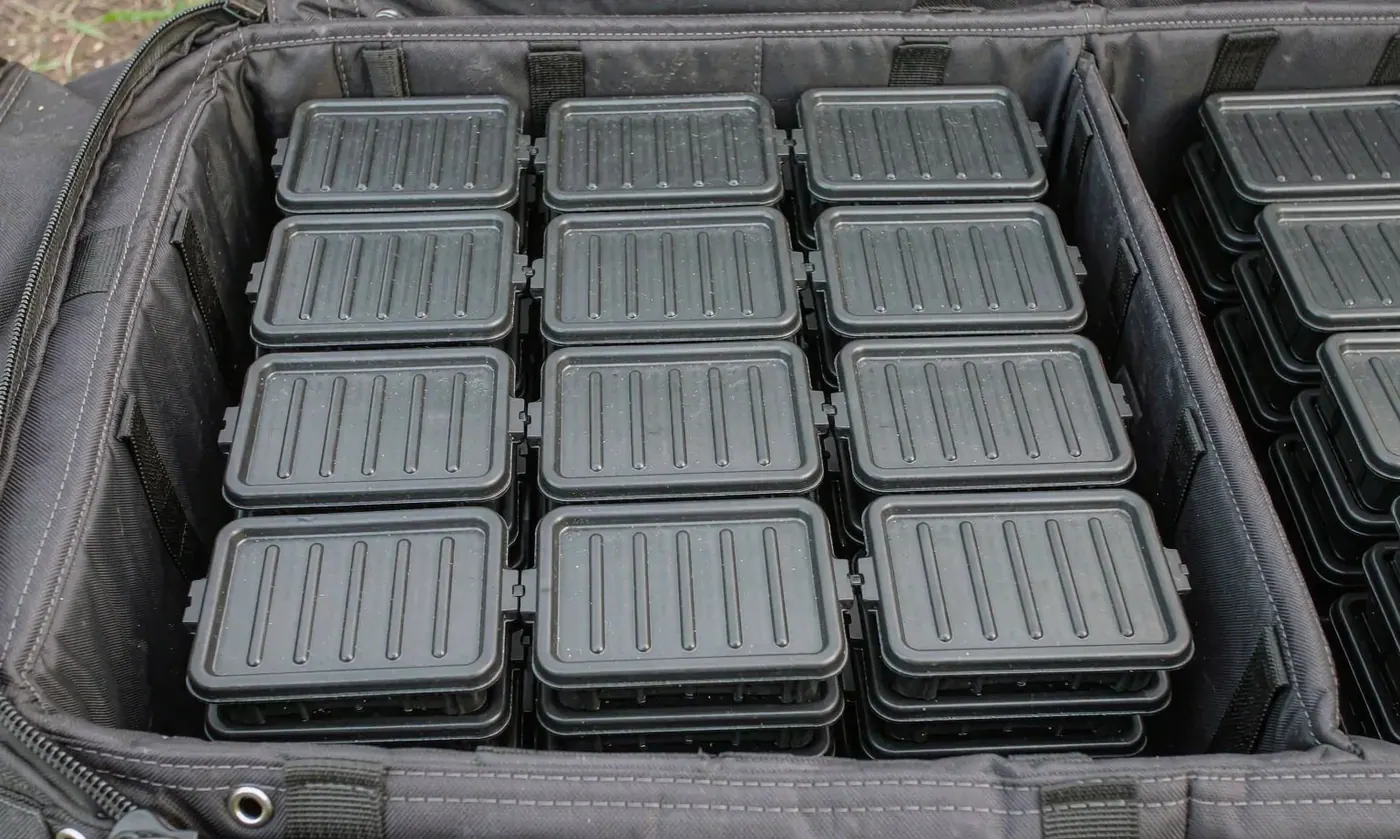
Freight efficiency is decided by two numbers nobody discusses early: packed carton volume and how well that carton tiles into a container. A tackle backpack that ships flat-packed may measure 480 by 380 by 120 millimetres per unit, giving around 10 pieces per export carton and roughly 1,050 pieces in a 20 foot container. Increase the packed height by twenty millimetres through a stiff base that cannot be compressed, and volume drops by almost ten percent of the shipment for a change nobody noticed in the development meeting.
| Shipment mode | Working volume | Pieces per shipment, mid-size backpack | Freight cost share | When it makes sense |
|---|---|---|---|---|
| 20 foot container | About 33 cubic metres | 900 to 1,200 pieces | Highest per unit sea cost | Opening orders and tests |
| 40 foot high cube | About 68 cubic metres | 2,000 to 2,600 pieces | Best per unit sea cost | Season-long programmes |
| Less than container load | Shared space | 100 to 600 pieces | Two to three times sea cost per unit | Emergency replenishment |
| Air freight | Chargeable weight basis | Only high-value fast movers | Six to ten times sea cost | Stock-out rescue only |
Ask for the packed carton specification before placing the order rather than after production starts. Two questions cover most of it: how many pieces fit one carton, and what is the stated burst strength of that carton. Adding this check costs nothing and takes one line in the enquiry email.
Incoterms in Plain Terms
Incoterms decide where risk and cost transfer, and three versions cover almost all practical work. FOB means the goods are delivered on board at the named port with export clearance done; everything after that is the buyers risk and cost. DDP means the seller arranges carriage, clearance and duty so goods arrive at the buyers door, which suits first-time importers and programme buyers without a customs broker. EXW leaves everything to the buyer from the collection point onward and is rarely advisable for anyone without representation in the shipping country.
| Term | Cost responsibility | Risk transfer point | Who it suits |
|---|---|---|---|
| FOB Xiamen | Buyer from the ships rail onward | Goods loaded on board | Importers with a forwarder and broker |
| DDP to destination | Seller to the delivery address | At delivery to the buyer | First-time importers and remote markets |
| CIF destination port | Seller to arrival port only | Goods loaded on board | Buyers wanting freight bundled, clearance own |
| EXW works address | Buyer throughout | At the collection point | Only with local representation |
DDP deserves a specific note because it is often quoted as though it were a premium service. In reality it is a risk transfer: the price includes freight, duty and clearance, which removes exposure to duty reclassification and to destination charges, and the usual cost difference against managing it yourself is two to five percent of landed value. For programmes shipping to upwards of one hundred nations, that predictability is generally worth more than the small theoretical saving. One caveat applies: quotations need a named destination city, because inland delivery cost varies more between cities within one country than between neighbouring countries. Order rhythm matters as well, since several smaller lots shipped this way often beat one large quarterly buy on both cash flow and clearance risk.
Payment Terms and How Risk Is Split
Standard terms across general merchandise programmes are a thirty percent deposit with the balance against copies of shipping documents, though several variants are normal. Letters of credit suit larger first transactions even though banks charge for the service, because documentation review provides a second check nobody else performs. Open account terms on the balance are typically reserved for programmes with several completed shipments behind them.
- Thirty percent deposit at order confirmation, seventy percent against copy documents, is the common default for first programmes.
- Letters of credit add bank fees but give a documentation review that catches description and packing errors before payment.
- Balance-on-arrival terms are sometimes offered to established accounts and are worth more than a one percent price concession.
- Currency is usually settled in United States dollars; agree who bears movement beyond two percent if the exemption matters to the buyer.
- Price validity should be stated with a date. Input fabrics move, and quotations older than ninety days rarely survive unchanged.
Once a programme has three clean shipments behind it, several levers become available that were not available at the start. Sampling cost often drops because artwork and tooling already exist, so later sampling rounds cover changes rather than first-time setup. Deposit terms can soften, which is worth more than it looks: moving from thirty percent to twenty percent on a repeat 3,000-piece programme releases working capital equivalent to several weeks of trading. And priority scheduling in peak season tends to follow proven continuity rather than order size alone.
Comparing Two Proposals Fairly
Two quotations that look fifteen percent apart are often within three percent once differences are normalised, mostly because they are not describing the same thing. Put both onto one line-by-line sheet with these items explicit: unit price and its validity date, the incoterm and named port, packed carton specification, lead time counted from approved sample or from deposit, included sampling cost, tooling applicable, and which material certificates accompany the shipment. Missing lines are information, not omissions.
Then check three claims that are easy to make and cheap to verify. Ask which social compliance scheme is audited and request the current audit reference rather than the logo. Ask which standard the welded seam is claimed against, discussed in the radio frequency welding process notes. And ask how the stated lead time is measured, set out alongside the timeline from sample to bulk shipment, since thirty-five days counted from deposit and thirty-five days counted from approved artwork differ by two to three weeks.
Quality Verification Before Money Leaves
Payment against documents means quality certainty has to exist before shipment rather than after arrival, which makes pre-shipment checking the highest-value line in the whole costing sheet. Standard practice is random sampling under ISO 2859-1 at general inspection level II, with major faults accepted at AQL 2.5 and minor faults at AQL 4.0. The mechanics and accept counts are set out in full in the AQL 2.5 acceptance guide, and physical test methods worth citing in any agreement come from ASTM International.
Two additions turn a standard inspection into a useful one for this category specifically. Add a tray-fit check so claimed capacity is verified against real trays rather than against a drawing, and add a loaded strap test on a sample of two units per colourway with fifteen kilograms for two minutes, since both are the failures most often reported by retail customers in the first season.

Documents an Import File Should Contain
Import delays are almost always documentation delays rather than production delays, and nearly all of them are avoidable with a checklist written before booking rather than before shipping. Assemble these items for each shipment and store them against both the purchase order number and the design code, because searches usually use one and disputes reference the other.
- Commercial invoice with tariff classification, country of origin and incoterm stated consistently with the quotation.
- Packing list showing carton count, net and gross weights, and carton numbering that matches physical markings.
- Bill of lading or airway bill with the consignee and notify party exactly as the forwarder requires.
- Certificate of origin where preferential duty treatment is claimed under an applicable trade arrangement.
- Current social compliance audit reference and material compliance documentation for the destination market.
- Packed and loaded photographs, retained together with the inspection report and sealed reference pieces.
Retail readiness belongs on the same checklist, because it is the item most often discovered too late. Chains typically require a scannable barcode assigned by the brand, a country of origin marking that survives handling, and either a sewn-in label or a hangtag carrying fibre content where applicable. Adding these after production starts means hand-work at the warehouse, which costs several times more than including them in the original build.
Writing the Brief That Gets Accurate Answers
Response quality tracks brief quality almost perfectly. A three-line enquiry asking for a waterproof fishing bag price will attract a generic figure based on assumptions, whereas a brief that states capacity, material denier and coating, tray configuration, closure type, target kilometres of field use, colourway count, quantity and delivery port will attract a number grounded in a real build. Include the target retail price band, because it tells the development team where the design has to land.
State three things explicitly that are otherwise silently assumed. Name the standards the goods must meet and who holds the test documentation. Fix the approval cycle, including who signs off artwork. And specify whether the programme is exclusive to the buyer, since that affects whether tooling investment makes sense for either side. Order size expectations follow naturally; opening quantities begin at 500 pieces per design and colour, set out in more detail in the MOQ note for fishing bag programmes.
Programme Notes
QUANZHOU JUNYUAN BAGS has handled waterproof bag programmes since 2014, with a founding team in this trade since 2004 and monthly output of 200,000 units verified by SGS. Every bulk shipment is inspected at AQL 2.5 before release, materials are screened for REACH and California Prop 65, and operations run under BSCI and ISO 9001 governance with management-system detail published by the International Organization for Standardization. Shipment runs FOB Xiamen or DDP to upwards of one hundred nations from the production programme, with enquiries also accepted at service@junyuanbags.com.
Practical next steps are straightforward and take about ten minutes for a buyer with a target specification. Send a short paragraph covering target capacity and use case, material preferences, tray and closure requirements, colourway count, quantity bands under consideration, and destination port or delivery city. material preferences, tray and closure requirements, colourway count, quantity bands under consideration, and destination port or DDP city. The response will typically include indicative pricing at three quantity levels, the sampling timeline, and the earliest realistic delivery date, which is enough to build a costing sheet the same week rather than the same quarter.
People Also Ask
How much does a bulk order of fishing tackle bags cost?
Unit prices fall in steps: roughly 8 to 12 percent from 500 pieces to 1,500 pieces, and a further 3 to 5 percent per tier above that, before freight and duty.
What is the minimum quantity for a bulk fishing bag order?
500 pieces per design and colour is the usual opening level, which allows a proper material buy without carrying excess risk on a first buy.
How many tackle bags fit in a 40 foot container?
Around 2,000 to 2,600 mid-size tackle backpacks, depending on how flat each unit packs and how efficiently the carton tiles.
What is the difference between FOB and DDP for bag imports?
FOB transfers cost and risk once goods are loaded on board; DDP carries carriage, duty and clearance to the delivery address, usually two to five percent higher.
What payment terms are normal for a first order?
Thirty percent deposit with the balance against shipping document copies, or a letter of credit on larger first transactions.
How do I compare two bag quotations fairly?
Normalise both onto one line sheet covering unit price validity, incoterm, carton spec, lead time trigger, sampling inclusion and documents attached.
Frequently Asked Questions
Q1. What quantity should a first bulk order be?
Around 500 pieces per design and colour is enough to complete a proper material buy and to prove the market without over-committing working capital.
Q2. Why does unit price drop so sharply between 500 and 1,500 pieces?
Because the longer run absorbs cutting changeover waste and allows trim to be purchased in roll rather than lot quantities, typically worth 8 to 12 percent.
Q3. Which shipping term is best for a first-time importer?
DDP to the destination city, because clearance, duty classification and destination charges sit with the shipper rather than with the buyer.
Q4. How much should be budgeted above unit price for landed cost?
Between 18 and 32 percent for freight, duty, port handling and inland delivery, depending on destination and how well the shipment fills a container.
Q5. What is the typical packed carton spec for a tackle backpack?
Around 10 pieces per export carton at roughly 480 by 380 by 120 millimetres per unit, though stiff bases and sewn inserts change this materially.
Q6. Should ocean freight be booked early?
Yes. Peak season surcharges from August to October commonly add several points to freight cost, and space tightens well before that window.
Q7. Is a letter of credit worth the bank fee?
Usually for first transactions above about 25,000 dollars in value, because the document review catches description errors that would otherwise be paid for.
Q8. How long is a quotation valid?
Typically ninety days. Beyond that, fabric and hardware input costs have usually moved and the figure should be reconfirmed.
Q9. Can different designs share one container?
Yes, and it is common. Mixing two or three designs of one material family improves container utilisation and spreads fixed documentation cost.
Q10. Who prepares export documentation?
The shipping partner prepares commercial documents; the buyer or forwarder handles import clearance unless the term is DDP, where the seller arranges it all.
Q11. What checklist items cause the most import delays?
Tariff classification errors, consignee details that do not match the forwarder record, and packing lists inconsistent with carton markings.
Q12. How soon must claims be raised after arrival?
Policies differ, but most agreements expect notification within seven days of receipt with photographs, so inspect immediately rather than at the warehouse later.
Q13. What should be included in the first enquiry email?
Capacity, material, tray configuration, closure type, colourway count, quantity bands, target retail band, destination port or city, and the standards to be met.