MOQ 500 means 500 pieces of one design in one colourway, not 500 bags spread across a range. It exists because four things have their own minimums below which unit cost climbs steeply: fabric is bought in dye lots, hardware arrives in standard pack sizes, cutting markers waste more material on short runs, and the first two hours of any production run are spent setting parameters rather than making bags. Below the minimum, expect a per-unit loading of roughly 1.50 to 4.00 dollars, or alternatively a material surcharge agreed in writing. There are six legitimate ways to reach 500, and most buyers only know two of them.
How the Minimum Is Counted
This is the point where most first enquiries go wrong, so it is worth stating plainly. A programme offering eight products in three colours each has twenty-four separate variants; ordering thirty units of every variant totals 720 pieces and looks generous, but every one of those twenty-four variants sits far below the level any material buy supports. The minimum applies per design per colourway, because that is the unit at which materials are purchased and machines are set up.
The practical consequence is that range breadth is expensive and depth is cheap. Three colours of one strong design at 500 each is a well-formed first order of 1,500 pieces. Twenty-four variants at sixty pieces each is twenty-four separate problems, each attracting its own material surcharge and each needing its own setup.
Where the Minimum Comes From
Production economics are remarkably similar across soft goods, and every component has a quantity at which it stops being awkward. Understanding those thresholds makes the minimum feel like arithmetic rather than policy, and it also shows which levers actually reduce it.
| Input | Why it has a threshold | Typical trigger | Cost effect below it |
|---|---|---|---|
| Body fabric | Woven and coated in dye lots rather than by the metre | Several hundred metres of one colour | Lot surcharge or restricted colour choice |
| Webbing and binding | Supplied on rolls of fixed length | One roll per colour per width | Short-length handling charge |
| Hardware, buckles and sliders | Standard pack sizes are thousands of pieces | One pack per finish | Higher unit price on small packs |
| Printed trims and labels | Print set-up cost is quantity independent | Typically several hundred units | Setup amortised over few units |
| Cutting marker efficiency | Short runs leave more unusable offcuts | Roughly one full day of cutting | Several percent extra material waste |
| Machine set-up time | First pieces calibrate tension, heat and feed | First one to two hours each run | Fixed cost spread over fewer units |
Note which of these are negotiable and which are physical. Machine set-up time exists regardless of who runs the equipment, whereas hardware pack sizes change entirely if a standard finish is acceptable instead of a matched one. That distinction is the basis of everything in the following section.
What Happens Below the Minimum
Ordering below the stated quantity is possible in most cases, and it is priced rather than refused. Two mechanisms are common: a per-unit loading or a flat setup contribution added to the invoice. Both are honest; both are worth comparing against simply ordering the minimum and paying to hold stock, which is sometimes the cheaper choice once attention is paid to the arithmetic.
| Order size per design and colour | Typical added cost per unit | Flat alternative | Better decision |
|---|---|---|---|
| 100 pieces | 3.50 to 4.00 dollars | Around 350 dollars setup | Usually buy 500 and hold stock |
| 200 pieces | 2.40 to 3.00 dollars | Around 400 dollars setup | Compare against stock holding cost |
| 300 pieces | 1.80 to 2.40 dollars | Around 450 dollars setup | Depends on retail margin |
| 400 pieces | 1.20 to 1.80 dollars | Around 500 dollars setup | Usually buy the extra 100 |
| 500 pieces | None | Not applicable | Standard rate |
The comparison against stock holding is worth doing explicitly. Holding an extra one hundred units for a season typically costs storage plus working capital of a few dollars per unit, which is often less than the surcharge on the smaller run. Ordering the minimum is therefore frequently the cheaper path even before considering that the extra units can be sold.
Six Ways to Reach the Minimum Honestly
Most buyers know two routes to the minimum, order more or pay a surcharge, and there are four more that cost nothing beyond a small change of approach. Listed in rough order of effectiveness, they reduce the effective threshold by working with how materials are bought rather than against it.
| Approach | How it works | Effect on effective minimum | Trade-off |
|---|---|---|---|
| Use existing standard colours | Buy fabric colourway already held or scheduled | Can remove the dye-lot threshold entirely | Less colour differentiation |
| Accept standard hardware finishes | Use stock buckles in silver or black rather than colour-matched | Removes pack-size problems | Slightly less colour coordination |
| Reduce colourways at launch | Two colours instead of four in season one | Concentrates volume above the threshold per variant | Narrower in-store display |
| Share one specification across sizes | Same material and trim set on 25, 35 and 45 litre versions | Combines the material buy for all three | Range looks related rather than varied |
| Combine variants within one shipment | Several designs on one order and one bill of lading | Total programme volume supports shared materials | Delivery is tied to the slowest item |
| Stage the programme | Order 500 of the core item first, add others after data | Working capital follows demand rather than forecast | Second round ships later |
The fourth row deserves attention because it is the least used and often the most effective. When three sizes of one design share identical fabric, webbing, hardware and thread colour, materials for all three can be purchased together, so the relevant minimum becomes the combined figure across the family rather than the figure for each size. Several very successful ranges use exactly this structure, and buyers perceive it as a family rather than as compromise.
Minimums Differ by Product Type
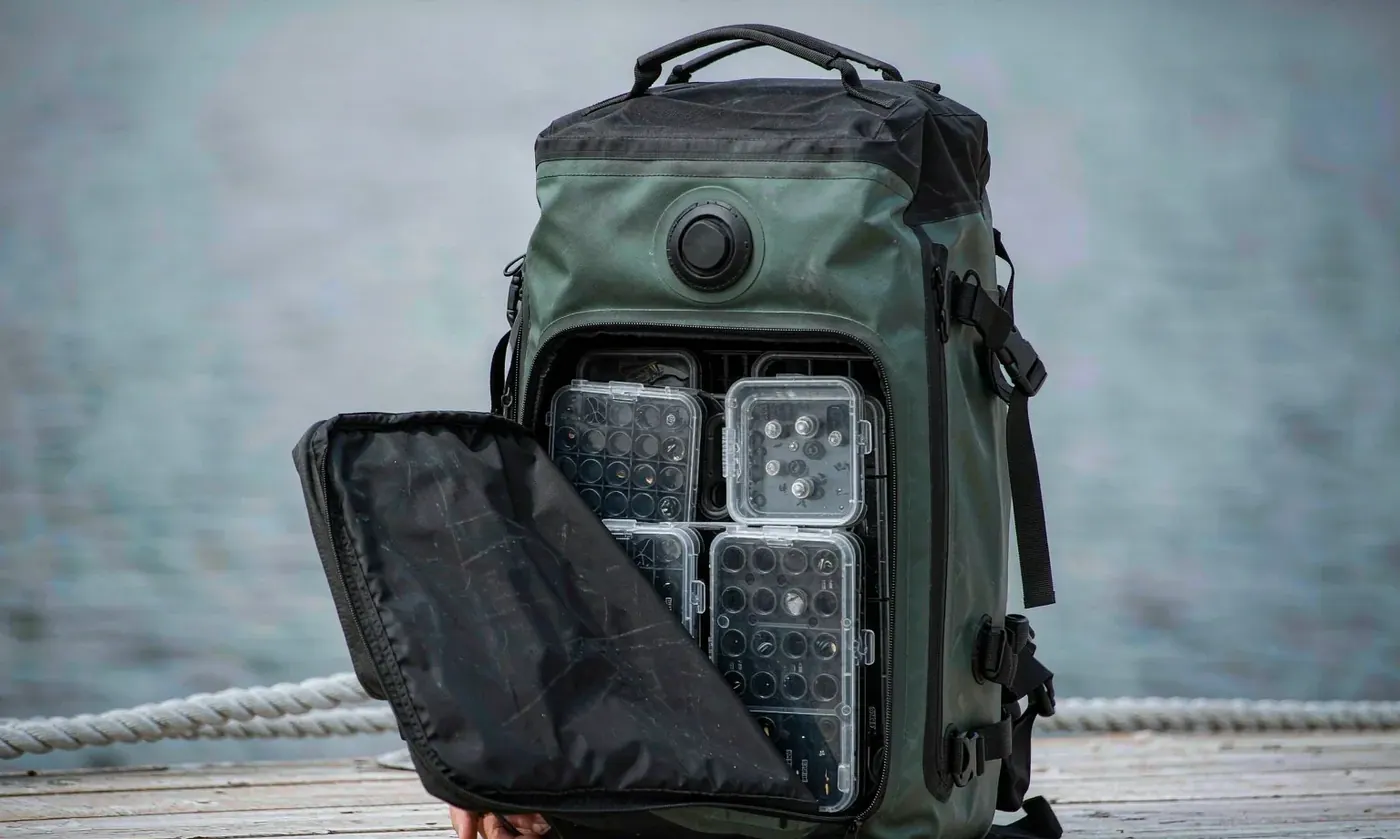
The working minimum is not identical across every item in a range, because the inputs differ. Printed accessories and smaller items frequently carry lower thresholds than large sewn bodies, since their material buy is dominated by fabric rather than by a dozen separate trims. Knowing where each product family sits allows a first order to be shaped around the items that are naturally flexible.
| Product family | Typical opening quantity | Binding input | Flexibility |
|---|---|---|---|
| Simple sling and chest packs | 300 to 500 pieces | Body fabric, one hardware finish | Most flexible on colour |
| Mid-size tackle backpack | 500 pieces | Fabric plus several trims | Standard |
| Large rolling or wheeled bag | 500 pieces, sometimes higher | Frame and wheel assemblies | Least flexible |
| Insulated companion bags | 300 to 500 pieces | Liner film and insulation | Flexible on size, fixed on liner |
| Printed attachments and small parts | 500 to 1,000 pieces | Tooling rather than material | Tooling cost dominates |
Use the second and third columns together when planning a launch range. Lead with an item from the flexible end where the shape allows it, since that item can carry a shorter colour run without penalty, and reserve standard quantities for the items whose inputs genuinely demand them.
Inventory Maths: Compare Holding Cost With Surcharge
The decision between paying a surcharge on a small order and buying the minimum is arithmetic rather than instinct, and it takes about five minutes. Take a typical case: a design forecast at 300 units per season, priced at 20 dollars at the 500-piece level with a 2.20 dollar surcharge applied below that. Ordering 300 units costs an extra 660 dollars. Ordering 500 units instead ties up 200 additional units, which at 20 dollars is 4,000 dollars of stock, costing perhaps 8 to 12 dollars per unit over a season in storage and capital, or roughly 1,600 to 2,400 dollars.
On those raw numbers the surcharge looks cheaper, and that is exactly where most comparisons stop too early. The 200 surplus units are not consumed; they carry into next season at full value, so the true comparison is 660 dollars against the carrying cost of 1,600 to 2,400 dollars plus the option value of having stock available when demand surprises. Once a discount scenario or a late listing is possible, buying the minimum usually wins, which explains why experienced buyers rarely take the surcharge route twice.
Five Persistent Misunderstandings
Most arguments about minimum quantities come down to one of five assumptions, none of which survives contact with how soft goods are actually bought and scheduled. Clearing them up early saves both sides time in the first week of a programme.
- That totals count. They do not; each design and colourway combination carries its own minimum because each has its own material buy.
- That the minimum is negotiable purely on price grounds. It moves when the inputs change, not when asked politely.
- That a higher-order quantity always shortens lead time. It generally does not, since the line queue and not the run length sets the date.
- That a small first order is lower risk. Below the threshold it often costs more per unit and removes the option of quick replenishment.
- That minimums are fixed policy. Standard colours, standard hardware and shared specifications across a size family can all lower the effective number.
Sizing a First Order Sensibly
A defensible first order balances three numbers: forecast demand for the season, how long cash can sit in inventory, and how quickly a second shipment can follow. In practice, ordering to cover roughly eight to twelve weeks of forecast rather than the full season usually outperforms both extremes, particularly for a first season, where forecast error is widest and where the cost of being wrong is highest for everyone involved. Enough stock arrives to read genuine demand, and there is still time for a replenishment run before the season turns.
Reorder speed is the hidden variable. A monthly replenishment cadence at 500 pieces per design works comfortably within standard sampling and production windows; issuing monthly reorders picks up demand signals quickly and keeps inventory lean, whereas one large annual buy removes flexibility and pushes poor estimates into clearance. The whole question of order rhythm belongs next to the sourcing discussion in the bulk fishing tackle bag sourcing guide, which also sets out how landed cost behaves once freight and duty are added to the unit figure. A second useful check is whether the forecast assumes one season or several: where a design is expected to run for three years, the per-unit economics of opening at a deeper quantity improve again, because artwork, tooling and any setup contributions amortise across a far larger total volume.
Cash flow deserves one further line in this planning, because it is usually the real constraint behind requests for smaller quantities. Deposits of thirty percent mean the cash impact of ordering 500 rather than 300 is not the full difference in goods value but roughly a third of it, with the balance falling due against documents weeks later. Buyers who model cash flow properly frequently find they can fund the larger order comfortably, and that the gap they feared was smaller than expected.
How the Minimum Interacts With Timeline
Volume and timing are linked more closely than buyers expect. A 500-piece order takes up less production time than the ruling minimum of a larger order, but it is scheduled within the same queue, so booking early matters more than size matters. The thirty-five to fifty day bulk window applies from approved sample and deposit, Because the same thirty-five to fifty day window applies whether the order is 500 pieces or 5,000, Buyers are frequently surprised by how rarely under-ordering saves calendar time, which is why it is worth checking the date before agreeing to any surcharge.
Sample approval is the variable that actually moves dates. Six to ten working days covers building one revision of a sample; each additional revision restarts part of that clock, and three revision rounds can add three weeks before bulk even begins. Deciding who approves, and how quickly, is worth more than negotiating two days off the production window. Detailed stage-by-stage scheduling appears in the order timeline note and the lead time guide.
Working Out What You Actually Need
The arithmetic of a first order rewards doing it once, carefully, on paper, and doing it before the first enquiry rather than after the first quotation. Take forecast demand for the strongest line, subtract what would be acceptable to sell out early, and check the remainder against the cash cost of holding it. Then repeat for a second and third colour, because colour split is usually the decision that determines whether the first season reads as confident or cautious.
- Start with a 60 or 30 or 10 split across core, secondary and experimental colourways, and expect it to change after the first month of data.
- Order to cover eight to twelve weeks rather than the season, provided a replenishment run can follow inside thirty-five to fifty days.
- Check whether one variant carries most of the demand risk; if it does, order that one deeper and keep others at minimum.
- Build a small buffer for promotional use, typically two to three percent of volume, since unexpected listings always appear and are rarely forecast.
- Revisit the split after thirty days of real sales rather than waiting for end of season.
One caution about deliberately thin orders. Ordering 200 pieces to test demand looks prudent and frequently costs more than either alternative: the surcharge raises unit cost, and if it sells out there may not be time for a second run before the season ends. Testing through existing channels, or through a smaller companion product, usually produces better information at lower cost.
Late additions to a range deserve a mention because they are where many programmes quietly lose money. A fourth or fifth variant added late in planning usually carries full setup cost and sells in the smallest volume, and its units end the season discounted. Adding it at the start of the following season, once there is data showing it will sell, costs nothing extra and carries far less risk.
There is one more honesty check worth applying to the whole plan. If a range concept only works when every variant is ordered below its natural threshold, the concept is too wide rather than the minimum being too high. Ranges built for this category succeed on three strong designs in three colours far more often than on twelve designs in one colour.
Questions Worth Asking Before Signing Off
Three questions resolve most uncertainty about minimum quantities, and all three should have answers in writing before deposit. Ask exactly how the minimum is counted, whether across a design family or per variant. Ask what the written cost is if a later reorder falls below the minimum, because second orders often do. And ask whether the same minimum applies to repeat orders, since several programmes allow smaller reorder quantities once artwork and tooling exist.
A fourth question separates reliable programmes from optimistic ones: what happens if a required material is no longer available. A reasonable answer involves written notice and a choice among substitutes rather than a silent substitution. Programmes that answer this well tend to answer every later question well too, which makes it a useful diagnostic in the first email exchange.
A fifth question is worth adding whenever a programme spans several seasons: what happens when a colourway is discontinued. Most material minimums are set per colour, so dropping a weak colour early is usually straightforward, while adding one later can attract the same setup charge as a new design. Planning colour additions for the start of a season rather than the middle avoids that cost entirely.
Programme Notes
QUANZHOU JUNYUAN BAGS has run waterproof bag programmes since 2014 with a founding team in this trade since 2004, opening orders at 500 pieces per design and colour. Monthly output runs at 200,000 units verified by SGS, operations follow BSCI and ISO 9001 with the relevant standard published by the International Organization for Standardization, and materials are screened for REACH and California Prop 65. Physical acceptance testing sits at AQL 2.5 with method references available from ASTM International.
Sampling takes six to ten working days, bulk takes thirty-five to fifty days from approved sample and deposit, and shipment runs FOB Xiamen or DDP to upwards of one hundred nations. Discuss quantity structure, colour splits and reorder expectations early, or write to service@junyuanbags.com.
People Also Ask
What does MOQ 500 mean for fishing bags?
Five hundred pieces of one design in one colourway. It is counted per variant rather than across a whole range of products.
Why is the minimum set at 500 pieces?
Because fabric dye lots, hardware pack sizes, cutting marker efficiency and machine setup time all have thresholds below which unit cost rises sharply.
Can I order fewer than 500 pieces?
Yes, generally with a per-unit loading of about 1.50 to 4.00 dollars or a flat setup contribution agreed in writing before the order.
Do different colours count toward the same minimum?
No. Each colourway is a separate material buy, so 500 spread across three colours is below the level for all three.
Is it cheaper to buy 500 and hold stock than 200 with a surcharge?
Often yes. Holding costs for a season usually fall below the surcharge, and the extra units remain saleable.
Does a repeat order still need 500 pieces?
Usually, though some programmes allow smaller reorders once tooling and artwork are established. Confirm before planning the second season.
Frequently Asked Questions
Q1. Is the minimum counted per design or per order?
Per design and per colourway, which is the unit at which materials are purchased and machines are set up.
Q2. Can different sizes of one design share the minimum?
Yes, when they share the same fabric, webbing, hardware and thread colour, because the material buy can be combined across the family.
Q3. What is the usual surcharge when ordering 300 pieces?
Around 1.80 to 2.40 dollars per unit, or a flat contribution near 450 dollars, depending on how each programme prices setup.
Q4. Does using stock colours reduce the minimum?
It can remove the dye-lot threshold entirely, which is usually the single most effective change available to a first-time buyer.
Q5. Is colour-matched hardware worth the extra pack-size cost?
Rarely on a first order. Standard finishes look deliberate in silver or black and avoid a higher per-unit hardware price.
Q6. How many colourways should a launch have?
Two or three. Each additional colourway is a separate material buy and typically costs three to six percent in unit efficiency.
Q7. What is a sensible first quantity for one design?
Enough to cover eight to twelve weeks of forecast demand, provided a replenishment order can follow inside the standard thirty-five to fifty day window.
Q8. Does an order below the minimum still take the same time to produce?
Yes, the bulk window is largely queue-driven, so booking early generally matters more than the quantity ordered.
Q9. Do sample revision rounds delay bulk production?
Yes. Six to ten working days covers roughly one round, and each additional revision adds to the clock before bulk starts.
Q10. Can several designs ship together on one order?
Yes. Combining variants on one order and one bill of lading lets total programme volume support shared material buys.
Q11. What happens if a required material becomes unavailable?
A well-run programme gives written notice and offers substitute options rather than substituting silently, so put that obligation in writing first.