Putting an own-brand logo on a fishing backpack costs between thirty cents and four dollars a unit depending on how it is applied, and the decision is mostly about order size rather than about taste. Embroidered badges suit runs of 500 pieces upward and add about ninety cents; silicone patches need tooling around one hundred and twenty dollars plus roughly sixty cents a unit; printed transfers suit anything above 300 pieces but must be tested for abrasion because a logo that cracks in month three damages the brand it was meant to build. A standard own-brand run takes six to ten working days for a sample and thirty-five to fifty days for bulk from approved artwork and deposit, at 500 pieces per colourway.
What Own-Brand Actually Means Here
Own-brand means an existing engineered shape carries your logo, labelling and colourway. It does not mean starting from a blank page, and that distinction is the reason it is fast and cheap. The pattern, tooling, material set and inspection method already exist and have already been proven across previous runs, so the buyer is buying certainty along with the product. A buyer who needs different geometry, a different closure or a different tray layout is asking for a new design, which is a different conversation with a different timeline.
Three levels sit inside the same headline and they should be named precisely in an enquiry, because confusing them is where budget disputes begin. Level one is labelling only: a woven label, a hangtag and barcoded packaging on an unchanged product. Level two is decoration on an existing shape: logo application plus chosen colourway from the existing palette. Level three is a modified shape: existing platform with changed features, which involves development even though it is often still called own-brand.
Logo Methods Compared
Five application methods cover nearly every fishing backpack programme, and each has a different cost curve, minimum quantity and durability story. The table uses typical figures for a single position logo; add roughly fifteen percent for each additional position because each adds handling time even where the material cost is negligible.
| Method | Usual minimum | Added cost per unit | Abrasion life | Best used for |
|---|---|---|---|---|
| Woven label sewn at a seam | 500 pieces per design | 25 to 45 cents | Life of the bag | Discreet brand marks, care labelling |
| Direct embroidery | 500 pieces | 70 cents to 1.40 dollars | Very high, thousands of washes | Heritage and premium positioning |
| Silicone or rubber patch | 500 pieces plus tooling | 55 to 95 cents | Very high, flexible at low temperature | Outdoor and saltwater ranges |
| Heat transfer print | 300 pieces plus film setup | 30 to 60 cents | Moderate unless tested | Multi-colour artwork and gradients |
| Embossed panel or moulded badge | 1,000 pieces plus tooling | 80 cents to 2.20 dollars | Very high | Flagship ranges with volume behind them |
Two things decide which is right more often than price does. The first is where the bag is sold: a rubber or embroidery mark survives life on a saltwater boat, whereas some printed transfers lose edge adhesion after repeated salt exposure. The second is colour count, because embroidery cost scales with stitch count rather than with design area, and a five-colour crest can cost several times a single-colour wordmark.
Artwork That Survives the First Production Run
Most delays on an own-brand launch trace back to artwork rather than to production. Vector artwork with fonts converted to outlines avoids the missing-font problem entirely, and a physical colour standard avoids the screen-to-fabric mismatch that is otherwise discovered only when the sample arrives. Budget one extra week the first time; programmes that send specification-complete files routinely hit their six to ten working day sampling window, and programmes that send screenshots rarely do.
| Artwork element | Requirement | Why it matters | Common error |
|---|---|---|---|
| File format | Vector file, fonts converted to outlines | Prevents substitution at the receiving end | Sending a flattened image file |
| Colour standard | Named physical colour reference for each thread or ink | Screens differ from fabric by several points | Approving colour on a phone display |
| Minimum text height | Six millimetres for embroidery, four for print | Below this the detail fills in | Scaling a business card logo down |
| Placement | Millimetres from two fixed edges, with a photo | Removes interpretation at layout | Describing position only in words |
| Tolerance note | Accepted variation stated, typically two millimetres | Avoids arguing over a non-issue | Assuming zero tolerance without saying so |
Colourway Economics
Every additional colourway is a separate material buy and usually a separate dye lot, which is why colour count moves unit price faster than almost any other specification change. Launching three colours rather than five typically improves unit cost by three to six percent while keeping shelf impact, and the withdrawn colours can be added in the second season once sell-through data shows which ones earn their place.
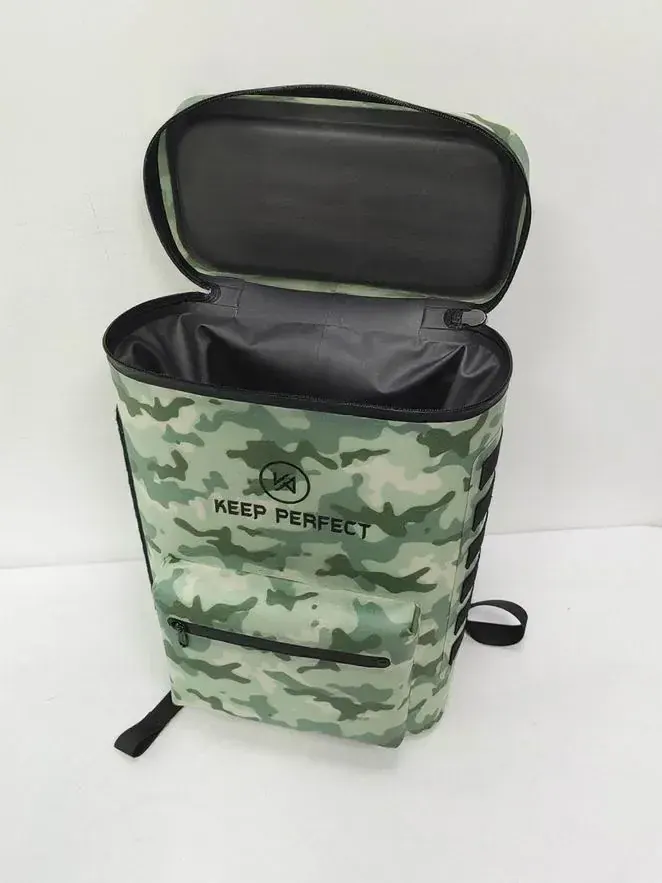
Colour choice also interacts with function. Dark linings make dark lures hard to find in low light, which is why light grey interiors dominate serious tackle ranges, while exterior colour affects how much an exposed deck bag heats in direct sun. A mid-tone surf-green shell at thirty degrees ambient stays roughly eight to twelve degrees cooler to the touch than a dark navy one, which is not a marketing point but does affect how the bag feels to pick up.
Tooling, Ownership and Exclusivity
Tooling questions are simple but should be settled in writing because they surface again after a successful first season. Cutting dies, embroidery tapes, heat-transfer films and moulding tools each have a cost and an owner. Standard practice is that the buyer pays for tooled items specific to their artwork and therefore owns them, while generic tooling for shared shapes remains the property of whoever made it. Write this down, along with who pays for storage if a programme pauses for eighteen months.
Exclusivity is the other recurring subject and it is usually available in two forms. Category exclusivity reserves the design for one buyer within one market or channel and typically requires continuity commitments rather than a single order. Shape exclusivity prevents the same tooling being sold to anyone else at all, which commands significantly higher volume commitments and is rarely worth buying unless the design genuinely carries the brand.
There is also a naming question that brands rarely plan for. Describing a bag as 35 litre in marketing while its measured capacity is nearer 31 litre invites returns and bad reviews that no amount of design work undoes. Ask for measured rather than nominal capacity, then write lower and let satisfied buyers note the difference, which is the cheaper and more durable position.
What It Costs, All In
Build a launch budget from four lines rather than one. The first is added unit cost for decoration, typically thirty cents to two dollars. The second is one-time setup: tooling or film, usually eighty to four hundred dollars depending on method. The third is sampling, generally charged per round and credited against the bulk order by most partners. The fourth is packaging artwork and barcodes, which is small but always forgotten.
| Programme size | Decoration per unit | One-time setup | Sampling cost | Total added programme cost |
|---|---|---|---|---|
| 500 pieces, one colour, print transfer | 45 cents | 120 dollars | One round credited | 345 dollars |
| 500 pieces, embroidery | 1.10 dollars | 90 dollars | One round credited | 640 dollars |
| 1,500 pieces, embroidery | 95 cents | 90 dollars | Credited against bulk | 1,515 dollars |
| 3,000 pieces, silicone patch | 70 cents | 210 dollars tooling | Credited against bulk | 2,310 dollars |
| 5,000 pieces, embossed badge | 1.40 dollars | 400 dollars tooling | Credited against bulk | 7,400 dollars |
Read the last column against expected margin rather than against unit price alone. An added cost of one dollar on a bag retailing at ninety dollars is negligible; the same dollar on a thirty-five dollar entry bag changes whether the line is worth listing. Judging decoration spend as a share of retail rather than as a headline cost is what separates programmes that look good on paper from ones that survive the season.
Labelling, Packaging and Retail Readiness
Nothing sinks an otherwise successful launch faster than arriving without what a retailer needs to receive stock. Most chains require a scannable barcode owned by the brand, a country of origin marking that survives handling, fibre or material content where applicable, and in many cases a hangtag carrying a printed product description. None of this is expensive if it is planned; adding it after goods are packed means hand-work at the warehouse, typically costing three to five times what it would have cost in the original build.
Packaging itself carries more of the brand than buyers expect. A printed hangtag with a clear capacity statement and a simple feature diagram does more work on shelf than any description on the product page, and costing typically runs fifteen to forty cents per unit depending on finish. Retailers also increasingly ask for plastic-free packaging, which points towards printed paper bands rather than polybags, and that decision changes carton packing methods, so it needs to be made before packaging artwork is designed rather than after.
Five Mistakes That Cost First Launches Money
The same five errors account for most avoidable cost on a first own-brand fishing bag programme. They are listed in the order they usually happen, which is also roughly the order in which they become expensive.
- Approving colour on screen rather than against a physical standard, then discovering a three-point mismatch once five hundred units are finished.
- Sending a low-resolution image instead of a vector file, which adds a week for artwork redrawing and often changes the cost estimate.
- Scaling a business-card logo down below six millimetres of text height, so fine detail fills in and the mark has to be redrawn.
- Ordering five colourways instead of three, which adds three separate material buys to a first order that has not yet proved demand.
- Treating packaging and barcodes as a post-production task, then paying warehouse rates for work that belongs in the build.
Note that none of these is a production problem. They are all decisions made during artwork and planning, which is why the cheapest project-management step available is to finish the brief completely before ordering the first sample rather than refining it while samples are already being cut.
Choosing Which Product to Launch First
Where a brand intends to build a whole own-brand range, sequencing matters. Start with the item that has the widest appeal and the lowest risk of size or fit problems: a mid-capacity backpack in one or two colours, with a compact sling added as the second item. Leave specialised shapes such as rolling bags or crate inserts until there is sell-through data, because they carry narrower demand and higher development cost.
Launching narrow and replenishing well beats launching wide every time in this category. A two-point range with monthly reorder against real data builds a brand faster than a ten-point range that ties up working capital for two seasons and then discounts half of it in the third.
Timeline and What Slows It Down
A realistic own-brand launch runs: one to two days for quotation against complete artwork, six to ten working days for a physical sample, three to seven days for approval and any revision, then thirty-five to fifty days for bulk counted from approved sample and deposit. Add ten to fifteen days for shipping depending on the port, which puts a first landing roughly nine to eleven weeks after artwork is final. Everything that slips, slips in the approval loop rather than in building.
Parallel paths compress this considerably and cost nothing. Arrange barcodes, packaging artwork and retail labelling while the sample is being built rather than after it is approved, since those three items sit outside the production sequence entirely. Programmes running them in parallel routinely land two weeks earlier than programmes doing them in sequence. Detailed scheduling for deeper development work is set out in the made-to-order design guide, and the order-stage view in the MOQ planning note.
Protecting the Brand Once It Ships
The work does not end at approval. Three controls keep an own-brand range consistent across seasons, and none of them costs much. Keep a sealed reference piece from every colourway and compare each new shipment against it. Require written notice before any material, trim or thread lot changes, since those substitutions are invisible in photographs and obvious in hand. And hold one annual re-cost of the whole range so that input movements do not quietly erode margin.
- Register the brand mark in every market where the range sells before the first shipment lands, not after a competitor appears.
- Keep the colour standard physical and stored away from light, since references fade faster than anyone expects.
- Ask for a retained sample with each repeat order, labelled with the production month, so drift over seasons is measurable.
- Set branding standards for saltwater exposure, then verify them: requirements for colourfastness and abrasion are published by AATCC, and physical durability methods by ASTM International.
- Photograph every approval. Approval comments are remembered differently by everyone present, and photographs settle it in seconds.
One further thing worth deciding before the first order: which parts of the range must look identical every season. Consistency is easier to protect than it is to recover. Once a brand mark has shipped in two different thread shades because nobody wrote down the reference, the second mistake is attributed to the brand rather than to an oversight, and correcting it means replacing stock that was technically acceptable.
Buyers should also decide early how claims will be substantiated, because retailers increasingly ask before listing. A stated IPX water rating needs a report rather than a sentence, a stated denier needs a material certificate, and any recycled content claim needs traceability back to input. Enforcement scrutiny of unsubstantiated claims now costs more than producing the evidence, and evidence gathered at development stage costs almost nothing compared with reconstructing it two seasons later.
Seasonality also deserves a line in the same plan. Northern hemisphere retail needs stock landed and on shelves by March for the spring opener, which means artwork finalised before the December holiday shutdown rather than in January, since that single month typically decides whether a launch catches the season or watches it pass from a warehouse.
Getting Started With a Short Brief
A useful first enquiry needs only six lines: target capacity and use case, the shape family of interest, decoration method being considered, colourway count, quantity band, and destination port or delivery city. Add target retail and the response can also say whether the plan is commercially realistic. Requests missing these details get a generic reply because there is nothing else to base one on.
Smaller items make good test cases. Launching with a compact item such as a own-brand fishing sling pack verifies artwork, colour standards and packaging on a low-volume run before committing to a large backpack programme, and the lessons transfer cleanly. Where a full-scale change is needed, including different geometry or a different tray layout, that belongs on the development track described in the made-to-order guide rather than here.
Programme Notes
QUANZHOU JUNYUAN BAGS has handled waterproof bag programmes since 2014 with a founding team in this trade since 2004, running own-brand work alongside stock repeats and development builds. Monthly output is 200,000 units verified by SGS, every bulk shipment is inspected at AQL 2.5 before release, materials are screened for REACH and California Prop 65, and operations run under BSCI and ISO 9001 governance with the applicable management standard published by the International Organization for Standardization.
Opening own-brand quantities begin at 500 pieces per design and colour, sampling takes six to ten working days, and bulk runs take thirty-five to fifty days from approved sample and deposit, shipped FOB Xiamen or DDP to upwards of one hundred nations. Add two to three percent of goods value to the plan for possible sorting or re-work after arrival: either it will not be needed, or it will matter a great deal. Send artwork-ready enquiries to service@junyuanbags.com.
People Also Ask
How much does it cost to put a logo on a fishing backpack?
Between thirty cents and four dollars a unit, plus setup of roughly eighty to four hundred dollars, depending on embroidery, print transfer, silicone patch or moulded badge.
What is the minimum order for an own-brand fishing bag?
500 pieces per design and colour for most decoration methods; heat transfer can start nearer 300 pieces and moulded badges usually need 1,000.
How long does a first own-brand run take?
About nine to eleven weeks from final artwork to landing: six to ten working days for a sample, thirty-five to fifty days for bulk, then shipping time.
What artwork format do I need to supply?
A vector file with fonts converted to outlines, plus a named physical colour standard for each thread or ink and placement in millimetres from two fixed edges.
Who owns the tooling paid for by the buyer?
Normally the buyer owns tooled items specific to their artwork; tooling shared across shapes stays with whoever produced it. Put it in writing either way.
Can I get exclusivity on a design?
Yes, usually either by market or channel with continuity commitments, or shape-wide exclusivity against higher volume commitments.
Frequently Asked Questions
Q1. What is the difference between own-brand and white label?
White label usually means identical goods sold under several brands; own-brand implies chosen colourway, branding and packaging, though the base shape may still be shared.
Q2. Can I add my logo to an existing shape without design changes?
Yes. Labelling and decoration sit on top of a proven pattern, which is why the timeline stays at six to ten working days for sampling.
Q3. Which logo method lasts longest in saltwater?
Silicone or rubber patches and embroidery perform best, since some printed transfers lose edge adhesion after repeated salt exposure and sun.
Q4. Does embroidery weaken waterproof fabric?
Not when it is applied to a non-critical panel. Avoid stitching through welded seams or taped areas, because every needle hole is a potential leak path.
Q5. Why do printed logos need abrasion testing?
Because print sits on the surface. Without testing against a standard method, cracking can appear within three months of retail handling.
Q6. Can I use several colours in one embroidered logo?
Yes, but cost scales with stitch count. A five-colour crest can cost several times more than a single-colour wordmark of the same size.
Q7. What is the smallest legible text height for embroidery?
Around six millimetres, and four millimetres for print. Below those figures fine detail tends to fill in during production.
Q8. Does adding an extra colourway change the price much?
Yes. Each colourway is a separate material buy, so moving from five colours to three typically improves unit cost by three to six percent.
Q9. Is sampling cost credited against the bulk order?
Usually yes for standard programmes, particularly once the order proceeds. Confirm it in writing before paying for the first round.
Q10. Can packaging and barcodes be arranged while the sample builds?
Yes, and doing so saves roughly two weeks because those items sit outside the production sequence entirely.
Q11. Do I need my own barcodes?
Retail chains generally require the brand to hold its own numbers. Arrange them early, since they are needed for packaging artwork.
Q12. What happens if a material lot changes mid-programme?
It should trigger written notice and usually a fresh reference comparison. Request this clause up front; undisclosed substitution is the most common source of drift.