Injection-molded EVA is a copolymer of ethylene and vinyl acetate, typically carrying 12 to 28 percent vinyl acetate by weight, with a density near 0.93 to 0.95 grams per cubic centimetre and a Shore A hardness between 60 and 90. It is closed cell, so water absorption sits below about 0.5 percent by weight even after prolonged immersion, and it cannot rot or mildew. Service temperature runs from roughly minus 20 to plus 60 degrees, tensile strength falls between 8 and 20 megapascals, and elongation at break is commonly 400 to 800 percent. Those six numbers explain almost everything the material does well and the two things it does badly.
What the Polymer Actually Is
Ethylene-vinyl acetate is a copolymer, which means two monomers are chained together rather than one. Polyethylene on its own is stiff and waxy; adding vinyl acetate disrupts the crystalline structure and makes the result softer, more flexible and more rubber-like as the vinyl acetate fraction rises. Molding grades for flexible articles generally sit between 12 and 28 percent vinyl acetate, and the exact fraction is the single biggest lever on how the finished body feels.
Below about 12 percent the material behaves closer to a stiff polyethylene and a molded wall feels hard and brittle in cold conditions. Above about 28 percent it becomes soft and tacky, holds shape poorly and creeps under load. The range used for tote bodies sits in the middle, typically 15 to 22 percent, which gives a wall that flexes when squeezed and returns rather than deforming. That is the property people describe when they say a bag feels substantial but not rigid.
| Vinyl acetate content | Feel and behaviour | Suitable for | Caution |
|---|---|---|---|
| 8 to 12 percent | Firm, close to polyethylene, brittle below freezing | Structural parts, stiff bases | Cracks in cold climates |
| 12 to 18 percent | Firm with good recovery, holds shape well | Large tote bodies, utility sizes | Slightly heavier feel |
| 18 to 22 percent | Soft, rubbery, excellent recovery | Most tote bodies, small sizes | Can feel flexible under heavy load |
| 22 to 28 percent | Very soft, high grip, slower recovery | Charms, grips, soft trims | Creeps under sustained load |
| Above 28 percent | Tacky, poor shape retention | Adhesives and films, not molded bodies | Not suitable for load-bearing walls |
Alongside the vinyl acetate fraction, two more parameters define a molding grade. Melt flow index determines how easily the melt fills a tool, and low-index grades are used where wall sections are thick and the flow path is long, such as a family-size body with a wide base. Density determines weight and, therefore, both the feel of the bag and its cost, since material mass is the largest single component of unit price.
Closed Cell: Why It Absorbs No Water
The property that defines the category is cell structure rather than chemistry. In a closed-cell material, each gas-filled cell is sealed from its neighbours, so there is no continuous capillary path for water to follow. Water sits on the surface and runs off, and immersion for hours changes the weight of the body by well under one percent. An open-cell foam of identical chemistry would soak like a sponge, which is why cell structure is specified separately from polymer grade.
| Material | Water absorption, 24 hour immersion | Drying behaviour | Mildew risk | Consequence in use |
|---|---|---|---|---|
| Closed-cell EVA | Below about 0.5 percent by weight | Surface water drains and evaporates | None | Bag is dry within an hour |
| Open-cell EVA foam | Can exceed 50 percent by volume | Holds water internally | Moderate to high | Not used for tote bodies |
| Cotton canvas | Up to about 25 percent of dry weight | Wicks and dries slowly, 3 to 8 hours | Real risk if stored damp | Sags and can smell |
| PVC-coated fabric | Near zero through the coating | Surface dries, seams hold water | Low at the fabric, moderate at seams | Seams are the weak point |
| Woven polypropylene | Low but not negligible | Dries quickly | Low | Water resistant rather than proof |
Three practical consequences follow. A body made of closed-cell EVA cannot rot, because there is no water retention to support biological growth. It cannot be stained by absorption, only by surface residue, which is why sunscreen comes off with detergent rather than requiring bleach. And it does not change weight or dimensions when wet, so a specification measured dry holds when wet, which is not true of any fabric alternative.
Properties That Matter in Service
Six properties cover most of what a buyer needs to know, and all six are measurable against published methods. Stating them with their method is what makes a specification enforceable rather than descriptive.
| Property | Typical value for tote grades | Why it matters | How it is checked |
|---|---|---|---|
| Density | 0.93 to 0.95 grams per cubic centimetre | Determines empty weight and material cost | Displacement or density gradient method |
| Shore A hardness | 60 to 90 | Governs feel, grip and resistance to denting | Durometer reading on a flat section |
| Tensile strength | 8 to 20 megapascals | Resists tearing at the handle root | Physical test methods from ASTM International |
| Elongation at break | 400 to 800 percent | Allows flexing without cracking | Physical test methods from ASTM International |
| Service temperature | About minus 20 to plus 60 degrees | Above 60 the shape can creep | Dimensional check after heat ageing |
| Water absorption | Below 0.5 percent in 24 hours | Confirms closed-cell structure | Immersion and reweigh |
Two of those deserve comment because they explain common field behaviour. Elongation at break of 400 to 800 percent is why a molded wall can be squeezed, dropped and stood on without cracking, and why these bags rarely fail by splitting. Service temperature of about 60 degrees is why a dark body left in summer sun deforms: the failure is thermal, not mechanical, and nothing about a thicker wall prevents it.
Injection Molding Against the Other Forming Routes
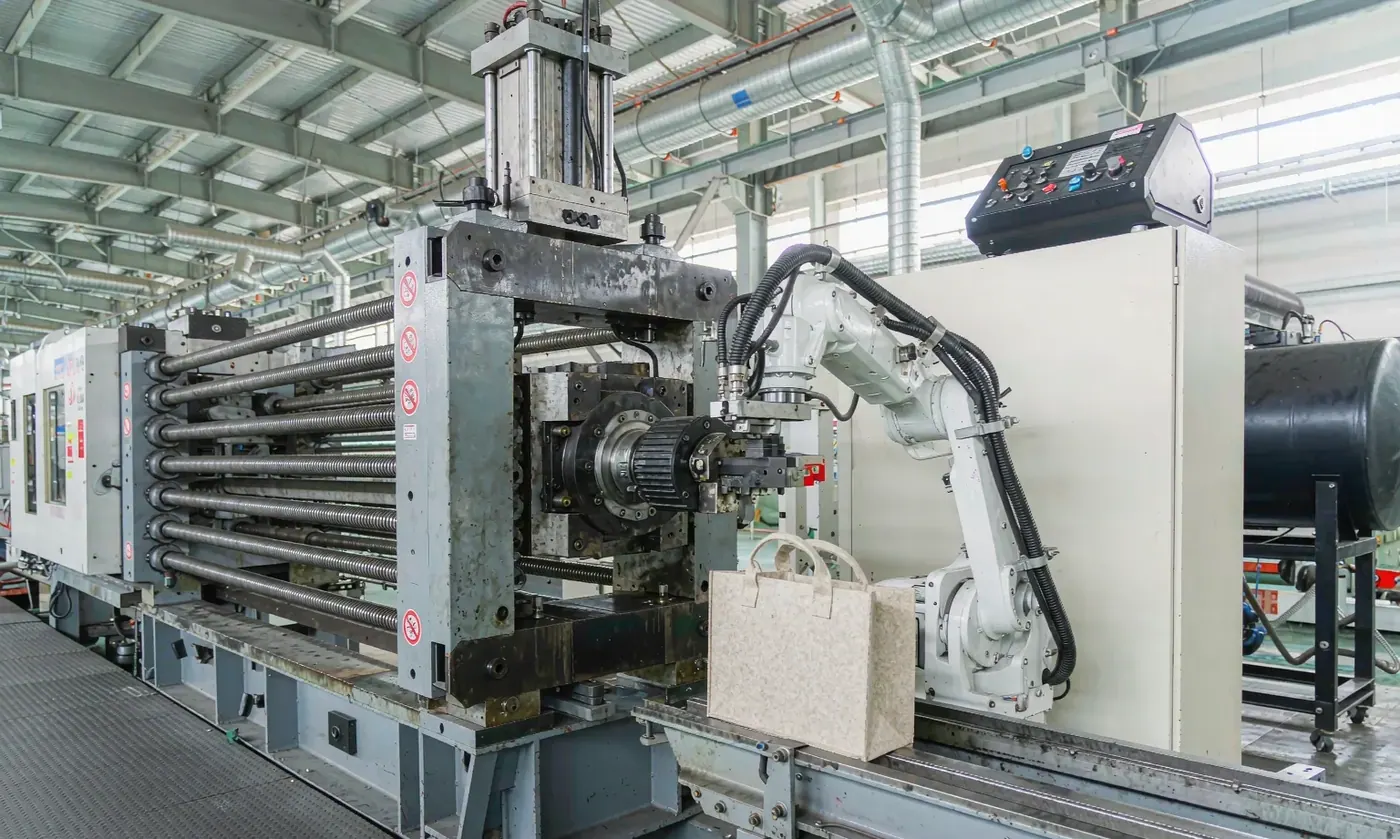
Injection-molded is a process claim as much as a material one, and it is the reason the body, handles and base leave production as a single piece. Melt at roughly 150 to 190 degrees is injected into a closed tool under pressure, held while it cools, and ejected. Cycle times for tote-sized parts run from 60 to 140 seconds depending on wall thickness and part size, which is why wall specification affects price as well as performance.
| Process | How it forms the part | Wall control | Fit for tote bodies | Economics |
|---|---|---|---|---|
| Injection molding | Melt injected into a closed tool | Excellent, taper is programmable | Ideal; one piece, no seams | High tool cost, low unit cost |
| Compression molding | Charge pressed between heated platens | Fair, thickness varies with flow | Workable for simple shapes | Lower tool cost, slower cycles |
| Cut and weld from sheet | Sheet cut, then joined by heat or adhesive | Uniform only, no taper possible | Produces seams, which leak and peel | Lowest tool cost, highest labour |
| Rotational molding | Powder tumbled in a heated tool | Poor control at corners | Rarely used; slow and thick walls | Cheap tools, very long cycles |
| Blow molding | Parison inflated against a tool | Hollow sections only | Not suitable for open-top bodies | Excellent for bottles, not totes |
The comparison explains the two things that define the category. Injection molding is the only route in the table that produces tapered walls, which is what allows material to be concentrated at the base and rim where load concentrates, and it is the only route that produces a body with no join at all. Cut-and-weld construction can look similar in a photograph, but it reintroduces the seam, and the seam is the part that fails.
What Goes Into the Compound
Virgin copolymer is rarely used alone. A molding compound for a tote body typically contains four or five additional components, and each one has a job and a compliance footprint. Knowing them is useful because most substance questions from retailers trace back to one of these rather than to the base polymer.
| Component | Purpose | Typical loading | Compliance relevance |
|---|---|---|---|
| Base EVA copolymer | Structure, flexibility, recovery | 80 to 95 percent | Low; the polymer itself is widely listed |
| Foaming agent | Creates the closed-cell structure | 1 to 3 percent | Decomposition residues are screened |
| Colour masterbatch | Colour through the section | 2 to 4 percent | Pigment screening is essential |
| UV stabiliser | Slows surface dulling and chalking | 0.2 to 1 percent | Usually low concern, worth declaring |
| Processing aid or lubricant | Improves flow and release | 0.5 to 2 percent | Should be declared in the brief |
The compliance implication is straightforward and worth acting on early. The base polymer is the easy part to document; pigments and additives are where screening effort should be concentrated, and they are the components most often omitted from a brief. Naming every colour and every trim in the specification, including charms, prints and care labels, is what keeps a single test report valid for the whole product rather than only for its body.
How the Holes Are Made and Why Diameter Is a Material Question
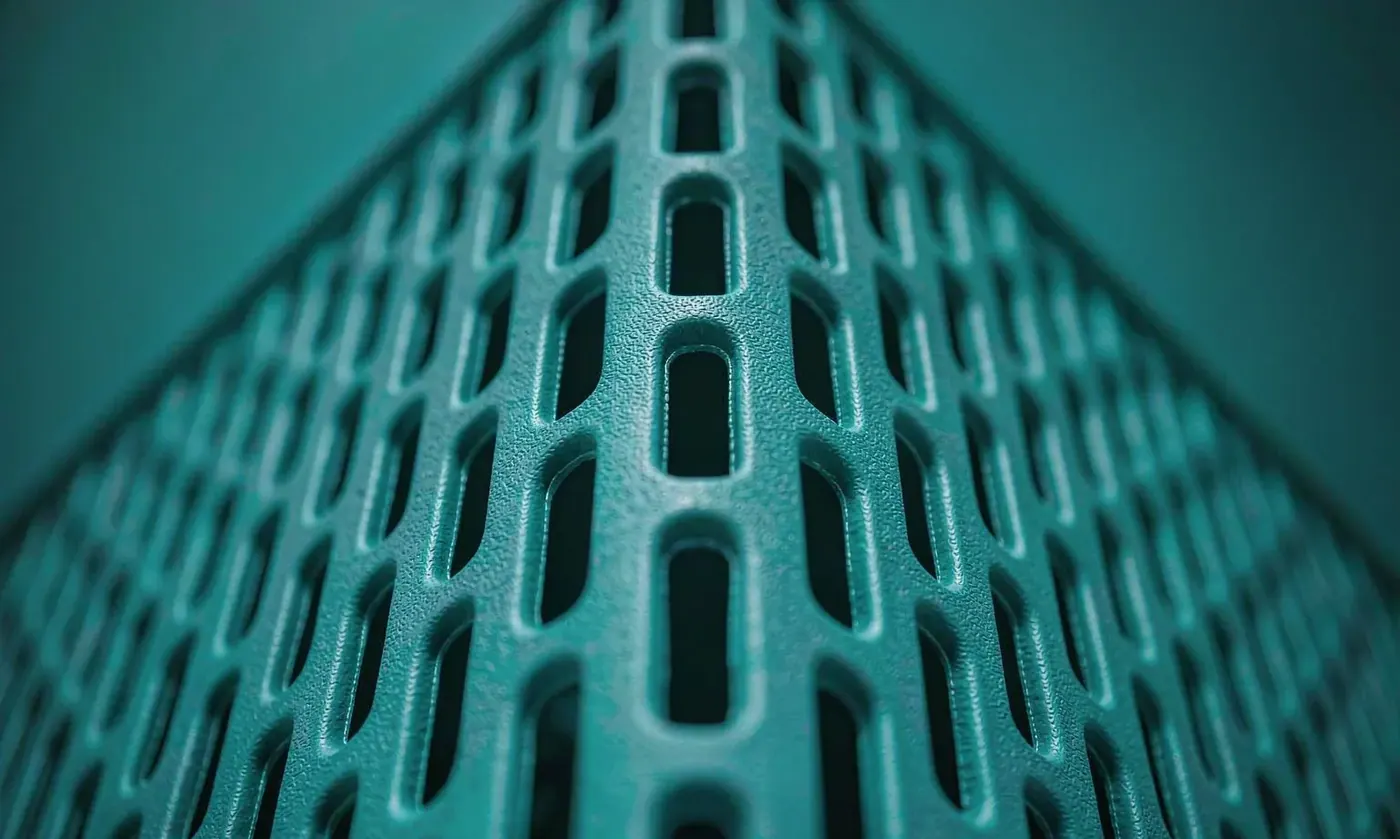
Perforations are formed in the tool rather than cut afterwards, which is why they have consistent edges and why changing diameter later is a tooling exercise rather than a setting change. Hole diameter between nine and twelve millimetres is the working range for beach use, and the material determines two things about it: how cleanly the wall releases from the tool at that diameter, and whether the remaining section between holes can carry load.
The material constraint that surprises people is the solid band above the top row. Fifteen millimetres of unbroken material is needed on a large body because the load path from the handles runs through that band, and a copolymer with high elongation will stretch rather than resist if the section is too small. This is a material property interacting with a geometric one, which is why the same wall thickness works on a small body and fails on a large one.
Colour: Masterbatch, Pigment and Ultraviolet Behaviour
Colour is added as a masterbatch, a concentrated pigment dispersion in a carrier polymer, dosed at around two to four percent of compound mass. Because it is dosed into the melt rather than applied to the surface, colour runs through the section, which is why a scratch on a molded body does not reveal a different colour underneath the way a coated fabric does. That is the single biggest durability advantage over printed alternatives.
Ultraviolet behaviour is the weaker side of the same story. Pigmented compounds resist well but not indefinitely: expect slow dulling over several seasons in high-index regions, faster on saturated and dark colourways because they absorb more energy. Ultraviolet stabiliser at 0.2 to 1 percent slows the process substantially and is worth specifying for resort programmes in tropical markets. Solid-colour bodies consistently hold their appearance longer than surface-printed artwork, because print sits on the skin layer and has no thickness to lose.
Temperature, Ultraviolet and Chemical Resistance
Three exposure categories cover field performance, and the material has a clear answer for each. Heat is the weakness, ultraviolet is slow and manageable, and chemicals are generally well tolerated with a short list of exceptions.
| Exposure | Material response | Practical limit | Field guidance |
|---|---|---|---|
| Heat | Softens progressively, then creeps under load | About plus 60 degrees in service | No dishwashers, no hot cars, store in shade |
| Cold | Stiffens but does not become brittle at molding grades | About minus 20 degrees | Usable in winter, avoid impact when frozen |
| Ultraviolet | Slow surface dulling and chalking over seasons | Managed with 0.2 to 1 percent stabiliser | Lighter colourways last longer in high-index regions |
| Salt water | No chemical attack at ambient temperature | Effectively unlimited | Rinse with fresh water for trims and hardware |
| Solvents | Surface layer attacked, leaving a dull patch | Avoid entirely | No acetone, no citrus degreasers |
| Dilute detergents | No effect | Safe at normal concentrations | Mild detergent is the only cleaner needed |
The heat limit is worth restating because it explains most of the deformation cases reported in this category. Sixty degrees sounds high until it is compared with measured surface temperatures: a dark body in direct summer sun reaches that within an hour in most temperate regions and faster in the tropics. The material does not fail suddenly at that point; it simply stops resisting load as well, and a bag standing with a heavy load inside will slowly deform.
Charms and Accessory Materials
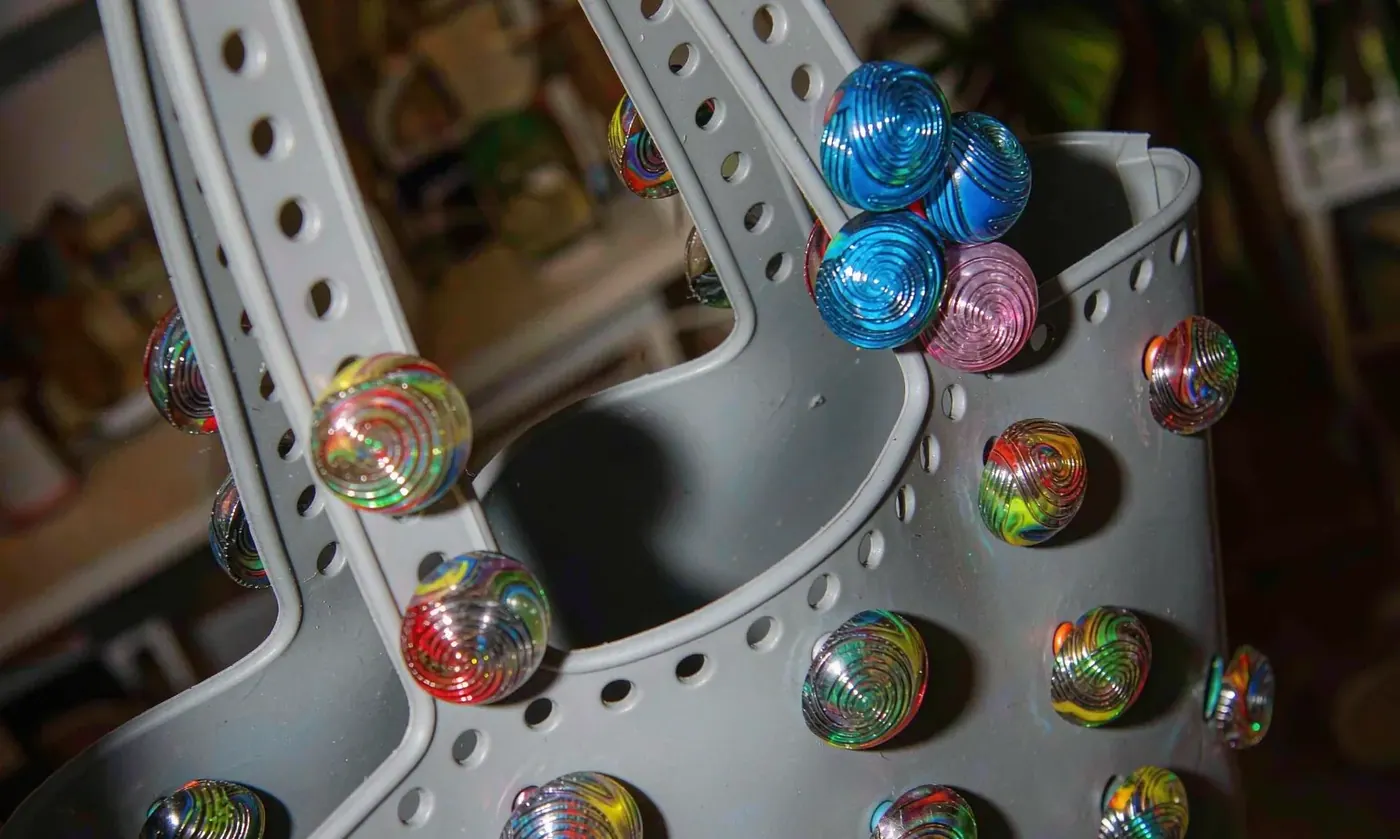
Charms are usually silicone or a softer EVA grade rather than the body compound, because they need to compress enough to seat in a hole and recover enough to stay there. Typical grades sit at 22 to 28 percent vinyl acetate or are silicone rubber at 40 to 70 Shore A, and they are moulded in separate small tools. Compatibility is geometric: a charm designed for a twelve millimetre hole spins loosely in a fourteen millimetre one and will not seat in a ten millimetre one.
Because charms are small parts, they carry additional obligations when sold with children sizes. Small-parts testing and migration testing for the pigment are both standard requests, and they are cheaper to run on the charm alone than on a finished bag. Buyers should specify the charm material in the same brief as the body, because a report that covers only the body leaves the accessory undocumented.
Compliance, Screening and the Documents to Request
Documentation for this material is comparatively straightforward, which is one reason the category works well in family and resort channels. Ethylene-vinyl acetate generally needs fewer additives than flexible PVC, and the closed-cell structure removes the plasticiser question that dominates PVC documentation. What remains is pigment screening, foaming agent residue and, where children are involved, small-parts and migration testing.
Substance obligations for the European market are administered by the European Chemicals Agency, with restricted substances generally held at or below 0.1 percent by weight. Physical test methods for the properties in the table above are published by ASTM International, and quality-management expectations for how results are documented come from the International Organization for Standardization. Ask for reports dated within twelve months that name the method, and for the compound and every pigment to be declared on the report rather than only the finished article.
Reading a Material Specification Sheet
A material sheet for a molded tote should fit on one page and name eight things. If it names fewer than six, it is a marketing sheet rather than a specification, and the gaps are usually in the areas that generate disputes later. Requesting the full sheet before sampling costs nothing and prevents the majority of specification arguments.
- Vinyl acetate content, which governs feel and cold behaviour, typically 15 to 22 percent for tote bodies.
- Density, which determines empty weight and is the largest single driver of material cost per unit.
- Shore A hardness, which should be stated with the measurement method and the section it was taken from.
- Tensile strength and elongation at break, each with the test method named rather than only the result.
- Water absorption over a stated immersion period, confirming closed-cell structure rather than open-cell foam.
- Service temperature range, which is where the 60 degree limit should appear explicitly.
Two entries are consistently missing and worth asking for by name. Ultraviolet stabiliser loading, which decides how the bag looks after three seasons in a high-index market, and pigment declaration per colourway, since a report covering the natural compound does not cover a finished coloured body. Asking for both at specification stage is the difference between one test campaign and three.
Programme Notes
Full category background sits in the injection-molded EVA tote guide, the forming route in detail is covered in the EVA injection molding process, and a material comparison against the most common alternative is set out in EVA tote versus PVC tote. QUANZHOU JUNYUAN BAGS has run waterproof bag programmes since 2014 with a founding team in this trade since 2004, covering injection-molded EVA work alongside sewn and welded ranges.
Monthly output runs at 200,000 units verified by SGS, operations follow BSCI and ISO 9001, materials are screened for REACH and California Prop 65, and every bulk shipment is inspected at AQL 2.5 before release. Programme minimums begin at 500 pieces per design and colour, with sampling at 6 to 10 working days and bulk at 35 to 50 days from approved sample and deposit. Send your target vinyl acetate range, hardness, wall thickness, colourway count, quantity and destination market to service@junyuanbags.com.
People Also Ask
What is EVA material made of?
A copolymer of ethylene and vinyl acetate, typically 12 to 28 percent vinyl acetate, molded into a closed-cell structure so it absorbs effectively no water.
Is EVA the same as rubber?
No. It behaves like soft rubber but is a thermoplastic copolymer that can be injection molded, is lighter at about 0.94 density, and is easier to document for compliance.
Why does EVA not absorb water?
Because it is closed cell: each gas-filled cell is sealed from its neighbours, so there is no capillary path for water to follow.
What temperature can EVA withstand?
About minus 20 to plus 60 degrees in service. Above 60 degrees the material softens and can creep under load, which is why hot cars and dishwashers are prohibited.
Does EVA contain phthalates?
Molding grades generally do not need plasticisers, which is why EVA documentation is simpler than flexible PVC. Pigment screening is still required.
How hard is EVA in tote bodies?
Typically 60 to 90 Shore A, with most bodies between 65 and 80, which gives a wall that flexes under the hand and recovers rather than deforming.
Frequently Asked Questions
Q1. What does EVA stand for?
Ethylene-vinyl acetate, a copolymer of ethylene and vinyl acetate whose properties change with the vinyl acetate fraction, typically 12 to 28 percent for molded articles.
Q2. Is EVA a foam or a solid?
Molded tote bodies are closed-cell foam: gas-filled cells sealed from each other inside a continuous polymer matrix, which is why the material is light and absorbs no water.
Q3. How much water does EVA absorb?
Below about 0.5 percent by weight over 24 hours of immersion, because the closed-cell structure leaves no capillary path for water.
Q4. What density is EVA?
Around 0.93 to 0.95 grams per cubic centimetre for tote grades, which is lighter than water and explains why an empty body floats.
Q5. What is the hardness of tote-grade EVA?
Typically 60 to 90 Shore A, with most bodies between 65 and 80 for a wall that flexes and recovers rather than denting or staying soft.
Q6. How strong is EVA?
Tensile strength of 8 to 20 megapascals with elongation at break of 400 to 800 percent, which is why molded walls flex and drop without cracking.
Q7. At what temperature does EVA deform?
Above about 60 degrees in service. A dark body in direct summer sun reaches that within an hour, which is why shade storage matters.
Q8. Is EVA safe for children products?
When sourced with documented screening, yes. Ask for pigment and additive screening plus small-parts testing for any charm sold with the bag.
Q9. Does EVA contain harmful plasticisers?
Molding grades generally do not require plasticisers, which is why screening is simpler than for flexible PVC. Pigments and additives still need to be declared.
Q10. How are the perforations made?
They are formed in the tool during molding rather than cut afterwards, which is why hole edges are consistent and why changing diameter later means a tooling change.
Q11. Does EVA fade in sunlight?
Slowly. Pigmented compounds resist well, ultraviolet stabiliser at 0.2 to 1 percent slows dulling further, and light colourways outlast dark ones in high-index regions.
Q12. Can EVA be recycled?
It is a thermoplastic and can be reprocessed, and production scrap is routinely reground. Post-consumer collection for molded articles remains limited in most markets.