Wall thickness on an injection-molded EVA tote runs 2.5 to 6 millimetres, and it is the specification that decides whether a bag stands up or folds over. Bending stiffness rises with the cube of thickness, so moving from 3 to 4 millimetres makes a wall about 2.4 times stiffer for roughly a third more material. Most quality bodies sit at 3.5 to 4.5 millimetres on the wall, 4 to 6 at the base, and 5 to 8 at the handle roots, which are the three zones a specification should name separately. QUANZHOU JUNYUAN BAGS holds all three to within 0.3 millimetres from 500 pieces per design and colour.
What Wall Thickness Actually Controls
Thickness is the most under-specified number on this category and the one that most directly determines whether a buyer is happy at the end of a season. It sets three things at once: how much the body resists folding when it is set down empty, how much it resists buckling under a load, and how much it weighs. Those three pull against each other, and the whole design problem of a moulded tote is finding the thickness that gives enough stiffness for the intended load without paying for weight that the user will carry all summer.
It also sets the price more directly than any other specification, because material is the largest component of the unit and material scales linearly with thickness. A 32 litre body at 3 millimetres uses roughly 1.5 kilograms of compound; the same body at 4.5 millimetres uses about 2.2. At a compound price between 1.60 and 2.40 dollars per kilogram, that difference is 1.10 to 1.70 dollars on the unit, which is a fifth of the price of the bag decided by one dimension.
| Property | Effect of a thicker wall | Practical reading |
|---|---|---|
| Bending stiffness | Rises with the cube of thickness | 4 millimetres is about 2.4 times stiffer than 3 |
| Resistance to buckling | Rises steeply | The wall holds shape under a load instead of folding |
| Empty weight | Rises linearly | Every tenth of a millimetre is carried all season |
| Unit price | Rises linearly with material | About 1.10 to 1.70 dollars from 3 to 4.5 millimetres |
| Cooling time | Rises with the square of thickness | A thicker body costs more machine time per piece |
| Cold stiffness | Thicker feels stiffer in the cold | Partly offset by a softer compound |
Reading a Thickness Specification
A thickness figure without a location is meaningless, because a well-designed body is not the same thickness everywhere. Three zones matter and a specification should name all three: the wall, which runs 3.0 to 4.5 millimetres on a quality body; the base, which runs 4 to 6 millimetres because it carries the whole load on the ground and resists the wear of being dragged; and the handle roots, which run 5 to 8 millimetres because that is where the load concentrates and where a thin section fails first.
| Zone | Thin body | Standard body | Heavy duty body | Failure if too thin |
|---|---|---|---|---|
| Wall | 2.5 to 3.0 millimetres | 3.5 to 4.5 millimetres | 4.5 to 6.0 millimetres | Folds over when set down empty |
| Base | 3.0 to 4.0 millimetres | 4.0 to 5.0 millimetres | 5.0 to 7.0 millimetres | Rocks, wears through, loses the tread |
| Handle root | 3.5 to 4.5 millimetres | 5.0 to 6.5 millimetres | 6.5 to 8.0 millimetres | Cracks at the radius under repeated load |
| Rim or lip | 4.0 to 5.0 millimetres | 5.0 to 7.0 millimetres | 7.0 to 9.0 millimetres | Rim rolls and the body loses its mouth shape |
| Perforation bridge | 8 to 12 millimetres | 12 to 18 millimetres | 18 to 25 millimetres | Cracks propagate between holes |
The last line of that table is the one most often overlooked and it is worth explaining. The material between two perforations is a bridge, and the bridge is the weakest part of a perforated wall. Making the wall thicker helps, but widening the spacing between holes helps more, because a crack that starts at one hole has further to travel before it reaches the next. A buyer who wants a rigid perforated body should specify hole spacing of 14 to 20 millimetres rather than simply asking for a thicker wall.
Why Rigidity Scales So Fast
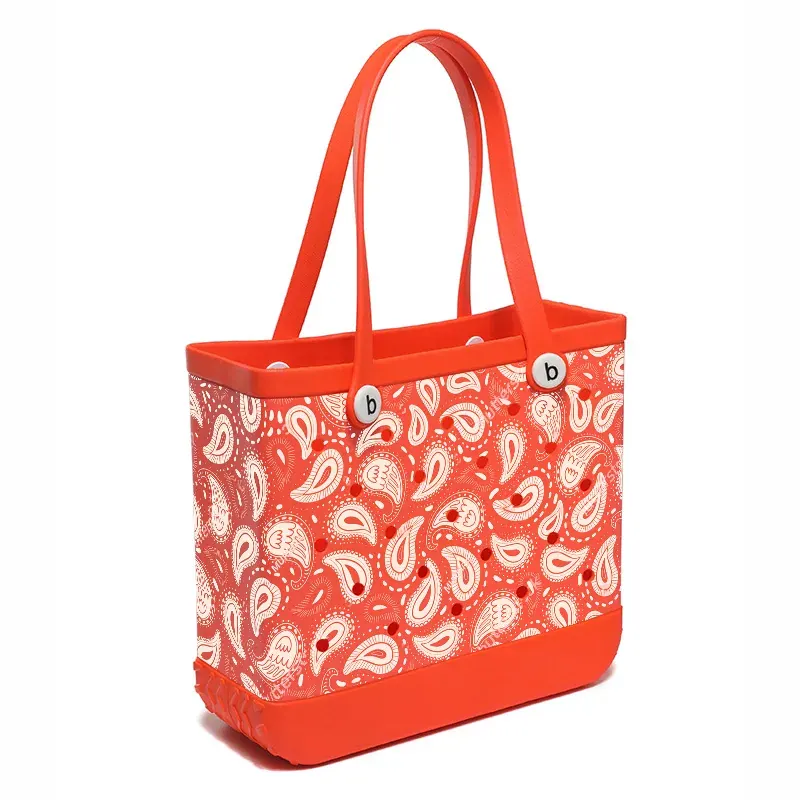
The reason thickness is so influential is geometric rather than chemical. The stiffness of a panel in bending is proportional to the cube of its thickness, so a change that looks small on a specification sheet has a large effect in the hand. Going from 3.0 to 3.5 millimetres is a 17 percent increase in material and a 59 percent increase in stiffness. Going from 3.0 to 4.0 millimetres is a 33 percent increase in material and a 137 percent increase in stiffness. No other single specification buys that much performance for that little weight.
The practical consequence is that the difference between a bag that stands up and one that folds over is often half a millimetre, and that is why two totes of the same nominal size behave so differently in a showroom. It is also why wall thickness is the first thing a buyer should measure on a sample with a calliper. A body quoted at 4.0 millimetres and delivered at 3.4 is a different bag from the one approved, and it is the single most common way a bulk order quietly under-delivers.
Base Thickness and the Tipping Problem

Tipping is the complaint that ends product lines, and it has two causes that are worth separating. The first is geometric: a base that is too narrow relative to the height of the body will tip regardless of thickness, and the remedy is a wider footprint rather than a thicker wall. The second is structural: a wall that is too thin folds at the rim and takes the body over with it, and the remedy is thickness. A buyer diagnosing a tipping problem should establish which one it is before changing the specification, because thickening a wall will not fix a narrow base.
| Symptom | Diagnosis | Measurement that confirms it | Correct remedy |
|---|---|---|---|
| Tips on flat ground when empty | Footprint too narrow for the height | Base width against body height | Widen the base, do not thicken the wall |
| Rim folds inward when empty | Wall too thin | Calliper at the wall, expect under 3 millimetres | Move to 3.5 to 4.5 millimetres |
| Rocks when set down | Base warped, not a thickness problem | Set on a level surface and look for movement | Fix cooling and rack the bodies |
| Buckles under a heavy load | Wall too thin for the load | Load test at 10 and 15 kilograms | Thicken the wall or add a rim bead |
| Base wears through in a season | Base too thin or too soft a compound | Base thickness and Shore hardness | Move to 5 to 7 millimetres at the base |
One geometric detail deserves its own mention because it does more for stability than thickness does: the beads or ribs moulded into the wall. A vertical rib of 2 to 3 millimetres standing proud of a 3.5 millimetre wall adds stiffness for a fraction of the material a thicker wall would need, in exactly the way a corrugated sheet is stiffer than a flat one of the same weight. A buyer who wants rigidity without weight should ask for ribbing before asking for thickness, and should expect the answer to cost less.
Thickness, Weight and What It Costs
Weight is the unavoidable cost of thickness and it is the reason no serious body is uniformly thick. A 32 litre body built entirely at 5 millimetres would weigh close to 3 kilograms, which is heavier than most buyers will carry any distance. The right approach is differential thickness: thick where the load and the wear are, thin where they are not. That is what the three-zone specification does, and it is why a well-designed 3.8 kilogram heavy-duty body can be stiffer where it matters than a crudely thick 4.5 kilogram one.
| Build | Wall | Base | Empty weight, 32 litres | Character |
|---|---|---|---|---|
| Light carry | 2.5 to 3.0 millimetres | 3.0 to 4.0 millimetres | 1.4 to 1.8 kilograms | Folds when empty, fine once loaded |
| Standard beach | 3.5 to 4.0 millimetres | 4.0 to 5.0 millimetres | 1.8 to 2.2 kilograms | Stands empty, the usual choice |
| Rigid family | 4.0 to 4.5 millimetres | 5.0 to 6.0 millimetres | 2.2 to 2.6 kilograms | Stands empty, carries 15 kilograms well |
| Heavy duty | 4.5 to 6.0 millimetres | 5.0 to 7.0 millimetres | 2.6 to 3.2 kilograms | Very stiff, heavy to carry empty |
Freight follows weight, and on a full container it is not a small number. Moving a range from a standard build to a heavy duty one adds roughly 0.8 kilograms per body, which on 1,200 pieces is about a tonne of additional payload across the shipment. That shows up as either a higher freight bill or fewer pieces per container, and it is a cost that never appears in the unit price comparison a buyer makes before choosing a thickness.
Where Thin Walls Fail
Thin walls fail in predictable places and in a predictable order, and knowing the sequence is what lets a buyer judge a sample in a minute rather than a season. The list below runs from the earliest failure to the latest.
- The rim rolls inward and the mouth loses its shape, usually within the first season and always first in hot weather.
- The wall folds at mid-height when the body is lifted by one handle with a partial load.
- The base flexes and the tread loses contact with the ground, so the body slides rather than grips on a wet deck.
- Stress whitening appears at a fold and does not fully recover, leaving a permanent crease.
- A crack starts at a perforation bridge and propagates between two holes, usually at a corner.
- The handle root cracks where it meets the rim, which is a structural failure and not repairable.
- The base wears through at the contact points and the body begins to hold water instead of draining.
The first four are cosmetic and the last three are structural, and the line between them sits around the fourth item. A buyer deciding whether a body is acceptable should treat the appearance of a permanent crease as the point at which the specification was wrong, because everything after it follows within a season. Physical test methods for the dimensional and flex checks that predict these failures are published by ASTM International.
Where Thick Walls Stop Paying
Thickness has a diminishing return and it arrives sooner than most buyers expect. The cube law works in both directions: the jump from 3.0 to 4.0 millimetres is transformative, the jump from 4.5 to 5.5 is a modest improvement in stiffness bought with a quarter more material, and beyond about 6 millimetres the body is stiff enough that anything further is weight without benefit. Nobody tips a 5 millimetre body, so making it 6 does nothing the user can feel.
There is also a processing penalty that appears at the top of the range. Cooling time scales with the square of thickness, so a 6 millimetre wall takes roughly twice as long in the tool as a 4.2 millimetre one, which doubles the machine time per piece and pushes the unit price up twice: once for the material and once for the cycle. A heavy duty body therefore costs noticeably more than the resin alone would suggest, and the difference is worth asking about before specifying one.
How Thickness Is Measured and Held

Thickness is checked with a calliper at named points, and the discipline of naming the points is what makes the check useful. Three readings on the wall at different heights, two on the base and one at each handle root is enough, and the tolerance worth agreeing is plus or minus 0.3 millimetres against the approved sample. Recording the actual figures rather than a pass or fail gives a buyer something enforceable, and it catches the drift that happens when a tool wears or a process is re-set mid-run.
Weight is the cross-check and the one that cannot be argued with. Weigh the approved sample, record the figure, and weigh bodies drawn from the bulk at inspection. A body that is 4 percent lighter than the approved master is thinner than it was approved at, whatever the calliper says at the one point someone chose to measure. Documented inspection practice for holding and recording those figures aligns with the International Organization for Standardization, and every bulk shipment in this programme is inspected at AQL 2.5 before release.
Choosing a Thickness for the Job
Thickness selection resolves quickly once the load and the carry distance are known, and the table below covers the common cases. The pattern is that the beach and pool cases can be lighter than instinct suggests, while anything carried a distance or set down empty on uneven ground needs the standard build or better.
| Use | Typical load | Build | Why |
|---|---|---|---|
| Pool or gym, short carry | 4 to 7 kilograms | Light, 2.5 to 3.0 millimetres | Always loaded when carried, weight matters most |
| Family beach day | 8 to 12 kilograms | Standard, 3.5 to 4.0 millimetres | Stands empty on sand, carries a full load |
| Boat or deck use | 8 to 14 kilograms | Standard to rigid, 4.0 to 4.5 millimetres | Needs to resist rolling, not just standing |
| Coach or shared team kit | 12 to 16 kilograms | Rigid, 4.0 to 4.5 millimetres | Set down empty on grass for hours |
| Garden or utility carry | 15 kilograms or more | Heavy duty, 4.5 to 6.0 millimetres | Hard objects and abrasive loads |
| Retail style-led range | Under 5 kilograms | Light, 2.5 to 3.0 millimetres | Looks matter more than load performance |
One final caution applies to the two light cases. A light body is entirely appropriate for a pool bag or a style-led range, and entirely wrong for a family beach bag, because a family bag spends most of its life either empty or half loaded and is set down on sand that is never level. Buyers who specify a light build for a beach programme to hit a price point end up with the tipping complaints, and they end up paying for the mistake twice, once in returns and once in the heavier replacement range.
Thickness and Hardness Work Together
Thickness is only half of the rigidity story and the other half is the hardness of the compound. A body moulded at 4 millimetres in a 45 Shore A compound and one moulded at 4 millimetres in a 70 Shore A compound are the same thickness and behave differently: the softer one feels grippy and forgiving and flexes more under load, the harder one feels more rigid and transmits more shock to the handle roots. Most bodies in this category sit between 50 and 65 Shore A, which is soft enough to absorb a knock and firm enough to hold a wall shape.
| Compound hardness | Feel | Rigidity at equal thickness | Best application |
|---|---|---|---|
| 40 to 50 Shore A | Soft, grippy, slightly compressible | Lowest, needs a thicker wall | Pool, kids, style-led ranges |
| 50 to 60 Shore A | Rubbery and forgiving | Balanced | The general beach range |
| 60 to 70 Shore A | Firm, holds shape well | High | Boat decks and utility carry |
| Above 70 Shore A | Hard, transmits shock | Highest, brittle in the cold | Rarely right for a tote |
The practical rule is that a softer compound needs more thickness to reach the same stiffness, so a buyer specifying both should set them together rather than one at a time. A beach range in a soft 48 Shore A compound wants 4.0 to 4.5 millimetres to stand up the way a 60 Shore A body does at 3.5. Getting that pairing wrong is the most common cause of a body that measures correctly and still behaves badly, because the calliper confirms the thickness while the compound quietly undoes it.
Programme Notes
Process detail sits in the EVA injection molding guide, perforation layouts in the perforated EVA tote page, and the full selection sequence in the EVA tote buying guide. Buyers comparing body options should start from the injection-molded EVA tote guide. QUANZHOU JUNYUAN BAGS has run waterproof bag programmes since 2014 with a founding team in this trade since 2004, at monthly output of 200,000 units verified by SGS, under BSCI and ISO 9001, with materials screened for REACH and California Prop 65 and every bulk shipment inspected at AQL 2.5 before release.
Send the body size, the intended load, the carry distance and the target weight to service@junyuanbags.com, and ask for the wall, base and handle root thickness as three separate figures rather than one, because a single number hides the zone that will fail first. Sampling runs 6 to 10 working days and bulk 35 to 50 days.
People Also Ask
What wall thickness should an EVA tote have?
3.5 to 4.5 millimetres on the wall, 4 to 6 at the base and 5 to 8 at the handle roots. Those three zones should be specified separately.
Why does my EVA tote fold over when empty?
The wall is too thin, usually under 3 millimetres. Bending stiffness rises with the cube of thickness, so 3.5 to 4 millimetres transforms it.
Does a thicker wall make a tote heavier?
Yes, linearly. A 32 litre body goes from about 1.5 kilograms at 3 millimetres to about 2.2 at 4.5 millimetres.
Is a thick base better than a thick wall?
For standing up, yes. The base carries the whole load on the ground and is specified thicker than the wall on every well-designed body.
How do I check the thickness of a sample?
With a calliper at the rim, three points on the wall, two on the base and one at each handle root, and agree a tolerance of plus or minus 0.3 millimetres.
Do ribs help as much as thickness?
More, per gram. A 2 to 3 millimetre vertical rib on a 3.5 millimetre wall adds stiffness for a fraction of the material a thicker wall needs.
Frequently Asked Questions
Q1. What is the standard wall thickness for an EVA tote?
3.5 to 4.5 millimetres on the wall, with the base at 4 to 6 and the handle roots at 5 to 8 millimetres.
Q2. Why is the base thicker than the wall?
It carries the entire load against the ground and takes the wear of being dragged, so it is specified a millimetre or two thicker than the wall.
Q3. How much stiffer is 4 millimetres than 3?
About 2.4 times stiffer in bending, for a third more material, because stiffness rises with the cube of thickness.
Q4. What is the thinnest wall that can be molded?
About 2.5 millimetres on a body this size. Below that the melt freezes before the cavity fills and the part cannot be made reliably.
Q5. Does a thicker wall stop a bag tipping?
Only if tipping is caused by a folding wall. If the base is too narrow for the height, thickness will not fix it and the footprint has to widen.
Q6. How much weight does thickness add?
About 0.8 kilograms between a standard and a heavy duty 32 litre build, which is a tonne across a 1,200 piece container.
Q7. Why does my tote rock when set down?
A warped base, which is a cooling problem rather than a thickness one. The fix is longer cooling and cooling on a rack instead of a pile.
Q8. What fails first on a thin-walled body?
The rim rolls inward, then the wall folds at mid-height under a partial load, then the base tread loses contact with the ground.
Q9. Are ribs better than extra thickness?
Yes, per gram of material. A vertical rib of 2 to 3 millimetres adds stiffness the way corrugation stiffens a flat sheet.
Q10. How is thickness held across a bulk order?
By measurement at named points with a plus or minus 0.3 millimetre tolerance, cross-checked against empty weight, applied to a sample drawn at AQL 2.5.