Choosing an EVA tote comes down to eleven checks, and six of them take seconds: size against your actual load, internal height for upright bottles, wall taper, rim band width, perforation diameter and base width relative to the mouth. The other five cover handle root and load rating, empty weight against the user, strap and closure hardware, compliance documentation dated within twelve months, and packed carton specification for freight. Work down the list and stop at the first failure, because nothing lower on it will rescue a bag that failed higher up. A well-specified body should last five to seven seasons near salt and sun.
The Eleven Points at a Glance
These checks are ordered by consequence rather than by convenience. The first six decide whether the bag does its job; the next four decide how long it lasts and whether it can be sold legally in the destination market; the last one decides what it costs to get it there. Most buyers who skip the list skip points six and ten, which are the two that generate most of the complaints and most of the clearance delays respectively.
| Point | What to check | Pass condition | What a fail causes |
|---|---|---|---|
| 1 | Size against real contents | Fits the load with 30 millimetres spare | Constant unpacking at the destination |
| 2 | Internal height | 24 centimetres or more for bottles | Bottles lie down and leak |
| 3 | Wall thickness and taper | 4 to 8 millimetres, thicker at the base | Flex, then permanent deformation |
| 4 | Rim band above top holes | 15 millimetres on large, 12 on small | Mouth collapses when lifted loaded |
| 5 | Perforation diameter | 9 to 12 millimetres for beach | Sand bridges, or small items escape |
| 6 | Base width versus mouth | Equal or up to 10 millimetres wider | Tipping with bottles loaded low |
| 7 | Handle root and load rating | Fillet above 6 millimetres, rating named | Tearing at the handle root |
| 8 | Empty weight against user | Under 10 percent of user body weight | A bag that does not get used |
| 9 | Strap and closure hardware | Rated, corrosion resistant, removable | Seized hardware within a season |
| 10 | Compliance documentation | Reports dated within 12 months | Delayed or blocked clearance |
| 11 | Packed carton specification | Pieces per carton and cube stated | Freight cost surprises after booking |
Two notes on using the list. First, it applies whether you are buying one bag or five thousand; only point eleven changes character, becoming a commercial question rather than a practical one. Second, several points are visible in a photograph if you know where to look, so the list can be run against an online listing in about two minutes before ordering rather than after delivery.
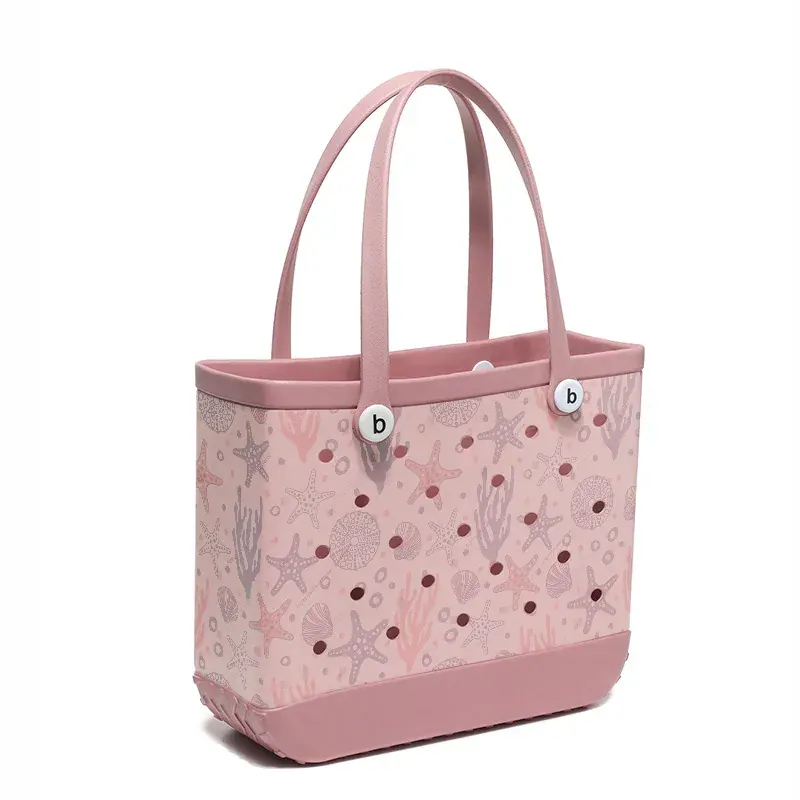
Point 1: Match Size to the Real Load, Not to the Name
Size names are inconsistent across this category, so measure the load instead. Lay the items for a typical trip on the floor in the shape they would take inside the bag, measure the footprint and height, and add thirty millimetres to each dimension for access. That exercise takes two minutes and resolves most sizing uncertainty, because the failure mode in this category is almost never too little volume; it is the right volume in the wrong shape.
As a working guide, one adult for a half day needs 10 to 14 litres, two people need 14 to 18, and a family of three or more for a full day needs 29 to 38. Families consistently buy down and then exchange, so if the honest answer is three people and a full day, choose the larger figure rather than hoping the smaller one will do.
Point 2: Check Internal Height Before Capacity
Internal height is the most skipped measurement and the one that decides whether drinks travel upright. A 1.5 litre bottle is about 33 centimetres tall, so it needs at least 24 centimetres of internal height to stand below the rim with its base supported. Bodies that are wide but shallow force bottles to lie down, which is fine until one leaks, and then it is the reason the bag gets retired early.
Measure at the centre of the body, not at the wall, because moulded bases are rarely flat on the inside and the usable height is the lowest point of the floor. If the bag is intended for picnic or sports use, add a further ten millimetres so a bottle can be lifted out without catching on the rim.
Point 3: Confirm Wall Thickness and Taper
Wall thickness should be four to five millimetres on small bodies and six to eight on large, and in both cases it should taper so the base carries more material than the upper wall. Load concentrates at the base and at the rim, not in the mid-wall, and a uniform section wastes compound where it does nothing while leaving the two areas that matter under-built.
The check takes two seconds: press the rim between thumb and forefinger and compare its resistance with the mid-wall. A rim that resists noticeably more indicates taper. A body that flexes uniformly from top to bottom is built to a single thickness and will deform under a full load within a season or two, even if it looks substantial in a photograph.
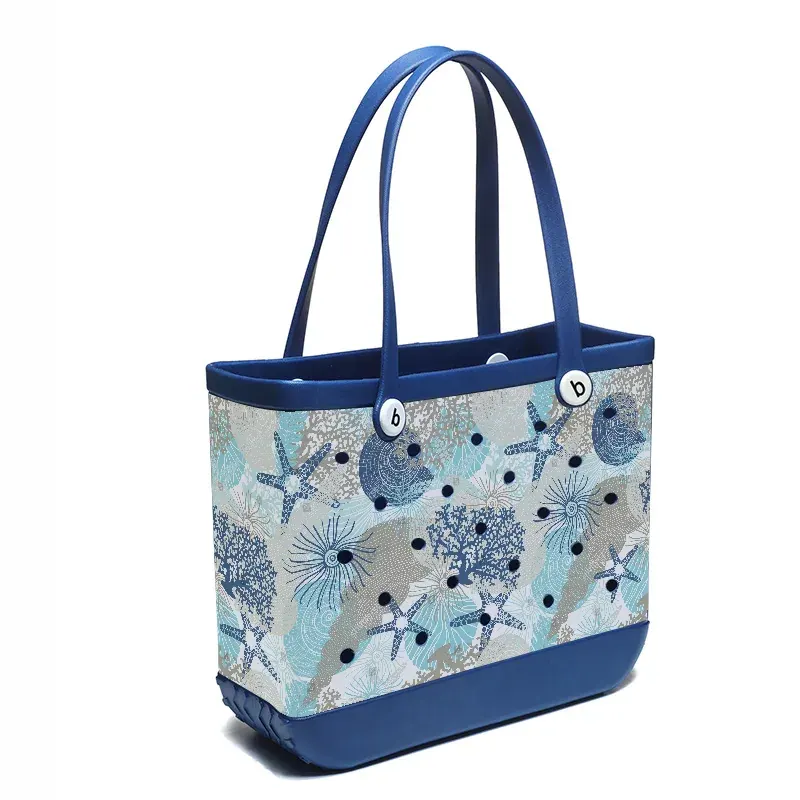
Point 4: Inspect the Rim Band Above the Top Row of Holes
The unbroken band of solid material above the highest row of perforations is what stops the mouth collapsing inward when a loaded bag is lifted by one handle. Fifteen millimetres is the target on large sizes and twelve on small ones. Below that, the mouth progressively folds in, the bag becomes awkward to load, and eventually it cannot stand open at all.
This is also the feature most often reduced to save material, because it is not visible from the front and does not show in a packed-flat photograph. Look at the side profile of the body, or ask for the dimension directly. It is a cheap specification to state and an expensive one to discover missing after a delivery of several thousand pieces.
Point 5: Get the Perforation Diameter Right
Hole diameter governs two competing outcomes, drainage and retention, and the useful range is narrower than most listings suggest. Between nine and twelve millimetres, damp sand passes cleanly while anything larger than a coin is retained. Below eight, wet sand bridges across the opening and stays behind. Above fourteen, lip balm, small toys and hair ties begin to escape.
| Hole diameter | Drain time after a dunk | Sand behaviour | What escapes | Verdict |
|---|---|---|---|---|
| 6 millimetres | About 20 seconds | Wet sand bridges | Nothing | Tidy, poor on sand |
| 8 millimetres | About 12 seconds | Damp sand sometimes bridges | Nothing | Acceptable for pool use |
| 10 millimetres | About 7 seconds | Sand passes cleanly | Nothing larger than a coin | Best all-round choice |
| 12 millimetres | About 5 seconds | Sand and grit pass | Very small items | Good for beach and garden |
| 14 millimetres | Under 4 seconds | Everything loose passes | Lip balm, small toys | Specialist use only |
Distribution matters as much as diameter. Holes concentrated low on the walls and across the base do the drainage work; holes carried high shorten the usable interior surface and weaken the rim at the same time. On kids sizes, stay at six to nine millimetres, which still passes sand but does not admit small fingers.
Point 6: Compare Base Footprint With the Mouth
A tote carrying six upright bottles concentrates roughly fifteen kilograms in its lower third, which is stable in a wide-base design and unstable in one whose base is narrower than its mouth. The rule is simple: the base should be at least as wide as the mouth, and ideally ten millimetres wider. Check with a tape rather than by eye, because the difference is often only a few millimetres and a few millimetres is enough.
The foot pattern matters too. Continuous rails spread load and resist sinking on soft sand and grip better on wet tile, while corner studs dig in on sand and concentrate force on hard surfaces. This is the specification most worth upgrading on a large size, because a large body on a narrow base with corner studs will tip for no apparent reason every time it is set down unevenly.
Point 7: Handle Root, Load Rating and the Method Behind It
The handle root is where these bags fail first, because it is lifted against load on every single use. Look underneath the body where the handle meets the rim: a fillet radius above six millimetres spreads that load and delays tearing substantially, while a sharp corner concentrates it and fails within a couple of seasons. This is the one check that requires picking the bag up, and it is the one most online buyers never do.
Load ratings should be stated with a test method. Typical ratings run from 6 to 12 kilograms on small bodies and 18 to 30 on large, and any figure above 30 should be treated with scepticism unless the method is named. Physical test methods for load and dimensional checks are published by ASTM International, and naming one turns a marketing number into a specification.
Point 8: Weigh the Empty Bag Against the Person Carrying It
Empty weight is the specification most often ignored and the one that decides whether a bag gets used. A child can comfortably carry about ten percent of body weight, so a 20 kilogram child needs a body of 0.4 to 0.6 kilograms to have any useful budget left for contents. Adults are less constrained but not immune: a family size at 2.4 kilograms plus a 12 kilogram load is a two-hand carry for most people over any distance.
Because material mass is also the largest component of unit cost, this is one of the rare cases where the better product and the cheaper product are the same one. Reducing empty weight on a small body improves the user experience and reduces cost at the same time, provided the reduction comes from the mid-wall and not from the base, rim or handle root.
Point 9: Straps, Closures and Hardware
A strap changes what the bag is for, raising the comfortable carry distance from about 150 metres to roughly 600. If one is fitted, the anchor needs a generous fillet because the strap pulls on the rim at an angle the handles never do, and the hardware should be rated to at least twice the intended load. Strap width should be 38 to 50 millimetres; anything under 25 digs in once the load passes about 10 kilograms.
Closures are worth more scepticism. A zip or lid contains rather than seals, and because the walls remain perforated, water that gets in is now held in instead of draining. Choose a closure for transport and car use, not for waterproofness. Hardware near salt water must be corrosion resistant with a moulded pull, because a metal slider on a saltwater bag seizes within a season. Inserts are often the better buy: a drop-in divider costs a fraction of a zip and separates wet from dry without changing how the body drains.
Point 10: Ask for Documentation Dated Within Twelve Months
Documentation is cheap when planned and expensive when retrofitted, and it is the point most likely to delay a launch. Three families of requirement cover most destinations, and all three are document requests rather than redesigns, provided the compound and colour masterbatch are named in the brief from the start.
| Requirement | Typical limit or trigger | Evidence to request | Refresh cycle |
|---|---|---|---|
| European REACH screening | Substances of very high concern at or below 0.1 percent | Current statement plus third-party report | Annually or on compound change |
| California Prop 65 | Below safe harbour or a compliant warning | Exposure assessment or label artwork | On material or market change |
| Phthalate screening | Restricted plasticisers at or below 0.1 percent | Extraction test per material and colour | Annually |
| Heavy metal migration | Against applicable migration limits | Migration report naming the method | Annually or per artwork |
| Children product rules | Additional migration and mechanical tests | Report referencing the applicable method | Per programme launch |
| Quality system expectation | Documented process control | ISO 9001 certificate and BSCI audit reference | Certificate validity period |
Substance obligations for the European market are administered by the European Chemicals Agency, and quality-management expectations for how checks are documented come from the International Organization for Standardization. Ask for reports dated within twelve months that name the method rather than merely the outcome, because that is what makes one document usable across several markets.
Point 11: Packing, Freight and Storage
A rigid body occupies its own volume whether empty or full, and unlike a fabric bag it cannot be compressed, folded or vacuum packed. Some designs nest partially and recover fifteen to thirty percent of the cube; others do not nest at all. Ask for the packed carton specification before costing freight rather than after booking it, and divide freight by piece count rather than by container, because the piece count is what determines margin.
Storage at the destination matters too. Large bodies do not nest fully, so three of them take three times the floor area of one rather than stacking into a single footprint. Hanging by both handles in a garage or utility room takes wall area instead of floor area and prevents water collecting in the base, which is the one storage failure that causes odour in a material that cannot absorb water.
Timing: When to Buy and When to Order for a Season
Retail timing in this category is unusually predictable. Northern hemisphere beach stock lands between February and April, so shelves are fullest and discounting is weakest from May to July, and clearance begins in late August. Buyers who can wait routinely see twenty to forty percent off family sizes in September, and buyers who need a specific colourway should take it in spring rather than hoping it survives to the sale, because popular colours are the first to go.
Programme timing runs on a different calendar entirely. Working back from a May shelf date, bulk production of 35 to 50 days plus sampling of 6 to 10 working days plus 18 to 35 days of sea freight means the specification has to be confirmed by around late January, and earlier if new tooling is needed. The single most common cause of a missed season is not production time but colour approval: masterbatch matching is usually the slowest step in the sequence, and it starts only once a physical reference has been agreed.
Five Mistakes the Checklist Prevents
Most dissatisfaction in this category comes from five predictable mismatches rather than from defects, and each one maps to a specific point on the list.
- Buying down on size for a family: point one. Three people for a full day needs 29 to 38 litres, and the 18 litre body will not do.
- Discovering bottles cannot stand upright: point two. Internal height of 24 centimetres is required and is rarely listed.
- Assuming perforated means waterproof: point nine. The body drains rather than seals, so sensitive items need a pouch.
- Ordering charms that do not seat: point five. A charm cut for twelve millimetre holes will not fit a nine millimetre body.
- Being surprised by freight: point eleven. Rigid bodies do not compress, and the packed carton specification must be asked for up front.
One further mistake is worth naming because it is not on the list: buying a bag for a job it was never designed for. A perforated open tote is the right answer for sand, water, mud and mess, and the wrong answer for keeping electronics dry, for travelling folded, or for carrying a laptop. Knowing that before ordering prevents the only complaint in this category that no specification can fix.
Programme Notes
Full category background sits in the injection-molded EVA tote guide, every size band side by side is in the EVA tote size chart, and the material science behind points three and five is set out in EVA tote materials explained. QUANZHOU JUNYUAN BAGS has run waterproof bag programmes since 2014 with a founding team in this trade since 2004, covering injection-molded EVA work alongside sewn and welded ranges.
Monthly output runs at 200,000 units verified by SGS, operations follow BSCI and ISO 9001, materials are screened for REACH and California Prop 65, and every bulk shipment is inspected at AQL 2.5 before release. Programme minimums begin at 500 pieces per design and colour, with sampling at 6 to 10 working days and bulk at 35 to 50 days from approved sample and deposit. Send your target dimension sheet, wall thickness, perforation preference, colourway count, quantity and destination market to service@junyuanbags.com.
People Also Ask
What should I look for when buying an EVA tote?
Size against your real load, internal height of 24 centimetres or more, tapered walls of 4 to 8 millimetres, a 15 millimetre rim band, and perforations at 9 to 12 millimetres.
What size EVA tote should I buy?
Ten to 14 litres for one adult, 14 to 18 for two, and 29 to 38 litres for a family of three or more on a full day.
Are perforated EVA totes waterproof?
The material absorbs no water, but the body is not sealed. Water passes through the holes in both directions, so sensitive items need a pouch.
How do I know if an EVA tote is well built?
Press rim against mid-wall for taper, check the handle root fillet is above 6 millimetres, and confirm the base is at least as wide as the mouth.
What is the best perforation size?
Nine to twelve millimetres for general beach use. Below eight, damp sand bridges the hole; above fourteen, small items escape.
Do I need certification to resell EVA totes?
In most channels yes. Ask for REACH and California Prop 65 screening, phthalate results and migration reports, all dated within twelve months.
Frequently Asked Questions
Q1. What is the most important thing to check before buying?
Size against the real load. Measure the items you actually carry and add thirty millimetres to each dimension, rather than trusting a size name.
Q2. How do I know what size to buy?
One adult needs 10 to 14 litres, two people 14 to 18, and a family of three or more on a full day needs 29 to 38 litres.
Q3. Why does internal height matter?
A 1.5 litre bottle is about 33 centimetres tall and needs at least 24 centimetres of internal height to stand upright below the rim.
Q4. What wall thickness is right?
Four to five millimetres on small bodies and six to eight on large, always tapered so the base carries more material than the upper wall.
Q5. How much solid material should be above the holes?
Fifteen millimetres on large sizes and twelve on small. Below that, the mouth progressively folds inward when the bag is lifted loaded.
Q6. Which perforation diameter should I choose?
Nine to twelve millimetres for general beach use, and six to nine for kids sizes where smaller holes also keep out small fingers.
Q7. Should the base be wider than the mouth?
Yes, or at least equal to it. A base narrower than the mouth tips when upright bottles concentrate about fifteen kilograms low in the bag.
Q8. Where do these bags fail first?
At the handle root, because it is lifted against load every use. A fillet radius above six millimetres delays that failure substantially.
Q9. How heavy should the empty bag be?
Under about ten percent of the user body weight for the total carried load. For a 20 kilogram child, that means a body of 0.4 to 0.6 kilograms.
Q10. Is a zip-top EVA tote waterproof?
No. A zip contains rather than seals, and because the walls remain perforated, water that enters is held in rather than draining.
Q11. What strap width is comfortable?
Thirty-eight to fifty millimetres. Anything under 25 millimetres digs into the shoulder once the load passes about 10 kilograms.
Q12. What documents should I ask for?
A current REACH statement, a California Prop 65 assessment, phthalate screening and migration reports for prints and charms, all dated within twelve months.
Q13. Is an EVA tote the right choice for carrying a laptop?
No. The body drains rather than seals, so electronics need a separate dry pouch inside regardless of how well the tote is built.