EVA tote sizes run from a mini at roughly 24 by 16 by 11 centimetres and 5 litres to an extra large at 54 by 34 by 28 centimetres and 42 litres, with five bands in between. The measurement that matters most is internal height, because 24 centimetres is what lets a 1.5 litre bottle stand upright, and the second is base footprint, because a base narrower than the mouth tips when loaded. Empty weight rises from 0.3 kilograms at the mini end to 2.6 at the top, and usable volume is typically 75 to 85 percent of the gross figure once wall thickness and perforations are accounted for.
How to Measure an EVA Tote Correctly
Most sizing confusion in this category comes from two different measurements being quoted as if they were the same thing. Outer dimensions include the wall thickness on each face, so on a body with five millimetre walls the internal length is ten millimetres shorter than the outer one, the internal width is ten shorter, and the internal height is shorter still because the base is thicker than the walls. A bag quoted at 48 centimetres outer is about 47 internal, and that difference is enough to decide whether something fits.
Four measurements should be taken on every bag and recorded in the same order, which makes comparisons between products meaningful rather than approximate. Measure at the widest point for the mouth, at the centre of the floor for internal height, at the outside of the base rails for footprint, and from the top of the rim to the underside of the handle for drop.
| Measurement | Where to take it | Why it matters | Common error |
|---|---|---|---|
| Outer length and width | Widest point of the mouth, outside to outside | Decides whether it fits a boot or locker | Measuring the base instead of the mouth |
| Internal height | Centre of the floor to the rim, not at the wall | Decides whether bottles stand upright | Measuring at the wall, where the floor is higher |
| Base footprint | Outside of the base rails | Decides tip resistance under load | Assuming it equals the mouth width |
| Handle drop | Rim top to handle underside | Decides shoulder or hand carry | Measuring the handle thickness instead |
| Wall thickness | At the base and at the rim separately | Indicates taper and load capacity | Measuring once and assuming uniform |
The Full Size Chart
Six bands cover the entire category, and the boundaries are dimensional rather than nominal. A product described as large by one seller and extra large by another is common, which is why the chart is organised by centimetres rather than by name. Usable volume is the figure to plan with: it is typically 75 to 85 percent of the gross geometric volume, because thick walls, the rim section and the base all consume space that a simple multiplication would credit to the interior.
| Band | Outer dimensions | Internal height | Usable volume | Empty weight | Typical load rating |
|---|---|---|---|---|---|
| Mini | 24 by 16 by 11 centimetres | 9 centimetres | About 5 litres | 0.3 to 0.45 kilograms | 3 to 5 kilograms |
| Kids | 28 by 19 by 13 centimetres | 11 centimetres | About 7 litres | 0.4 to 0.6 kilograms | 5 to 8 kilograms |
| Small | 33 by 23 by 14 centimetres | 12 centimetres | About 10 litres | 0.7 to 0.9 kilograms | 8 to 12 kilograms |
| Medium | 41 by 27 by 19 centimetres | 17 centimetres | About 18 litres | 1.0 to 1.4 kilograms | 12 to 18 kilograms |
| Large | 48 by 31 by 24 centimetres | 22 centimetres | About 32 litres | 1.6 to 2.1 kilograms | 18 to 26 kilograms |
| Extra large | 54 by 34 by 28 centimetres | 26 centimetres | About 42 litres | 2.3 to 2.6 kilograms | 24 to 30 kilograms |
Two patterns in that table are worth acting on. Empty weight roughly triples from the small band to the large one while volume only triples as well, which means the weight penalty per litre is roughly constant and the real cost of capacity is carried weight rather than efficiency. And internal height grows faster than volume across the bands, which is why the small size cannot stand a bottle upright even though it holds what sounds like a generous ten litres.
Litres Into Objects: What Each Band Actually Holds
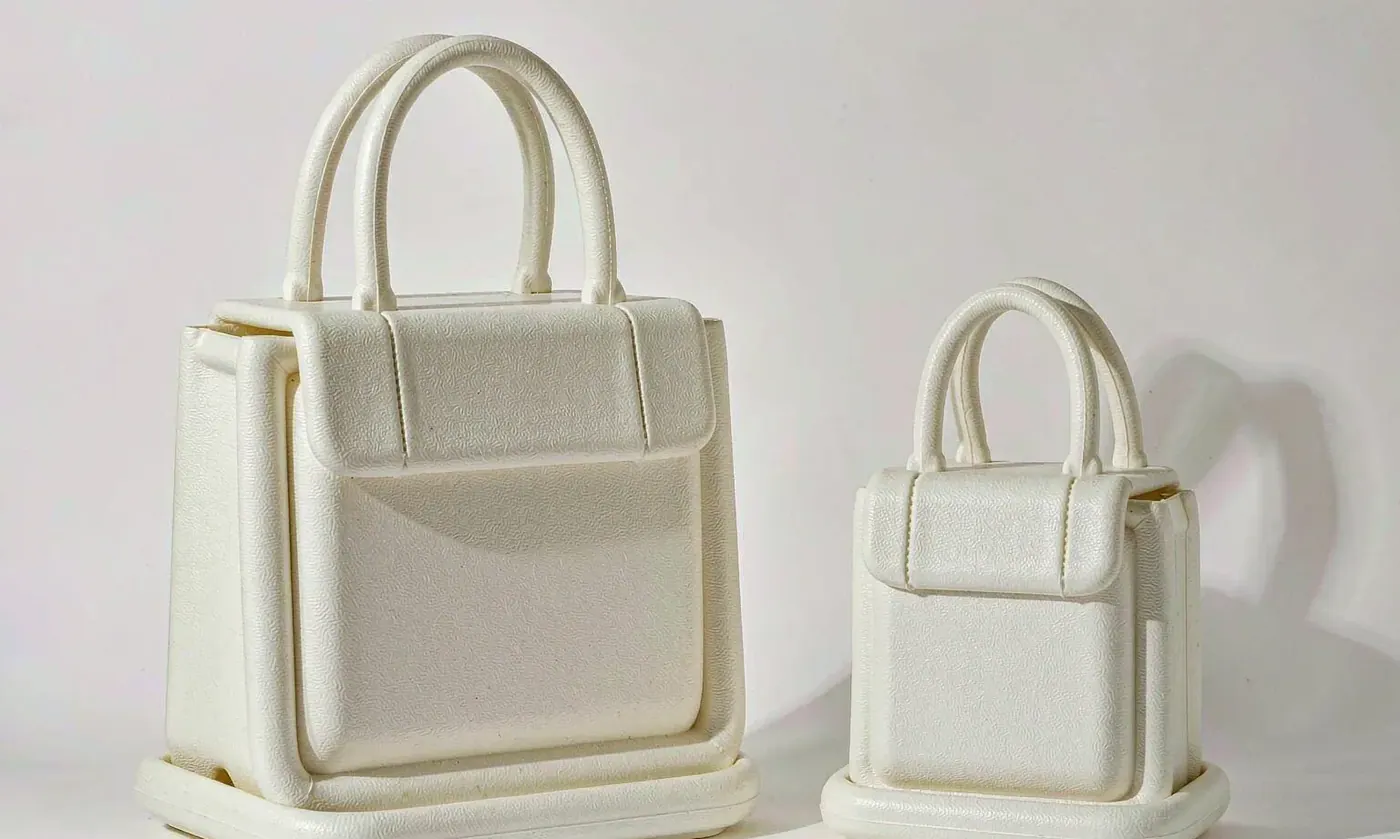
Litre figures are abstract until they are converted into the things people carry. Towels are the useful unit because they are bulky and incompressible: a folded towel occupies about 5 litres and a rolled one about 3.5. Hard objects pack worse than soft ones because they leave voids, so a load that is mostly bottles and containers needs about ten percent more volume than its nominal size suggests.
| Band | Folded towels | 1.5 litre bottles upright | Full swim kit | Family picnic | Sports kit |
|---|---|---|---|---|---|
| Mini, 5 litres | One small towel | None, too short | Goggles and sunscreen only | No | No |
| Kids, 7 litres | One towel plus goggles | One, lying down | Yes for one child | No | No |
| Small, 10 litres | Two towels | One, lying down | Yes plus a book | Snacks only | No |
| Medium, 18 litres | Four towels | Two upright | Yes for two | Light picnic | Yes for one |
| Large, 32 litres | Six towels | Four upright | Yes for four | Full picnic | Yes for two |
| Extra large, 42 litres | Eight towels | Six upright | Yes for five | Full picnic plus chairs | Full team kit |
The bottle row is the one to check first, because it is binary: a body either has 24 centimetres of internal height or it does not, and no packing technique changes that. From the large band upward, bottles stand upright and drinks travel safely; below the medium band they lie down, which is acceptable until one leaks. Anyone whose load regularly includes upright drinks should treat the large band as the floor rather than an option.
Handle Drop, Strap Dimensions and Carry Fit
Handle dimensions are the least-published measurements in the category and among the most consequential for comfort. Drop, meaning the distance from the top of the rim to the underside of the handle, decides whether a loaded bag can be carried on a shoulder or only in the hand. Below about 20 centimetres it is a hand carry only; between 22 and 28 it works over a forearm or on a shoulder for short distances; and above 40 it is a genuine shoulder carry, which usually means a detachable strap rather than a molded handle.
| Carry method | Drop required | Comfortable load | Comfortable distance | Notes |
|---|---|---|---|---|
| Hand carry, two handles | Any, typically 12 to 18 centimetres | Up to 12 kilograms | 100 to 150 metres | Standard on all molded bodies |
| Forearm or crook of the elbow | 20 to 26 centimetres | Up to 9 kilograms | 150 to 250 metres | Common on medium sizes |
| Shoulder carry, molded handle | 26 to 32 centimetres | Up to 7 kilograms | 200 to 300 metres | Rare, needs a tall rim |
| Shoulder carry, detachable strap | 40 to 60 centimetres | Up to 15 kilograms | 400 to 600 metres | Strap width 38 to 50 millimetres |
| Cross-body strap | 55 to 75 centimetres | Up to 10 kilograms | 600 metres or more | Best for long walks with children |
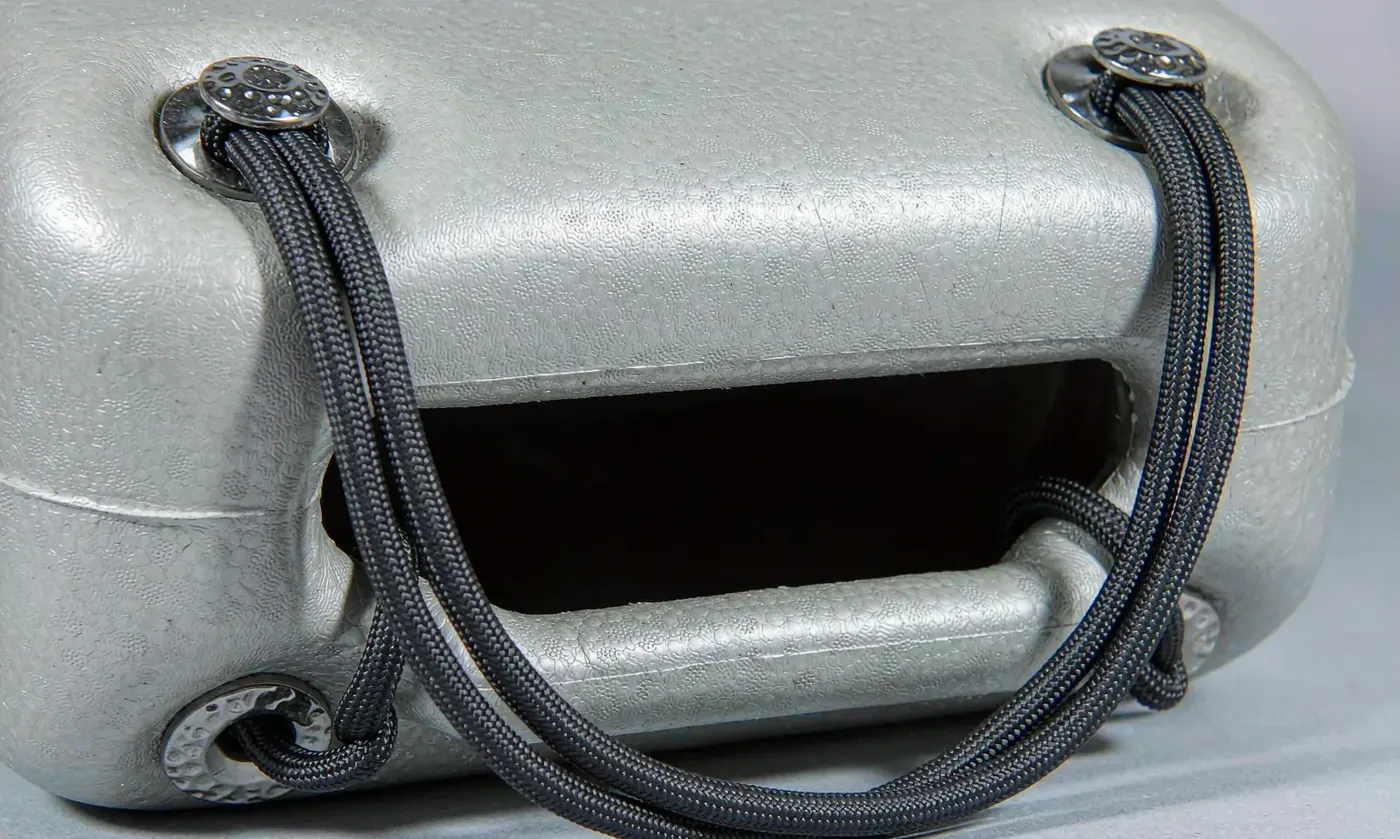
Handle cross-section matters as much as drop. A molded handle carrying 12 kilograms should present at least 12 by 18 millimetres of section, because anything thinner digs into the hand on a long carry, and the fillet where it meets the rim should have a radius above six millimetres to spread the load. These are the two dimensions most often reduced on lighter builds, and they are the reason two bags of the same size can feel very different after two hundred metres.
Matching Band to People and Duration
Two variables decide the band in almost every case: how many people are using it at once and how long they are out. The matrix below is the fastest route to a decision, and the exceptions are few enough to be named afterwards.
| People | Up to 2 hours | Half day | Full day | Notes |
|---|---|---|---|---|
| One adult | Kids or small, 5 to 10 litres | Small, 10 litres | Medium, 18 litres | Most single users are over-served by large |
| Two adults | Small, 10 litres | Medium, 18 litres | Large, 32 litres | Large only if drinks and food are shared |
| One adult and one child | Small, 10 litres | Medium, 18 litres | Large, 32 litres | Wet kit adds roughly 4 litres |
| Family of three or more | Medium, 18 litres | Large, 32 litres | Extra large, 42 litres | Families consistently buy down |
| Group or team | Large, 32 litres | Extra large, 42 litres | Two large bodies | Two mediums beat one extra large for packing |
The one frequent exception is the family that walks a long distance. In that case the limiting factor is carry comfort rather than capacity, and the right answer is a medium body with a shoulder strap rather than an extra large one carried by hand. The second exception is the household with storage constraints: a body that does not fit a cupboard or a car footwell gets used twice a year regardless of how well it holds a family load.
Weight, Cube and Freight by Band
Size drives cost twice over at programme level: through material mass, which sets unit price, and through packed cube, which sets freight per unit. Small bodies nest deeply and ship efficiently; large ones barely nest at all. The result is that freight per unit can differ by a factor of five between the smallest and largest band on the same lane, which is a larger spread than the difference in unit price.
| Band | Nesting depth | Pieces per 40-foot high cube | Indicative sea freight per unit | Comment |
|---|---|---|---|---|
| Mini | About 55 percent | 4,000 to 5,500 | USD 0.55 to 0.90 | Best container economics in the category |
| Kids | About 50 percent | 3,200 to 4,200 | USD 0.70 to 1.05 | Strong, but needs rim protection |
| Small | About 40 percent | 2,600 to 3,400 | USD 0.85 to 1.30 | Balanced size and economics |
| Medium | About 30 percent | 1,600 to 2,200 | USD 1.30 to 1.95 | Standard retail proposition |
| Large | Minimal | 900 to 1,400 | USD 2.10 to 3.20 | Freight is material to margin |
| Extra large | None useful | 700 to 1,100 | USD 2.70 to 4.10 | Consider regional production at volume |
The practical rule for anyone comparing quotations is to divide freight by piece count rather than by container. A container price is what gets quoted and a piece count is what determines margin, and the two do not move together in this category. Physical test methods for dimensional and load checks are published by ASTM International, and quality-management expectations for documenting them come from the International Organization for Standardization.
Perforation Count and Drain Area by Band
Size and perforation interact in a way that is easy to miss: a larger body has more wall area, so it carries far more holes, and total open area rises faster than volume does. That is why large bodies often drain as fast as small ones despite holding four times as much, and why a mini with too few holes can drain more slowly than a large one with many.
| Band | Typical hole count | Open area as a share of wall | Drain time after a dunk | Sand behaviour |
|---|---|---|---|---|
| Mini | 20 to 40 | 8 to 12 percent | 8 to 14 seconds | Passes dry sand only |
| Kids | 30 to 55 | 8 to 12 percent | 7 to 12 seconds | Passes dry and damp sand |
| Small | 50 to 90 | 10 to 15 percent | 6 to 10 seconds | Passes damp sand cleanly |
| Medium | 90 to 150 | 10 to 15 percent | 5 to 8 seconds | Passes damp sand and grit |
| Large | 150 to 240 | 12 to 18 percent | 4 to 7 seconds | Passes everything loose |
| Extra large | 220 to 320 | 12 to 18 percent | 4 to 6 seconds | Passes everything loose |
The practical consequence is that hole diameter should be chosen by band rather than copied across a range. Kids sizes do best at six to nine millimetres, which keeps small fingers out while still passing sand; small and medium bodies work at nine to twelve; and large bodies can run at twelve to fourteen because there is enough interior volume that losing a lip balm through a hole is a small risk against the benefit of fast drainage. Copying one diameter across every size in a range produces a kids bag with holes too large and an extra large body that drains more slowly than it should.
Six Sizing Errors Worth Avoiding
Six mistakes account for most of the returns in this category, and none of them is a product defect. Each maps to a single measurement that can be checked before ordering.
- Comparing litre figures between products that were measured differently. Compare internal dimensions instead.
- Ignoring internal height and then discovering bottles have to lie down: 24 centimetres is the threshold.
- Buying the band that fits the contents exactly. Thirty millimetres of spare space is needed for access.
- Choosing a band that does not fit the storage space, which turns a correctly sized bag into an unused one.
- Forgetting that wet loads grow. A soaked towel does not compress the way a dry one does.
- Assuming the base equals the mouth. A narrower base tips once bottles concentrate about fifteen kilograms low in the bag.
The cheapest way to avoid all six is the floor test described earlier: lay out the real load, measure its footprint and height, add thirty millimetres, and compare that against internal dimensions rather than against a product name. It takes two minutes and it works whether the purchase is one bag or five thousand.
For programme buyers there is one further check worth adding, because it is invisible on a sample and expensive at delivery. Confirm the tolerance on every dimension, typically plus or minus three millimetres, and state whether it applies to the outer or the internal figure. A large body delivered three millimetres under on internal height still passes a loose tolerance but loses the ability to stand bottles upright, which is the specification most likely to generate a retail complaint.
Does Size Change the Care Routine?
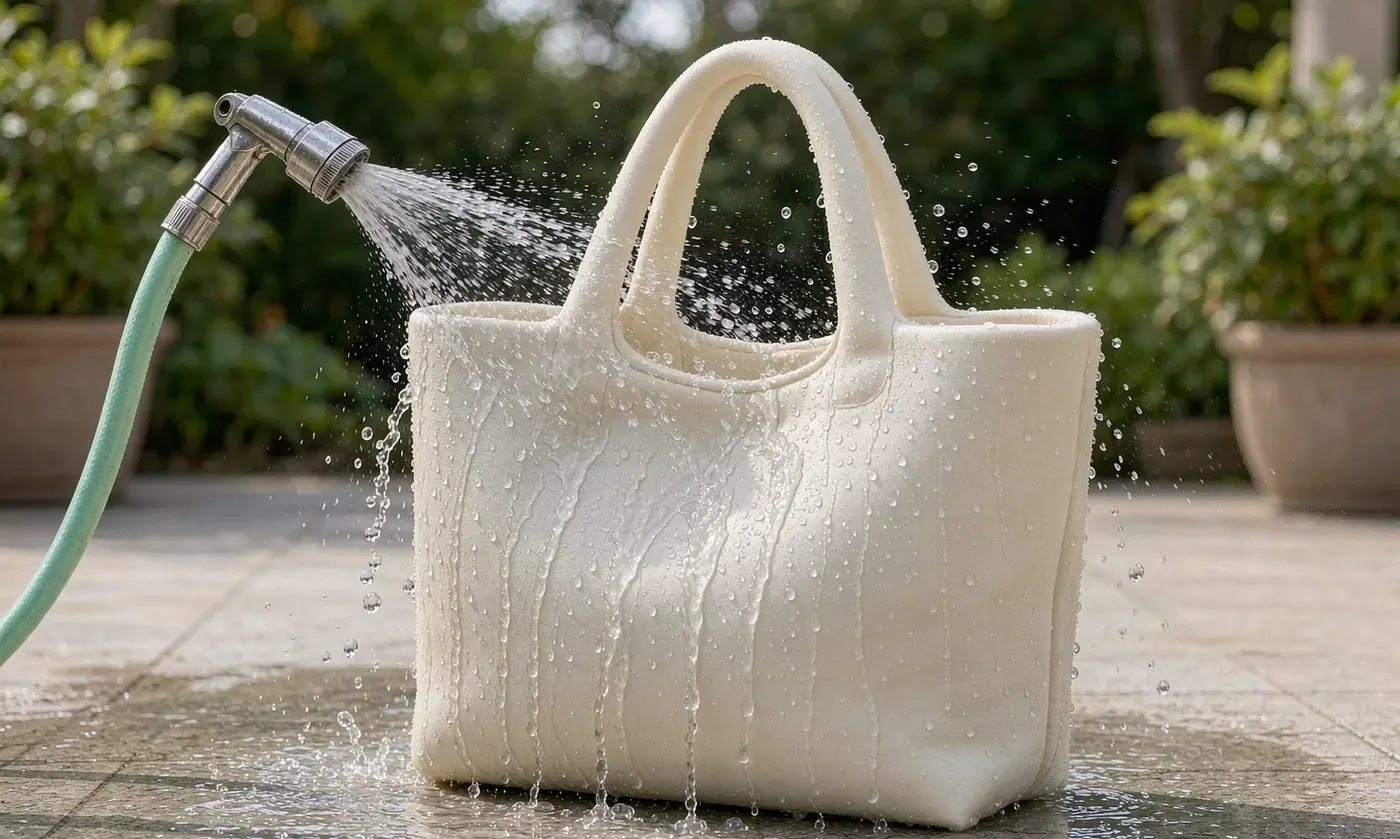
The method is identical across every band, but the logistics differ enough to matter. Bodies up to the small band fit a sink or a shower tray and can be rinsed one-handed in a minute or two, which is why they get cleaned after most uses and stay presentable. Medium bodies need an outdoor tap, and large and extra large bodies need a hose worked from the inside outward, because there is too much surface to cover from above.
Drying time scales with enclosed volume rather than with wall area: a mini is dry in 20 to 40 minutes, a small in 30 to 60, a medium in 45 to 90, and a large or extra large in 60 to 150 minutes standing open in shade. Heat sensitivity also scales, because a larger dark panel absorbs more energy and has more room to creep, which is why shade storage matters more at the top of the chart than at the bottom.
Programme Notes
The large band in detail sits in the large EVA tote guide, the small and kids bands in the small EVA tote guide, and a direct comparison of the two ends of the chart in large versus small EVA tote. QUANZHOU JUNYUAN BAGS has run waterproof bag programmes since 2014 with a founding team in this trade since 2004, covering every band in the chart alongside sewn and welded ranges.
Monthly output runs at 200,000 units verified by SGS, operations follow BSCI and ISO 9001, materials are screened for REACH and California Prop 65, and every bulk shipment is inspected at AQL 2.5 before release. Programme minimums begin at 500 pieces per design and colour, with sampling at 6 to 10 working days and bulk at 35 to 50 days from approved sample and deposit. Send your target band, internal dimension requirements, colourway count, quantity and destination to service@junyuanbags.com, and ask for the packed carton specification at the same time, because it changes landed cost more than any other single line.
People Also Ask
What are the standard EVA tote sizes?
Six bands from mini at 24 by 16 by 11 centimetres to extra large at 54 by 34 by 28 centimetres, covering 5 to 42 litres of usable volume.
How do I measure an EVA tote?
Take outer length and width at the mouth, internal height at the centre of the floor, base footprint at the outside of the rails, and handle drop from rim to handle underside.
What size EVA tote fits a family of four?
The large band at about 48 by 31 by 24 centimetres and 32 litres, which carries six towels, a picnic kit and upright drinks.
How much usable volume does a size lose to walls?
Typically 15 to 25 percent. Gross geometric volume overstates the interior because walls, rim and base all consume space.
What internal height do I need for upright bottles?
At least 24 centimetres, measured at the centre of the floor, which lets a 33 centimetre 1.5 litre bottle stand below the rim.
Which size band ships most efficiently?
The mini band, at 4,000 to 5,500 pieces per 40-foot high cube, against 700 to 1,100 for extra large bodies.
Frequently Asked Questions
Q1. What is the standard EVA tote size chart?
Six bands: mini 24 by 16 by 11, kids 28 by 19 by 13, small 33 by 23 by 14, medium 41 by 27 by 19, large 48 by 31 by 24 and extra large 54 by 34 by 28 centimetres.
Q2. How many litres is each size?
About 5, 7, 10, 18, 32 and 42 litres of usable volume respectively, after wall thickness and base are accounted for.
Q3. Should I measure outer or internal dimensions?
Internal for anything that has to fit inside, and outer for anything the bag has to fit into, such as a car boot, locker or shelf.
Q4. What internal height lets bottles stand upright?
Twenty-four centimetres or more, measured at the centre of the floor rather than at the wall where the base is thicker.
Q5. How heavy is each size?
From 0.3 to 0.45 kilograms for a mini up to 2.3 to 2.6 kilograms for an extra large, with the large band at 1.6 to 2.1 kilograms.
Q6. What load rating goes with each size?
Roughly 3 to 5 kilograms at the mini end rising to 24 to 30 at the top, with the large band typically rated between 18 and 26 kilograms.
Q7. How much usable volume do the walls consume?
Typically 15 to 25 percent of the gross geometric figure, because walls, rim section and base thickness all take space from the interior.
Q8. Which size is right for one adult?
The small band at 10 litres for a half day and the medium at 18 litres for a full day. Large is usually more than one person needs.
Q9. Why does my tote hold less than the stated litres?
Because the stated figure is often gross volume. Plan with usable volume, and add about ten percent for loads made up of hard objects.
Q10. How much spare space should I allow?
About thirty millimetres on each dimension, which is what makes the bag usable without unpacking it at the destination.
Q11. Does the base measurement differ from the mouth?
Often yes, and it should be equal to or wider than the mouth. A narrower base tips once bottles concentrate load low in the bag.
Q12. Which band has the best freight economics?
The mini band, at 4,000 to 5,500 pieces per 40-foot high cube, against 700 to 1,100 for extra large bodies that do not nest.