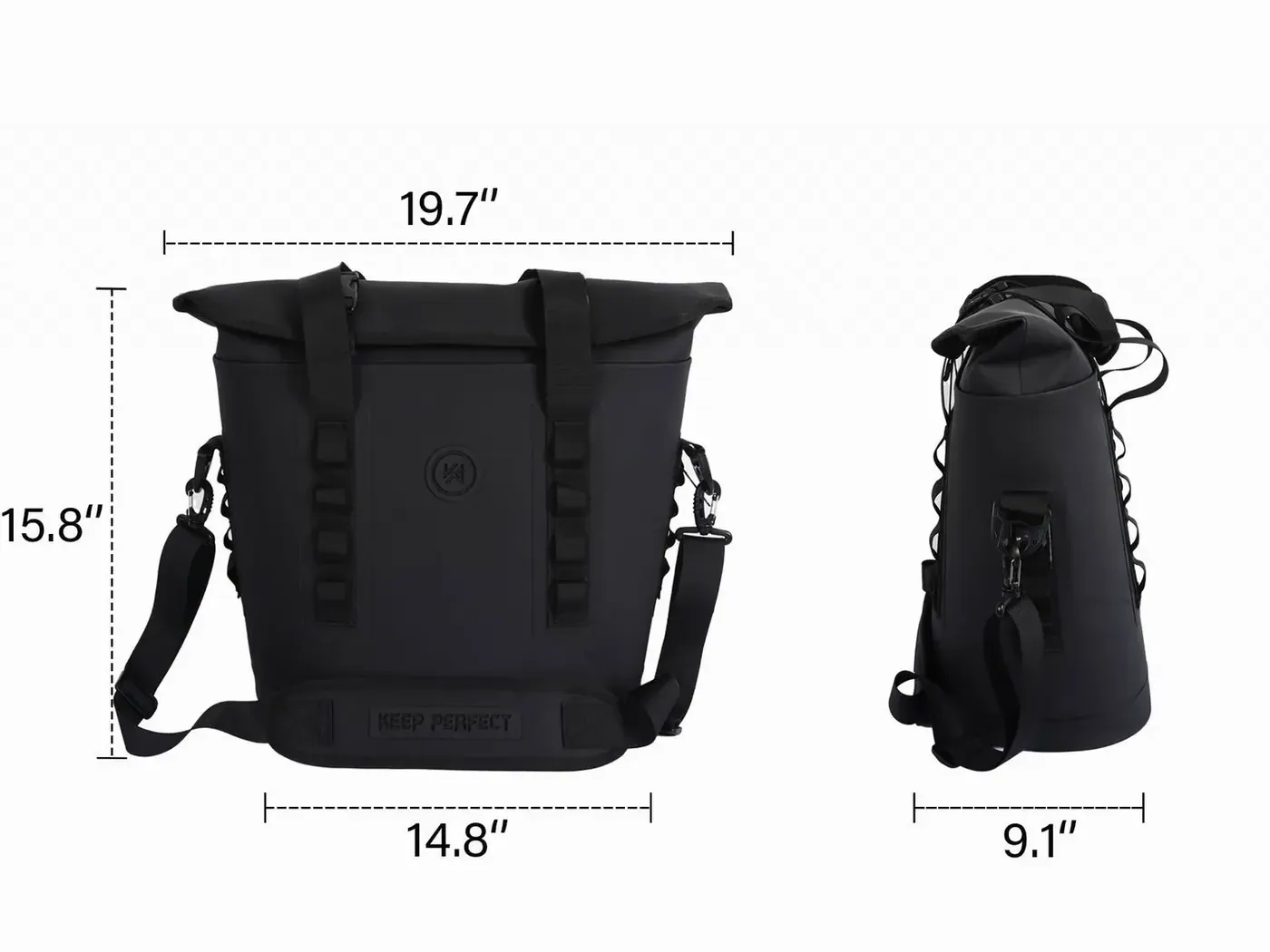
A beach day for two people needs 12 to 16 litres, which fits an 18 litre EVA tote with room to spare: two quick-dry towels at 3 to 4 litres, sunscreen and a first aid pouch at 1 litre, two drinks at 2 to 3 litres, snacks at 1 litre, and a dry pouch for phones and keys. A family of four needs 24 to 30 litres and wants a 32 litre body. Load heavy items at the base, sunscreen and snacks last, and expect the return load to be 1 to 2 kilograms heavier because wet towels weigh roughly three times what dry ones do.
How Much Actually Fits
Capacity claims in this category run 10 to 20 percent optimistic, so the useful exercise is to add up what you intend to carry and compare it against real volume rather than against a number on a hangtag. A body described as 18 litres typically holds 15 to 16 comfortably and 17 at a push, and a body described as 32 holds 27 to 29 with the mouth still able to close visually.
The second reason to work in litres rather than in items is that the same item count can occupy very different volumes. Two cotton towels take about 4 litres; the same two towels in quick-dry microfibre take about 1.5. That single substitution is the difference between a comfortable 18 litre bag and an overflowing one, and it is the most effective packing change available.
| Stated capacity | Usable volume | Comfortable load | Best for |
|---|---|---|---|
| 7 litres (kids) | 6 litres | 6 to 7 litres | One child, towel, drink and a toy |
| 10 litres (small) | 8 to 9 litres | 8 to 9 litres | One adult, or a pool and gym bag |
| 18 litres (medium) | 15 to 16 litres | 15 to 16 litres | Two adults, the default beach body |
| 32 litres (large) | 27 to 29 litres | 27 to 29 litres | A family of four, or a shared load |
| 40 litres and above | 34 to 36 litres | 34 to 36 litres | Large groups, cabana and boat use |
Sizing up one step is almost always the right call when a load sits near the limit, because an overfilled rigid body is worse than a larger one. A bag packed to 100 percent of usable volume has no room for the return load, and the return load is always bulkier than the outbound one.
The Core List and What Each Item Costs You in Volume
The list below is the realistic minimum for a beach day and the volumes are measured rather than guessed. Every item on it appears in most people's bags; the ones people forget are at the bottom.
| Item | Volume per person | Wet or dry | Where it goes | Note |
|---|---|---|---|---|
| Quick-dry towel | 0.75 to 1.5 litres | Dry out, wet back | Base layer | Cotton costs three times the volume |
| Sunscreen SPF 30 to 50 | 0.2 litres | Dry | Top layer | The main staining risk in the bag |
| Water, 1 litre bottle | 1 litre | Dry | Upright at the base | Needs 24 centimetres internal height |
| Snacks in a sealed tub | 0.5 litres | Dry | Top layer | Sealed, because the body drains |
| Phone and keys in a dry pouch | 0.2 litres | Dry | Clipped to a handle root | The perforations will not keep them dry |
| Sunglasses in a hard case | 0.2 litres | Dry | Top layer | Loose glasses scratch against bottles |
| Spare dry top or cover-up | 0.5 litres | Dry | Middle layer | The item most often left behind |
| Small first aid kit | 0.3 litres | Dry | Top layer | Plasters and saline for a cut foot |
| Wet bag or dry pouch for swimsuits | 0.5 litres | Wet on the return | Middle layer | Keeps wet kit off dry kit |
Adding two adults gives 6.5 to 8.4 litres, which is comfortably inside an 18 litre body. Adding two children and their towels gives 12 to 15 litres, still inside the same body. It is only when a third and fourth adult towel, four drinks and a shared snack load are added that the total reaches 24 to 30 litres and a 32 litre body becomes necessary.
Loading Order: The Cheapest Organisational Tool
In a single open volume, the order things go in is the only structure available and it costs nothing. Load in reverse order of use, so the last thing needed is the first thing in.
- Base layer: towels laid flat, then bottles upright against a wall so they cannot tip into the middle.
- Middle layer: spare clothing, books, and the wet pouch that will be empty going out and full coming back.
- Top layer: sunscreen, snacks, sunglasses and the first aid kit, which are needed first and most often.
- Clipped to a handle root: phone, keys and anything that must not end up at the bottom of the bag.
- Never at the base: anything sharp, anything that leaks, and anything you will need within two minutes of arriving.
The bottle position is the detail that prevents the most common complaint. A bottle lying on its side at the base concentrates load in one spot and tips the bag when it is set down; the same bottle upright against a wall spreads load and keeps the base stable. Two bottles, one against each end wall, is the arrangement that works.
Sunscreen position matters for a different reason. It is the one item that stains, it is the item most likely to leak, and it is the item needed first. Keeping it upright at the top rather than buried means leaks are found immediately rather than discovered at the end of the day.
Family of Four: The Full Load
A family day is a different arithmetic exercise because four people generate four towels, four drinks and a shared set of everything else, and because at least one child will need something unexpected. The list below is the realistic full load and it is the reason a 32 litre body exists.
| Item | Quantity | Volume | Notes |
|---|---|---|---|
| Quick-dry towels | 4 | 3 to 6 litres | Cotton would need 10 to 12 litres |
| Water bottles | 4 at 1 litre | 4 litres | About 50 to 100 ml per kilogram of body weight per day |
| Snacks in sealed tubs | 2 | 1 to 1.5 litres | Sealed, because the body drains and does not close |
| Sunscreen and lip balm | 2 | 0.4 litres | Reapply every two hours in strong sun |
| Spare dry tops | 2 | 1 litre | Children get cold before adults notice |
| Toys, bucket and spade | 1 set | 2 to 4 litres | The bulkiest item and the first candidate to leave behind |
| Wet pouch for swimsuits | 1 large | 1 litre | Or a drop-in liner for the return leg |
| First aid and wipes | 1 kit | 0.5 litres | Plasters, saline, antihistamine |
That totals 13 to 18 litres outbound and 16 to 22 on the return once four wet towels are added, which is why a family of four is comfortable in a 32 litre body and cramped in an 18 litre one. The single largest saving is the towel choice: four microfibre towels take 3 to 4 litres against 10 to 12 for cotton, and that difference alone moves a family from a large bag to a medium one.
Weight and Carry Distance
Volume is rarely the binding constraint on a beach day; weight is, because the walk from a car park to the sand is often 200 to 600 metres and the load is carried in one hand. The table below is the weight of a typical load at each size and the distance at which it starts to matter.
| Load | Outbound weight | Return weight | Comfortable carry distance |
|---|---|---|---|
| One adult, 10 litre body | 3 to 4 kg | 4 to 5 kg | 600 metres or more |
| Two adults, 18 litre body | 6 to 8 kg | 7 to 9 kg | 300 to 500 metres |
| Family of four, 32 litre body | 12 to 15 kg | 14 to 17 kg | 100 to 250 metres, or two bags |
| Two children with their own bodies | 2 to 3 kg each | 3 to 4 kg each | Any distance, they carry it |
| Boat or cabana, no walk | Up to 20 kg | Up to 22 kg | No constraint |
Two conclusions follow. The return load is always 1 to 2 kilograms heavier than the outbound one because wet towels weigh roughly three times what dry ones do, so pack on the assumption that the walk back is the harder of the two. And above about 10 kilograms, two smaller bags carried one in each hand is more comfortable than one large one, because the load is balanced rather than one-sided.
Sun protection over a long day on exposed sand is the health item worth planning rather than improvising, and guidance on sun exposure and sunscreen use is published by the United States Centers for Disease Control and Prevention. Reapplication every two hours, and after swimming, is the part people skip, which is why sunscreen belongs at the top of the bag rather than buried at the base.
What People Overpack
Four categories account for most of the excess volume in a beach bag, and cutting them is the fastest way to fit a family load into a smaller body.
- Cotton towels. Four of them take 10 to 12 litres against 3 to 4 for microfibre, and they stay damp for days.
- Too much water. Plan 50 to 100 millilitres per kilogram of body weight per day, not one bottle per person per hour.
- Spare clothing for every eventuality. One cover-up per child is enough; a second is insurance against nothing.
- Bulky toys. A bucket and spade takes 2 to 4 litres; a frisbee takes almost none and occupies children longer.
- Books that will not be read. One each, or a shared e-reader in a pouch, rather than four paperbacks.
- Full-sized toiletries. Decant into 100 millilitre bottles and the wash bag halves in volume.
The water row is the one to think about twice, because underpacking water is a genuine risk on a hot day and overpacking it is the most common cause of a bag that is too heavy to carry. The 50 to 100 millilitres per kilogram rule covers drinking; add about 500 millilitres per person for rinsing sand off feet and hands, and the figure is right.
Add-ons That Earn Their Place
Four accessories are worth carrying and everything else is optional. Each of the four solves a problem that actually occurs on a beach day rather than one that occurs in a product photograph.
| Accessory | What it solves | Volume | Cost |
|---|---|---|---|
| Drop-in liner | Wet and dry separation on the return leg | Minimal, it replaces loose volume | 12 to 25 dollars |
| Clipped pouch | Phone and keys stay findable | 0.2 litres | 4 to 9 dollars |
| Dry pouch for electronics | The perforations will not keep a phone dry | 0.2 litres | 6 to 14 dollars |
| Charm or coloured tag | Identifies the bag on a crowded beach | None | 3 to 8 dollars |
The dry pouch is the one that surprises people. A perforated body drains in both directions, so it will not protect a phone from rain, spray or a leaky bottle. Anyone carrying a phone, a car key fob or an e-reader needs a pouch, and that is true regardless of which size body is used.
The End-of-Day Reset
The reset takes about five minutes and it is what keeps the bag ready for the next day rather than needing a recovery session. Do it in this order and the bag will be dry before the evening.
- Shake the bag out dry first, upside down. Sand comes off dry far more easily than damp.
- Empty everything, including the liner and pouches, and put wet towels straight into a wash.
- Rinse the body inside and out at tap pressure for about sixty seconds, including the perforations.
- Turn it upside down for ten to thirty seconds and let it drain. A fully perforated body empties in four to ten seconds.
- Stand it open in shade, mouth angled downward, and leave it until the next outing, usually 30 to 60 minutes.
- Check the base for a bottle or a spade left behind, which is the most common thing found the following morning.
Sunscreen and marine life is worth one line: several jurisdictions restrict certain sunscreen ingredients near reefs, and guidance on protecting coral reef ecosystems is published by the United States National Oceanic and Atmospheric Administration. Choosing a mineral-filter product where a reef is present is a small packing decision with a real environmental effect.
Four Worked Loads, From Solo to Group
The four scenarios below cover almost every beach day, and each one lists the outbound volume, the return volume and the body that fits. The difference between outbound and return is the part people forget, and it is why a bag that seems comfortably large on the way out is full to the brim on the way back.
| Scenario | Outbound volume | Return volume | Body that fits | Note |
|---|---|---|---|---|
| One adult, half day | 4 to 6 litres | 5 to 7 litres | 10 litres | Fits a locker and a car footwell |
| Two adults, full day | 12 to 16 litres | 14 to 18 litres | 18 litres | The default, with room to spare |
| Family of four | 13 to 18 litres | 16 to 22 litres | 32 litres | Two medium bodies also work |
| Group of six or more | 24 to 34 litres | 28 to 38 litres | Two 32 litre bodies | Two is easier to carry than one huge one |
The group row makes a point worth repeating: above about 10 kilograms, two bags carried one in each hand beats one large bag, because the load is balanced and each bag can be set down independently. It also means one bag can be rinsed while the other is still in use, which matters on a trip where the same bag is needed every day.
Two further items belong in a beach load and are usually left behind: a small first aid kit with plasters and saline, which gets used more often than anything else in the bag, and a spare dry top per child, because children get cold on the walk back long before adults notice the temperature dropping. Both are small, and both are the difference between a good day and an early departure.
What to Leave in the Car Instead
Roughly a third of what people carry to a beach could stay in the car, and removing it is the easiest way to fit a family load into a smaller body. Four categories belong in the vehicle rather than in the bag.
- Bulk water. Carry what is needed for the session and leave the rest in the boot, chilled if possible.
- Spare towels. One per person is enough on the sand; the spares can wait in the car for the ride home.
- Bulky toys. A bucket and spade takes 2 to 4 litres and is usually used for twenty minutes.
- Change of clothes for everyone. One cover-up per child in the bag, the full change in the car.
- The picnic blanket, if it is separate from the towels. Roll it and carry it under an arm rather than in the bag.
The water row deserves one qualification. Leaving bulk water in a hot car is fine for drinking but it will be warm, and a warm bottle is the reason people end up buying drinks at a beach kiosk. A single chilled bottle in the bag plus a reserve in the boot is the arrangement that works, and it keeps the carried weight down without leaving anyone thirsty.
Programme Notes
The largest bodies are covered in the large EVA tote range, internal dimensions for every size sit in the EVA tote size chart, and packing for trips rather than days is set out in EVA tote for travel. QUANZHOU JUNYUAN BAGS has run waterproof bag programmes since 2014 with a founding team in this trade since 2004, and develops beach and travel sizes alongside sewn and welded ranges.
Monthly output runs at 200,000 units verified by SGS, operations follow BSCI and ISO 9001, materials are screened for REACH and California Prop 65, and every bulk shipment is inspected at AQL 2.5 before release. Programme minimums begin at 500 pieces per design and colour, with sampling at 6 to 10 working days and bulk at 35 to 50 days from approved sample and deposit, shipped FOB Xiamen or DDP to more than 100 countries. Send your target size, colourway count and quantity to service@junyuanbags.com.
People Also Ask
What fits in an 18 litre EVA tote?
About 15 to 16 litres of real load: two quick-dry towels, two litres of water, sunscreen, snacks and a dry pouch, with room for the return load.
Do I need a 32 litre tote for a family of four?
Yes. A family load runs 13 to 18 litres outbound and 16 to 22 on the return once four wet towels are added.
How much water should I pack for a beach day?
About 50 to 100 millilitres per kilogram of body weight per day for drinking, plus roughly 500 millilitres per person for rinsing.
Will a perforated tote keep my phone dry?
No. The holes drain in both directions, so a phone, key fob or e-reader needs a dry pouch inside.
Why is the return load heavier?
Wet towels weigh roughly three times what dry ones do, which adds 1 to 2 kilograms to the walk back.
How do I stop sand getting into everything?
Shake the bag out dry before packing, brush feet before they reach the towel, and keep sandy toys in a mesh pouch.
Frequently Asked Questions
Q1. What size EVA tote do I need for a beach day?
Eighteen litres for two adults, 32 litres for a family of four, and 10 litres for one person or a pool session.
Q2. How much does an 18 litre tote really hold?
About 15 to 16 litres of usable volume. Stated capacity in this category runs 10 to 20 percent optimistic.
Q3. Does a perforated tote keep electronics dry?
No. The perforations drain in both directions, so a phone or key fob needs a dry pouch inside the bag.
Q4. How much water should I carry?
About 50 to 100 millilitres per kilogram of body weight per day, plus roughly 500 millilitres per person for rinsing sand off.
Q5. Why is the bag heavier on the way back?
Wet towels weigh about three times what dry ones do, which typically adds 1 to 2 kilograms to the return load.
Q6. Should I use cotton or microfibre towels?
Microfibre. Four cotton towels take 10 to 12 litres against 3 to 4 for quick-dry, and they stay damp for days.
Q7. How do I keep sand out of the bag?
Shake the body out dry before packing, brush feet before they reach the towel, and keep sandy toys in a mesh pouch.
Q8. What is the best loading order?
Towels and upright bottles at the base, spare clothing in the middle, sunscreen and snacks on top, phone and keys clipped to a handle.
Q9. Is one large bag better than two smaller ones?
Above about 10 kilograms, two smaller bags carried one in each hand is more comfortable because the load is balanced.
Q10. How do I reset the bag at the end of the day?
Shake it out dry, rinse for sixty seconds, drain it for ten to thirty seconds, and stand it open in shade for 30 to 60 minutes.