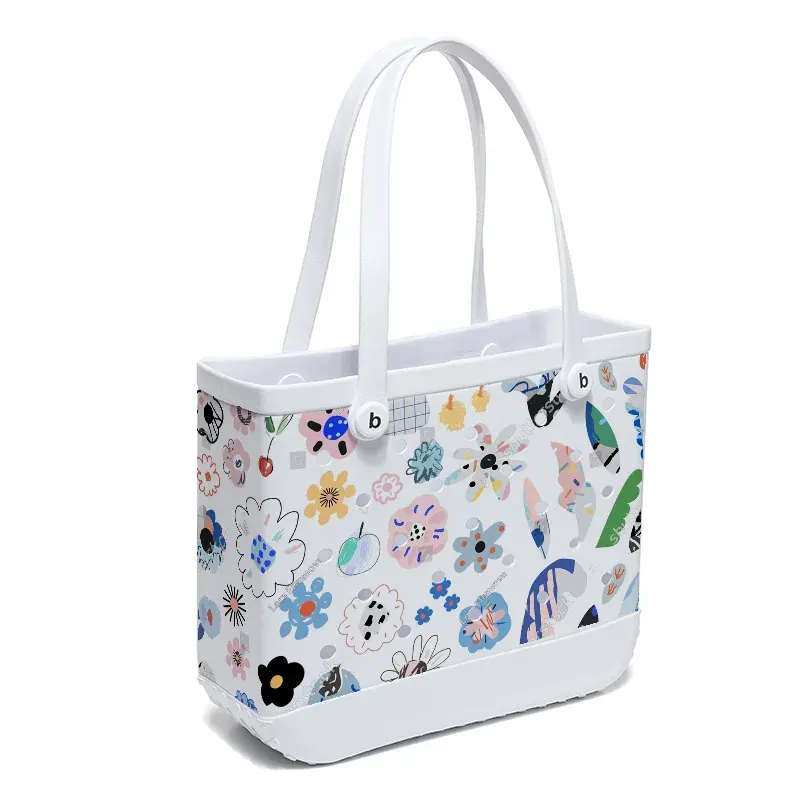
A large EVA tote measures roughly 46 to 54 centimetres across the mouth, holds between 28 and 42 litres, and weighs 1.6 to 2.6 kilograms empty. In practice that means six beach towels plus a picnic kit, or four towels plus a change of clothes, drinks and wet gear, with room left to reach into the bag rather than unpack it. The size that matters most is not the litre figure but the base footprint, because a base narrower than the rim is what makes a loaded tote tip. Load ratings for this size band typically sit between 18 and 30 kilograms, and the wall thickness needed to hold that is six to eight millimetres at the base.
Where the Large Size Band Starts and Ends
Large is not a marketing label in this category, it is a dimensional one. The band begins where a tote stops fitting comfortably in a car footwell and ends where it no longer passes through a standard door while carried by one handle. In numbers, the mouth sits between 46 and 54 centimetres, the height between 24 and 30 centimetres, and the usable volume between 28 and 42 litres. Below 46 centimetres the bag behaves like a mid size and stops carrying a family load; above 54 centimetres it becomes a utility carry that most people cannot lift one-handed when full.
The reason the band is worth defining precisely is that two totes with the same litre figure can behave differently. A tall, narrow body holds the same volume as a shorter, wider one but reaches it through a smaller opening, which means digging rather than lifting out. For a family load of towels, drinks and a wet swimsuit, opening area beats litres almost every time.
| Large size sub-band | Outer dimensions | Usable volume | Empty weight | Realistic load |
|---|---|---|---|---|
| Large, shallow | 48 by 31 by 22 centimetres | Around 29 litres | 1.6 to 1.9 kilograms | Four towels, snacks, two bottles |
| Large, standard | 48 by 31 by 24 centimetres | Around 32 litres | 1.7 to 2.1 kilograms | Six towels, picnic kit, drinks |
| Large, deep | 50 by 32 by 27 centimetres | Around 38 litres | 2.0 to 2.4 kilograms | Six towels, wet gear, sports kit |
| Extra large utility | 54 by 34 by 28 centimetres | Around 42 litres | 2.3 to 2.6 kilograms | Full family day plus chairs or toys |
Litres Translated Into Actual Contents
Litre figures are abstract until they are converted into objects. Beach towels are the useful unit because they are bulky, incompressible and present in every load. A rolled towel occupies roughly 3.5 litres and a folded one roughly 5 litres, so a 32 litre body holds about six folded towels with nothing else, or four folded towels plus food, drink and a wet bag. Anyone quoting a higher number is counting rolled towels and no hard items.
| Load combination | Volume required | Fits in 29 litres | Fits in 32 litres | Fits in 38 litres |
|---|---|---|---|---|
| Four folded towels only | About 20 litres | Yes, with space to spare | Yes | Yes |
| Six folded towels | About 30 litres | Tight, no hard items | Yes | Yes, easily |
| Four towels, two 1.5 litre bottles, food | About 26 litres | Yes | Yes | Yes |
| Six towels, drinks, wet swimsuit, toys | About 34 litres | No | Tight | Yes |
| Family picnic plus two chairs | About 42 litres | No | No | Extra large only |
Two adjustments make these estimates honest. Hard objects such as bottles, food containers and sunscreen tubes pack worse than towels because they leave voids, so add about ten percent to any load that is mostly rigid items. And wet gear takes more space than dry gear of the same weight, because a soaked towel does not compress the way a dry one does. If the plan involves carrying wet items home, size for the wet state rather than the dry one.
Dimensions That Matter More Than Volume
Four measurements predict whether a large tote is pleasant or frustrating, and only one of them appears in most product listings. Base footprint governs stability. Mouth area governs access. Height governs whether a bottle stands upright or has to lie down. And handle drop governs whether the bag can be carried on a shoulder when loaded, which matters more than people expect once the load passes fifteen kilograms.
| Measurement | Target for a large size | What happens if it is missed | How to check |
|---|---|---|---|
| Base footprint | At least as wide as the mouth, ideally 10 millimetres wider | Loads with bottles tip on uneven ground | Compare base width with rim width with a tape |
| Mouth area | 46 by 28 centimetres or more | You unpack to reach anything at the bottom | Measure internal opening, not outer |
| Internal height | 23 centimetres or more | 1.5 litre bottles cannot stand upright | Stand a bottle inside before buying |
| Handle drop | 22 to 28 centimetres | Cannot shoulder-carry a heavy load | Measure from rim top to handle underside |
| Rim height above top holes | 15 millimetres or more of solid material | Mouth collapses inward when lifted by one handle | Look for an unbroken band at the top |
The measurement most often skipped is internal height, and it is the one that decides whether drinks travel upright. A 1.5 litre bottle is about 33 centimetres tall, so it needs an internal height of at least 24 centimetres to stand securely below the rim with the base supported. Large totes that are wide but shallow force bottles to lie down, which is fine until one leaks.
Weight: Empty, Loaded and Carried
Weight is the honest cost of this size band. A large tote weighs 1.6 to 2.6 kilograms before anything goes inside it, which is three to four times a canvas equivalent, and a realistic family load adds 8 to 14 kilograms. That puts total carried weight between 10 and 17 kilograms, which is comfortable for a short carry from car to sand and tiring for anything longer. Load ratings published for this size typically sit between 18 and 30 kilograms, and any figure above 30 should be treated with scepticism unless a test method is named.
| Load case | Contents weight | Total carried | Comfortable carry distance | Note |
|---|---|---|---|---|
| Two-person beach half day | 5 to 7 kilograms | 7 to 9 kilograms | 400 metres or more | Easy one-handed carry |
| Family beach full day | 9 to 13 kilograms | 11 to 16 kilograms | 150 to 250 metres | Two handles, close to the body |
| Family picnic with drinks | 13 to 17 kilograms | 15 to 20 kilograms | 80 to 150 metres | Carry with two hands or a trolley |
| Sports kit and wet gear | 11 to 15 kilograms | 13 to 18 kilograms | 100 to 200 metres | Load heavy items low and central |
| Maximum rated load | 18 to 30 kilograms | 20 to 32 kilograms | Short moves only | Above this, handles deform |
Distribution changes the experience more than total weight does. Placing bottles and food low and central keeps the centre of gravity under the handles, and it is the difference between a bag that swings and one that walks. Placing the same mass high or to one side makes a fifteen kilogram load feel heavier than a well-packed eighteen kilogram one, and it is the usual reason a tote appears to tip for no reason.
Packing Order for a Full-Size Load
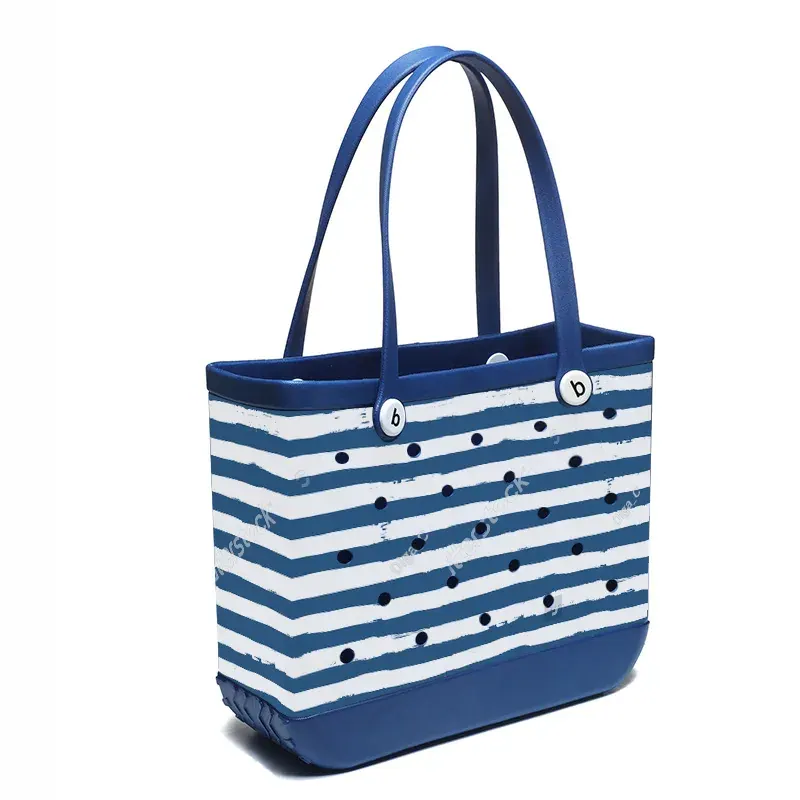
A large tote packs well in a fixed order, and following it means nothing has to be unpacked at the destination. Hard, heavy and leakable items go first and low; soft bulky items go next; the items needed first go last and on top.
- Bottles and food containers first, standing upright and centred over the base, since this is the only layer that must not shift.
- Wet items second, ideally in a pouch, because the perforations drain them and nothing below them can be soaked.
- Towels third, folded rather than rolled for large sizes, because folding fills the corners that rolling leaves empty.
- Soft items such as clothing and hats next, pushed into the gaps left by the towels rather than laid on top.
- Sunscreen, keys and phones last, in the top layer or a pouch, because these are the items reached for first.
The one thing worth adding to a large size is an insert. A divider that separates wet from dry costs little and turns one open volume into two usable ones, and it is the accessory most often bought after the first season rather than with the bag. Inserts are size-specific, so a divider bought for a 48 centimetre body will float in a 54 centimetre one; match the insert to the exact internal dimensions, not to the product name.
Large Totes in Cars, on Boats and on Soft Sand
Context decides whether the large size is the right one, and three contexts cover most of the real use. In a car, the limiting factor is boot or footwell width: a 48 centimetre body fits across most estate and SUV boots and does not fit in a small hatchback footwell, so measure before buying rather than after. On a boat, the large size works for gear transfer from car to deck but is the wrong choice as an onboard bag, because deck and hatch space is tighter than any beach and a wide base becomes an obstacle. On soft sand, a wide base is a genuine advantage: continuous base rails spread load and stop the bag sinking, whereas narrow corner studs dig in.
One more context is worth naming because it is where the large size loses: air travel. A rigid 32 litre body does not fold, does not compress and does not fit a packing cube system, and at 2 kilograms empty it consumes a meaningful share of a baggage allowance before a single item is packed. Travellers who want this material at the destination are better served by shipping it ahead or hiring locally than by checking it in.
Fit Check: Measure Your Own Load Before You Buy
The most reliable way to choose a large size is to measure the load rather than to trust a product name. Lay the items for a typical trip on the floor in the shape they would take inside the bag, measure the footprint and the height, and add thirty millimetres to each dimension for access. That single exercise resolves most of the sizing uncertainty in about two minutes, and it prevents the commonest mistake in this category, which is buying a bag that holds the right volume in the wrong shape.
| Item to measure | Typical dimension | Space it needs | Adjustment to apply |
|---|---|---|---|
| Longest rigid item, usually a bottle | 33 centimetres tall | 24 centimetres internal height | Must stand upright to avoid leaks |
| Folded towel stack | 40 by 30 by 8 centimetres | About 5 litres each | Add ten percent for wet towels |
| Food container or cool block | 25 by 18 centimetres | Base area, loaded low | Pack first and centred |
| Wet swimsuit and wet towel | Variable | Separate pouch if possible | Perforations drain but do not isolate |
| Toys, shovel or ball | Up to 30 centimetres | Top layer only | Keep out of the base where they shift |
Two results are worth acting on immediately. If the longest rigid item cannot stand upright in the internal height, the body is too shallow for that load and no amount of packing technique fixes it. And if the footprint of the base layer is close to the full base area, there is no room left for soft items to fill the voids, which is when a bag feels full while still looking half empty.
Structural Requirements at Large Size
Scaling a molded tote up is not a linear exercise. Load rises with volume while handle cross-section and rim section rise far more slowly, so a large size needs deliberately more material in three places or it will fail in the field rather than in the showroom. Wall thickness should be six to eight millimetres at the base, tapering to four or five at the upper wall. The rim needs a generous fillet radius where it meets the handles. And the base needs continuous rails rather than corner studs, because a large footprint on soft ground concentrates load at the perimeter.
- Ask for wall thickness at the base and at the rim separately. A uniform four millimetre wall on a 32 litre body will deform under a full load.
- Check the handle root from underneath: a fillet radius above six millimetres spreads load and prevents tearing at that joint.
- Press the rim between thumb and forefinger; it should resist noticeably more than the mid-wall, which indicates tapered construction.
- Look at the foot pattern: continuous rails outperform studs on sand and on wet pool decks where studs concentrate load.
- Lift the loaded bag by one handle. Wall flex is normal; the mouth collapsing inward past about thirty percent is not.
Who Should Not Buy the Large Size
The large size is the most returned size in this category, and the returns are almost all the same three mismatches. Solo users who buy for one person end up carrying a bag half full, which is heavier and bulkier than it needs to be and slides around in a car boot. Travellers who buy for a flight discover that a rigid 32 litre body cannot be folded, compressed or packed around. And people with limited storage find that a large tote does not hang on a hook, does not fit a standard cupboard shelf and lives permanently on the floor.
The smaller size is genuinely better in three situations: daily pool visits by one or two people, use as a car organiser or sports kit bag where the load is light but awkward, and any situation where the bag must be lifted into an overhead locker, a boat hatch or a narrow shelf. If the honest answer to how many people use it at once is one or two, the small size will be used more often and complained about less.
Care, Storage and Heat Limits at Large Size
Cleaning a large tote takes about three minutes and no products. Hose it inside and out at normal tap pressure, tip it upside down so the perforations drain, and stand it open in shade for an hour. Sunscreen residue comes off with warm water, mild detergent and a soft cloth. Nothing else is needed, and the four things that damage these bags are all avoidable: machine washing, water above sixty degrees, solvents, and long exposure to direct summer sun on a dark colourway.
Heat is the risk that scales with size, because a larger dark body absorbs more energy and a larger panel has more room to creep. Surface temperature on a dark tote left in direct summer sun can pass sixty degrees within an hour, which is enough to soften the shape permanently. Ultraviolet exposure is the slower process that dulls colour over seasons; the ultraviolet index forecasts published by the National Oceanic and Atmospheric Administration are a reasonable proxy for how aggressive local sun is, and in high-index regions storing the bag in shade rather than on a sunny deck adds seasons to its appearance.
Storage is the other size-specific issue. Large bodies do not nest fully, so three of them occupy roughly three times the floor area of one rather than stacking into a single footprint. Hanging is the efficient answer if the handles allow it: a large tote hung by both handles in a garage or utility room takes about 0.15 square metres of wall instead of 0.15 square metres of floor, and it cannot collect standing water in the base.
Specification Notes for Large-Size Programmes
Buyers specifying a large size for a retail or resort programme should fix five numbers in writing before sampling: outer dimensions including the base, internal height at the centre, wall thickness at base and rim, stated load rating with the test method named, and the perforation diameter. Physical test methods published by ASTM International give a neutral reference for load and dimensional checks, and process expectations from the International Organization for Standardization cover how those checks are documented. Naming the method rather than merely the result is what makes a report usable across markets.
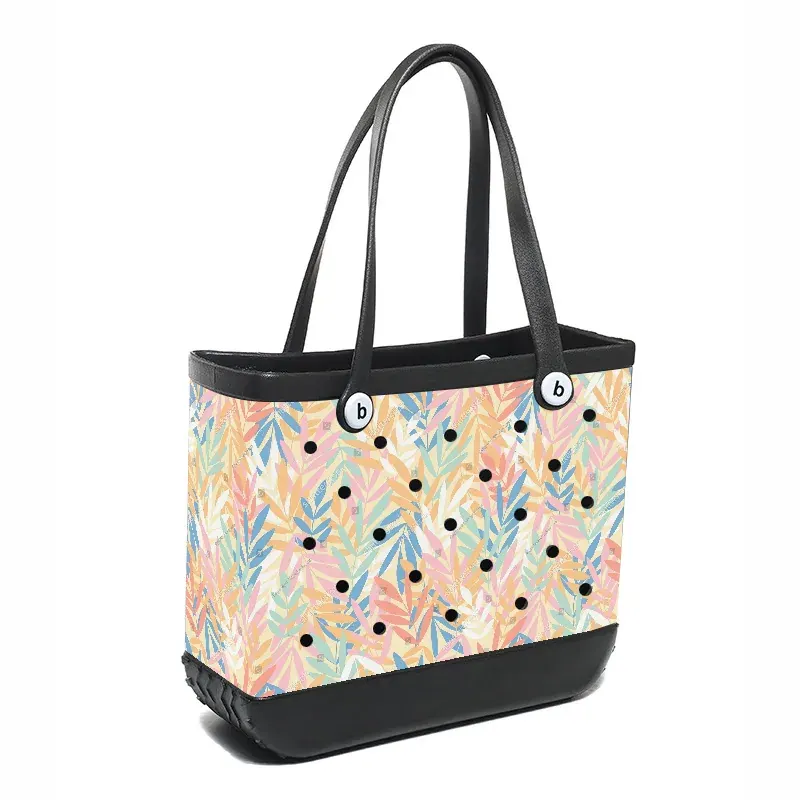
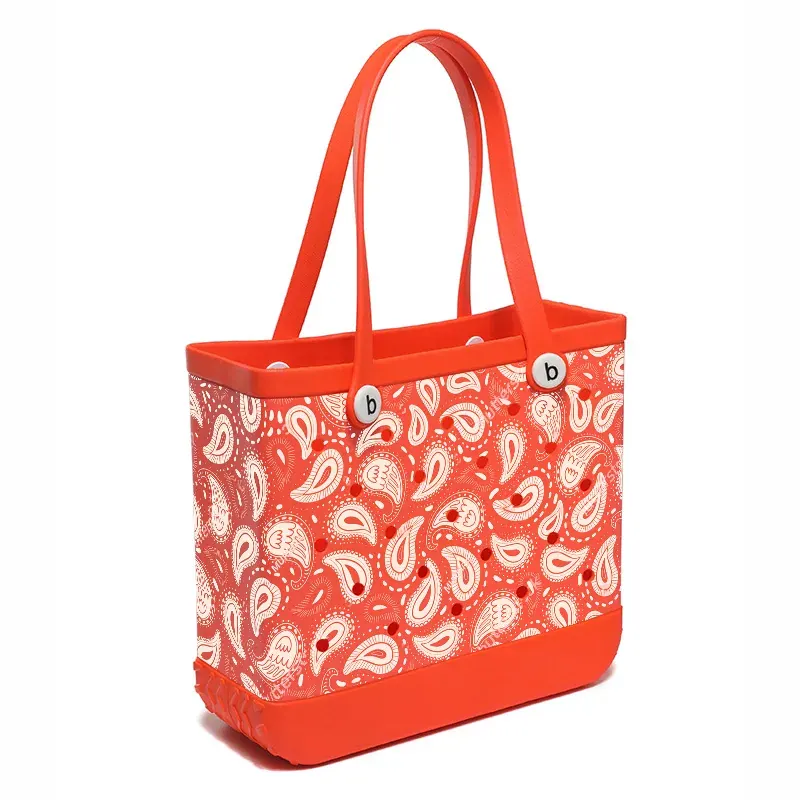
Colourway and decoration behave differently at large size too. A large panel shows colour inconsistency more readily than a small one, so moulded colour matching should be approved under a standard light source rather than on screen, and print placement tolerances tighten because a five millimetre error is more visible on a 48 centimetre face. Full category background sits in the injection-molded EVA tote guide, the other end of the size range is covered in the small EVA tote guide, and every band side by side is in the EVA tote size chart.
QUANZHOU JUNYUAN BAGS has handled waterproof bag programmes since 2014 with a founding team in this trade since 2004, including large-size injection-molded EVA work alongside sewn and welded ranges. Monthly output runs at 200,000 units verified by SGS, operations follow BSCI and ISO 9001, materials are screened for REACH and California Prop 65, and every bulk shipment is inspected at AQL 2.5 before release. Programme minimums begin at 500 pieces per design and colour, with sampling at 6 to 10 working days and bulk at 35 to 50 days from approved sample and deposit. Send your target dimensions, load rating, colourway count and quantity to service@junyuanbags.com.
People Also Ask
What size is considered a large EVA tote?
A mouth between 46 and 54 centimetres, height between 24 and 30 centimetres, and usable volume between 28 and 42 litres.
How many towels fit in a large EVA tote?
About six folded towels in a 32 litre body, or four folded towels plus food, drinks and a wet swimsuit.
How much does a large EVA tote weigh?
Between 1.6 and 2.6 kilograms empty depending on size and wall thickness, rising to 15 or 20 kilograms with a full family load.
Can a large EVA tote hold drinks upright?
Yes if internal height is 24 centimetres or more, which lets a 1.5 litre bottle stand below the rim with the base supported.
Will a large EVA tote fit in a car boot?
Usually yes across the width of an estate or SUV boot, and usually no in a small hatchback footwell. Measure the boot first.
Is a large EVA tote good for air travel?
No. A rigid 32 litre body cannot be folded or compressed and weighs around 2 kilograms empty, which consumes a large share of a baggage allowance.
Frequently Asked Questions
Q1. What are the dimensions of a large EVA tote?
Typically 48 by 31 by 24 centimetres for a standard large, up to 54 by 34 by 28 centimetres for an extra large utility body, with usable volume from 29 to 42 litres.
Q2. How many litres is a large EVA tote?
Between 28 and 42 litres depending on depth. A standard large sits around 32 litres and a deep large around 38 litres.
Q3. How much weight can a large EVA tote carry?
Published load ratings usually sit between 18 and 30 kilograms. Treat any figure above 30 kilograms with scepticism unless a test method is named.
Q4. Does a large tote tip over when loaded?
Only if the base footprint is narrower than the mouth. Look for a base at least as wide as the rim, ideally ten millimetres wider.
Q5. What wall thickness should a large size have?
Six to eight millimetres at the base tapering to four or five at the upper wall. A uniform four millimetre wall will deform under a full load.
Q6. How do I stop bottles falling over inside?
Choose an internal height of 24 centimetres or more and load bottles first, upright and centred over the base.
Q7. Is the large size better than two small totes?
For a family load, yes, because one wide opening is easier to work with than two. For two people on separate schedules, two small totes are used more often.
Q8. Can a large EVA tote be used as a sports or pool bag?
Yes. The perforations drain wet kit and the body hoses clean in about three minutes, which suits swim, gym and junior sports use.
Q9. How should a large tote be stored?
Hung by both handles in shade if possible. Large bodies do not nest fully, so three of them take three times the floor area of one.
Q10. Does a dark large tote fade or warp in the sun?
It can. Surface temperature on a dark body left in direct summer sun can pass sixty degrees within an hour, which is enough to creep the shape.
Q11. What should a bulk buyer specify for a large size?
Outer dimensions including the base, internal height at centre, wall thickness at base and rim, stated load rating with the test method, and perforation diameter.