A small EVA tote measures 24 to 36 centimetres across the mouth, holds between 6 and 16 litres and weighs 0.4 to 1.0 kilograms empty. That is enough for one or two people for half a day: two towels, sunscreen, a bottle and a book, or a child swim kit with goggles and a change of clothes. Small sizes are the most-used and least-returned band in this category, because they fit a car footwell, a cupboard shelf and a pool locker, and because a child can carry one. Load ratings typically sit between 6 and 12 kilograms, and wall thickness of three to five millimetres is sufficient at this scale.
Where the Small Size Band Starts and Ends
Small in this category means a body that can be carried with one hand by an adult and with two hands by a primary school child. In numbers, the mouth runs from 24 to 36 centimetres, the height from 12 to 20 centimetres, and the usable volume from 6 to 16 litres. Empty weight sits between 0.4 and 1.0 kilograms, which is light enough that a six year old can carry a loaded bag a reasonable distance without dragging it.
Below 24 centimetres the product stops being a tote and becomes a mini or a child toy-sized carry: it holds goggles, sunscreen and a small towel, and very little else. Between 30 and 36 centimetres is the range that does the most real work, because it accepts a folded full-size towel laid flat rather than rolled, which is what makes it usable for an actual swim rather than a token one.
| Small size sub-band | Outer dimensions | Usable volume | Empty weight | Typical user |
|---|---|---|---|---|
| Mini carry | 24 by 16 by 11 centimetres | About 5 litres | 0.3 to 0.45 kilograms | Toddlers, toy and snack carry |
| Kids size | 28 by 19 by 13 centimetres | About 7 litres | 0.4 to 0.6 kilograms | Children aged about 3 to 8 |
| Personal size | 33 by 23 by 14 centimetres | About 10 litres | 0.7 to 0.9 kilograms | One adult, half day |
| Everyday small | 36 by 25 by 16 centimetres | About 14 litres | 0.85 to 1.05 kilograms | One adult, full day or two people |
Volume figures at this scale are misleading in a specific way. A 10 litre body sounds small next to a 32 litre family tote, but the difference in what people actually carry is far less than three to one, because most single-person loads are dominated by two or three bulky items rather than by total volume. The small size fails only when the load includes something long, hard or shared.
Everyday Use: What a Small Tote Replaces
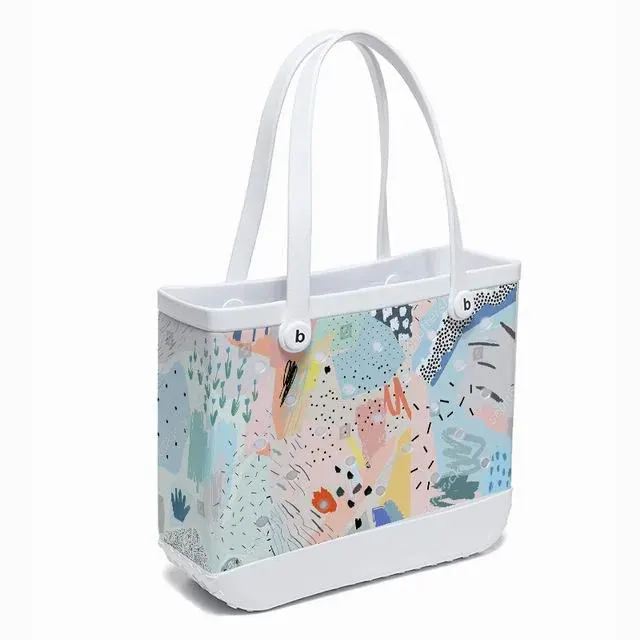
The small size earns its place by replacing three things rather than by being a small beach bag. It replaces the fabric shopper that cannot be rinsed, the plastic crate that looks wrong outside a garage, and the open cardboard box that people use for sports kit until it falls apart. All three fail in the same way: they cannot be hosed down and they hold water. A perforated molded body solves both, and it does it at a weight that makes daily use realistic.
| Everyday job | What goes in | Volume needed | Why molded EVA beats the alternative |
|---|---|---|---|
| Swim kit | Towel, goggles, swim cap, flip flops | 7 to 10 litres | Drains in seconds and dries before the next session |
| Car organiser | Charging cable, wipes, water, first aid | 6 to 10 litres | Wide base stays upright on a moving floor |
| Sports kit | Boots, shin pads, shirt, bottle | 12 to 16 litres | Hoses clean after a muddy pitch |
| Garden carry | Hand tools, gloves, seed trays | 10 to 14 litres | Soil falls through the perforations |
| Beach half day | Two towels, sunscreen, bottle, book | 12 to 16 litres | Sand shakes out rather than settling in |
The honest limit of the small size is the shared load. The moment two adults and a child are involved, or the moment drinks for four people are needed, the small body runs out of room and everything has to be stacked rather than placed. That is not a defect, it is the trade-off for a bag that fits anywhere, and it is why most households that own one small tote end up owning a large one as well rather than replacing it.
Kids Sizes: Proportions, Weight and Safety
Sizing for children is a different problem from sizing for adults, because the constraint is reach and strength rather than the volume of the load. A child can comfortably carry about ten percent of body weight, so a 20 kilogram child should be carrying no more than about 2 kilograms, which means the empty weight of the bag matters more than its capacity. A kids size at 0.4 to 0.6 kilograms empty leaves room for a towel, goggles and a drink inside that budget, and anything heavier does not.
| Age band | Suggested size | Empty weight | Safe carried load | What it holds |
|---|---|---|---|---|
| 2 to 4 years | 24 by 16 by 11 centimetres | 0.3 to 0.45 kilograms | Up to 1 kilogram | Snacks, a small towel, one toy |
| 5 to 8 years | 28 by 19 by 13 centimetres | 0.4 to 0.6 kilograms | Up to 2 kilograms | Towel, goggles, drink, change of clothes |
| 9 to 12 years | 33 by 23 by 14 centimetres | 0.7 to 0.9 kilograms | Up to 3.5 kilograms | Full swim kit plus a book or tablet in a pouch |
| Teen and adult small | 36 by 25 by 16 centimetres | 0.85 to 1.05 kilograms | Up to 6 kilograms | Full day kit for one |
Three safety points are worth stating plainly for children sizes. Charms and decorative inserts are small parts and should be tested against the applicable small-parts requirement for the destination market; the toy and consumer safety methods published by ASTM International are the reference most buyers name. Perforations can trap small fingers if the hole diameter is large relative to a child hand, so kids sizes generally use holes at the smaller end of the range, around six to nine millimetres. And no tote of any size is a flotation device: the material is buoyant when empty, but a loaded bag sits low in the water and nothing about the design makes it a safety aid.
Poolside and Gym: the Small Size Sweet Spot
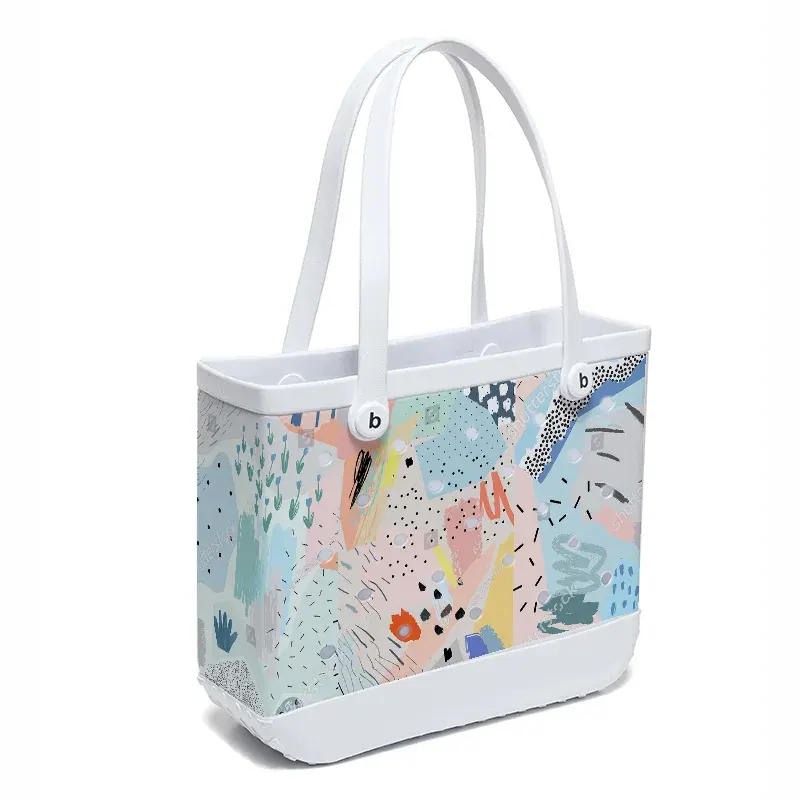
Poolside is where the small size is least arguable. The load is predictable, the distance is short, the surface is wet, and everything comes home damp. A perforated body drains on the walk back to the car, the base does not soak a changing room bench, and the whole bag rinses in under a minute at the end of the day. Gym use follows the same logic, with the addition that a small tote fits a standard locker where no large size will.
- Rinse and drain at the pool rather than at home: a minute with a hose removes chlorine residue that would otherwise sit in the base.
- Dry open rather than closed. Air circulation through the perforations is what stops a damp bag developing an odour between sessions.
- Keep a small wet pouch inside for swimsuits. The holes drain water but they do not isolate wet fabric from dry items.
- Choose a lighter colourway for pool use. Dark bodies left on a deck in summer sun pass sixty degrees at the surface within an hour.
- Check the base rails before buying for a tiled deck: continuous rails grip better on wet, smooth surfaces than corner studs.
Hygiene is the reason this matters rather than mere tidiness. Damp swim kit stored in a closed bag is a recognised way to carry bacteria and chlorine by-products around between sessions, and the guidance on healthy swimming published by the United States Centers for Disease Control and Prevention is explicit about drying and storing swim items rather than leaving them wet. A bag that drains and air-dries in an hour removes that step from the routine instead of adding one.
Structural Notes at Small Size
Small bodies need less material than large ones, and over-specifying them is a real cost mistake. Wall thickness of three to five millimetres is sufficient, because the loads are lower and the spans are shorter; specifying the six to eight millimetres used on a family size adds weight without adding life. What should not be reduced is the rim section and the handle root, because those two features fail from lifting rather than from load, and a small bag gets lifted far more often than a large one.
- Ask for three to five millimetre walls with a taper rather than a uniform section; the base should still carry the most material.
- Check the handle root fillet: above six millimetres radius, and it will survive being snatched up by one handle repeatedly.
- Look for a rim with at least twelve millimetres of solid material above the top row of holes, which keeps the mouth open under load.
- Prefer a base slightly wider than the mouth. Small bags are lifted and set down constantly, and a narrow base tips when the load shifts.
- Confirm the perforation diameter is six to nine millimetres for kids sizes, which passes sand but does not admit small fingers.
Weight of the empty body is the specification most worth optimising at this scale. At 0.4 kilograms a kids size is genuinely child-portable; at 0.8 kilograms it is not, and it will be dragged or carried by an adult instead. Because material mass is the largest single component of unit cost, a lighter small body is both better to use and less expensive to make, which is a rare case where the improvement and the saving point the same way.
Small or Large: A Practical Decision
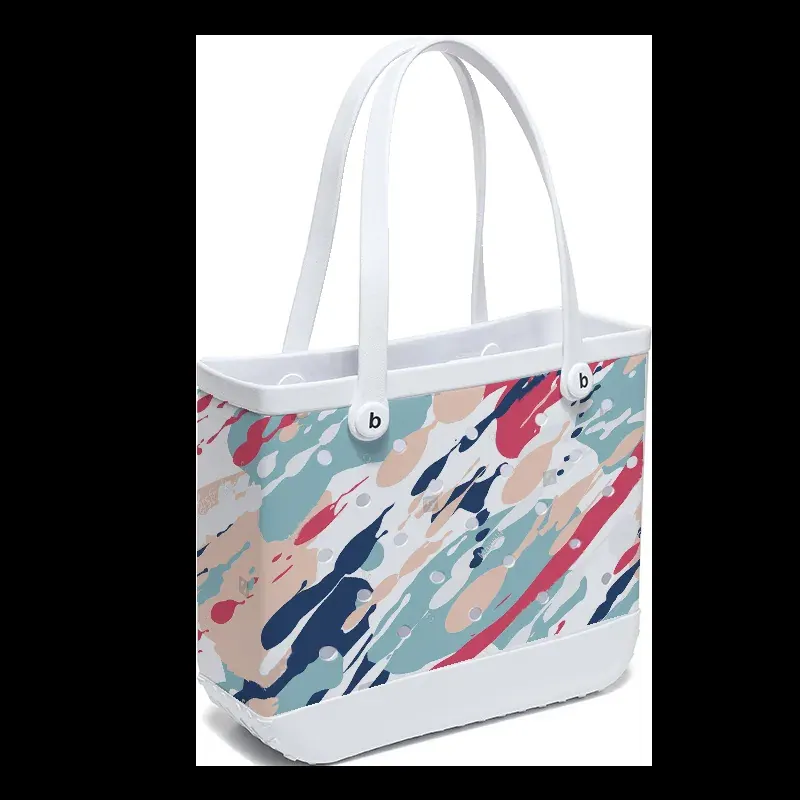
The choice is not about preference, it is about three variables that can each be answered in seconds: how many people, how long, and where the bag has to fit. Answer those and the size follows, with very few genuinely borderline cases.
| Situation | People | Duration | Where it must fit | Recommended size |
|---|---|---|---|---|
| Solo swim or gym session | One | 1 to 2 hours | Locker or gym bag | Small, 7 to 10 litres |
| Child swim lesson | One child | 1 hour | Poolside bench or car footwell | Kids size, 5 to 7 litres |
| Couple at the beach | Two | Half day | Car boot alongside other kit | Small to mid, 10 to 16 litres |
| Family beach day | Three or more | Full day | Car boot, then sand | Large, 29 to 38 litres |
| Everyday car or garden carry | One | Ongoing | Footwell or shelf | Small, 10 to 14 litres |
The borderline case worth naming is the couple with a child who go to the beach for a full day. The honest answer there is one large tote rather than two small ones, because the wet gear, the food and the drinks do not divide cleanly across two bodies and someone ends up carrying both. Two small totes win when the two people are on different schedules, which is common in families with clubs and lessons.
Charms, Inserts and Personalisation
Personalisation is proportionately more valuable at small size, because a small body is the one a child will claim as their own and the one most likely to be bought as a gift. Two routes exist and they behave differently. Pressed-in charms fit a specific hole diameter, so the body specification determines which accessory families can be sold with it, and a charm made for twelve millimetre holes will spin loosely in a fourteen millimetre one. Hanging tags fit anything but move and can be lost.
Compatibility should be written down before ordering. Hole diameter, hole spacing and the width of the solid band above the top row together determine which charms seat properly, and changing any of them after the tool is cut is expensive. The full accessory picture is set out in the EVA tote charms range, and inserts that divide a small body into wet and dry halves are covered in the insert and organiser guide.
Care, Storage and Why Small Sizes Last
Small totes are easier to look after than large ones in three specific ways, and all three come from size. They fit in a sink or a shower tray, so rinsing takes under a minute and needs no hose. They dry faster, because there is less enclosed volume and the perforations ventilate the whole body rather than the upper half. And they store anywhere, including hung on a hook by one handle in a hallway, which means they are used more often rather than being fetched from a garage.
The four things that damage them are identical to the large sizes and equally avoidable. Machine washing flexes the body against itself and can crease it permanently. Water above sixty degrees risks deformation, which rules out dishwashers. Solvent cleaners dull the surface and make later cleaning harder. And long exposure to direct sun on a dark colourway raises surface temperature past the point where the shape holds. Store it indoors and out of direct sun, and avoid greenhouses, conservatories and sheds that reach high summer temperatures, since a small body has thinner walls than a family size and creeps sooner.
Five Mistakes Buyers Make With Small Sizes
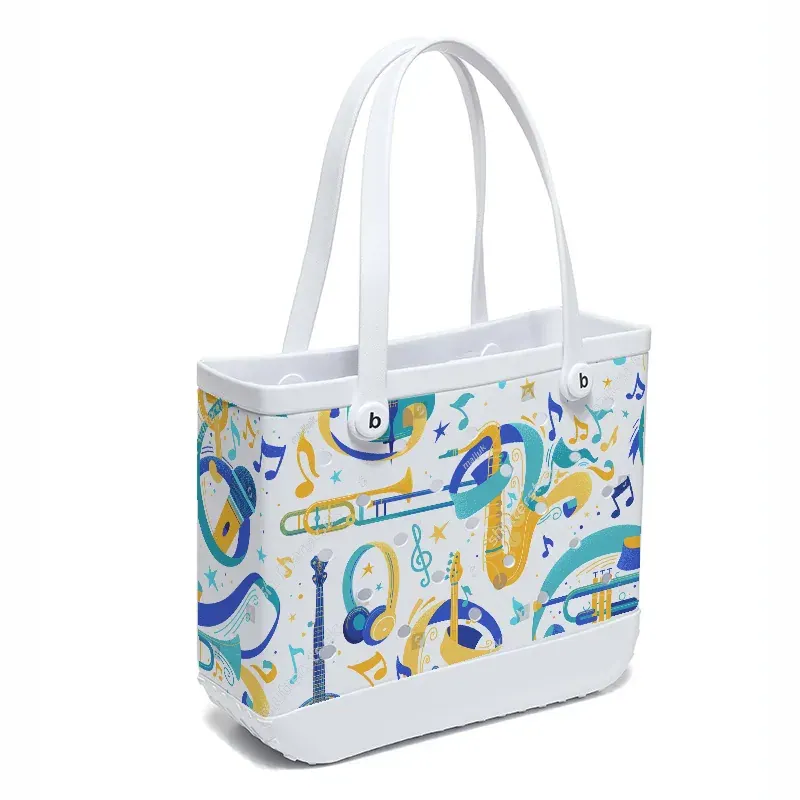
Small totes are returned far less often than large ones, but when they are returned the reason is almost always one of five predictable mismatches. None of them is a product defect, and all of them can be avoided by checking one specification before ordering rather than after delivery.
- Buying a mini size for an adult. Bodies below 24 centimetres hold goggles and sunscreen but not a folded towel, and they read as a toy in adult hands.
- Over-specifying wall thickness. Asking six to eight millimetres on a 7 litre body adds roughly forty percent to the empty weight for no gain in service life.
- Ignoring empty weight on kids sizes. At 0.8 kilograms a kids body exceeds what a five year old can carry comfortably, and it gets dragged instead.
- Ordering charms without checking hole diameter. A charm cut for twelve millimetre holes will not seat in a nine millimetre body, and the body cannot be changed afterwards.
- Assuming small means cheap to ship. Small bodies nest well, but mini sizes need individual protection or the rims scuff in transit.
The single check that prevents most of these is to specify the use case in writing before the size is chosen. Stating that the bag is for a five year old at a weekly swim lesson, or for one adult at a gym three times a week, immediately rules out three of the four sub-bands and makes the remaining choice obvious. Buyers who skip that sentence are the ones who end up with a technically correct bag that nobody reaches for.
Programme Notes
Buyers specifying small and kids sizes for retail or resort programmes should fix four numbers in writing: outer dimensions including base footprint, wall thickness at base and rim, empty weight target, and perforation diameter. Empty weight deserves particular attention in kids sizes because it decides whether a child can actually carry the product. Process and documentation expectations for dimensional and load checks follow the frameworks published by the International Organization for Standardization, and small-part requirements for charms are covered by the consumer safety methods referenced earlier.
QUANZHOU JUNYUAN BAGS has run waterproof bag programmes since 2014 with a founding team in this trade since 2004, covering small and kids-size injection-molded EVA work alongside sewn and welded ranges. Monthly output runs at 200,000 units verified by SGS, operations follow BSCI and ISO 9001, materials are screened for REACH and California Prop 65, and every bulk shipment is inspected at AQL 2.5 before release. Programme minimums begin at 500 pieces per design and colour, with sampling at 6 to 10 working days and bulk at 35 to 50 days from approved sample and deposit. Full category background sits in the injection-molded EVA tote guide, the other end of the range in the large EVA tote guide, and every band side by side in the EVA tote size chart.
Send your target dimensions, empty weight target, colourway count, quantity and destination market to service@junyuanbags.com, and ask for the packed carton specification at the same time, since small bodies nest deeply and freight economics at this size are unusually good.
People Also Ask
What size is a small EVA tote?
A mouth between 24 and 36 centimetres, height between 12 and 20 centimetres, and usable volume between 6 and 16 litres.
How much does a small EVA tote weigh?
Between 0.4 and 1.0 kilograms empty depending on size and wall thickness, with kids sizes at the lightest end around 0.4 kilograms.
What size EVA tote is right for a child?
Around 28 by 19 by 13 centimetres for ages 5 to 8, weighing 0.4 to 0.6 kilograms so a child can carry about 2 kilograms in total.
Can a small EVA tote hold a full-size towel?
Yes from about 30 centimetres across, which lets a folded towel lie flat. Below that, towels have to be rolled.
Are EVA tote charms safe for children?
They are small parts and should be tested against the small-parts requirement for the destination market before being sold with kids sizes.
How do you dry a small EVA tote after swimming?
Rinse it under a tap, tip it to drain, and hang it open by one handle in shade. Perforated bodies dry in well under an hour.
Frequently Asked Questions
Q1. What are the dimensions of a small EVA tote?
Typically 28 by 19 by 13 centimetres for a kids size and 33 by 23 by 14 centimetres for a personal size, with usable volume from about 7 to 10 litres.
Q2. How many litres is a small EVA tote?
Between 6 and 16 litres. The most useful everyday sizes sit at 10 to 14 litres, which holds two towels, sunscreen, a bottle and a book.
Q3. Is a small EVA tote big enough for the beach?
For one or two people for half a day, yes. For three or more people for a full day, no, and a large size is the honest answer.
Q4. What weight can a small EVA tote carry?
Published ratings usually sit between 6 and 12 kilograms. For children, keep the total carried load near ten percent of body weight.
Q5. What wall thickness should a small size have?
Three to five millimetres with a taper toward the base. Specifying the six to eight millimetres used on family sizes adds weight without adding service life.
Q6. Do small totes fit in a gym locker?
Yes. Bodies up to about 36 centimetres across fit a standard locker, which no large size will do.
Q7. Can a child carry a small EVA tote?
Yes if the empty weight is 0.4 to 0.6 kilograms. Heavier bodies get dragged or carried by an adult instead.
Q8. Are the perforations safe for small fingers?
Kids sizes generally use holes at six to nine millimetres, which passes sand and water without admitting small fingers.
Q9. Does a small EVA tote float?
An empty one floats because the material is buoyant. A loaded bag sits low, and no tote of any size is a flotation device.
Q10. How long does a small EVA tote take to dry?
Under an hour open in shade after a tap rinse, because the perforations ventilate the whole body rather than only the upper half.
Q11. What should a bulk buyer specify for kids sizes?
Outer dimensions, wall thickness, empty weight target and perforation diameter, plus small-parts testing for any charm sold with the bag.