Choose the large EVA tote if three or more people use it at once, or if the load includes upright drinks and a picnic; choose the small one if one or two people use it, or if it has to fit a car footwell, a locker or a cupboard shelf. The large body is about 48 by 31 by 24 centimetres with 32 litres and 1.6 to 2.1 kilograms empty; the small is about 33 by 23 by 14 centimetres with 10 litres and 0.7 to 0.9 kilograms. Large carries roughly three times the volume for twice the weight, and it drains faster, tips less and is the only one of the two that stands bottles upright.
The Short Answer, With Numbers
The decision is not really about preference, it is about three facts that can each be checked in seconds: how many people use the bag at once, how long they are out, and where the bag has to fit when it is not being used. Answer those and the size follows, with very few genuinely borderline cases. Where people do sit on the fence, the tie is usually broken by storage rather than by capacity.
Both sizes share the same construction and the same material, so nothing about durability, cleaning or water behaviour changes between them. What changes is geometry, and geometry does three things: it sets how much fits, it sets how far the bag can be carried before it becomes uncomfortable, and it sets whether the bag lives in a hallway or in a garage. The last of those decides how often it gets used, which is the outcome that actually matters.
| Attribute | Large EVA tote | Small EVA tote | Practical difference |
|---|---|---|---|
| Outer dimensions | 48 by 31 by 24 centimetres | 33 by 23 by 14 centimetres | Large is about 45 percent longer |
| Usable volume | About 32 litres | About 10 litres | Large carries roughly three times as much |
| Internal height | 22 centimetres | 12 centimetres | Only large stands a bottle upright |
| Empty weight | 1.6 to 2.1 kilograms | 0.7 to 0.9 kilograms | Small is less than half the weight |
| Load rating | 18 to 26 kilograms | 8 to 12 kilograms | Large suits shared loads |
| Drain time after a dunk | 4 to 7 seconds | 6 to 10 seconds | Faster at large size, more open area |
| Pieces per 40-foot container | 900 to 1,400 | 2,600 to 3,400 | Small ships three times as efficiently |
One line in that table is counter-intuitive and worth explaining, because it reverses the usual assumption. The large body drains faster than the small one, despite holding three times as much, because it carries roughly three times as many perforations and a greater share of open wall area. Water leaves through area, not through volume, so bigger drains quicker.
Capacity in Practice: What the Extra 22 Litres Buys
Twenty-two litres sounds like a modest difference and in practice it is the difference between a bag that works for a family and one that does not. The reason is that the awkward part of a family load is not its volume but its shape: towels are bulky, bottles are tall, and a wet swimsuit does not compress. A small body fits the towels or the bottles, but rarely both at once.
| Load | Small, 10 litres | Large, 32 litres | Verdict |
|---|---|---|---|
| Two towels, sunscreen, a book | Fits with room to spare | Fits | Small is the better fit |
| Four towels and two bottles | No, bottles must lie down | Fits with space left | Large only |
| Six towels and a picnic kit | No | Fits | Large only |
| Child swim kit plus a parent kit | Tight | Fits comfortably | Large only |
| One towel, goggles and a drink | Fits easily | Mostly empty and slides around | Small is the better fit |
| Sports kit for one | Tight | Fits with room for wet gear | Large, if carried a short distance |
The last two rows are the ones that get ignored. A large body carrying a small load is not merely oversized, it is worse: contents slide around the base on every step, and the empty volume collects sand and water that a fuller bag would not. Downsizing has a real floor, and a solo user with a large bag usually ends up resenting it rather than enjoying the spare room.
Where Each One Fits: Car, Home and Destination
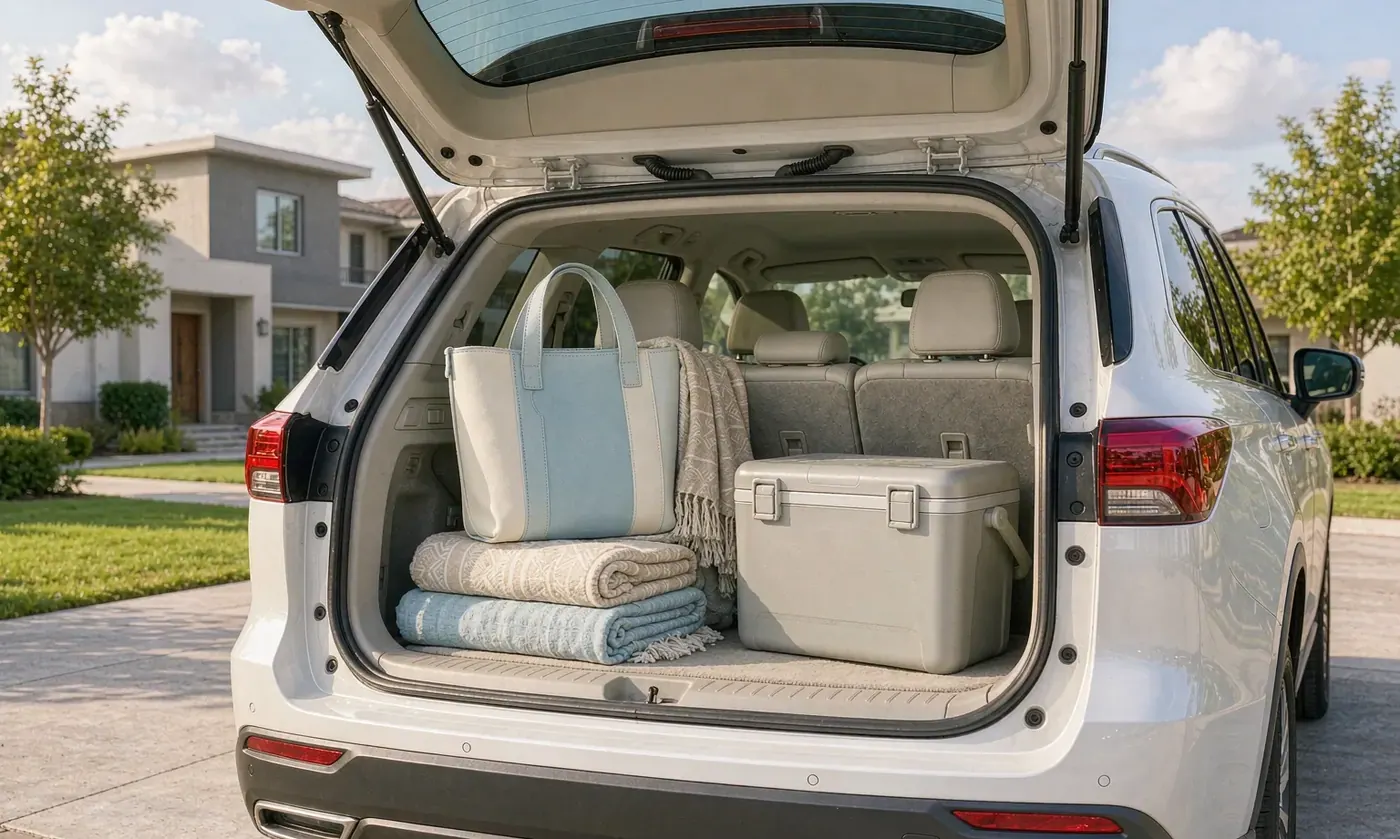
Fit is the constraint that most often decides this, and it is almost never considered before purchase. A 48 centimetre body fits across the boot of an estate or an SUV and does not fit in the footwell of a small hatchback, a gym locker or a standard kitchen cupboard shelf. A 33 centimetre body fits all three, which is why it gets taken out of the house far more often.
| Location | Small fits | Large fits | Note |
|---|---|---|---|
| Car footwell | Yes | Rarely | Decides daily use for most households |
| Estate or SUV boot, across the width | Yes | Yes | Large needs about 50 centimetres clear |
| Small hatchback boot | Yes | Only at an angle | Measure before buying |
| Gym or pool locker | Yes | No | Small is the only realistic option |
| Kitchen cupboard shelf | Yes | No | Large lives on the floor |
| Hung on a hallway hook | Yes, light enough | Yes if the hook is rated | Large needs two handles on a strong fixing |
| Aircraft overhead or under-seat | Yes | No | Neither is ideal; a rigid body does not compress |
Storage deserves more weight in the decision than it usually gets. A bag that has to be fetched from a garage or a shed is used two or three times a season regardless of how well it holds a family load, whereas a bag that hangs by the door gets used weekly. That utilisation gap is the single largest driver of satisfaction in this category, and it favours the small size more often than capacity arguments suggest.
Who Carries It: Weight, Reach and Children
Empty weight is the specification that decides who can actually use the bag. A small body at 0.7 to 0.9 kilograms is the only one of the two a primary school child can carry with a useful load inside, because a child can comfortably carry about ten percent of body weight. A large body at 1.6 to 2.1 kilograms is already a third of that budget for a 20 kilogram child before anything goes in it.
Handle drop differs between the two sizes in a way that compounds the weight issue. Small bodies typically have a drop of 12 to 18 centimetres, which is a hand carry, while large bodies run 20 to 26, which allows a forearm or a short shoulder carry. Neither is comfortable beyond a few hundred metres, and anyone regularly walking more than about 300 metres with either size should specify a detachable strap with a 40 to 60 centimetre drop and a width of 38 to 50 millimetres.
Reach matters too, and it is rarely mentioned. A 48 centimetre mouth is wide enough that a shorter adult or an older child cannot comfortably reach the far bottom corner while carrying it, and a 24 centimetre deep body puts the base out of comfortable reach for the same people. The small body can be searched one-handed at hip height, which sounds trivial and is the reason it gets used for daily tasks rather than only for outings.
Sand and Water Behaviour at Each Size
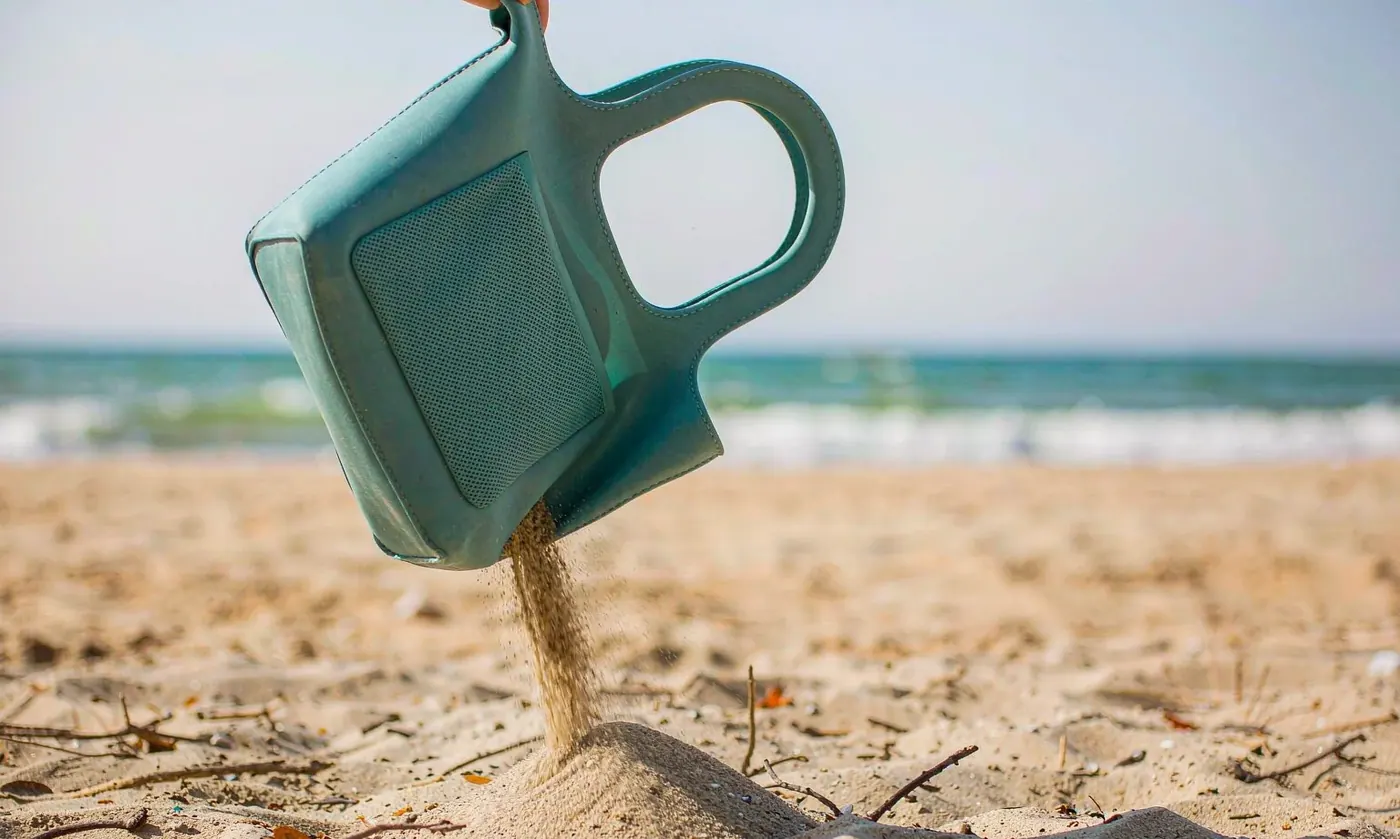
Both sizes shed sand and water through the same mechanism, but the larger body does more of both per unit of time because it carries more open area. Where a small body might have 50 to 90 holes, a large one has 150 to 240, and total drain area rises faster than volume. The practical result is that a large bag loaded with wet gear is dry sooner than a small one loaded proportionally, which surprises people who expect the opposite.
The behavioural difference that does favour the small size is how often it gets cleaned. Because it fits a sink and can be rinsed one-handed in a minute or two, a small body is rinsed after most uses and stays presentable. A large body needs a hose and a couple of minutes, and in practice it is rinsed weekly at best. Over a season that difference shows up as appearance rather than as function, and it is one of the quieter arguments for the small size.
Cost Per Use and Honest Utilisation
Purchase price difference between the two sizes is smaller than most people expect, because material mass scales with size but tooling, packing and handling do not. At retail, a small body sits around USD 35 to 50 and a large one around USD 55 to 75. The more useful comparison is cost per use, because that is where the two sizes diverge dramatically depending on how often the bag leaves the house.
| Usage pattern | Small, cost per use | Large, cost per use | Better value |
|---|---|---|---|
| Weekly, one person | About USD 0.11 at 40 uses a year | About USD 0.17 at 40 uses a year | Small |
| Weekly, family of four | Does not fit the load | About USD 0.17 at 40 uses a year | Large, by default |
| Twice a month, one person | About USD 0.46 | About USD 0.69 | Small |
| Twice a season, family | Does not fit the load | About USD 1.40 | Neither; consider hiring |
| Daily pool use, one person | About USD 0.05 at 200 uses | Unwieldy at that frequency | Small, decisively |
The pattern is consistent and slightly uncomfortable for anyone who already owns a large bag: the small size wins on cost per use in every scenario where it can physically hold the load, and the large size wins only by default where the small one cannot. That is the honest framing of the decision, and it explains why most households that own both reach for the small one most of the time and use the large one perhaps ten times a year.
Poolside, Gym and Everyday Scenarios
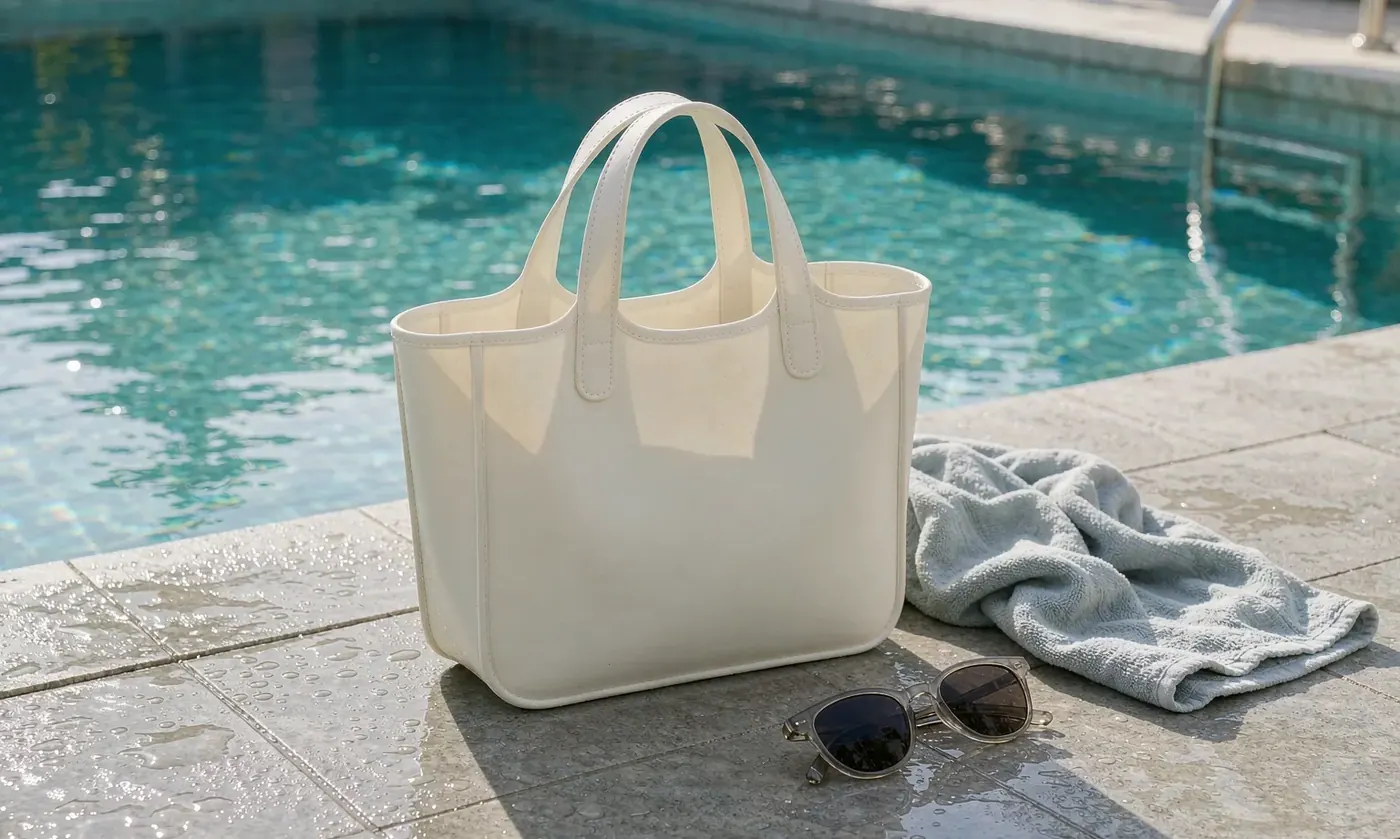
Three everyday contexts favour the small size so strongly that the comparison barely applies. Poolside, the load is one towel and goggles, the distance is short, and the bag has to fit a locker or a bench edge. At the gym, the same applies with the addition of a locker and a shower. And for everyday car or garden carry, the load is light but awkward, which is exactly the profile the small body was proportioned for.
Three contexts favour the large one just as strongly. A family beach day with food and drinks. Anything involving wet gear for more than one person, because wet items do not compress and a small body fills with two towels and a swimsuit. And any load that includes upright bottles, which needs 24 centimetres of internal height and therefore rules the small size out entirely. If any of those three describes the main use, the decision is already made.
Season and Climate Considerations
Climate changes the calculation in two ways that are easy to overlook. Heat exposure scales with panel size, so a large dark body left on a deck or in a boot reaches higher surface temperatures than a small one and has more room to creep. And drying time scales with enclosed volume, so a large wet body left closed stays damp considerably longer than a small one, which matters in humid regions where drying is already slow.
| Condition | Large body | Small body | Practical guidance |
|---|---|---|---|
| Hot tropical sun, dark colourway | Surface passes 60 degrees fast, more creep risk | Warms quickly but less area to deform | Choose light colourways, store both in shade |
| Humid climate, wet load | Up to 150 minutes to dry | 30 to 60 minutes to dry | Dry the large one open and upside down |
| Cold winter use | Usable, material stiffens below freezing | Usable, easier to carry with gloves | Avoid impact when either is frozen |
| Windy exposed beach | Wide mouth catches wind, contents blow | Less exposed area | Both benefit from a low packing profile |
| Short season, stored most of the year | Takes floor space it may not justify | Stores on a shelf | Small suits occasional seasonal use |
The seasonal pattern worth planning for is the off-season. A household in a temperate climate uses either size roughly twenty to forty times a year and stores it for the rest, which makes storage the dominant consideration for most of the ownership period. A small body on a shelf costs nothing to store; a large one on a garage floor is in the way for eight months, and that irritation is the most common reason a large bag is eventually given away.
When Buying Both Is the Right Answer
Most households that use these bags regularly end up owning both, and that is not a failure of the decision but the correct outcome. The two sizes do different jobs, and trying to make one do both produces a bag that is either too heavy for daily use or too small for family outings.
- Buy the small one first. It is the size that gets used weekly, and it establishes whether the category suits the household at all.
- Add the large one only when a specific load has failed to fit the small one, which is a better trigger than a general sense of wanting more room.
- Give each a fixed home: the small one hung by the door or in a footwell, the large one in a boot or a garage.
- Choose different colourways so nobody argues about which is whose, and so the two are not confused at a busy beach.
- Do not expect either to replace the other. The commonest regret is donating the large one because it did not fit a cupboard.
For programme buyers the same logic applies to range planning. A retail range with one size should usually stock the large body, because it is the one bought for families and gifted, while a range with two should lead with the small one on margin and use the large one as the anchor. Stocking both also captures the second purchase, which in this category is common within twelve months.
Decision Table
One last pass, in the order the questions are usually asked. Find the row that matches the dominant use and take the recommendation; where two rows conflict, the higher one wins because storage and carry frequency matter more than occasional capacity.
| If the dominant situation is | Choose | Reason | Specification to check |
|---|---|---|---|
| Three or more people at once | Large | Small cannot hold the load | Internal height 22 centimetres or more |
| Upright drinks are part of the load | Large | Small has 12 centimetres internal | Measure at the centre of the floor |
| One person, pool or gym, most days | Small | Fits a locker, rinses in a sink | Empty weight under 0.9 kilograms |
| Storage is a cupboard shelf or footwell | Small | Large does not fit either | Outer length under 36 centimetres |
| A child will carry it | Small | Weight budget is about 10 percent of body weight | Empty weight 0.4 to 0.6 kilograms |
| Wet gear for more than one person | Large | Wet items do not compress | Full perforation, holes 10 to 12 millimetres |
Physical test methods for dimensional and load checks are published by ASTM International, and quality-management expectations for documenting them come from the International Organization for Standardization. Cleaning guidance for either size aligns with the safer chemical practice published by the United States Environmental Protection Agency: mild detergent, warm water and a soft cloth, with solvents and machine washing avoided.
Programme Notes
The large size in detail sits in the large EVA tote guide, the small size in the small EVA tote guide, and every band side by side in the EVA tote size chart. QUANZHOU JUNYUAN BAGS has run waterproof bag programmes since 2014 with a founding team in this trade since 2004, covering both sizes alongside sewn and welded ranges.
Monthly output runs at 200,000 units verified by SGS, operations follow BSCI and ISO 9001, materials are screened for REACH and California Prop 65, and every bulk shipment is inspected at AQL 2.5 before release. Programme minimums begin at 500 pieces per design and colour, with sampling at 6 to 10 working days and bulk at 35 to 50 days from approved sample and deposit. Send your target size band, dimensions, colourway count, quantity and destination to service@junyuanbags.com.
People Also Ask
Is a large or small EVA tote better?
Large for three or more people or upright drinks; small for one or two people, lockers, cupboards and daily use.
How much bigger is a large EVA tote?
About 48 by 31 by 24 centimetres with 32 litres against 33 by 23 by 14 centimetres with 10 litres, roughly three times the volume for just over twice the weight.
Can a large EVA tote fit in a car footwell?
Rarely. A 48 centimetre body needs a boot about 50 centimetres wide, which rules out most footwells and small hatchback boots.
Which size drains faster?
The large one, at 4 to 7 seconds against 6 to 10, because it carries roughly three times as many perforations and more open area.
Can a child carry a large EVA tote?
No. At 1.6 to 2.1 kilograms empty it exceeds what a child can carry with any useful load inside.
Should I buy both sizes?
Usually yes for a family. The small one gets used weekly and the large one perhaps ten times a year, and they do different jobs.
Frequently Asked Questions
Q1. What is the size difference between large and small EVA totes?
Large is about 48 by 31 by 24 centimetres with 32 litres; small is about 33 by 23 by 14 centimetres with 10 litres.
Q2. How much more does a large EVA tote weigh?
About 1.6 to 2.1 kilograms empty against 0.7 to 0.9, so roughly twice the weight for three times the volume.
Q3. Which size should a family of four buy?
Large. A small body cannot hold four towels plus food and drinks, and it cannot stand bottles upright.
Q4. Which size is better for one person?
Small. It fits a locker and a car footwell, weighs under 0.9 kilograms and is rinsed in a sink rather than needing a hose.
Q5. Can a large EVA tote fit in a small car?
Only across the boot of an estate or SUV, needing about 50 centimetres clear. It does not fit a footwell or a small hatchback.
Q6. Which one drains faster after a swim?
The large one, at 4 to 7 seconds against 6 to 10, because drain speed depends on open area rather than on volume.
Q7. Is the large size harder to carry?
Yes. Empty weight is roughly double, and a 48 centimetre mouth puts the far bottom corner out of comfortable reach for shorter users.
Q8. Which size is better value for money?
Small, in every scenario where it can physically hold the load. Large wins only by default where the small one cannot.
Q9. Can children use either size?
Only the small one, and preferably a kids size at 0.4 to 0.6 kilograms, since a child carries about ten percent of body weight.
Q10. Which size should I buy first?
Small. It is the size that gets used weekly, and it establishes whether the category suits the household before adding a large one.
Q11. Do both sizes need the same care?
The method is identical, but the small body is rinsed far more often because it fits a sink and takes a minute rather than needing a hose.