An EVA pool tote is the right size at 10 to 18 litres, which holds two towels, goggles, a drink and a wet swimsuit without becoming heavy on a short walk from a changing room to a lounger. The material matters more than the size: closed-cell EVA absorbs no water, so a wet swimsuit left inside does not create a damp bag, and the perforations drain in four to ten seconds so the body is dry before the next session. Rinse it with fresh water after each swim, keep it off hot decking in direct sun, and expect a service life of four to seven seasons.
Why a Pool Bag Is a Different Job From a Beach Bag
Pool carry and beach carry look similar and place different demands on a bag. A beach load is bulky and sandy and gets carried a long way; a pool load is smaller, wetter and gets carried a short distance several times a day. That changes which specifications matter. Sand shedding stops being important, drying speed becomes the dominant property, and locker fit replaces boot fit as the dimensional constraint.
It also changes what ruins a bag. At a beach the enemy is grit and ultraviolet exposure; at a pool it is chlorine residue and repeated wet-dry cycles. Chlorine left to dry on the surface is not a cosmetic problem on EVA, because the material does not absorb it, but it is a problem for anything else in the bag and for any fabric trim. A body that can be rinsed in a shower between sessions solves most of it.
| Requirement | Beach load | Pool load | Which specification matters |
|---|---|---|---|
| Dominant contaminant | Sand and salt | Chlorine and sunscreen | Rinse access rather than hole size |
| Carry distance | 100 to 300 metres | 20 to 60 metres, several times | Weight less critical, access more |
| Storage between uses | Garage or boot | Locker or changing room | Outer length under 36 centimetres |
| Drying window | Overnight is usually fine | Same day, often same hour | Full perforation, open storage |
| Load size | Up to 32 litres | 10 to 18 litres | Medium body is usually enough |
| Surface it stands on | Sand, which shifts | Wet tile, which does not | Continuous base rails |
The practical summary is that a pool bag should be smaller, lighter and quicker to dry than a beach bag, and that the property worth paying for is drainage rather than capacity. Most people who buy a 32 litre family body for pool use find it too large within a fortnight and end up using a 10 litre body instead.
What a Swim Load Actually Contains
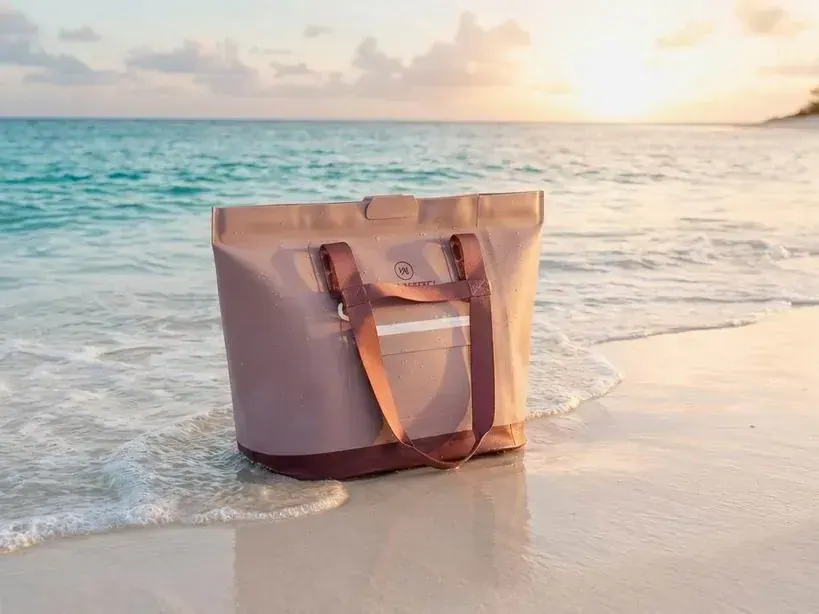
A pool load is more predictable than a beach load, which is why a smaller body works. Two towels, goggles, a cap, a drink, sunscreen and a wet swimsuit account for almost every session, and they total around 7 to 9 litres. Add a book or a tablet in a pouch and the load reaches 10 litres, which is exactly the capacity of a small body.
| Item | Volume | Wet or dry | Where it goes | Note |
|---|---|---|---|---|
| Two quick-dry towels | 3 to 4 litres | Dry going, wet returning | Base layer | Quick-dry matters for daily sessions |
| Goggles and swim cap | 0.5 litres | Wet | Top layer or a pouch | Rinse them with the bag |
| One water bottle | 1 to 1.5 litres | Dry | Upright if height allows | Needs 24 centimetres internal height |
| Sunscreen and lip balm | 0.5 litres | Dry | Top layer | The main staining risk |
| Wet swimsuit | 0.5 to 1 litre | Wet | Dry pouch or wet compartment | Never loose against dry items |
| Book or e-reader in a pouch | 0.5 litres | Dry | Top layer | Pouch it: the body drains, it does not seal |
The one item that surprises people is the towel choice. Cotton towels are bulky and slow to dry, and two of them plus a wet swimsuit can push a 10 litre body to its limit. Quick-dry microfibre towels occupy roughly a third of the volume, dry within an hour, and are the single change that makes a small pool body work comfortably for two people.
Wet Gear and Chlorine: What Actually Happens
The material is unaffected by chlorine at pool concentrations, which is worth stating plainly because people worry about it. Ethylene-vinyl acetate is not attacked by the oxidizing levels found in swimming pools, salt water or sunscreen at ambient temperature. What chlorine does affect is anything else in the bag, and any fabric trim, strap or insert, which is why rinsing with fresh water matters even though the body itself is indifferent.
The more important effect is the wet-dry cycle. A bag used daily goes from wet to dry and back five or six times a week, and a fabric bag in that cycle will smell within a fortnight and mildew within a month. A perforated molded body cannot, because there is no structure to hold water and no organic fibre to support growth. That single difference is the reason pool and swim programmes specify this material, and it is the point worth making to anyone comparing it with a fabric swim bag.
Deck Behaviour: Standing, Slipping and Spills
Wet pool decking is the most demanding surface these bags meet, and three behaviours decide whether a body is pleasant there. It has to stay upright when set down unevenly, it must not slide on smooth wet tile, and it should not collect a puddle underneath itself. All three are governed by the base rather than by the walls.
- Look for continuous base rails rather than corner studs. Rails grip wet tile and spread load; studs concentrate it and slide.
- Check the base is at least as wide as the mouth, because a narrow base tips once a bottle concentrates load low in the bag.
- Set the bag down rather than dropping it. A rigid body on wet tile does not absorb an impact and the rim takes the load.
- Avoid dark colourways on an exposed deck. Surface temperature passes sixty degrees within an hour in summer sun.
- Do not rely on it to keep anything dry. The perforations drain in both directions, so electronics need a pouch.
Puddling underneath is the one that catches people out. A body with a flat base and no drainage path can hold a thin film of water beneath it on a perfectly flat wet deck, and lifting it then tips that water onto the floor. Standing the bag at a slight angle when leaving it for any length of time, or choosing a body with raised rails, removes the problem entirely.
Locker, Bench and Changing Room Fit
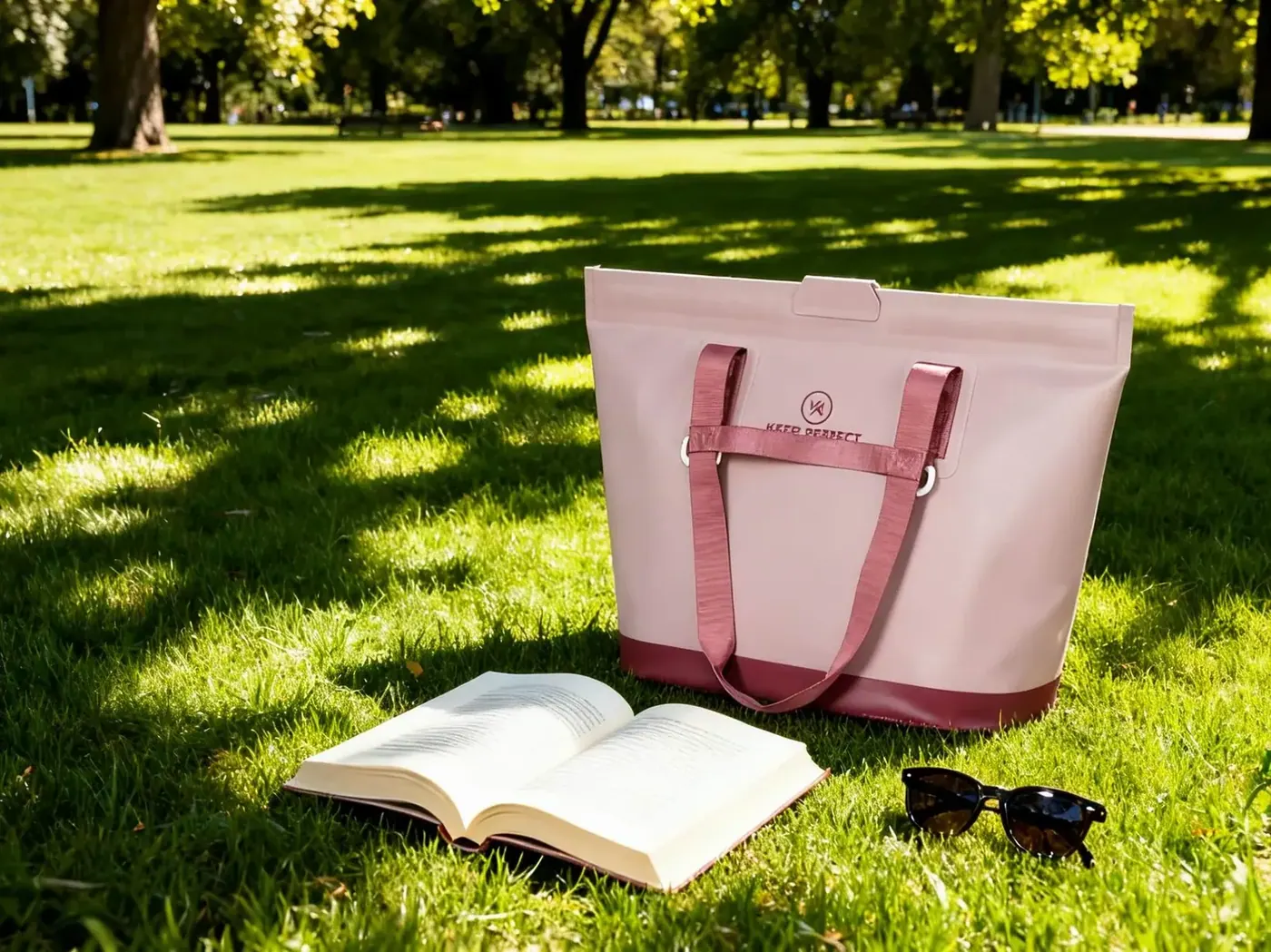
Pool storage is tighter than beach storage and it is the constraint that decides size. A standard changing-room locker is roughly 30 to 40 centimetres wide internally, which accepts a small body and rejects a large one outright. A bench or lounger edge accepts anything, but a body wider than about 36 centimetres overhangs and gets knocked.
| Storage location | Small, 10 litres | Medium, 18 litres | Large, 32 litres | Recommendation |
|---|---|---|---|---|
| Standard changing locker | Fits | Sometimes, at an angle | No | Small only |
| Bench or lounger edge | Fits comfortably | Fits | Overhangs | Small or medium |
| Family changing room floor | Fits | Fits | Fits | Any, subject to space |
| Car footwell after a session | Fits | Fits | Boot only | Small or medium |
| Hung on a changing-room hook | Yes, by one handle | Yes | Yes if the hook is rated | Any, hung by both handles |
For anyone using a public pool with lockers, the small body is the only realistic choice and the decision is already made. For a home pool or a hotel pool where the bag is carried from a room and set beside a lounger, the medium body is comfortable and still manageable, and the large one only makes sense when several people share a single bag.
The Two-Minute Rinse Routine Between Sessions
The routine that keeps a pool bag fresh is shorter than most people expect, and doing it at the pool rather than at home is what makes it sustainable. Rinse, drain, dry open, and nothing else.
- Rinse the body in the pool shower at tap pressure, inside and out, which takes about sixty seconds.
- Rinse goggles and cap at the same time, since chlorine residue on them is what stiffens head straps.
- Turn the bag upside down for thirty seconds. A fully perforated body empties in four to ten seconds after a dunk.
- Stand it open in shade with the mouth angled downward, and leave it until the next session, usually 30 to 60 minutes.
- Empty it completely at the end of the day. Anything left inside overnight will be damp in the morning.
Drying properly is a hygiene step rather than a tidiness one. Guidance on healthy swimming published by the United States Centers for Disease Control and Prevention is explicit about drying swim items between sessions rather than storing them wet, and a body that drains and air-dries inside the hour removes that step from a family routine instead of adding one to it.
Goggles, Caps and the Small Items That Go Missing
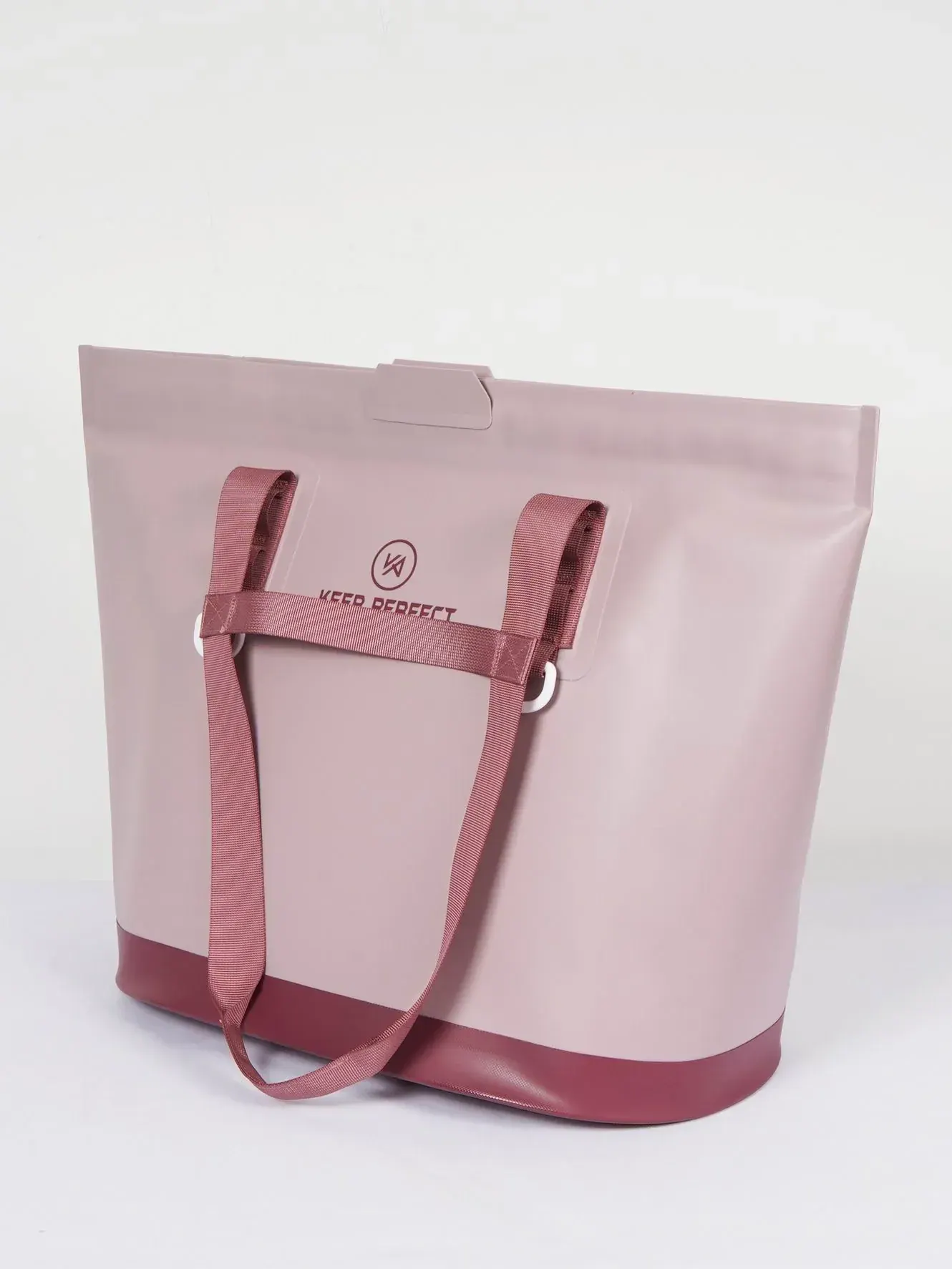
Small swim items are the reason a pool bag becomes frustrating, and the cause is always the same: an open body with one volume lets small objects migrate to the corners and disappear under a towel. Three fixes are cheap and none of them changes how the bag drains.
- Give goggles and cap a fixed pouch. They are the two items most often lost and the two that matter most at the start of a session.
- Use a charm or a coloured tag on the outside of the bag so it can be identified without opening it, which halves the number of searches.
- Keep a small mesh pouch for nose clips, hair ties and ear plugs, since these are exactly the size that escapes attention rather than the perforations.
- Load small items last and on top. Anything placed under a towel will be found only when the bag is emptied.
- Check the perforation diameter if items genuinely go missing: holes above twelve millimetres can pass lip balm and hair ties.
It is worth repeating that perforations are rarely the escape route for anything people actually care about. A hole at ten millimetres retains anything larger than a coin, and items reported as lost through the holes are almost always found later inside the bag. The real problem is visibility in a single open volume, which a pouch solves for a couple of dollars.
Children, Swim Lessons and Family Pool Sessions
Swim lessons are the most demanding pool scenario, because everything is wet, everything is needed at a specific moment, and the person packing is usually in a hurry. A kids body per child plus one parent body is the setup that works, and it mirrors the logic used for beach days: children carry their own towel and drink, and the parent carries the shared items.
| Swim scenario | Parent carries | Child carries | Notes |
|---|---|---|---|
| One child, one lesson | Small, 10 litres | Kids, 7 litres | Child carries towel, goggles and drink |
| Two children, staggered lessons | Medium, 18 litres | Two kids bodies | Two loads are easier than one large one |
| Family pool afternoon | Large, 32 litres | Nothing | One bag works when children are small |
| Swim club training, daily | Medium, 18 litres with an insert | Kids or small | Insert separates wet kit from dry kit |
| Holiday pool, hotel room nearby | Small, 10 litres | Kids, 7 litres | Rinse in the room shower between sessions |
The detail that matters most with children is emptying the bag fully at the end of the day. A child body left with a damp towel inside overnight will be damp in the morning, and while the bag itself cannot be damaged by it, the towel can develop an odour within a day and the habit is the one that eventually makes the bag smell. Empty, rinse and dry open, and the problem never starts.
End of Season and Off-Season Storage
At the end of a pool season the routine extends by about ten minutes and it is worth doing properly, because it is also the moment to catch the two failures that matter. Hose the body, wash it with mild detergent, rinse until no residue remains, and dry it completely in shade. Then inspect the handle roots for cracking and the base rails for wear, since those are the parts that fail and both are cheaper to address before the next season than during it.
Storage is where pool bags most often get damaged, and it is entirely avoidable. Store the body dry, open and upside down, hung by both handles if there is a suitable hook, out of direct sun and away from any heat source. Remove charms and inserts and store them separately so hole edges are not stressed, and do not stack anything heavy inside it, because sustained load on a moulded base over several months can creep the shape.
Sunscreen, Staining and What to Avoid
Sunscreen is the only substance that routinely marks these bags, and it does so by sitting on the surface rather than by absorbing. It comes off with warm water, mild detergent and a soft cloth, and it comes off more easily if it is dealt with the same day rather than after a week of repeated applications.
Three things should be avoided, and all three cause permanent rather than temporary damage. Solvent cleaners, including most bathroom sprays and degreasers, attack the surface layer and leave a dull patch that collects dirt faster than the surrounding area. Machine washing flexes the body against itself and can crease it permanently. And water above sixty degrees, including dishwashers, risks deforming the shape. Cleaner choice is easier with the safer chemical guidance published by the United States Environmental Protection Agency as a reference, and a mild detergent is genuinely all that is needed.
One further comparison is worth making explicitly, because it is the question pool users ask most often: this material against a fabric swim bag. A fabric swim bag is lighter, folds into a locker more easily and can be machine washed, which are three real advantages. Against them, it absorbs water, needs hours to dry, holds chlorine residue in its fibres and will smell within a fortnight of daily use. For a bag used twice a week or less, fabric is defensible; for daily sessions, a perforated moulded body wins on every measure except weight.
Choosing Size and Colour for Pool Use
Two choices decide most of the experience, and both are simple once the use case is clear. Size follows storage: a locker means small, a lounger means small or medium, and a shared family load means large. Colour follows heat: light colourways stay cooler and hold their appearance longer in exposed positions.
| Pool situation | Recommended size | Recommended colourway | Reason |
|---|---|---|---|
| Public pool with lockers | Small, 10 litres | Light or bright | Locker fit and easy identification |
| Home pool, one or two users | Small to medium, 10 to 18 litres | Mid-tone | Enough room without excess weight |
| Hotel or resort pool | Small, 10 litres | Bright, with charms | Identifiable on a crowded deck |
| Swim club, daily training | Medium, 18 litres | Light, with an insert | Separates wet kit from dry kit |
| Family sharing one bag | Large, 32 litres | Light | Towels for several people plus drinks |
Physical test methods for dimensional and load checks on molded articles are published by ASTM International, which is where the load and temperature limits quoted in this guide come from. Consumers never need the numbers, but asking which method a rating was tested under is the fastest way to separate a real specification from a marketing one.
Programme Notes
The moulded rubber alternative is covered in the rubber beach tote range, full category background sits in the injection-molded EVA tote guide, and the complete cleaning routine is set out in are EVA totes washable. QUANZHOU JUNYUAN BAGS has run waterproof bag programmes since 2014 with a founding team in this trade since 2004, covering pool and swim sizes alongside sewn and welded ranges.
Monthly output runs at 200,000 units verified by SGS, operations follow BSCI and ISO 9001, materials are screened for REACH and California Prop 65, and every bulk shipment is inspected at AQL 2.5 before release. Programme minimums begin at 500 pieces per design and colour, with sampling at 6 to 10 working days and bulk at 35 to 50 days from approved sample and deposit. Send your target size, colourway count, quantity and destination market to service@junyuanbags.com.
People Also Ask
What size EVA tote is best for a pool?
The small body at about 10 litres, which fits a changing-room locker and holds two towels, goggles, a drink and a wet swimsuit.
Does chlorine damage an EVA tote?
No. The material is not attacked by pool chlorine at ambient concentration, though fresh water rinsing is still needed for trims and other contents.
How do I keep a wet swimsuit from soaking everything?
Use a dry pouch or a drop-in insert. The perforations drain water but they do not separate wet fabric from dry items.
Can an EVA tote go in a pool locker?
A small body can. A standard locker is roughly 30 to 40 centimetres wide internally, which rules out large sizes entirely.
How quickly does an EVA pool tote dry?
About 30 to 60 minutes standing open in shade, because the perforations ventilate the whole body rather than only the top.
What colour is best for pool use?
A light or bright colourway. Dark bodies pass sixty degrees at the surface within an hour in summer sun, which can deform the shape.
Frequently Asked Questions
Q1. What size EVA tote should I use for the pool?
Ten litres for one or two people, 18 for a swim club or a small family, and 32 only when several people share one bag.
Q2. Will chlorine damage the bag?
No. Pool chlorine does not attack EVA at ambient concentration, though rinsing with fresh water is still needed for straps, inserts and contents.
Q3. How do I stop a wet swimsuit soaking my towel?
Use a dry pouch or a drop-in insert divider. The perforations drain water but do not separate wet items from dry ones.
Q4. Will it fit in a changing-room locker?
A small body will, at about 33 centimetres long. A large body will not, since most lockers are 30 to 40 centimetres wide internally.
Q5. Does the bag slide on wet pool decking?
Not if it has continuous base rails. Corner studs slide on smooth wet tile and concentrate load, which is the main deck complaint.
Q6. How long does it take to dry between sessions?
About 30 to 60 minutes standing open in shade for a small body, and 45 to 90 for a medium, because the perforations ventilate the whole interior.
Q7. Can I leave it on the pool deck in the sun?
A light colourway in shade is safer. A dark body in direct summer sun passes sixty degrees at the surface within an hour, which can creep the shape.
Q8. How do I remove sunscreen from it?
Warm water, mild detergent and a soft cloth, then rinse well. Deal with it the same day, since repeated applications build up.
Q9. Can I machine wash a pool tote?
No. A cycle flexes the body against itself and can crease it permanently. Rinse it in a shower and dry it open in shade.
Q10. What is the best colour for a pool bag?
Light or bright. It stays cooler in sun, holds its appearance longer, and a bright body is easier to identify on a crowded deck.