EVA and PVC reach flexibility by different routes, and that single difference explains almost everything else. EVA is flexible as polymerised, at a density of 0.93 to 0.95 grams per cubic centimetre, and stays soft to about minus 30 degrees. PVC is rigid until plasticiser is added, runs 1.30 to 1.45 grams per cubic centimetre, and stiffens noticeably near zero. A 32 litre EVA body weighs 1.8 to 2.4 kilograms against 2.6 to 3.6 for the same volume in PVC. Choose EVA for weight, cold weather and one-piece moulding; choose PVC where a clear glossy finish matters more than weight.
Two Polymers, Two Routes to Flexibility
The distinction that governs this comparison is chemical rather than marketing. Ethylene-vinyl acetate copolymer is intrinsically soft: the vinyl acetate comonomer disrupts crystallinity in the ethylene chain, so the material is flexible as polymerised, with nothing added. Polyvinyl chloride is intrinsically rigid, with a glass transition near 80 degrees, and it only becomes soft when a plasticiser is blended into it. One material is flexible because of what it is; the other is flexible because of what was added to it, and added things can migrate, evaporate and attract regulatory attention.
That difference cascades. Because EVA needs no plasticiser, its properties are stable over the life of the article. Because PVC depends on one, its softness changes as the plasticiser slowly leaves, which is why a PVC bag that is supple in its first summer is noticeably stiffer by its third. The vinyl acetate content sets where EVA sits on the range: 12 to 18 percent gives a firm, rubbery body suitable for a rigid tote, while 28 to 40 percent gives the soft, almost foam-like feel used in footwear midsoles and in the softest totes.
| Property | Injection-molded EVA | Plasticised PVC | Practical consequence |
|---|---|---|---|
| Density | 0.93 to 0.95 grams per cubic centimetre | 1.30 to 1.45 grams per cubic centimetre | PVC is 40 to 50 percent heavier at equal volume |
| Hardness range | 40 to 80 Shore A | 55 to 90 Shore A | Both cover the tote range, EVA softer at the bottom |
| Flexibility mechanism | Intrinsic, from the comonomer | Added plasticiser | PVC softness changes over time |
| Cold flexibility | Flexible to about minus 30 degrees | Stiffens near zero, cracks below minus 10 | EVA for cold water and winter |
| Upper service temperature | About 70 to 80 degrees | About 60 to 70 degrees | Both deform in a hot car |
| Clarity | Translucent at best | Water clear possible | PVC wins on a clear glossy finish |
Weight and What It Does to the Carry
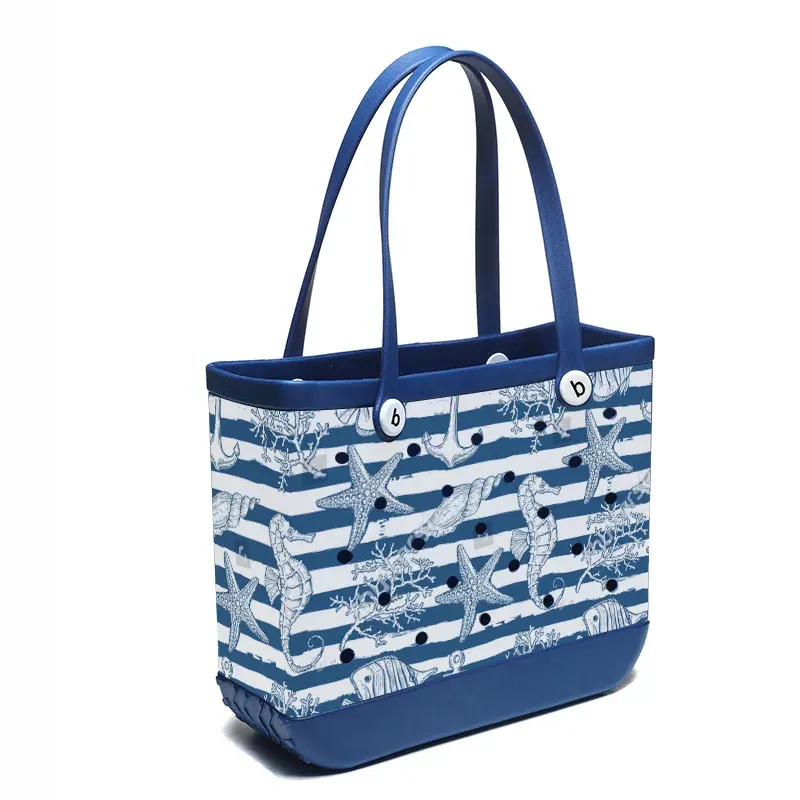
Weight is the difference buyers feel first and it is not marginal. A 32 litre body in EVA weighs 1.8 to 2.4 kilograms empty; the same volume in a welded PVC sheet at 0.8 to 1.0 millimetre weighs 2.6 to 3.6 kilograms. On a 7 kilogram load that is the difference between carrying 9 kilograms and carrying 10.5, and on a 300 metre walk from a car park it is the difference between one trip and two stops. For a family bag loaded with towels, bottles and toys the empty weight is the specification that decides whether the bag gets used.
Weight also changes the freight arithmetic, and not only because heavier goods cost more to ship. Heavier bodies nest less well in a carton because they resist the slight compression that lets moulded bodies settle, so a PVC order can pack 20 to 30 percent fewer pieces per container than the same volume in EVA. That is a landed cost difference that never appears in a unit price comparison, which is exactly why landed cost rather than unit price is the figure worth comparing.
Clarity, Colour and Finish
PVC wins this section outright and it is the main reason anyone chooses it. Plasticised PVC can be produced water clear, in saturated transparent colour, with a high gloss surface that EVA cannot match; EVA is translucent at best and usually looks slightly waxy. For a fashion tote, a clear stadium-compliant bag or a product where the contents are part of the look, that clarity is the whole point and no EVA body will substitute for it.
Colour stability runs the other way. EVA takes pigment well and holds it, with a properly stabilised body showing a modest fade over three to five seasons. Clear PVC yellows under ultraviolet exposure as the polymer degrades, and the effect is most visible on exactly the clear finish that justified choosing it, typically appearing within two seasons of regular sun exposure. Pigmented PVC hides the yellowing better but loses the clarity that was the reason for choosing the material, which is the trap at the centre of this comparison.
Cold, Heat and Weather
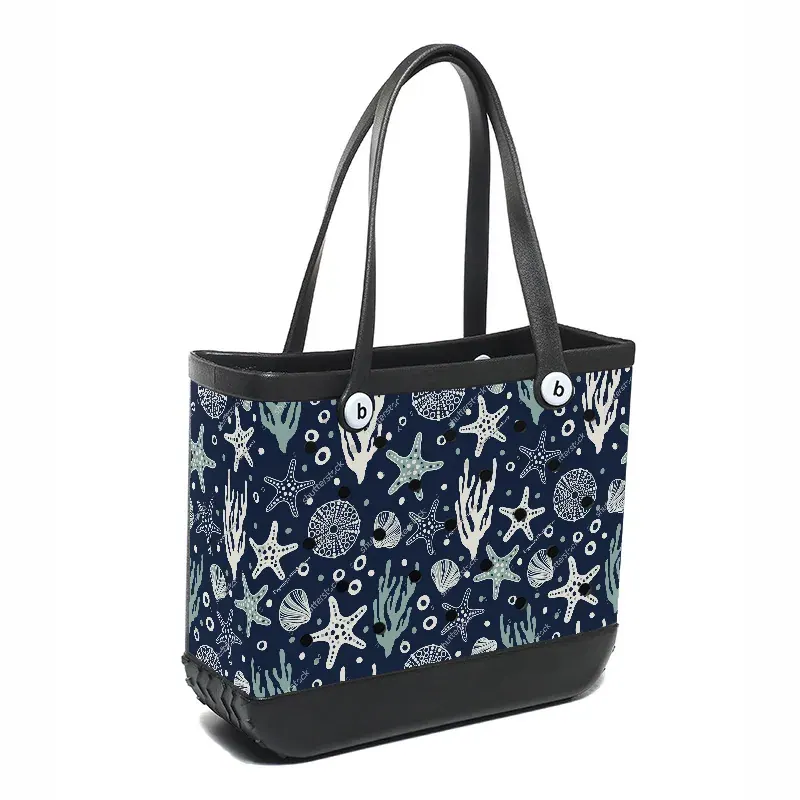
Temperature separates the two more sharply than any other property, and in both directions. EVA stays flexible to roughly minus 30 degrees, which makes it the only sensible choice for a bag used on a winter beach, a boat in a northern latitude or a ski resort programme. Plasticised PVC stiffens noticeably as it approaches zero and can crack below about minus 10, and the temperature at which that happens depends on which plasticiser was used, which is a specification detail most buyers never see and should ask for.
| Condition | EVA behaviour | PVC behaviour | Verdict |
|---|---|---|---|
| Minus 20 degrees | Remains flexible | Stiff, risks cracking on a fold | EVA clearly |
| Near zero | Unchanged | Noticeably stiffer | EVA |
| Summer shade, 30 degrees | Stable | Stable, slight plasticiser odour | Even |
| Direct sun, surface above 60 | Softens, can creep | Softens sooner, plasticiser migrates faster | EVA, marginally |
| Salt water | Unaffected | Unaffected, hardware still at risk | Even |
| Ultraviolet over two seasons | Modest fade | Clear grades yellow | EVA |
| Sunscreen and oils | Surface marks, wipes off | Can soften and cloud the surface | EVA |
Heat is the one condition that defeats both, and it is worth being blunt about it. A dark body of either material left in direct summer sun passes 60 degrees within an hour, and both will deform under load at that temperature. The mitigation is the same for both and it is behavioural rather than material: light colourways, storage out of direct sun, and never leaving a loaded bag in a closed car. Any claim that one of these materials is immune to heat should be treated as marketing.
How Each One Is Formed
The two materials are made into bags by entirely different processes, and that determines what shapes are possible. EVA is injection moulded: pellets are melted and injected into a closed tool, and a complete body with its handles, base and perforations comes out as one piece in a single cycle of 90 to 150 seconds. There are no seams, no welds and no glued joints, which is why a moulded tote can be hosed down and left to drain without anything coming apart.
PVC is a sheet material in this application. It is calendered or extruded into film, then cut and joined, either by radio frequency welding or by solvent welding, with handles and trim added as separate components. The welds are strong when they are made well and they are the failure point when they are not: a bag that leaks at a seam has a weld defect, and a weld defect is invisible until it fails. Welded construction also makes a one-piece perforated body impractical, which is why the perforated, drain-through design that defines the beach category is an EVA shape rather than a PVC one.
| Attribute | Injection-molded EVA | Welded PVC sheet |
|---|---|---|
| Pieces in the finished body | One | Several panels plus handles and trim |
| Joints | None | RF or solvent welds at every seam |
| Perforations | Formed in the tool, any layout | Cut after welding, limited layouts |
| Cycle or build time | 90 to 150 seconds per body | Several minutes of cutting and welding |
| Failure point | Handle radius under repeated load | The weld line |
| Tooling | 6,000 to 18,000 dollars | Cutting dies and weld jigs, far less |
What Each One Costs
Raw material favours PVC and finished goods favour EVA, which is the counterintuitive part of this comparison. PVC compound runs roughly 1.10 to 1.60 dollars per kilogram and EVA compound 1.60 to 2.40, so on resin alone a PVC bag should be cheaper. It is not, because the PVC bag needs cutting, welding, handle attachment and trim, all of which are labour operations, while the EVA body leaves the machine finished. At 2,000 pieces the two land within about ten percent of each other; above about 10,000 pieces the moulded body pulls clearly ahead.
| Order quantity | EVA body, 32 litres | PVC body, 32 litres | Why |
|---|---|---|---|
| 500 pieces | 9.80 to 11.50 dollars | 9.20 to 11.00 dollars | PVC avoids a tooling charge |
| 2,000 pieces | 8.20 to 9.60 dollars | 8.00 to 9.40 dollars | Close, PVC slightly ahead |
| 10,000 pieces | 6.20 to 7.40 dollars | 6.80 to 8.20 dollars | Moulding beats labour at volume |
| 50,000 pieces | 5.60 to 6.60 dollars | 6.40 to 7.60 dollars | EVA clearly ahead |
Two costs sit outside those figures and both favour EVA. Freight is higher per unit on PVC because of the weight and the packing density described earlier. And rework risk is higher, because a weld defect appears at inspection or in the field rather than at the machine, whereas a moulding defect is caught in the first hundred pieces of a run. Neither appears in a unit price and both appear in a season's accounts.
Chemicals, Compliance and Disposal
This is the section that decides the question for programmes selling into the European Union, and it is the reason several retail chains have moved away from plasticised PVC in consumer articles. The softness in a PVC tote comes from a plasticiser, and certain plasticisers are restricted in articles placed on the European market. Restrictions and candidate listing for substances of very high concern are administered by the European Chemicals Agency, and a buyer placing a PVC programme there needs a screening report naming which plasticiser system was used rather than a general statement of compliance.
EVA carries no plasticiser and contains no chlorine, which removes the plasticiser question entirely and simplifies both the screening and the end-of-life story. It is not a biodegradable material and should not be described as one; it is a thermoplastic that can be reground and reprocessed, and off-cuts from a moulding run are routinely regrindable within the same programme. PVC presents a harder disposal case because chlorine content restricts incineration options and plasticiser content restricts mechanical recycling, and buyers with a stated packaging or product policy should check the material against that policy before choosing it.
Verification is straightforward for both. Ask for a screening report per material set — body, strap webbing, print ink and any trim — and check the date, because a report is valid for about a year or until a formulation changes. Physical test methods for hardness, cold bend and tensile checks are published by ASTM International, and documented quality management around holding those records aligns with the International Organization for Standardization. A programme that names the plasticiser system and dates the report has answered the question properly; one that says compliant has not.
Which One Suits Which Buyer
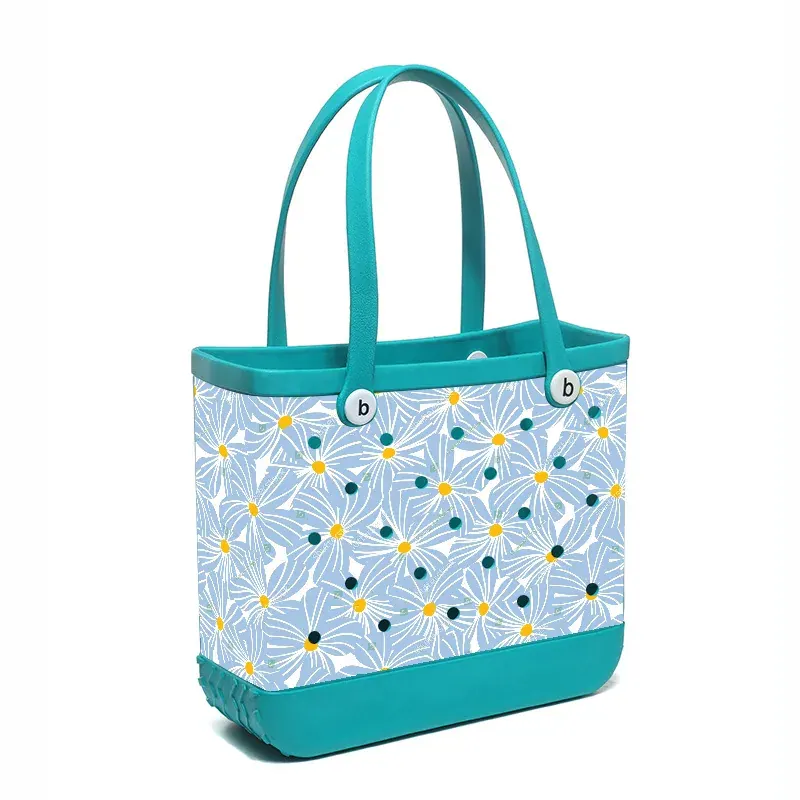
The decision is genuinely application-led and the honest answer is that each material owns a set of uses. EVA owns anything that has to drain, stand on wet ground, be hosed down, stay light on a long carry, or work in cold weather. PVC owns anything where clarity, gloss or a low tooling entry cost is the deciding factor. Anyone who tells you one of them is universally better is selling something.
| Use case | Choose | Reason | Avoid because |
|---|---|---|---|
| Family beach bag, sand and wet kit | EVA | Drains, hoses clean, 40 percent lighter | PVC holds water and welds can fail |
| Cold water, winter or boat use | EVA | Flexible to minus 30 degrees | PVC stiffens near zero and cracks below minus 10 |
| Clear fashion or stadium tote | PVC | Water clear and glossy | EVA is translucent at best |
| Low tooling budget, first programme | PVC | No mould cost | Unit price overtakes above 10,000 pieces |
| Resort programme with artwork | EVA | Semi-perforated panel takes print | Printing on clear PVC clouds the surface |
| Programme with a strict chemical policy | EVA | No plasticiser, no chlorine | PVC needs a named plasticiser system |
One hybrid note closes the comparison. Some programmes use a moulded EVA base with a clear PVC upper to get drainage where it matters and clarity where it shows. It works mechanically and it complicates both the recycling story and the compliance story, because the article now contains two material declarations instead of one. Buyers considering it should ask whether the clarity is worth two screening reports and a mixed-material disposal classification, and in most beach applications the answer is no.
Care and Service Life
Both materials are low maintenance and neither needs anything beyond fresh water, but the failure signs differ and recognising them early is what gets a bag replaced under warranty rather than argued about.
- Rinse with fresh water after any salt water session, paying attention to strap fittings on both materials.
- Hose an EVA body at tap pressure; wipe a PVC body rather than hosing it, since water pressure at a weld is a stress the weld did not need.
- Store both out of direct sun. A dark body of either material passes 60 degrees within an hour in summer.
- Never use solvents. They attack PVC quickly and leave EVA tacky.
- Watch for stiffness in a PVC body: it is plasticiser loss and it is irreversible.
- Watch for whitening at a fold on EVA: it is stress whitening and it usually recovers when the stress is removed.
- Retire a bag with a cracked handle radius or a split weld. Both are structural and neither can be repaired to last.
Service life on a well-kept EVA body is five to seven seasons of regular beach use; a clear PVC body is typically two to four before yellowing makes it look tired, and a pigmented one three to five. Hardware rather than material ends most bags of either type, and a corrosion-resistant fitting rinsed occasionally will outlast the body it is attached to.
Telling the Two Apart Without a Specification Sheet
A buyer standing in a showroom with two samples and no documentation can separate the materials in about a minute, and the checks are worth knowing because a misdescribed sample is a common problem. Weight is the fastest test: pick up both bodies of the same size and the PVC one is obviously heavier, by roughly half again. Odour is the second and it is reliable — plasticised PVC has a faint characteristic smell that strengthens in a warm room, while EVA is close to odourless. Flex the wall and the EVA body springs back with a rubbery feel, whereas PVC feels slicker and slower to recover.
The burn test is definitive and should never be done on a sample you might return, but it is worth knowing what it shows: EVA burns with a blue flame and a wax-like smell, while PVC self-extinguishes with a green flame and an acrid chlorine odour. In practice nobody needs it, because density, odour and flex give the answer in combination. What the showroom check cannot tell you is which plasticiser system a PVC body uses, and that is the question with regulatory weight, so it has to be asked in writing regardless of what the sample suggests.
| Check | EVA | PVC | Reliability |
|---|---|---|---|
| Weight in the hand | Noticeably lighter | Heavy for its size | High |
| Odour in a warm room | Almost none | Faint, characteristic | High |
| Flex and recovery | Rubbery, springs back | Slicker, slower recovery | Medium |
| Surface finish | Matte to satin, slightly waxy | High gloss, can be water clear | High |
| Sound when tapped | Dull thud | Sharper click | Medium |
| Plasticiser system | None present | Cannot be identified by hand | Requires a written declaration |
Programme Notes
Material detail sits in the EVA tote materials guide, the body range in the injection-molded EVA tote guide, and the rubberised end of the category in the waterproof rubber beach tote guide. Buyers weighing a canvas alternative should read the EVA tote versus canvas comparison as well. QUANZHOU JUNYUAN BAGS has run waterproof bag programmes since 2014 with a founding team in this trade since 2004, at monthly output of 200,000 units verified by SGS, under BSCI and ISO 9001, with materials screened for REACH and California Prop 65 and every bulk shipment inspected at AQL 2.5 before release.
Send the volume, the use case, the weight target and the destination market to service@junyuanbags.com, and ask for the empty weight and the packed carton quantity on both materials before deciding, because those two figures carry more weight in a season than the unit price does.
People Also Ask
Is EVA better than PVC for a beach bag?
For a draining family beach bag, yes: it is 40 to 50 percent lighter at equal volume, stays flexible to minus 30 degrees and moulds as one piece with no welds.
Why is PVC clearer than EVA?
Plasticised PVC can be made water clear, while EVA is translucent at best. That clarity is the main reason to choose PVC.
Which is cheaper, EVA or PVC?
PVC compound is cheaper per kilogram, but the finished EVA body is cheaper above about 10,000 pieces because moulding replaces cutting and welding labour.
Does PVC crack in cold weather?
Yes. Plasticised PVC stiffens near zero and can crack below about minus 10, while EVA stays flexible to roughly minus 30 degrees.
Is plasticised PVC restricted in Europe?
Certain plasticisers are restricted. Buyers need a screening report naming the plasticiser system rather than a general statement of compliance.
Which material lasts longer outdoors?
EVA, at five to seven seasons. Clear PVC yellows under ultraviolet exposure, usually within two seasons of regular sun.
Frequently Asked Questions
Q1. What is the main difference between EVA and PVC totes?
EVA is flexible as polymerised and needs no plasticiser; PVC is rigid until one is added, which makes it heavier and changes how it ages.
Q2. How much heavier is a PVC beach bag?
About 40 to 50 percent at equal volume: 2.6 to 3.6 kilograms for a 32 litre PVC body against 1.8 to 2.4 for the same volume in EVA.
Q3. Which material is better in cold weather?
EVA. It stays flexible to about minus 30 degrees, while PVC stiffens near zero and risks cracking below about minus 10.
Q4. Can EVA be made clear?
Not really. EVA is translucent at best; water clear requires plasticised PVC, which is the main reason to choose it.
Q5. Why does clear PVC turn yellow?
Ultraviolet degradation of the polymer. It is most visible on exactly the clear finish that justified choosing the material, usually within two seasons.
Q6. Does a PVC tote have seams?
Yes. PVC is a sheet material joined by radio frequency or solvent welding, and the weld line is the failure point an EVA body does not have.
Q7. Which is cheaper at 10,000 pieces?
EVA, at 6.20 to 7.40 dollars against 6.80 to 8.20 for the welded PVC body, because moulding replaces cutting and welding labour.
Q8. Is EVA free of plasticisers?
Yes. It contains no plasticiser and no chlorine, which removes the plasticiser question entirely for European programmes.
Q9. Can either material be recycled?
EVA can be reground and reprocessed within a programme. PVC is harder because chlorine restricts incineration and plasticiser content restricts mechanical recycling.
Q10. How long does each material last?
Five to seven seasons for a well-kept EVA body, three to five for pigmented PVC and two to four for a clear one before yellowing shows.
Q11. Which should I choose for a resort programme?
EVA, because a semi-perforated upper panel takes print cleanly, while printing on clear PVC clouds the surface it was chosen for.