An EVA tote is waterproof in the only sense that matters at a beach: the material absorbs effectively no water, drains in four to seven seconds through its perforations and is dry within the hour. Canvas is water resistant at best, absorbing up to roughly 25 percent of its own dry weight in water and taking several hours to dry. Neither keeps contents dry if submerged, because an open-top perforated body is not a sealed container. The decision is therefore about what happens to the bag rather than to its contents, and on that measure EVA wins on water, sand and cleaning while canvas wins on weight, packability and softness.
What Waterproof Means for Each Material
The word waterproof is doing different work in each case, and conflating the two is what causes most disappointment. Ethylene-vinyl acetate is a closed-cell copolymer: water cannot enter the cell structure, so the material itself takes up effectively nothing and cannot rot, mildew or stain. Canvas is a woven fabric, usually cotton or a cotton blend, whose fibres and interstices hold water by capillary action; a wet canvas tote can gain around a quarter of its dry weight in retained water.
That distinction produces the behaviours people actually notice. A perforated EVA body dropped in the surf comes out, drains in seconds and is dry in an hour standing in shade. A canvas body in the same situation stays damp for hours, becomes heavy enough to sag, and if it is put away wet it will smell within a day or two and can mildew within a week. For anyone whose bag gets wet most times it is used, this single difference outweighs everything else in the comparison.
| Water behaviour | Injection-molded EVA | Canvas tote | Practical consequence |
|---|---|---|---|
| Water absorption | Effectively zero | Up to about 25 percent of dry weight | Canvas gets heavier and sags when wet |
| Drain time after a dunk | 4 to 7 seconds | Does not drain, wicks instead | EVA is usable again immediately |
| Drying time | About 60 minutes in shade | 3 to 8 hours depending on humidity | Canvas needs a drying plan |
| Mildew risk | None | Real risk if stored damp | Canvas fails in humid climates |
| Staining from sunscreen or food | Rinses off | Absorbs and often remains | Canvas discolours over a season |
| Behaviour when set on wet ground | Base sheds water | Base wicks water upward | Canvas soaks contents from below |
One caveat belongs here for honesty. Neither material makes a sealed container. An open-top perforated EVA tote lets water in as readily as it lets it out, so a phone in the bag will get wet in the surf regardless of which material is chosen. The difference is what happens next: the EVA body is dry and clean an hour later, while the canvas one is still damp and carrying salt.
Sand, Dirt and What Each Bag Carries Home
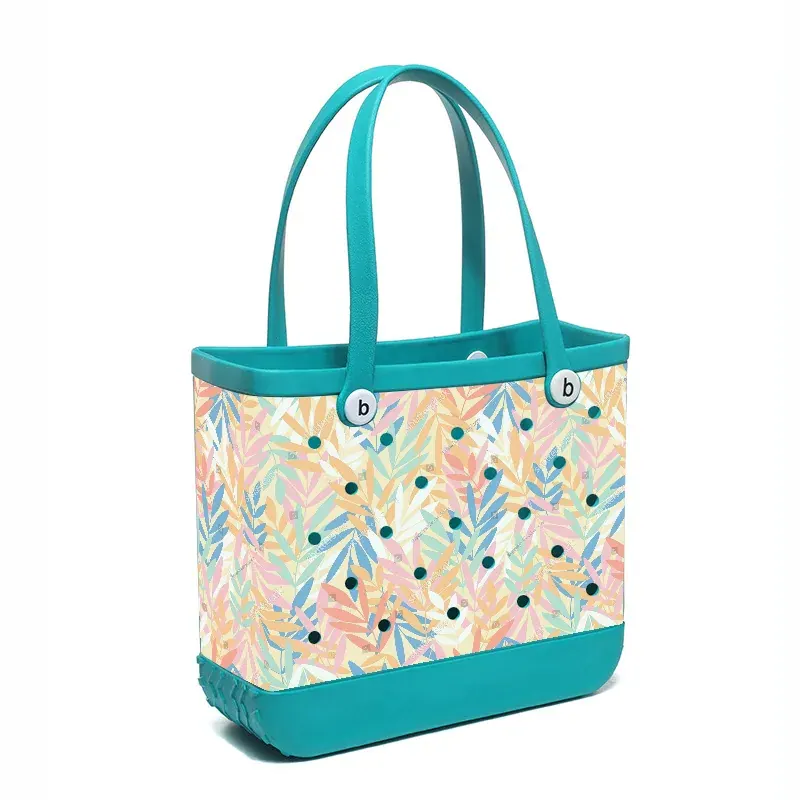
Sand is the second deciding factor and it behaves in opposite ways in the two materials. Perforated EVA lets dry and damp sand fall through holes of nine to twelve millimetres, so a shake at the end of the day removes most of what came in. Canvas holds sand in the weave and in the seams, particularly along the base, and no amount of shaking removes it; it has to be brushed or vacuumed, and some of it stays permanently in the stitching.
| Contaminant | How EVA handles it | How canvas handles it | Time to deal with it |
|---|---|---|---|
| Dry beach sand | Falls through the perforations | Trapped in the weave and seams | EVA 10 seconds, canvas 5 to 10 minutes |
| Damp sand | Passes at 10 millimetres and above | Cakes into the weave | EVA seconds, canvas needs drying first |
| Sunscreen residue | Rinses off with mild detergent | Absorbs and leaves a mark | EVA 1 minute, canvas a wash cycle |
| Food and drink spills | Hoses out, no stain | Stains unless treated immediately | EVA 1 minute, canvas a full wash |
| Mud and grass | Hoses through the holes | Grinds into the fibres | EVA 2 minutes, canvas pre-soak plus wash |
| Salt residue | Rinses away completely | Crystallises in the fibres and stiffens the fabric | EVA 1 minute, canvas a full wash |
The accumulated effect over a season is larger than the per-incident numbers suggest. A canvas bag used at the beach twice a week will be washed perhaps eight times over a summer, and each wash costs water, time and a little of the fabric life. An EVA bag in the same use is hosed perhaps forty times and washed never. For a household, that is the difference between a chore and a non-event.
Washing and Drying: Method, Time and Frequency
Washing is where the two materials invert their usual advantages. Canvas can go in a washing machine, which sounds like the better answer until the full cycle is counted: a wash at 30 or 40 degrees, a slow spin, and three to eight hours of drying before it can be used again, plus the risk of shrinkage on cotton and of colour loss on printed artwork. EVA cannot go in a machine at all, because flexing the body against itself can crease it permanently, but it does not need to: a hose at tap pressure and a minute of rinsing is the whole routine.
| Care task | EVA tote | Canvas tote | Winner |
|---|---|---|---|
| Routine clean after a beach day | Hose inside and out, about 3 minutes | Brush out sand, then wash if stained | EVA |
| Removing sunscreen | Warm water, mild detergent, soft cloth | Pre-treat and machine wash | EVA |
| Deep clean at season end | Hose and air dry, about 10 minutes | Machine wash plus full dry, 4 to 9 hours | EVA |
| Machine washable | No, flexing creases the body | Yes, subject to shrinkage risk | Canvas |
| Dry time before reuse | About 60 minutes | 3 to 8 hours | EVA |
| Risk of damage from cleaning | Solvents and heat above 60 degrees | Shrinkage, colour loss, seam stress | Neither, if done properly |
The standard references here are worth naming because they decide what a care label can claim. Textile wash and colour-fastness test methods are published by the American Association of Textile Chemists and Colorists, and physical test methods for molded articles come from ASTM International. Consumers do not need those numbers, but a buyer comparing two products should ask which method a claim was tested under, because a wash-fastness result without a method number is not a result.
Weight, Packability and Travel
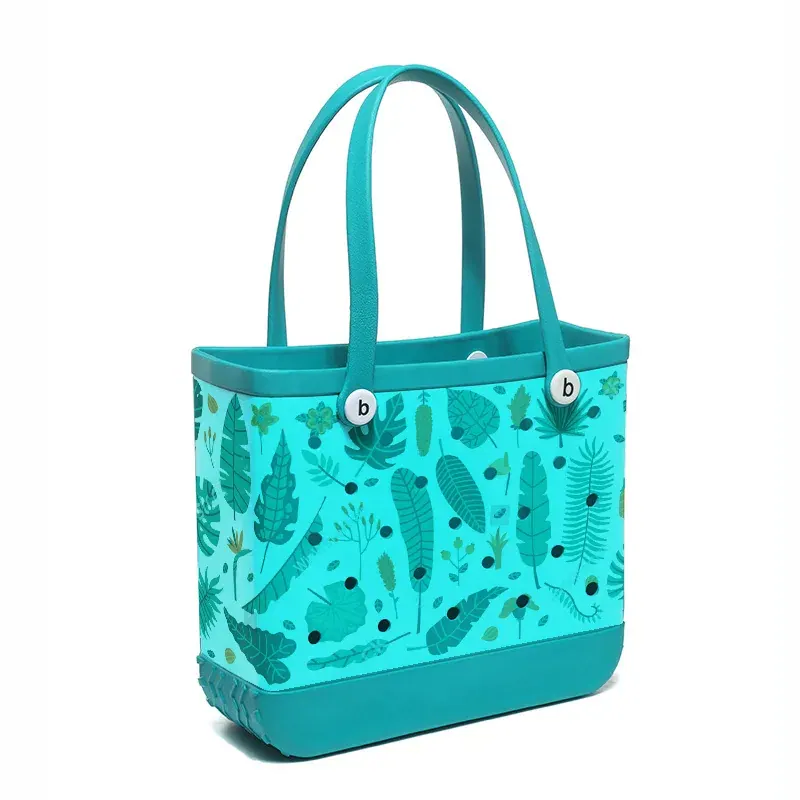
Canvas wins this section outright and it should be conceded early. A canvas family tote weighs roughly 0.5 to 0.7 kilograms empty against 1.6 to 2.1 for the equivalent EVA body, and it folds nearly flat while the moulded one cannot be compressed at all. For anyone flying to a destination, or carrying the bag empty for a long distance before it is used, that difference is decisive: the EVA body consumes a meaningful share of a baggage allowance and takes up space even when empty.
The counter-argument applies only to people who do not travel with the bag. Where the tote lives by a door and is carried from a car to sand and back, empty weight is barely noticed and the fold-flat advantage is irrelevant, because the bag never has to be packed. That is the honest shape of the trade-off: canvas for bags that travel, EVA for bags that stay. Anyone who does both needs one of each rather than a compromise between them.
Durability and the Two Failure Modes
The two materials do not fail in comparable ways, so counting years is less useful than naming the failure. Canvas fails by abrasion and seam stress: the base wears through, handles tear away from the body at the stitch line, and the fabric thins where it is folded repeatedly. EVA fails by deformation and tearing at stress points: the handle root tears if the fillet radius is too small, the rim loses shape, and heat above about sixty degrees can creep the body permanently.
| Failure mode | Typical onset in EVA | Typical onset in canvas | Preventable by |
|---|---|---|---|
| Handle detachment | Rare; tears at the root after 4 to 7 years | Common; stitch failure after 2 to 4 years | EVA: fillet radius above 6 millimetres |
| Base wear | Rails wear after 5 to 7 years | Fabric thins after 2 to 4 seasons | Avoid dragging either on abrasive surfaces |
| Seam or join failure | None, the body is one piece | Common failure point | Canvas: reinforced binding and bar tacks |
| Shape loss | Heat creep above 60 degrees | Sags when wet and loaded | Store both in shade, dry and unloaded |
| Mildew or odour | Does not occur | Within days if stored damp | Canvas: always dry fully before storage |
| Colour loss | Slow UV dulling over seasons | Washing fades prints within a season | Both: store out of direct sun |
In regular weekend use near water, sand or mud, a well-specified EVA body lasts four to seven years and a canvas tote lasts two to four. In occasional dry use, such as shopping or carrying books, that gap narrows to almost nothing, because neither material is being stressed in the way it is weakest. This is the reason the comparison has no universal winner: the environment decides it.
Comfort, Feel and the Small Daily Frictions
Three small things influence satisfaction more than buyers expect, and they are worth stating because they rarely appear in specifications. Canvas feels soft against skin and drapes against the body when carried, while a moulded body is rigid and can dig into a hip or a thigh on a long walk. Canvas is quiet, while a rigid body clicks against hard surfaces and rattles when bottles are carried loose inside it. And canvas accepts pins, patches and embroidery, while a moulded surface accepts only printing and pressed charms.
Against those, EVA has two daily advantages that are easy to underrate. It stands up on its own when set down, which means no kneeling to retrieve a tipping bag on uneven sand, and it keeps its opening accessible rather than collapsing around its contents. Anyone who has watched a soft bag fold over and spill on a windy beach will recognise why a rigid body is worth the weight.
Cost Over Five Years
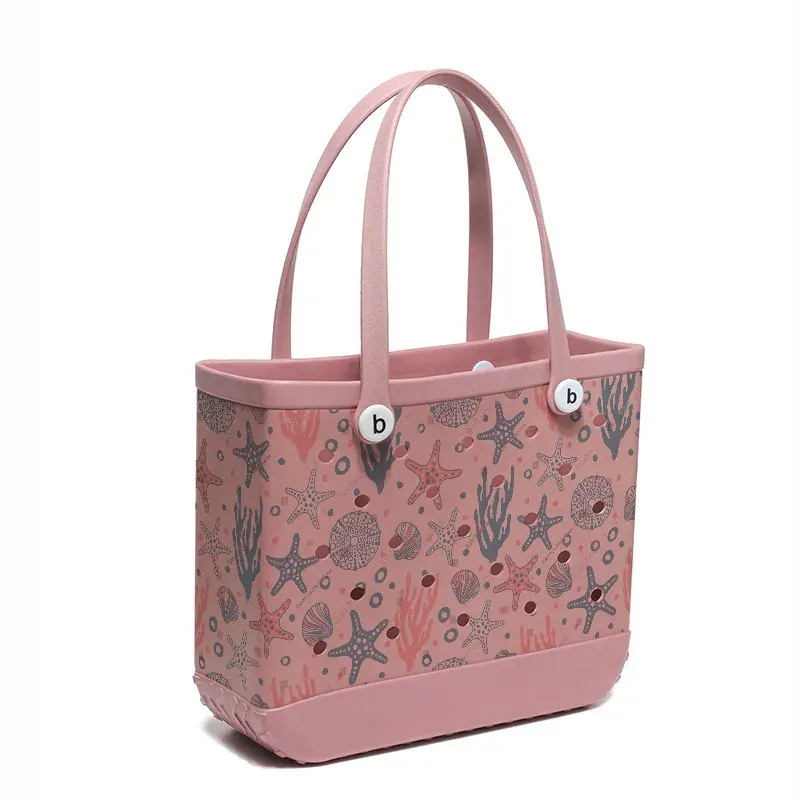
Purchase price favours canvas and total cost of ownership usually favours EVA, and the crossover is easy to calculate. A decent canvas beach tote retails around USD 25 to 45 and lasts two to four seasons in wet use. A comparable EVA body retails around USD 40 to 75 and lasts four to seven. Over a five-year window the canvas buyer buys twice and the EVA buyer buys once.
| Scenario | Canvas over 5 years | EVA over 5 years | Cheaper option |
|---|---|---|---|
| Wet use twice a week | Two bags at USD 35, about USD 70 | One bag at USD 60 | EVA, by roughly USD 10 |
| Occasional dry use, twice a month | One bag at USD 30 still serviceable | One bag at USD 55 | Canvas, by roughly USD 25 |
| Family with children, heavy wet use | Three bags at USD 35, about USD 105 | One bag at USD 70 | EVA, by roughly USD 35 |
| Fly to the destination every trip | One bag at USD 30, folds flat | One bag at USD 60 plus baggage cost | Canvas |
| Resort or rental fleet, washed between guests | Replaced every season | Hosed between guests, lasts years | EVA, decisively |
The rental and resort row deserves emphasis because it is the clearest case in the table. A fleet of totes that has to be turned around between guests, hosed down and put back into service within an hour is a task a moulded body handles and a fabric one does not, and the labour saved dwarfs the difference in unit price.
When Canvas Is Genuinely the Better Choice
Four situations favour canvas without qualification, and a buyer in any of them should ignore the rest of this comparison. Stating these plainly is more useful than arguing that one material always wins, because most dissatisfaction in this category comes from buying the right bag for the wrong context.
- The bag travels by air or folds into luggage. A rigid 32 litre body cannot be compressed and weighs around 2 kilograms empty.
- The load is light and dry, such as shopping, books or a farmers market, where nothing about water behaviour matters.
- The bag must be machine washable, for example where a household has no outdoor tap or hose and no space to air-dry a rigid body.
- Personalisation means embroidery, patches or pins, which a fabric surface accepts and a moulded one does not.
A fifth case is softer but real: some people simply prefer the feel of fabric, and a bag that is pleasant to carry gets used more often than a technically better one that lives in a garage. Preference is a legitimate input to a decision about a personal item, and it should not be argued away with a water absorption figure.
Buying Both: What Households Actually End Up With
Very few households settle permanently on one material. The pattern that repeats is a moulded body that lives by the door and is used for anything wet or sandy, plus a fabric bag that lives folded in a cupboard and is taken on trips. Once the two roles are separated, the comparison stops being a contest and becomes a simple allocation, and the total spend is lower than trying to make one bag do both jobs badly.
- Keep the moulded body for anything that comes home wet, sandy, muddy or smelly, and accept that it will not fold.
- Keep the fabric bag for travel, shopping and anything that has to be packed into luggage or a locker.
- Give each a fixed storage place: hung by the handles for the rigid body, folded on a shelf for the fabric one.
- Do not expect one to replace the other. The most common regret is donating the rigid bag because it did not pack flat.
- Buy the rigid body one size larger than feels necessary and the fabric one one size smaller, since wet loads grow and travel loads shrink.
The allocation also scales to programmes. Resort and rental operations buy only moulded bodies, travel and lifestyle ranges buy mostly fabric, and general beach retail carries both in roughly equal measure. Buyers who stock only one material consistently lose the sale that the other one would have won, and the returns profile is more mixed than the sales profile.
Decision Guide
The comparison resolves on one question: will the bag get wet or sandy most times it is used? If yes, EVA. If no, canvas. Everything else is refinement, and the table below handles the cases where the answer is genuinely mixed.
| Situation | Recommended material | Reason | Specification to prioritise |
|---|---|---|---|
| Family beach most weekends | EVA | Sand falls through, hoses clean | Holes at 10 to 12 millimetres, 6 to 8 millimetre walls |
| Pool bag used daily | EVA | Drains and dries between sessions | Wall thickness 4 to 6 millimetres, light colourway |
| Holiday where the bag flies | Canvas | Folds flat, weighs under 0.7 kilograms | Reinforced base and bound seams |
| Shopping and everyday carry | Canvas | Soft, light, machine washable | Heavyweight canvas, bar tacked handles |
| Boat or kayak gear transfer | EVA | Cannot rot, rinses of salt | Wide base rails, corrosion-resistant hardware |
| Resort or rental fleet | EVA | Hosed and back in service within an hour | Solid colourway, retail-ready packing |
Full category background sits in the injection-molded EVA tote guide, the moulded rubber alternative is covered in the rubber beach tote range, and the cleaning routine in detail is set out in are EVA totes washable.
Programme Notes
QUANZHOU JUNYUAN BAGS has run waterproof bag programmes since 2014 with a founding team in this trade since 2004, covering injection-molded EVA work alongside sewn and welded ranges. Monthly output runs at 200,000 units verified by SGS, operations follow BSCI and ISO 9001, materials are screened for REACH and California Prop 65, and every bulk shipment is inspected at AQL 2.5 before release. Programme minimums begin at 500 pieces per design and colour, with sampling at 6 to 10 working days and bulk at 35 to 50 days from approved sample and deposit.
Care and cleaning guidance for consumer-facing products aligns with the safer chemical practice published by the United States Environmental Protection Agency. Send your target size, material, colourway count, quantity and destination market to service@junyuanbags.com, and ask for the packed carton specification at the same time if you are comparing landed costs between materials.
People Also Ask
Is an EVA tote fully waterproof?
The material is, absorbing effectively no water and draining in seconds. The bag is not sealed, so contents still need a pouch if they must stay dry.
Does canvas absorb water?
Yes, up to roughly a quarter of its dry weight, which is why a wet canvas tote sags and takes three to eight hours to dry.
Which is easier to clean after a beach day?
EVA. A hose at tap pressure takes about three minutes, against brushing, washing and several hours of drying for canvas.
Which material lasts longer near salt water?
EVA, at four to seven years against two to four for canvas, because salt does not attack the polymer but crystallises in fabric and stiffens it.
Can an EVA tote go in the washing machine?
No. Flexing the body against itself can crease it permanently. Hose it and air dry it open in shade instead.
Is canvas better for air travel?
Yes. It folds nearly flat and weighs 0.5 to 0.7 kilograms, against 1.6 to 2.1 kilograms for a rigid family-size EVA body.
Frequently Asked Questions
Q1. Which is more waterproof, EVA or canvas?
EVA. It absorbs effectively no water and drains in seconds, while canvas wicks water and holds up to about a quarter of its dry weight.
Q2. Do perforated EVA totes keep contents dry?
No. Water passes freely in both directions, so anything sensitive needs a pouch. The advantage is that the bag itself dries in about an hour.
Q3. Does canvas go mouldy if stored wet?
It can, within days in humid conditions. EVA cannot, because closed-cell material has no structure to hold water or support mould growth.
Q4. How long does each take to dry?
EVA about 60 minutes standing open in shade. Canvas three to eight hours depending on fabric weight and humidity.
Q5. Which handles sand better?
EVA, by a wide margin. Sand falls through holes of nine to twelve millimetres, while canvas traps it in the weave and seams.
Q6. Can I machine wash a canvas beach tote?
Yes, subject to shrinkage on cotton and colour loss on prints. An EVA body must never be machine washed, as flexing creases it permanently.
Q7. Which weighs more?
EVA. A family size is 1.6 to 2.1 kilograms empty against 0.5 to 0.7 for canvas, and it cannot be folded flat for travel.
Q8. Which lasts longer in regular wet use?
EVA at four to seven years against two to four for canvas. In dry, occasional use the gap narrows to almost nothing.
Q9. How does each one fail?
Canvas fails at seams and by abrasion of the base. EVA fails by tearing at the handle root, rim deformation or heat creep above sixty degrees.
Q10. Is EVA more expensive?
At purchase, yes, typically USD 40 to 75 against USD 25 to 45. Over five years of wet use it is usually cheaper because it is bought once.
Q11. Which is better for a resort or rental fleet?
EVA. It can be hosed down and returned to service within an hour, which canvas cannot match without a full wash and dry cycle.
Q12. When should I choose canvas instead?
When the bag flies or folds into luggage, when the load is light and dry, when machine washing is required, or when you want embroidery or patches.