A vinyl beach bag is lighter, softer in the hand at 400 to 800 grams against 900 to 1,600 grams, and cheaper at 3 to 7 dollars against 6 to 14, but it stiffens in cold, yellows under ultraviolet exposure and is sealed rather than draining. A perforated EVA body is heavier and firmer, stays flexible down to minus 30 degrees, drains a dunk in four to ten seconds and runs four to seven seasons against two to four. Choose vinyl for a light occasional bag in a warm climate and EVA for anything used on sand, around water or in a cold winter.
The Short Answer
The two materials are aimed at different jobs and are often compared as though they were not. Vinyl is a flexible sheet that is cut and sewn or welded into a soft bag, so it drapes, folds flat and weighs little. EVA is a closed-cell compound that is moulded into a shape, so it stands up on its own, holds its form under load and weighs more. The first feels like a bag; the second behaves like a container.
That difference drives everything downstream. A soft bag collapses when empty and folds for storage, which is genuinely convenient, and it also collapses when set down on wet sand, which is not. A rigid body takes up the same volume empty or full, which is inconvenient in a cupboard and is exactly what makes it usable on a beach, a boat deck or a muddy field.
| Property | Vinyl beach bag | Perforated EVA body | Which wins where |
|---|---|---|---|
| Material form | Flexible sheet, cut and joined | Moulded closed-cell body | Vinyl for packing, EVA for standing |
| Typical weight, medium size | 400 to 800 grams | 900 to 1,600 grams | Vinyl for carrying light |
| Behaviour when empty | Folds flat | Holds its shape | Vinyl for storage, EVA for use |
| Water behaviour | Sealed, holds water in | Perforated, drains out | EVA wherever things get wet |
| Cold flexibility | Stiffens near 0 degrees | Flexible to minus 30 degrees | EVA in any cold market |
| Ultraviolet ageing | Yellows and stiffens | Chalks slowly, keeps form | EVA for outdoor storage |
| Unit price | 3 to 7 dollars | 6 to 14 dollars | Vinyl for a tight budget |
| Service life | Two to four seasons | Four to seven seasons | EVA on cost per use |
What Each Material Actually Is
Vinyl in this context is flexible polyvinyl chloride sheet, usually calendered or cast, sometimes with a fabric backing. The base polymer is rigid, so flexibility comes from plasticisers added at the compounding stage, typically 20 to 40 percent by weight. That is the important structural fact about vinyl: its softness is an additive rather than a property of the polymer, and additives migrate.
Ethylene-vinyl acetate has no such dependency. The copolymer is intrinsically flexible across the vinyl acetate range used for moulded articles, and a well-formulated compound needs no plasticiser at all. Its softness is a property of the polymer rather than a borrowed one, which is the root cause of almost every difference in the comparison that follows.
The second structural difference is how each becomes a bag. Vinyl is joined: sewn, welded or glued, and every join is a potential leak path and a potential failure point. A moulded body is one piece with no join in the load path, which is why a perforated body can be full of holes and still be more reliably watertight at the base than a sewn vinyl bag with no holes at all.
Flexibility, Cold and the Feel in the Hand
Flexibility is where vinyl wins on first impression and loses over time. A new vinyl bag is soft and drapy, and it feels pleasant in a shop. The decline is predictable: plasticiser migrates to the surface and volatilises, the sheet stiffens, and the stiffening accelerates with heat and ultraviolet exposure. A vinyl bag left in a hot car boot for a summer can emerge noticeably firmer than it went in.
| Condition | Vinyl behaviour | EVA behaviour | Practical meaning |
|---|---|---|---|
| At 25 degrees, new | Soft and drapy | Firm and springy | Vinyl feels nicer in the shop |
| At 0 degrees | Noticeably stiff, creases at folds | Essentially unchanged | EVA for winter markets |
| At minus 20 degrees | Brittle, cracks at fold lines | Flexible, some stiffening | Vinyl is not a cold-climate bag |
| After two summers of sun | Yellowed, stiffer, tacky surface | Slight chalking, form retained | EVA roughly doubles the life |
| After a season in a hot car | Firmer, odour increases | No measurable change | EVA for a bag kept in a vehicle |
| At a crease held under load | Permanent white crease line | Recovers when unloaded | EVA tolerates being stacked |
Cold flex and brittleness of flexible sheet are assessed by impact and bend methods published by ASTM International, and the numbers in the table reflect what those methods show for a general-purpose plasticised sheet against a moulded closed-cell compound. The practical translation is simple: a vinyl bag is a summer and warm-climate product, and an EVA body is a year-round one.
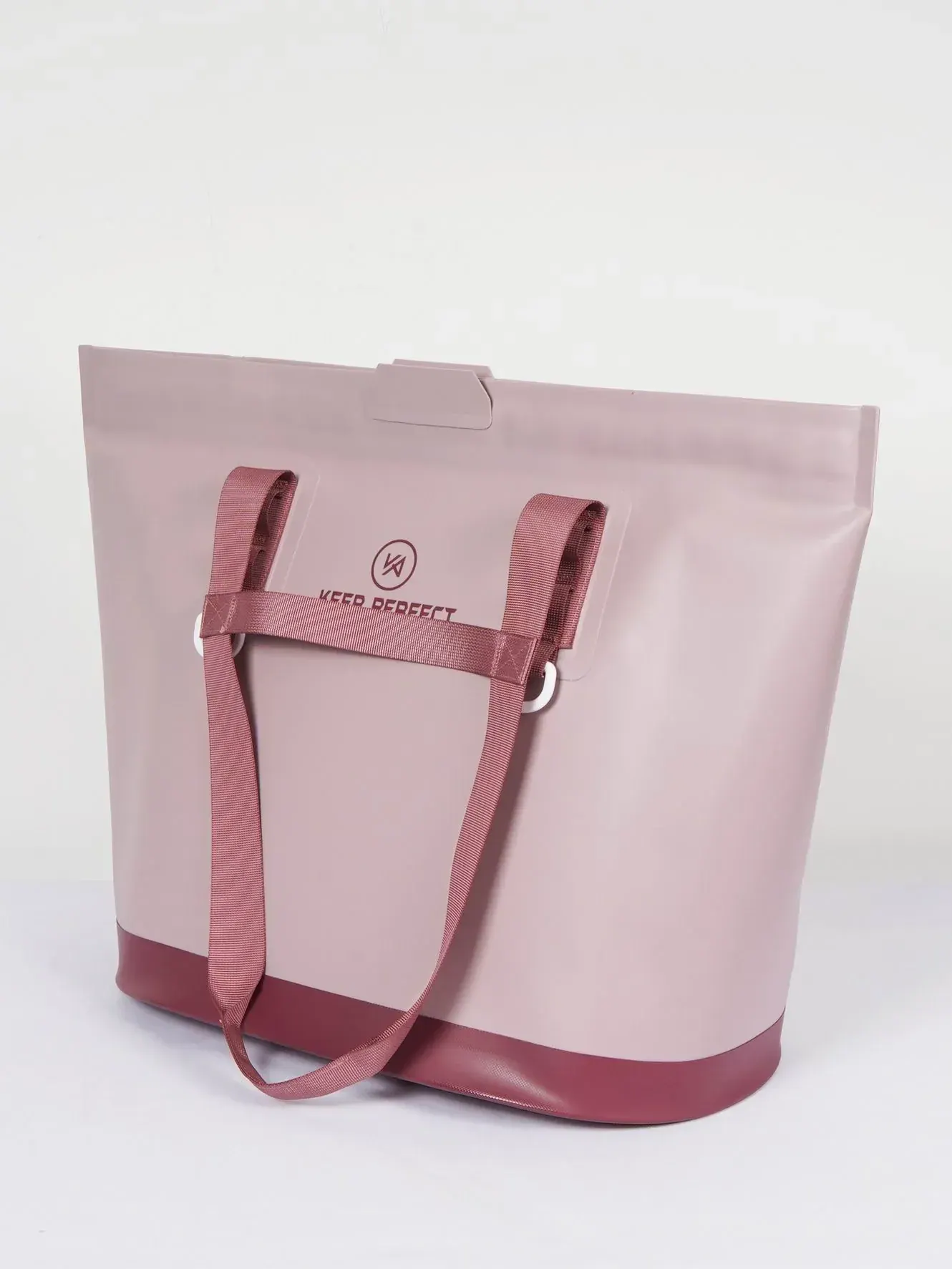
Weight, Drape and What the Numbers Mean in Use
Weight looks like a clear vinyl win and is more nuanced than it appears. A medium vinyl bag at 500 grams against a medium EVA body at 1,200 grams is a 700 gram difference, which is meaningless when the bag holds 6 kilograms and significant when it is carried empty across a car park. The honest summary is that vinyl is easier to carry when nearly empty and EVA is easier to carry when full, because a rigid body spreads load against the body better than a soft one that hangs.
- Vinyl drapes against the body and is comfortable to carry empty over a short distance.
- A rigid body distributes load across a wider contact area, which matters above about 5 kilograms.
- Vinyl folds flat for storage and travel, which is a real advantage for a bag taken on holiday.
- A moulded body occupies its full volume in a car boot, which is the most common complaint about it.
- Neither absorbs water, so neither gets heavier when wet, unlike any fabric alternative.
The storage point is worth taking seriously rather than dismissing. A household with limited cupboard space and a bag used four times a year may genuinely be better served by a bag that folds flat, and that is a legitimate reason to choose vinyl. Most of the rest of the comparison favours the moulded body, but not this one.
Water Behaviour: Sealed Versus Draining
This is the largest functional difference and the one that decides most purchases. A vinyl bag is sealed, so it keeps water in as reliably as it keeps water out. A wet swimsuit placed inside leaves a puddle at the base that has to be poured out and dried, and any sand carried in stays in. A perforated body drains the same load in four to ten seconds and shakes sand out through the holes.
| Situation | Vinyl bag | Perforated EVA body | Winner |
|---|---|---|---|
| Wet swimsuit and towel inside | Puddle at the base, needs drying | Drains in four to ten seconds | EVA |
| Sand carried in on towels | Stays in, needs wiping | Shakes out through the holes | EVA |
| Sudden rain while at the beach | Contents stay dry | Contents get wet | Vinyl |
| Rinsing the bag after use | Wipe and dry the base | Hose through, drain, done | EVA |
| Melting ice from a drink | Pools at the base | Drains away | EVA |
| Keeping a phone dry in rain | Sealed, genuinely dry | Needs a pouch | Vinyl |
The rain row is the one honest advantage for vinyl and it should not be argued away. A sealed bag keeps contents dry in a shower; a perforated one does not and never will, because the holes that drain it work in both directions. Anyone who needs rain protection for electronics should use a pouch inside whichever bag they choose, and should know that the moulded body will not provide it on its own.
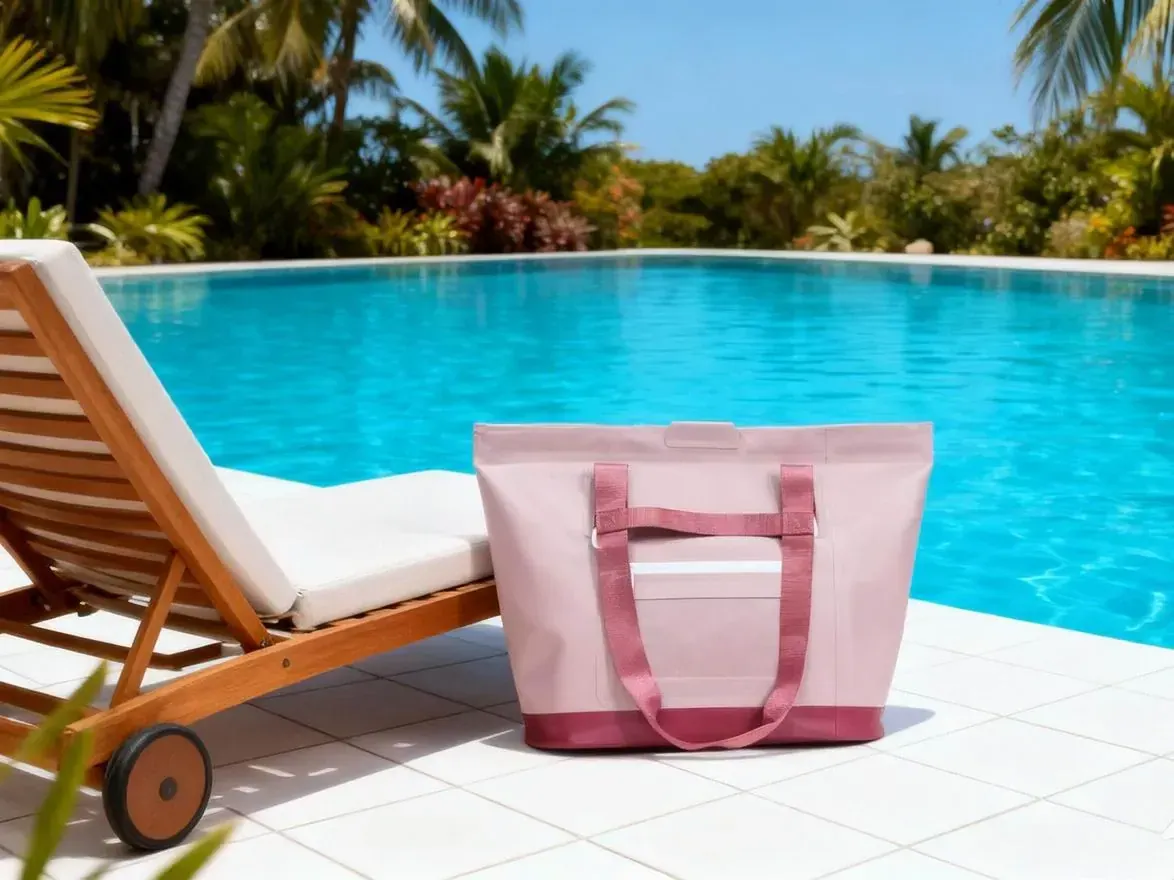
Ageing, Ultraviolet Exposure and Surface Change
Both materials age in sunlight and they age differently. Vinyl yellows, stiffens and eventually develops a tacky surface as plasticiser migrates outward, and a clear or pale vinyl bag shows all three within two to three seasons of outdoor use. EVA chalks slowly at the surface and loses some colour saturation, but retains its form and its flexibility, which is why the same body keeps working long after it stops looking new.
Heat accelerates both processes, and the combination of heat and ultraviolet is worse than either alone. A bag stored on a shelf in a garage ages far less than the same bag left on a deck or in a car boot. The storage advice is identical for both materials and takes ten seconds: rinse, dry, and keep out of direct sun when not in use.
Odour, Staining and Cleaning
Odour is the complaint that most often sends a vinyl bag to the back of a cupboard. A new vinyl bag can smell strongly of plasticiser, and the smell intensifies in heat and does not fully dissipate for several weeks. An EVA body has a faint characteristic smell when new that typically clears within a few days and does not return with heat.
| Issue | Vinyl | EVA | What to do |
|---|---|---|---|
| New product odour | Noticeable, stronger in heat | Faint, clears in a few days | Air both outdoors before first use |
| Sunscreen marks | Can stain permanently | Sits on the surface, washes off | Mild detergent on both, promptly |
| Odour retention after wet use | Yes, if stored damp | No, it cannot hold water | Dry both open in shade |
| Solvent cleaner damage | Dissolves the surface | Dulls the surface | Use neither; mild detergent only |
| Machine washing | Not recommended | Not recommended | Rinse and wipe for both |
| Heat deformation | Above about 60 degrees | Above about 70 degrees | Keep both out of hot cars |
Sunscreen behaves differently and the distinction is worth stating. On vinyl, some formulations leave a permanent mark because the solvent component attacks the surface. On EVA, sunscreen sits on top and washes off with warm water and mild detergent, which is the more forgiving behaviour for a product that meets sunscreen every day of its working life.
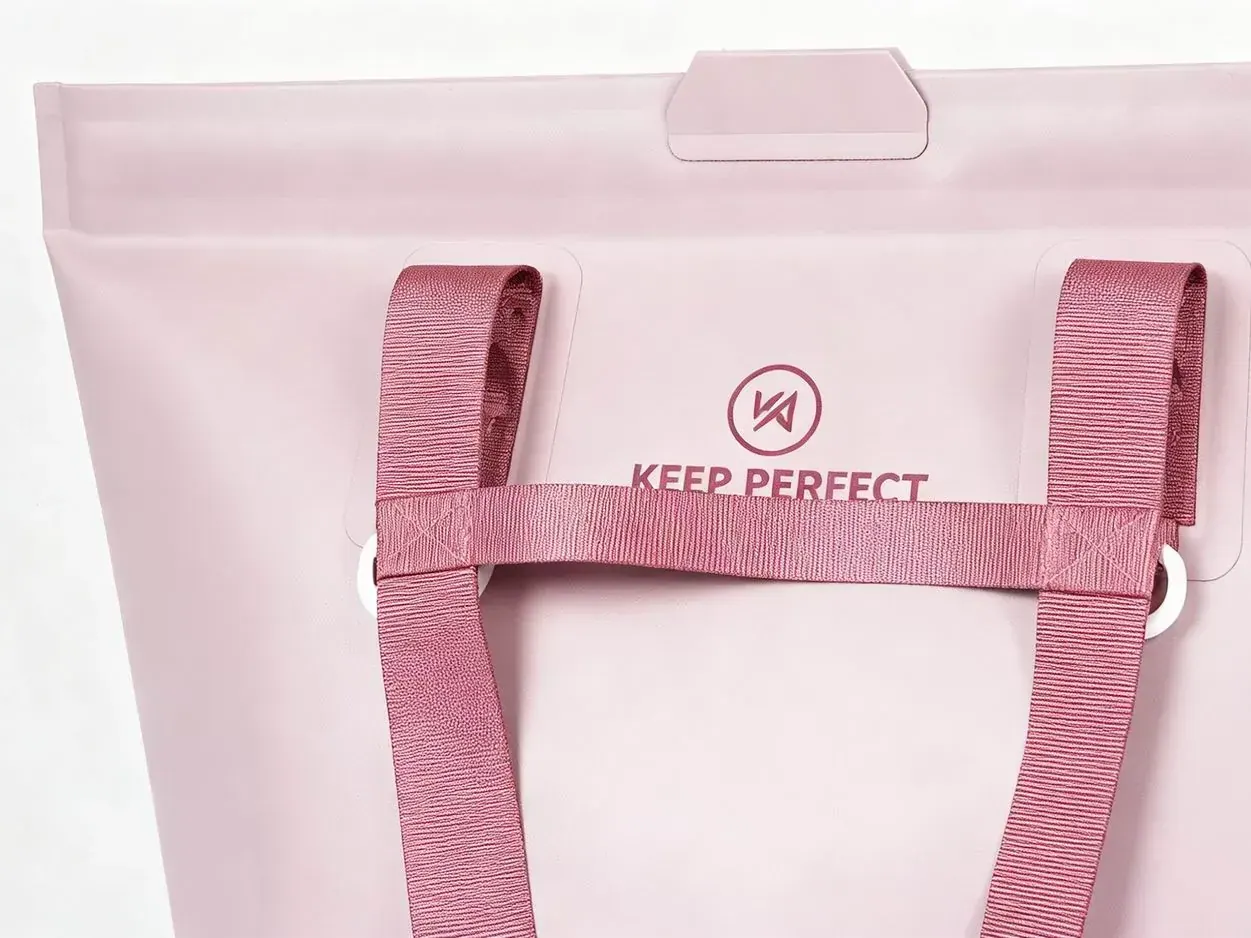
Cost, Repair and End of Life
Vinyl wins on purchase price and loses on cost per use. At 3 to 7 dollars against 6 to 14, a vinyl bag is roughly half the price, and at two to four seasons against four to seven, it lasts roughly half as long. The arithmetic lands close to even over a decade, and it swings decisively towards the moulded body once the cost of a bag that collapses or holds water is counted as an inconvenience rather than as a rounding error.
| Factor | Vinyl | EVA | Comment |
|---|---|---|---|
| Purchase price | 3 to 7 dollars | 6 to 14 dollars | Vinyl is cheaper to buy |
| Service life | Two to four seasons | Four to seven seasons | EVA lasts roughly twice as long |
| Cost per season | 1.25 to 2.00 dollars | 1.20 to 2.30 dollars | Close to parity over a decade |
| Repairability | Weldable and patchable | Limited, mostly cosmetic | Vinyl can be repaired |
| Recyclability | Complicated by chlorine content | Thermoplastic, reprocessable in principle | Collection is the real limit for both |
| Resale or hand-on value | Low | Moderate, form is retained | EVA bodies survive being passed on |
Repairability is the one category vinyl clearly wins and it is worth acknowledging. A split seam on a vinyl bag can be re-welded or patched by anyone with a heat tool, while a cracked handle root on a moulded body is effectively the end of the bag. If a bag is going to be used hard and repaired rather than replaced, that matters.
Information on vinyl chloride and on the environmental profile of chlorinated polymers is published by the United States Environmental Protection Agency, and it is the reason vinyl is handled differently at end of life in most collection systems. Neither material is straightforwardly recyclable through household streams, and buying one that lasts twice as long is the more effective environmental decision available here.
Which One for Which Use
The decision table below is the practical summary, and it says that the two materials are not really competitors. Vinyl is a light travel and occasional bag for a warm climate. EVA is a working container for sand, water, boats and cold weather.
| Use case | Better choice | Why | Caveat |
|---|---|---|---|
| Daily beach use in summer | EVA | Drains sand and water, stands up | Heavier to carry empty |
| Holiday bag packed in a suitcase | Vinyl | Folds flat, weighs little | Replace every few seasons |
| Boat, marina and paddle sports | EVA | Drains, stable, grips a deck | Electronics need a pouch |
| Pool and swim club | EVA | Air-dries inside the hour | Vinyl holds water at the base |
| Winter market or gym use | EVA | Stays flexible in the cold | Vinyl stiffens near 0 degrees |
| Promotional giveaway on a budget | Vinyl | Lowest unit cost, printable | Short service life |
| Rain protection for electronics | Vinyl | Sealed | Use a pouch inside either bag |
If there is one line to take away, it is that the sealed-versus-draining difference outweighs every other factor in the comparison. Everything else, including price, weight and feel, is a matter of degree, and the choice between a bag that holds water and one that sheds it is a matter of kind.
Printing, Branding and How Each Surface Takes a Mark
Decoration behaves very differently on the two materials, and this is a practical consideration for anyone buying in quantity. Vinyl sheet takes print well and cheaply, which is why promotional vinyl bags are ubiquitous: screen print and heat transfer both bond to a smooth plasticised surface with no pretreatment. A closed-cell moulded body is harder to print on because the surface is low energy and slightly textured, so an applied mark needs either a suitable ink system or a formed alternative.
| Decoration route | Vinyl | EVA body | Durability |
|---|---|---|---|
| Screen print | Excellent, no pretreatment | Possible with the right ink system | Vinyl better, both rub in time |
| Heat transfer | Excellent | Fair, adhesion varies with the compound | Vinyl better |
| Formed into the body | Not available | Available, permanent | EVA far better |
| Attached plate or badge | Possible | Possible | Comparable |
| Charm or tag | Possible | Designed for it, through the perforations | EVA better |
The durability conclusion is the one that matters commercially. A printed mark on either material will rub under repeated handling, and the difference is that a moulded body offers a permanent alternative in the form of a mark formed into the tool. For a promotional bag with a six week life, print on vinyl is the cheaper correct answer. For a retail or resort bag expected to look presentable for years, a formed mark on a moulded body is the better one.
How to Choose in One Minute
Three questions settle it for almost everyone, and they are worth asking in order because the first one usually ends the discussion.
- Will the bag regularly hold anything wet? If yes, choose the draining body, because a sealed vinyl bag holds water and has to be poured out and dried.
- Will it be used below about 5 degrees? If yes, choose the moulded body, because vinyl stiffens near zero and cracks at fold lines in hard frost.
- Does it need to fold flat for storage or travel? If yes, choose vinyl, because a moulded body occupies its full volume empty or full.
- Is the budget the binding constraint at 3 to 7 dollars? If yes, choose vinyl, and plan to replace it every two to four seasons.
- Will it be left outdoors between uses? If yes, choose the moulded body, because vinyl yellows and stiffens under ultraviolet exposure.
If the answers point in both directions, the honest recommendation is to own one of each rather than to compromise. A vinyl bag that folds into a suitcase and a moulded body that lives in a car boot cover the two cases properly, and together they cost less than one premium bag in either material.
Programme Notes
Compound and construction detail is set out in the EVA tote materials guide, the polyvinyl chloride comparison sits in EVA tote vs PVC tote, and the full category background is in the injection-molded EVA tote guide. QUANZHOU JUNYUAN BAGS has run waterproof bag programmes since 2014 with a founding team in this trade since 2004, and develops moulded bodies alongside sewn and welded ranges.
Monthly output runs at 200,000 units verified by SGS, operations follow BSCI and ISO 9001, materials are screened for REACH and California Prop 65, and every bulk shipment is inspected at AQL 2.5 before release. Programme minimums begin at 500 pieces per design and colour, with sampling at 6 to 10 working days and bulk at 35 to 50 days from approved sample and deposit, shipped FOB Xiamen or DDP to more than 100 countries. Send your target market, size and quantity to service@junyuanbags.com.
People Also Ask
Which is better for a beach bag, EVA or vinyl?
EVA for regular beach use, because it drains sand and water and stands up on sand. Vinyl for a light bag that folds flat for travel.
Does vinyl crack in cold weather?
Yes. A plasticised sheet stiffens near 0 degrees and can crack at fold lines near minus 20, while EVA stays flexible to minus 30.
Why does a vinyl bag get stiff over time?
Plasticiser migrates to the surface and volatilises. Heat and ultraviolet exposure accelerate it, so stiffness is a property of ageing.
Can a perforated EVA tote keep things dry in rain?
No. The holes drain in both directions. Use a dry pouch inside for electronics in either material.
Which material lasts longer outdoors?
EVA, at four to seven seasons against two to four for vinyl, which yellows and stiffens under ultraviolet exposure.
Is an EVA tote heavier than a vinyl bag?
Yes, roughly 900 to 1,600 grams against 400 to 800 for a medium size, but it spreads load better when full.
Frequently Asked Questions
Q1. What is the main difference between EVA and vinyl?
Vinyl is a flexible sheet that is joined into a soft bag; EVA is a closed-cell compound moulded into a rigid body. One drapes, the other stands.
Q2. Which is lighter?
Vinyl, at 400 to 800 grams for a medium bag against 900 to 1,600 grams for a moulded body of the same size.
Q3. Does vinyl stiffen in cold weather?
Yes. It stiffens noticeably near 0 degrees and can crack at fold lines near minus 20 degrees, while EVA stays flexible to minus 30.
Q4. Why does vinyl get stiff with age?
The plasticiser that makes it flexible migrates to the surface and volatilises, accelerated by heat and ultraviolet exposure.
Q5. Which keeps contents dry in rain?
Vinyl, because it is sealed. A perforated EVA body drains in both directions, so electronics need a pouch inside.
Q6. Which handles wet gear better?
EVA. A wet swimsuit in a vinyl bag leaves a puddle that has to be poured out; the same load drains from a perforated body in seconds.
Q7. How long does each last?
Vinyl runs two to four seasons outdoors and yellows as it ages. EVA runs four to seven and chalks slowly while keeping its form.
Q8. Which smells more when new?
Vinyl, and the odour intensifies in heat. EVA has a faint smell that usually clears within a few days.
Q9. Can either be machine washed?
Neither is recommended. Rinse and wipe both with mild detergent, and never use solvent cleaners on either surface.
Q10. Which is better value over time?
Close to parity on cost per season, but EVA wins on convenience because it drains, stands up and keeps its shape under load.