A hospitality-grade EVA tote is specified at 18 to 32 litres with a 2.0 to 2.6 millimetre wall, a continuous base rail and a decoration panel that survives daily housekeeping, and it is ordered in blocks of 500 pieces per colour with 6 to 10 working days for samples and 35 to 50 days for bulk. The specification matters because a guest tote changes hands every three to five nights, is wiped down two or three times per stay with whatever is on the housekeeping trolley, and spends most of its working life in direct sun. Pick a size that swallows two folded towels and two drinks, a wall thick enough not to crease when twenty bags are stacked, and a mid-tone colourway that hides sunscreen marks without passing sixty degrees at the surface in July.
What a Hospitality Tote Has to Endure
A retail beach tote meets one family a few dozen times a year. A resort tote meets a different family every three to five nights, which is sixty to ninety different users a year, and it is handled by housekeeping two or three times during each stay. Nothing about that duty cycle resembles retail use, and specifying on retail logic is the most common reason a hospitality programme replaces its bags after a single season.
Four exposures do the damage, and they act together rather than separately. Ultraviolet load in a tropical or Mediterranean property runs at 1,200 to 2,000 hours of direct sun a year. Chlorinated water at 1 to 3 parts per million free chlorine contacts the bag daily. Housekeeping chemicals are applied far more often than any owner expects. And the bags are stacked twenty to forty deep in a store room between seasons, which is where most permanent deformation actually happens.
| Exposure | Annual dose in a tropical property | What fails first | Specification response |
|---|---|---|---|
| Direct sun | 1,200 to 2,000 hours | Surface chalking and colour shift | UV-stabilised compound, mid-tone colourway |
| Chlorinated pool water | Daily contact at 1 to 3 ppm | Fabric trim and any insert | Single-material body, no fabric parts |
| Salt air within 300 m of shore | Continuous | Any metal hardware | Design with no metal components |
| Housekeeping wipe-down | 90 to 150 wipes a year | Dulling from solvent cleaners | Written protocol: mild detergent only |
| Stacked storage | 20 to 40 bags deep, weeks at a time | Creasing at the rim | Wall thickness at or above 2.0 mm |
| Guest overload on departure day | 8 to 14 kg, often wet | Handle root cracking | Radiused handle root and wall gusset |
The table is worth reading as a buying document rather than as background. Every row has a specification answer, and every one of those answers is a question a buyer can put to a programme partner before placing an order. Asking which wall thickness and which UV package a quoted body uses will separate a real hospitality specification from a retail body with a logo on it within about five minutes.
Sizing by Room Type, Not by Guest Count
Hospitality sizing is driven by what has to be carried from a room to a lounger and back, and that is remarkably consistent across properties. A couple needs two towels, sunscreen and two drinks, which lands at about 14 to 16 litres of actual volume and therefore wants an 18 litre body. A family of four needs four towels, snacks, toys and drinks, which lands at 26 to 30 litres and wants a 32 litre body. Ordering one size for a whole property is the single most common mistake, because the couple then carries a half-empty bag and the family carries two.
| Room or setting | Typical guests | Recommended size | What it must hold | Bags to issue |
|---|---|---|---|---|
| Standard hotel room | 1 to 2 | 18 litres | Two towels, sunscreen, two drinks | 2 per room |
| Family suite or villa | 3 to 5 | 32 litres | Four towels, snacks, toys, drinks | 2 to 3 per unit |
| Spa treatment room | 1 | 10 litres | Robe, slippers, wet kit | 1 per guest in use |
| Poolside cabana | 2 to 4 | 32 litres | Towels, drinks, books, phones | 1 per cabana |
| Whole-house vacation rental | 4 to 8 | 32 litres | Group beach kit, single load | 2 to 4 per property |
| Timeshare or residence club | 2 to 6 | 18 and 32 litres mixed | Both patterns across the year | 1 of each per unit |
Two sizes cover almost every property, and the ratio matters more than the absolute numbers. A resort with 200 rooms running at 70 percent occupancy will typically issue around 320 bags a day at peak, and a 60/40 split towards the 18 litre body suits a couples property while a 40/60 split towards the 32 litre body suits a family property. Getting that split wrong by twenty points produces either a pile of unused large bags in the store room or a queue at the towel hut.
Colour and Marking: What Actually Reads Across a Pool Deck
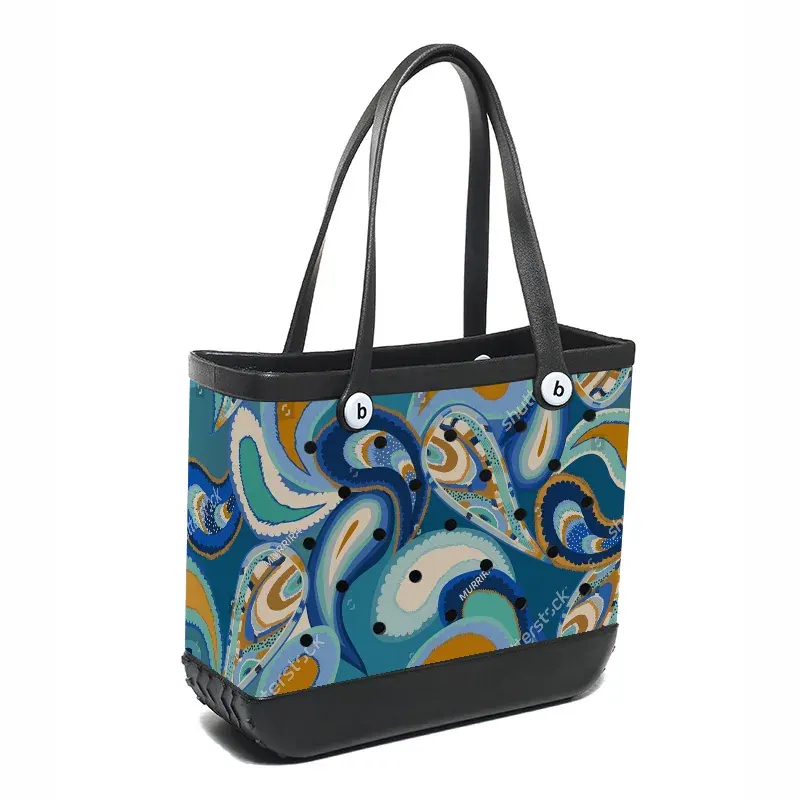
A resort tote does two jobs at once. It carries kit, and it advertises the property to everyone within sight of the pool. That second job has measurable requirements: a logo must be legible from eight to fifteen metres across bright water, which in practice means a decoration panel of 90 to 140 millimetres on the longest face and a contrast ratio that survives glare rather than a subtle tone-on-tone treatment that photographs beautifully and reads as nothing from a lounger.
- Keep the mark between 90 and 140 millimetres wide. Below 90 it stops reading past eight metres; above 140 it starts to look like a hire bag rather than an amenity.
- Specify contrast, not subtlety. A dark mark on a light body reads in glare; a mid-tone mark on a mid-tone body disappears at midday.
- Place the panel on the largest flat face, above the perforation field, so holes do not break up the stroke of the lettering.
- Choose a body colour that hides sunscreen. Mid-tone and heathered colourways show less than white or butter yellow.
- Avoid dark navy and black on an exposed deck. Surface temperature passes sixty degrees within an hour in peak summer sun.
Decoration method follows the duty cycle rather than the artwork. A mark that is applied on the surface will be rubbed by housekeeping wipes within a season; a mark that is formed into the body survives the life of the bag. The trade-off is that formed marks cost more at low volumes and are fixed once the tool is cut, so the artwork has to be signed off before production rather than adjusted later. Decoration options for this format are set out in the custom EVA tote decoration guide.
Spa and Wet Areas: Oils Are the Real Enemy
Chlorine is the worry everyone raises and the substance that does the least damage, because the closed-cell structure is not attacked by oxidising disinfectants at pool concentration. Oils are the opposite case. Massage oil, body oil and high-SPF sunscreen sit on the surface, pick up dust and sand, and build into a film that looks like permanent staining. It is not permanent, but removing it takes a degreaser, and degreasers are exactly what damages the surface layer.
| Substance | What it does to the body | How to remove it | Time before it sets |
|---|---|---|---|
| Pool chlorine at 1 to 3 ppm | Nothing measurable | Fresh water rinse | No action needed |
| Sunscreen SPF 30 to 50 | Surface film that holds dust | Warm water and mild detergent | Remove within 24 hours |
| Massage and body oil | Tacky film, appears as staining | Mild detergent, soft brush, repeat | Remove the same day |
| Self-tanning product | Orange transfer that looks permanent | Detergent plus dilute bicarbonate paste | Within hours if possible |
| Solvent bathroom cleaner | Dulls the surface permanently | Not reversible | Avoid entirely |
| Wet towel left inside overnight | No damage to the bag, odour in the towel | Rinse and dry open | Empty at end of day |
The operational conclusion is simple and belongs in the housekeeping manual rather than in a product spec sheet: rinse the bag at the end of every treatment day, and never reach for a solvent spray. A body that is rinsed daily will look presentable for four to seven seasons in spa service. The same body cleaned weekly with a bathroom spray will look tired inside eighteen months, and no specification change will prevent that.
Vacation Rentals: Turnover, Loss and the Replacement Cycle
Vacation rentals are the harshest channel of the three, because there is no housekeeping team and no staff member with any stake in the bag. A short-term rental tote is used by a group for three to seven nights, is taken to the beach, to a supermarket and sometimes to another property, and is left in a car boot between lets. Reported annual loss and attrition in this channel runs at 30 to 40 percent, against 10 to 15 percent in staffed resorts, and the replacement order has to be planned rather than reactive.
Two operating decisions cut that figure materially. The first is to accept loss as a budget line and reorder on a fixed calendar rather than waiting for a complaint, because a rental without a tote generates a review mention and a review mention costs far more than a bag. The second is to brand lightly rather than heavily: a heavily branded amenity reads as property equipment and travels home in suitcases, while a neutral body with a small mark reads as a shared item and stays put.
The Housekeeping Protocol That Extends Service Life
Service life in hospitality is decided by the cleaning protocol far more than by the material, and the protocol is worth writing down because it takes under two minutes per bag. Everything below is within the capability of a standard housekeeping trolley and none of it requires a special product.
- Empty the bag fully first. Anything left inside overnight will be damp in the morning and is the source of most odour complaints.
- Rinse with fresh water at tap pressure, inside and out, for about thirty seconds. A fully perforated body drains in four to ten seconds afterwards.
- Wash visible marks with warm water and mild dish detergent on a soft cloth. Never use bathroom spray, degreaser or solvent wipes.
- Rinse again until no residue remains, because detergent film attracts sand and makes the next clean harder.
- Stand the bag upside down on a rack for thirty to sixty minutes, then store it open and out of direct sun.
- Inspect the handle roots once a month. Cracking there is the one failure that puts a bag out of service immediately.
Hygiene guidance for shared wet items published by the United States Centers for Disease Control and Prevention is explicit that drying between uses matters more than the cleaning agent, and a perforated body that drains and air-dries inside the hour satisfies that requirement without adding a step to the housekeeping round. That is the practical argument for a drained body over a fabric amenity bag: the fabric alternative needs a laundry cycle, and a laundry cycle is a cost line that never appears in the bag price.
Cost per Stay Rather Than Cost per Bag
Hospitality buyers compare landed unit prices and then discover that the cheapest body is the most expensive line in the budget. The correct unit of comparison is cost per occupied stay, which is the landed price divided by the number of stays the bag survives. A body at 8.40 dollars landed that lasts 90 stays costs 0.09 dollars per stay. A body at 6.10 dollars landed that chalks and creases after 35 stays costs 0.17 dollars per stay and generates a guest comment in the process.
| Specification level | Landed cost per unit, 18 L | Service life in resort use | Cost per occupied stay |
|---|---|---|---|
| Light retail body, 1.4 mm wall | 5.80 to 7.20 dollars | 25 to 40 stays | 0.15 to 0.29 dollars |
| Mid specification, 2.0 mm wall | 7.40 to 9.60 dollars | 60 to 100 stays | 0.07 to 0.16 dollars |
| Hospitality grade, 2.4 to 2.6 mm wall | 9.80 to 13.40 dollars | 120 to 200 stays | 0.05 to 0.11 dollars |
| Hospitality grade with formed logo | 11.20 to 15.80 dollars | 120 to 200 stays | 0.06 to 0.13 dollars |
| Replacement buy, air freight | Add 2.40 to 4.10 dollars | As above | Adds 0.02 to 0.04 dollars per stay |
The fourth row is the one that surprises procurement teams. A formed mark raises the unit price by roughly 1.40 to 2.40 dollars and removes the recurring cost of re-marking or discarding bags whose printed logo has rubbed off, so it reduces total cost in any programme running beyond about eighteen months. It also removes the largest single cause of a bag looking shabby while remaining structurally sound.
Ordering Blocks and Timing for a Property Opening
Hospitality orders are larger and less forgiving of delay than retail orders, because a property opening has a fixed date and the bags are part of the guest-facing setup. Programme minimums start at 500 pieces per design and colour, sampling runs at 6 to 10 working days, and bulk runs at 35 to 50 days from approved sample and deposit. Working backwards from an opening date, the artwork needs to be signed off roughly 90 days ahead and the colourway decision about 100 days ahead.
| Order block | Typical quantity | Sampling window | Bulk window | Planning note |
|---|---|---|---|---|
| Single property, one size | 500 to 1,500 pieces | 6 to 10 working days | 35 to 50 days | Safe at 90 days before opening |
| Single property, two sizes | 1,000 to 3,000 pieces | 6 to 10 working days | 35 to 50 days | Order both sizes in one release |
| Group order, three properties | 3,000 to 9,000 pieces | 8 to 12 working days | 45 to 60 days | Allocate per property at packing |
| Seasonal top-up | 200 to 800 pieces | Skip if repeating | 30 to 40 days | Match the original colourway batch code |
| Emergency replacement | 100 to 500 pieces | Skip | Add 18 to 25 days transit | Air freight adds 2.40 to 4.10 dollars |
The row that catches people out is the seasonal top-up. Colour matching across batches is achievable but not exact, and a property that tops up with a visibly different shade ends up with two populations of bags on the same deck and a question from the general manager. Ordering the full first-year requirement in one release, or agreeing a batch code with the programme desk at the outset, avoids the problem entirely.
Specification Checklist for Hospitality Buyers
The checks below take about twenty minutes on a sample and catch almost everything that goes wrong later. They are written as target values rather than as questions, because a value is what goes into a purchase specification.
| Check | Target value | Why it matters | How to verify |
|---|---|---|---|
| Wall thickness | 2.0 to 2.6 mm | Resists creasing in stacked storage | Calliper at four points on the side wall |
| Base rail | Continuous, not corner studs | Grips wet tile and spreads load | Visual plus a push test on wet decking |
| Handle root radius | Generous, no sharp transition | The most common structural failure | Flex the handle 30 times and inspect |
| Perforation diameter | 8 to 12 mm | Drains fast, retains small items | Measure five holes with a gauge |
| Colourfastness to light | Grade 4 or better | Two seasons of tropical sun | AATCC grey scale method |
| Loaded drop and carry | No crack at 10 kg | Departure-day overload | ASTM physical test method |
| Restricted substances | REACH and Prop 65 screened | Guest-facing product in the EU and US | Third-party report per colourway |
Light fastness and colour change are assessed against grey scale methods published by AATCC, and the load and drop figures quoted above come from physical test methods published by ASTM International. A buyer does not need to run these tests, but asking which method a rating was measured under is the fastest way to tell a genuine specification from a marketing claim, and any serious programme partner will answer with a method number rather than an adjective.
Programme Notes
Volume pricing and packing for this channel are covered in the wholesale EVA tote programme, decoration methods and artwork windows are set out in the custom EVA tote guide, and guest-facing packing guidance sits in EVA tote for travel. QUANZHOU JUNYUAN BAGS has run waterproof bag programmes since 2014 with a founding team in this trade since 2004, and issues resort and spa sizes alongside sewn and welded ranges.
Monthly output runs at 200,000 units verified by SGS, operations follow BSCI and ISO 9001, materials are screened for REACH and California Prop 65, and every bulk shipment is inspected at AQL 2.5 before release. Programme minimums begin at 500 pieces per design and colour, with sampling at 6 to 10 working days and bulk at 35 to 50 days from approved sample and deposit, shipped FOB Xiamen or DDP to more than 100 countries. Send your room count, size split, artwork and opening date to service@junyuanbags.com.
People Also Ask
What size tote should a resort provide in each room?
An 18 litre body in a standard room for one or two guests, and a 32 litre body in family suites, villas and cabanas. Two sizes cover almost every property.
How many totes does a 200 room resort need?
Around 320 in circulation at 70 percent occupancy at peak, plus 15 to 25 percent held in the store room for turnover, damage and loss.
Do resort totes need to be branded?
A mark of 90 to 140 millimetres on the largest flat face reads from eight to fifteen metres and turns an amenity into visible marketing across the pool.
How long does a hospitality grade tote last?
120 to 200 stays at a 2.4 to 2.6 millimetre wall with a daily rinse protocol, against 25 to 40 stays for a light retail body.
What damages a resort tote fastest?
Solvent cleaners, creasing from deep stacked storage at a thin wall, and handle root cracking under departure-day overload of 8 to 14 kilograms.
Should vacation rentals buy or supply totes?
Buy and budget for loss. Attrition in unstaffed rentals runs at 30 to 40 percent a year, so a planned reorder beats a reactive one.
Frequently Asked Questions
Q1. What size EVA tote is best for a hotel room?
Eighteen litres for a standard room holding two towels, sunscreen and two drinks, and 32 litres for a family suite or villa holding four towels and group kit.
Q2. How many bags should a resort order for its first season?
Enough for peak occupancy plus 15 to 25 percent held back. A 200 room property at 70 percent occupancy needs roughly 320 in circulation plus a store reserve.
Q3. Does chlorine damage these bags in pool service?
No. Pool chlorine at 1 to 3 parts per million does not attack the closed-cell structure. Oils and sunscreens are the substances that mark the surface.
Q4. What cleaning products should housekeeping avoid?
Solvent sprays, degreasers and bathroom cleaners. They dull the surface permanently. Warm water and mild dish detergent are all that is needed.
Q5. How do you remove sunscreen and massage oil?
Warm water, mild detergent and a soft cloth or brush, applied the same day. Detergent plus a bicarbonate paste handles self-tanning transfer.
Q6. Can the property logo be moulded into the bag?
Yes. A formed mark survives the life of the body and costs about 1.40 to 2.40 dollars more per unit than a surface-applied mark.
Q7. What is the minimum order for a hospitality programme?
500 pieces per design and colour, with sampling at 6 to 10 working days and bulk at 35 to 50 days from approved sample and deposit.
Q8. How far ahead of a property opening should we order?
About 90 days for a single property and 100 to 120 days for a group order across three or more properties, allowing for artwork sign-off.
Q9. Why do two sizes work better than one?
A couple carries a half-empty 32 litre body and a family needs two 18 litre bodies. Matching size to room type removes both complaints.
Q10. How much does a resort tote cost per occupied stay?
Between 0.05 and 0.11 dollars for a hospitality grade body lasting 120 to 200 stays, against 0.15 to 0.29 for a light body replaced every season.
Q11. Can we top up a colourway later and match it?
Close but rarely exact. Agree a batch code at the outset or order the full first-year requirement in one release to avoid two shades on one deck.