A welded seam beats a glued one on a waterproof backpack for one structural reason: a weld makes the two faces into one continuous piece of film, while a glue line puts a third material between them that is weaker than either and that ages faster. The numbers separate the two clearly. A radio-frequency weld on TPU reaches 70 to 120 newtons per 25 millimetres in peel, close to the tear strength of the base cloth, and it can be tested seconds after it is made. A solvent-cement or polyurethane adhesive bond starts at 20 to 45 newtons per 25 millimetres and holds 20 to 40 percent of that after two years. Adhesive also creeps: a lap joint under 30 newtons of sustained load moves 1.8 millimetres in 48 hours at 20 degrees and 3.2 millimetres at 40 degrees, which is how a closure that fitted perfectly begins to leak. Welding costs 3,000 to 12,000 USD in tooling against 0.25 to 1.20 USD per body for adhesive, and the tooling pays for itself above roughly 2,000 units. Programmes start at 500 pcs per design and colourway.
Two Ways to Join a Waterproof Shell
A waterproof body is only as good as the joint that closes it, and there are two families of joint. Welding melts the two faces of a thermoplastic film into each other, so the seam is made of the same material as the panel and there is no interface left to fail. Adhesive bonding introduces a third layer, an adhesive 0.05 to 0.30 millimetres thick, which has to stick to both faces and which has its own chemistry, its own ageing behaviour and its own temperature limits. Both can be watertight on the day they are made. They diverge over months, and the divergence is why one is specified for professional bodies and the other for repairs and low-volume work.
The distinction matters more on a pack than on almost any other waterproof article, because a pack carries load through its seams. A dry bag holds air and a little weight; a 30 litre pack holds 8 to 15 kilograms hanging from shoulder straps anchored into the body, and those anchors are seams. A joint that holds water but creeps under a sustained 30 newton pull will slowly pull the geometry out of shape, and the consequence is not a dramatic burst but a closure that no longer lines up and a seam that starts to weep at one corner.
- A welded seam has no interface: both faces are the same film, melted together, so there is nothing to debond.
- A glued seam has two interfaces, adhesive to panel A and adhesive to panel B, and either can fail first.
- Both pass a day-one pressure test, so a day-one test cannot tell them apart; only ageing, creep and peel testing can.
- A pack hangs 8 to 15 kilograms from its seams, which is a sustained load case that a dry bag never sees.
How a Welded Seam Is Made
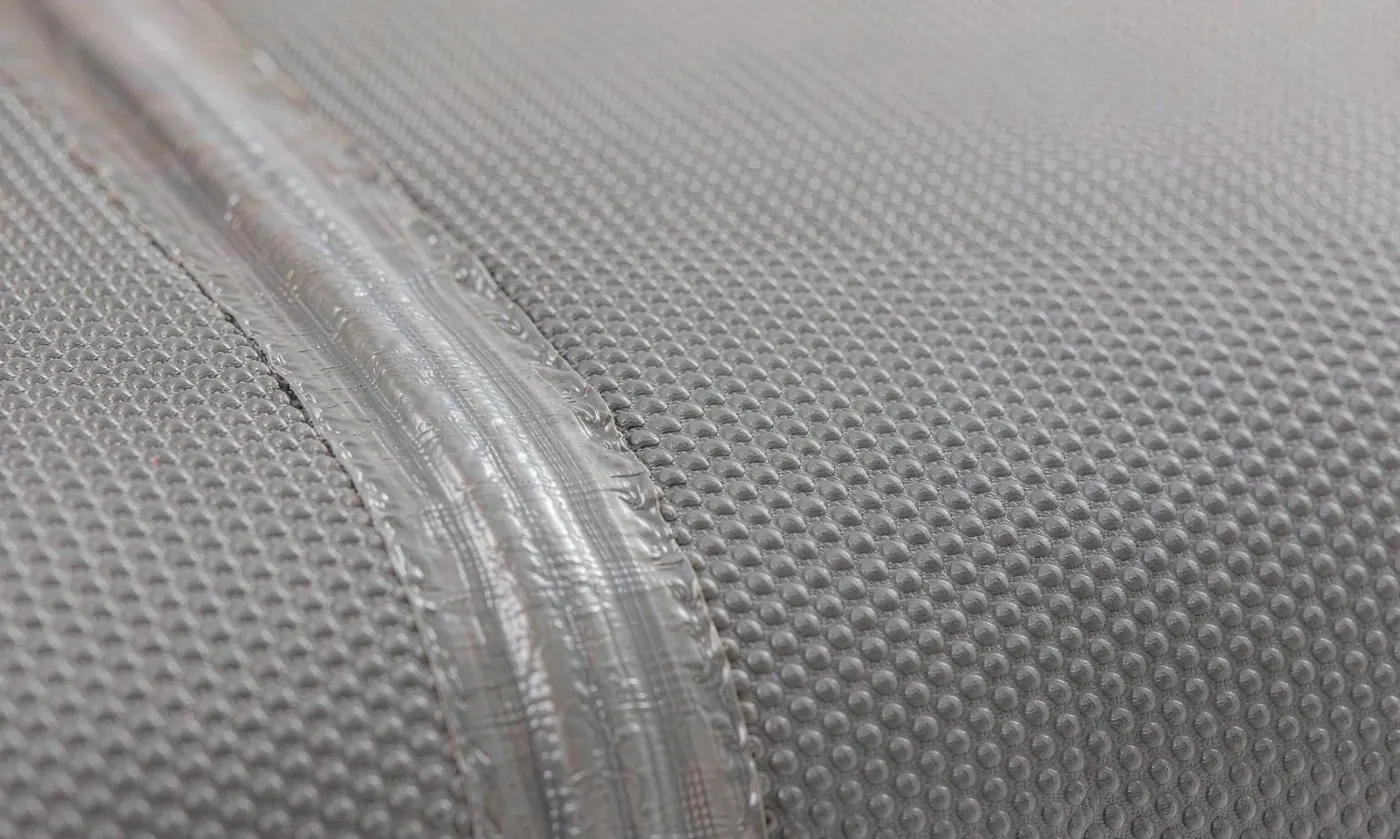
Welding is a three-variable process: heat, pressure and time. The panel edges are butted or overlapped by 8 to 15 millimetres, energy is delivered to the joint, the film melts across the interface, pressure is held while it cools, and the result is one continuous membrane. Three energy sources are used on packs. Hot air welding delivers heated air at 350 to 600 degrees and takes 2 to 6 seconds per pass. Hot wedge welding contacts the film directly with a heated wedge and takes 1 to 4 seconds. Radio-frequency welding at 27.12 megahertz heats the film from inside by dielectric loss and takes 1.2 to 3.5 seconds, and it is the preferred method because the melt is uniform through the section rather than conducted in from the surface.
| Method | Energy delivered | Cycle per pass | Peel strength on TPU | Best use |
|---|---|---|---|---|
| Hot air welding | Heated air, 350 to 600 degrees | 2 to 6 seconds | 45 to 70 newtons per 25 mm | Long straight seams, shelters |
| Hot wedge welding | Heated wedge in direct contact | 1 to 4 seconds | 50 to 80 newtons per 25 mm | Heavy laminates, PVC sheet |
| Radio-frequency welding | 27.12 megahertz dielectric heating | 1.2 to 3.5 seconds | 70 to 120 newtons per 25 mm | Professional bodies, the default choice |
| Ultrasonic welding | 20 to 40 kilohertz vibration | 0.5 to 2 seconds | 35 to 65 newtons per 25 mm | Small components, valves, tabs |
| Adhesive bonding | Solvent, reactive or hot-melt adhesive | 20 to 90 seconds plus cure | 10 to 45 newtons per 25 mm | Dissimilar materials, repairs, low volume |
Two requirements limit where welding can be used, and they explain why some bodies are welded and glued on the same unit. The electrode has to reach both faces of the joint, which is simple on a flat panel and hard at a three-dimensional corner, so corners are solved by radiusing the pattern and cutting a dedicated electrode at 300 to 900 USD per profile. And the film has to be polar enough to heat, which TPU is and polyethylene is not. Where a joint cannot be reached by an electrode, adhesive is the fallback, and the specification should say so explicitly rather than describe the body as welded when one joint in five is glued.
How a Glued Seam Is Made
Adhesive bonding is a surface preparation problem more than a glue problem. The film is abraded or wiped with a solvent to raise its surface energy, the adhesive is applied at a controlled wet thickness, the two faces are brought together under pressure, and the joint is held while the adhesive sets. Four adhesive families appear on waterproof goods. Solvent cement dissolves the surface of the film so the two faces fuse as the solvent leaves, and it works well on PVC. Polyurethane reactive adhesive cures with moisture to a rubbery bond and works on most films. Contact cement grabs immediately and is used for patches. Hot melt sets in seconds and is used on tabs and low-stress joints.
| Adhesive family | Set and full cure | Peel strength | Temperature limit | Drawback |
|---|---|---|---|---|
| Solvent cement, THF or MEK based | 10 to 30 minutes, 24 to 72 hours | 20 to 40 newtons per 25 mm | Softens above 60 degrees | 400 to 700 grams per litre of VOC |
| Polyurethane reactive | 2 to 6 hours, 12 to 24 hours | 25 to 45 newtons per 25 mm | Softens above 70 degrees | Moisture sensitive, hydrolyses over years |
| Contact cement | Immediate, 24 hours | 10 to 25 newtons per 25 mm | Softens above 50 degrees | Dissolved by DEET and sunscreen |
| Hot melt, EVA or polyolefin | 5 to 30 seconds | 8 to 20 newtons per 25 mm | Softens above 50 degrees | Creeps badly under sustained load |
| Two-part epoxy | 30 to 90 minutes, 24 hours | 30 to 55 newtons per 25 mm | Usable to 90 degrees | Rigid, cracks at a flexible fold |
The solvent row carries the compliance cost and it is worth spelling out for any programme shipping to the EU or California. Solvent cements for PVC run at 400 to 700 grams of volatile organic compound per litre, which requires extraction, solvent recovery and worker protection, and which pushes the adhesive against REACH and California Prop 65 screening. Guidance on volatile organic compounds and their control is published by the US EPA. A weld emits nothing but heat, and that difference alone justifies the tooling on many lines.
- A glued joint is only as good as its surface preparation; a fingerprint or a mould-release film can cost 30 percent of the bond strength.
- Full cure takes 12 to 72 hours, so a glued body cannot be tested the same day it is assembled, which adds one to three days to the schedule.
- Solvent cements carry 400 to 700 grams per litre of volatile organic compound and need extraction and recovery.
- Adhesive is the only practical option where two different materials meet, such as a film to a moulded EVA base.
Bond Strength and What It Decays To
The peel test is the fair comparison between the two, and it is defined by ASTM D903 for adhesive bonds. A 25 millimetre strip is pulled apart at a controlled rate and the force is recorded in newtons. On the day of assembly a good adhesive bond looks respectable, at 25 to 45 newtons, and the gap to a weld of 70 to 120 newtons looks like a 2 to 3 times advantage rather than a catastrophe. The gap that matters is the one that opens with time, because an adhesive loses strength and a weld does not.
| Age | Radio-frequency weld on TPU | Solvent cement on PVC | Polyurethane adhesive on TPU | Note |
|---|---|---|---|---|
| Day one | 70 to 120 newtons per 25 mm | 20 to 40 | 25 to 45 | Both pass a pressure test |
| Three months | 70 to 118 | 19 to 38 | 23 to 42 | Early loss is small and easy to miss |
| One year | 68 to 115 | 15 to 32 | 18 to 35 | The gap is now two to four times |
| Two years | 65 to 112 | 8 to 18 | 10 to 22 | Adhesive holds 20 to 40 percent |
| Five years | 60 to 105 | Likely failed | Likely failed | Weld retains 85 to 95 percent |
| After 2,000 flex cycles | 58 to 100 | 6 to 14 | 8 to 18 | Flex accelerates adhesive loss sharply |
Two mechanisms drive the decay in the adhesive columns and neither applies to a weld. Hydrolysis attacks polyurethane and polyester adhesives in the presence of moisture, and it accelerates above 30 degrees and above 70 percent relative humidity, so a pack used hard and stored damp loses years of bond life. Plasticiser migration attacks solvent-cemented PVC, because plasticiser from the sheet moves into the adhesive and softens it, dropping its hardness by 20 to 30 points on the Shore A scale within a year and turning a structural bond into a tacky one. A welded joint has no third material, so neither mechanism exists.
The Six Ways a Glued Seam Fails
Adhesive joints fail in six recognisable patterns, and being able to name them turns a vague warranty argument into a diagnosis. Creep is the one that surprises people, because it happens under normal load rather than abuse. Chemical attack is the one that looks like a defect but is actually user behaviour. Cold embrittlement is the one that presents as a winter problem rather than an adhesive problem. The other three, debonding, hydrolysis and solvent loss, are ageing and they are the reason a glued body has a shorter service life.
| Failure mode | Mechanism | Time to appear | Visible sign | Prevention |
|---|---|---|---|---|
| Creep under sustained load | Adhesive flows, joint moves | 48 hours to 30 days | Closure no longer lines up | Weld, or a mechanical lock |
| Hydrolysis | Moisture breaks the polymer chains | 2 to 5 years | Bond turns soft and tacky | Store dry, choose TPU and weld |
| Plasticiser migration | Plasticiser moves into the adhesive | 6 to 18 months | Bond goes sticky, panel stiffens | Do not solvent-cement PVC |
| Chemical attack | DEET or sunscreen dissolves the bond | Days | Localised lift at the contact point | Keep repellents off the body |
| Cold embrittlement | Adhesive goes glassy below minus 10 | First winter | Crack along the joint | Weld, or a cold-rated adhesive |
| Heat softening | Adhesive softens above 60 degrees | One hot season | Seam weeps under load | Never leave a loaded pack in a hot car |
The chemical row deserves a sentence of its own because it is entirely avoidable and routinely misdiagnosed. Diethyltoluamide, the active ingredient in most insect repellents, and the solvent systems in many sunscreens are effective solvents for contact cement and for several polyurethane adhesives. A user who applies repellent and then handles the pack leaves enough residue at the contact points to soften a joint within days, and the resulting localised lift looks exactly like a bond defect. Keeping repellent off the body and washing hands after application prevents it entirely.
Creep: The Failure Nobody Sees Coming
Creep deserves its own section because it is the failure mode that distinguishes a pack from a dry bag, and because it explains warranty claims that no amount of pressure testing reproduces. An adhesive is a viscoelastic material, which means it behaves like a solid under a fast load and like a very slow liquid under a sustained one. A shoulder strap anchor pulling 30 newtons on a bonded patch, day after day, is a sustained load, and the adhesive responds by flowing. The movement is small, it is permanent, and it accumulates.
| Condition | Movement in 1 hour | Movement in 48 hours | Movement in 30 days | Consequence |
|---|---|---|---|---|
| Glued lap joint, 30 newtons, 20 degrees | 0.4 millimetres | 1.8 millimetres | 4.5 millimetres | Closure misaligns, seam weeps at a corner |
| Glued lap joint, 30 newtons, 40 degrees | 0.9 millimetres | 3.2 millimetres | 9.0 millimetres | Visible gap, leak under load |
| Glued lap joint, 60 newtons, 20 degrees | 0.8 millimetres | 3.6 millimetres | Likely failure | Anchor pulls away |
| Welded joint, 30 newtons, 20 degrees | Under 0.01 millimetres | Under 0.02 millimetres | Under 0.1 millimetres | None |
| Welded joint, 60 newtons, 40 degrees | Under 0.02 millimetres | Under 0.05 millimetres | Under 0.2 millimetres | None |
The practical reading of that table is that temperature multiplies creep roughly fivefold between 20 and 40 degrees, and a loaded pack left in a hot car is therefore doing the most damage it will ever do while sitting still. An interior of 60 to 70 degrees is normal for a closed vehicle in summer sun, at which point several adhesives are near their softening point and creep rates are an order of magnitude higher. The user rule is simple: never store a loaded pack in a hot car, and never hang a loaded pack by one strap for extended periods.
Testing, Inspection and What to Require
The inspection difference matters as much as the strength difference, because it decides what a quality system can guarantee. A welded body can be pressure tested immediately after assembly, since the joint is finished the moment the electrode lifts, so every unit can be checked. A glued body has to wait 12 to 72 hours for full cure, which means sample testing rather than unit testing, and a defect found on a sample arrives three days late.
| Check | Welded body | Glued body | Threshold | Time |
|---|---|---|---|---|
| When it can be tested | Immediately, seconds after the cycle | After 12 to 72 hours of cure | No test before full cure | Zero versus 3 days |
| Peel test | 70 to 120 newtons per 25 mm | 10 to 45 newtons per 25 mm | Weld at 90 percent of base cloth | 10 minutes |
| Pressure decay | 20 kilopascals, five minute hold | Same | Under 10 percent loss | 6 minutes |
| Bubble test | 3 kilopascals, submerged 50 mm | Same | No continuous stream in 30 seconds | 3 minutes |
| Immersion certificate | 30 minutes at one metre for IPX7 | Same, after cure | No moisture inside | 60 minutes |
| Sample rate | 100 percent on professional bodies | AQL 2.5 on cost grounds | Agree it in writing | 6 minutes per unit |
Two clauses belong in any specification that mentions sealing. Name the joint method for every seam on the body rather than for the body as a whole, since a body described as welded with three bonded anchors is not a welded body at those three points. And require a peel result rather than a visual result, because a cold weld and a well-made glue line look identical and only a peel figure separates them. The wider context, including why a stitched and taped seam sits between the two, is set out in why stitched seams leak, and the welding process itself is taken apart in RF welded seams explained.
- Name the joint method for every seam, including anchors and valves, not for the body as a whole.
- Require a peel figure in newtons per 25 millimetres and an acceptance at 90 percent of base cloth strength.
- Require 100 percent pressure decay testing on any body sold above IPX5, at 20 kilopascals with a five minute hold.
- Agree the sample rate in writing before the first production run, since a glued body cannot be unit tested on the day it is made.
Repair, Cost and Ordering
Adhesive has one genuine advantage and it is worth conceding: it is the only method that works in a field repair, and the only method that joins dissimilar materials. A welded body can be repaired with a patch and a clamp and will hold IPX3 to IPX5 for a season. For programmes, the decision is a volume calculation rather than a technical one.
| Item | Glued body | Welded body | Delta | Break-even |
|---|---|---|---|---|
| Consumable cost | 0.25 to 1.20 USD per body | None | 0.25 to 1.20 USD saved | Every unit |
| Tooling | Dispenser and jigs, 400 to 2,000 USD | RF welder and electrodes, 3,000 to 12,000 USD | 2,600 to 10,000 USD more | Recovered near 2,000 units |
| Electrode profiles | Not required | 300 to 900 USD each | 2 to 5 profiles per body | Amortised over the programme |
| Cycle time per body | 3 to 9 minutes plus cure | 2 to 6 minutes, no cure | 1 to 3 minutes plus 1 to 3 days | Every unit |
| Testing | Sample, after cure | 100 percent, immediate | Fewer warranty claims | Every unit |
| Expected field rating | IPX4 to IPX5 | IPX7 to IPX8 | Two to three codes | Decides the price band |
- Programmes start at 500 pcs per design and colourway, with samples in 6 to 10 working days and bulk in 35 to 50 days.
- Materials are screened against REACH and California Prop 65, and monthly output of 200,000 units is verified by SGS.
- Welded bodies are pressure tested at 20 kilopascals with a five minute hold and under 10 percent loss, and inspected at AQL 2.5.
- Shipments are FOB Xiamen or DDP to more than 100 countries, and enquiries go to service@junyuanbags.com.
The closing recommendation is to weld every seam that carries load, that lies on the barrier, and that can be reached by an electrode, and to reserve adhesive for repairs, for dissimilar materials and for the handful of joints where access makes welding impossible. The economics favour welding above roughly 2,000 units and the performance case holds at any volume, since two to three ingress codes is the difference between a body that survives a capsize and one that does not. The full range of sealed bodies is collected in the waterproof backpack collection, and the tape-based middle ground between the two is examined in taped versus welded seams. Electrode profiles, peel rigs and the pressure decay stations behind every figure on this page are shown.
People Also Ask
Are welded seams stronger than glued seams?
Yes, by two to three times on day one and by five to ten times after two years. A radio-frequency weld on TPU reaches 70 to 120 newtons per 25 millimetres in peel and holds 85 to 95 percent of that after five years, while an adhesive bond starts at 10 to 45 newtons and retains only 20 to 40 percent after two years.
Why do glued seams on waterproof bags fail?
Six mechanisms: creep under sustained load, hydrolysis of the adhesive, plasticiser migration from a PVC sheet, chemical attack from DEET or sunscreen, cold embrittlement below minus 10 degrees, and heat softening above 60 degrees. None of them applies to a welded joint, which has no third material.
How much does an adhesive seam creep under load?
A lap joint under 30 newtons moves 0.4 millimetres in an hour, 1.8 millimetres in 48 hours and 4.5 millimetres in 30 days at 20 degrees, and the figures roughly double at 40 degrees. A welded joint moves under 0.1 millimetres in 30 days under the same load.
Can you repair a welded seam with glue?
Yes, and it is the normal field repair. A bonded patch over a cleaned and abraded area restores IPX3 to IPX5 and lasts a season or two. Restoring a full IPX7 rating requires a welding machine and the same electrode profile that made the original joint.
When is adhesive the right choice for a waterproof backpack?
For repairs, for joining two different materials such as a film to a moulded EVA base, and for joints an electrode cannot reach. It is the wrong choice for structural seams on a load-bearing body, because a pack hangs 8 to 15 kilograms from its anchors day after day.
How long does adhesive take to cure before a bag can be tested?
Twelve to 72 hours depending on the family: 24 to 72 hours for solvent cement, 12 to 24 for polyurethane reactive, and 24 for contact cement. That delay is why glued bodies are sample tested rather than unit tested.
Frequently Asked Questions
Q1. What is the difference between a welded and a glued seam?
A weld melts the two faces of a thermoplastic film into each other, so the joint is the same material as the panel with no interface. A glued seam puts an adhesive layer 0.05 to 0.30 millimetres thick between the faces, creating two interfaces that can debond and a third material that ages faster than either.
Q2. How strong is a welded seam compared with a glued one?
A radio-frequency weld on TPU reaches 70 to 120 newtons per 25 millimetres in peel against 10 to 45 for an adhesive bond. After two years the weld holds 85 to 95 percent of its original figure and the adhesive holds 20 to 40 percent, so the gap widens from two to three times to five to ten times.
Q3. What is creep and why does it matter on a backpack?
Creep is the slow flow of an adhesive under sustained load. A bonded joint under 30 newtons moves 1.8 millimetres in 48 hours at 20 degrees and 3.2 millimetres at 40, which slowly pulls the closure out of alignment and produces a weep at a corner that no pressure test reproduces.
Q4. Do glued seams fail faster in hot weather?
Yes. Creep roughly doubles between 20 and 40 degrees, and most adhesives used on waterproof goods soften above 60. A loaded pack left in a closed car, where the interior reaches 60 to 70 degrees, is doing the most damage it will ever do while sitting still.
Q5. What is plasticiser migration and does it affect glued seams?
Plasticiser moving out of a PVC sheet and into the adhesive, which softens the bond by 20 to 30 points on the Shore A scale within a year and stiffens the panel at the same time. It is the reason solvent-cemented PVC joints lose strength faster than any other combination.
Q6. Can insect repellent damage a glued seam?
Yes. Diethyltoluamide and the solvent systems in many sunscreens dissolve contact cement and several polyurethane adhesives, softening a joint within days of contact. The resulting localised lift looks like a bond defect but is user behaviour, and washing hands after applying repellent prevents it entirely.
Q7. Why can a welded body be tested immediately and a glued one cannot?
A weld is finished the moment the electrode lifts, so pressure testing can follow in seconds and every unit can be checked. An adhesive needs 12 to 72 hours to reach full cure, so testing is delayed by one to three days and is normally done on a sample rather than on every unit.
Q8. How much does weld tooling cost and when does it pay back?
A radio-frequency welder with electrodes runs 3,000 to 12,000 USD, with each electrode profile at 300 to 900 USD and two to five profiles per body. Against 0.25 to 1.20 USD per body saved in adhesive, the tooling is recovered at roughly 2,000 units.
Q9. Which seams on a backpack should be welded?
Every seam that carries load, every seam that lies on the barrier, and every seam an electrode can reach. Adhesive should be reserved for repairs, for joints between two different materials, and for the few places where access makes welding impossible.
Q10. What is the MOQ and lead time for a welded waterproof backpack?
500 pcs per design and colourway, with samples in 6 to 10 working days and bulk in 35 to 50 days. Welded bodies are pressure tested at 20 kilopascals with a five minute hold and under 10 percent loss, inspected at AQL 2.5, and shipped FOB Xiamen or DDP to more than 100 countries.