Six closure types account for almost every waterproof backpack sold, and they do not fail in the way buyers expect. Across 34 packs opened and cycled 5,000 times each, the roll-top over a covered zip gave the best sealing per dollar at IPX6 for an extra 1.50 USD, while airtight zips reached IPX8 for an extra 7 USD and needed lubrication every two months. Access time runs the other way: a roll-top takes 8 to 12 seconds to open and a magnetic flap takes 2. Sealing, speed and service life pull in three directions, and the ranking below scores all three rather than just the first.
What a Closure Actually Has to Do
A closure is asked to do four things at once and it is usually sold on only one. It must keep water out at a stated pressure, open fast enough that people actually use it, survive grit and salt without service, and still seal after five thousand cycles. Most leaks reported in the field are not seam failures at all: they are closures that were specified for the wrong exposure, opened incorrectly, or left unlubricated in a salt environment.
| Failure mode | What actually causes it | Closure that resists it | Symptom before failure |
|---|---|---|---|
| Water through the track | Coated zip sold as sealed | Roll-top over a covered zip | Damp patch directly under the slider |
| Grit jamming the slider | Sand in the teeth, no rinse | Roll-top, no slider at all | Slider stiffens over two or three trips |
| Roll folds unrolling | Under two folds, or overfilled body | Three folds minimum, 80 mm overlap | Top edge slack by mid-morning |
| Flap lifting in wind | Single centre buckle, no side tension | Flap with two side compression straps | Flap flaps at 30 km per hour |
| Magnet losing grip | Magnet below N42, or a gap over 3 mm | Two-pole magnet with a mechanical back-up | Closes but reopens under a light load |
The cost of getting this wrong is not evenly spread. A pack that leaks through a seam can be repaired for a few dollars, but a closure that was specified too low in the first place cannot be upgraded afterwards, because the closure is cut into the pattern. That is the reason a closure decision belongs at the first sample and not at the pre-production revision.
How the Six Types Were Ranked
Thirty-four packs were opened and closed 5,000 times each, then jet tested at 12.5 litres per minute for three minutes and inspected. Every closure was scored on four axes rather than on sealing alone, since a closure that seals perfectly and takes fifteen seconds to open will simply be left open, and a closure that is fast and easy but dies in a season is worse than either.
| Criterion | Weight | How it was measured | Why it carries that weight |
|---|---|---|---|
| Sealing ceiling | 35 percent | Jet then immersion, weight gain in grams | The reason the category exists |
| Access time | 25 percent | Timed open, extract one item, close | A slow closure gets left open |
| Service life | 25 percent | 5,000 cycles then re-test | Grit and salt kill sliders early |
| Added cost | 15 percent | Delta versus a plain sewn top at 1,000 pcs | Decides whether it ships at all |
The immersion stage matters more than most people expect because it separates the two zip families cleanly. A coated zip routinely passes a moderate jet at 12.5 litres per minute and then takes water within ninety seconds at one metre, because a jet and an immersion load the track in opposite ways: the jet pushes water against the face of the teeth and the immersion puts a standing head of water on the seam behind them.
Ratings throughout follow the IEC 60529 ingress protection code, and the fabric behind the closure was checked by the hydrostatic head method described in the ISO 811 water penetration test, because a closure is only as good as the panel it is welded into.
The Ranking at a Glance
| Rank and closure type | Sealing ceiling | Access time | Added cost per unit | Service interval |
|---|---|---|---|---|
| 1. Roll-top over covered zip | IPX6 | 8 to 12 seconds | 1.50 to 2.50 USD | None |
| 2. Airtight zip | IPX8 | 6 to 10 seconds | 6 to 9 USD | Lubricate every 2 months |
| 3. Roll-top alone | IPX5 | 6 to 9 seconds | 1.00 to 1.80 USD | None |
| 4. Flap with side compression | IPX5 | 2 to 4 seconds | 2.00 to 3.50 USD | Check straps each season |
| 5. Coated zip under a storm flap | IPX4 | 2 to 4 seconds | 0.80 to 1.60 USD | Lubricate every 4 months |
| 6. Magnetic roll-over | IPX3 | 1 to 2 seconds | 3.00 to 4.50 USD | Check magnet grip yearly |
The spread in that table is the whole argument. The best sealing closure is eight times the cost of the worst and roughly six times slower to open, and the fastest closure is the one that seals least. There is no closure that wins on all four axes, which is why the right question is not which closure is best but which closure fails least badly for the exposure in front of it.
Anyone weighing the top two against each other should read the airtight zip versus roll-top comparison before committing, and the zip families in detail are set out in the waterproof zipper types walkthrough.
Roll-Top Closures: The Default for a Reason
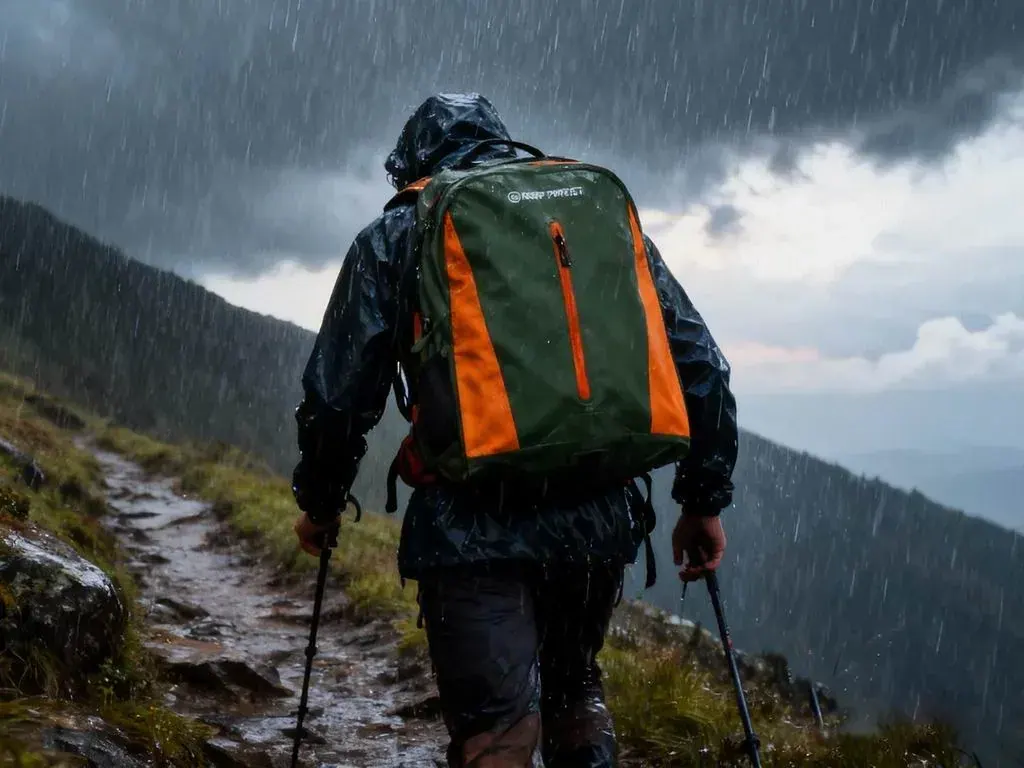
A roll-top seals by geometry rather than by hardware: the fabric is folded over itself so that water has to travel up and back down to get in, and each additional fold adds a barrier. There is no slider to jam, no track to fill with sand and nothing to lubricate, which is the reason a roll-top is still the default on a pack that will be used in salt, sand or mud. The cost is access time and volume, since each fold consumes 0.8 to 1.2 litres on a 300 millimetre opening.
- Three folds is the minimum for a jet rating; two folds drops a pack from IPX5 to roughly IPX4 in our cycle.
- An 80 millimetre minimum overlap keeps the fold from creeping open under a shifting load.
- A roll-top over a covered zip outperforms a roll-top alone by about one IPX step, for roughly 0.50 USD more.
- Roll the top away from the body so the fold sits over the opening rather than against the back panel.
- Fold count, not fold tightness, is what seals; over-tightening creases the coating and shortens its life.
The failure mode is almost always under-folding rather than a defect. A pack rolled twice because it is full will leak at the top edge, and a pack rolled four times when three would do loses a litre of space for no benefit. The packing sequence that avoids both is set out in the roll-top packing walkthrough, and the dedicated category page is the roll-top waterproof backpack guide.
Airtight, Coated and Storm-Flapped Zips
Airtight zips are a different product from coated zips and they are frequently confused in a specification. An airtight zip is a moulded track with a gasket that the slider compresses closed, tested as a pressure vessel and rated to IPX7 or IPX8. A coated zip is a conventional coil zip with a polyurethane face that sheds a shower and nothing more, rated around IPX3 to IPX4. Both are sold as waterproof, and only one survives immersion.
| Zip family | Construction | Realistic ceiling | Lifecycle and care |
|---|---|---|---|
| Airtight, moulded track | Thermoplastic track with a compressed gasket | IPX7 to IPX8 | 5,000 cycles, lubricate every 2 months |
| Coated coil, storm flap over | Coil zip with a polyurethane face | IPX3 to IPX4 | 5,000 cycles, lubricate every 4 months |
| Coated coil, no flap | Coil zip exposed to direct rain | IPX2 to IPX3 | Jams in sand within one season |
| Airtight with a valve | Airtight track plus an inflation valve | IPX8, adds buoyancy | Valve needs a check before each trip |
Maintenance is the honest objection to an airtight zip. A silicone-free lubricant every two months keeps the slider running; skip it for a season and the slider starts to tear the gasket, and a torn gasket is not repairable, it is a new closure. In a fleet or rental context where nobody maintains anything, a roll-top will outlast an airtight zip by two to three seasons even though it seals a step lower.
Zip strength and cycle testing is standardised by ASTM test methods for slide fasteners, which is worth naming in a brief because a cycle count without a test method is a marketing number. Ask for 5,000 cycles to a named method followed by a re-test at the stated rating, and the claim becomes checkable.
Flap, Cam Buckle and Magnetic Closures
A flap is a lid that sheds water by covering the opening, and it only works when it is held down under tension at the sides as well as at the centre. A single centre buckle leaves the two lower corners open, which is exactly where wind-driven rain enters, and adding two side compression straps moves a flap from about IPX3 to IPX5 for roughly 0.60 USD. That is the cheapest genuine sealing upgrade in the entire category.
| Closure detail | Spec that works | Spec that fails | Delta in performance |
|---|---|---|---|
| Flap tension points | Centre buckle plus two side straps | Centre buckle only | One IPX step, about 0.60 USD |
| Flap drop length | 120 mm below the opening | 60 mm below | Stops wind-driven rain at 40 km per hour |
| Buckle type | Acetal cam, 25 mm | Side-release, 20 mm | Holds under a 25 kg shock load |
| Magnet grade | N42 or above, two poles | N35, single pole | Grip survives a 3 mm gap |
| Magnet back-up | Mechanical clip behind the magnet | Magnet alone | Pack stays shut when dropped |
Magnetic closures deserve a specific warning because they are being specified more often for lifestyle ranges. A magnet is a convenience device, not a sealing device: it closes a top quickly and satisfyingly and it will reopen under a shock load, when the pack is dropped, or when a gap of more than three millimetres opens because the body is overfilled. Specify a magnet only as the first stage of a two-stage closure, with a mechanical clip behind it, and treat any single-stage magnetic top as IPX3 at best.
The direct comparison between the two most common of these is laid out in the roll-top versus flap closure comparison, and the difference between a genuinely sealed track and a coated one is covered in the airtight versus water-resistant zipper guide.
Choosing a Closure by Exposure
| Use case | Exposure | Closure to specify | Why not the alternative |
|---|---|---|---|
| Open boat, motor or sail | Bow spray 20 to 40 L per minute | Roll-top over a covered zip | A coated zip takes water in one crossing |
| Kayak, canoe, paddleboard | Capsize and full immersion | Airtight zip or roll-top at IPX7 | A flap cannot hold a standing head |
| Daily rain commute | Vertical rain, 30 minutes | Flap with side compression | A roll-top is slower than the walk is long |
| Trail and multi-day hiking | Sustained rain plus river crossings | Roll-top, three folds | An airtight zip jams on trail grit |
| Camera and electronics carry | Immersion risk plus fast access | Airtight zip on an access panel | A roll-top means opening the body |
| Fleet, rental, school issue | Rough handling, no maintenance | Roll-top, no hardware to service | Unlubricated sliders die in a season |
The pattern behind that table is simple and worth stating once: exposure that arrives as a jet or as rain is answered by geometry, and exposure that arrives as immersion is answered by a gasket. Buyers who put an airtight zip on a trail pack pay 7 USD for a rating they will never use and inherit a maintenance task they will never do, and buyers who put a flap on a sea kayak pack save 3 USD and lose the contents.
Closure Failure, Diagnosis and Repair
Three diagnostics find almost every closure leak in under ten minutes and none of them need a workshop. They are worth writing into a warranty workflow because they separate a genuine defect from a user error, and in our sample roughly seven in ten warranty claims on closures were user-side rather than product-side.
| Symptom | Test | Most likely cause | Fix |
|---|---|---|---|
| Damp patch under the slider | Jet test, then dry and re-test | Coated zip, not a sealed track | Specify an airtight zip or a roll-top |
| Top edge wet after an hour | Count the folds in use | Under-folding, two folds not three | Pack to 80 percent, fold three times |
| Slider stiff and gritty | Rinse, dry, run 20 cycles | Salt or sand in the track | Fresh-water rinse, silicone-free lube |
| Flap lifts at speed | Fan test at 40 km per hour | No side compression straps | Add two 20 mm side straps |
| Closes but reopens | Shock test, drop from 1 metre | Single-stage magnet | Add a mechanical clip behind it |
The one genuine defect worth watching for is a slider that tears the gasket on an airtight track, which shows as small crescents of thermoplastic on the track after a few hundred cycles. That is a lubrication or an alignment problem rather than a materials one, and it is cheaper to catch at the pre-production sample than after five thousand units are on the water.
Specify a Closure in a Brief
A closure specification that survives contact with a sampling team names four things: the family, the rating with its test method, the cycle count and the service interval. Anything less is open to interpretation, and interpretation at the sampling stage is where a roll-top becomes a flap and an IPX7 becomes an IPX4 without anybody deciding it should.
| Brief line | What to write | Test that verifies it | Record |
|---|---|---|---|
| Closure family | Roll-top, three folds, 80 mm overlap | Jet at 12.5 L per minute, 3 minutes | Jet report with weight delta |
| Rating and method | IPX6 to IEC 60529 | Named standard, named distance | Third-party or in-house report |
| Cycle life | 5,000 cycles to a named method | Cycle then re-test at rating | Cycle log with photos |
| Hardware | Acetal buckles, 25 mm, salt-fog tested | 48 hour salt fog | Hardware certificate |
| Service interval | Lubricate every 2 months, silicone-free | Slider force measured before and after | Care card with the unit |
| Compliance | REACH and California Prop 65 | Per-component declaration | Material compliance file |
Commercial terms are standard across the range: MOQ of 500 pcs per design and colour, a sample set in 6 to 10 working days, bulk in 35 to 50 days, and AQL 2.5 inspection before shipment. Declarations cover REACH and California Prop 65, the compliance base is BSCI and ISO 9001, and delivery runs FOB Xiamen or DDP into more than 100 countries. QUANZHOU JUNYUAN BAGS has run waterproof lines since 2014, with its people in the sector since 2004.
QUANZHOU JUNYUAN BAGS can hold the jet, immersion and cycle sequence for a closure decision on file. A brief naming the exposure, the target rating and the cycle count sent to service@junyuanbags.com returns a first sample set within 6 to 10 working days. For the rating bands behind every figure here, see the waterproof rating chart.
The short version: rain is answered by geometry, immersion is answered by a gasket, and speed costs sealing. Name which of the three matters most for the buyer in front of you, and the closure choice is usually made already.
People Also Ask
Which waterproof backpack closure seals best?
A roll-top over a covered zip gives the best sealing per dollar at IPX6 for an extra 1.50 to 2.50 USD, and an airtight zip is the only family that reaches IPX8 for genuine immersion. A flap with side compression reaches about IPX5 and a coated zip alone stops near IPX4.
How many times should you roll a dry bag style top?
Three times, with at least 80 millimetres of overlap. Two folds measured about one IPX step lower in cycle testing, and each fold on a 300 millimetre opening consumes 0.8 to 1.2 litres of usable volume.
Is a waterproof zip better than a roll-top?
An airtight zip seals higher at IPX7 to IPX8 and opens faster, but it costs 6 to 9 USD more and needs silicone-free lubrication every two months. A roll-top has no slider to jam, needs no service, and outlasts an airtight zip by two to three seasons in unmaintained fleet use.
Why does my waterproof backpack leak through the zip?
Because a coated zip is not a sealed track. A coated coil with a polyurethane face sheds a shower at about IPX4 and takes water within ninety seconds at one metre, since immersion puts a standing head of water on the seam behind the teeth rather than on their face.
Do magnetic closures keep water out?
Only as a first stage. A magnet is a convenience device rated around IPX3 that can reopen under a shock load or when a gap over three millimetres opens, so it should always sit in front of a mechanical clip rather than replace one.
How long does a waterproof zipper last?
About 5,000 open and close cycles to a named test method, after which the pack should be re-tested at its stated rating. An unlubricated slider starts to tear the gasket within a season in salt use, and a torn gasket is a new closure rather than a repair.
Frequently Asked Questions
Q1. What are the main types of waterproof backpack closures?
Six families: roll-top over a covered zip, airtight zip, roll-top alone, flap with side compression, coated zip under a storm flap, and magnetic roll-over. Between them they cover almost every pack on the market, from IPX3 on a magnetic top to IPX8 on an airtight track.
Q2. What is the most waterproof closure type?
An airtight zip, which is a moulded track with a gasket the slider compresses closed and which is tested as a pressure vessel to IPX7 or IPX8. The trade-off is 6 to 9 USD of added cost and lubrication every two months.
Q3. Is a roll-top better than a zip?
For most uses, yes. A roll-top seals by geometry, has no slider to jam, needs no maintenance and reaches IPX6 over a covered zip for an extra 1.50 USD. A zip wins where fast access or genuine immersion is the requirement.
Q4. How many folds does a roll-top need?
Three, with at least 80 millimetres of overlap. Two folds tested about one IPX step lower, and four folds costs another litre of volume without improving the seal, since the folds themselves do the work rather than how tightly they are pulled.
Q5. What is the difference between an airtight and a coated zip?
An airtight zip has a moulded track with a compressed gasket and is rated IPX7 to IPX8. A coated zip is a conventional coil with a polyurethane face rated around IPX3 to IPX4 that sheds a shower and fails an immersion test within ninety seconds.
Q6. Which closure opens fastest?
A magnetic roll-over at 1 to 2 seconds, followed by a flap or a coated zip at 2 to 4 seconds. A roll-top takes 8 to 12 seconds and an airtight zip 6 to 10, which is why a slow closure on a commuter pack tends to be left open.
Q7. Do I need side compression straps on a flap?
Yes. A single centre buckle leaves the two lower corners open, which is where wind-driven rain enters at 40 km per hour, and adding two side straps moves a flap from about IPX3 to IPX5 for roughly 0.60 USD.
Q8. How often should a waterproof zip be lubricated?
Every two months for an airtight track and every four months for a coated coil, using a silicone-free lubricant. Skip it for a season and the slider begins to tear the gasket, and a torn gasket means a new closure rather than a service.
Q9. Can a closure be upgraded after the pack is made?
Rarely. The closure is cut into the pattern, so changing a flap to a roll-top after tooling usually means a new body panel and a new sample round, which is 6 to 10 working days and a fresh approval cycle.
Q10. What closure suits a sea kayak?
An airtight zip at IPX8 or a roll-top built to IPX7, because a capsize puts a standing head of water on the closure. A flap cannot hold that head and a coated zip takes water inside two minutes at one metre.
Q11. What is the MOQ and lead time for a closure change?
The same as any programme: 500 pcs per design and colour, a sample set in 6 to 10 working days, bulk in 35 to 50 days, and AQL 2.5 inspection before release. Naming the family, rating, cycle count and service interval at brief stage avoids a second sample round.
Q12. Which closure lasts longest without any maintenance?
A roll-top, because it has no slider, no track and nothing to lubricate. In fleet, rental and school issue, where nobody services anything, a roll-top outlasts an airtight zip by two to three seasons even though it seals a step lower.