A roll-top closure is the right choice whenever the pack may be submerged, dropped in surf, or exposed to sustained heavy rain; a flap closure is the right choice when access speed and one-handed operation matter more than immersion protection. A roll-top needs a minimum of three folds over 100 to 150 millimetres of fabric to reach IPX6 to IPX7, and it takes 8 to 15 seconds to close properly. A flap with a drawstring throat and side buckles closes in 3 to 6 seconds but typically lands at IPX3 to IPX5 because water runs down the face and enters at the throat. Programme entry is 500 pcs per design and colour, samples in 6 to 10 working days, bulk in 35 to 50 days.
How Each Closure Actually Keeps Water Out
The two systems use completely different physics. A roll-top does not seal at all in the conventional sense: it creates a long, tortuous path. Water entering the mouth must climb against gravity through three or more folds of coated fabric pressed together by side compression, so the resistance is a function of fold count and compression force rather than of any gasket. That is why a roll-top with only two folds leaks in rough conditions while the same bag with four folds stays dry.
A flap closure works by shedding rather than by blocking. The outer panel throws the bulk of the water off to the sides, and the real barrier is the drawstring throat or covered zipper underneath. This works well for rain falling from above and fails quickly when the pack is lying in water, being dragged through surf, or upside down in a raft, because in all three cases gravity stops helping and starts working against the flap.
There is also a pressure dimension that rarely appears in marketing copy. A pack half filled with air and sealed at altitude or in a hot vehicle carries a small internal overpressure of 1 to 3 kilopascals, and that pressure pushes outward at exactly the point where the seal is weakest. The practical instruction is simple: squeeze the air out before the final fold. It takes 2 seconds and it removes a failure mode that accounts for a surprising share of damp packs after a mountain descent or a hot afternoon.
Both approaches are rated under the same published code. The ingress definitions in IEC 60529 cover water jets at IPX5 and IPX6 and temporary immersion at IPX7, and they also define the dust codes from IP5X to IP6X that matter for desert and beach use. The important discipline is to test the whole pack in the configuration it will be carried in, with the closure closed by a person rather than by a technician who has practised fifty times.
| Property | Roll-top closure | Flap closure | Practical meaning |
|---|---|---|---|
| Sealing principle | Tortuous path by folding | Shedding plus throat barrier | Folding survives immersion |
| Typical tested rating | IPX6 to IPX7 | IPX3 to IPX5 | Two to three code steps apart |
| Close time | 8 to 15 seconds | 3 to 6 seconds | Flap is two to three times faster |
| One-handed operation | No | Yes, with practice | Flap wins on a moving bike |
| Volume adjustability | Compresses 20 to 40 percent | Fixed shell volume | Roll-top stabilises partial loads |
| Failure mode | Under-rolled or creased fold | Water tracking behind the flap | Both are user-error sensitive |
Fold Count, Seal Height and Compression Force
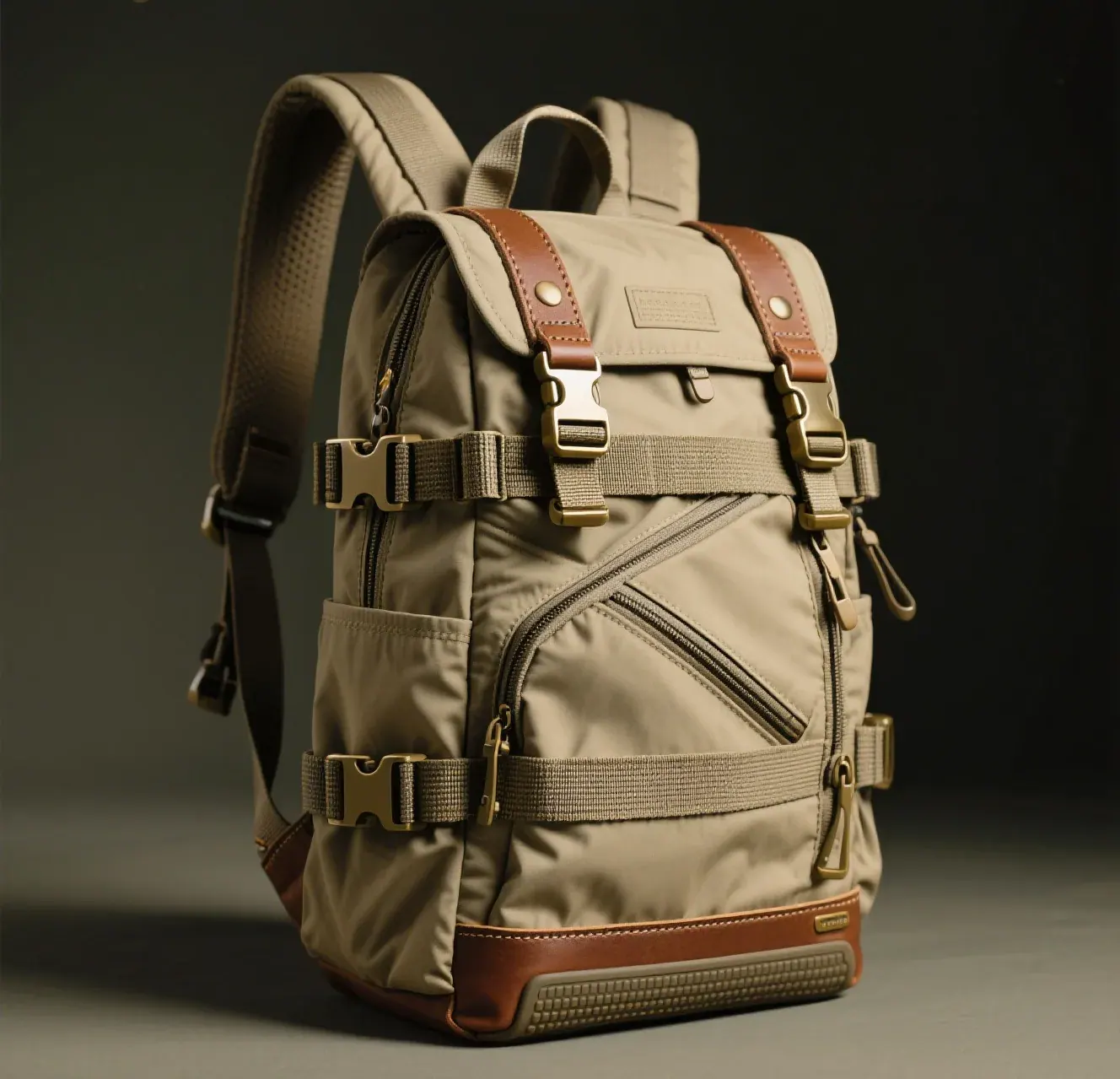
Roll-top performance is arithmetic. The available seal height is the fabric between the stiffener and the clip line, typically 100 to 150 millimetres on a 20 to 30 litre pack, and each fold consumes roughly 30 to 45 millimetres of that height. Three folds therefore need about 100 to 135 millimetres, which is why a pack designed with only 90 millimetres of free fabric can never be rolled properly no matter how carefully the user works.
Compression is the second variable. Side buckles or a top bar apply 20 to 60 newtons across the folded band, and below roughly 15 newtons capillary action starts pulling water through the folds. This is why a roll-top closed loosely after a big lunch stays dry on a drizzly commute and leaks badly during a kayak rescue: the difference is not the bag, it is the tension.
Stiffeners matter as much as buckles. A semi-rigid band of 2 to 4 millimetres moulded into the mouth keeps the fold straight; without it, users produce a curved fold with a gap at each end, which is the single most common cause of a roll-top that fails a test it should pass. Specifying a stiffener costs a fraction of a dollar and removes most field complaints.
| Roll-top parameter | Minimum for IPX5 | Minimum for IPX6 to IPX7 | How to verify |
|---|---|---|---|
| Fold count | 2 folds | 3 to 4 folds | Visual check in the field |
| Free fabric height | 80 mm | 120 to 150 mm | Measure from stiffener to clip |
| Compression force | 15 N | 30 to 60 N | Force gauge on the buckle band |
| Mouth stiffener | Optional | 2 to 4 mm semi-rigid | Sample inspection |
| Fold line coating | TPU 0.3 mm | TPU 0.4 to 0.6 mm | Micrometer on the panel |
Access Speed and Real-World Handling
Speed is the flap closure's strongest argument. Reaching a camera, a wallet, or a rain shell from a flap pack takes 3 to 6 seconds and can be done with one hand while the other stays on a handlebar or a paddle. The same retrieval from a roll-top takes 8 to 15 seconds, requires both hands, and usually means putting the pack down, which is exactly what nobody wants to do on a wet rock.
There is a second dimension: partial access. A roll-top must be unrolled and rerolled every time, and each cycle adds wear to the fold line. A flap with a magnetic or cam buckle can be opened and closed 30 to 60 times a day without meaningful wear. For professions where the pack is opened constantly, guide work, photography, survey work, that difference decides the purchase long before waterproof ratings do.
Hybrid designs try to buy both. A flap over a roll-top throat, or a flap over a covered technical zipper, gives fast access with the sealing element behind it. The compromise is bulk and cost: an extra panel of 0.4 to 0.6 millimetre coated fabric adds 60 to 120 grams and roughly 12 to 18 percent to the closure cost, and it introduces a second place for grit to collect.
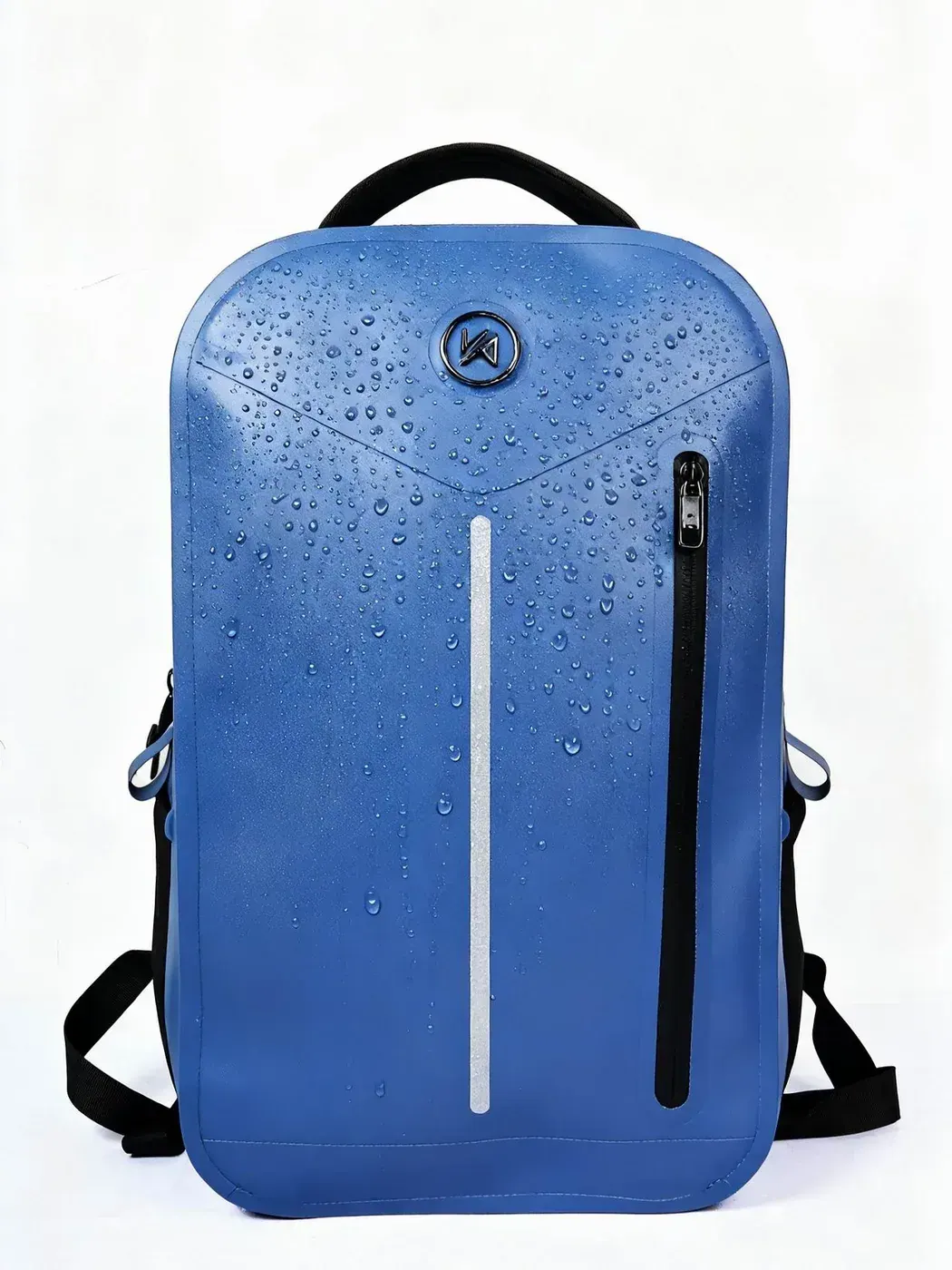
- Roll the mouth down at least three times, keeping each fold flat and parallel before clipping.
- Squeeze air out before the final fold so internal pressure does not push water in at the corners.
- Clip both sides before lifting the pack; a single clipped side produces a curved fold with end gaps.
- On a flap pack, always close the throat drawstring first, then the flap; reversing the order traps a channel.
- Rinse grit from closure hardware weekly; a buckle packed with sand loses 30 to 50 percent of its grip.
Rain, Spray and Laboratory Correlation
Laboratory ratings and field experience correlate well if the test matches the exposure. A spray test that wets the fabric and measures strike-through is a good proxy for a 20 minute shower, while a jet test is a better proxy for riding or boating at speed. Standardised textile methods exist for exactly this: AATCC publishes spray and rain test methods that let a buyer specify a numeric performance rather than a vague claim, and those results can be tracked across production lots.
This matters because water behaviour changes with time. A new coated fabric sheds water for the first 6 to 12 months, then wetting out begins as the finish abrades and contamination accumulates. A pack that passed a spray test at sample stage can fail the same test after a season of salt spray, sunscreen, and sunscreen-contaminated hands, which is why care instructions and a re-treatment path belong in the specification, not just in the manual.
Cold changes the hardware rather than the fabric. Below about minus 5 degrees Celsius, buckle tongues stiffen and users apply less force, so a roll-top that sealed at 40 newtons in summer may only see 20 newtons in January. Specifying cold-cycle testing at minus 10 to minus 20 degrees Celsius catches this before the first winter return wave.
| Exposure | Realistic roll-top result | Realistic flap result | Recommended choice |
|---|---|---|---|
| 20 minute urban shower | Dry | Dry if throat closed | Either |
| Two hour hike in steady rain | Dry | Damp at the throat seam | Roll-top |
| Boating with spray at 40 km/h | Dry | Damp to wet at the face | Roll-top |
| Temporary drop in water, 30 minutes at 1 m | Dry at IPX7 | Wet | Roll-top |
| Desert dust and sand | Good, folds block ingress | Poor, grit packs the throat | Roll-top |
| Frequent one-handed access | Slow | Fast | Flap |
Durability: Where Each Closure Wears Out
Roll-tops wear at the fold. A pack opened twice a day accumulates 700 to 900 fold cycles per year, and the crease line is where coating delamination and pinholing begin, typically after 2,500 to 5,000 cycles on a 0.3 millimetre film and later on a 0.5 millimetre film. Specifying a thicker film at the mouth and a fold radius above 8 millimetres roughly doubles that life for a small cost.
Flaps wear at hardware and at abrasion points. Buckles see the same open-close count plus grit contamination, and the flap face abrades wherever it folds over a loaded edge. Webbing and buckle strength are commonly checked against procedures published by ASTM International, and the useful specification is not just breaking strength but cycle life after salt fog exposure, because that is what a coastal season does to a closure.
| Wear item | Roll-top target | Flap target | Verification method |
|---|---|---|---|
| Fold or crease life | 5,000 to 8,000 cycles | Not applicable | Cycle then retest at IPX6 |
| Buckle cycle life | 10,000 cycles | 10,000 cycles | Cycled prototype |
| Buckle strength after salt fog | Above 200 N | Above 200 N | Salt fog 48 hours then pull |
| Webbing abrasion | No failure at 5,000 rubs | No failure at 5,000 rubs | Abrasion cycle count |
| Film thickness at the mouth | 0.4 to 0.6 mm | Not applicable | Micrometer sample check |
| Hardware at minus 20 degrees Celsius | Operable with gloves | Operable with gloves | Conditioned handling trial |
Weight, Component Count and Cost Structure
Weight differences are smaller than most buyers expect. A roll-top mouth adds 40 to 90 grams over a simple throat because of the stiffener band and the extra fabric height, and the side buckles add another 20 to 40 grams. A flap assembly with a covered zipper, two buckles, and a reinforced face panel adds 90 to 160 grams. On a 25 litre pack weighing 900 to 1,300 grams, that is a 5 to 12 percent swing, which is measurable but rarely decisive on its own.
Component count matters more than weight for reliability. A roll-top has three functional parts: stiffener, fabric band, and two buckles. A flap has five or more: outer panel, throat drawstring or zipper, cord lock, buckles, and often a storm gutter. Each additional component is another item that can be wrongly assembled by the user, and user assembly error causes far more wet packs in the field than material failure ever does.
Cost follows the same logic but with a twist. A roll-top is cheaper to build and more expensive to trim well, because the value sits in film thickness at the fold and in a stiffener that users never see. A flap is more expensive to build and cheaper to make look premium, because visible hardware and panel shaping read as quality in a showroom. Buyers specifying for rental or fleet duty should spend the money on the invisible parts.
| Cost and weight item | Roll-top | Flap | Buyer note |
|---|---|---|---|
| Closure component count | 3 parts | 5 or more parts | Fewer parts means fewer user errors |
| Added weight over a plain throat | 60 to 130 g | 90 to 160 g | 5 to 12 percent of pack weight |
| Closure cost share | 8 to 12 percent | 12 to 18 percent | Hardware dominates flap cost |
| Where value is hidden | Film thickness and stiffener | Panel shaping and hardware finish | Invisible parts drive field reliability |
| Repairability | Buckle replaceable in 5 minutes | Panel often sewn in | Roll-top is easier to service |
Choosing by Activity
Activity decides the trade-off more cleanly than price does. Anything involving immersion, kayaking, rafting, canoe camping, surf launching, pushes to a roll-top without argument. Anything involving frequent access with one hand, photography, guiding, bike commuting, pushes toward a flap or a hybrid. Everything in between depends on how often the pack is opened relative to how wet it gets.
Volume behaviour also splits the two. A roll-top compresses a partially filled pack by 20 to 40 percent, which stabilises the load and reduces the sloshing that makes a half-empty pack uncomfortable. A flap shell has a fixed volume, so a half-full pack sags and moves unless the user adds compression straps. For riders and paddlers carrying variable loads that difference is felt on every trip.
Three quick field checks settle most purchases. First, close the empty pack the way the manual shows and submerge it in a bath for 30 minutes with a paper towel inside; any dampness means the geometry is wrong. Second, fill the pack to 40 percent and walk 500 metres on uneven ground to feel whether the closure stabilises the load or lets it slosh. Third, open and close the pack ten times wearing gloves, because that is the condition under which a supposedly fast closure becomes slow and frustrating.
Readers choosing a roll-top body should start with the roll-top waterproof backpack range, and anyone comparing a roll-top against a technical zipper should read the TIZIP versus roll-top comparison before deciding, because a high-grade waterproof zipper buys access speed at a significantly higher unit cost. The full category overview sits in the waterproof backpack hub.
Specification and Programme Numbers
Whichever closure is chosen, the specification should be numeric. Free fabric height for rolling, fold count illustrated in the manual, compression force at the buckle band, film thickness at the mouth, buckle cycle life after salt fog, and a rating target tested on the finished article. Writing these six lines into a tech pack removes most of the disputes that otherwise arise when a production sample behaves differently from the prototype.
QUANZHOU JUNYUAN BAGS develops both closure families from one material library, starting at 500 pcs per design and colour with samples in 6 to 10 working days and bulk in 35 to 50 days. Materials may be screened against REACH and California Prop 65, release inspection can run at AQL 2.5, and delivery can be FOB Xiamen or DDP into more than 100 countries. Fold geometry, stiffener design, and hardware selection are documented. Briefs may be sent to service@junyuanbags.com.
One final rule of thumb for buyers: specify the closure by what it must survive, not by how it looks. If the sentence describing the use case contains the words submerged, surf, or raft, order a roll-top with at least three folds and 120 millimetres of free fabric. If it contains the words repeatedly, one-handed, or while moving, order a flap over a properly covered throat and accept that it will not survive a swim.
People Also Ask
How many rolls does a roll-top backpack need?
Three full folds for IPX6 to IPX7 performance, four in rough conditions. Each fold consumes 30 to 45 millimetres of fabric, so the mouth needs 120 to 150 millimetres of free height between the stiffener and the clip line.
Is a flap closure waterproof enough for hiking?
For steady rain with the throat drawstring closed properly, yes, but expect damp at the throat seam after about two hours. For sustained heavy rain or any immersion risk, a roll-top is the safer choice by two to three rating steps.
Why does my roll-top leak even though it looks closed?
Usually fold shape or tension. A curved fold leaves gaps at both ends, and compression below about 15 newtons lets capillary action pull water through. Use a mouth stiffener of 2 to 4 millimetres and clip both sides to 30 to 60 newtons.
Which closure lasts longer?
Depends on the environment. A roll-top fold line typically survives 5,000 to 8,000 cycles on a 0.4 to 0.6 millimetre film, while a flap buckle survives about 10,000 cycles but loses 30 to 50 percent of grip when packed with sand or salt.
Can a flap closure be upgraded to immersion rating?
Only with a technical waterproof zipper or a roll throat underneath, which changes the cost structure substantially. A conventional flap over a covered coil zip realistically reaches IPX4 to IPX5, not IPX7.
Do roll-top packs keep dust out as well as water?
Yes, and often better than flaps. The folded band blocks airborne particles effectively, which is why desert and beach users commonly prefer rolled mouths. IEC 60529 dust codes from IP5X to IP6X describe that performance if it needs to be certified.
Frequently Asked Questions
Q1. What is the main difference between a roll-top and a flap closure?
A roll-top blocks water with a folded tortuous path and reaches IPX6 to IPX7; a flap sheds water and relies on a throat barrier underneath, typically reaching IPX3 to IPX5. The roll-top is slower to open but survives immersion.
Q2. How long does each closure take to open and close?
A roll-top takes 8 to 15 seconds with two hands, while a flap takes 3 to 6 seconds and can be worked one-handed. That difference matters most for users who open the pack 30 to 60 times per day.
Q3. Can a flap pack be used for kayaking?
Only for short trips in calm conditions with the bag secured upright. Any capsize or swim will put water through the throat, so paddlers should use a roll-top rated IPX6 or IPX7 and clip it to the boat.
Q4. How much fabric height does a proper roll-top need?
120 to 150 millimetres of free fabric between the stiffener and the clip line for three to four folds. Packs designed with only 80 to 90 millimetres cannot be rolled to immersion standard no matter how carefully the user works.
Q5. Do roll-tops work in freezing weather?
The fabric does, the user often does not. Below minus 5 degrees Celsius stiff hands apply less compression, so a roll that sealed at 40 newtons in summer may only reach 20 newtons. Specify cold-cycle testing at minus 10 to minus 20 degrees Celsius.
Q6. Is a hybrid flap over roll-top worth the extra cost?
Yes for mixed use, roughly 12 to 18 percent more on the closure plus 60 to 120 grams. It buys fast access with a sealed throat behind it, at the cost of extra bulk and one more place for grit to collect.
Q7. Which closure is better for beach and sand use?
A roll-top. Grit packs into drawstring throats and buckle mechanisms, costing 30 to 50 percent of closure grip, while a folded band simply keeps particles out. Rinse hardware in fresh water after every salt session regardless.
Q8. How do I know when a roll-top fold line is worn out?
Look for coating crazing or pinholes along the crease, typically after 2,500 to 5,000 cycles on thin film. Test by rolling the empty pack, sealing it, and submerging it in a bath for 30 minutes; any dampness inside means the mouth panel has reached end of life.
Q9. Do ratings apply to the fabric or the finished pack?
The finished pack in its carried configuration. A fabric swatch can pass a hydrostatic head test while the assembled bag fails, because the closure, the seam corners, and the strap roots are where water actually enters. Always test the assembled article.
Q10. What are MOQ, sample and bulk times for either closure?
The same for both: 500 pcs per design and colour, prototype samples in 6 to 10 working days, bulk in 35 to 50 days after sign-off. Book any rating test at prototype stage so it does not extend the production window.