Breathability and waterproofing pull against the same physical space in a backpack shell. A coated fabric that holds 10,000 mm of hydrostatic head typically transmits under 1,000 g of water vapour per square metre per day, while a vented mesh panel that moves sweat freely lets liquid water in within seconds. The practical answer is not one material but a split design: a sealed chamber for the load and a ventilated, drained path at the body contact zones. Specify 8-12 mm of back panel standoff, target IPX6 on the finished chamber, and accept that a truly submersible pack will always feel warmer than a shower-resistant one.
Why One Panel Cannot Maximise Both Properties
Liquid water enters through holes and pressure; water vapour leaves through the same kind of pathway driven by a humidity gradient. A shell that blocks droplets at 10,000 mm of water column is, by construction, largely closed to vapour as well. This is why the honest engineering answer is zoning rather than a single magic laminate: seal where water arrives, ventilate where sweat is generated, and never put the two requirements on the same square centimetre of fabric.
Riders, commuters, and hikers describe the same complaint with different words: a wet back after 40 minutes. In most cases the moisture is sweat that could not escape, not rain that got in. Distinguishing the two matters, because the fix is completely different. A leak needs a seam or closure repair; a sweat problem needs airflow, load reduction, or a different back panel, and resealing a shell will not change it.
| Property | What it measures | Typical waterproof shell | Typical vented panel |
|---|---|---|---|
| Hydrostatic head | Liquid water resistance in mm | 5,000-10,000 mm | 0-500 mm |
| MVTR | Vapour transmission g per m2 per 24 h | 300-1,200 g | 8,000-15,000 g |
| RET | Resistance to evaporative transfer | 20-40 | Under 6 |
| Air permeability | Air flow at a stated pressure drop | Near zero | 100-400 mm per second |
Read these four numbers together, never in isolation. A fabric marketed on a high MVTR figure may have been tested under a different temperature and humidity gradient than the one your market uses, so always state the test condition in the specification. For a waterproof backpack the liquid number is non-negotiable and the vapour number is a comfort target that improves with panel design rather than with the shell fabric.
Coatings, Membranes, and Film Laminates
Three constructions carry almost the whole market. A polyurethane coating on 420D to 840D nylon gives 3,000-5,000 mm at low cost and adds 40-80 g per square metre, but it blocks vapour almost completely. A TPU film laminate bonded at 0.10-0.25 mm reaches 8,000-10,000 mm and can be RF welded, which removes needle holes from the seam entirely. A microporous or hydrophilic membrane laminated between face fabric and backer sits in the middle and is the usual choice when some vapour flow is required on a worn panel.
Film thickness drives both performance and hand feel. Going from 0.10 mm to 0.20 mm typically raises hydrostatic head by 30-50 percent and adds roughly 90 g per square metre, while reducing drape and making cold-weather folding stiffer. Welding temperature windows also narrow as thickness rises, so the same seam setting that works at 0.12 mm can under-weld at 0.20 mm and produce a seam that looks correct and leaks at the edge.
| Construction | Hydrostatic head | Mass addition | Weldable | Vapour flow |
|---|---|---|---|---|
| PU coating on nylon | 3,000-5,000 mm | 40-80 g per m2 | No, needs tape | Very low |
| TPU film laminate | 8,000-10,000 mm | 90-160 g per m2 | Yes, RF welded | Very low |
| Membrane laminate | 5,000-10,000 mm | 110-180 g per m2 | Limited | Moderate |
| Uncoated ripstop | Under 500 mm | 30-60 g per m2 | No | High |
The outermost finish matters as much as the film. A durable water repellent treatment makes water bead and roll instead of wetting the face fabric, which keeps the surface dry and preserves whatever vapour pathway exists. That finish wears off after roughly 20 to 30 wash cycles or 300 hours of abrasion, and it is refreshed with heat or a spray-on product rather than replaced. The DWR versus membrane comparison explains why a beading surface is not the same thing as a waterproof barrier.
Back Panel Architecture and the Sweaty Back Problem
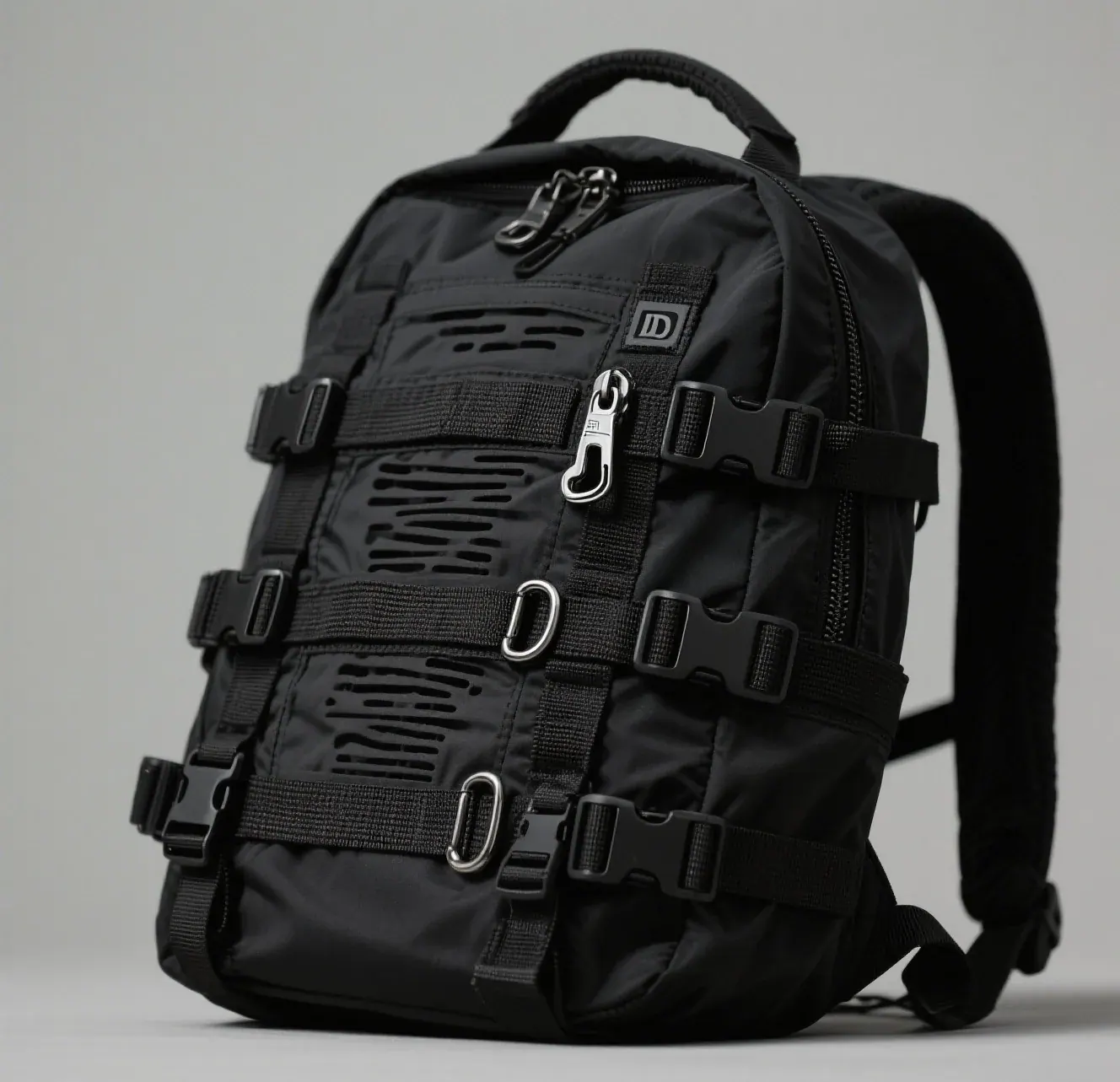
Most sweat complaints are solved at the panel, not at the fabric. A suspended mesh back panel with 8-12 mm of standoff creates an air channel that moves vapour sideways and upward as the wearer walks. Below 6 mm the channel collapses under load; above 15 mm the pack pushes away from the spine and the load feels unstable. Curved aluminium or moulded stays hold the channel open at 6-8 kg, where a flat foam panel closes to 3 mm and behaves like a solid sheet.
Contact area is the second lever. A panel that touches the back across 60 percent of its area will feel wet regardless of fabric choice; reducing contact to 25-35 percent with shaped foam islands and a continuous mesh face keeps the same load support with far less sensation of dampness. Shoulder straps follow the same rule: 55-75 mm width, perforated foam of 8-12 mm thickness, and a spacer mesh face rather than a solid laminate.
- Target 8-12 mm standoff on the back panel, verified under a 6 kg load rather than empty.
- Keep contact area between 25 and 35 percent using shaped foam islands.
- Use 8-12 mm perforated foam in shoulder straps with a spacer mesh face.
- Vent the lumbar zone separately; it generates the most sweat per square centimetre.
- Never route the air channel through the sealed chamber through an unprotected opening.
Load mass is the variable buyers ignore. Sweat rate roughly doubles between a 4 kg and a 9 kg load at the same pace and clothing, so a heavier pack will feel wetter on an identical panel. Reducing carried mass by 1 kg often improves comfort more than any fabric upgrade, and it costs nothing. Where the load cannot fall, shift dense items closer to the spine so the panel does not have to work against a long lever arm, and recheck standoff after the change rather than assuming the geometry held.
Clothing choice interacts with the panel too. A waterproof shell jacket worn under a pack traps vapour at exactly the spot where the panel already restricts flow, and the result is usually blamed on the bag. Venting the jacket, dropping to a lighter mid layer for climbs, and scheduling a two-minute stop to open both systems will change the perceived outcome more than any change to the pack specification.
Panel geometry also decides how quickly the pack dries between uses. A closed-cell foam laminate bonded directly to the shell can hold 40-80 g of water after a wet ride and needs 12-24 hours to release it, while an open spacer mesh sheds most surface water in under an hour once the pack is stood upright in moving air. For programmes where users ride or walk daily, specify open-cell or perforated foam with a drainage path so yesterday moisture does not become today complaint.
Cold Weather, Condensation, and Off-Season Behaviour
Cold changes the trade-off in a direction most buyers do not expect. As film temperature falls from 20 degrees to minus 5 degrees, a TPU laminate stiffens and its fold radius grows, which makes a three-turn roll harder to seat and increases the chance of a corner crease that does not fully close. Specify a low-temperature bend screen at the target climate and require the closure to be operable in gloves.
Condensation is the second cold-weather issue. When warm humid air inside the chamber meets a chilled shell wall, water condenses on the inside surface and looks exactly like a leak. It is not. Reduce it by packing items dry, avoiding a warm damp layer sealed inside a cold pack, and opening the chamber for 20-30 minutes on arrival. Placing dry indicator tissue at the seams before a cold trip distinguishes condensation on the wall from ingress at a seam.
Off-season storage also matters. Store loosely filled at 15-25 degrees with 40-60 percent relative humidity, out of direct sun, and with the closure left open so the chamber is not under constant fold stress. A pack stored compressed for four months can develop a permanent crease at the roll line that no amount of field care will remove.
Ventilation That Does Not Leak
A drain path and a vent path are different things. A drain lets liquid water out of an external pocket through a hole at the lowest point, and it must be positioned so a pack set down in a puddle does not take water in. A vent moves air through a protected channel with a baffled inlet and an upward-facing outlet. Both can coexist with a sealed main chamber as long as the vent and drain serve only the non-critical zones and never penetrate the primary wet boundary.
The failure pattern to avoid is a mesh pocket sewn through the main chamber wall. Every needle hole in a laminated shell is a potential capillary, and stitch holes at the base of a pocket are the most common source of the mysterious damp patch that appears after a long walk. Use a welded external pocket island instead, or accept that pocket is not part of the waterproof claim.
| Feature | Safe placement | Risky placement | Test check |
|---|---|---|---|
| Drain grommet | External pocket base | Main chamber floor | Fill and drain, then water screen |
| Air channel | Behind back panel | Through chamber wall | Spray at 20 mm per hour for 60 min |
| Mesh pocket | Welded external island | Stitched through chamber | Indicator tissue behind pocket |
| Valve or port | Above waterline on panel | Base of sealed chamber | Immersion screen with load |
Where a pack must be genuinely submersible, there is no safe vent into the chamber at all. Accept the warmer back, reduce load mass, and manage clothing instead. A pack rated IPX7 with three closure turns is a sealed box; asking it to breathe is asking for the rating to be false.
Activity Targets: How Much of Each Do You Need
Different activities sit at different points on the curve. A city commuter walking 15 minutes in light rain needs strong splash resistance and good back airflow, not immersion protection. A sea kayaker needs absolute sealing and accepts a wet back because the pack spends most of the trip on the deck. A hiker on a four-day route needs sustained rain protection plus real airflow, which is why expedition packs use a sealed main body with a heavily ventilated harness.
| Activity | Chamber target | Panel target | Priority |
|---|---|---|---|
| Urban commute, 15-30 min | IPX4-IPX5 | 8-12 mm standoff, 30 percent contact | Airflow |
| Day hike in rain | IPX6 | 10-12 mm standoff, 30 percent contact | Balanced |
| Multi-day trek | IPX6 | 12 mm standoff with stays | Rain plus airflow |
| Kayak or raft | IPX7 | Sealed, minimal panel | Absolute sealing |
| Motorcycle ride | IPX6 | Low profile, stable panel | Stability |
For wet urban travel the commuter class is usually the right compromise, and the waterproof commuter backpack range is built around ventilated harnesses on splash-resistant bodies. Where the route includes real trail time and sustained rain, the waterproof hiking backpack range moves to sealed chambers with load-carrying harnesses that still channel air.
How the Two Sides Are Measured
Liquid resistance and vapour transmission are measured by different methods and reported in different units, which is where most marketing confusion starts. Hydrostatic head uses a rising water column until three drops penetrate; the result in millimetres is the number printed on most specifications. Vapour transmission is usually reported as mass per area per day, and it depends on the temperature and humidity gradient used in the test, so two laboratories can publish different figures for the same fabric.
- State hydrostatic head in mm with the test method and the endpoint definition.
- State vapour transmission with the temperature and humidity gradient used.
- Test the finished panel assembly, not only the flat fabric coupon.
- Re-test after abrasion and after 20 wash cycles, because finishes change.
- Keep one retained sample per production lot for dispute resolution.
Test methods for coated fabrics and water resistance are published by AATCC, while broader material and laboratory methods are maintained by ASTM International and ISO. Citing the method number in a purchase specification is the single cheapest way to avoid an argument about whether a result is comparable.
Specifying the Balance for a Programme
Write the requirement as two independent clauses. Clause one covers the chamber: hydrostatic head, seam construction, closure type, and the finished-pack screen with load and accessories fitted. Clause two covers the harness: standoff in millimetres under load, contact area percentage, strap foam thickness, and spacer mesh specification. Mixing them into one sentence produces a pack that fails both.
One more practical check belongs in the clause set: the soaked-panel test. Wet the harness, load the pack to its stated maximum, and measure standoff again after ten minutes. Spacer mesh that holds 10 mm dry can drop to 6 mm saturated, which is exactly the point where users start reporting a damp back. Requiring the loaded wet value, not the dry value, costs nothing in tooling and removes the most common comfort complaint in the category.
Two clauses also make the acceptance conversation easier at goods-in. When a shipment is challenged, a chamber result and a harness measurement can be repeated in an afternoon with a spray rig, indicator tissue, and a loaded standoff gauge. A vague single-line requirement such as waterproof and breathable cannot be tested at all, and disputes on that wording usually end with the buyer absorbing the cost.
| Specification item | Chamber clause | Harness clause |
|---|---|---|
| Liquid resistance | 8,000-10,000 mm, welded seams | Not applicable |
| Closure | Three turns, 75-100 mm clean material | Not applicable |
| Airflow | Not applicable | 8-12 mm standoff under 6 kg |
| Contact | Not applicable | 25-35 percent contact area |
| Verification | 60 min spray plus immersion screen | Standoff measured under load |
QUANZHOU JUNYUAN BAGS has developed waterproof bag programmes since 2014, with the founding team active in the industry since 2004 and monthly output of 200,000 units verified by SGS. BSCI and ISO 9001 systems support the workflow, and materials are screened for REACH and California Prop 65. Every bulk order is inspected at AQL 2.5 before shipment.
MOQ is 500 pcs per design and colour, samples take 6-10 working days, and bulk runs 35-50 days from approved sample. A chamber and harness brief can be emailed to service@junyuanbags.com; include target activity, load range, climate, and any immersion requirement. FOB Xiamen or DDP service to more than 100 countries follows an approved sample and a complete test record.
The closing rule is worth restating: sealing and airflow are won in different places. Buy a welded, tested chamber for the gear and a suspended, drained harness for the body, and stop looking for one fabric that does both. Packs built that way stay dry inside and feel considerably better on the back after the first hour.
People Also Ask
Do waterproof backpacks make your back sweat more?
Yes, a fully sealed shell blocks vapour as well as liquid, so sweat accumulates at the contact area. The fix is a suspended mesh panel with 8-12 mm standoff and reduced contact area, not a thinner coating on the chamber fabric.
Can a backpack be both fully waterproof and breathable?
Not across the same panel. A chamber rated IPX7 is sealed by definition, so ventilation has to happen at the harness and external zones. Any claim of a submersible and highly breathable main body should be treated with caution.
What hydrostatic head is enough for a hiking backpack?
Five thousand millimetres handles sustained rain, and 8,000-10,000 mm suits expedition use where the pack body presses against wet ground. Above 10,000 mm the added film thickness mostly costs drape and cold-weather flexibility.
How much back panel standoff actually helps?
Eight to 12 mm measured under a 6 kg load is the useful range. Below 6 mm the channel collapses, and above 15 mm the pack pushes away from the spine and feels unstable on uneven ground.
Why does my pack get wet inside when it never rained?
In most cases that is sweat, not ingress. Confirm by placing dry indicator tissue inside the chamber before a dry-weather walk; if it stays clean while the back panel is damp, the problem is vapour, not a leak.
Does a breathable membrane work in a backpack the way it works in a jacket?
Less effectively, because the pack has no body-heat-driven pressure differential across most of its area and the load presses the panel flat. Membranes help on straps and lumbar zones more than on the main chamber.
Frequently Asked Questions
Q1. Is a waterproof backpack always less breathable?
A sealed chamber is, yes. Complete liquid blocking and high vapour transmission cannot occupy the same fabric area, so the practical solution is a sealed chamber plus a ventilated harness.
Q2. What MVTR figure should I ask for?
Ask for the value together with the test gradient, because figures are not comparable across different conditions. On a waterproof shell the number is secondary to the hydrostatic head result.
Q3. How do I tell sweat from a leak inside my pack?
Place dry indicator tissue at the closure corners, seams, and base before a dry-weather walk. Clean tissue with a damp back means sweat; any wet point means a genuine ingress path.
Q4. Does a rain cover make a backpack breathe better?
No. A cover adds another layer over the back panel and usually reduces airflow. It protects the shell from wetting out but does nothing for vapour escape.
Q5. Are mesh back panels strong enough for heavy loads?
Yes when they are tensioned over moulded stays or a frame sheet. The mesh carries comfort, not structure; the frame carries load. Check standoff under the real load, not empty, and recheck it after the pack has been soaked, because a wet mesh stretches and can lose several millimetres of channel height under the same mass.
Q6. Can I add ventilation holes to a waterproof pack?
Only into external zones with baffled, upward-facing outlets. Any hole in the primary chamber wall removes the waterproof claim and usually voids the immersion result.
Q7. What fabric denier works best for a waterproof shell?
Four hundred twenty to 840 denier nylon or polyester with a TPU film laminate covers most programmes. Higher denier improves abrasion but adds mass and reduces packability.
Q8. How thick should the TPU film be?
Zero point one two to zero point two zero millimetres is the common range. Thicker film raises hydrostatic head by 30-50 percent but stiffens the hand and narrows the welding window.
Q9. Will a breathable panel reduce the IPX rating?
It does not have to, provided the vented zones sit outside the primary wet boundary. The finished-pack screen must include the panel and all accessories fitted.
Q10. How often should a DWR finish be refreshed?
Roughly every 20 to 30 wash cycles or 300 hours of abrasion. Refresh with heat or a spray-on product; a beading finish is not the waterproof barrier itself.
Q11. What is the MOQ and timing for a ventilated waterproof pack?
The baseline is 500 pcs per design and colour, with samples in 6-10 working days and bulk in 35-50 days from approved sample and deposit.