Choose a hydration pack when you need to drink while moving for more than 60 minutes; choose a waterproof cycling backpack when rain, immersion risk, or heavy cargo matter more than sip convenience. A 1.5 to 3 litre bladder adds 1.6 to 3.2 kilograms of water weight carried low against the back, and lets a rider drink 600 to 1,000 millilitres per hour without unclipping. A welded cycling backpack in the 18 to 30 litre class reaches IPX6 to IPX7, carries 5 to 9 kilograms of gear, and dries in 2 to 4 hours, but it requires a stop of 15 to 30 seconds per drink. Programme entry is 500 pcs per design and colour, samples in 6 to 10 working days, bulk in 35 to 50 days.
Fluid Demand Sets the Format First
The decision starts with physiology, not hardware. A cyclist working at a moderate pace in 25 degree heat loses 0.8 to 1.5 litres of sweat per hour, and at race intensity in 32 degree heat that figure can exceed 2 litres per hour. Replacing even two thirds of that loss means carrying and drinking roughly 600 to 1,200 millilitres every hour, which is a genuine engineering constraint on any bag that has to stay on a moving rider's back.
Two bottle cages on a frame carry about 1.4 litres in total and require one hand off the bars for 8 to 15 seconds per drink. That is perfectly acceptable on a road ride with calm traffic, and it is unacceptable on technical singletrack where both hands are needed for 40 percent of the time. A hose and bite valve solve the hands problem: a rider drinks 20 to 40 millilitres in 2 seconds without changing body position or line.
Heat illness guidance published by the US Centers for Disease Control and Prevention consistently frames fluid replacement as a scheduled behaviour rather than a response to thirst, because thirst lags actual deficit by a meaningful margin in dry heat. For cycling that translates into a planning rule: carry enough for the longest gap between refills plus 500 millilitres, and drink on a timer rather than when the mouth feels dry.
| Ride condition | Sweat loss per hour | Fluid to carry | Best format |
|---|---|---|---|
| Cool commute under 45 minutes | 0.3 to 0.6 L | 0.5 to 0.75 L | Bottle plus small backpack |
| Warm road ride, 2 hours | 0.8 to 1.2 L | 1.5 to 2 L | 1.5 to 2 L hydration pack |
| Hot gravel ride, 4 hours | 1.2 to 1.8 L | 3 L plus refills | 3 L hydration pack or hybrid |
| Singletrack, 90 minutes | 0.8 to 1.4 L | 1.5 to 2 L | Hydration pack, hands stay on bars |
| Bikepacking day with resupply | 1.0 to 1.5 L | 2 L plus bottles | Waterproof pack plus bottles |
| Wet winter commute | 0.4 to 0.8 L | 0.75 L | Waterproof backpack, bottle |
Where the Water Weight Actually Sits
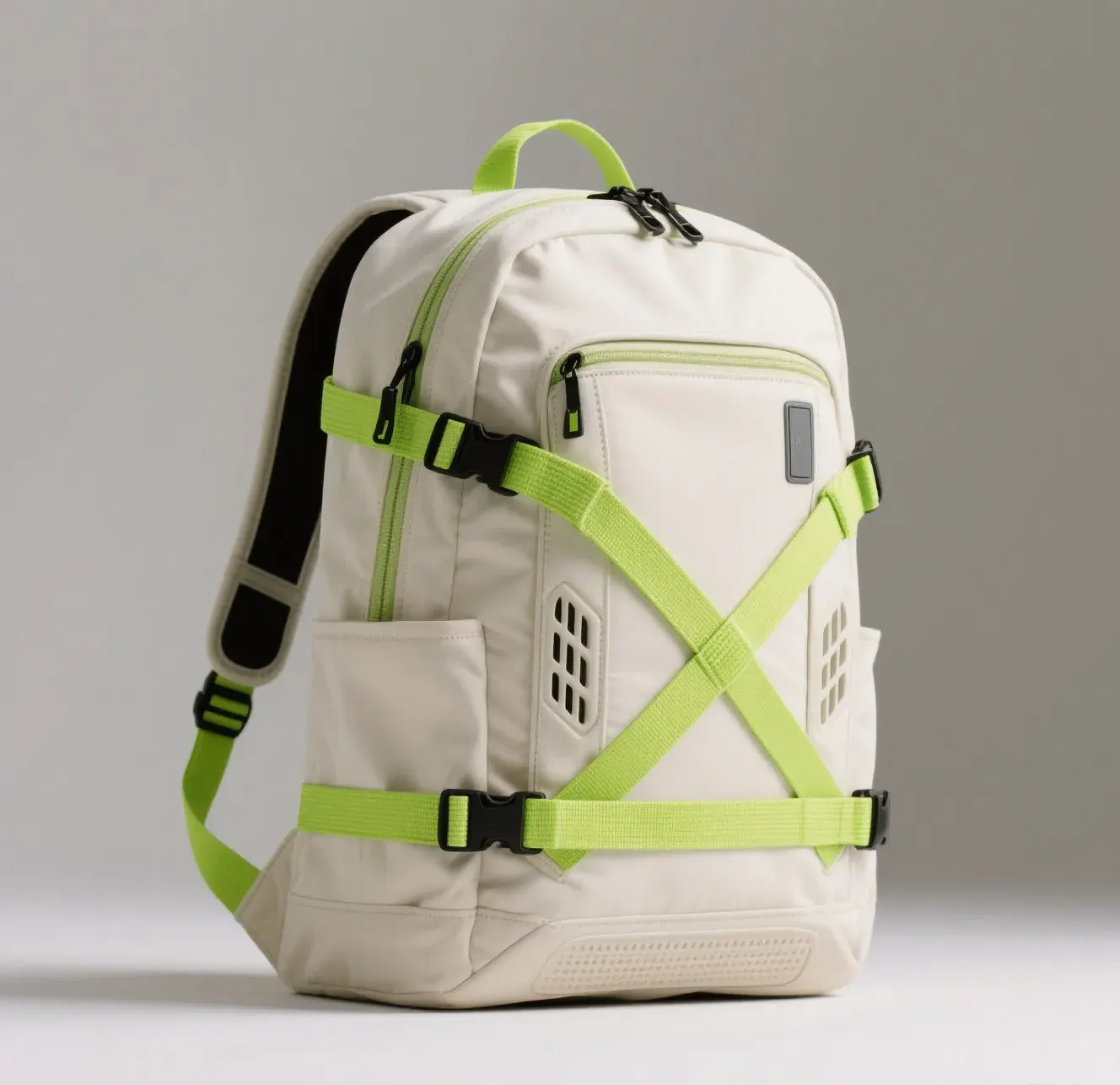
Water is heavy and its weight moves. A full 3 litre bladder is 3.2 kilograms including the reservoir, and a half-full bladder sloshes with a period of roughly 0.5 to 1 second, which riders feel as a shove in the lower back on every bump. Good hydration sleeves address this with a compression panel or a rigid back sheet that keeps the reservoir flat, plus a hang tab that stops the bladder from folding into the bottom of the sleeve.
Position matters as much as mass. A reservoir carried in the lower third of the pack, roughly 100 to 200 millimetres above the hip line, keeps the combined centre of mass close to the rider spine and reduces the pendulum effect when standing on the pedals. A reservoir stuffed in the top of a tall pack does the opposite, and riders who complain that their pack feels unstable on climbs are usually describing exactly that mistake.
A waterproof cycling backpack without a sleeve can still carry water, but the physics change. Two 750 millilitre bottles in side pockets weigh 1.6 kilograms and sit further from the spine, so they sway more on rough ground. In exchange the pack gains usable volume, because a bladder sleeve permanently occupies 2 to 4 litres of internal space that could hold a jacket or a tool roll.
| Water option | Weight when full | Access time | Space occupied | Stability |
|---|---|---|---|---|
| 1.5 L bladder | 1.6 kg | 2 seconds, no hands off bars | 2 L internal | Excellent when compressed flat |
| 3 L bladder | 3.2 kg | 2 seconds | 4 L internal | Good with a rigid sleeve |
| Two 750 ml bottles | 1.6 kg | 8 to 15 seconds, one hand | External pockets | Fair, sways on rough ground |
| One 750 ml bottle | 0.8 kg | 8 to 15 seconds | External pocket | Good |
| Bladder plus bottle | 2.4 kg | Mixed | 2 L internal plus pocket | Good, allows electrolyte split |
Waterproof Ratings: What Each Format Really Achieves
Ratings are where the two formats diverge most. A typical hydration pack is built as a light shell with a large U-shaped zipper and a hose port, and that port is a permanent hole in the system. Even with a grommet, the hose exit is the weakest point, so most hydration packs settle at water resistant to IPX4 performance in practice rather than at a tested immersion level.
A welded cycling backpack with a roll-top closure and radio frequency welded seams behaves differently. Because there is no hose port and no long curved zipper, the same construction that gives a dry bag its rating applies, and IPX6 to IPX7 is realistic. Published code definitions come from IEC 60529, and the key point for buyers is that the rating applies to the assembled article, not to the fabric swatch on a sample card.
Riders who need both properties should look for a hybrid: a roll-top body with an internal bladder sleeve and a hose port that seals with a compression grommet plus a storm flap. That configuration costs roughly 12 to 20 percent more than a plain welded body and typically lands at IPX5 to IPX6, which is adequate for rain and spray though not for full submersion. Rating selection is covered in more depth in the IPX rating guide for waterproof backpacks.
| Construction | Typical tested rating | Hose port | Realistic use |
|---|---|---|---|
| Light hydration shell, covered zip | IPX3 to IPX4 | Yes, grommet only | Dry climate trail riding |
| Hydration pack with welded seams | IPX4 to IPX5 | Yes, sealed grommet | Wet trail riding, no immersion |
| Roll-top welded cycling backpack | IPX6 to IPX7 | No | Commuting, kayak transfers, immersion |
| Hybrid roll-top with sealed port | IPX5 to IPX6 | Yes, compression grommet | All-weather endurance riding |
| Roll-top plus internal dry liner | IPX7 for contents | No | Electronics and documents |
Hygiene, Biofilm and Cleaning Time
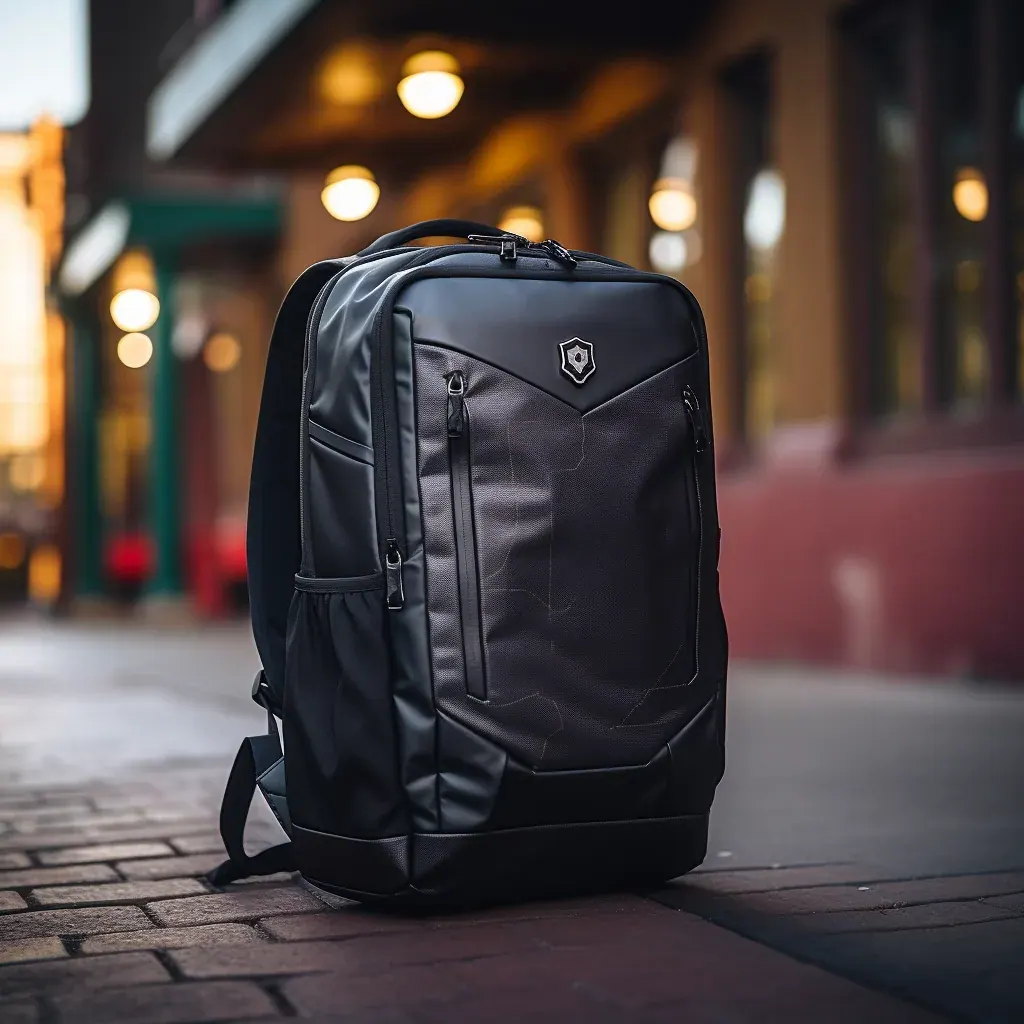
Every hydration system has a maintenance cost that buyers routinely forget. A reservoir used three times a week in warm weather develops visible biofilm in 2 to 4 weeks unless it is dried after every ride, and a full clean with a brush and a cleaning tablet takes 10 to 15 minutes plus 4 to 8 hours of drying with the reservoir propped open. Riders who skip drying are the ones who report a plastic taste and, occasionally, stomach upset.
The hose is worse than the bladder. Internal diameter of 6 to 9 millimetres and a length of 800 to 1,000 millimetres means a large surface area in a narrow tube where stagnant water sits between rides. A hose should be flushed with 200 to 300 millilitres of hot water after every ride and replaced every 3 to 6 months on a heavy schedule, which is a recurring consumable cost of roughly 6 to 12 USD per year.
- Empty and invert the reservoir after every ride; never store a bladder with more than 50 millilitres left inside.
- Brush the reservoir interior and the bite valve weekly with a tablet soak of 15 to 30 minutes.
- Flush the hose with 200 to 300 millilitres of water at 60 degrees Celsius or hotter after each use.
- Replace the hose every 3 to 6 months and the bite valve every 6 to 12 months on a heavy schedule.
- Dry the pack shell open and inverted for 2 to 4 hours before it goes back into a closed space.
A waterproof cycling backpack has almost none of this overhead. The interior is a dry box; wiping it out takes about 60 seconds and drying takes 2 to 4 hours. For a fleet operator or a rental programme that difference is decisive: a hydration fleet needs a cleaning protocol and spare parts inventory, while a welded fleet needs a hose and a drying rack.
Bikepacking and Long-Day Load Planning
Bikepacking changes the question again, because the bike itself carries most of the load. Frame bags of 3 to 6 litres, seat packs of 8 to 16 litres, and handlebar rolls of 5 to 12 litres together absorb 16 to 34 litres, leaving the rider's back for only what must be reached while moving: water, food, and one layer. That residual load is typically 1.5 to 3.5 kilograms, which is squarely hydration-pack territory.
Where a waterproof backpack wins on long days is weather exposure and resupply gaps. A two-day route with a 60 kilometre stretch between water sources needs 3 to 4 litres of capacity, and a welded body protects the sleeping layer that would otherwise end the trip if it soaked through. Many bikepackers therefore run a small hydration pack for drinking plus a welded 20 to 30 litre body for the layer, accepting the weight penalty of two systems for the security of redundancy.
| Route type | On-bike volume | On-back volume | Recommended on-back format | Reason |
|---|---|---|---|---|
| Gravel day, 5 hours | 6 to 12 L | 4 to 8 L | 2 L hydration pack | Drinking without stopping |
| Bikepacking overnight | 16 to 26 L | 10 to 18 L | Waterproof 20 L roll top | Layer must stay dry |
| Bikepacking, wet forecast | 16 to 26 L | 12 to 20 L | Waterproof 25 L plus bottles | Redundancy beats sip speed |
| Alpine day with river crossings | 4 to 8 L | 14 to 22 L | IPX6 or IPX7 backpack | Immersion risk |
| Winter training ride | 2 to 4 L | 6 to 10 L | Hydration pack with insulated hose | Hose freezes below minus 5 degrees Celsius |
| Bike to work, 40 minutes | 0 to 2 L | 14 to 22 L | Waterproof commuter pack | Laptop and documents |
Readers weighing the on-bike alternative should also compare the waterproof cycling backpack range against pannier layouts before committing, because a load moved from the back to a rack removes sweat entirely. For riders whose week mixes trail and office, the geometry of the waterproof commuter backpack range usually bridges both without a second purchase.
Fit, Sweat and Contact Comfort
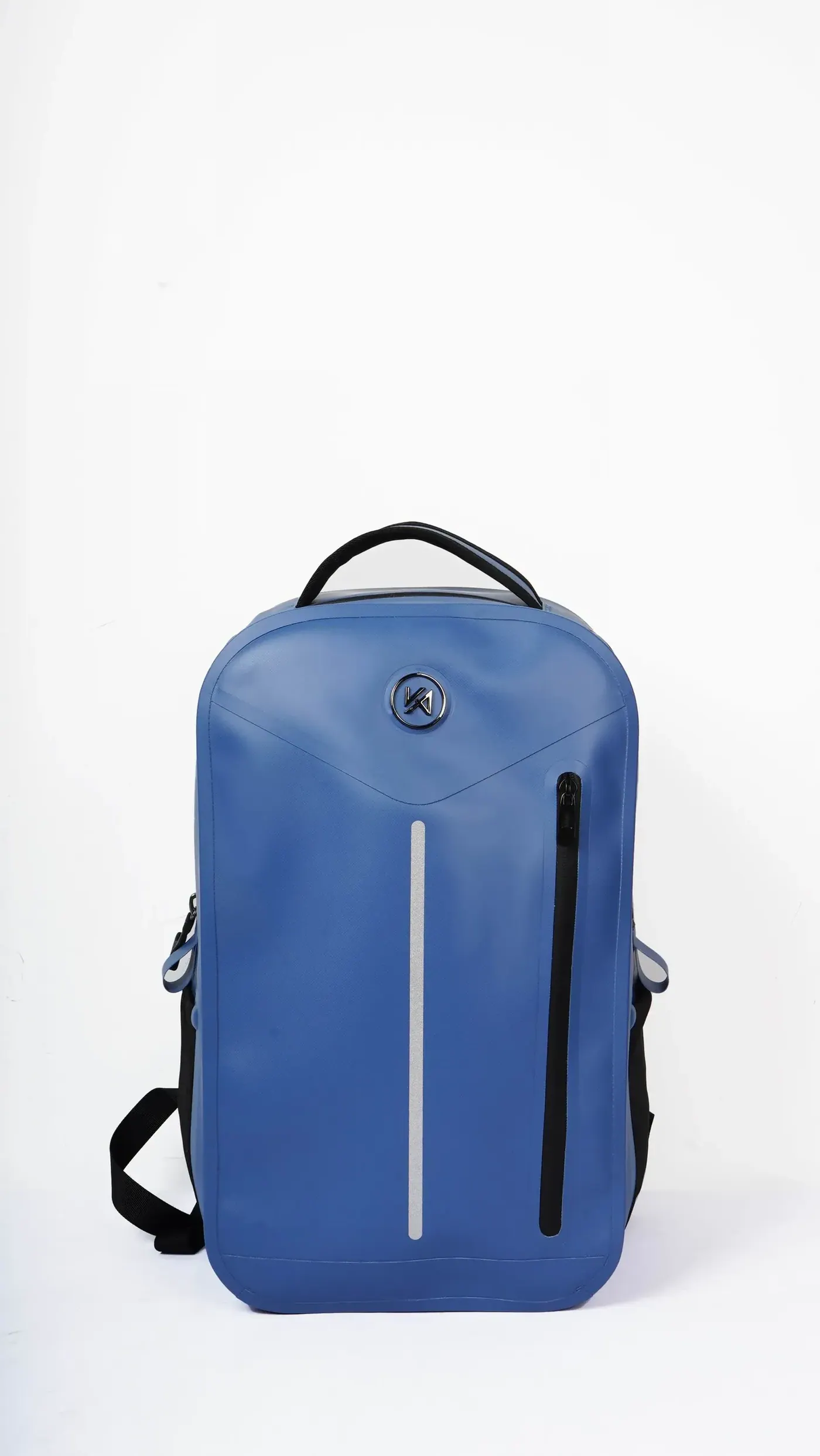
Cyclists lean forward 30 to 45 degrees for hours, so a pack that feels fine standing in a shop can be unbearable on the bike. The useful measurements are back length, typically 400 to 480 millimetres for a cycling pack, shoulder strap spacing at the collar of 60 to 90 millimetres, and strap foam of 8 to 12 millimetres with a mesh cover. A pack longer than the torso presses on the helmet rim and lifts under braking.
Sweat management is the second comfort variable and it interacts with waterproofing. A welded TPU shell does not breathe, so a rider in 28 degree heat will soak a shirt against the back panel within 20 to 30 minutes no matter what the marketing says. Mitigations are geometric: raised rails or a 3D mesh panel that creates a 6 to 12 millimetre air gap, and a sternum strap set 20 to 40 millimetres below the collarbone so the pack does not choke when out of the saddle.
Strap geometry also decides whether drinking is possible. A hose routed over the shoulder with a magnetic clip 100 to 150 millimetres from the bite valve lets a rider drink without looking, and that clip should hold at least 300 grams of pull so it does not release on a rock garden. Sternum strap position matters too: too high and it presses the trachea, too low and the pack swings outward on climbs.
Durability, Materials and Testable Specs
Failure modes differ. Hydration packs fail at the bite valve, at the hose-to-reservoir connection, and at the zipper that runs around three sides of the shell. Cycling backpacks fail at the roll-top fold line, which flexes perhaps 2,500 to 4,000 times per season, and at the base panel that contacts the rear tyre spray and road grit. Both formats should be specified with numbers rather than adjectives.
A workable checklist: base textile 400D to 800D for a hydration shell and 500D to 1000D for a cycling body; coating mass above 180 grams per square metre; seam peel above 40 newtons per 25 millimetres for taped seams and above 70 newtons per 25 millimetres for welded seams; reservoir film at 0.3 to 0.5 millimetres with a welded perimeter; and a documented cycle target for every zipper. Abrasion and tear procedures published by ASTM International give both parties a repeatable method for those claims.
| Component | Hydration pack target | Waterproof cycling pack target | Test or check |
|---|---|---|---|
| Base textile | 400D to 600D | 500D to 1000D | Denier certificate |
| Seam construction | Taped or welded, 20 mm | RF welded, 20 to 25 mm | Peel test per 25 mm |
| Closure | Coil zip, 5,000 cycles | Roll top, 5,000 to 8,000 folds | Cycle prototype then retest |
| Reservoir film | 0.3 to 0.5 mm TPU | Not applicable | Welded perimeter inspection |
| Strap root strength | 20 kg static | 25 kg static | Static lift for 60 seconds |
| Colour fastness | Grade 4 after 40 hours | Grade 4 after 40 hours | Light fastness check |
Programme Numbers and Buying Rules
Three rules resolve most cases. Rule one: if the ride exceeds 60 minutes and hands must stay on the bars, take the hydration pack and budget for cleaning. Rule two: if the cargo includes electronics, documents, or a sleeping layer, take the welded cycling pack and accept a 15 to 30 second stop per drink. Rule three: if both apply on the same route, use a hybrid roll-top body with a sealed hose port and verify the port separately, because it is the part most likely to fail.
Commercially the two formats share a material library, so terms do not change. Entry is 500 pcs per design and colour, samples return in 6 to 10 working days, and bulk runs 35 to 50 days after sign-off. Two line items deserve attention at quotation stage: reservoirs and hoses are usually sourced separately and add 3 to 6 days to the sample window, and a rating test on a hybrid body with a hose port must be booked at prototype stage rather than after tooling.
QUANZHOU JUNYUAN BAGS develops both formats from one material library, starting at 500 pcs per design and colour with samples in 6 to 10 working days and bulk in 35 to 50 days. Materials may be screened against REACH and California Prop 65, release inspection can run at AQL 2.5, and delivery can be FOB Xiamen or DDP into more than 100 countries. Reservoir fitment, hose routing, and closure selection are documented. Briefs may be sent to service@junyuanbags.com.
Riders whose routes mix trail and pavement should also read the waterproof hiking backpack range overview, because a hiking body with a proper hip belt carries a 7 to 9 kilogram load far better than either cycling format. The crossover point is about 6 kilograms: below it a cycling pack is quicker to use, above it a hiking harness saves the shoulders over a full day.
People Also Ask
Can a waterproof backpack hold a hydration bladder?
Yes, if the body includes an internal sleeve with a hang tab and a sealed hose port. Expect IPX5 to IPX6 on a hybrid rather than IPX7, because the hose exit is the weakest point in the system and should be tested as part of the finished article.
How much water should a cyclist carry per hour?
Plan for 600 to 1,000 millilitres per hour in moderate conditions and up to 1,200 millilitres per hour in heat above 30 degrees Celsius. Sweat loss of 0.8 to 1.5 litres per hour is typical, and thirst lags actual deficit, so drink on a timer rather than waiting.
Why does my hydration pack taste like plastic?
Biofilm. A reservoir used several times a week develops film in 2 to 4 weeks unless it is emptied and dried after every ride. Soak with a cleaning tablet for 15 to 30 minutes, brush the interior, flush the hose with hot water, and replace the hose every 3 to 6 months.
Do hydration packs work in freezing weather?
Only with an insulated hose and an insulated bite valve cover. Water in an exposed 800 to 1,000 millimetre hose freezes within 20 to 40 minutes below minus 5 degrees Celsius, so blow water back into the reservoir after each sip to keep the tube clear.
Is a roll-top backpack better than a hydration pack for bikepacking?
For the layer and electronics, yes. On-bike bags carry 16 to 34 litres, leaving the back for a 10 to 18 litre welded body that keeps a sleeping layer dry. Use a small hydration pack or bottles for drinking and treat the welded body as the weatherproof reserve.
How heavy is a full 3 litre bladder?
About 3.2 kilograms including the reservoir itself. Carried low and compressed flat against the back it is stable; left loose in the top of a tall pack it produces a pendulum effect that riders feel on every bump and climb.
Frequently Asked Questions
Q1. Which is better for a one hour commute, a hydration pack or a waterproof cycling backpack?
A waterproof cycling backpack. A 40 to 60 minute ride needs only 0.5 to 0.75 litres, which a bottle covers, while the welded body protects a laptop, documents, and a change of clothes. The hydration advantage only appears when the ride is long enough to require drinking while moving.
Q2. What bladder volume should I buy?
1.5 litres for rides up to 2 hours in moderate temperatures, 2 litres for 2 to 4 hours, and 3 litres only for hot rides beyond 4 hours or routes with long resupply gaps. Remember that every litre is a kilogram carried on the back.
Q3. Are hydration packs waterproof?
Most are water resistant rather than waterproof, typically IPX3 to IPX4 in practice, because the hose port and the long shell zipper are hard to seal. Welded hydration bodies with a sealed grommet reach IPX4 to IPX5, which handles rain but not full immersion.
Q4. Can I put a laptop in a waterproof cycling backpack?
Yes. Look for a suspended sleeve with 8 to 12 millimetres of closed-cell foam and a raised base so the corner never sits in residual water. A welded 20 to 25 litre body with a roll top will keep a 15 inch laptop dry through an hour of heavy rain.
Q5. How often should the hose and bite valve be replaced?
Hose every 3 to 6 months and bite valve every 6 to 12 months on a heavy schedule of three or more rides per week. That is roughly 6 to 12 USD per year in consumables, which should be included in any fleet budget.
Q6. Why does my pack feel unstable when I stand on the pedals?
Usually because the reservoir is sitting too high. Keep the water in the lower third of the pack, about 100 to 200 millimetres above the hip line, and use a compression panel or rigid sleeve so the bladder cannot fold or slosh.
Q7. Does a waterproof shell make sweating worse?
Yes. A welded TPU shell does not breathe, so expect a wet shirt after 20 to 30 minutes in warm conditions. Raised back rails creating a 6 to 12 millimetre air gap reduce the contact area substantially, which is the only real mitigation.
Q8. What is the practical difference between IPX5 and IPX6 for cycling?
IPX5 is a 6.3 millimetre nozzle at 12.5 litres per minute; IPX6 is a 12.5 millimetre nozzle at 100 litres per minute, both for at least 3 minutes from 3 metres under IEC 60529. For sustained rain at speed, specify IPX6.
Q9. Should bikepackers use bottles instead of a bladder?
Often yes, because bottles in frame and handlebar positions move weight off the back and allow electrolyte and plain water to be separated. A bladder earns its place only where drinking must happen without a hand leaving the bars.
Q10. What are MOQ, sample and bulk times for either format?
Identical: 500 pcs per design and colour, prototype samples in 6 to 10 working days, bulk in 35 to 50 days after sign-off. Reservoir and hose sourcing typically adds 3 to 6 days to the sample window, and rating tests should be booked at prototype stage.