Waterproof backpack terms fall into 5 groups: water tests such as IPX4–IPX8, material measures such as 420D and g/m², construction terms such as RF welding and seam tape, fit numbers such as 45 cm torso length, and buying controls such as AQL 2.5 and MOQ 500 pcs. No single term proves the whole pack: a 500D TPU-coated shell can still leak at a stitched pocket or incomplete closure. Use this glossary to translate each label into a measurable requirement, sample test, and purchasing decision.
Water Ratings: IPX, Hydrostatic Head, and Exposure
IPX is the familiar shorthand for water-ingress protection when no dust rating is stated. IPX4 addresses splash, IPX5 and IPX6 address water jets of different severity, IPX7 covers temporary immersion under defined conditions, and IPX8 covers immersion conditions agreed for the item. The formal vocabulary comes from IEC information on IP ratings. Always ask whether the claim applies to the complete closed backpack, not a zipper or fabric swatch.
Hydrostatic head is the pressure of a water column that a textile resists before leakage, commonly stated in mm. A result such as 10,000 mm describes the tested material under a named method; it does not include seams, openings, or wear. Spray test evaluates surface wetting or water impact under a specified procedure. Immersion means the entire item goes below water, but the depth, duration, orientation, temperature, and load must still be recorded.
| Term | Plain meaning | Number to record | Common misuse |
|---|---|---|---|
| IPX4 | Splash from multiple directions | Method duration and sample state | Calling it immersion protection |
| IPX5 | Lower-force water jet exposure | Nozzle, flow, distance, time | Applying a component result to the pack |
| IPX6 | Stronger jet exposure | Finished load and closure method | Equating it with unlimited rain |
| IPX7 | Temporary immersion | Depth and time | Omitting whether the pack was loaded |
| Hydrostatic head | Fabric pressure resistance | mm result and test method | Treating it as a whole-item result |
Ingress simply means unwanted entry of water. Leak path is the route it follows, which may begin 150 mm from the visible wet spot. Wet boundary is the continuous surface intended to exclude water; external organisers may sit outside it. Blank control is dry tissue or another reference used to distinguish real ingress from moisture introduced by hands or condensation. These terms make test reports more precise.
Textile Numbers: Denier, GSM, Coating, and Lamination
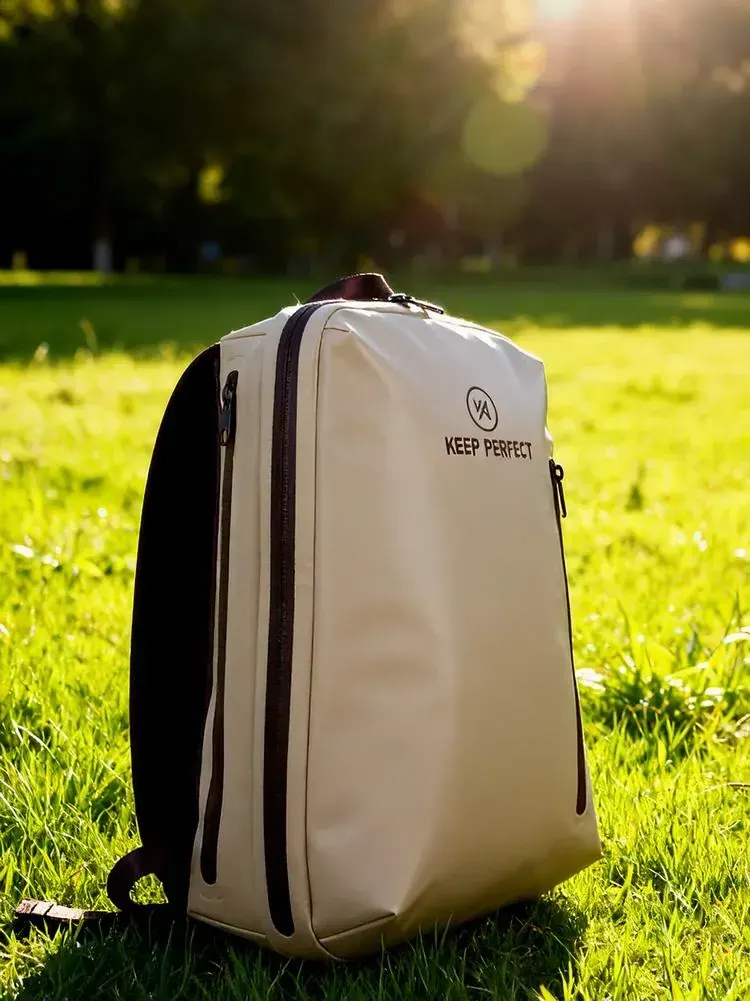
Denier, written D, measures yarn linear mass. A 500D yarn is heavier per unit length than a 210D yarn of the same fibre, but the number does not state weave density, tear strength, abrasion life, or water resistance. GSM or g/m² states finished material mass per square metre. Two 500D textiles can differ by 80 g/m² because of weave and coating, so both numbers belong on a meaningful material sheet.
Coating is polymer applied to a textile surface; film is a distinct layer; lamination bonds layers together. TPU, thermoplastic polyurethane, is valued for flexibility, abrasion behaviour, and weldable waterproof layers. PVC, polyvinyl chloride, supports robust coated constructions at different mass and hand. Selection should compare thickness, adhesion, cold flex, chemical declarations, and price rather than declaring one polymer universally superior.
| Material term | Unit or description | Useful companion result | Question for a brief |
|---|---|---|---|
| Denier | Yarn mass per 9,000 m | Tear and tensile strength | Which fibre and weave? |
| GSM | Finished g/m² | Coating share and thickness | Is the value before or after coating? |
| Film thickness | Usually mm or µm | Adhesion and flex result | Measured at which points? |
| Ripstop | Reinforcement grid | Tear propagation result | Grid size and yarn type? |
| Lamination | Bonded layer system | Peel strength after conditioning | Which face, film, and adhesive? |
Ripstop is a weave containing heavier reinforcement yarns intended to slow tear growth; it does not prevent puncture. Face textile is the visible load-bearing cloth, while backer or scrim supports the waterproof layer. Peel strength measures resistance to layer separation under a defined width and rate. Relevant physical methods can be selected from catalogues maintained by ASTM International.
A useful material line therefore looks like this: 420D nylon face, 310 g/m² finished mass, 0.18 mm TPU layer, named abrasion result, named peel result after 24 hours at the agreed conditioning temperature, and declarations for the destination market. By contrast, premium waterproof fabric is not a specification because it contains no number that 2 samples can be compared against.
Seam Vocabulary: Welds, Tape, Stitching, and Peel
RF welding uses radio-frequency energy to heat compatible polar materials between electrodes, forming a joint under pressure. Hot-air welding heats overlapping coated surfaces with controlled air and pressure. Ultrasonic joining uses high-frequency mechanical vibration and is suited to selected materials and geometries. None of these terms alone states joint width, peel strength, pressure resistance, or appearance.
Seam tape is a strip bonded over a stitched seam to block needle holes. Taped seam and welded seam are not synonyms: one covers a sewn line, the other fuses compatible layers. Stitch density counts stitches over a stated length. More stitches can weaken coated material by placing holes too closely, so density should match webbing load and textile construction rather than being maximised.
- Overlap: the width of one coated panel lying over another, often 15–30 mm in waterproof shells.
- Peel: force that separates the joint by pulling its layers apart from an edge.
- Shear: force acting along the plane of the joint, common under a loaded panel.
- Weld skip: an unjoined local section caused by contamination, geometry, or uneven energy.
- Three-way junction: a meeting of 3 seam lines where thickness changes and leak risk rises.
Seam allowance is material reserved beyond a stitch line or joining edge. Binding wraps an exposed edge for finish or abrasion control but does not necessarily seal it. Reinforcement island is an added bonded area that spreads an anchor load without puncturing the central wet boundary. The construction concepts are illustrated further in the RF-welded seams guide.
Closure Terms: Roll-Top, Zip Types, Valves, and Compression
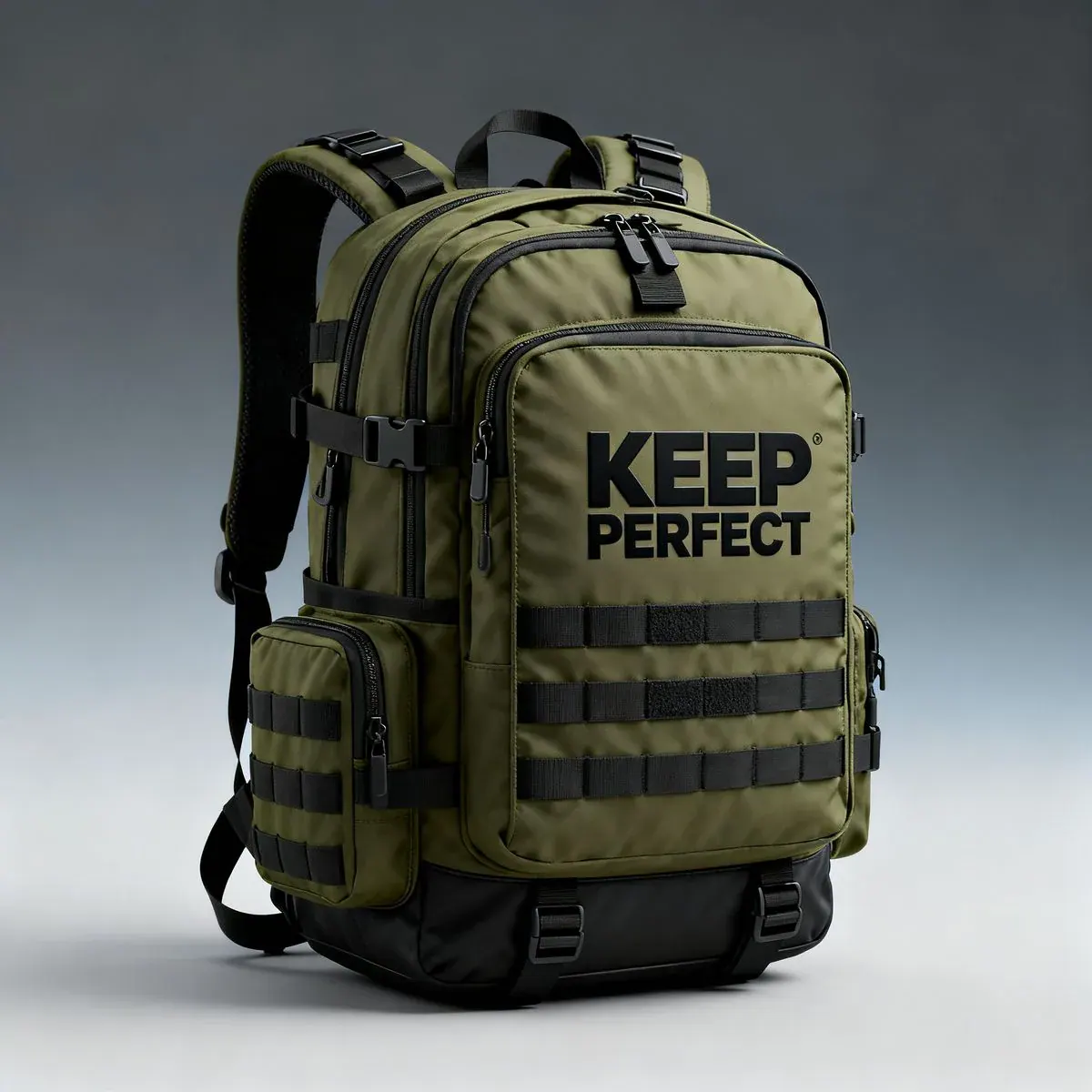
Roll-top describes a flexible opening closed by rolling the top edge before clipping it. The important numbers are clear rolling depth, usually 75–100 mm, and completed turns, commonly at least 3. Side-buckle closure brings the ends together; top-buckle closure clips them to one another over the opening. The geometry changes how the body compresses and where rain collects.
Water-resistant zipper generally uses coated tape and protected coil geometry to reduce rain entry but is not automatically airtight. Airtight zipper uses a sealing profile intended to restrict air and water under defined conditions and may need 25–40 N to start. Zipper garage covers the parked slider at one end. Storm flap places a material shield over an opening to redirect water.
| Closure term | Main advantage | Measured requirement | Typical trade-off |
|---|---|---|---|
| Three-turn roll-top | Simple rain seal | 75–100 mm clear rolling zone | Slower access |
| Water-resistant zip | Fast everyday opening | Spray result on finished pocket | Not inherently submersible |
| Airtight zip | Potential immersion performance | Starting force and pressure result | Cost, stiffness, maintenance |
| Storm flap | Redirects rain from a zip or opening | Coverage and drainage path | Can catch wind |
| Purge valve | Releases trapped air | Closure, leak, and cycle test | Adds another penetration |
Purge valve or air valve lets trapped air leave so a closed pack compresses, but the valve becomes part of the wet boundary. Compression strap controls volume externally and should not be confused with a compression sack, which reduces soft contents. Keeper retains a loose strap tail. Cam buckle grips webbing through a moving lever, while a side-release buckle closes by inserting two flexible prongs.
The correct closure follows the event: 2 hours of driven rain points toward a carefully tested roll-top or protected sealed system; repeated train access may favour a covered zipper; immersion requires purpose-specific closure evidence. The waterproof closure types overview compares these options without treating one as the answer to every route.
Fit and Carry Terms: Torso, Load Transfer, and Harness
Torso length is measured from the seventh cervical vertebra at the base of the neck to the top of the iliac crest. Matching within about 3 cm helps place a load-transfer belt correctly. Harness is the complete carry system: shoulder straps, sternum strap, belt, back panel, and adjusters. Load lifters angle from upper shoulder straps toward the pack to pull its top closer to the body, becoming most useful above roughly 10 kg.
Hip belt may mean a narrow stabiliser or a structured load-transfer component. A 25–35 mm strap can control swing at 4–6 kg; a 50 mm or wider structured belt can move 20–30 percent of a load above 7 kg onto the pelvis. Sternum strap controls shoulder-strap position and should adjust vertically over about 80–100 mm. It should not be tightened until it pulls the shoulders inward.
Back-panel channel is a recessed path intended to move some air; a typical depth is 8–12 mm before loading. Suspended mesh creates a larger gap but moves the pack farther from the spine. Frame sheet is a semi-rigid internal layer that spreads pressure, while a stay is a stronger vertical support. Every support adds mass, so choose it for the real 5, 8, or 12 kg load.
Inspection and Compliance Terms
AQL means acceptable quality limit within a defined sampling plan. AQL 2.5 does not mean 2.5 percent defective pieces are intentionally accepted; it is an index used with lot size, inspection level, code letter, sample size, and acceptance numbers. The inspection document must still classify critical, major, and minor defects. A missing closure part might be major; a life-safety claim without evidence may be critical.
Golden sample is the signed reference for approved materials, dimensions, colour, workmanship, and function. Pre-production sample confirms the intended build before the main run. Top-of-production sample checks early output, while retention sample is held for later comparison. A verbal approval is not a controlled sample because nobody can measure it 6 months later.
REACH is the European Union framework addressing chemical substances; California Proposition 65 concerns listed chemical exposure warnings in California. ISO 9001 concerns a quality management system, and BSCI is a social-compliance framework. None of these automatically proves pack waterproofing. Chemical topics can be checked through the European Chemicals Agency, while water and physical tests remain separate records.
How to Read a Technical Data Sheet in Ten Minutes
Read a data sheet in a fixed order so one attractive number does not dominate. First identify the finished article and revision date. Second find nominal capacity, internal dimensions, and maximum load. Third locate the material stack, including face fibre, denier, finished g/m², and waterproof-layer thickness. Fourth identify every closure and seam type. Fifth find the complete-item water test. Finally check physical methods, chemical declarations, inspection plan, and commercial timing.
Circle any noun without a unit or method. Heavy duty, marine grade, premium, all-weather, and durable are positioning terms until a value follows. Replace each with something repeatable: 500D nylon, 340 g/m², 0.20 mm film, IPX6-level finished-pack test, 20 mm joint overlap, 10,000 abrasion cycles, or 200 N anchor pull. The revised sheet may become longer, but disagreement becomes shorter.
| Reading pass | Find this | Acceptable evidence | Red flag |
|---|---|---|---|
| Identity | Article, drawing, revision | One controlled reference code | No date or mixed versions |
| Geometry | Litres, mm, kg | Tolerance and loaded state | Capacity without dimensions |
| Material | Fibre, D, g/m², layer | Full stack and thickness | One polymer name only |
| Construction | Closure and every seam | Drawing plus joint width | All seams called sealed |
| Verification | Water and physical tests | Method, sample, condition, pass line | Pass stated without conditions |
If 2 documents conflict, the controlled drawing and signed sample need an explicit priority written into the order record. A photo can clarify colour or placement but cannot define 0.18 mm film thickness or 20 mm overlap. Likewise, a test report cannot replace the product drawing because it proves only the identified sample. Link the report, sheet, and sample with one reference code so later inspection compares like with like.
New buying teams can use the waterproof backpack category overview to see how the terms combine in a real product hierarchy. Read from exposure to closure, shell, seam, fit, and inspection in that order. Starting with a colour or pocket count before defining the wet boundary tends to create late changes, while starting with the route produces a coherent set of numbers.
Commercial and Logistics Terms
MOQ is minimum order quantity; a baseline here is 500 pcs per design and colour. Sample lead time is the period after the brief and materials are settled, commonly 6–10 working days. Bulk lead time is the planned 35–50 days after approval and commercial confirmation. These periods should be placed on a dated critical path that also includes testing, packaging, and transport.
FOB Xiamen identifies a shipping term and named port under the agreed Incoterm responsibilities. DDP describes delivery with broader seller-side responsibility to the named destination, subject to the agreed scope. Compare landed cost using carton count, gross mass, duties, final address, and transit, not unit price alone. Carton optimisation means balancing protection, dimensional weight, and container efficiency.
QUANZHOU JUNYUAN BAGS has worked on waterproof programmes since 2014, with its team in the sector since 2004. Monthly output can reach 200,000 pieces as SGS verified, while BSCI and ISO 9001 systems, AQL 2.5 inspection, and REACH or California Prop 65 screening provide separate control layers. FOB Xiamen and DDP service to more than 100 countries address different logistics needs.
Teams can send a term sheet or email service@junyuanbags.com. Replace vague words with values: 25 L, 7 kg load, IPX6-level exposure, 3 roll turns, 20 mm weld overlap, 500 pcs per colour, and 40-day bulk target. A shared vocabulary shortens approval because every term leads to a drawing, number, or test.
The glossary rule is simple: whenever a label appears, ask for its unit, test article, conditioning, method, and pass line. Denier without tear data, IPX without a finished sample, or AQL without defect definitions is incomplete. Five extra numbers in the brief can prevent weeks of disagreement later.
People Also Ask
What does 500D mean on a waterproof backpack?
It means the yarn has a linear mass of 500 denier; it does not by itself state waterproofness, abrasion life, or tear strength. Pair it with fibre, weave, finished g/m², coating thickness, and physical test results.
What is the wet boundary of a backpack?
It is the continuous material, seams, closure, and sealed penetrations intended to keep water out of the protected chamber. External organisers can sit outside that boundary and carry a lower rain claim.
What is a golden sample in bag purchasing?
It is the signed physical reference for approved dimensions, materials, colour, construction, workmanship, and function. Inspection pieces should be compared against it using tolerances rather than memory or photographs alone.
What does peel strength mean for a welded seam?
It is the force needed to separate joined layers by pulling from an edge under a defined specimen width and rate. It differs from shear, which loads the joint along its plane.
What is clear rolling depth on a roll-top?
It is the unobstructed material above the packed contents available to form the seal. Many designs need roughly 75–100 mm for 3 firm turns; a rigid item inside that zone can create a leak path.
What is a backpack retention sample?
It is a piece kept after an approved run for later comparison or investigation. It preserves evidence of materials, dimensions, colour, seams, closure operation, labels, and packing long after shipment.
Frequently Asked Questions
Q1. What is an IPX6 waterproof backpack?
It is a finished pack intended to meet the relevant stronger water-jet exposure when closed and tested as stated. The result should name the sample load, closure method, duration, orientation, and pass criterion.
Q2. What is the difference between IPX7 and IPX8?
IPX7 covers temporary immersion under defined standard conditions, while IPX8 uses immersion conditions stated for the equipment and agreed beyond that level. Depth and duration must be named for either result to guide use.
Q3. What does TPU-coated fabric mean?
It means a textile carries a thermoplastic polyurethane waterproof layer. Record the face textile, finished mass, film thickness, adhesion, cold flex, abrasion, weld compatibility, and declarations rather than relying on the polymer name alone.
Q4. What does PVC-coated fabric mean?
It is a textile combined with a polyvinyl chloride coating system, often selected for robust and economical construction. Finished mass, thickness, flexibility, weld quality, chemical declarations, and use temperature determine suitability.
Q5. What is RF welding on a backpack?
It is a joining process that uses radio-frequency energy and pressure to fuse compatible coated surfaces. Joint overlap, clean material, geometry, energy, and post-conditioning peel performance all affect the result.
Q6. What is a taped seam?
It is usually a stitched seam covered by bonded tape to block needle holes. Tape chemistry, application temperature, pressure, seam shape, and three-way junctions determine whether it remains sealed after flexing.
Q7. What is an airtight zipper?
It is a closure with a sealing profile intended to restrict air and water under defined conditions. It may require 25–40 N to start, needs clean alignment, and should not be confused with an ordinary coated water-resistant zipper.
Q8. What is a backpack purge valve?
It is a valve that releases trapped air so a sealed body can compress. Because it penetrates the wet boundary, it needs its own leak, closure, operation-cycle, and accidental-opening checks.
Q9. What is backpack torso length?
It is the distance from the seventh cervical vertebra at the base of the neck to the top of the iliac crest. Matching within about 3 cm helps a load-transfer belt sit and work correctly.
Q10. What are load lifters?
They are straps angling from the upper shoulder area toward the pack body to pull its top closer to the wearer. They become more useful on loads above roughly 10 kg and need a working angle, not decorative slack.
Q11. What does AQL 2.5 mean?
It is an acceptance-sampling index used with lot size, inspection level, code letter, sample size, and acceptance numbers. It is not permission to intentionally ship 2.5 percent defective units.
Q12. What does MOQ 500 pcs per colour mean?
It means each approved design and colour begins at 500 pieces unless a different written arrangement applies. Material, closure, and layout should be approved before multiplying colour variants.
Q13. What does FOB Xiamen mean?
It names an Incoterm arrangement and the port of Xiamen for transfer of defined responsibilities. Buyers should confirm freight, insurance, duties, inland movement, carton data, and destination handling when comparing landed cost.
Q14. What does DDP delivery mean?
It refers to delivery with broad seller-side responsibilities to the named destination under the agreed scope. The final address, duties, taxes, import requirements, carton dimensions, and exclusions must be confirmed in writing.
Q15. Which glossary terms matter most in a buying brief?
Start with litres, internal dimensions, maximum kg, IPX or exposure, closure, material system, joint method and overlap, torso range, inspection level, declarations, MOQ, sample days, bulk days, and shipping term.