Waterproof backpacks are tested against two separate families of methods, and quoting one without the other is the reason so many ratings are meaningless. The enclosure code published by IEC 60529 defines IPX1 to IPX8, and a pack tested at IPX6 survives a 12.5 millimetre nozzle delivering 100 litres per minute for 3 minutes at 3 metres, while IPX7 means 30 minutes of immersion at 1 metre. Separately, the fabric itself is measured for hydrostatic head, where a TPU laminate typically reaches 10,000 to 20,000 millimetres of water column against 1,000 to 3,000 for a coated woven face. A pack can pass IPX7 and still fail a hydrostatic head test, because the first measures the assembled enclosure and the second measures the material. Note that IEC 60529 was written for electrical enclosures and is applied to bags by convention, so the test conditions have to be stated on the report. Programme entry is 500 pcs per design and colour, samples in 6 to 10 working days, bulk in 35 to 50 days, FOB Xiamen.
What an IP Rating Covers, and What It Does Not
The first thing to understand is that IEC 60529 was written for enclosures around electrical equipment, not for soft goods. There is no bag standard within it, and when a pack is described as IPX7 the statement means the pack was tested using the conditions given in that standard for the second characteristic digit. This is a genuine convention and a useful one, but it only holds if the report states the conditions, because the standard itself leaves the details of the specimen, the orientation and the duration partly to the parties involved.
The second thing is that the code says nothing about the material. A pack with a pinhole in a welded seam can pass a spray test if the hole happens to face away from the nozzle, and the same pack will fail a hydrostatic head test on that material within seconds. Ratings therefore have to be read as an assembly result and paired with a material result, which is exactly what the two families of methods below provide.
| Rating | Protection against | Everyday equivalent | Realistic use on a pack |
|---|---|---|---|
| IPX3 | Spraying water at up to 60 degrees from vertical | Light wind driven rain | Minimum for a commuting body |
| IPX4 | Splashing water from any direction | Heavy rain, no pressure | Standard claim for urban packs |
| IPX5 | Water jets from a 6.3 mm nozzle | Pressure wash, storm exposure | Boating and deck use |
| IPX6 | Powerful jets from a 12.5 mm nozzle | Heavy sea, deck wash down | Coastal and paddle sport |
| IPX7 | Immersion at 1 metre for 30 minutes | Accidental full submersion | Kayaking, rafting, wet exits |
| IPX8 | Continuous immersion beyond 1 metre | Agreed between the parties | Technical dive and rescue kit |
A caution that saves a great deal of argument later: the digits are not cumulative in the way buyers assume. IPX8 does not automatically include IPX6, because the two are tested differently and a closure that seals under static immersion may not hold against a jet. Where both behaviours are needed, specify both tests explicitly rather than relying on the higher number.
How an IPX Test Is Actually Run
The chamber work is more mechanical than most people expect. For the jet tests, IPX5 and IPX6, the specimen is mounted on a turntable, the nozzle is set at a fixed distance and the flow is metered rather than estimated. The difference between the two is nozzle diameter and flow rate: 6.3 millimetres at 12.5 litres per minute for IPX5, against 12.5 millimetres at 100 litres per minute for IPX6. Both run for 3 minutes at a distance of roughly 2.5 to 3 metres, and both rotate the specimen so every face is presented.
| Level | Method | Flow or depth | Duration | Pass criterion |
|---|---|---|---|---|
| IPX1 | Vertical dripping water | 1 mm per minute | 10 minutes | No ingress on the interior |
| IPX2 | Dripping at 15 degree tilt | 3 mm per minute | 10 minutes | No ingress on the interior |
| IPX3 | Oscillating spray, 60 degree arc | About 10 litres per minute | 5 minutes | No ingress on the interior |
| IPX4 | Splash from any direction | About 10 litres per minute | 5 minutes | No ingress on the interior |
| IPX5 | 6.3 mm nozzle jet | 12.5 litres per minute | 3 minutes at 3 metres | No ingress on the interior |
| IPX6 | 12.5 mm nozzle jet | 100 litres per minute | 3 minutes at 3 metres | No ingress on the interior |
| IPX7 | Immersion at 1 metre | Whole article submerged | 30 minutes | No ingress, interior dry |
| IPX8 | Continuous immersion | Deeper than 1 metre, as agreed | Longer than 30 minutes | No ingress, as agreed |
The way ingress is judged matters more than the numbers suggest. Most laboratories use a paper indicator or a moisture sensitive patch inside the pack, and the criterion is any visible moisture on it, not a quantity of water. On a soft body this creates a subtlety: water trapped in the roll top collar or in a webbing channel can migrate inward after the test ends and be recorded as ingress, which is why specimens should be opened and inspected immediately rather than left to stand.
The immersion test has its own trap. A pack placed in a tank is buoyant, so it has to be weighted, and the weighting method changes the result: a weight resting on the collar presses the closure together and can turn a marginal sample into a pass, while a weight suspended below it pulls the fabric and can turn a good closure into a failure. Report the weighting method alongside the result, and compare only reports that used the same one.
Hydrostatic Head, Spray and Abrasion on the Material
The material tests answer the question the enclosure test cannot: how much pressure the fabric itself takes before water passes through. Hydrostatic head, run to ISO 811, clamps a specimen over a column of water and raises the pressure until three droplets appear on the far face, recording the height of the column in millimetres. It is the single most comparable number in the category, and it is the one to quote when comparing two fabrics rather than two finished packs.
| Method | What it measures | Typical result | Interpretation for a pack |
|---|---|---|---|
| Hydrostatic head, ISO 811 | Pressure before penetration | TPU laminate 10,000 to 20,000 mm | Above 10,000 mm suits immersion use |
| Hydrostatic head, ISO 811 | Pressure before penetration | PU coated woven 1,000 to 3,000 mm | Rain only, not immersion |
| Spray test, ISO 4920 | Surface wetting after spraying | Rating 90 to 100 when new | Falls to 70 after 20 wash cycles |
| Abrasion, ISO 12947 | Cycles to yarn break | 20,000 to 50,000 cycles | Below 20,000 wears at the base |
| Tear strength, ISO 13937 | Force to propagate a tear | 40 to 90 newtons | Above 40 newtons resists snagging |
Two relationships in that table are worth committing to memory. Hydrostatic head falls with abrasion rather than with age: a 10,000 millimetre laminate abraded to 60 percent of its original thickness will typically read 4,000 to 6,000 millimetres, which is why the base of a pack fails long before the sides. And a spray test rating measures the finish rather than the fabric, so a rating of 100 on a new pack tells you the DWR is intact and nothing at all about whether water will eventually get through.
Abrasion is the test most often skipped and the one that best predicts real field life. A pack used daily on a commute is abraded at the base, at the shoulder strap contact points and along the lower back panel, and those three zones account for the large majority of warranty claims. Specifying a base material one class above the body material, typically 840 denier against 420, adds 60 to 120 grams and extends the service life by a season or more.
Seams, Welds and Closures Under Test
Seams are where waterproof bodies fail, and the reason is that a seam is a joint between two materials rather than a material in its own right. A welded seam is tested for peel strength, meaning the force required to separate the two faces at a 90 or 180 degree angle, and for burst, meaning the pressure at which the joint opens. A stitched and taped seam is tested the same way, but its failure mode is different: the tape lifts rather than the weld parting, and it lifts progressively from the edge inward.
| Test | Method in outline | Typical pass value | Failure mode it catches |
|---|---|---|---|
| Weld peel strength | 50 mm strip peeled at 90 degrees | Above 40 newtons per 50 mm | Cold weld, contaminated surface |
| Weld burst | Pressurised until the joint opens | Above 150 kilopascals | Incomplete weld along the run |
| Tape adhesion | Peel after 20 wash cycles | Above 15 newtons per 25 mm | Tape lifting at the seam edge |
| Seam leakage | Spray the seam line for 5 minutes | No moisture on the reverse | Needle holes, skipped stitches |
| Zip cycling | 500 to 2,000 open and close cycles | No tooth separation, no weep | Slider wear, tape delamination |
The most useful piece of practical advice in this whole subject is to test the closure after cycling rather than before. A water resistant coil zip on a new pack seals well; the same zip after 500 cycles with grit in the teeth behaves differently, and the difference is large enough that a pack rated on a fresh closure is being rated optimistically. Cycling then spraying takes an extra day and produces a number that survives contact with a customer.
The rating system applied to the enclosure side of all this is published by IEC, and the material methods referenced above sit in the catalogue maintained by ISO. Citing both the number and the method in a specification is the only reliable way to make a claim auditable, and it costs nothing to do.
Hardware and Attachment Points
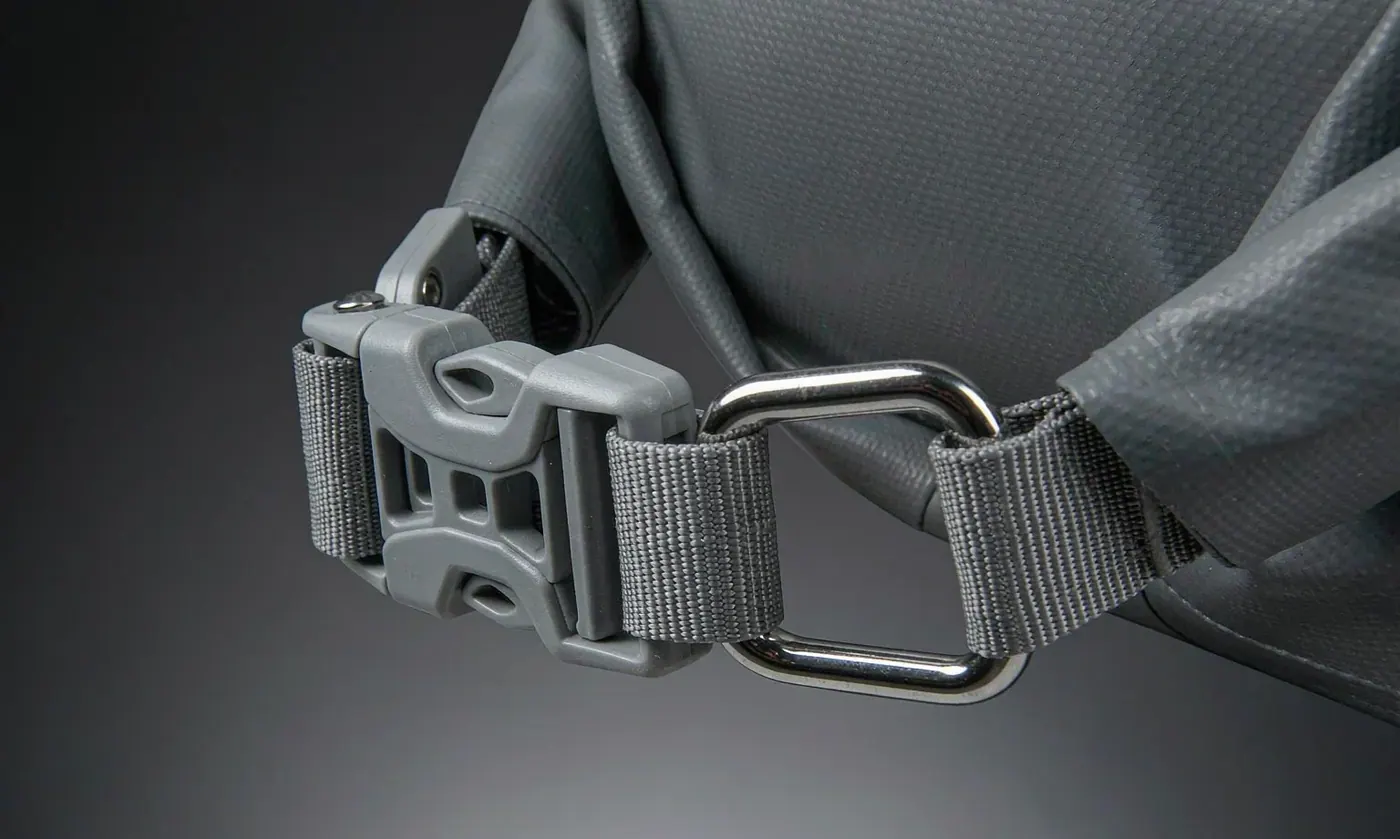
Hardware testing is the least glamorous part of a programme and the part most often omitted, which is odd given that a failed buckle renders a pack unusable just as effectively as a leak. The relevant measurements are simple: pull strength on an attachment point, cycle life on a buckle, and corrosion resistance on anything metal. A shoulder strap attachment should hold above 500 newtons on a static pull, and a D-ring used for towing or lashing above 300 newtons.
| Component | Test | Pass value | Note |
|---|---|---|---|
| Shoulder strap attachment | Static pull to failure | Above 500 newtons | Test wet as well as dry |
| Lashing D-ring | Static pull, 45 degree angle | Above 300 newtons | Angle matters more than direction |
| Side release buckle | 5,000 open and close cycles | No crack, no latch slip | Cycle at minus 10 degrees as well |
| Webbing | Tensile to break | Above 1,500 newtons for 25 mm | Check the weave, not just the width |
| Metal press stud | Salt fog, 48 hours | No red rust on the surface | Relevant to saltwater use |
Two conditions change hardware results substantially and are routinely omitted. Temperature: a polyoxymethylene buckle that cycles cleanly at 20 degrees can become brittle below minus 10, and cycling a sample in a cold chamber costs little and catches the failure before a winter season does. And wet state: webbing that has been soaked and dried repeatedly loses 5 to 10 percent of its tensile strength, and a strap attachment tested only dry will be optimistically specified.
The finished pack tests described here are complemented by the far simpler checks any buyer can run without a laboratory, which are covered in the at home testing guide, and by the consumer-facing rating chart maintained in the IPX rating guide.
Reading a Test Report Without Being Misled
A test report is only as good as its sample description, and the sample description is the first thing to check. A report that says one piece of black coated fabric tells you nothing you can rely on, because the next shipment may use a different coating weight, a different laminate or a different finish. The description should name the material, the construction, the coating or film type, the colour and ideally the batch, so that the result can be tied back to a purchase.
- Check accreditation: the report should state ISO 17025 accreditation and show the accreditation body's mark.
- Check the sample description: material, construction, coating, colour and batch, not a generic textile label.
- Check the conditioning: textiles are conditioned at 20 degrees and 65 percent relative humidity for 24 hours before testing.
- Check the date: results older than 12 months should be re-run after any material or process change.
- Check the method and the year: methods are revised, and a 2013 edition result is not the same as a current edition one.
- Check whether it was a pass on a fresh specimen or a cycled one, which is the difference between optimistic and realistic.
The conditioning point deserves emphasis because it explains otherwise baffling discrepancies. A textile tested at 20 degrees and 65 percent relative humidity behaves differently from the same textile tested straight off a production floor in a humid month, and the difference in a hydrostatic head result can be 10 to 20 percent. That is not a laboratory error; it is the material responding to moisture content, and it is why identical fabrics can produce different numbers in different places.
Why Two Laboratories Report Different Numbers
When two accredited laboratories return different results on the same fabric, the cause is almost always a specimen or procedural variable rather than an error. Understanding which variables move the number is more useful than arguing about which laboratory is right, because it tells you what to specify so that results are comparable in future.
| Variable | Effect on the result | How to control it |
|---|---|---|
| Specimen conditioning | 10 to 20 percent on hydrostatic head | Condition 24 hours at 20 degrees, 65 percent RH |
| Test face orientation | Large, can double the apparent result | State which face is presented to the water |
| Rate of pressure rise | 5 to 15 percent on hydrostatic head | Use the rate given in the method |
| Specimen clamping | Edge leakage gives false low results | Check the clamp is clean and correctly torqued |
| Specimen history | Abrasion and washing lower results sharply | Test new, and again after 20 cycles |
Orientation is the largest of those and the most frequently overlooked. A laminated fabric has a face and a back, and presenting the coated side to the water gives a different result from presenting the textile side by a wide margin. Any report that does not record which face was tested should be treated as indicative rather than definitive, and re-run with that detail recorded.
Building a Test Plan for a Programme
A first-season test plan does not need every method in the catalogue; it needs the methods that catch the failures this product will actually see. For a commuting body that is spray, hydrostatic head and zip cycling. For a paddle or boating body it is IPX6 or IPX7, weld peel and hardware pull. For a children's or school body it is those plus the CPSIA chemical tests handled in a separate part of the programme. Choosing four or five methods per design and repeating them annually covers the risk at a cost of roughly 600 to 1,200 USD.
- Fix the test list at specification stage, before the first sample, so the sample can be built to pass it.
- Test the highest risk closure after cycling rather than fresh, which is the single largest realism improvement available.
- Pair every assembly result with a material result, because neither alone predicts field behaviour.
- Re-run any test after a material, coating or closure change, however small the change appears.
- Keep reports with the bill of materials, and make sure the sample description matches it line for line.
One scheduling point determines whether testing delays a programme or runs alongside it. The long poles are the cycle tests and the chemical screens, at 10 to 15 working days each, while hydrostatic head and spray come back in 3 to 5. Running the long items in parallel with the 6 to 10 working day sampling window rather than after it keeps the critical path unchanged, which is the difference between a programme that ships on time and one that slips by a fortnight.
Every bulk order is inspected at AQL 2.5 before shipment, and the test reports, inspection records and the specification sheets behind each range are held. For the buyer-facing side of this subject, the selection criteria built on these results are set out in the waterproof backpack buying guide, and the simpler checks that can be run without a laboratory are described in the at home testing guide.
People Also Ask
Is IPX7 better than IPX6 for a backpack?
Not necessarily. IPX6 is a 100 litre per minute jet and IPX7 is 30 minutes of static immersion at 1 metre, and the two are tested differently. A closure that seals under immersion may not hold against a jet, so specify both if you need both.
What hydrostatic head do I need for a waterproof backpack?
Above 10,000 millimetres of water column for immersion or paddle use, and 3,000 to 5,000 for rain commuting. A TPU laminate typically reads 10,000 to 20,000 against 1,000 to 3,000 for a coated woven face.
Does IEC 60529 apply to backpacks?
Not formally. The standard was written for electrical enclosures and is applied to soft goods by convention, which is why the test conditions, orientation and weighting method have to be stated on the report for a rating to mean anything.
Why did my IPX7 backpack leak?
Usually because of abrasion or a closure fault rather than the fabric. Hydrostatic head falls as the base abrades, and a zip that sealed when new can weep after 500 cycles with grit in the teeth.
How long does waterproof testing take?
Three to 5 working days for hydrostatic head and spray, 10 to 15 for cycle tests and chemical screens. Run the long items in parallel with sampling rather than after it to keep the critical path unchanged.
Can two labs give different results on the same fabric?
Yes, typically from conditioning, orientation, clamping or the rate of pressure rise. Conditioning alone moves hydrostatic head by 10 to 20 percent, and orientation can change the apparent result by more.
Frequently Asked Questions
Q1. What does IPX7 mean on a backpack?
Immersion at 1 metre for 30 minutes with no ingress to the interior. It is tested as an assembled article rather than as a fabric, so it should always be paired with a hydrostatic head result on the material itself.
Q2. Is a waterproof backpack tested to ISO standards?
The material tests are: ISO 811 for hydrostatic head, ISO 4920 for spray and ISO 12947 for abrasion. The enclosure side uses the code in IEC 60529, which is applied to bags by convention rather than by design.
Q3. How much hydrostatic head is enough for rain?
Three to 5 thousand millimetres of water column is adequate for sustained rain; 1,000 to 3,000 is light shower territory. Above 10,000 is only necessary if the pack will be submerged or sat in standing water.
Q4. Do welded seams need their own test?
Yes, for peel strength and burst. A welded seam should hold above 40 newtons per 50 millimetre strip in peel and above 150 kilopascals in burst, and the common failure is a cold weld rather than a weak material.
Q5. Should a zip be tested before or after cycling?
After cycling, because a fresh closure gives an optimistic result. Run 500 to 2,000 open and close cycles and then spray, which adds one day and produces a number a customer will recognise.
Q6. What pull strength should a shoulder strap have?
Above 500 newtons on a static pull for the attachment point, and above 300 newtons for a lashing D-ring at a 45 degree angle. Test wet as well as dry, since soaked webbing loses 5 to 10 percent of tensile strength.
Q7. Why does my pack pass in the lab and fail on the trail?
Because laboratory specimens are conditioned, unabraded and freshly closed. Real packs are abraded at the base, carry grit in their closures and are loaded, each of which lowers the effective rating.
Q8. How much does a full test programme cost?
About 600 to 1,200 USD per design for four or five physical methods, plus 400 to 800 for the chemical screens if the market requires them. That is small against the cost of a failed season.
Q9. Do I need IPX8 rather than IPX7?
Only for sustained deep immersion. IPX8 conditions are agreed between the parties rather than fixed by the standard, so an IPX8 claim without a stated depth and duration on the report is not meaningful.
Q10. How often should testing be repeated?
Annually, and after any change of material, coating, closure or hardware. A change of fabric batch alone is enough to move a hydrostatic head result, so batch-linked reports are worth keeping.
Q11. Can I test a waterproof backpack at home?
Yes, for the gross failures: a hose test at a fixed distance, a 30 minute bath test and a paper indicator inside the pack. What home tests cannot do is produce a number comparable to a laboratory result.