A waterproof backpack sold into the EU or California has to satisfy two different chemical regimes at once: REACH, which restricts substances in articles placed on the EU market, and California Proposition 65, which requires a warning before exposure to a listed chemical unless exposure is below a safe harbour level. In practice the substances that matter on a waterproof pack are four: phthalate plasticisers in PVC coatings and printed logos, long chain PFAS in durable water repellent finishes, heavy metals in pigments, hardware and prints, and certain azo dyes in linings and webbing. The common limit for the four restricted phthalates is 0.1 percent by weight of the plasticised material, and CPSIA applies 100 ppm of total lead for children's products. Verifying all four by accredited laboratory testing costs roughly 400 to 800 USD per material set and takes 5 to 15 working days. For programme planning, materials are confirmed at sampling at 6 to 10 working days and bulk runs 35 to 50 days at 500 pcs per design and colour, FOB Xiamen.
What REACH and Prop 65 Actually Require
REACH is a European Union regulation on the registration, evaluation, authorisation and restriction of chemicals, and it applies to articles as well as to substances. For a bag brand the operative part is Annex XVII, the list of restricted substances, and the candidate list of substances of very high concern, which now runs to over 240 entries. The obligation is on whoever places the article on the EU market, which for an imported pack is the importer of record rather than the overseas producer, and that is why European buyers ask for declarations so early.
Proposition 65 is a different kind of instrument. It is a California right-to-know law rather than a product standard: it does not ban a substance, it requires a clear and reasonable warning before exposing anyone to a listed chemical, unless the business can show exposure is below a safe harbour level. The list runs to roughly 900 chemicals. The practical consequence is that compliance is demonstrated either by testing below a safe harbour or by applying a warning label, and most brands prefer the former because a Prop 65 warning on a hangtag is a sales problem.
| Requirement | Scope | Operative limit or action | What it means for a pack |
|---|---|---|---|
| REACH Annex XVII, phthalates | All articles on the EU market | 0.1 percent by weight, sum of four phthalates | Applies to PVC coatings, prints and grips |
| REACH SVHC candidate list | Articles above 0.1 percent w/w | Declaration, and notification above 1 tonne per year | Checked against the full materials list |
| REACH Annex XVII, azo dyes | Textile and leather in skin contact | 30 mg/kg per listed aromatic amine | Affects linings, webbing and dyed panels |
| California Prop 65 | Products sold in California | Warning, or exposure below safe harbour | Phthalates, lead, cadmium, BPA are the usual triggers |
| CPSIA, children's products | Products for children 12 and under | 100 ppm total lead, 0.1 percent phthalates | Applies to school and youth packs |
The two regimes overlap but do not agree, which is the single most useful thing for a buyer to understand. REACH is a substance restriction with a defined threshold and no warning option. Prop 65 is an exposure-based warning scheme with no single threshold, only safe harbour levels that differ per chemical and per route of exposure. A pack can therefore be fully compliant with REACH and still require a California warning, which is not a contradiction and not a defect.
Where Restricted Substances Hide in a Waterproof Pack
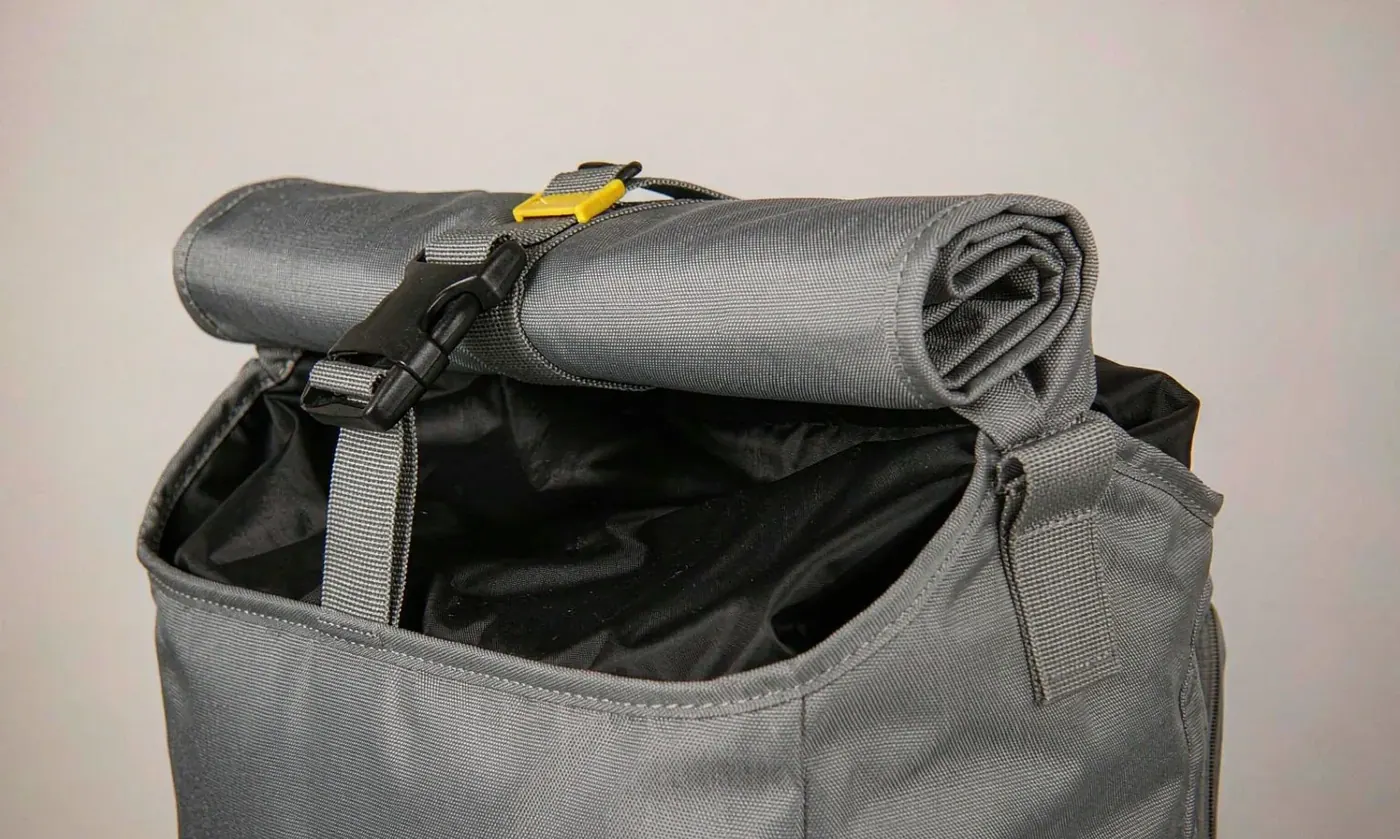
A waterproof pack contains more chemistry than it appears to, because waterproofing is achieved with coatings, films, prints and adhesives rather than with the base fabric alone. Working through the bill of materials component by component is the only reliable way to find the risk, and the four components that account for nearly all findings are the coating or laminate, the print, the hardware finish and the dyed textile parts.
| Component | Substance class at risk | Where it comes from | Typical control |
|---|---|---|---|
| PVC or PU coating | Phthalate plasticisers | Plasticiser package in the coating formulation | Switch to a non-phthalate or TPU film |
| Screen print and logo | Phthalates, heavy metals | Plastisol inks and pigment concentrates | Water based or silicone ink, tested batch by batch |
| DWR finish | Long chain PFAS | C6 or C8 fluorocarbon finish | Move to a paraffin or silicone finish |
| Metal hardware | Nickel release, lead | Plating bath and brass alloy | Nickel-free plating, lead-free brass |
| Lining and webbing | Azo dyes, PAHs | Dyestuff selection and rubber components | Use dyes from a restricted substance free list |
One pattern recurs across audits: the fabric passes and the print fails. Base fabrics from a large mill are usually supported by a full restricted substance declaration because the mill sells into apparel and has to maintain one, while a decorative print applied later is often bought locally with no declaration behind it. On a pack with four or five prints, the prints are therefore the highest risk items in the whole specification despite representing under 2 percent of the mass.
Adhesives and seam sealing tapes are the second blind spot. A solvent based adhesive used to bond a stiffener or to attach a lining can carry toluene or a phthalate plasticiser, and it sits inside a closed laminate where it is invisible on the finished article. Asking for the adhesive data sheet alongside the fabric declaration closes this gap for the cost of one email, and it is the single cheapest control in the whole list.
Phthalate-Free: What the Claim Means and How to Verify It
Phthalate-free is a claim about the plasticiser package, not about the whole product, and it should always be stated that way. Phthalates are added to PVC to make it flexible; a rigid PVC component may contain none and still not be described as a phthalate-free product if another component contains them. The four phthalates restricted under REACH are DEHP, DBP, BBP and DIBP, limited to 0.1 percent by weight in the plasticised material, and California adds DINP, DIDP and DnOP to the list.
| Plasticiser | Status under REACH | California listed | Common substitute |
|---|---|---|---|
| DEHP | Restricted, 0.1 percent | Yes | DOTP or DINCH |
| DBP | Restricted, 0.1 percent | Yes | DOTP or DINCH |
| BBP | Restricted, 0.1 percent | Yes | DOTP or DINCH |
| DIBP | Restricted, 0.1 percent | No | DOTP or DINCH |
| DINP and DIDP | Not restricted in articles | Yes | DOTP or DINCH |
| DOTP and DINCH | Not restricted | No | Already the substitute |
Verification is a GC-MS test on a dissected sample, and it is more specific than most buyers expect. The laboratory separates and quantifies individual phthalate compounds rather than producing a single pass or fail number, so the report shows DEHP at a level such as 0.008 percent and DBP below the reporting limit of 0.005 percent. Turnaround is typically 5 to 7 working days at 80 to 150 USD per sample, and the sample has to be a single homogeneous material, which means a printed panel has to be tested separately from the base fabric.
The substitute question matters as much as the restriction. DOTP and DINCH are the two workhorse replacements and both are widely available, but DINCH costs roughly 15 to 25 percent more per kilogram and DOTP gives a slightly stiffer hand, which changes how a coating behaves at low temperature. On a pack intended for winter use that stiffness is a real specification issue rather than a cosmetic one, and it is worth asking for a coating sample at the intended thickness before committing.
Chemical inventories and the action plans behind these restrictions are published by EPA in the United States, and the European list is maintained under REACH. Neither list is static: substances are added most years, and a materials declaration that was accurate 18 months ago may be out of date. Re-issuing the declaration for each season rather than reusing a previous one is the cheapest defence against this drift.
PFAS in Durable Water Repellent Finishes
The second live issue on waterproof packs is per and polyfluoroalkyl substances in durable water repellent finishes. A DWR is applied to the outer face so water beads and runs off rather than wetting out the textile, and the most effective versions historically used long chain C8 fluorocarbons, with C6 versions as the first replacement. Several US states and the EU are restricting PFAS in textiles, and the direction of travel is clearly toward fluorine free finishes, so specifying one now avoids a re-specification later.
- C8 finishes: largely withdrawn, effective, and now the highest regulatory risk in the category.
- C6 finishes: still widely used, better toxicological profile, under active restriction in several jurisdictions.
- Fluorine free: paraffin, silicone or polyurethane based, now reaching 80 to 90 percent of C6 performance on spray tests.
- Total fluorine screening: a screening test at 200 to 350 USD tells you whether any fluorine is present at all.
- Targeted PFAS analysis: LC-MS/MS for specific compounds, 300 to 500 USD and 10 to 15 working days.
The performance trade is smaller than it was. A modern fluorine free finish on a 420 denier nylon will typically hold a spray test rating of 90 to 95 after 20 washing cycles, against 95 to 100 for a C6 finish, which is a difference most users will never observe in the field. What fluorine free finishes do give up is oil repellency, which matters on a pack that will meet sunscreen or insect repellent rather than just rain. The full discussion of finish chemistry is set out in the PFAS-free materials guide.
Heavy Metals, Azo Dyes and CPSIA
Heavy metals enter a pack through three routes: pigments in dyed fabric and prints, plating on metal hardware and press studs, and stabilisers in PVC. The thresholds differ sharply between adult and children's products, which is why a school pack and a hiking pack of identical construction can have completely different compliance outcomes. Under CPSIA a children's product is limited to 100 ppm total lead in any accessible substrate and 90 ppm in coatings, and it needs third party testing at a CPSC accepted laboratory plus a certificate.
| Substance | REACH or EU limit | CPSIA limit, children's products | Testing method | Typical turnaround |
|---|---|---|---|---|
| Total lead | 500 ppm in articles in scope | 100 ppm substrate, 90 ppm coating | ICP-OES or ICP-MS | 7 to 10 working days |
| Cadmium | 100 ppm in plastics in scope | Not separately limited | ICP-OES or ICP-MS | 7 to 10 working days |
| Nickel release | 0.5 micrograms per square centimetre per week | Not limited | EN 12472 with EN 1811 | 10 to 15 working days |
| Azo dyes | 30 mg/kg per listed amine | Not limited | EN 14362 parts 1 and 3 | 7 to 12 working days |
| PAHs | 1 mg/kg, 0.5 for toys | Not limited | GC-MS after extraction | 7 to 12 working days |
Hardware is where a compliance programme most often fails on the first attempt, because nickel release is a migration test rather than a content test. A buckle can contain nickel and still pass, and it can contain very little nickel and fail, because the test measures what comes off the surface under artificial sweat over a week. The fix is a nickel-free plating specification rather than a content specification, and it costs 0.10 to 0.35 USD more per hardware item on average.
Prints deserve a second mention here, because lead in a pigment is still found in screen prints bought without a declaration. The control is cheap: specify the ink by brand and product code, require the pigment declaration with each batch, and test one print per colour per season. On a pack with five print colours that is five tests at roughly 90 USD each, or 450 USD, which is a small sum against the cost of a recall or a delisting.
Documentation: What to Ask For and How to Read It
Four documents cover almost every compliance question a retailer or marketplace will ask, and requesting all four at the start of a programme rather than at the end is the difference between a two week listing process and a six week one. They are a restricted substance declaration from each material source, a laboratory test report from an accredited laboratory, a technical file describing the bill of materials, and where applicable a children's product certificate.
- Restricted substance declaration: issued per material, signed, dated within 12 months, and naming the standard it is declared against.
- Test report: from an ISO 17025 accredited laboratory, with the sample description matching the bill of materials rather than saying textile only.
- Technical file: a bill of materials listing every component, its material, its source and its declaration reference.
- Children's product certificate: required for CPSIA scope, naming the laboratory and the specific test dates.
- Batch traceability: a lot number linking each bulk run back to the fabric batch that was tested.
Two habits make those documents far more useful. The first is to insist that the sample description on a test report matches the bill of materials exactly, because a report describing coated polyester when the pack uses a TPU laminate is worthless in an audit. The second is to keep declarations to a maximum of 12 months old and re-issue them at each season, since both the REACH candidate list and the Prop 65 list change during a year.
Laboratory accreditation is the third thing worth checking, and it is easy to check: the report should state accreditation to ISO 17025 and show the accreditation body's mark. A report from an unaccredited laboratory may be technically accurate and is still rejected by most large retailers, which means the money spent on it was wasted. Accreditation frameworks and the general standards references used in this area sit under ISO, and textile colour fastness and related methods are published by AATCC.
Testing Plan, Cost and Turnaround
A sensible first-season testing plan is not exhaustive; it is targeted at the four risks and repeated annually plus at any material change. In budget terms, screening a complete material set for a single pack design runs roughly 400 to 800 USD and takes 5 to 15 working days depending on which methods are used. That is a rounding error against a bulk order and a very cheap insurance policy against a delisting, which typically costs 20 to 60 times as much in lost margin and freight.
| Test | Method | Cost per sample | Turnaround | Run it when |
|---|---|---|---|---|
| Phthalate screen | GC-MS | 80 to 150 USD | 5 to 7 working days | Every coated or printed material, every season |
| Total fluorine screen | Combustion ion chromatography | 200 to 350 USD | 7 to 10 working days | Any pack with a DWR finish |
| Heavy metals | ICP-OES or ICP-MS | 120 to 200 USD | 7 to 10 working days | Hardware, pigments, children's products |
| Azo dyes | EN 14362 | 150 to 250 USD | 7 to 12 working days | Every dyed lining, webbing and panel |
| Nickel release | EN 12472 with EN 1811 | 180 to 300 USD | 10 to 15 working days | Any metal part in skin contact |
One testing decision saves real money: test materials rather than finished products wherever the method allows. A fabric roll can be tested once and used across 6 designs, whereas testing each finished pack multiplies the cost by the number of designs. The exception is anything where the process changes the chemistry, which in practice means prints, coatings applied after weaving and adhesives, all of which must be tested in their applied state.
Building a Compliant Materials List for a Programme
The most efficient sequence is to fix the materials list before the first sample rather than after it, because changing a coating at sample approval adds 10 to 15 working days to a programme and changing it after bulk has been cut is not possible. The sequence runs: select materials with declarations already in hand, build the bill of materials with a declaration reference on every line, cut the sample, then test the highest risk items in parallel with the sample review rather than after it.
- Fix the coating first: TPU film or a non-phthalate PU coating removes the largest single risk at the start.
- Specify inks by code and require a pigment declaration per batch, not a generic statement about the ink range.
- Ask for the adhesive and seam tape data sheets, which are the two items most often missing from a materials file.
- Choose a fluorine free DWR unless oil repellency is required, and record the reason if you do not.
- Re-issue declarations every 12 months and re-test after any material source change, however small.
Cost impact of doing all this is modest and worth stating plainly. A non-phthalate coating adds about 0.15 to 0.40 USD per pack at typical volumes, a fluorine free finish adds 0.10 to 0.30 USD, nickel-free hardware adds 0.10 to 0.35 USD per metal item and the testing programme adds roughly 0.05 to 0.15 USD per unit amortised across a 500 piece run. The total is usually under 1.50 USD against a retail price that a compliance failure would remove entirely.
For programmes running through Aquagrip, materials are screened for REACH and California Prop 65 compliance as a standard part of specification, and every bulk order is inspected at AQL 2.5 before shipment. Materials declarations, test reports and the inspection records for each run are held. The product ranges built on those materials are described in the waterproof backpack overview, and the physical test side of the same subject is covered in the IP and ISO testing guide.
People Also Ask
What is the REACH limit for phthalates in bags?
0.1 percent by weight of the plasticised material, measured as the sum of DEHP, DBP, BBP and DIBP. The limit applies per material rather than per finished product, so a coating and a print are assessed separately.
Does a waterproof backpack need a Prop 65 warning?
Only if exposure to a listed chemical exceeds a safe harbour level and no warning exemption applies. Most brands avoid the warning by testing below the safe harbour, since a Prop 65 label on a hangtag suppresses sales.
Is PVC banned in backpacks in the EU?
No. PVC itself is not restricted; what is restricted is the plasticiser package used to make it flexible. A phthalate-free PVC or a TPU film meets the same requirement without changing the construction.
How much does compliance testing cost for a backpack?
Roughly 400 to 800 USD to screen a complete material set for one design: 80 to 150 USD for a phthalate screen, 120 to 200 for heavy metals and 200 to 350 for a total fluorine screen.
Can a pack pass REACH and still need a Prop 65 warning?
Yes. REACH is a substance restriction with defined thresholds and no warning option, while Prop 65 is exposure based. The two regimes use different lists and different logic, so compliance with one does not imply compliance with the other.
How often should materials declarations be re-issued?
Every 12 months, and immediately after any change of material source. Both the REACH candidate list and the Prop 65 list change during a year, so a declaration that was accurate 18 months ago may no longer be.
Frequently Asked Questions
Q1. Is a phthalate-free waterproof backpack really free of phthalates?
It means the plasticiser package contains no restricted phthalates above the reporting limit, typically 0.005 percent. Always ask whether the claim covers the coating, the print and the hardware, because a claim about one component is not a claim about the whole pack.
Q2. Which phthalates are restricted under REACH?
DEHP, DBP, BBP and DIBP, at 0.1 percent by weight in the plasticised material. California additionally lists DINP, DIDP and DnOP, which are not restricted in articles under REACH.
Q3. What is the difference between REACH and California Prop 65?
REACH restricts the presence of a substance above a defined threshold, with no warning option. Prop 65 requires a warning before exposure to a listed chemical unless exposure falls below a safe harbour level, so it is an exposure scheme rather than a content limit.
Q4. Do PVC and TPU differ on compliance?
Yes. PVC requires a plasticiser package, which is where phthalate risk sits, while TPU is inherently flexible and needs no plasticiser. That is why TPU film bodies are the simpler specification for a compliance-led programme.
Q5. What is the lead limit for a children's backpack?
100 ppm total lead in any accessible substrate and 90 ppm in coatings under CPSIA, with third party testing at a CPSC accepted laboratory and a children's product certificate. Adult products are not held to those figures.
Q6. How long do compliance test results take?
Five to 7 working days for a phthalate screen by GC-MS, 7 to 10 for heavy metals by ICP, and 10 to 15 for nickel release. Plan for the longest item in the set rather than the shortest.
Q7. Are fluorine-free DWR finishes as good as C6?
Close, but not identical. A modern fluorine free finish reaches 80 to 90 percent of C6 performance on a spray test after 20 wash cycles, and gives up oil repellency, which matters only where the pack meets sunscreen or insect repellent.
Q8. Do I need to test every colour of the same pack?
For prints and pigments, yes: test one print per colour per season at roughly 90 USD each. For the base fabric, one test per material covers all colours of that material, since the pigment risk sits in the print rather than the cloth.
Q9. What is a restricted substance declaration?
A signed statement from a material source confirming that a named material meets a named standard, dated within 12 months. It is not a substitute for testing, but it is what makes a testing plan targeted rather than exhaustive.
Q10. Why do hardware parts fail compliance testing?
Usually on nickel release, which is a migration test rather than a content test. A buckle can contain nickel and pass, or contain little and fail, so the correct specification is nickel-free plating rather than a nickel content limit.
Q11. Does compliance add much to unit cost?
Usually under 1.50 USD in total: 0.15 to 0.40 USD for a non-phthalate coating, 0.10 to 0.30 for a fluorine free finish, 0.10 to 0.35 per metal item for nickel-free plating, and 0.05 to 0.15 amortised testing across a 500 piece run.