A dependable waterproof backpack helmet holder uses 3 attachment points, keeps the shell at least 40 mm clear of the ground, and limits movement to about 25 mm while walking or riding. A 25–35 L pack with an IPX6-level body, welded seams, and clips rated above 200 N suits most bicycle, motorcycle, ski, and work helmets. For buying programmes, a practical baseline is MOQ 500 pcs per design and colour, samples in 6–10 working days, and bulk delivery in 35–50 days.
Why External Helmet Carry Needs More Than One Clip
A helmet is awkward cargo because it is hollow, rounded, and wider than a normal 20–30 L pack. Hanging it from one loop creates a pendulum: every 1 km of walking produces thousands of small swings, and a 1.4 kg motorcycle helmet can lever a lightly stitched tab away from the shell. A useful carrier therefore spreads force through 3 points or a four-corner net. Two points control side movement; the third prevents the helmet from bouncing upward when the wearer steps off a curb, mounts a bicycle, or crosses rough ground.
The direct specification is simple. Keep loaded movement below 25 mm in each direction, place the lower support 80–120 mm above the pack base, and give every load-bearing clip a static rating of at least 200 N. The rating is intentionally far above helmet mass because a sudden stop can multiply force by 4–6 times. A soft spacer panel between the pack and helmet also prevents grit trapped on the shell from abrading paint during a 2-hour transfer.
| Carry layout | Useful load | Movement target | Best setting |
|---|---|---|---|
| Single top loop | Under 0.6 kg | Often over 70 mm | Short walk only |
| Two side clips | 0.6–1.1 kg | Under 45 mm | Compact bicycle helmet |
| Three-point cradle | 0.8–1.8 kg | Under 25 mm | Trail, road, or riding helmet |
| Four-corner stretch net | 0.7–1.5 kg | Under 30 mm | Mixed helmet shapes |
| Panel pocket | Up to 1.6 kg | Under 15 mm | Frequent transit |
One attachment point is acceptable only when the helmet is empty, light, and carried for less than 15 minutes. For a commute or a 5 km approach, three-point restraint is the minimum sensible layout. Buyers comparing purpose-built cycling models can use the waterproof cycling backpack range as a reference for low-profile clips, while larger road helmets fit the geometry shown in the waterproof motorcycle backpack collection.
Match the Carrier to Helmet Shape and Mass
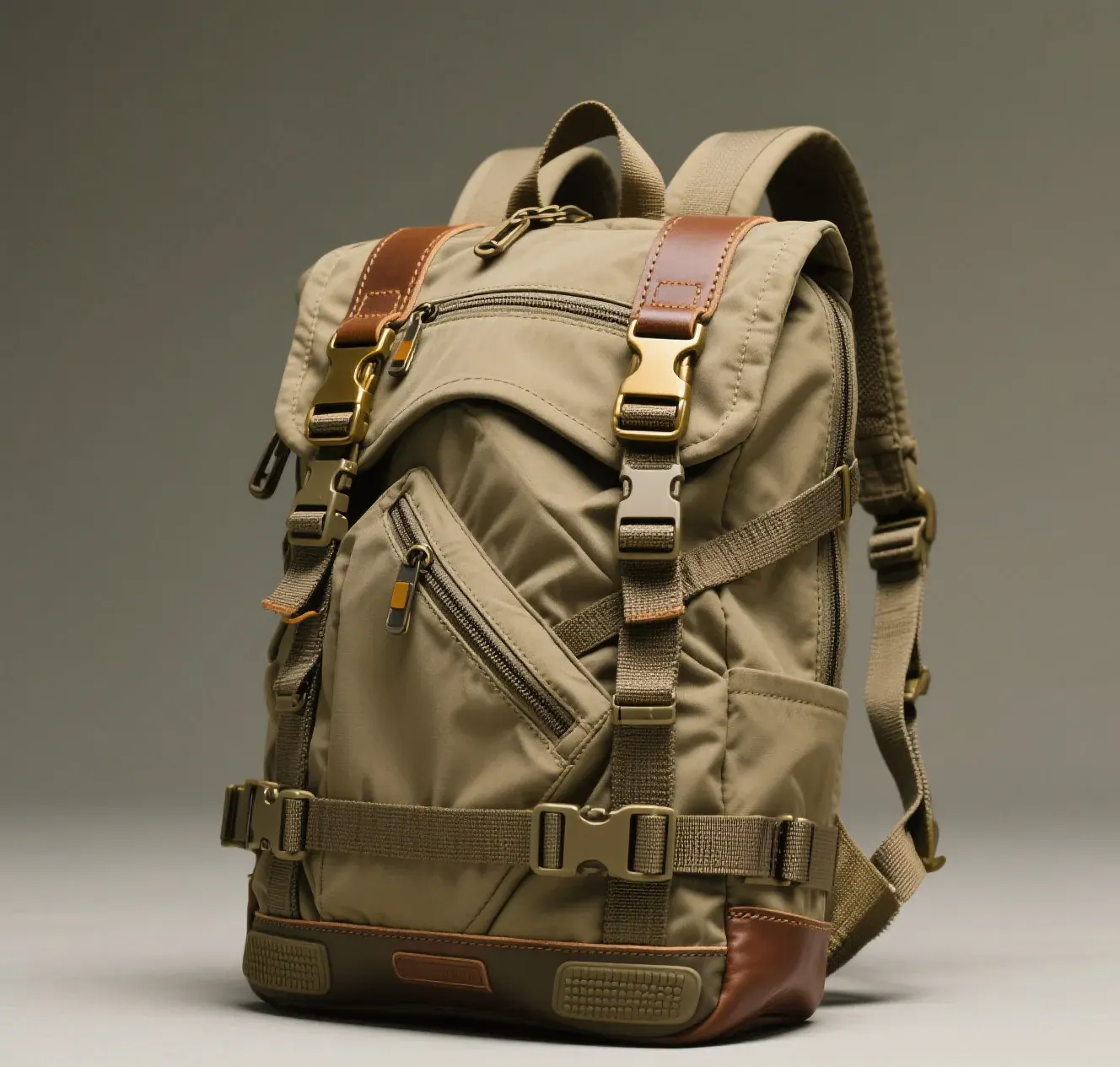
Helmet categories differ more than their marketing names suggest. A vented road helmet may weigh 220–350 g and compress slightly under a stretch net; a full-face mountain-bike model is commonly 750–1,100 g; an adventure motorcycle helmet with visor and communication unit can reach 1.7 kg. The retention panel must cover the widest third of the shell without pressing the visor, blocking a vent-mounted light, or loading the delicate edge of a peak.
Measure 3 values before approving a carrier: maximum shell width, front-to-back length, and loaded mass. Add 30 mm to width and 40 mm to length for gloves and easy insertion. A road helmet measuring 220 × 280 mm can use a 250 × 320 mm stretch panel; a 270 × 360 mm full-face shell needs a 300 × 400 mm cradle. A buckle placed directly over a visor is a rejection point even if the helmet technically fits.
| Helmet type | Typical mass | Carrier envelope | Preferred restraint |
|---|---|---|---|
| Road cycling | 220–350 g | 250 × 320 mm | Stretch panel plus 2 hooks |
| Trail cycling | 350–500 g | 270 × 340 mm | Three-point elastic cradle |
| Full-face cycling | 750–1,100 g | 290 × 390 mm | Webbing cradle with spacer |
| Equestrian | 450–650 g | 280 × 350 mm | Breathable panel, 3 clips |
| Motorcycle | 1.3–1.8 kg | 310 × 410 mm | Non-stretch lower cup, 4 anchors |
Do not put gloves, a lock, or wet footwear inside the helmet to save space. That adds uneven mass, strains the chin strap, and may transfer chain oil or grit to the liner. A 0.7 L accessory pocket beside the carrier is a better place for gloves, while a U-lock belongs close to the back panel. The helmet should remain an independent load that can be removed in under 20 seconds without opening the waterproof compartment.
Waterproof Body, Exposed Carrier: Keep the Boundary Clear
External carry does not make the helmet dry. It keeps the internal 25–35 L chamber available for clothing, electronics, and tools while the helmet remains exposed to rain. The pack body should use coated fabric and welded primary seams, with a roll-top closed through at least 3 firm turns. An IPX6-level design target is appropriate for driven rain and wheel spray; IPX7 or IPX8 is relevant only when accidental immersion is a real part of the route.
Ingress protection language comes from IEC guidance for IP ratings. A complete pack is not automatically certified merely because its fabric is waterproof, so the test brief must name the finished closure, seams, valves, and attachment penetrations. Helmet anchors should sit on welded reinforcement islands or external daisy webbing rather than puncturing the wet boundary with an unsealed stitch line.
- Use a roll-top with 3 turns and 75 mm of usable rolling depth for sustained rain.
- Keep every helmet anchor outside the sealed chamber or cover its stitch line with a continuous internal patch.
- Specify a 30-minute spray check after a 200 N anchor pull test, not before it.
- Drain the carrier panel through two openings of 8–12 mm so it cannot hold a cup of rainwater.
- Place reflective details above the helmet edge, where they remain visible from 50 m behind.
The sequence matters because an anchor can pass a spray check when new and leak after loading distorts its seam. Pull first, spray second, then inspect the inner face with dry absorbent paper. The related IPX rating guide for waterproof backpacks explains test limits; it also helps buying teams avoid translating a fabric result into an unsupported whole-pack claim.
Anchor Strength, Elastic Recovery, and Hardware
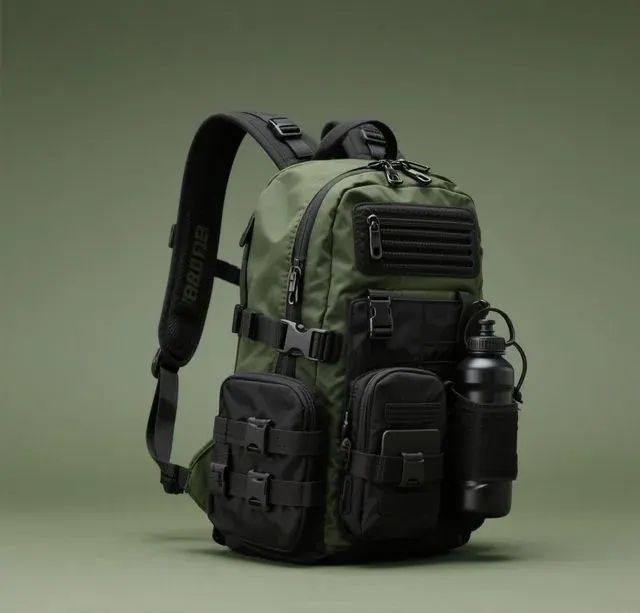
A carrier fails in one of 3 ways: the anchor tears out, elastic loses recovery, or a clip opens under twisting load. Test them separately. Each anchor should hold 200 N for 60 seconds without visible shell whitening or seam growth above 2 mm. Elastic mesh should recover to at least 90 percent of its original length after 5,000 extensions at 30 percent strain. A clip should remain closed after 1,000 wet cycles and 24 hours of drying.
| Test item | Method | Acceptance line | Why it matters |
|---|---|---|---|
| Anchor pull | 200 N for 60 seconds | No tear; growth under 2 mm | Controls sudden-stop load |
| Elastic cycling | 5,000 cycles at 30% strain | At least 90% recovery | Stops a loose helmet after a season |
| Clip operation | 1,000 wet open-close cycles | No unintended release | Represents daily commuting |
| Cold flex | 2 hours at -10°C, then 50 bends | No cracking or lockup | Protects winter use |
| Abrasion | 10,000 rub cycles at contact patch | No hole through face layer | Limits shell scuffing |
Acetal hardware is light and resists rain, while 316 stainless parts suit salt exposure but add 20–45 g. The relevant material and textile methods can be selected from the catalogues maintained by ASTM International. Record the exact strap width, load direction, conditioning temperature, and sample count; a bare statement that a clip is strong has no purchasing value.
Placement for Cycling, Motorcycling, and Walking
Placement changes with motion. On a bicycle, the helmet should sit high enough to clear the rear wheel spray zone but low enough not to touch the rider's head when looking upward. Leave at least 60 mm between the carried shell and the base of the wearer's helmet. On a motorcycle transfer, keep the load centred and below shoulder level so a 1.6 kg shell does not pull the wearer backward. For walking, the widest point must not extend more than about 60 mm beyond either side of the torso in crowded stations.
A 20-minute dynamic fit test reveals errors a static display cannot. Walk stairs, turn quickly, crouch, and step over a 250 mm obstacle with the real helmet attached. Then ride for 15 minutes if cycling is the stated use. The shell must not strike the head, elbows, rear rack, or seat. A carrier that looks compact but hits once per pedal cycle will be returned regardless of its waterproof performance.
Load the internal chamber before testing external placement. A half-empty roll-top collapses differently from a full one, and a helmet positioned perfectly on an empty 28 L body may tilt once 6 kg is packed inside. Start with the densest 2 kg close to the spine, add clothing around it, close the roll evenly, and only then tension the cradle until two fingers can slide beneath its upper edge.
Field Packing and Daily Handling
A carrier earns its place when the whole handoff takes under 30 seconds. Open the lower cradle, seat the helmet base first, draw the upper panel across the crown, and close the side clips in sequence. Tighten until movement is below 25 mm, but stop before a buckle presses a visor or a strap crosses a vent-mounted light. Tuck 100 mm or more of loose webbing into elastic keepers because flapping ends can reach spokes or snag a door handle.
After rain, remove the helmet rather than leaving it against a wet pack overnight. Open all vents, wipe the shell, and air the liner for 4–8 hours away from a heater. Rinse road salt from the carrier with fresh water after winter rides, then cycle each clip 3 times while wet to clear grit. Never apply petroleum lubricant to acetal buckles or elastic; a clean water rinse and a soft brush are enough.
For riders deciding between an external cradle and an enclosed compartment, the helmet-compartment comparison explains the trade: external carry saves 8–12 L of internal volume and dries faster, while an enclosed bay protects the helmet surface and adds pack depth. The external answer is better for wet daily use; the compartment answer is better where scuff protection outranks airflow.
Sample Approval: Test Retention After Real Wear
A new cradle can look secure because fresh elastic is at maximum recovery. Approval should therefore include conditioning that imitates ownership. Load the largest approved helmet, hold the pack at 35°C for 8 hours, remove it for 16 hours, and repeat that cycle 5 times. Then expose the empty carrier to 2 hours of rain, dry it naturally, and run the 20-minute movement course again. The post-conditioning movement must remain below 25 mm, not merely the original result.
Inspect contact points under angled light. A carrier may retain safely yet leave a dull rub mark after 10 km because one buckle edge touches the crown. Apply removable witness film to 6 likely contact zones, walk 5 km with a 7 kg internal load, and reject any sharp wear line wider than 2 mm. Soft binding should wrap every panel edge, while buckle bodies should remain at least 15 mm away from painted shell surfaces.
| Approval stage | Condition | Pass line | Sample record |
|---|---|---|---|
| Initial fit | Largest and smallest helmets | Two-finger tension; visor clear | Front and side photographs |
| Dynamic walk | 5 km, 7 kg internal load | Movement under 25 mm | Movement at 1 km and 5 km |
| Warm conditioning | 5 cycles: 8 h at 35°C | No permanent panel distortion | Panel dimensions before and after |
| Wet conditioning | 2 h rain, natural dry | Clips close normally | Closure force and visual note |
| Contact check | Witness film at 6 points | No sharp mark over 2 mm | Marked contact map |
Small and large helmets belong in the same review because one adjustable carrier can fail at opposite ends. The smallest shell may fall through the lower cup, while the largest can overstretch the upper panel and place a clip against the visor. Test both with the same internal load and the same compression settings. If one tension range cannot hold both, create two clearly labelled carrier sizes rather than asking users to solve the mismatch with knots.
Packaging should preserve the approved adjustment. Close clips without stretching the panel, route straps through keepers, and avoid folding elastic beneath a heavy buckle for a 40-day sea journey. At receipt, inspect 5 pieces from different cartons and compare panel dimensions with the approved sample. A carrier compressed in transit can recover after 24 hours; one that remains more than 8 percent shorter should be quarantined for review.
A Buying Brief That Can Be Measured
Write the brief around one real helmet, not the word universal. State its 3 dimensions, mass with accessories, travel mode, internal load, rain target, and acceptable pack width. Then lock 5 pass-or-fail figures: 200 N per anchor, under 25 mm movement, 90 percent elastic recovery after 5,000 cycles, 3 roll-top turns, and no visible ingress after the agreed spray exposure. Those numbers let two prototypes be compared without opinions.
QUANZHOU JUNYUAN BAGS supports waterproof programmes with an MOQ of 500 pcs per design and colour, sample timing of 6–10 working days, and bulk timing of 35–50 days. AQL 2.5 inspection can include anchor pull, clip operation, dimensions, and closure checks. The organisation has worked in this category since 2014, follows BSCI and ISO 9001 systems, screens materials for REACH and California Prop 65, and ships FOB Xiamen or DDP to more than 100 countries.
A technical team can review the helmet envelope and test sequence. Send the helmet drawing, a side photograph, and target 25–35 L capacity to service@junyuanbags.com. The most useful first sample contains two different cradle tensions on the same pack body, because that isolates retention feel without changing waterproof construction.
Run one final release check with winter gloves and a wet pack. The wearer should attach or remove the helmet in under 30 seconds without placing it on the ground, and each clip must give a clear tactile confirmation. Repeat the sequence 10 times with the 1.8 kg reference shell. If webbing twists, a keeper releases, or the lower cup folds inward on any cycle, revise the routing before approval; users should not need a special technique to reproduce the tested result.
The final decision rule is compact: choose 3-point restraint for any helmet above 0.6 kg or any carry beyond 15 minutes, specify 200 N anchors, and test movement with the pack loaded to its real 6–9 kg working mass. A holder that passes those checks protects comfort, helmet finish, and the sealed chamber at the same time.
People Also Ask
How does a helmet attach to a waterproof backpack?
A secure design seats the helmet in a lower cup or panel, crosses its crown with an upper restraint, and closes 2 side clips. Those 3 points should keep movement below about 25 mm while leaving the sealed main chamber unopened.
What capacity works with an external bicycle helmet holder?
A 25–30 L body suits commuting and day rides, while 30–35 L allows clothing, shoes, and tools for longer transfers. External carry preserves roughly 8–12 L that an internal helmet compartment would otherwise occupy.
Will a helmet carrier reduce backpack waterproofing?
Not when anchors remain outside the wet boundary or receive continuous internal sealing patches. Test the loaded anchors at 200 N first and conduct the finished-pack spray check afterward, because pulling can reveal a seam leak.
How tight should a helmet net be?
Tight enough to limit motion to 25 mm but loose enough for two fingers beneath the upper edge. Over-tension can press a visor, distort a peak, or shorten elastic life without improving practical retention.
Can one holder fit cycling and motorcycle helmets?
It can if its envelope reaches about 310 × 410 mm and its lower section does not stretch under a 1.8 kg load. However, a compact road helmet fits better in a smaller 250 × 320 mm panel, so two sizes usually give cleaner retention.
Where should reflective trim sit when a helmet covers the pack?
Place it above the carrier edge and on both shoulder straps, with a second strip below the helmet if space permits. Check visibility from 50 m behind with the largest approved helmet attached, not with the pack empty.
Frequently Asked Questions
Q1. Is a single helmet clip safe for a long walk?
A single loop is reasonable only for a helmet below 0.6 kg and a transfer under about 15 minutes. Longer routes need 3-point restraint because one clip permits 70 mm or more of swing and concentrates every shock at one anchor.
Q2. What load rating should helmet clips have?
Specify at least 200 N per load-bearing clip or anchor and hold that force for 60 seconds. The margin covers the 4–6 times force increase that can occur when a 1–2 kg helmet stops suddenly.
Q3. Does the carried helmet stay dry?
No. An external cradle leaves it exposed, although its open panel should drain quickly. Put electronics and clothing inside the welded 25–35 L chamber, and dry the helmet liner for 4–8 hours after rain.
Q4. How many attachment points are best?
Three are enough for most road, trail, and equestrian helmets: two control sideways swing and one stops vertical bounce. Heavy motorcycle shells benefit from 4 anchors and a non-stretch lower cup.
Q5. Can the holder carry a full-face helmet?
Yes, when its working envelope is around 290 × 390 mm for a cycling shell or 310 × 410 mm for a motorcycle shell. Keep buckles away from the visor and test with communication units or lights installed.
Q6. Should the helmet sit high or low on the backpack?
It should sit above the lower wheel-spray zone, at least 40 mm clear of the ground when the pack is set down, and 60 mm below the wearer's helmet. The correct position is confirmed during a 20-minute loaded movement test.
Q7. How do I stop a helmet from bouncing?
Seat its base in the lower support, close both side clips, and tension the upper panel until movement stays below 25 mm. Pack the internal 6–9 kg load first because body shape changes when the roll-top is full.
Q8. What is the best carrier material?
A soft abrasion-resistant face over controlled elastic works for light helmets; heavy shells need a non-stretch webbing cup with padded contact zones. Elastic should retain at least 90 percent length recovery after 5,000 cycles.
Q9. How should a helmet holder be cleaned?
Rinse grit and road salt with fresh water, brush lightly, operate each clip 3 times while wet, and air dry. Avoid heat and petroleum lubricant, which can affect elastic and attract more dirt to buckle tracks.
Q10. What are the order quantities and timing for a helmet-carry pack?
The baseline is 500 pcs per design and colour, a sample in 6–10 working days, and bulk in 35–50 days. Approve the real helmet envelope, 200 N anchor test, and loaded movement result before confirming the run.