Most people comparing Bogg Bag alternatives are comparing the same underlying product: a one-piece injection-molded EVA body with perforated walls, an open top and no lining. The differences that actually change how a bag performs are few and measurable: wall thickness between three and eight millimetres, perforation diameter between six and fourteen millimetres, empty weight between 0.4 and 2.6 kilograms, and whether the rim has at least fifteen millimetres of solid material above the top row of holes. Prices for comparable bodies span roughly USD 25 to 90 at retail, and the spread is explained by material mass and brand rather than by any functional difference most users would notice in a season.
What Shoppers Are Actually Comparing
The search for Bogg Bag alternatives usually starts with price and ends with specification. The original product defined a category that is now made by many programmes, and the category is unusually easy to compare because the construction is the same everywhere: molten ethylene-vinyl acetate injected into a closed tool so the body, handles and base emerge as one piece. There is no lining, no seam and no fabric layer, so the things that differ between two bags are dimensional and material rather than structural.
That is good news for a buyer, because it means the comparison can be done on paper. Five specifications explain almost all of the difference in use: wall thickness, perforation diameter, empty weight, rim section and base footprint. Two more explain most of the difference in price: material mass and colourway complexity. Everything else, including most of the marketing language in the category, has little bearing on whether the bag does its job for five seasons or one.
| Specification | Typical range in this category | What a weak value looks like | What a strong value looks like |
|---|---|---|---|
| Wall thickness at base | 3 to 8 millimetres | Under 3 millimetres, visible flex when lifted empty | 6 to 8 millimetres on large sizes, 4 to 5 on small |
| Perforation diameter | 6 to 14 millimetres | Under 8, damp sand bridges the hole | 9 to 12 millimetres for general beach use |
| Empty weight, family size | 1.4 to 2.1 kilograms | Under 1.2, the body feels hollow and flexes | 1.6 to 1.9, heavy enough to stay upright |
| Solid band above top holes | 10 to 25 millimetres | Under 12, the mouth collapses when lifted | 15 millimetres or more of unbroken material |
| Base footprint versus rim | Narrower to 15 millimetres wider | Narrower than the mouth, tips when loaded | Equal to or wider than the mouth |
Price Versus Build: Where the Money Actually Goes
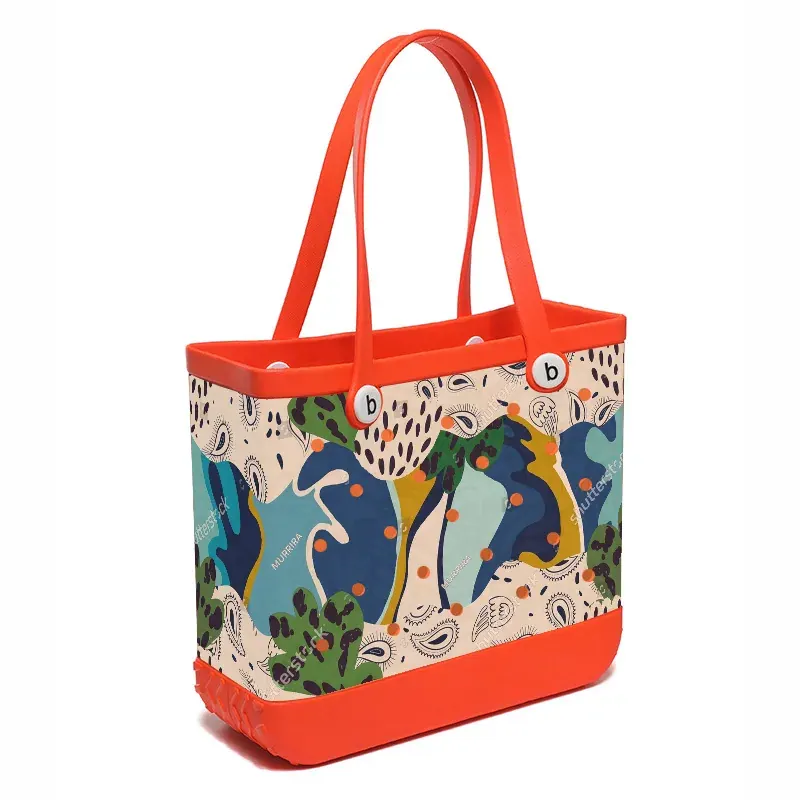
Retail prices for perforated EVA totes span roughly USD 25 to 90, and the spread is far narrower in terms of material than it is in terms of money. A family-size body uses about 1.6 kilograms of compound, and compound is a commodity input, so the physical difference between a USD 35 bag and a USD 75 bag is usually 200 to 400 grams of material, a more complex colourway, and a retail margin that reflects brand rather than build. That is not to say the cheaper bag is identical: it usually has thinner walls, a narrower rim band and a simpler foot pattern, all of which shorten service life.
| Retail band | Typical build | Expected service life | Who it suits |
|---|---|---|---|
| USD 25 to 40 | 3 to 4 millimetre walls, basic foot pattern, single colour | Two to three seasons | Occasional use, one season events |
| USD 40 to 60 | 4 to 6 millimetre walls, tapered section, decent rim band | Four to five seasons | Regular family use, most buyers |
| USD 60 to 75 | 6 to 8 millimetre walls, wide base rails, matched colourway | Five to seven seasons | Heavy weekly use, salt and sun |
| USD 75 to 90 | As above plus decoration, charms, retail packaging | Five to seven seasons | Gift and resort retail |
| Programme pricing at 500 pieces | Any of the above, specified by the buyer | As specified | Retail and resort programmes |
The useful way to read that table is by cost per season rather than by sticker price. A USD 35 bag replaced after two seasons costs about USD 17.50 per year of use; a USD 65 bag lasting six seasons costs about USD 10.80 per year and is rinsed rather than replaced. Buyers who use the bag most weekends near sand and salt come out ahead on the heavier build, and buyers who use it twice a summer do not.
Weight, Wall Thickness and the Feel Test
Weight is the specification most easily judged in a shop and most often misread. A heavier body is not automatically better, because weight can come from a thick base, a heavy rim or simply a larger overall size, and only the first two help. What matters is where the material sits: tapered construction puts more compound at the base and rim, where stress concentrates, and less in the mid-wall, where it only adds weight.
Three checks take less than a minute and predict most of the difference between a body that lasts and one that slumps. Press the rim between thumb and forefinger and compare its resistance with the mid-wall; a rim that resists noticeably more indicates taper. Lift the empty bag by one handle and watch the mouth; some flex is normal, collapse past about thirty percent is not. And set the bag on a hard floor and press one corner down twenty millimetres; it should resist rather than rock, which indicates a base footprint wide enough for uneven loads.
Perforation Pattern: Drainage Against Retention
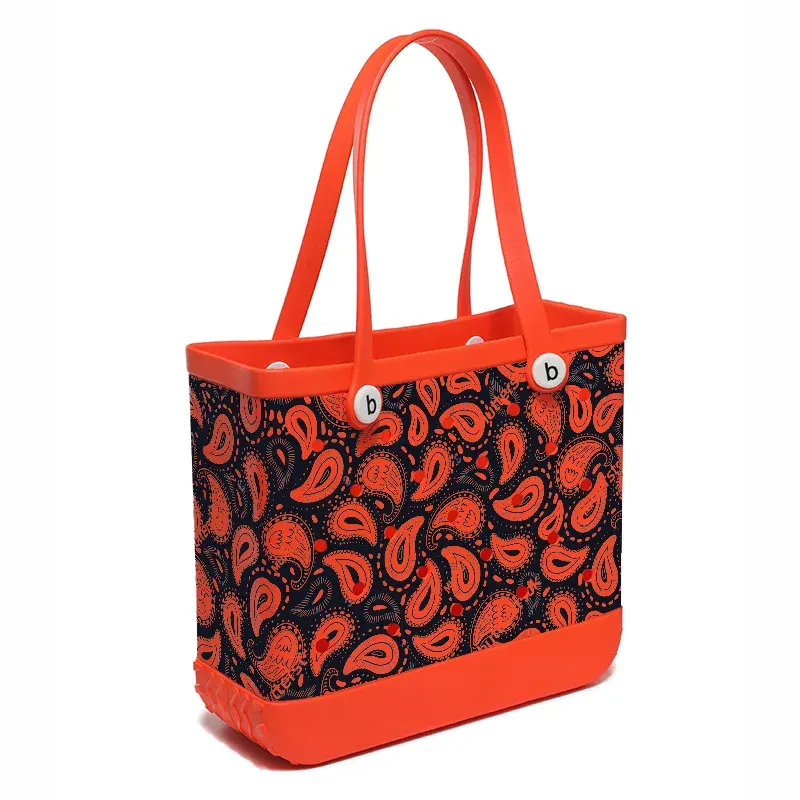
The holes are the visible signature of the category and the specification most often chosen for looks rather than for function. Diameter governs two competing outcomes: drainage speed and retention of small items. Small holes look tidier and retain everything, but damp sand bridges across them and stays behind. Large holes drain in under four seconds and pass everything loose, including lip balm and small toys.
| Hole diameter | Drainage after a dunk | Sand behaviour | What escapes | Verdict |
|---|---|---|---|---|
| 6 millimetres | About 20 seconds | Wet sand bridges the hole | Nothing | Tidy, poor on sand |
| 8 millimetres | About 12 seconds | Damp sand sometimes bridges | Nothing | Acceptable for pool use |
| 10 millimetres | About 7 seconds | Sand passes cleanly | Nothing larger than a coin | Best all-round choice |
| 12 millimetres | About 5 seconds | Sand and grit pass | Very small items can slip | Good for beach and garden |
| 14 millimetres | Under 4 seconds | Everything loose passes | Lip balm, small toys | Specialist use only |
Distribution matters as much as diameter. Holes concentrated low on the walls and across the base do the drainage work, while holes carried high up the wall shorten the usable interior surface and weaken the rim. The practical rule is to look for at least fifteen millimetres of solid material above the top row on large sizes and twelve millimetres on small ones, because that unbroken band is what keeps the mouth open when the bag is lifted by one handle with a full load inside.
Size and Capacity Compared
Sizes are described inconsistently across the category, so comparing litre figures between brands is unreliable in a way that comparing dimensions is not. Two products both described as large can differ by ten litres, and two products with the same litre figure can differ in opening area by a third. Measure the mouth and the height rather than trusting the name, and then check the internal height against the tallest thing you intend to stand inside.
| Common name | Outer dimensions | Usable volume | Empty weight | Realistic contents |
|---|---|---|---|---|
| Mini or kids | 24 by 16 by 11 centimetres | About 5 litres | 0.3 to 0.45 kilograms | Goggles, sunscreen, a small towel |
| Small | 33 by 23 by 14 centimetres | About 10 litres | 0.7 to 0.9 kilograms | Two towels, bottle, book |
| Medium | 41 by 27 by 19 centimetres | About 18 litres | 1.0 to 1.4 kilograms | Four towels, snacks, clothing |
| Large | 48 by 31 by 24 centimetres | About 32 litres | 1.6 to 2.1 kilograms | Six towels, picnic kit, drinks |
| Extra large | 54 by 34 by 28 centimetres | About 42 litres | 2.3 to 2.6 kilograms | Full family day plus bulky kit |
The most common sizing error in this category is buying down. Shoppers compare a large body with a medium one in photographs, decide the medium looks sufficient, and then discover that six towels and a picnic kit do not fit. Families almost always end up at the large size, and the medium is the size most often exchanged. The exception is the solo or couple buyer, for whom the medium is generous and the large is simply heavy.
Durability: What Fails First and When
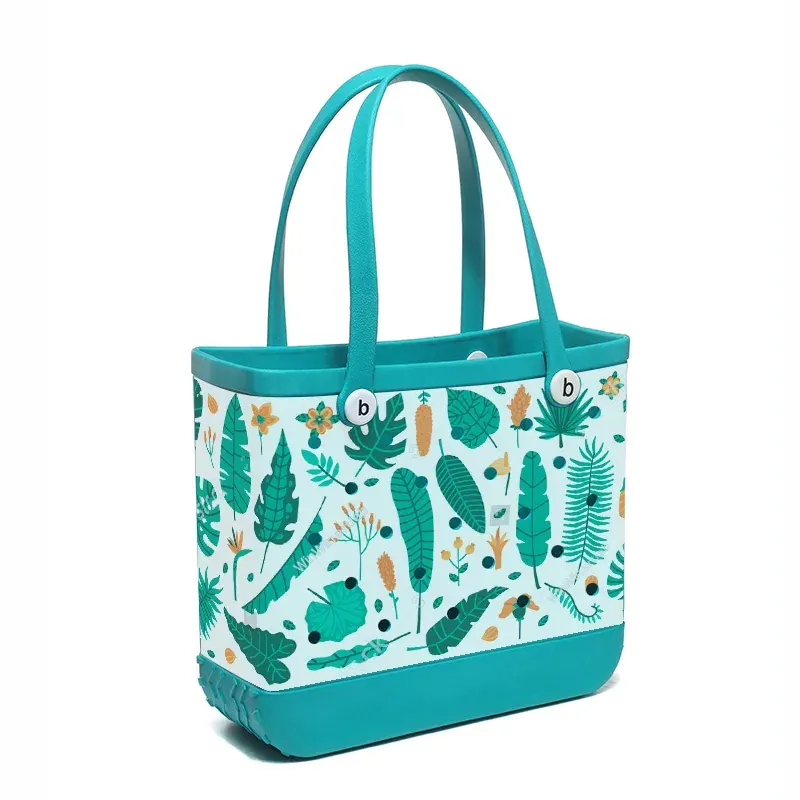
These bags rarely fail catastrophically. They fail by slow deformation, and the sequence is consistent enough to predict. The handle root is usually first, because it is lifted against load every single use and a sharp fillet concentrates that stress. The rim follows, losing its shape so the mouth no longer stands open. The base is third, either wearing through at the rails or creeping flat so the bag rocks. Wall splitting is rare and almost always the result of an impact rather than of load.
- Handle root tearing: look for a fillet radius above six millimetres where the handle meets the rim, which spreads load and delays this failure substantially.
- Rim collapse: requires at least fifteen millimetres of solid material above the top row of holes on a large size.
- Base wear: continuous rails last far longer than corner studs, particularly on abrasive surfaces such as concrete pool decks.
- Heat creep: a dark body left in direct summer sun passes sixty degrees at the surface within an hour, which is enough to deform the shape permanently.
- Surface dulling: solvents attack the skin layer and leave patches that collect dirt faster than the surrounding material did.
Water and salt are not the threat most buyers expect them to be. Closed-cell EVA absorbs effectively no water, salt does not attack the polymer at ambient temperature, and a rinse with fresh water removes everything that matters. The material enemies are heat, solvents and sustained point loading, and all three are avoidable without any special care routine.
Compliance and Documentation Worth Asking For
Because these totes are sold into family and resort channels, documentation matters commercially even where it is not strictly required. Three lines cover most markets and none is expensive when planned: substance screening for the European market, an exposure assessment or compliant warning for California, and additional migration and mechanical testing where the product is marketed towards children or sold with small charms.
Substance obligations for the European market are administered by the European Chemicals Agency, with restricted substances generally held at or below 0.1 percent by weight. Physical test methods for load, dimensional and mechanical checks are published by ASTM International, and quality-management expectations for how those checks are documented come from the International Organization for Standardization. Asking for a report dated within twelve months that names the method rather than merely the outcome is what makes the document usable in more than one market.
Choosing Between Options: A Decision Guide
Most comparisons resolve on one priority. Decide which single outcome matters most, and the specification follows without much further thought. The table below maps the four common priorities onto the specifications that deliver them.
| If your priority is | Specify this | Avoid this | Expected result |
|---|---|---|---|
| Sand shedding at the beach | Holes at 10 to 12 millimetres, low and on the base | Holes under 8 millimetres | Sand falls through instead of bridging |
| Carrying heavy loads | 6 to 8 millimetre walls, wide base rails, 15 millimetre rim band | Uniform 4 millimetre walls | Stays upright, holds shape past five seasons |
| Child carrying it | Empty weight 0.4 to 0.6 kilograms, holes 6 to 9 millimetres | Adult small sizes at 0.9 kilograms | A child can carry about 2 kilograms unaided |
| Retail shelf appeal | Matched colourway, retail carton, charm compatibility | Plain export carton with no hangtag | Higher sell-through at resort and gift channels |
| Lowest cost per season | 4 to 6 millimetre tapered walls, standard colourway | Thinnest available walls | Four to five seasons at a mid price |
One honest caveat closes the comparison. No tote in this category is a dry bag. The material sheds water completely and cannot rot, but the perforations mean the body is not a sealed container, so anything that must stay dry needs a pouch inside. Buyers who understand that before ordering are satisfied with the product; buyers who discover it at the waterside are not, regardless of which brand they chose.
How to Judge One in a Shop in Two Minutes
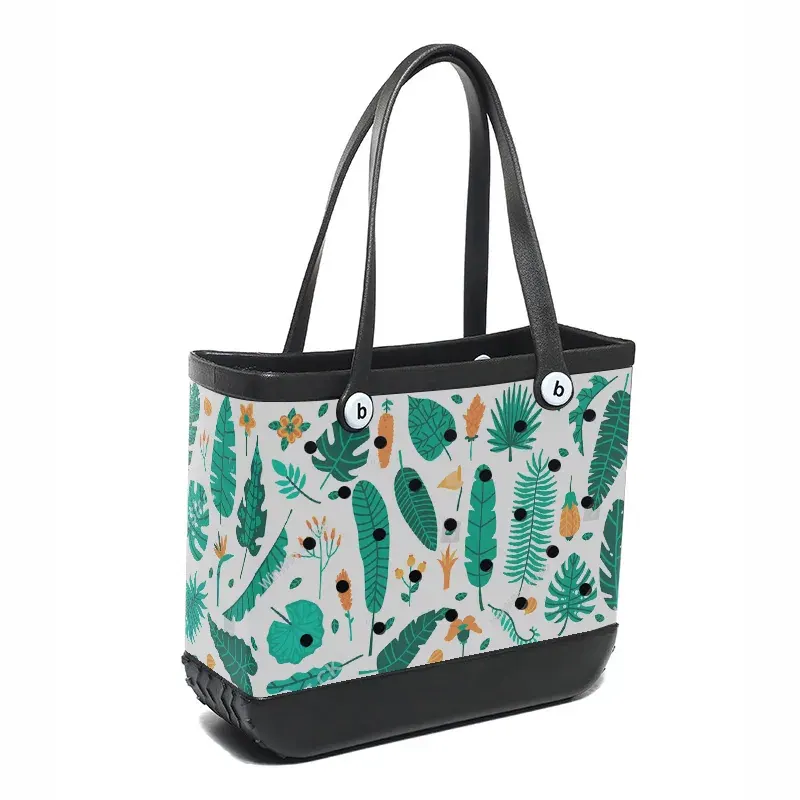
Photographs hide almost everything that matters in this category and show only the perforation pattern, which is the least important specification. Five physical checks in a shop or on delivery take about two minutes and give a far better prediction of satisfaction than any product description. None of them requires tools, and three of them can be done without unpacking the bag.
| Check | How to do it | Pass condition | What a fail predicts |
|---|---|---|---|
| Rim versus mid-wall | Press each between thumb and forefinger | Rim resists noticeably more | Untapered walls and early rim collapse |
| One-handle lift | Lift the empty bag by one handle and watch the mouth | Less than about 30 percent inward flex | Mouth collapse once loaded |
| Corner press | Set on a hard floor, press one corner down 20 millimetres | It resists rather than rocking | Tipping when bottles are loaded low |
| Drain timing | Dunk and lift the empty body, count seconds | Under 10 seconds to stop dripping | Holes too small, sand will bridge |
| Handle root | Look underneath where handle meets rim | Fillet radius above 6 millimetres | Tearing at the root within two seasons |
The two checks worth prioritising are the rim comparison and the one-handle lift, because both predict the failure that users actually complain about: a bag whose mouth no longer stands open. The drain timing matters more for beach use than for pool use, and the corner press matters more for anyone who carries upright bottles. Handle root inspection is the one that requires picking the bag up, and it is the specification most often skimped on lower-priced bodies.
Decoration, Charms and Packaging Differences
Two products with identical bodies can present very differently, and presentation is where a large part of the retail price difference sits. Three decoration routes exist and they behave differently in service. Moulded-in colour is the most durable because it runs through the material rather than sitting on it. Surface printing allows detailed artwork but sits on the skin layer and can scuff. Pressed-in charms add identity and are the highest-margin accessory in the category, but they depend entirely on hole diameter matching the body.
Packaging matters more in this category than in most, because rigid bodies arrive with their own volume and the carton has to protect the rim rather than the fabric. Retail-ready cartons with a printed face and a hangtag cost roughly USD 0.60 to 1.80 per unit more than a plain export carton, and they are worth it above about 2,000 units where the shelf presentation drives sell-through. Below that, a plain carton with a hangtag applied at destination is usually the better economics.
Programme Notes
The category background, including what injection molding means for construction and how each specification behaves, sits in the injection-molded EVA tote guide. Ranked picks across sizes and price bands are collected in the EVA beach tote round-up, and colourway, decoration and packaging development are handled inside the made-to-order EVA tote programme.
QUANZHOU JUNYUAN BAGS has run waterproof bag programmes since 2014 with a founding team in this trade since 2004, including injection-molded EVA work alongside sewn and welded ranges. Monthly output runs at 200,000 units verified by SGS, operations follow BSCI and ISO 9001, materials are screened for REACH and California Prop 65, and every bulk shipment is inspected at AQL 2.5 before release. Programme minimums begin at 500 pieces per design and colour, with sampling at 6 to 10 working days and bulk at 35 to 50 days from approved sample and deposit, shipped FOB Xiamen or DDP to upwards of one hundred nations. Send your target dimensions, wall thickness, perforation preference, colourway count and quantity to service@junyuanbags.com.
People Also Ask
What should I look for in a perforated EVA tote?
Wall thickness of 4 to 8 millimetres, holes at 9 to 12 millimetres, at least 15 millimetres of solid rim above the top row, and a base as wide as the mouth.
How much should a good EVA beach tote cost?
Between USD 40 and 75 at retail for a build that lasts four to seven seasons. Below USD 40 usually means thinner walls and a shorter service life.
Do all perforated EVA totes perform the same?
No. Wall thickness, perforation diameter, rim section and base width differ substantially, and those four specifications decide drainage, stability and service life.
What hole size is best for sand?
Ten to twelve millimetres. Below eight, damp sand bridges the hole and stays behind; above fourteen, small items begin to escape.
Why do some EVA totes collapse at the mouth?
The rim lacks enough solid material above the top row of holes. Fifteen millimetres or more on a large size keeps the mouth open under load.
Is a perforated EVA tote the same as a dry bag?
No. The material absorbs no water but the holes mean the body is not sealed, so sensitive items need a pouch inside.
Frequently Asked Questions
Q1. What is the difference between a Bogg Bag and other EVA totes?
Mainly wall thickness, rim section, colourway complexity and brand margin. The underlying construction, a one-piece injection-molded EVA body with perforated walls, is the same across the category.
Q2. Are cheaper EVA totes as durable?
They are usually thinner. A build with 3 to 4 millimetre walls typically lasts two to three seasons, while 6 to 8 millimetre tapered walls last five to seven.
Q3. What wall thickness should I look for?
Four to six millimetres for small sizes and six to eight for large, ideally tapered so the base carries more material than the upper wall.
Q4. Which perforation size drains best?
Twelve millimetres drains in about five seconds. Ten millimetres is the best all-round compromise at around seven seconds while still retaining anything larger than a coin.
Q5. Do these totes keep contents dry?
No. The material sheds water completely, but the perforations mean the body is not a sealed container. Use a pouch for electronics and anything sensitive.
Q6. Why does the rim matter so much?
It resists collapse of the mouth when the bag is lifted by one handle. Look for at least fifteen millimetres of solid material above the top row of holes.
Q7. Do EVA totes fade in the sun?
Slowly. Solid-colour bodies resist better than surface-printed artwork, and storing the bag in shade adds seasons to its appearance.
Q8. Can an EVA tote be left in a hot car?
It should not be. Surface temperature on a dark body in direct sun can pass sixty degrees within an hour, which is enough to creep the shape permanently.
Q9. What is the best size for a family of four?
A large size around 48 by 31 by 24 centimetres, about 32 litres, which carries six towels, a picnic kit, drinks and wet gear.
Q10. How heavy should a family-size tote be?
Between 1.6 and 2.1 kilograms empty. Lighter bodies on a large size usually mean thin walls and visible flex under load.
Q11. What compliance documents should a buyer request?
A current REACH statement, a California Prop 65 assessment, phthalate screening, and heavy metal migration results for prints and charms, all dated within twelve months.
Q12. Can these totes be used for boating or kayaking?
Yes for carrying gear to and from the water, provided sensitive items are in a pouch. Nothing about the design makes the bag a flotation device.