A bass fishing backpack is a tray management system before it is a bag, and the specification that decides it is access speed: an angler changing method every 15-20 minutes needs a labelled tray out and open in under 15 seconds with the pack still worn. Ten bass builds were assessed for 2026 across 30-52 litres, four to eight 3700 trays, 1.40-2.60 kg empty, door types from top-load sleeve to full front drop-down, and 30-58 USD FOB Xiamen bands at MOQ 500 pcs per design and colour. Samples take 6-10 working days and bulk 35-50 days. The pick is the 42 L six-tray build at 1.95 kg.
Access Speed Is the Specification
Bass fishing is a method-switching discipline. An angler works a crankbait for 15 minutes, sees bait flick, and switches to a topwater within a minute, then goes back. Each switch costs time, and in a tournament that time is the difference between thirty casts an hour and forty. The pack either supports that rhythm or breaks it.
| Door type | Tray out and open | Pack removed? | Suits | Added cost |
|---|---|---|---|---|
| Full front drop-down | 8-12 seconds | No | Boat and tournament | 4.00-6.00 USD |
| Vertical front rails | 12-15 seconds | No | Bank and boat | 2.50-4.00 USD |
| Side zip access | 18-25 seconds | No | Compact builds | 2.00-3.00 USD |
| Horizontal top sleeve | 25-40 seconds | Yes | Bank, low cost | Baseline |
| Removable tray caddy | 10-14 seconds | No | Tournament | 5.50-7.50 USD |
Those figures assume a labelled tray in a known slot. An unlabelled tray turns every retrieval into a search, and the measured difference between a labelled and an unlabelled set is about nine seconds per switch. Over a six-hour session with 20 switches, that is three minutes of lost fishing, which is roughly four extra casts and, in a competition, sometimes the difference between cashing a cheque and not.
The Tray Plan: One Technique, One Tray
The tray plan should follow the technique rather than the lure type, because an angler reaches for a technique and then picks a colour inside it. Six trays cover the standard bass season: crankbaits, topwater, jigs and creature baits, spinnerbaits and chatterbaits, soft plastics by size, and terminal tackle. A seventh tray for spare hooks and weights prevents the terminal tackle drifting into every other tray.
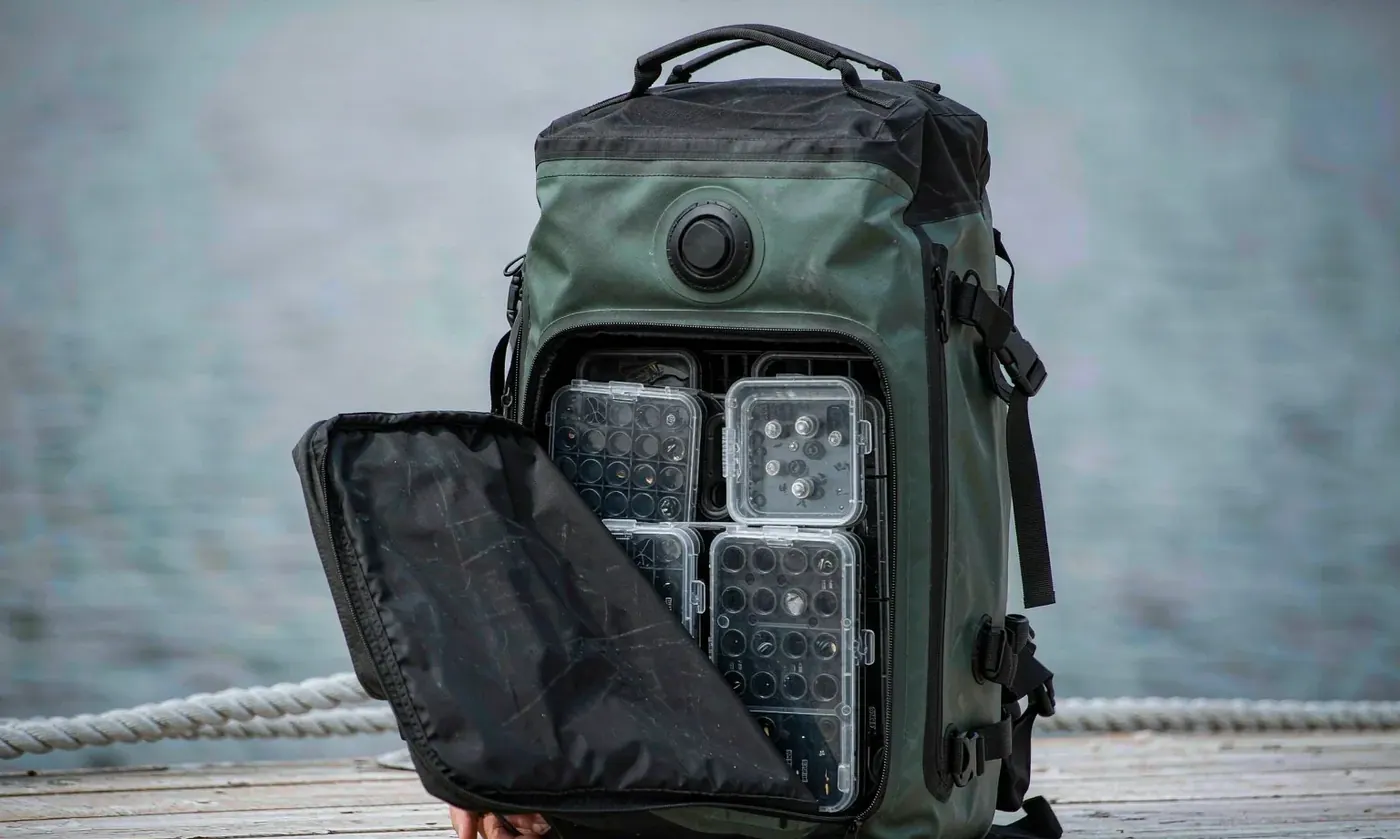
Deep 3700 trays suit bass better than shallow 3600 trays, because a 150 mm swimbait or a bulk pack of creature baits needs the extra 15 mm of depth. That choice costs capacity: six deep trays occupy the rail space of about eight shallow trays, so a bass build needs 40 litres or more to carry six. The dimensional trade is laid out in the 3600 versus 3700 tray comparison.
| Tray | Contents | Depth needed | Refill frequency |
|---|---|---|---|
| 1 | Crankbaits by diving depth | 55 mm | Twice a season |
| 2 | Topwater walkers and poppers | 55 mm | Once a season |
| 3 | Jigs and creature baits | 55 mm | Every trip |
| 4 | Spinnerbaits and chatterbaits | 55 mm | Twice a season |
| 5 | Soft plastics by size in binder sleeves | 40 mm | Every trip |
| 6 | Terminal: hooks, weights, swivels | 40 mm | Every two trips |
The Ten Builds at a Glance
Tray counts are stated for deep 3700 trays, which is the bass standard, and the volume column assumes those trays fitted. Access time is the measured figure for a labelled tray with the pack worn, taken as an average of ten retrievals rather than a best case. Larger-format alternatives are compared in the large tackle backpack ranking.
| Build | Volume | Weight | Trays | Access | FOB band |
|---|---|---|---|---|---|
| Tournament 42 | 42 L | 1.95 kg | 6 x 3700 | 9 s | 44-54 USD |
| Bank 34 | 34 L | 1.60 kg | 4 x 3700 | 13 s | 32-40 USD |
| Boat 46 | 46 L | 2.15 kg | 6 x 3700 plus caddy | 8 s | 46-58 USD |
| Compact 30 | 30 L | 1.40 kg | 4 x 3700 | 14 s | 30-38 USD |
| Caddy 38 | 38 L | 1.80 kg | 5 x 3700 in a caddy | 10 s | 40-50 USD |
| Kayak 32 | 32 L | 1.55 kg | 4 x 3700 | 15 s | 34-43 USD |
| Co-Angler 36 | 36 L | 1.70 kg | 5 x 3700 | 12 s | 36-45 USD |
| Guide 50 | 50 L | 2.40 kg | 8 x 3700 | 11 s | 48-58 USD |
| Value 30 | 30 L | 1.45 kg | 4 x 3600 | 22 s | 26-33 USD |
| Junior 26 | 26 L | 1.20 kg | 3 x 3700 | 20 s | 24-31 USD |
1. Tournament 42: Best Overall
Forty-two litres at 1.95 kg with six deep 3700 trays behind a full front drop-down door, a measured access time of 9 seconds, and a removable caddy for the two most-used trays. The FOB band is 44-54 USD.
It leads because the numbers line up. Six deep trays is the standard bass season in one bag, 42 litres is what those trays need, and the drop-down door is fast enough to keep the rhythm. The moulded base and a 90 mm hip belt carry about 15 kg, which is what six full trays plus water and tools actually weigh.
2. Bank 34: Best for Bank Anglers
Thirty-four litres at 1.60 kg with four deep trays on vertical front rails, a measured access time of 13 seconds, and a low-profile body for walking through cover. The FOB band is 32-40 USD.
Bank bass fishing is a walking discipline, and this build is specified for it: 380 mm wide so it passes through scrub, a narrower shoulder yoke, and no external rod fittings to catch on branches. Four trays is one fewer than a boat angler carries, and that is the right economy when the angler is covering 3-5 km on foot.
3. Boat 46: Best for Boat Anglers
Forty-six litres at 2.15 kg with six deep trays plus a removable two-tray caddy that hangs at the front of the deck, giving an access time of 8 seconds. The FOB band is 46-58 USD, the top of this group alongside the guide build.
The caddy is the feature that earns the price. Two trays taken out of the bag and hung within arm reach turns a method switch into a hand movement, and on a boat there is nowhere better to put them. It needs a positive stop and a rated hanger, since a caddy that drops at the first wake is worse than no caddy at all.
4. Compact 30: Best for Small Kits
Thirty litres at 1.40 kg with four deep trays, an access time of 14 seconds, and a body small enough to sit in a kayak tankwell or a boat hatch. The FOB band is 30-38 USD.
Four trays covers a single-method day with a backup, and for many anglers that is enough. The specification worth noting is that this build achieves 30 litres with four deep trays by using a tight rail pitch of 60 mm and a shallow external pocket set, so the pack is compact but the trays are not compromised.
5. Caddy 38: Best for Soft Plastics
Thirty-eight litres at 1.80 kg with five deep trays and a dedicated binder sleeve set holding 12 soft-plastic packets, with a measured access time of 10 seconds. The FOB band is 40-50 USD.
Soft plastics are the bulk problem in bass fishing and the reason a tray plan alone is not enough. Binder sleeves keep packets flat, visible, and separated by colour, and they stop the plasticiser migration that happens when different soft baits are stored in contact. Twelve sleeves weigh about 180 g and add about 2.80 USD.
6. Kayak 32: Best for Kayak Bass
Thirty-two litres at 1.55 kg with four deep trays, a 380 mm height so it clears a kayak seat, corner leash points, and a float panel sized for 6 kg. Access takes 15 seconds. The FOB band is 34-43 USD.
Height and flotation are what make it a kayak build rather than a small bank build. A pack taller than 420 mm blocks a paddle stroke, and without a float panel a 12 kg pack sinks. Access is slower than the drop-down builds because a kayak pack cannot fully open a front door while it is stowed, which is an accepted trade.
7. Co-Angler 36: Best for Co-Anglers
Thirty-six litres at 1.70 kg with five deep trays, an access time of 12 seconds, and a divided front pocket sized for a second angler kit. The FOB band is 36-45 USD.
A co-angler shares a boat and carries a reduced kit, which changes the specification in a specific way: fewer trays, more separation, and a flat profile so the bag can be stowed under a seat or behind a console. This build is 360 mm tall and carries a moulded base so it can be set on a wet deck between spots.
8. Guide 50: Best for Guide Duty
Fifty litres at 2.40 kg with eight deep trays, an access time of 11 seconds, bolted strap anchors, and a serviceable closure. The FOB band is 48-58 USD.
Eight trays is a guide carrying kit for two people across four methods, and at 2.40 kg plus trays the pack approaches 18 kg loaded. A 100 mm hip belt and a 3 mm frame sheet carry that, and the bolted anchors mean a worn strap is a 15-minute replacement. Guides do not return bags; they repair them, so serviceability is the specification that matters.
9. Value 30: Best Budget Build
Thirty litres at 1.45 kg with four shallow 3600 trays on a horizontal top sleeve, an access time of 22 seconds, and a 26-33 USD band. It is the honest entry point for a first bass bag.
Shallow trays and a top sleeve are the two savings, and both are visible in use: the pack has to come off to change a tray, and a 150 mm swimbait does not fit a 40 mm tray. For an angler fishing soft plastics and jigs in a pond, neither matters. The one element that should not be cut is the rail pitch tolerance.
10. Junior 26: Best for Young Anglers
Twenty-six litres at 1.20 kg with three deep trays, an access time of 20 seconds, a shorter back panel of 360 mm, and a 24-31 USD band. It is sized for a smaller torso rather than simply scaled down.
A junior build fails when it is a shrunken adult bag, because a 460 mm back panel on a 380 mm torso puts the load on the neck. This build has a 360 mm panel and 45 mm straps with 8 mm foam, which is correct for a 4-5 kg load. It also uses acetal buckles that a young angler can operate with cold hands.
Water, Food, and the Livewell Bag
A bass day runs six to eight hours and often involves keeping fish alive for a weigh-in, which puts a second wet item alongside bait and food. A pack that handles only trays forces the angler to carry a second bag, and the better designs accept that with a dedicated compartment.
| Item | Compartment | Why | Cost to add |
|---|---|---|---|
| Drinking water, 2 L | Insulated side pocket | Heat and a long day | 3.00-4.50 USD |
| Food | Insulated pocket, divided from bait | Cross-contamination | Shared pocket |
| Weigh-in or livewell bag | External drained sleeve | Wet and slimy | 1.80-2.60 USD |
| Rain shell | External drained sleeve | Traps water against trays | 1.80-2.60 USD |
| Soft plastics | Binder sleeves in a tray slot | Plasticiser migration | 2.80 USD |
Protecting Licence, Phone, and Weigh-In Cards
A tournament angler carries paper: a licence, a weigh-in slip, and sometimes a printed rule sheet. Paper in a tackle chamber ends up wet within two sessions, and a wet weigh-in slip is a real problem rather than an annoyance. A rigid waterproof sleeve inside the lid pocket is the whole solution.
Electronics deserve the same treatment and one extra step. A phone in a sealed pouch still suffers from condensation when the pouch is closed on a hot deck with a wet bag around it, so a silica sachet in the pouch is worth the 0.30 USD. The pouch should be tethered, because a pouch that floats away when set down is a pouch that gets lost.
Bank, Kayak, and Boat: Which Build for Which Water
The same species is fished from three platforms and each one pulls the specification in a different direction. A bank angler walks and needs a narrow body; a kayak angler stows and needs a low body; a boat angler neither walks nor stows and should optimise purely for access speed. Buying a boat pack for bank use is the most common mismatch in this category.
| Platform | Priority | Body shape | Trays | Build |
|---|---|---|---|---|
| Bank | Carry comfort, narrow body | 380 mm wide, low | 4 | Bank 34 |
| Kayak | Stowage and flotation | 380 mm tall, leashed | 4 | Kayak 32 |
| Boat | Access speed | Any shape | 6 plus caddy | Boat 46 |
| Tournament | Access and inventory | Drop-down door | 6-8 | Tournament 42 |
| Guide duty | Serviceability | Full front rails | 8 | Guide 50 |
Checks Before Approving a Bass Sample
Bass-specific failures are about repetition: a door cycled 40 times a day and trays drawn hundreds of times a season. Five checks cover it, and the cycle test is the one that separates a bag built for occasional use from one built for tournament rhythm.
| Check | Method | Pass condition | Catches |
|---|---|---|---|
| Access time | Ten labelled retrievals, average | Under 15 seconds | Top sleeve sold as fast access |
| Door cycle | Open and close 3,000 times | No zip or seam failure | Lightweight door hardware |
| Tray fit | Insert stated deep trays | Closes without force | Shallow pitch sold for deep trays |
| Loaded carry | Carry 15 kg for 2 km | No back ache | Belt without a stiffener |
| Caddy pull | Load the caddy and pull to 10 kg | No deformation | Hanger sewn to face fabric |
Component requirements should reference published methods from ASTM International for strength and abrasion, and colour performance from AATCC, which matters more here than buyers expect: a labelled tray system depends on colour coding surviving, and a fabric or trim that fades destroys the labelling convention within a season.
Programme, Pricing, and Compliance
A bass brief should open with the tray standard and the access time target, because those decide the door and therefore the shell. Specify tray count and volume next, then platform shape, and treat hardware as a consequence of the duty cycle. Settling the door type first avoids the most expensive revision in this category, which is a re-cut front panel.
| Programme item | Baseline | Note |
|---|---|---|
| MOQ | 500 pcs per design and colour | Tray colour can vary above the baseline |
| Sampling | 6-10 working days | Add 5-7 days for a moulded base tool |
| Bulk | 35-50 days | From approved sample and deposit |
| Inspection | AQL 2.5 | Include access time, door cycle, tray fit, loaded carry |
| Compliance | REACH and California Prop 65 | Screen coatings, films, inks, hardware, tray polymer |
QUANZHOU JUNYUAN BAGS has developed waterproof bag programmes since 2014, with the founding team active in the trade since 2004. Monthly output of 200,000 units is verified by SGS, and BSCI and ISO 9001 systems structure the workflow. Materials are screened for REACH and California Prop 65, and every bulk order is inspected at AQL 2.5 before shipment.
A bass programme brief can be emailed to service@junyuanbags.com with tray standard, tray count, access target, platform, and quantity. FOB Xiamen or DDP service to more than 100 countries follows an approved sample and a complete test record. The general category sits in the fishing tackle backpack range.
People Also Ask
How many tackle trays does a bass angler need?
Six deep 3700 trays cover a season: crankbaits, topwater, jigs, spinnerbaits, soft plastics, and terminal tackle. Four covers a single-method day.
Are 3700 trays better than 3600 for bass?
Yes, because a 150 mm swimbait or a bulk pack of creature baits needs the extra 15 mm of depth. The trade is that six deep trays occupy the rail space of about eight shallow ones.
How fast should a bass tackle backpack be to open?
Under 15 seconds from decision to an open tray with the pack worn. A full front drop-down door achieves 8-12 seconds and a horizontal top sleeve takes 25-40 seconds.
Why label tackle trays?
A labelled tray saves about nine seconds per switch against an unlabelled one. Over 20 switches in a six-hour session that is roughly four extra casts.
What should a co-angler carry?
A reduced kit of four to five trays with more separation and a flat profile, since the bag is stowed under a seat or behind a console rather than carried.
Do soft plastics belong in trays?
In binder sleeves rather than loose. Sleeves keep packets flat and separated, which stops plasticiser migration between colours stored in contact.
Frequently Asked Questions
Q1. What is the best bass fishing backpack?
A 42 L build at 1.95 kg with six deep 3700 trays behind a full front drop-down door, a 9-second access time, and a 44-54 USD FOB band.
Q2. How many trays does a bass fishing backpack hold?
Four to eight deep 3700 trays. Four suits a bank or kayak angler, six is the season standard, and eight is a guide or tournament inventory.
Q3. Are 3700 trays better than 3600 trays for bass?
Yes for most bass lures, because a 150 mm swimbait needs 55 mm of depth. The cost is capacity: six deep trays take the rail space of about eight shallow trays.
Q4. How quickly can I get a tray out of a bass backpack?
Eight to 12 seconds with a full front drop-down door, 12-15 seconds with vertical front rails, and 25-40 seconds with a horizontal top sleeve that requires removing the pack.
Q5. What size backpack suits bank bass fishing?
About 34 L with four deep trays and a narrow 380 mm body, so it passes through scrub and stays comfortable over 3-5 km on foot.
Q6. What suits kayak bass fishing?
A 32 L build at 380 mm tall with four trays, corner leash points, and a float panel sized for 6 kg. Above 420 mm the pack blocks a paddle stroke.
Q7. Do I need a hip belt on a bass tackle backpack?
Yes above about 12 kg loaded, which is what six full trays plus water and tools weigh. A 90 mm padded belt with a stiffener carries it comfortably.
Q8. How do I stop soft plastics melting together in a tray?
Use binder sleeves rather than a shared tray. Sleeves keep packets separated by colour and stop plasticiser migration between baits stored in contact.
Q9. What is a tray caddy on a bass backpack?
A removable frame holding two trays that hangs at the front of a boat deck. It cuts a method switch to a hand movement and needs a positive stop plus a rated hanger.
Q10. Should a bass backpack have rod holders?
For bank fishing yes, at 420 mm separation with a closed lower cup. On a boat or kayak rods are usually racked, and holders only add width and snag points.
Q11. How do I keep a licence and weigh-in slip dry?
Use a rigid waterproof sleeve inside the lid pocket, and add a silica sachet for a phone. Paper in a tackle chamber wets through within about two sessions.
Q12. What is the difference between a boat pack and a bank pack?
A boat pack optimises purely for access speed, since it is neither walked nor stowed. A bank pack needs a narrow low body and carry comfort, and buying the wrong one is the most common mismatch.
Q13. What is the MOQ and lead time for a bass tackle backpack programme?
MOQ is 500 pcs per design and colour, samples take 6-10 working days plus 5-7 days for a moulded base tool, and bulk runs 35-50 days from approved sample and deposit.