Eight ice fishing gear bags were ranked for 2026 on the number that actually decides hardwater service life: the temperature at which the shell still passes a cold bend test, from minus 20 to minus 40 degrees. Alongside that, each build is scored on glove closure operation, sled loading behaviour, and litre efficiency, across 14-60 usable litres and 15-52 dollar FOB Xiamen bands at MOQ 500 pcs per design and colour. Samples take 6-10 working days and bulk runs 35-50 days. The best all-round choice is the 38 L backpack rated to minus 35 degrees.
How These Eight Were Scored
Most gear round-ups rank ice bags on litres and pocket count, which are the two things that matter least on frozen water. This ranking weights cold behaviour first, because a bag that cracks at a fold line in February has failed completely regardless of how well it is organised. Each build was scored on cold flex, glove operation, sled behaviour, and litre efficiency, in that order of importance.
Cold flex is measured as a stated pass temperature with a conditioning time, not as a marketing temperature range. A result of no cracking after four hours at minus 35 degrees is enforceable and comparable. Published coated-fabric methods from ASTM International cover low-temperature bend testing, and the conditioning time matters as much as the temperature, because a shell that survives an hour may still fail at four.
| Criterion | Weight | Top score | Bottom score |
|---|---|---|---|
| Cold flex pass temperature | 35 percent | Minus 40 degrees after 4 hours | Minus 15 degrees or unstated |
| Glove closure operation | 25 percent | Oversized puller, one-handed | Small puller, needs a bare hand |
| Sled behaviour | 20 percent | Flat base, stable, drainable | Rounded base that rolls on a sled |
| Litre efficiency | 20 percent | Volume matched to real kit | Volume claimed, trays do not fit |
The Eight Builds at a Glance
Platform matters more here than in any other fishing format, because hardwater anglers use two carriers at once and each has a different job. The sled takes shelter and auger, the backpack takes the personal layer and small tackle, and a tote or bucket handles trays inside the shelter. Volume figures below are usable litres for the stated platform rather than a single comparable number.
| Build | Platform | Volume | Cold flex | Weight | FOB band |
|---|---|---|---|---|---|
| Hardwater 38 | Backpack | 38 L | Minus 35 degrees | 1.40 kg | 34-42 USD |
| Bucket 20 Insert | Bucket insert | 20 L | Minus 30 degrees | 0.75 kg | 18-24 USD |
| Sled 60 Duffel | Sled duffel | 60 L | Minus 30 degrees | 1.85 kg | 30-38 USD |
| Shelter 26 Tote | Open tote | 26 L | Minus 25 degrees | 0.90 kg | 22-28 USD |
| Shelter 45 Bag | Shelter bag | 45 L | Minus 30 degrees | 1.65 kg | 32-40 USD |
| Electronics 14 | Case | 14 L | Minus 40 degrees | 0.85 kg | 28-35 USD |
| Rod 22 Sleeve | Rod bag | 22 L | Minus 35 degrees | 0.80 kg | 24-31 USD |
| Starter 28 | Backpack | 28 L | Minus 20 degrees | 1.10 kg | 15-20 USD |
Loading the Sled
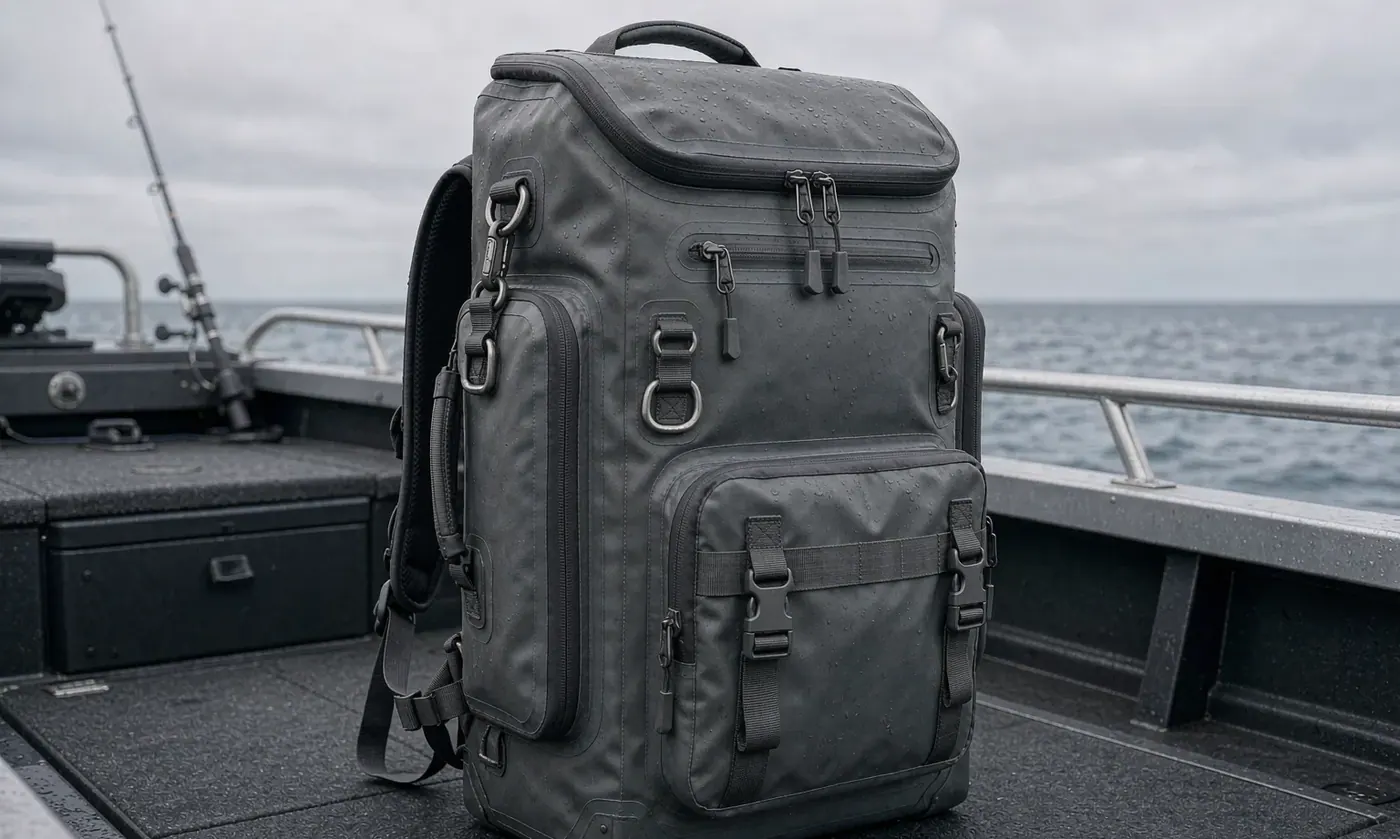
The sled is the primary carrier on hardwater and the bag has to work with it rather than against it. Three things decide that: a flat base that does not roll, a low profile that does not catch wind, and drain channels that let meltwater escape rather than freeze the bag to the deck overnight. A rounded backpack base fails all three, which is why several otherwise good bags are poor hardwater choices.
Strapping is the second half. A bag on a sled needs two compression points rather than one, because a single strap lets the bag rotate on every bump and eventually works loose. Give the bag two horizontal webbing loops at mid-height and a pair of vertical loops, and it will stay put across rough ice. This costs about 0.60 USD and it is the difference between a bag that arrives and one that is dragged.
| Sled factor | Requirement | Failure sign | Correction |
|---|---|---|---|
| Base profile | Flat, wide, no rocker | Bag rolls on every bump | Widen and flatten the base |
| Height | Low enough to clear wind | Bag catches wind and shifts | Reduce height, widen footprint |
| Drain | Channels that shed meltwater | Bag freezes to the deck | Add sloped drain channels |
| Strapping | Two horizontal loops plus two vertical | Strap works loose | Add a second strap point |
| Weight placement | Heavy items low and central | Sled tips on a pressure ridge | Load the heavy gear first |
Meltwater on a sled deck is the specific hazard that catches buyers out. Water from a thaw day, from an auger, or from the bag itself sits in the sled, and overnight it freezes solid. A bag frozen to a sled deck cannot be lifted without tearing the base, so the drain channels and a smooth welded base are worth more on hardwater than any ingress rating.
1. Hardwater 38: Best Overall
Thirty-eight litres, a cold-flex result at minus 35 degrees after four hours, an oversized zip puller that works with a winter glove, and a flat welded base that sits stable on a sled. It carries two or three shallow trays, a spare layer, a flask, and ice picks in an external pocket. Weight is 1.40 kg and the reference band is 34-42 USD.
The closure is the reason it leads. A standard puller at minus 25 degrees with a gloved hand is genuinely difficult, and an oversized puller with a long tape tail costs about 0.40 USD and removes the problem entirely. This build pairs that with a low-temperature lubricant on the tape, which is the second half of the answer and the half most often skipped.
2. Bucket 20 Insert: Best for Bucket Users
A five-gallon bucket is the classic hardwater seat and tackle holder, and an insert turns it into a proper organisers. Twenty litres of shaped storage that drops into the bucket, holds two shallow trays at the top, and lifts out in one motion so the bucket can still be used as a seat or for a catch. Cold flex is minus 30 degrees and the reference band is 18-24 USD.
The dimension to check is the bucket itself. A nominal five-gallon bucket varies by 10-15 mm between brands at the top and bottom diameters, so the insert should be tapered rather than straight and should sit on the bucket rim rather than on its base. A rim-hung insert also stays dry when meltwater collects in the bottom, which is the usual failure of a base-resting design.
3. Sled 60 Duffel: Best for Shelter and Bulk
Sixty litres of soft duffel is the right shape for a hub shelter, a helmet, and bulk clothing, because a duffel packs irregular shapes far better than a backpack does. Cold flex is minus 30 degrees, the base is a welded coated panel with drain channels, and the whole thing lies flat on the sled. Weight is 1.85 kg and the reference band is 30-38 USD.
Two details matter at this size. The opening should run at least 70 percent of the length so a collapsed shelter can be dropped in rather than folded, and the closure should be a covered zip with a garage because a duffel zip carries real tension when the bag is overfilled. A duffel that cannot be closed without a struggle will be closed badly, and a badly closed zip is a leak.
4. Shelter 26 Tote: Best for Inside the Shelter
Once the shelter is up, the useful bag is an open tote that sits on the ice and lets trays be seen from above. Twenty-six litres, a stiffened rim that holds shape at minus 20 degrees, a textured base that grips, and a cold-flex result at minus 25 degrees because inside a shelter the exposure is far milder than outside. Weight is 0.90 kg and the reference band is 22-28 USD.
The specification that decides it is rim stiffness in the cold, because a floppy rim makes the tote useless and most materials stiffen as the temperature drops. A moulded rim rather than a padded one holds its shape across the whole range, and it drains as well as it stiffens. This is the cheapest build here that anglers genuinely use every session.
5. Shelter 45 Bag: Best for Shelter Transport
A hub shelter of 1.8-2.4 m weighs 12-20 kg packed, and carrying it needs a bag shaped for a long awkward load rather than for litres. Forty-five litres with a full-length opening, a reinforced base with a replaceable wear strip, and four compression straps. Cold flex is minus 30 degrees, weight 1.65 kg, and the reference band is 32-40 USD.
The wear strip is the specification to insist on. A shelter bag is dragged across ice and snow rather than carried, and the base is the only part that cannot be protected by the way the angler handles it. A replaceable strip turns a bag-ending failure into a 2 USD part, and it is the single cheapest piece of insurance in the whole category.
6. Electronics 14: Best for Cold-Sensitive Gear
A sonar unit, a phone, and a heated-jacket battery all lose usable capacity below freezing, and a dedicated insulated case is the honest answer. Fourteen litres with 10 mm closed-cell insulation, a welded liner, and a cold-flex result at minus 40 degrees because the case itself has to stay flexible to protect what is inside. Weight is 0.85 kg and the reference band is 28-35 USD.
The design rule is that insulation slows the fall in temperature rather than holding heat, so the case works only if the contents go in warm. A battery placed in the case at room temperature will still be usable four to six hours later at minus 20 degrees, while one placed in cold will not recover. That distinction should be on the hangtag, because it is the difference between the product working and being blamed.
7. Rod 22 Sleeve: Best for Ice Rods
Ice rods are short, typically 600-900 mm, and brittle when cold, so they need a rigid sleeve rather than straps. Twenty-two litres with four internal sleeves of 700 mm, a closed bottom on each, and a cold-flex result at minus 35 degrees. Weight is 0.80 kg and the reference band is 24-31 USD.
Sleeve diameter is the detail most often wrong. An ice rod with a reel fitted needs 60-70 mm of internal diameter, and a sleeve sized for a bare rod blank will not accept it. Specify the diameter with the reel on, and add a drain hole at the bottom of each sleeve, because rods go in wet and the sleeve will otherwise freeze solid overnight.
8. Starter 28: Best Budget Build
Twenty-eight litres, a cold-flex result at minus 20 degrees, a covered zip with a standard puller, and a coated base panel rather than a welded one, at a 15-20 USD band. This is the entry build for a buyer testing a market, and it is genuinely usable for a season of mild hardwater days.
The honest limit is the temperature. Minus 20 degrees is a mild-day rating, and a January cold snap will stiffen the shell and make the closure hard to work. Sold into a market with mild winters it performs well; sold into a market with real cold it generates complaints, and the correct response is to move to the Hardwater 38 rather than to argue about the specification.
Protecting Electronics and the Spare Layer
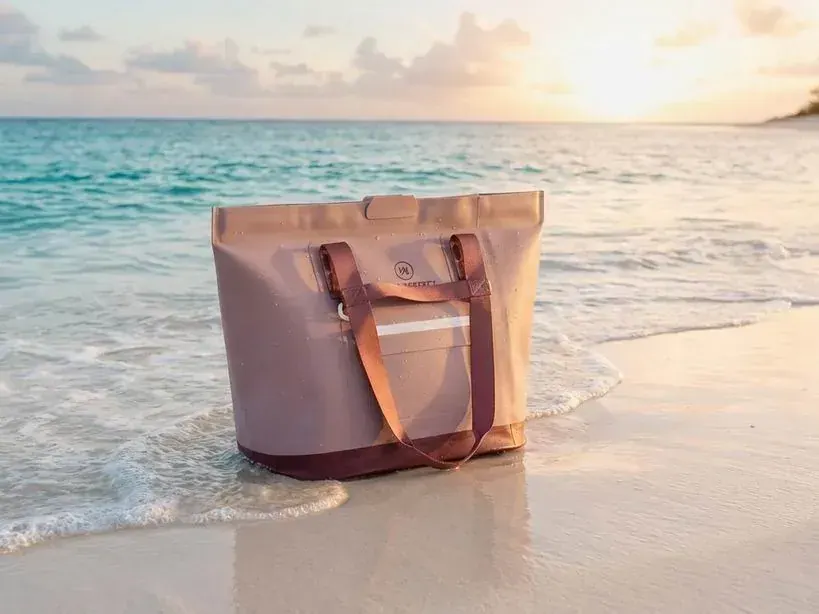
Two categories of contents decide whether a hardwater session ends early: electronics and the spare dry layer. Both fail in the cold rather than in the water, and both need thermal protection rather than a higher ingress rating. A sealed pouch slows heat loss slightly, an insulated case slows it a lot, and keeping either near the body is more effective than both.
| Item | Cold behaviour | Protection | Check |
|---|---|---|---|
| Phone | Shuts down well before empty | Inner pocket near the body | Carry a power bank in the same pocket |
| Sonar battery | Capacity drops 30-50 percent | Insulated case, start warm | Spare cell in a jacket pocket |
| Heated garment cell | Runtime roughly halves | Connected and under the shell | Size for 60 percent of rated runtime |
| Spare dry layer | Frozen, unusable | Sealed liner inside the bag | Inspect before each trip |
| Headlamp | Dims, then cuts out | Inner pocket, body side | Carry a second small light |
Cold exposure is a safety matter as well as a comfort one, and guidance from the Centers for Disease Control and Prevention covers cold-related health risk. A bag that keeps a spare layer dry and a phone working is part of that, which is why these two items deserve their own specification rather than being treated as packing details.
Catch and Bait: The Cooler Question
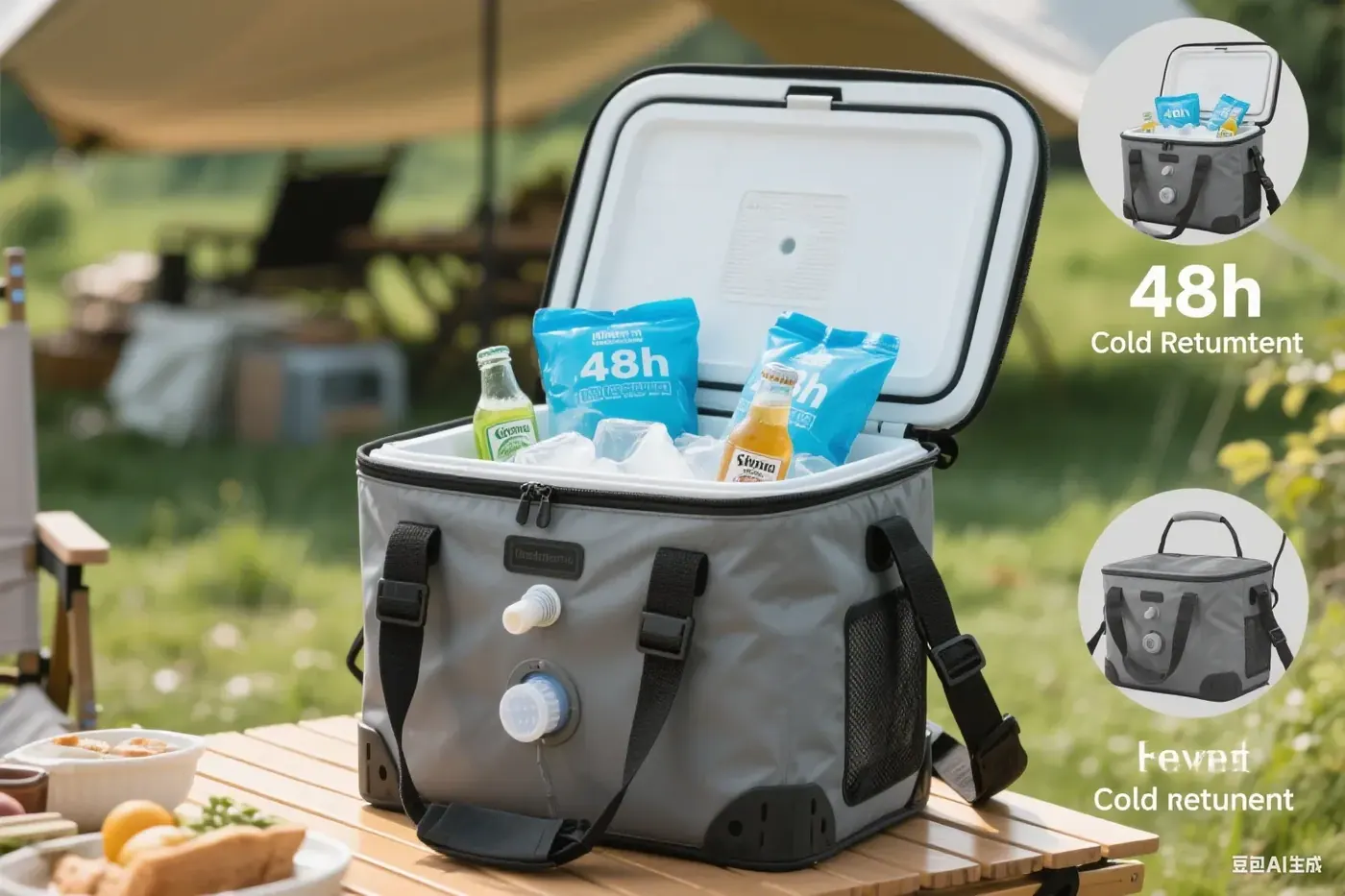
A cooler section on a hardwater bag is not about keeping anything cold, and that is worth stating before a buyer specifies one. It is about keeping a catch from freezing solid on the walk back and about holding bait above freezing. Those are opposite requirements in the same compartment, which is why the answer is usually two separate containers rather than one.
| Contents | Requirement | Geometry | Failure if wrong |
|---|---|---|---|
| Catch | Keep from freezing solid | Insulated 8 mm, drained | Fish frozen to the liner |
| Bait | Keep above freezing | Separate sealed container | Bait frozen and unusable |
| Drinks | Insulated, upright | Bottle sleeve, drained bottom | Bottle bursts if it freezes |
| Meltwater | Drain, do not retain | Sloped channel, no lip | Refreezes inside the base |
| Odour | Removable liner | Lift-out welded tray | Odour becomes permanent |
Bait deserves a specific note because it is the most damaging thing an angler puts in a bag. Bait juice seeps into seams, it freezes, and the odour is permanent. Use a removable sealed container, rinse it separately, and never let bait touch a compartment directly. A compartment that has held bait loose will carry the smell for the life of the bag.
Programme, Testing, and Compliance
An ice fishing brief should lead with the cold-flex temperature and its conditioning time, because that single line decides whether the programme works. Specify the closure puller and lubricant next, then the base and drain geometry, then the sled strapping. Volume and organisation come last, which is the opposite of the order most buyers write them in and the reason most hardwater samples need a second round.
| Programme item | Baseline | Note |
|---|---|---|
| MOQ | 500 pcs per design and colour | Colour split negotiable above the baseline |
| Sampling | 6-10 working days | Add 7-10 days if cold bend testing is required |
| Bulk | 35-50 days | From approved sample and deposit |
| Inspection | AQL 2.5 | Include cold flex sample, closure pull, base weld, drain rate |
| Compliance | REACH and California Prop 65 | Screen coatings, films, inks, hardware |
QUANZHOU JUNYUAN BAGS has developed waterproof bag programmes since 2014, with the founding team active in the industry since 2004. Monthly output of 200,000 units is verified by SGS, and BSCI and ISO 9001 systems structure the workflow. Materials are screened for REACH and California Prop 65, and every bulk order is inspected at AQL 2.5 before shipment.
A hardwater brief can be emailed to service@junyuanbags.com; include platform, litres, cold-flex target, closure requirement, market, and quantity. FOB Xiamen or DDP service to more than 100 countries follows an approved sample and a complete test record. Specification detail is covered in the ice fishing bag overview, end-of-season care in the seasonal maintenance guide, and the wider category in the waterproof fishing tackle bag overview.
People Also Ask
What temperature should an ice fishing bag be rated to?
Ask for a cold bend result with a conditioning time, such as no cracking after four hours at minus 35 degrees. Minus 20 is a mild-day rating and minus 35 suits real winter.
Why does a bag freeze to the sled?
Meltwater sits on the sled deck and refreezes overnight. Drain channels and a smooth welded base break the bond; a rounded fabric base does not.
How do I keep electronics working on the ice?
Keep them in an inner pocket near the body or in an insulated case, and start warm. Insulation slows the temperature fall but will not rewarm a cold battery.
Should an ice fishing bag have a cooler section?
Only for a catch or for bait, and ideally as two separate containers. A catch needs to avoid freezing solid while bait needs to stay above freezing, which are opposite requirements.
What is the best way to carry ice rods?
In a rigid sleeve of 60-70 mm internal diameter with the reel fitted, 700 mm long, with a drain hole at the bottom so the sleeve cannot freeze solid.
What keeps a bag secure on an ice sled?
Two horizontal webbing loops at mid-height plus two vertical loops. A single strap lets the bag rotate on every bump and works loose across rough ice.
Frequently Asked Questions
Q1. What is the best ice fishing gear bag overall?
A 38 L backpack with a cold-flex result at minus 35 degrees after four hours, an oversized glove-friendly zip puller, and a flat welded base that sits stable on a sled.
Q2. What temperature should an ice fishing bag withstand?
Look for a stated cold bend result rather than a range. Minus 35 degrees after four hours suits real winter, while minus 20 is only a mild-day rating.
Q3. Why does a bag freeze to the sled deck?
Meltwater sits on the deck and refreezes overnight. Drain channels and a smooth welded base break the bond; a rounded fabric base freezes solid and tears when lifted.
Q4. Should the auger and shelter go in the bag?
No. A hand auger weighs 4-6 kg and a hub shelter 12-20 kg. Both belong in a sled duffel, and the backpack should carry only the personal layer and small tackle.
Q5. How do I keep electronics working in the cold?
Keep them in an inner pocket near the body or in an insulated case, and start warm. Insulation slows the temperature fall but will not rewarm an already cold battery.
Q6. Is a cooler section useful on a hardwater bag?
For a catch or for bait, yes, but as two separate containers. A catch must avoid freezing solid while bait must stay above freezing, which are opposite requirements.
Q7. How should ice rods be carried?
In a rigid sleeve of 60-70 mm internal diameter sized with the reel on, about 700 mm long, with a drain hole at the bottom so the sleeve cannot freeze solid.
Q8. What is the best build for inside a shelter?
An open tote of about 26 L with a moulded rim that holds shape in the cold and a textured base that grips the ice. A padded rim goes floppy as the temperature drops.
Q9. How should a bag be strapped to a sled?
Two horizontal webbing loops at mid-height plus two vertical loops. A single strap lets the bag rotate on every bump and eventually works loose.
Q10. What is the smallest useful hardwater backpack?
About 28 L for a mild-winter market and 38 L for real cold, because a cold day needs a spare layer, a flask, and extra food that a summer session does not.
Q11. What is the MOQ and lead time for an ice fishing bag programme?
MOQ is 500 pcs per design and colour, samples take 6-10 working days plus 7-10 if cold bend testing is required, and bulk runs 35-50 days from approved sample and deposit.