An ice fishing bag has to survive two things at once: sub-freezing flex and standing slush. Specify a shell that still bends at minus 30 degrees, a closure that can be worked with gloves on, a base that sheds meltwater instead of freezing to it, and 30-45 L for a full hardwater day at 10-16 kg. Most ice bags spend the session sitting on a sled rather than on a back, so a flat low base and reinforced drag points matter more than harness padding. Programme baseline is MOQ 500 pcs per design and colour, samples in 6-10 working days, and bulk in 35-50 days.
Cold Changes the Material Before It Changes the Angler
Hardwater sessions run between roughly minus 5 and minus 25 degrees before wind chill, and the bag is exposed for every minute of that. Polymer behaviour shifts across that range in a way it does not across the same span in mild weather: a coated shell that folds easily at 20 degrees can crack along a fold line at minus 20, and the crack usually appears at the stiffest point of the panel rather than at the seam. Cold failure is a materials question first and a weather question second.
The practical divide is between a PVC face and a TPU face. Standard PVC coating stiffens noticeably once the temperature drops below about minus 10 to minus 15 degrees, because the plasticiser that keeps the film supple moves more slowly as the cold increases. TPU film keeps most of its bend down to roughly minus 30 degrees, which is why a winter programme should specify a TPU face or a TPU laminate rather than a PVC face even when the PVC option is cheaper and thicker on paper.
| Shell element | Typical cold limit | Behaviour below the limit | Winter specification |
|---|---|---|---|
| Standard PVC coating | Minus 10 to minus 15 degrees | Stiffens, then crazes at folds | Avoid on a hardwater bag |
| Cold-flex PVC grade | Minus 25 to minus 30 degrees | Stiffens gradually | Acceptable with a stated test record |
| TPU film face | Minus 30 degrees or lower | Remains bendable | Preferred for ice programmes |
| TPU laminate on polyester | Minus 30 degrees | Bend follows the base cloth | Best balance of cost and cold flex |
| Nylon 66 hardware | Minus 20 degrees when dry | Becomes brittle and snaps | Use POM or cold-rated nylon |
The useful evidence is a cold bend result rather than a claim. Published coated-fabric methods from ASTM International cover low-temperature bend testing, and asking for a stated pass temperature with the conditioning time is far more reliable than asking for a winter-grade material. A spec that reads no cracking after four hours at minus 30 degrees is enforceable; a spec that reads cold resistant is not.
Closures, Zips, and Hardware Below Freezing
The closure is the part the angler touches most and the part that fails first in the cold. A waterproof zip runs on a coated tape and a slider, and both stiffen as the temperature falls, so the pull force rises and the slider is more likely to be forced off the teeth by a gloved hand. Oversized pullers, a longer tape tail, and a low-temperature lubricant all reduce that risk, and a roll-top avoids it altogether because there are no teeth to force.
Buckles deserve the same attention. Acetal, usually called POM, holds itsimpact strength well below minus 30 degrees and is the safe default. Dry nylon 66 loses toughness earlier and tends to crack at the ladderlock where webbing tension concentrates, so a winter bag should either use acetal hardware or a nylon grade with a stated low-temperature rating. Metal hardware is workable but conducts cold straight to the hand, and a bare metal buckle at minus 20 degrees is unpleasant to operate.
| Component | Cold risk | Better choice | Check |
|---|---|---|---|
| Waterproof zip tape | Stiffens, higher pull force | TPU-coated tape with low-temperature lube | Pull test after 4 hours at minus 25 degrees |
| Slider and puller | Gloved hand forces the slider | Oversized puller, long tape tail | Operate with a winter glove |
| Buckle | Dry nylon cracks at the ladderlock | Acetal (POM) or cold-rated nylon | Webbing pull at minus 25 degrees |
| Webbing | Ice crystals cut the weave | Tight-weave polyester | Inspect after 20 drag sessions |
| Base rails | Freeze to the sled deck | Smooth welded rail with no slot | Lift test after overnight freeze |
One habit prevents most closure damage: clear ice from the tape before pulling. A slider forced over frozen crystals cuts the coating, and a single cut in a waterproof tape is a permanent leak. Brushing the tape with a gloved thumb for two seconds costs nothing and removes the grit that would otherwise be ground into the sealing surface.
Sled, Bucket, Backpack, or Tote: Picking the Platform
Ice fishing has four carry platforms and they are not interchangeable. A sled carries the heavy shelter and auger across flat ice and is towed rather than worn. A bucket is the classic seat and tackle holder, cheap and warm to sit on, but it carries almost nothing else and it tips. A backpack carries the personal layer, food, water, and small tackle over a walk-in approach of 0.5-3 km. A tote carries trays and a catch bag inside a shelter once the camp is set.
Most experienced hardwater anglers use two of the four at once: a sled for the heavy camp items and a backpack for the personal kit. That combination changes what the backpack needs, because it no longer has to carry the auger or the shelter. It can be smaller, lighter, and better organised, which is the opposite of what a buyer usually assumes when they see the total pile of gear at the start of a session.
| Platform | Carries | Best for | Limit |
|---|---|---|---|
| Ice sled | Shelter, auger, 40-80 kg | Flat ice, walk under 2 km | Useless on pressure ridges or deep snow |
| Five-gallon bucket | Tackle, a seat, a small catch | Short sessions near access | Tips, carries little, no back comfort |
| Backpack 30-45 L | Layers, food, water, small tackle | Walk-in approach of 0.5-3 km | Should not carry the auger |
| Open tote | Trays, spare reel, catch bag | Inside a shelter, camp use | No weather protection at all |
| Rolling bag | Trays and bulk tackle | Paved or ploughed access | Wheels fail in slush and snow |
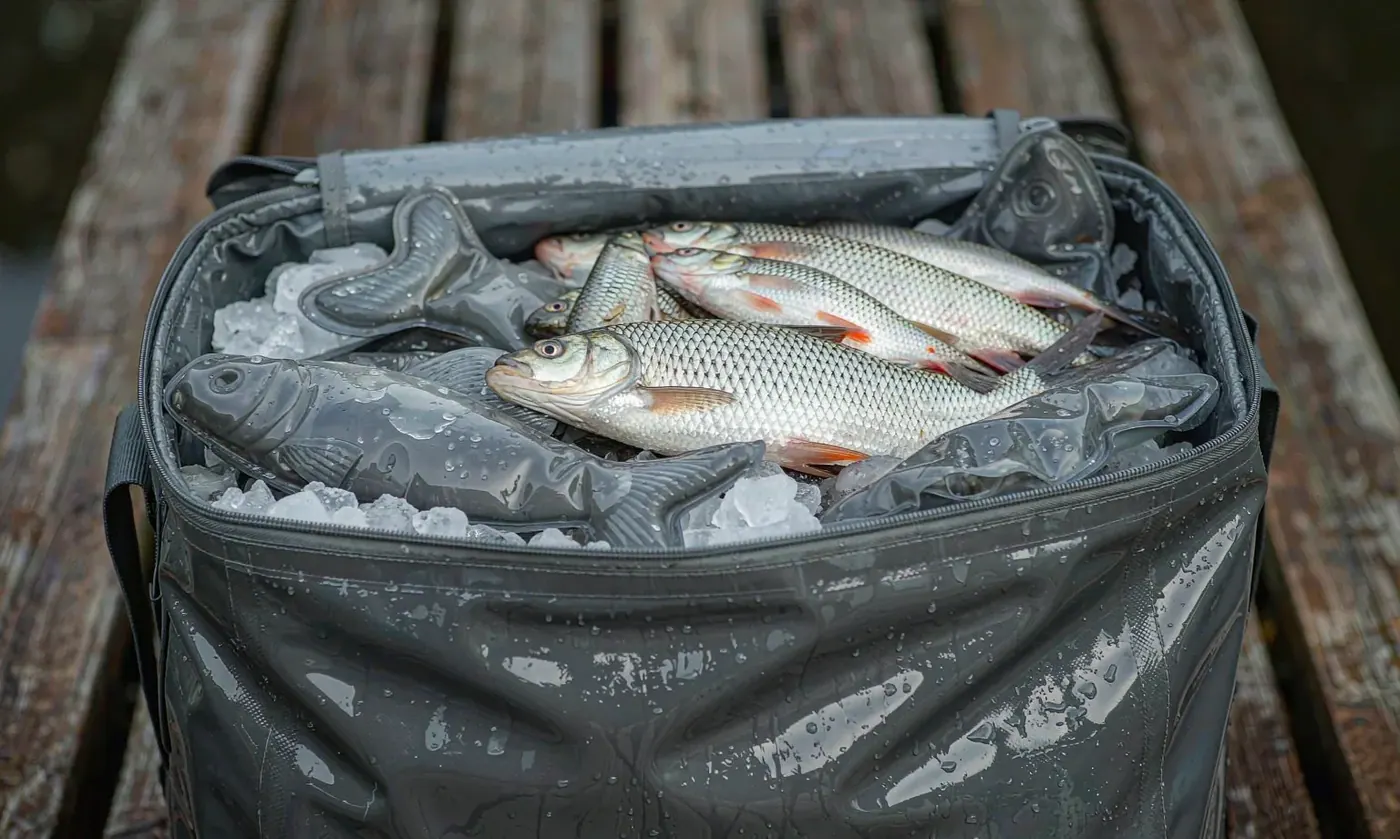
The waterproof fishing tackle bag range covers the soft-platform side of that split. For hardwater, the useful filter is whether the item will be set down in slush at any point in the session: anything that will should have a welded base and a drain path, and anything that will not can be a simpler sewn construction.
Volume and Load for a Hardwater Day
A hardwater day is heavier than a summer day for the same fishing, because clothing, food, and a warm drink layer all add bulk. Thirty to 38 L suits a half-day session with two trays and a personal layer. Thirty-eight to 45 L suits a full day with a shelter, or a day where the angler carries a second pair of boots and a spare shell. Loaded weight typically lands between 10 and 16 kg.
That weight is carried over ice and snow, which is slipperier than a trail and less forgiving of a shifting load. Keep the dense items low and close to the spine, keep water insulated and central, and keep the load symmetrical left to right so a slip does not turn into a twist. A hip belt is worth having even at 10 kg on ice, because it lowers the centre of gravity at exactly the moment balance matters most.
| Session | Volume | Loaded weight | Typical contents |
|---|---|---|---|
| Two to four hours near access | 25-32 L | 8-11 kg | Two trays, one layer, flask, snacks |
| Half day with a walk-in | 30-38 L | 10-13 kg | Three trays, layers, 1.5 L drink, ice picks |
| Full day with shelter | 38-45 L | 13-16 kg | Shelter, four trays, spare boots, food |
| Overnight or two-day camp | 45-60 L | 16-22 kg | Sleep system, stove, extra fuel, more water |
Water and warm drink volume should be calculated rather than guessed. Plan 400-600 ml per hour in cold air because cold exposure drives fluid loss and thirst signals are blunted, and add 40 percent as a margin for a longer day or a delayed pick-up. That usually means 1.5-3 L carried, which is 1.5-3 kg of the total and the heaviest single category in the bag.
Waterproof Level: Slush Is the Real Exposure
Ice fishing water exposure is not rain. It is standing slush at the hole, meltwater on the ice surface during a thaw, spray from an auger, and the wet slush that forms under anything warm sitting on the ice. All of it is low-pressure and continuous rather than forceful, so an IPX5 or IPX6 rating covers the realistic case, and IPX7 with a stated depth and duration is worth specifying only for a bag that will be set down in standing water on a thaw day.
The second requirement is that the bag does not freeze to the ice. A wet fabric base sitting on ice at minus 15 degrees bonds within a minute or two, and pulling it free can tear the coating. A smooth welded base with no fabric face makes that bond much weaker, and a closed-cell base pad gives an extra layer of separation. Any base that uses a stitched corner box is a liability here, because the stitch line is both a leak path and a place for ice to key into.
| Exposure | Typical rating | Design answer | Verification |
|---|---|---|---|
| Slush at the hole | IPX5 | Welded base, drain path | 60-minute standing slush test |
| Meltwater on a thaw day | IPX6 | Covered closure, raised base | Spray test loaded, indicator tissue dry |
| Auger spray | IPX6 | Covered side pockets | Spray test at 3 nozzles |
| Full immersion, rare | IPX7 with depth and time | Roll-top or airtight zip | 30 minutes at 1 m |
| Freeze bonding to ice | Not an ingress code | Smooth welded base, no fabric face | Overnight freeze and lift test |
Ingress codes are defined by the IEC ingress protection framework, and any immersion claim must state its depth and duration to mean anything. A bag rated IPX7 without a condition is not a specification. The point that matters more on ice is the base and drain geometry, because a bag that sits in slush for six hours is tested by geometry far more than by a spray cabinet.
Ice Safety, Floatation, and Cold-Water Immersion
No specification discussion for hardwater gear is complete without the safety layer, because the consequences of getting it wrong are not measured in warranty claims. Ice thickness guidance widely used in North America puts 10 cm of clear ice as the minimum for a single angler on foot, about 12-13 cm for a small group, and considerably more for any vehicle. Those figures assume clear blue ice; white or honeycombed ice carries far less, and thickness varies across a single lake.
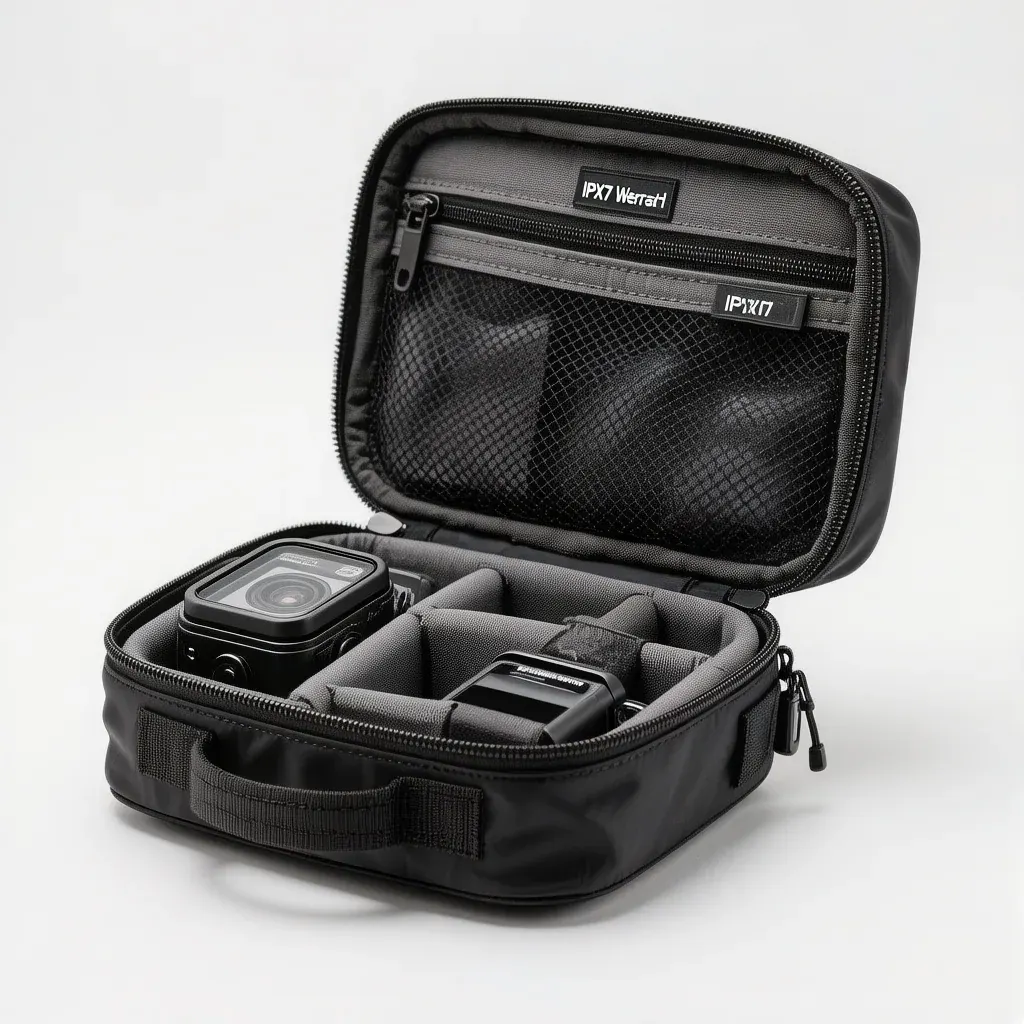
The carry system should support the safety plan rather than complicate it. Ice picks belong in an external pocket that can be reached with gloves on and without setting the bag down, a throw rope belongs where it can be pulled one-handed, and a flotation aid should be worn rather than packed. United States Coast Guard guidance covers flotation device selection, and NOAA marine and weather resources support the pre-trip check on temperature, wind, and freeze-thaw history.
| Safety item | Where it lives | Access requirement | Why |
|---|---|---|---|
| Ice picks | External chest or shoulder pocket | Gloved, one-handed, standing | Self-rescue window is seconds |
| Throw rope | External side sleeve | One-handed pull | Used for someone else |
| Flotation aid | Worn, not packed | Already on the body | Packed gear does not save anyone |
| Spare dry layer | Sealed liner inside the bag | Two-minute access | Post-immersion warmth |
| Phone and power bank | Warm inner pocket near the body | Gloved access | Cold kills battery capacity fast |
A bag can also be part of the flotation story. Closed-cell foam in the back panel or base adds buoyancy, and a sealed main chamber traps air, but neither is a substitute for a worn flotation device. Some buyers ask whether a waterproof fishing bag will float if it goes through the ice; the honest answer is that an unsealed bag with a partly open closure will sink, and further detail sits in the buoyancy discussion for fishing bags.
Electronics, Batteries, and Cold
Cold is harder on electronics than on fabric. A lithium-ion cell loses a large part of its usable capacity below freezing and recovers when warmed, so a phone that shows 40 percent at minus 20 degrees may simply shut down rather than actually being flat. A sonar unit, a heated jacket battery, and a headlamp all behave the same way, and the failure usually happens at the moment the angler most needs the device.
The carry answer is thermal, not electrical. Keep cells in an inner pocket close to the body where they sit near 20-30 degrees, keep one spare battery in an inside jacket pocket rather than in the bag, and keep the phone in a sealed liner rather than an external pocket. Allow any device brought from cold into a warm shelter to acclimatise before charging it, because condensation forms inside a cold device the moment it meets warm humid air.
| Device | Cold behaviour | Carry position | Mitigation |
|---|---|---|---|
| Phone | Shuts down well before empty | Warm inner pocket near the body | Carry a power bank in the same pocket |
| Sonar or flasher battery | Capacity drops 30-50 percent | Insulated sleeve inside the bag | Spare cell kept in a jacket pocket |
| Headlamp | Dims, then cuts out | Inner pocket, body side | Carry a second small light |
| Power bank | Discharges faster when cold | Warm inner pocket | Warm before use, never charge cold |
| Heated garment cell | Runtime roughly halves | Connected and under the shell | Size the cell for 60 percent of rated runtime |
Auger, Shelter, and Long-Item Carry
The auger and the shelter are the two items that decide whether a bag can be worn at all. A powered auger weighs 8-12 kg and an eight-inch hand auger 4-6 kg, and neither belongs on a back over any real distance; both go on the sled. A hub shelter of 1.8-2.4 m weighs 12-20 kg packed, and it also goes on the sled. That leaves the backpack carrying only the personal layer, food, water, and small tackle, which is why 30-45 L is the right band rather than 60 L.
When a long item does have to be carried on the bag, give it two support points at least 400 mm apart and a closed lower cup so it cannot slide through when the bag is set down. Rods carried in a sleeve on a hardwater bag are normally short ice rods of 600-900 mm, which are easier than a full rod but still awkward, because they are brittle when cold and they poke into everything. A rigid sleeve beats a strap pair for ice rods every time.
| Item | Weight | Platform | Carry method |
|---|---|---|---|
| Eight-inch hand auger | 4-6 kg | Sled | Strapped flat, blade covered |
| Powered auger | 8-12 kg | Sled | Upright in a cradle, fuel separated |
| Hub shelter 1.8-2.4 m | 12-20 kg | Sled | Bagged, strapped low and central |
| Ice rods 600-900 mm | 0.4-1.0 kg | Backpack | Rigid side sleeve with a closed bottom |
| Scoop and skimmer | 0.5-1.5 kg | Sled or external sleeve | Drained sleeve, open bottom |
Tackle Storage That Does Not Freeze Solid
Ice fishing tackle is small, numerous, and used with cold wet hands, which is a combination most tray systems handle badly. Jigs, spoons, and small soft plastics live in shallow trays with dividers rather than deep compartments, and the tray has to open with a gloved hand because taking a glove off at minus 20 degrees costs real dexterity within about 60 seconds. That single constraint rules out a lot of otherwise good tray designs.
Water is the second problem. Hooks and jigs come out of the hole wet, they go back into the tray wet, and the tray then freezes overnight with the contents locked in ice. Drill drain holes in the tray floor, keep trays in a drained zone rather than a sealed one, and dry the trays fully at the end of every session. A tray that has been frozen solid once will usually have bent dividers and rust spots on every hook in the compartment.
| Storage item | Winter requirement | Failure mode | Correction |
|---|---|---|---|
| Shallow tray with dividers | Gloved one-hand opening | Angler removes the glove | Larger latch, taller pull tab |
| Jig and spoon box | Drain holes in the floor | Freezes solid overnight | Drill drains, dry after every session |
| Tip-up and rig wallet | Flat, stiff, wipeable | Absorbs water and stiffens | Use a coated wipe-clean wallet |
| Line spool pocket | Dry and separate from hooks | Line freezes and kinks | Keep spools in a warm inner pocket |
| Catch bag or cooler | Drained, removable liner | Refreezes inside the base | Removable liner, drain after every session |
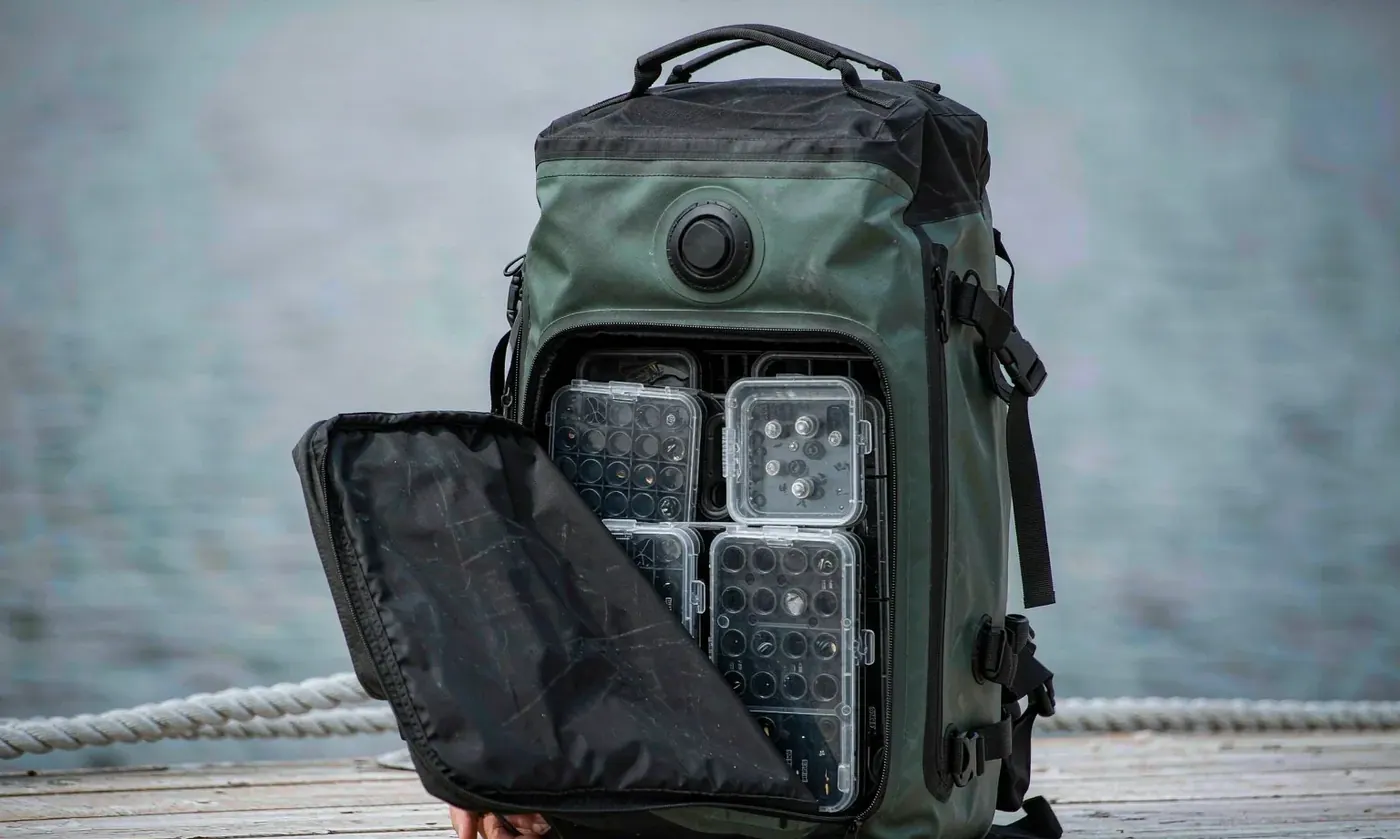
Organisation detail matters more than capacity on hardwater. Count what actually goes in the bag: two to four trays, a tip-up wallet, a spool pocket, a tool slot for pliers and a hook file, and a drained wet zone for the scoop. Anything beyond that tends to be carried in the sled instead, and a bag designed around the sled split is far more usable than one designed to hold everything.
After-Session Routine and Off-Season Storage
The routine after a hardwater session is short but not optional. Empty the bag completely, brush ice and grit from every closure, drain and dry the trays separately, wipe the interior, and leave the bag open in a heated space for 12-24 hours. Folding a damp bag and putting it in a cold vehicle is the single most common cause of a spring complaint about a winter bag.
Off-season storage is where winter gear is won or lost. Never store a bag frozen and folded, because a fold held below freezing will crease permanently in a coated film. Bring it to room temperature, dry it fully, stuff it loosely to keep its shape, and store it at 15-25 degrees out of direct sun. Check elastic and webbing for ultraviolet and cold damage before the next season, and re-run a water screen at the start of every winter.
| Task | When | Method | Pass condition |
|---|---|---|---|
| Empty and brush closures | Every session | Soft brush, gloved thumb | No grit or ice in the tape |
| Drain and dry trays | Every session | Separate, open, 12-24 hours | No ice or standing water |
| Wipe interior | Every session | Damp cloth, no solvent | No salt or bait residue |
| Full dry, open, heated space | Every session | 12-24 hours, all closures undone | Interior completely dry |
| Off-season store | End of season | Room temperature, loosely stuffed | No creases, no frozen folds |
The seasonal fishing bag maintenance schedule sets out the full year, and the ice fishing bag comparison shows how individual models perform against the criteria above. Both are worth reading before a winter programme is specified, because the expensive failures in this category are almost always specification failures rather than build failures.
Programme Brief and Acceptance Criteria
Write one brief covering usable litres, shell with a stated cold bend temperature, closure type with glove operation, base and drain geometry, harness and drag point specification, protection level with its test condition, hardware grade, and compliance. Add acceptance criteria for dimensions, litres, seam appearance, coating thickness, cold bend result, drain rate, and colour fastness, and state who pays for third-party testing if results differ.
| Programme item | Baseline | Note |
|---|---|---|
| MOQ | 500 pcs per design and colour | Colour split negotiable above the baseline |
| Sampling | 6-10 working days | Add 3-5 days for a cold-flex shell change |
| Bulk | 35-50 days | From approved sample and deposit |
| Inspection | AQL 2.5 | Include closure pull, base weld, drag point, water screen |
| Compliance | REACH and California Prop 65 | Screen coatings, films, inks, hardware |
QUANZHOU JUNYUAN BAGS has developed waterproof bag programmes since 2014, with the founding team active in the industry since 2004. Monthly output of 200,000 units is verified by SGS, and BSCI and ISO 9001 systems structure the workflow. Materials are screened for REACH and California Prop 65, and every bulk order is inspected at AQL 2.5 before shipment.
A hardwater brief can be emailed to service@junyuanbags.com; include target temperature range, litres, platform split between sled and backpack, hardware grade, market, and quantity. FOB Xiamen or DDP service to more than 100 countries follows an approved sample and a complete test record. Cold-weather behaviour of shells is treated in more depth in the cold-weather flexibility guide.
People Also Ask
What temperature should an ice fishing bag be rated to?
Ask for a stated cold bend result rather than a rating. A TPU face should show no cracking after four hours at minus 30 degrees, and standard PVC coating is usually the wrong choice below minus 15 degrees.
Do ice fishing bags need to be fully waterproof?
Slush and meltwater are low-pressure and continuous, so IPX5 to IPX6 covers the realistic case. IPX7 only matters for a bag that will stand in water on a thaw day.
Why does a bag freeze to the ice?
A wet fabric base bonds to ice within a minute or two at minus 15 degrees. A smooth welded base with no fabric face and a closed-cell base pad breaks that bond.
How much should a hardwater day bag hold?
Thirty to 38 L for a half day at 10-13 kg, and 38-45 L for a full day with a shelter at 13-16 kg. The auger and shelter belong on a sled, not on a back.
Where should batteries go in cold weather?
In a warm inner pocket near the body. A lithium cell loses a large part of its usable capacity below freezing and recovers when warmed, so a cold phone often shuts down rather than running flat.
Can tackle trays be left wet overnight?
No. Wet jigs freeze the tray solid, bend the dividers, and rust every hook in the compartment. Drill drain holes and dry trays fully after every session.
Frequently Asked Questions
Q1. What is the most important feature on an ice fishing bag?
Cold flexibility. A shell that still bends at minus 30 degrees and a closure that can be worked with gloves on matter more than any waterproof rating on hardwater.
Q2. Is TPU better than PVC for an ice fishing bag?
Yes in practice. Standard PVC stiffens below about minus 15 degrees, while TPU film keeps most of its bend to roughly minus 30 degrees.
Q3. What waterproof rating suits ice fishing?
IPX5 to IPX6 covers slush, meltwater, and auger spray. Specify IPX7 only if the bag will stand in water, and always state the depth and duration.
Q4. How do I stop the bag freezing to the ice?
Use a smooth welded base with no fabric face, add a closed-cell base pad, and avoid stitched corner boxes that give ice something to key into.
Q5. How big should an ice fishing backpack be?
Thirty to 45 L for a full day at 10-16 kg. Carry the auger and shelter on a sled rather than increasing the bag volume.
Q6. Should an ice fishing bag carry the auger?
No. A hand auger weighs 4-6 kg and a powered auger 8-12 kg. Both go on the sled; strapping either to a backpack is the usual cause of harness failure.
Q7. Why do zips get hard to pull in the cold?
The coated tape and slider stiffen, so pull force rises and a gloved hand can force the slider off the teeth. Use an oversized puller and a low-temperature lubricant.
Q8. What hardware works below freezing?
Acetal, usually called POM, holds impact strength well below minus 30 degrees. Dry nylon 66 becomes brittle and tends to crack at the ladderlock.
Q9. How should tackle trays be handled on ice?
Use shallow divided trays with drain holes and a latch that opens with a gloved hand. Dry them fully after every session or they will freeze solid overnight.
Q10. What is the MOQ and lead time for an ice fishing bag programme?
MOQ is 500 pcs per design and colour, samples take 6-10 working days, and bulk runs 35-50 days from approved sample and deposit.