An inshore kayak pack has to satisfy four conditions at once: it stays under 420 mm tall so it clears a seat back, it floats or is leashed when the boat rolls, its hardware survives salt spray for more than 96 hours, and it keeps trays dry in a foot of water. Nine inshore builds were assessed for 2026 across 16-32 litres, 0.75-1.55 kg, IPX6 to IPX7 ratings, and 24-52 USD FOB Xiamen bands at MOQ 500 pcs per design and colour. Samples take 6-10 working days and bulk 35-50 days. The pick is the 22 L submersible build at 1.05 kg.
What Inshore Does to a Fishing Pack
Inshore is a specific environment rather than a milder version of offshore. The water is warm, shallow, and full of sunscreen and bait oil; the sun is direct with no shade for eight hours; and the pack is repeatedly wetted by paddle drip, spray, and the occasional roll. Each of those conditions attacks a different component, and a pack designed for freshwater banks fails in a season.
Salt is the first attacker and it targets hardware rather than fabric. A coated fabric survives salt indefinitely, while a plated steel slider shows rust in about 72 hours of spray exposure and jams within two weeks. Ultraviolet exposure is the second, and it attacks the coating and the thread: polyester thread loses roughly 40 percent of its strength after 500 hours of direct exposure where a UV-rated bonded nylon thread loses about 15 percent.
| Inshore condition | Component attacked | Specification that answers it | Test |
|---|---|---|---|
| Salt spray and paddle drip | Sliders, buckles, eyelets | 316 stainless or acetal hardware | 96 hours of neutral salt spray |
| Direct sun, no shade | Coating and thread | UV-rated bonded nylon thread | 500 hours of accelerated exposure |
| Shallow warm water | Seams and adhesives | Welded seams rather than glued | Warm-water soak at 30 degrees |
| Sunscreen and bait oil | Coatings and films | Oil-resistant TPU face | 24-hour contact wipe test |
| Capsize and rolling | Whole pack | Float panel plus leash points | Float test with 6 kg aboard |
Hardware Is Where Salt Wins or Loses
Every inshore pack in this group was specified around its hardware, because hardware is what fails. A plated steel slider costs 0.12 USD and rusts; a 316 stainless slider costs 0.85 USD and does not; an acetal polymer slider costs 0.45 USD, does not rust, and is lighter, though it creeps under sustained load. The correct choice depends on where the part sits rather than on price alone.
| Component | Budget material | Serviceable material | Behaviour in salt | Added cost |
|---|---|---|---|---|
| Zip slider | Plated zinc alloy | 316 stainless or acetal | Rusts in 72 hours; jams | 0.70-0.85 USD |
| Buckles | Polypropylene | Acetal | Becomes brittle in UV | 0.30-0.45 USD each |
| Eyelets and drains | Brass-plated steel | 316 stainless | Stains the fabric rust-red | 0.25-0.40 USD each |
| Webbing | Standard polyester | Solution-dyed polyester | Fades and loses strength | 0.30-0.60 USD per metre |
| Thread | Standard polyester | UV-rated bonded nylon | 40 percent strength loss in 500 h | 0.20-0.35 USD per bag |
Neutral salt spray exposure is the standard way to compare these choices, and a specification of 96 hours without red rust is a reasonable requirement for an inshore pack. The full material comparison is set out in the saltwater hardware guide, and test methods for strength and abrasion come from ASTM International. A pack that passes a spray test and still jams at the slider has simply moved the failure, so both should be required.
Kayak Fit: Height, Leash, and Float
A kayak imposes three dimensional limits that a bank pack never meets. The body must stay under about 420 mm tall so it sits behind the seat without blocking a paddle stroke; it must be narrow enough at 320-360 mm to drop into a tankwell; and it must not protrude past the hull, because anything protruding catches water and slows the boat.
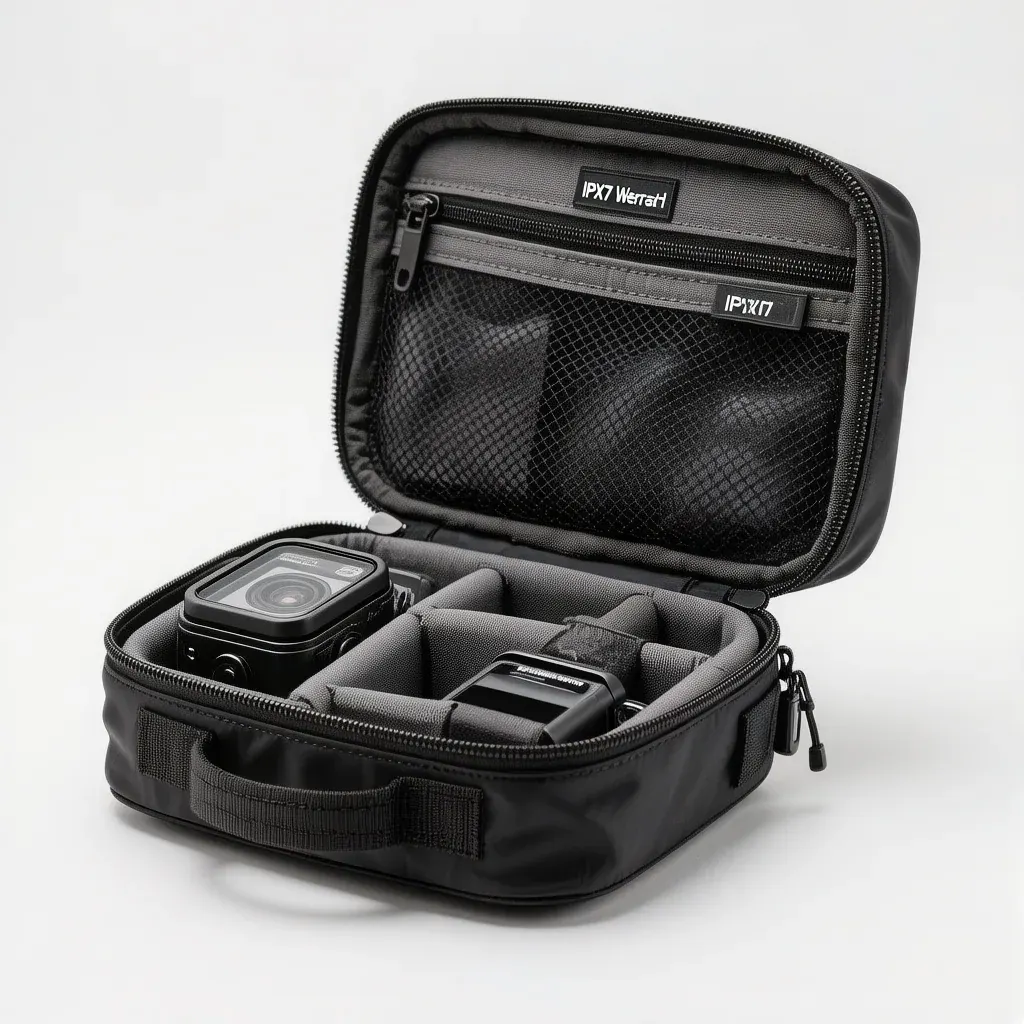
Leashing and flotation are the two safety-adjacent specifications, and both are cheap. Two load-rated leash points cost about 0.60 USD and a closed-cell float panel sized for 5-7 kg costs about 1.80 USD. Together they turn a capsize from a total loss into a recovery, which is why every build in this group carries them.
| Requirement | Number | Why | Cost |
|---|---|---|---|
| Body height | Under 420 mm | Clears the seat back and the paddle stroke | Design choice |
| Body width | 320-360 mm | Drops into a tankwell | Design choice |
| Leash points | Two, load-rated | Capsize recovery | 0.60 USD |
| Float panel | Sized for 5-7 kg | Buoyancy with a full tray set | 1.80 USD |
| Drain path | Two 10 mm grommets | Paddle drip leaves the chamber | 0.50 USD |
Tides and weather deserve a note because they decide how far an inshore angler paddles and therefore how much kit goes aboard. Marine conditions and tide predictions are published by NOAA, and the practical consequence for a pack brief is simple: a paddling session of 5-10 km argues for a lighter, lower pack, and a pack built for that distance should not be sold with a four-tray claim.
The Nine Builds at a Glance
Ratings are quoted as tested conditions rather than codes alone, since a code without a condition proves nothing. Tray counts assume 3600 trays unless stated. Loaded weight includes two full trays, a litre of water, tools, and a shell, which is the realistic inshore kit. The wider kayak category is tracked in the kayak tackle bag ranking.
| Build | Volume | Weight | Rating | Trays | FOB band |
|---|---|---|---|---|---|
| Submersible 22 | 22 L | 1.05 kg | IPX7, 30 min at 1 m | 2 x 3600 | 34-42 USD |
| Flats 18 | 18 L | 0.80 kg | IPX6, deck wash | 2 x 3600 | 26-33 USD |
| Sight 16 | 16 L | 0.75 kg | IPX6 | 1 x 3600 plus utility | 24-30 USD |
| Guide 28 | 28 L | 1.35 kg | IPX6 | 4 x 3600 | 36-45 USD |
| Tankwell 26 | 26 L | 1.20 kg | IPX7, 30 min at 1 m | 3 x 3600 | 38-47 USD |
| Hybrid 24 | 24 L | 1.15 kg | IPX6 | 3 x 3600 | 32-40 USD |
| Minimalist 16 | 16 L | 0.85 kg | IPX5 | 2 x 3500 | 22-28 USD |
| Tournament 30 | 30 L | 1.55 kg | IPX6 | 4 x 3700 | 42-52 USD |
| Convertible 20 | 20 L | 1.00 kg | IPX6 | 2 x 3600 | 30-38 USD |
Paddling Comfort and PFD Clearance
A pack worn while paddling has to clear a life jacket. The shoulder yoke must sit above the PFD collar and the sternum strap must fall below it, or the two fight each other and the angler ends up with the pack straps over the jacket, which is uncomfortable and makes the jacket hard to adjust in an emergency.
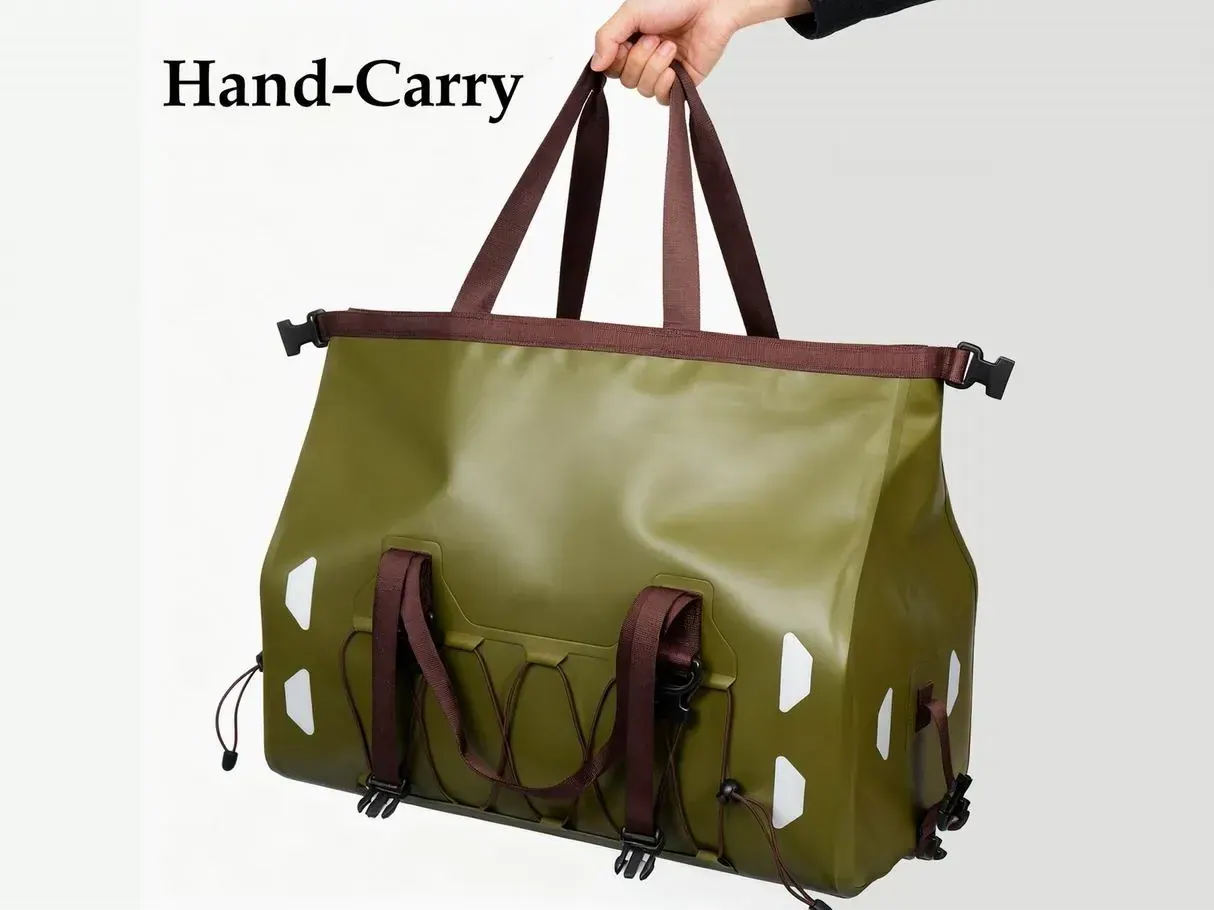
Strap geometry follows from that constraint: 55-65 mm straps with a sternum strap adjustable across 150 mm of height give enough range to clear most jackets. The second paddling requirement is that the pack must not shift during a stroke, and a 20 mm webbing stabiliser or a direct clip to the seat frame solves it for about 1.10 USD.
1. Submersible 22: Best Overall
Twenty-two litres at 1.05 kg, welded liner tested to half an hour under a metre of water, two 3600 trays, 400 mm tall, with two leash points and a float panel sized for 6 kg. The FOB band is 34-42 USD.
It leads because inshore kayak fishing is the one discipline where the pack genuinely goes under. A roll in shallow water puts the bag at 300-600 mm for as long as it takes to right the boat, and a spray-rated shell takes water through the zip in that time. The float panel is the other reason: at 6 kg of tackle this pack comes back.
2. Flats 18: Best for Sight Fishing
Eighteen litres at 0.80 kg rated IPX6 against a deck wash, two 3600 trays, and a height of 360 mm so it sits low behind the seat. It is the build for shallow-water sight fishing where the angler stands or poles and needs a light pack. The FOB band is 26-33 USD.
The relevant detail is what is not aboard: no rod tubes, no cooler, no heavy base. A flats pack is a tray bag and a water bottle, and every 100 g saved is 100 g less to right after a roll. The external pliers holster and a leader caddy at the shoulder are the only fittings, and both sit within the hull line.
3. Sight 16: Best for Minimal Kits
Sixteen litres at 0.75 kg rated IPX6, one 3600 tray plus a utility tray, with a moulded pliers dock and a single shoulder tool tether. It suits an angler who fishes one method and knows the water. The FOB band is 24-30 USD.
At 0.75 kg it is the lightest build here and the one most likely to be worn for the whole session rather than stowed. The compromise is honest: one tray means one method, and an angler who wants a second pattern has to carry it loose. A moulded base keeps the pack upright when it is set down on a wet deck.
4. Guide 28: Best for Guide Duty
Twenty-eight litres at 1.35 kg rated IPX6, four 3600 trays, 410 mm tall, with bolted strap anchors and a serviceable closure. It is built for a guide running inshore trips 120-plus days a season. The FOB band is 36-45 USD.
Serviceability is what earns the price here. Strap anchors bolt through a reinforced patch so a worn strap is a 15-minute swap, and the closure is a standard model available as a spare. A guide pack that fails in week six costs more than the price difference, and the failure point after a season of salt is the slider and the strap anchor rather than the fabric.
5. Tankwell 26: Best for Stowage
Twenty-six litres at 1.20 kg, welded and tested to 30 minutes at 1 m, three 3600 trays, sized at 340 x 400 mm so it drops into a tankwell without being strapped. The FOB band is 38-47 USD.
The tankwell fit is the argument and the caution. A bag that needs to be lashed down is a bag that gets left loose, and a loose bag in a tankwell is what goes overboard first. This build uses a friction fit with two corner loops for a secondary line, and its flat base stops it rolling in the well when the boat heels.
6. Hybrid 24: Best Mixed Fresh and Salt
Twenty-four litres at 1.15 kg rated IPX6, three 3600 trays, with a freshwater-safe coating and hardware specified for both environments. It suits an angler who fishes an estuary one day and a reservoir the next. The FOB band is 32-40 USD.
The specification trick is a rinse-friendly interior: a welded liner with a smooth face and two drain grommets, so the pack can be hosed out after a salt session in about two minutes. Salt crystals left in a seam are what cause the long-term damage, and a pack that cannot be rinsed properly will fail regardless of how good its hardware is.
7. Minimalist 16: Best Value
Sixteen litres at 0.85 kg rated IPX5, two 3500 utility trays, with acetal buckles and a coated coil zip. The FOB band is 22-28 USD and it is the entry build for occasional inshore use.
The saving is in the closure and the rating: IPX5 resists a nozzle jet of 12.5 litres per minute, which is rain and light spray but not a roll. That is a fair trade for an angler who fishes from a stable kayak in calm water, provided the listing says so. Acetal hardware is retained even at this price, because plated hardware would fail within a season.
8. Tournament 30: Best for Kayak Tournaments
Thirty litres at 1.55 kg rated IPX6, four deep 3700 trays, with a moulded base, a catch-measure board sleeve, and a documented weight so the angler knows the pack weight before a weigh-in. The FOB band is 42-52 USD.
Tournament specifics drive the design: a measure board sleeve at the back that keeps the board flat and accessible, and a documented empty weight printed on the label. Four deep trays is the maximum sensible on a kayak, and at 1.55 kg plus trays the pack should be stowed rather than worn while paddling.
9. Convertible 20: Best for Walking to Launch
Twenty litres at 1.00 kg rated IPX6, two 3600 trays, with a second shoulder strap that stows in a rear sleeve so the pack converts from a sling to a small backpack for the walk to the launch. The FOB band is 30-38 USD.
The second strap has to be real to earn its 3.50 USD: 45 mm with 8 mm foam, not a webbing loop. It must also stow flush behind a panel, because loose webbing catches on a deck line and on a paddle. Once aboard, the pack reverts to sling mode and rotates to the chest for tray access.
Keeping a Catch and Water Separate
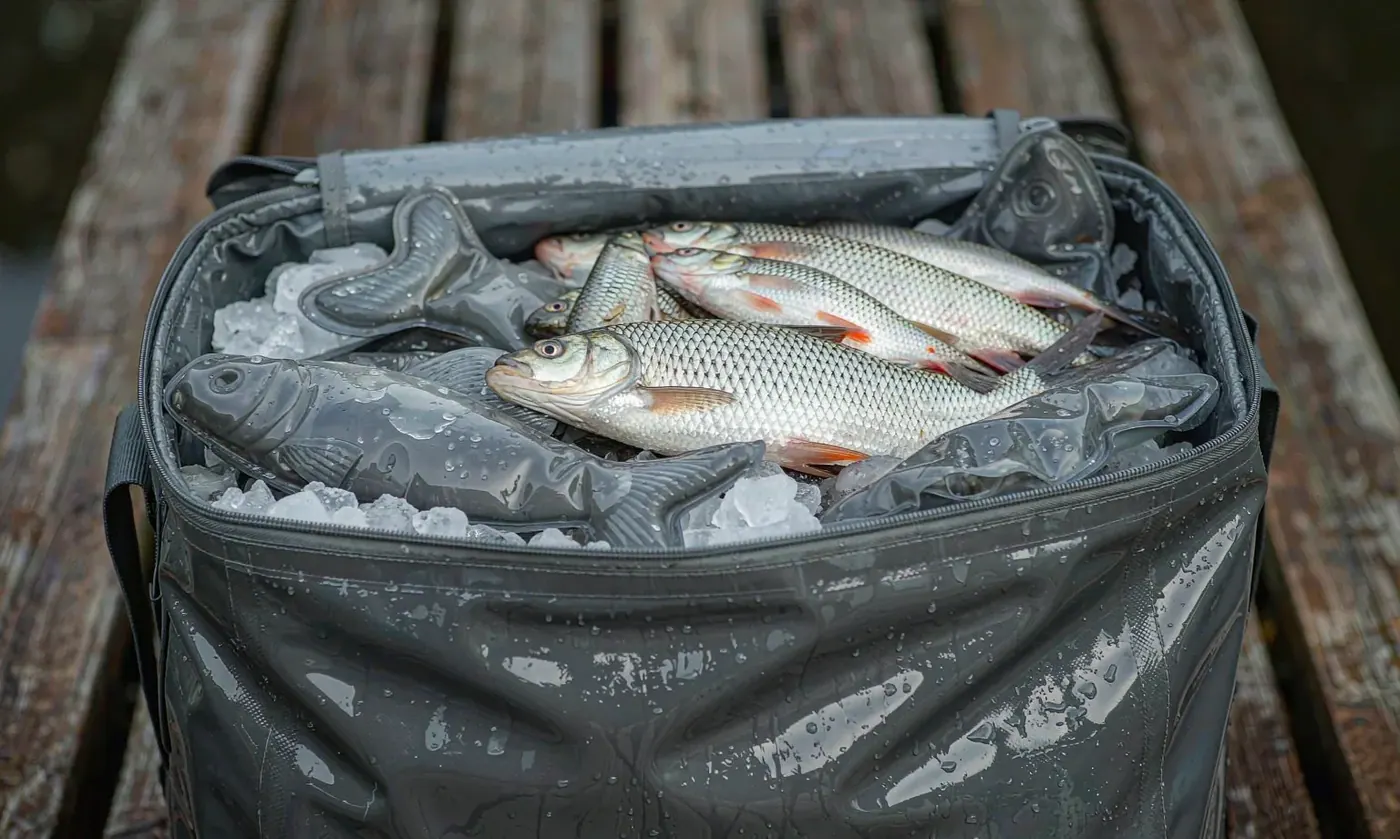
Inshore anglers often keep a fish for the table, and a fish in a tackle pack is a decision that smells by the second trip. The answer is a dedicated sealed compartment or a separate kill bag, and the compartment approach only works if it drains, because meltwater and slime have to leave rather than pool.
| Item | Where it goes | Why | Cost to add |
|---|---|---|---|
| Catch for the table | Sealed drained compartment or kill bag | Slime and meltwater | 6.50-9.00 USD |
| Bait | Sealed insulated pocket | Bait oil contaminates soft plastics | 3.50-5.00 USD |
| Water and food | Insulated pocket, own liner | Cross-contamination | Shared pocket, divided |
| Paddle drip | Drained base, two 10 mm grommets | Water collects at the floor | 0.50 USD |
| Phone and keys | Sealed liner pouch | A roll ends the day otherwise | 1.00-2.00 USD |
Rinsing closes the loop. A pack used in salt should be hosed inside and out after every session and dried with the chambers open, which takes about ten minutes and roughly doubles the service life of the hardware. That instruction belongs on the care card, because most premature failures in this category are storage failures rather than design failures.
Checks Before Approving an Inshore Sample
Inshore failures are corrosion and leakage, and both are testable in a week rather than a season. Five checks cover the field, and the salt spray test is the one that separates a genuine inshore pack from a freshwater pack with a blue colourway.
| Check | Method | Pass condition | Catches |
|---|---|---|---|
| Salt spray | 96 hours neutral salt spray on hardware | No red rust, no jam | Plated steel sliders and eyelets |
| Float test | Submerge with 6 kg aboard | Floats or stays leashed | No float panel, no leash points |
| Rinse test | Hose the interior, time it | Clean in under 3 minutes | Seams that trap salt crystals |
| Seat clear | Fit behind a seat, paddle 20 strokes | No paddle contact | Body over 420 mm tall |
| UV exposure | 500 hours accelerated on thread and coating | Under 20 percent strength loss | Standard polyester thread |
Water ingress claims should carry a condition from the IEC ingress protection framework, and the salt spray requirement should be written as hours to first red rust rather than as a generic corrosion-resistant claim. Words like marine grade mean nothing without a number behind them, and a buyer who accepts them will discover the difference during the first season.
Programme, Pricing, and Compliance
An inshore brief should open with the rating and the hardware specification, because those two decide the cost and the service life. Specify body height and width next, then flotation and leashing, and treat tray count as an outcome of the dimensional limits rather than a starting point.
| Programme item | Baseline | Note |
|---|---|---|
| MOQ | 500 pcs per design and colour | Hardware finish can vary above the baseline |
| Sampling | 6-10 working days | Add 4-6 days for a welded liner |
| Bulk | 35-50 days | From approved sample and deposit |
| Inspection | AQL 2.5 | Include salt spray, float test, seat clearance, rinse time |
| Compliance | REACH and California Prop 65 | Screen coatings, films, inks, hardware, foam |
QUANZHOU JUNYUAN BAGS has run waterproof bag programmes since 2014, with the founding team in the trade since 2004. Output of 200,000 units a month is verified by SGS, and BSCI and ISO 9001 systems structure the work. Materials are screened against REACH and California Prop 65, and bulk orders are inspected at AQL 2.5 before shipment.
An inshore brief can be emailed to service@junyuanbags.com with rating, litres, hardware level, tray count, and quantity. FOB Xiamen or DDP service to more than 100 countries follows an approved sample and a complete test record. The wider saltwater category sits in the saltwater fishing bag range.
People Also Ask
What makes a fishing backpack suitable for inshore kayak use?
Under 420 mm tall so it clears the seat, a rating of IPX6 or better, hardware that survives 96 hours of salt spray, and either a float panel or two leash points.
Do inshore fishing packs need stainless hardware?
Sliders and eyelets do. Plated steel shows rust in about 72 hours of spray and jams within two weeks, while 316 stainless or acetal parts do not rust at all.
What happens to a tackle pack when a kayak rolls?
It goes in unless it floats or is leashed. A closed-cell panel sized for 5-7 kg costs about 1.80 USD and turns a capsize loss into a recovery.
How tall can a kayak fishing backpack be?
Under about 420 mm, and 320-360 mm wide, so it sits behind the seat without blocking a paddle stroke and drops into a tankwell.
What rating does an inshore pack need?
IPX6 for spray and deck wash, and a rating tested to half an hour under a metre of water if the boat can roll. A roll puts the pack at 300-600 mm for as long as it takes to right the boat.
How do I stop salt ruining a fishing pack?
Rinse it inside and out after every session and dry it with the chambers open. Salt crystals left in a seam cause more long-term damage than anything the water does during the trip.
Frequently Asked Questions
Q1. What is the best inshore fishing backpack for a kayak?
A 22 L build at 1.05 kg with a welded liner tested to 30 minutes at 1 m, two 3600 trays, a 400 mm height, two leash points, and a float panel sized for 6 kg, at 34-42 USD FOB.
Q2. How tall can a kayak fishing pack be?
Under about 420 mm so it clears the seat back and the paddle stroke, and 320-360 mm wide so it drops into a tankwell.
Q3. Do I need a submersible pack for inshore kayak fishing?
If the boat can roll, yes. A roll puts the bag 300-600 mm under water while the angler rights the kayak, and a spray-rated zip takes water in that window.
Q4. What hardware survives salt water?
316 stainless and acetal polymer. Plated zinc alloy sliders rust in about 72 hours of spray exposure, while acetal parts do not rust and are lighter, though they creep under sustained load.
Q5. How long should hardware last in salt spray?
Ninety-six hours of neutral salt spray without red rust is a reasonable specification for an inshore pack, and it should be written as hours to first red rust rather than as a marine grade claim.
Q6. Should a kayak fishing pack float?
Either it floats or it is leashed. A closed-cell panel sized for 5-7 kg costs about 1.80 USD, and two load-rated leash points cost about 0.60 USD.
Q7. How many trays does a kayak fishing pack hold?
Two to four 3600 trays depending on the build. Above four trays the pack becomes too tall for the seat and should be stowed rather than worn while paddling.
Q8. Can a fishing backpack be worn over a life jacket?
Yes, if the yoke sits above the PFD collar and the sternum strap falls below it. Straps of 55-65 mm with 150 mm of sternum adjustment clear most jackets.
Q9. Where does a kept fish go on a kayak?
In a sealed drained compartment or a separate kill bag. Loose in a tray chamber, slime and meltwater sour the bag within one trip.
Q10. What is the lightest useful inshore kayak pack?
About 0.75 kg for 16 L holding one tray plus a utility tray. Every 100 g saved is 100 g less to right after a roll, which is why minimal builds are popular for sight fishing.
Q11. How do I clean a saltwater fishing pack?
Hose it inside and out after every session and dry it with the chambers open. That takes about ten minutes and roughly doubles the service life of the hardware.
Q12. What is the MOQ and lead time for an inshore pack programme?
MOQ is 500 pcs per design and colour, samples take 6-10 working days plus 4-6 days for a welded liner, and bulk runs 35-50 days from approved sample and deposit.