An offshore tackle bag is specified against four pressures that a freshwater bag never sees: continuous salt spray, a deck wash at 100 litres per minute, ultraviolet exposure with no shade for ten hours, and loads of 20-30 kg of big-game tackle. Nine offshore builds were assessed for 2026 across 40-90 litres, hardware rated for 240 hours of neutral salt spray, lure bays accepting lures to 400 mm, and 32-80 USD FOB Xiamen bands at MOQ 500 pcs per design and colour. Samples take 6-10 working days and bulk 35-50 days. The pick is the 60 L offshore duffel at 2.60 kg.
What Offshore Does to a Bag
Offshore is a harsher version of inshore rather than a different activity, and the difference is measurable. Spray exposure is continuous rather than occasional, so a specification of 96 hours to first red rust becomes 240 hours. Direct sun runs ten hours with no shade, so ultraviolet resistance is tested to 1,000 hours rather than 500. And the kit itself is heavier: a big-game spread of lures, leader spools, and tools runs 20-30 kg rather than 8-12.
| Condition | Inshore | Offshore | Specification that answers it |
|---|---|---|---|
| Salt spray | Occasional | Continuous | 240 hours neutral salt spray, no red rust |
| Ultraviolet | 500 hours tested | 1,000 hours tested | Solution-dyed fabric, UV-rated thread |
| Deck wash | Rare | 100 L/min routine | IPX6 minimum, welded seams |
| Load | 8-12 kg | 20-30 kg | Moulded base, rated handles at 30 kg |
| Ambient temperature | Moderate | 30-40 degrees on deck | Adhesives rated above 60 degrees |
Temperature deserves particular attention because it is the failure nobody attributes correctly. A deck in the tropics reaches 50-60 degrees, and an adhesive that is specified for ambient conditions softens at that temperature, so a glued seam that holds in a warehouse creeps offshore. Welded seams, or adhesives rated above 60 degrees, are the requirement rather than the upgrade.
Sea state and weather planning sit behind all of this: conditions offshore are forecast by NOAA, and the practical consequence for a bag brief is that a trip cancelled for weather still leaves the bag on a wet deck for a week. Storage behaviour between trips matters as much as behaviour during one.
Big-Game Tackle Does Not Fit Standard Trays
The first offshore-specific problem is dimensional. A big-game lure runs 200-400 mm with a skirt and a hook rig, and a standard 3700 tray at 355 x 230 mm will not take one laid straight. Either the lure goes in diagonally, which wastes half the tray, or the bag needs a lure bay rather than a tray system.
| Item | Size | Standard tray fit | Offshore answer | Note |
|---|---|---|---|---|
| Skirted trolling lure | 200-300 mm | Diagonal only in a 3700 | Open lure bay with dividers | Lures tangle if stacked |
| Large plunger or popper | 300-400 mm | Does not fit | Deep bay, 480 mm long | Needs a rigid bay |
| Leader spool | 150 mm coil | Fits a utility tray | Dedicated spool rack | Coils unwind if loose |
| Harness and belt | Bulky, soft | Wastes a tray | External sleeve | Keep dry and out of the sun |
| Gaff or flying gaff head | 250-400 mm | Does not fit | Sheathed external pocket | Sharp, must be covered |
The answer most offshore bags converge on is a hybrid: two or three trays for terminal tackle and hooks, plus an open lure bay with removable dividers taking four to eight rigged lures. That is a different internal geometry from a bass bag, and it is the specification to settle first, because it decides the shell shape rather than following from it.
Hardware and Seams: Where Offshore Bags Fail
Two components account for most offshore failures, and neither is the fabric. Hardware corrodes and seams creep. Both are cheap to specify correctly and both are invisible when new, which is why they are the two items to write into a brief with numbers attached rather than adjectives.
| Component | Minimum for offshore | Test | Failure if under-specified | Added cost |
|---|---|---|---|---|
| Sliders and buckles | 316 stainless or acetal | 240 h neutral salt spray | Rust and jam within weeks | 0.70-0.85 USD |
| Thread | UV-rated bonded nylon | 1,000 h exposure | Seam opens under load | 0.20-0.35 USD |
| Seams | Welded, not glued | 60 degree peel test | Creep on a hot deck | 3.50-5.00 USD |
| Base | Moulded, drained | Wet deck, 30 minutes | Contents soak through | 2.40-4.00 USD |
| Handles | Rated to 30 kg | Pull test to 30 kg | Handle pulls out loaded | 1.60-2.20 USD |
The full material comparison is set out in the saltwater hardware guide, and strength and abrasion requirements should reference published methods from ASTM International. The point of writing numbers is that they can either be met or not, whereas marine grade can mean anything from genuine 316 stainless to a plating that lasts a fortnight.
The Nine Builds at a Glance
Volume is main-chamber capacity with the lure bay fitted, and loaded weights assume a realistic big-game spread: six rigged lures, terminal tackle, three leader spools, tools, and water. Every build here has a moulded drained base and hardware rated for 240 hours of salt spray, because at this level those are entry requirements rather than features.
| Build | Volume | Empty / loaded | Lures | Rating | FOB band |
|---|---|---|---|---|---|
| Offshore Duffel 60 | 60 L | 2.60 / 24 kg | 6 in a bay | IPX6 | 46-58 USD |
| Deck Bag 45 | 45 L | 2.10 / 18 kg | 4 in a bay | IPX6 | 38-48 USD |
| Big Game Tote 75 | 75 L | 3.20 / 28 kg | 8 in a bay | IPX5 | 52-64 USD |
| Backpack 55 | 55 L | 2.40 / 20 kg | 5 in a bay | IPX6 | 48-60 USD |
| Compact 40 | 40 L | 1.95 / 16 kg | 3 in a bay | IPX6 | 32-40 USD |
| Submersible 65 | 65 L | 2.90 / 26 kg | 6 in a bay | IPX7 | 58-72 USD |
| Hard-Base Case 50 | 50 L | 3.40 / 22 kg | 4 in a bay | IPX6 | 54-66 USD |
| Charter 90 | 90 L | 3.80 / 32 kg | 10 in a bay | IPX6 | 66-80 USD |
| Convertible 48 | 48 L | 2.55 / 19 kg | 4 in a bay | IPX6 | 44-55 USD |
Deck Wash and Salt Spray: What the Rating Must Cover
A deck wash is the defining offshore event. It runs at about 100 litres per minute from a hose at close range, it is directed at everything on deck, and it happens at the end of every trip. A bag rated for rain takes water through the zip and the seams in that event, and the contents are soaked before anyone notices.
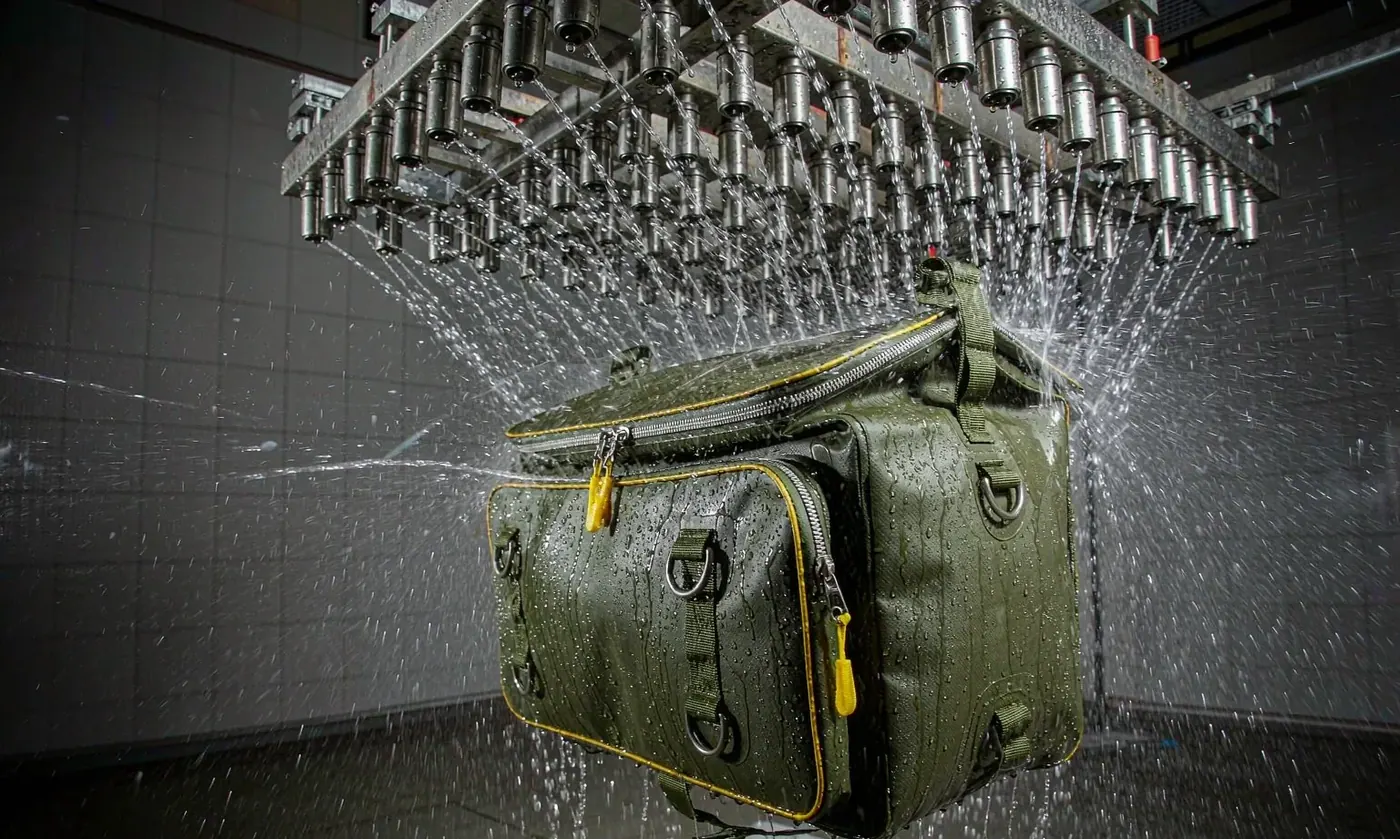
IPX6 is the minimum that answers it: 100 litres per minute at three metres for three minutes, which is the deck wash plus margin. IPX7 adds immersion, which matters if the bag can go overboard or sit in a scupper. Ratings are defined by the IEC ingress protection framework, and a code without a condition is decoration.
| Event | Water delivered | Rating needed | Test to require |
|---|---|---|---|
| Rain and light spray | Low | IPX4 | Nozzle at 10 L/min |
| Heavy spray at speed | Moderate | IPX5 | Nozzle at 12.5 L/min |
| Deck wash | 100 L/min | IPX6 | Jet at 3 m for 3 minutes |
| Overboard or scupper | Immersion | IPX7 | 30 minutes at 1 m |
| Wash-down then sun | Thermal cycling | Adhesives above 60 degrees | Peel test after a 60 degree soak |
1. Offshore Duffel 60: Best Overall
Sixty litres at 2.60 kg empty and about 24 kg loaded, with a divided lure bay holding six rigged lures, three 3700 trays of terminal tackle, a moulded drained base, and hardware rated for 240 hours of salt spray. The FOB band is 46-58 USD.
It leads because it solves the two offshore problems in one body: the lure bay handles lures that do not fit trays, and the moulded drained base survives the deck wash that ends every trip. Handles are rated to 30 kg and bar-tacked through reinforced patches, which matters because a 24 kg bag is lifted into a vehicle by two people rather than carried.
2. Deck Bag 45: Best for Day Boats
Forty-five litres at 2.10 kg and about 18 kg loaded, four lures in the bay, two 3700 trays, and a low 320 mm profile so it sits under a gunwale. The FOB band is 38-48 USD.
A low profile is the specification that suits a smaller boat, where a tall bag catches a rod butt and blocks a walkway. At 320 mm this bag slides under a gunwale and against a bulkhead, and the four-lure bay is the right size for a day boat running a modest spread. The base is moulded and drained as standard.
3. Big Game Tote 75: Best for Lure Spreads
Seventy-five litres at 3.20 kg holding eight rigged lures in a divided open bay, with a reinforced rim and four grab handles, at a 52-64 USD band. It is the build for a boat running a full spread where lures are rigged and ready.
An open top is correct here rather than a compromise, because a rigged lure with hooks is easier to lift out than to unzip around. The rim needs stiffening at 4 mm to keep the mouth open when the bag is loaded, and the bay dividers should be removable so the tote can be hosed out properly after a trip.
4. Backpack 55: Best for Walk-On Charters
Fifty-five litres at 2.40 kg with a stowable harness, five lures in the bay, three 3700 trays, and two external rod tubes, at a 48-60 USD band.
The harness is what earns the price, and it has to be genuine: 55 mm straps with 10 mm foam and a padded belt, because a 20 kg load carried 300 m from a car park is the whole reason to choose this format. The tubes need two mounts each separated by 300 mm, since a rod is a long lever and a single mount works loose on a boat deck.
5. Compact 40: Best for Small Spreads
Forty litres at 1.95 kg and about 16 kg loaded, three lures in the bay, two 3700 trays, and a 300 mm profile, at a 32-40 USD band. It suits an angler running a light spread on a smaller boat.
Three lures is the honest capacity and it should be stated plainly, because a buyer expecting six will be disappointed. What the size buys is handling: at 1.95 kg and 300 mm tall the bag is easy to move around a crowded deck, and it fits in a cabin berth rather than living on the sole.
6. Submersible 65: Best for Open Boats
Sixty-five litres at 2.90 kg inside a welded liner tested to 30 minutes at 1 m, six lures in a drained bay, and a moulded base with a scupper drain, at a 58-72 USD band.
The scupper drain is the offshore-specific detail. A welded shell that cannot drain collects wash-down water and sits wet for a week between trips, and a bag with a drain path at the base plus a vented upper chamber dries in about a day. Where a bag genuinely can go overboard, a float panel sized for 10 kg is worth the 2.40 USD.
7. Hard-Base Case 50: Best for Protection
Fifty litres at 3.40 kg with a semi-rigid moulded shell around the base and lower walls, four lures in a padded bay, and a lid that closes against a compression seal, at a 54-66 USD band.
A semi-rigid case is the right choice when the bag is stacked under other gear or when expensive reels travel in it. The trade is weight and bulk: 3.40 kg empty and a shape that does not compress, so it does not fit a tight hatch. It also needs a pressure-equalisation path, since a sealed case taken from a cool cabin to a hot deck builds a partial vacuum at the lid.
8. Charter 90: Best for Charter Operations
Ninety litres at 3.80 kg holding ten rigged lures, five 3700 trays, and a separate leader rack, with a replaceable base panel and bolted handles, at a 66-80 USD band. Loaded weight approaches 32 kg.
At this size the bag is moved rather than carried, and the specification follows: four handles rated to 30 kg, a base that unbolts for replacement, and a body that stands square when loaded. Charter duty is the harshest in the category, and a bag designed so its consumable parts can be replaced is worth more than one with a higher litre figure.
9. Convertible 48: Best for Mixed Use
Forty-eight litres at 2.55 kg with a removable harness and a removable lure bay, four lures, two 3700 trays, and a 44-55 USD band. It converts between a deck bag and a carried bag for an angler who fishes from different boats.
Removability is the whole argument: the lure bay lifts out so the bag becomes a general gear bag for a travel day, and the harness stows so it becomes a deck bag. Both need to lock positively, because a bay that shifts or a harness that dangles creates a snag on a working deck.
Carrying Rods, Gaffs, and Long Tools
Offshore kit includes items that no tray accommodates: a gaff head of 250-400 mm, a flying gaff, a tag stick, and a harness. Each is long, sharp or heavy, and each needs a dedicated covered position rather than a pocket, because a bare hook on a moving deck is a hazard to the crew as much as a risk to the bag.
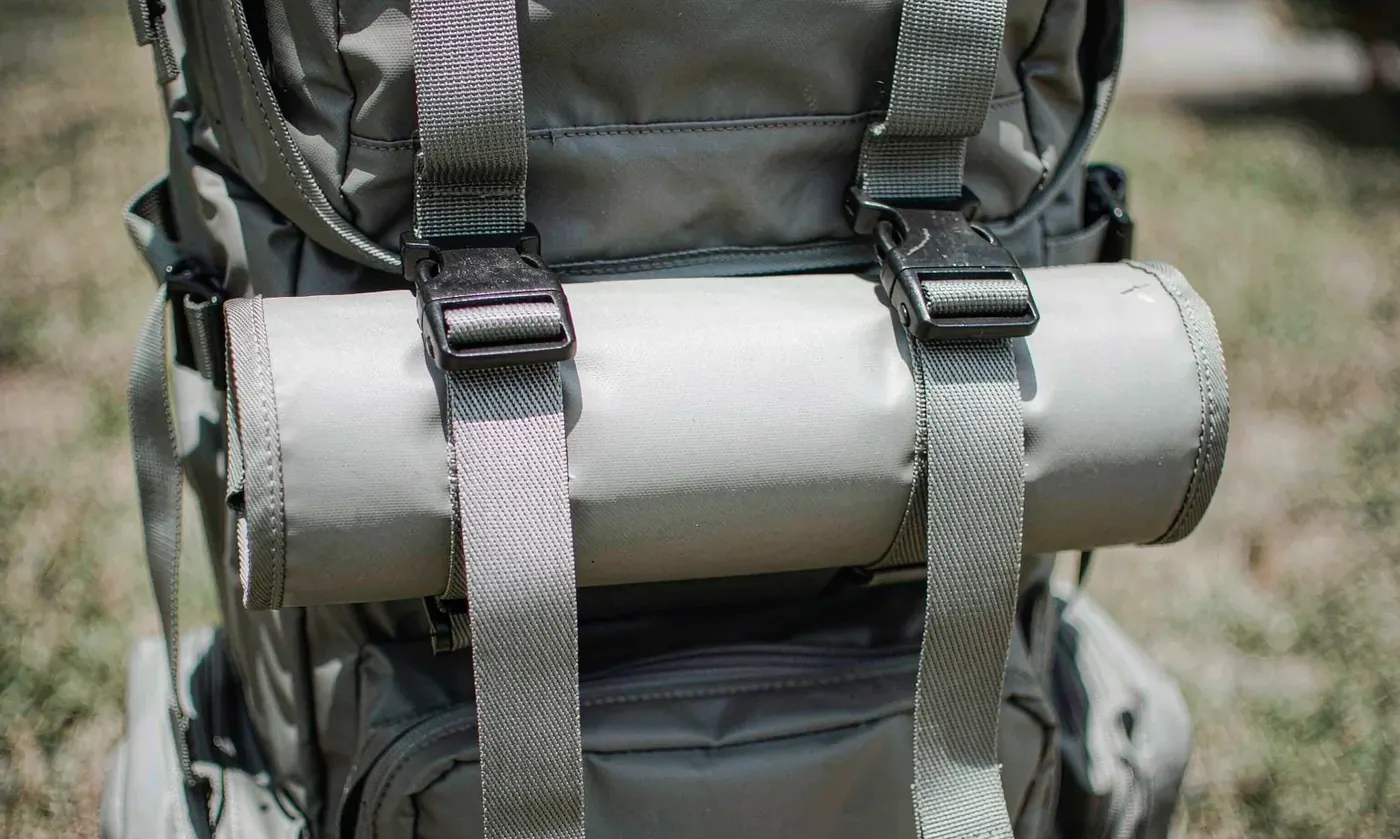
| Item | Position | Requirement | Cost |
|---|---|---|---|
| Gaff head | Covered sheath at the side | Sheath over the hook, drained | 2.40-3.20 USD |
| Tag stick | Sleeve beside the gaff | Covered, one-handed draw | 1.60-2.20 USD |
| Leader spools | Rack inside the lid | Coils held, not loose | 2.20-3.00 USD |
| Harness | External sleeve, shaded | Out of direct sun | 1.80-2.40 USD |
| Rod butts | Two tubes or a rack | Mounts 300 mm apart | 3.00-4.00 USD |
Sharp items should be covered rather than merely stored. A gaff head in an open pocket catches on a wash-down hose, on a net, and on a leg, and a moulded sheath costs about 2.40-3.20 USD. That is the clearest example of a specification that is about the crew rather than about the customer.
Moving a Heavy Bag on a Rolling Deck
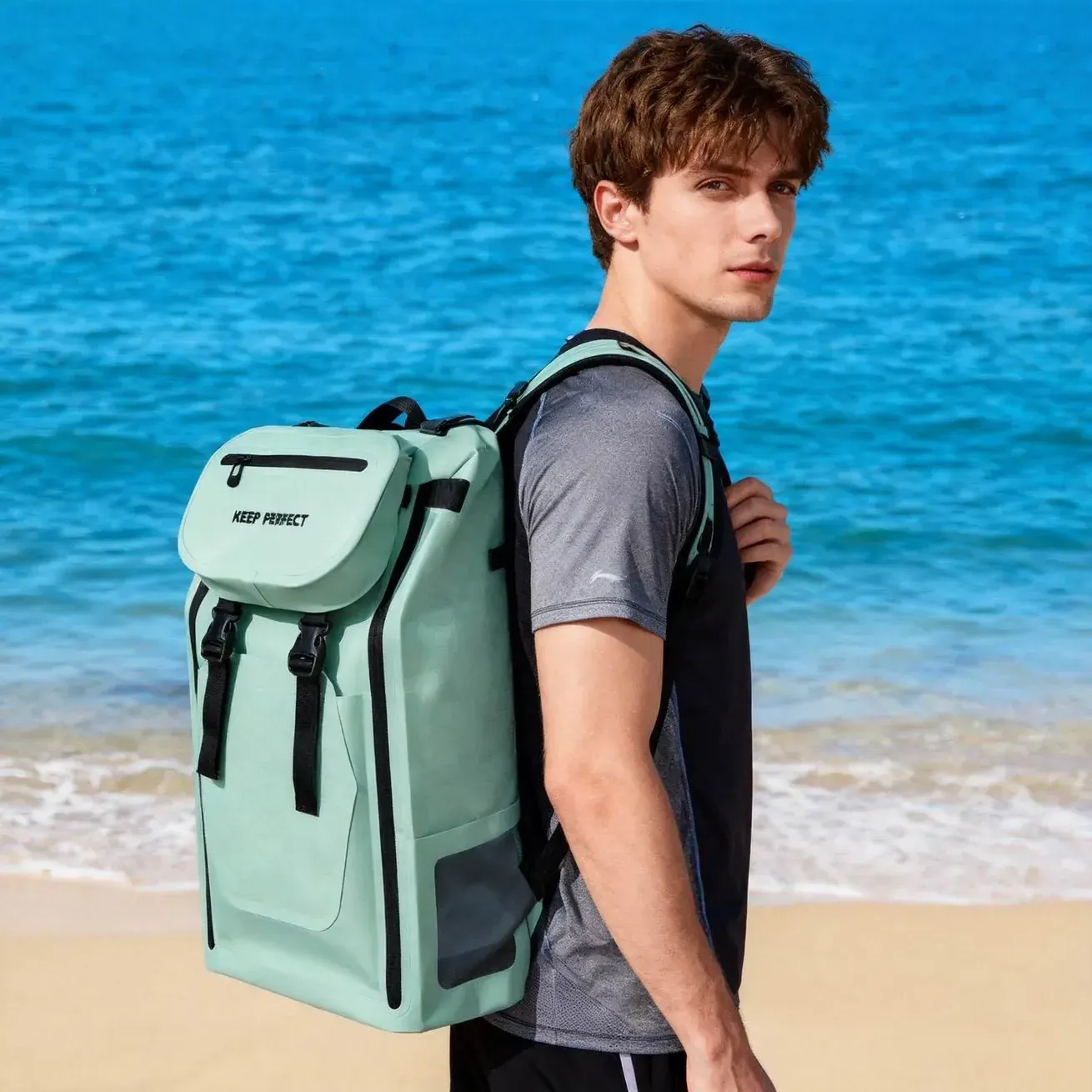
At 20-30 kg an offshore bag is not carried so much as positioned, and the design has to acknowledge that. Two handles are not enough: a loaded bag needs four, spaced about 300 mm apart, so two people can share the load and so one person can steady it against a roll. A bag with a single grab handle at the top encourages exactly the lifting posture that injures backs.
| Movement | Right handling | Wrong handling | Design answer |
|---|---|---|---|
| Lift from dock to deck | Two people, four handles | One person, top handle | Four handles rated to 30 kg |
| Move across a rolling deck | Set down and slide | Carry at arm length | Moulded base that slides |
| Stow under a gunwale | Low profile, pushed | Lifted over a rail | Under 320 mm tall |
| Load into a vehicle | Two people, low lift | Shoulder carry | Grab handles at each end |
A moulded base that slides is an underrated offshore feature. A bag dragged across a deck by its handles puts the whole load on the handle attachment, while one that can be pushed across a non-marking base costs nothing in wear. The base polymer should be specified as non-marking, because a black scuff line across a white gelcoat is the sort of damage a charter operator remembers.
Checks Before Approving an Offshore Sample
Offshore failures are slow, expensive, and mostly invisible when new, so the approval protocol is heavier than for a freshwater bag. Five checks take about a week because two of them are exposure tests, and that week is worth more than a season of warranty claims.
| Check | Method | Pass condition | Catches |
|---|---|---|---|
| Salt spray | 240 h neutral salt spray on hardware | No red rust, no jam | Plated hardware sold as marine grade |
| Deck wash | 100 L/min at 3 m for 3 min | Interior dry | Rain rating sold as offshore |
| UV exposure | 1,000 h on fabric and thread | Under 20 percent strength loss | Standard polyester thread |
| Heat peel | Peel test after 60 degree soak | No seam creep | Adhesive rated for ambient only |
| Handle pull | Pull each handle to 30 kg | No stitch pull-out | Handles sewn to face fabric |
Two of those checks are the ones buyers skip and later regret: the heat peel test and the 240-hour spray test. Both take calendar time rather than labour, which is exactly why they get dropped when a programme is running late, and both are the tests that predict whether the bag is still serviceable in year two rather than year one.
Programme, Pricing, and Compliance
An offshore brief should open with the rating and the hardware level, because those decide the closure, the seams, and a meaningful share of the cost. Specify the lure bay next, then the base and handles, and treat volume as an outcome. Settling the rating first avoids the most expensive revision, which is discovering after sampling that the seams need to be welded.
| Programme item | Baseline | Note |
|---|---|---|
| MOQ | 500 pcs per design and colour | Hardware finish can vary above the baseline |
| Sampling | 6-10 working days | Add 6-8 days for a welded liner tool |
| Bulk | 35-50 days | From approved sample and deposit |
| Inspection | AQL 2.5 | Include salt spray sample, deck wash, handle pull, seam peel |
| Compliance | REACH and California Prop 65 | Screen coatings, films, inks, hardware, foam |
QUANZHOU JUNYUAN BAGS has run waterproof bag programmes since 2014, with the founding team in the trade since 2004. Output of 200,000 units a month is verified by SGS, and BSCI and ISO 9001 systems structure the work. Materials are screened against REACH and California Prop 65, and bulk orders are inspected at AQL 2.5 before shipment.
An offshore brief can be emailed to service@junyuanbags.com with rating, lure capacity, hardware level, volume, and quantity. FOB Xiamen or DDP service to more than 100 countries follows an approved sample and a complete test record. The wider category sits in the saltwater fishing bag range, and carried formats are compared in the saltwater backpack ranking.
People Also Ask
What makes a tackle bag suitable for offshore fishing?
A rating of IPX6 or better against a deck wash, hardware rated for 240 hours of salt spray, welded seams with adhesives stable above 60 degrees, and a moulded drained base.
Why do big game lures not fit standard trays?
A skirted lure runs 200-400 mm and a 3700 tray is 355 x 230 mm, so a large lure only fits diagonally. Offshore bags use an open lure bay with dividers instead.
Is IPX6 enough for offshore use?
Yes for a deck wash, which delivers about 100 litres per minute at close range. IPX7 is needed only if the bag can go overboard or sit in a scupper.
Why do offshore bags fail in the second season?
Hardware corrosion and seam creep. Plated hardware rusts and glued seams soften at the 50-60 degrees a tropical deck reaches, so both need numbers in the brief.
How heavy is a loaded offshore tackle bag?
20-30 kg for a full spread. At that weight handles rated to 30 kg and a moulded base matter more than capacity, and the bag is lifted by two people rather than carried.
Should a gaff be carried in the bag?
In a covered drained sheath at the side, never loose. A bare hook in an open pocket catches on hoses, nets, and legs, and a moulded sheath costs about 2.40-3.20 USD.
Frequently Asked Questions
Q1. What is the best offshore tackle bag for big game?
A 60 L duffel at 2.60 kg with a divided lure bay holding six rigged lures, three 3700 trays, a moulded drained base, and hardware rated for 240 hours of salt spray, at a 46-58 USD FOB band.
Q2. What rating does an offshore tackle bag need?
IPX6 minimum, which is 100 litres per minute at three metres for three minutes and covers a deck wash. IPX7 is needed where the bag can go overboard.
Q3. Why do big game lures need a special bay?
A skirted lure runs 200-400 mm and a 3700 tray measures 355 x 230 mm, so a large lure only fits diagonally and wastes half the tray. An open bay with dividers holds four to ten rigged lures.
Q4. How long should offshore hardware last in salt spray?
240 hours of neutral salt spray without red rust, against 96 hours for inshore. Write it as hours to first red rust rather than accepting a marine grade claim.
Q5. Why do glued seams fail offshore?
A tropical deck reaches 50-60 degrees and an adhesive rated for ambient conditions softens, so the seam creeps. Require welded seams or an adhesive rated above 60 degrees with a heat peel test.
Q6. How much weight can an offshore tackle bag carry?
20-30 kg for a full spread. Handles should be rated to 30 kg and bar-tacked through reinforced patches, and the bag should be lifted by two people.
Q7. Is an open-top tote better than a zip bag offshore?
For a full lure spread, yes, because a rigged lure with hooks is easier to lift out than to unzip around. The rim needs a 4 mm stiffener to stay open when loaded.
Q8. Should an offshore bag be submersible?
Only for open boats and where the bag can go overboard. A welded shell needs a drain path at the base and a vented upper chamber, or it stays wet between trips.
Q9. What is a semi-rigid offshore case for?
Protecting reels and stacked gear. It costs 3.40 kg of empty weight and does not compress, so it will not fit a tight hatch, and it needs a pressure-equalisation path.
Q10. How do I carry a gaff and tag stick safely?
In covered drained sheaths at the side, with the hook enclosed. A bare hook in an open pocket is a hazard to the crew as well as a risk to the bag.
Q11. Does an offshore bag need UV-resistant fabric?
Yes. Direct sun runs ten hours with no shade, so fabric and thread should be tested to 1,000 hours with under 20 percent strength loss, using solution-dyed fabric and UV-rated thread.
Q12. What is the MOQ and lead time for an offshore bag programme?
MOQ is 500 pcs per design and colour, samples take 6-10 working days plus 6-8 days for a welded liner tool, and bulk runs 35-50 days from approved sample and deposit.