The best waterproof travel backpack is usually a 25–35 L roll-top or sealed clamshell weighing 0.7–1.2 kg, sized within the airline limit actually booked, and tested around IPX5–IPX6 for real rain. Choose 18–24 L for city day trips, 25–32 L for one-bag short travel, and 35–45 L for road or expedition travel where carry-on limits are not decisive. This ranking compares 10 practical pack formats rather than unverified product claims, so buyers can match closure, laptop protection, weight, and access to the trip.
Travel Ranking at a Glance
A useful ranking begins with the route. A 22 L day pack can be first for a wet city weekend and last for a 4-day field trip. We scored each format on water control, opening speed, carry comfort, space efficiency, and transport fit, with 100 points available. Water control carries 30 points, comfort 25, access 20, transport geometry 15, and empty-weight efficiency 10. The score assumes the stated closure is used correctly and the pack is loaded within its intended range.
| Rank and format | Capacity / weight | Water target | Best trip |
|---|---|---|---|
| 1. Balanced roll-top | 28–32 L / 0.8–1.1 kg | IPX6-level | Wet city plus trail |
| 2. Sealed travel clamshell | 30–35 L / 1.0–1.4 kg | IPX5-level | Organised one-bag travel |
| 3. Light urban roll-top | 20–24 L / 0.55–0.8 kg | IPX5-level | Weekend city use |
| 4. Laptop wet-weather pack | 22–28 L / 0.8–1.2 kg | IPX5-level | Work travel |
| 5. Adventure carry-on | 35–40 L / 1.1–1.45 kg | IPX6-level | Long mixed trip |
| 6. Packable dry day pack | 18–22 L / 0.35–0.6 kg | IPX4–IPX5 | Secondary excursion bag |
| 7. Marine transit pack | 25–35 L / 0.9–1.3 kg | IPX6–IPX7 | Ferry and boat route |
| 8. Camera travel pack | 25–32 L / 1.2–1.7 kg | IPX5–IPX6 | Optics and media |
| 9. Winter travel pack | 30–38 L / 1.1–1.6 kg | IPX6-level | Cold wet routes |
| 10. Oversize road pack | 40–45 L / 1.2–1.8 kg | IPX6-level | Vehicle-led travel |
No score should override an airline or body measurement. External dimensions, not litres, determine whether a pack enters a sizing frame, and published limits can vary by carrier, fare, route, and aircraft. The carry-on rule guide for waterproof backpacks explains what to verify before departure. Always check the current booking directly rather than assuming a universal 55 × 35 × 23 cm rule.
1–2: Balanced Roll-Top and Sealed Travel Clamshell
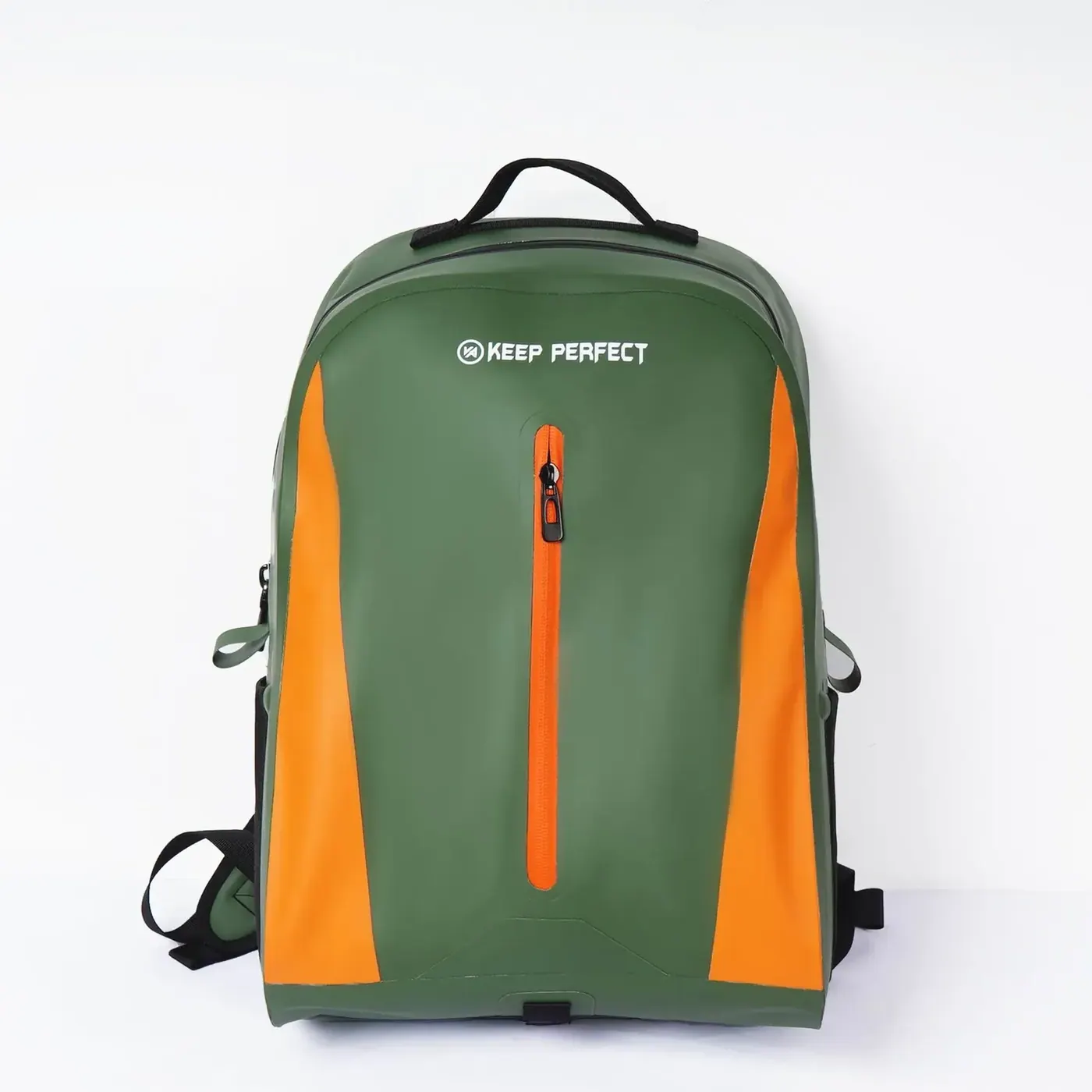
1. Balanced 28–32 L roll-top, 90/100. This format wins because it carries 6–9 kg comfortably, maintains 3 closure turns, and fits most short-trip loads without becoming a deep box. Look for 55–70 mm shoulder straps, 4 side-compression points, a raised 15-inch sleeve, and a 0.8–1.1 kg empty mass. Its weakness is opening speed: a buried charger can take 30–45 seconds to reach, so one protected quick pocket is valuable.
2. Sealed 30–35 L travel clamshell, 87/100. A U-shaped opening exposes clothing and organisers without vertical digging. It works especially well for rail and hotel travel, where the bag opens flat several times a day. The trade-off is closure length: a 900–1,200 mm perimeter has more track to keep clean, and corners deserve close spray testing. Target a loaded depth under 230 mm, internal retaining straps, and 1.0–1.4 kg empty weight.
Choose between these 2 by access count. If the main chamber opens fewer than 4 times daily and rain exposure is high, the roll-top's simple wet boundary usually wins. If it opens 8–12 times in sheltered spaces, clamshell organisation saves time. Both should hold the heaviest items within 50 mm of the back and lift electronics at least 50 mm above the base.
| Check | Balanced roll-top | Sealed clamshell | Decision line |
|---|---|---|---|
| Main access | 20–45 seconds | 10–20 seconds | Count openings per day |
| Closure length | Short folded mouth | 900–1,200 mm track | More track means more cleaning |
| Useful load | 6–9 kg | 6–10 kg | Fit harness at real mass |
| Packing style | Vertical modules | Flat organiser layout | Match lodging routine |
| Rain priority | Very strong | Strong with tested corners | Use actual exposure |
Ingress terms should be tied to a tested finished item. The IEC description of IP ratings clarifies the difference between splash, jets, and immersion. For ordinary wet travel, a documented IPX5-to-IPX6-level result is more relevant than an unneeded immersion claim that adds 200 g and a high-force closure.
3–4: Light Urban Roll-Top and Laptop Wet-Weather Pack
3. Light 20–24 L urban roll-top, 84/100. At 0.55–0.8 kg, this is the best weekend and secondary-city format. It holds a rain layer, compact clothes, 1 L water, food, and small electronics while remaining narrow on buses. Choose a body around 440–480 mm high and 280–310 mm wide. The compromise is load transfer: beyond about 7 kg, a minimal harness becomes tiring over a 10 km day.
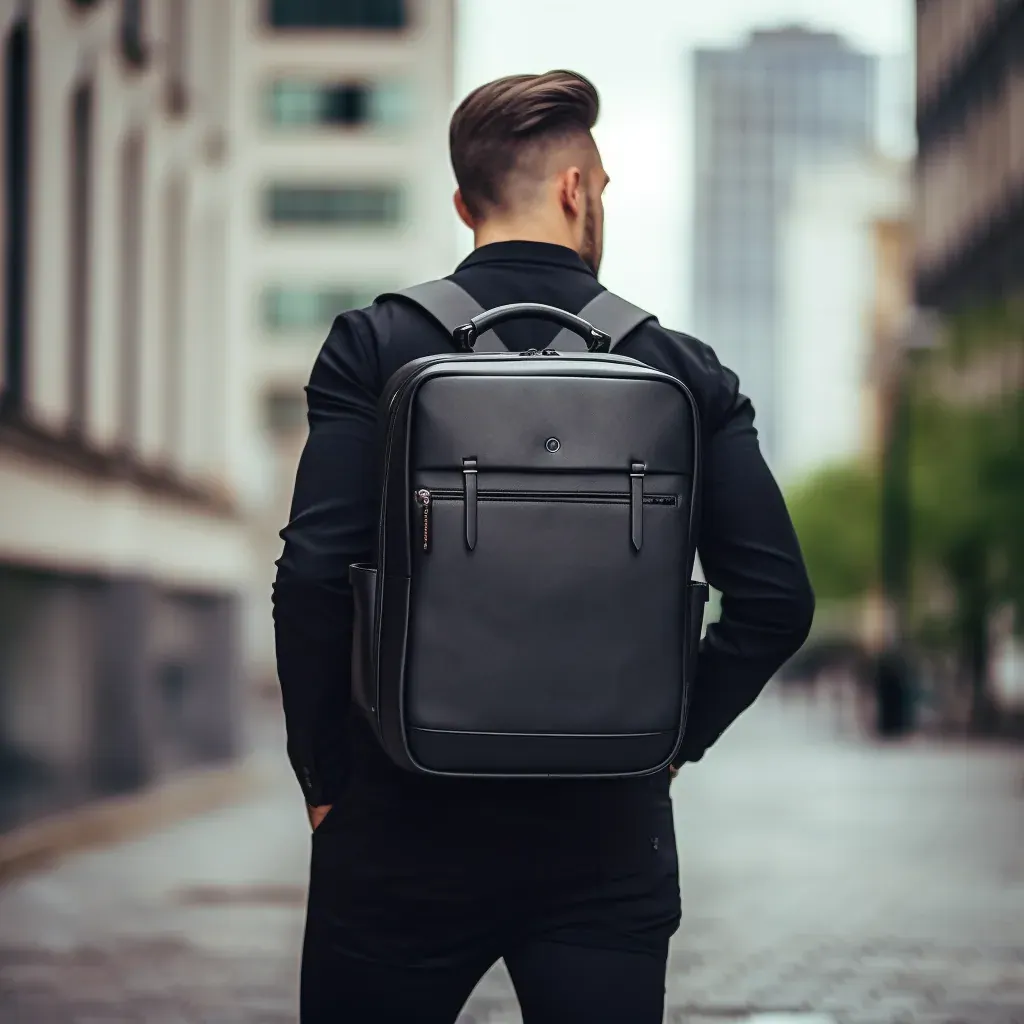
4. Laptop-focused 22–28 L pack, 82/100. The defining feature is not a padded rectangle; it is a raised, suspended sleeve with 10–15 mm base padding, 5–10 mm side foam, and an opening that does not expose the main chamber. A 16-inch device may require an internal zone near 390 × 270 mm. Test with the actual device plus charger, because advertised screen size does not describe shell dimensions.
Work travellers should separate bottle and computer. A 1 L bottle belongs in an external retained pocket or an independent sealed sleeve, never above the device. Keep passport and media in a 0.5–0.8 L inner pouch. The waterproof travel backpack selection page compares layouts, while laptop-specific protection should be confirmed through loaded drop and base set-down checks.
5–6: Adventure Carry-On and Packable Day Pack
5. Adventure 35–40 L carry-on, 79/100. This format suits 3–5 days when footwear, insulation, or technical layers exceed a 30 L body. Look for 1.1–1.45 kg empty mass, a 7–12 kg harness, load lifters, and compression that keeps depth inside the booked limit. It ranks lower only because a 40 L shell is easy to overfill: 3 roll turns and airline geometry disappear before the traveller notices.
6. Packable 18–22 L dry day pack, 76/100. At 0.35–0.6 kg, it rides inside the main luggage and becomes a beach, market, or excursion bag. Its simple unstructured body dries quickly and occupies about 1–2 L when folded. Expect a lighter harness, no rigid computer protection, and comfortable loads around 2–5 kg. It is an excellent second pack and a weak primary carrier for a 10 kg travel day.
The 2 formats can work together. Use the 38 L body for transit and the 20 L pack for local movement. Pack the day body loosely rather than crushing it into a hard 0.5 L ball, which creates repeated coating folds. On arrival, give it 30 minutes to relax, then inspect fold lines before placing a phone or documents inside.
7–8: Marine Transit and Camera Travel
7. Marine 25–35 L transit pack, 75/100. Ferry decks, launch transfers, and shore landings create driven spray, wet surfaces, and the possibility of a brief drop. A welded body, reinforced lower 150 mm, non-corroding external hardware, and IPX6-to-IPX7 target can be justified. Flotation must never be assumed: a closed air-filled pack may float differently when loaded with dense tools, and it is not a life-saving device.
8. Camera 25–32 L travel pack, 73/100. A removable insert with 25–50 mm closed-cell cells protects optics, while the outer body manages rain. Keep the technical cassette below the closure fold and allocate at least 20 percent volume to personal items. Its 1.2–1.7 kg empty mass is the penalty. Test a 600 mm loaded drop on base, back, and lower corner with mass-matched equipment.
For water travel, safety guidance from the U.S. Coast Guard boating resources should guide personal flotation and on-water behaviour. A dry pack keeps equipment organised and may support gear recovery, but it does not replace a correctly selected and worn personal flotation device. Keep emergency communication separately secured to the person where the activity plan requires it.
| Special format | Protection feature | Mass penalty | Acceptance check |
|---|---|---|---|
| Marine transit | Welded body and reinforced base | 100–300 g | Spray plus controlled float behaviour |
| Camera travel | Removable closed-cell cassette | 400–700 g | Three loaded 600 mm drops |
| Laptop travel | Raised sleeve and side foam | 150–300 g | Base set-down with 50 mm lift |
| Winter travel | Cold-flex shell and glove pulls | 100–250 g | Fifty bends after -10°C conditioning |
| Packable day use | Minimal structure | Lowest mass | Five hundred fold cycles |
Physical screens should name the method, load, temperature, and sample count. Relevant abrasion, tensile, and impact approaches can be selected from resources at ASTM International. A claim such as rugged travel pack is not comparable; 10,000 abrasion cycles at the base or 3 drops at 600 mm can be repeated.
9–10: Winter Travel and Oversize Road Pack
9. Winter 30–38 L pack, 72/100. Cold-weather clothing occupies more volume, gloves reduce dexterity, and coated materials stiffen. Specify 50 bends after 2 hours at -10°C, pulls at least 50 mm long, and space for a 6–8 L insulating layer. A 1.1–1.6 kg empty range is common when foam and reinforced straps are added. Keep a dry layer independently contained because wet insulation can become a safety issue.
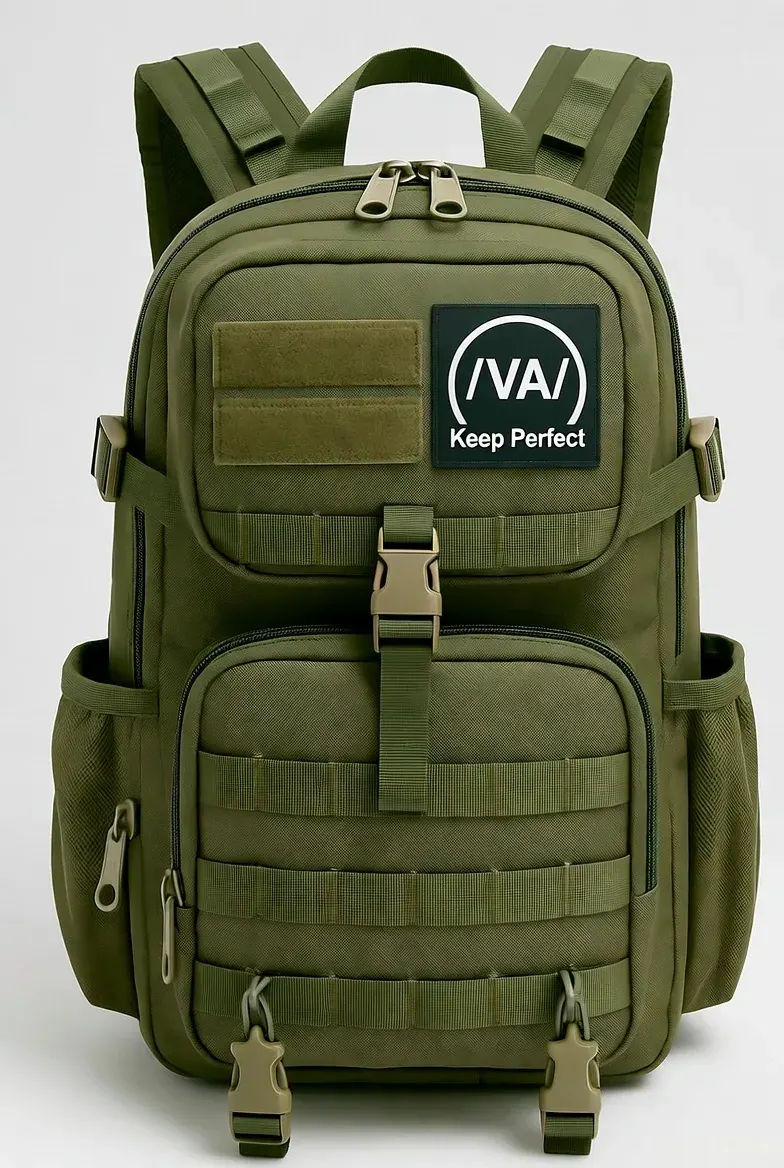
10. Oversize 40–45 L road pack, 69/100. This is the best shape for a vehicle-led trip and the easiest to misuse as carry-on. It handles boots, bulky clothing, and shared equipment, with loads of 10–14 kg when the harness is designed accordingly. It ranks tenth for air travel because a full body often exceeds depth or mass limits, not because it lacks capability. Use it where the vehicle, lodge, and route define transport.
Cold wet travel has human consequences beyond luggage. CDC guidance on hypothermia explains why staying dry and recognising early warning signs matters. Pack one complete dry layer in an independent 5–8 L module, and do not sacrifice that reserve to fit another gadget.
How to Choose from the Ten Formats
Write 6 trip values: longest walking distance, maximum loaded mass, largest transport dimensions, rain duration, daily main-opening count, and highest-value water-sensitive item. A traveller walking 12 km with an 8 kg load in 2 hours of rain should favour the 28–32 L roll-top. A rail traveller opening the bag 10 times daily under station cover may choose the clamshell. A ferry photographer needs marine construction plus a camera cassette.
Run a 3-part sample test. First, pack the complete list and confirm closure plus external dimensions. Second, walk 5 km, climb 100 steps, and score shoulder pressure and movement. Third, place tissue at 6 internal points and apply the agreed water exposure. A pack that passes only the spray test can still fail travel through poor access, airline geometry, or a painful harness.
Check weight after packing, not from arithmetic alone. Toiletries, cables, and small accessories routinely add 1–2 kg beyond the planned list. Keep a 10 percent mass reserve and a 15 percent volume reserve. If the shell closes only after sitting on it, move up one format or remove gear; forced closure distorts the wet boundary and makes every later access slower.
Price Bands: Pay for the Feature That Changes the Trip
Price bands should follow construction rather than logos. A simple 18–24 L rain pack may prioritise a roll-top and low mass; a mid-range 28–32 L travel design adds a stable harness, raised device sleeve, and protected quick pocket; a higher-cost marine or camera build adds airtight closure, corrosion-resistant parts, or a removable impact cassette. Compare delivered specifications instead of expecting every feature in the lowest band.
| Travel tier | Typical feature set | Feature worth paying for | Feature to question |
|---|---|---|---|
| Light day | 18–24 L, simple roll-top | Low mass and reliable closure | Excess internal dividers |
| Balanced short trip | 25–32 L, harness, quick pocket | Fit and loaded rain result | Decorative external straps |
| Organised work | 22–35 L, raised device zone | Base lift and access | Unprotected bottle route |
| Marine or camera | 25–35 L, specialised protection | Defined water or impact test | Heavy parts without a test role |
| Long road travel | 35–45 L, stronger harness | Load transfer and compression | Carry-on claims without dimensions |
Use the broader waterproof backpack comparison to establish a baseline, then pay only for features that answer the written trip matrix. An airtight closure is valuable near immersion and burdensome on a sheltered train journey; a 600 g camera cassette is valuable around optics and wasted around clothing. Every added part should answer an exposure, access, fit, or protection requirement.
Landed cost should include sample rounds, test work, cartons, freight, duties, and expected service life. A pack that costs 12 percent more yet prevents one damaged computer or avoids a replacement season can be the less expensive system. Conversely, paying for an unsupported marine label adds no measurable value. Put method, condition, and pass line beside every priced upgrade.
Buying Programme and Final Recommendation
QUANZHOU JUNYUAN BAGS supports waterproof pack programmes from MOQ 500 pcs per design and colour, with samples in 6–10 working days and bulk in 35–50 days. AQL 2.5 inspection can cover external dimensions, litres, mass, closure operation, seam appearance, strap pull, pocket count, and agreed water checks. Work follows BSCI and ISO 9001 systems, with REACH and California Prop 65 screening.
A ranked brief can be reviewed. Email the trip matrix, target 25–35 L size, loaded mass, device dimensions, closure preference, and transport limit to service@junyuanbags.com. Shipping can run FOB Xiamen or DDP to more than 100 countries after the approved sample and test record are locked.
For most travellers, rank 1 remains the balanced 28–32 L roll-top: it protects against serious rain, carries 6–9 kg, and avoids the temptation to overpack. Choose the clamshell when frequent sheltered access is decisive, the 20–24 L urban format for a weekend, and 35–45 L only when the load or non-air route genuinely needs it. The best pack is the smallest format that passes the complete trip simulation.
People Also Ask
What capacity is best for one-bag waterproof travel?
Twenty-five to 32 L suits many 2–4 day trips, while 35–40 L helps with cold layers or technical equipment. Measure the real packing list and keep 15 percent volume reserve plus enough space for 3 roll-top turns.
How much should a waterproof travel pack weigh empty?
A balanced 28–32 L roll-top usually falls around 0.8–1.1 kg, and a structured clamshell around 1.0–1.4 kg. Protective inserts and immersion closures add mass, so compare every extra gram with a defined benefit.
Is a roll-top inconvenient for travel?
It is slower if small items are buried, but one protected quick pocket and vertical packing modules solve much of the problem. It excels when the main chamber opens fewer than about 4 times daily and rain protection is central.
Can a waterproof backpack count as carry-on luggage?
It can when its loaded external dimensions and mass fit the exact airline, fare, route, and aircraft rules. Litres do not guarantee compliance; a deep 35 L body may fail a sizing frame even when partly empty.
Which travel pack format protects cameras best?
A 25–32 L welded outer body with a removable closed-cell cassette gives a useful balance. Allow 25–50 mm around optics, keep the insert below the closure fold, and run loaded 600 mm drops on 3 faces.
Do waterproof travel backpacks need a rain cover?
A sound welded or sealed body does not need one for its protected chamber. A cover can keep harness foam cleaner and reduce surface wetting, but wind can lift it and it does not seal the wearer-facing side.
Frequently Asked Questions
Q1. What is the best waterproof backpack size for a weekend?
An 18–24 L pack works for minimal city travel, while 25–30 L suits an extra layer, second footwear, or work equipment. Load the exact list and preserve 15 percent spare volume before choosing.
Q2. Is 40 L too large for waterproof travel?
Not for vehicle-led or cold trips, but it can be too deep or heavy for some airline limits. A full 40 L body also encourages a 10–14 kg load, which requires a proper harness and belt.
Q3. Which closure is best for frequent hotel access?
A sealed clamshell opens in 10–20 seconds and displays clothing well. Inspect its 900–1,200 mm track and corners carefully; a roll-top is simpler for wet exposure but slower when opened 8–12 times daily.
Q4. How should a laptop be protected during wet travel?
Use a suspended sleeve at least 50 mm above the base, with 10–15 mm lower foam and 5–10 mm side protection. Keep bottles outside or in an independent sealed zone and test with the real device.
Q5. What waterproof level suits ordinary travel rain?
A documented IPX5-to-IPX6-level finished-pack result is appropriate for many wet routes. IPX7 or IPX8 is justified only when immersion is plausible and the added closure force, mass, and cost are acceptable.
Q6. Should I choose a packable waterproof backpack?
Choose it as a 0.35–0.6 kg secondary bag for 2–5 kg excursion loads. It is less suitable as a primary 10 kg carrier because minimal foam, frame support, and load transfer limit comfort.
Q7. How do I test travel comfort before departure?
Carry the complete load for 5 km and 100 steps, then score shoulder pressure, neck contact, movement, and heat. Repeat access to the phone, water, and rain layer while wearing the clothing planned for the trip.
Q8. Can a travel backpack float?
It may float when closed with trapped air, but behaviour changes with dense contents, valves, and leakage. Test only for controlled gear recovery and never use a pack as a substitute for approved personal flotation.
Q9. What is the best lining colour for travel?
Light grey, pale blue, or muted orange improves contrast with black cables, gloves, and devices. A bright interior can reduce search time without changing exterior visibility or water performance.
Q10. How much spare volume should I leave?
Leave about 15 percent of usable volume and a 10 percent mass reserve. The space supports souvenirs, wet-item separation, and easy closure rather than forcing rigid objects into the roll zone.
Q11. How should a travel pack be cleaned after salt spray?
Rinse the shell and closure with fresh water, operate the closure gently, empty every pocket, and air dry open for 8–24 hours. Do not store it folded while salt or moisture remains.
Q12. What is the normal MOQ for a travel backpack programme?
The baseline is 500 pcs per design and colour. Approve one construction, closure, harness, and test record before expanding colour options so every variant retains the same functional basis.
Q13. How long does sample and bulk delivery take?
Samples commonly take 6–10 working days after the brief is settled, and bulk takes 35–50 days after approval. Place testing, packaging, freight, and destination work on the same dated plan.