A waterproof motorcycle backpack belongs on the shortlist only when three numbers agree: 20-30 L of usable volume, a finished-pack result at IPX6 or better, and a harness that keeps vertical load movement under 20 mm at 90-110 km/h. Ten configuration classes were scored on closure design, aerodynamic stability, helmet handling, wet-road visibility, and hardware life. The top three use welded or RF-sealed shells with roll-top or TIZIP closures, external helmet capture, and more than 80 square centimetres of retroreflective area. Sourcing baseline is MOQ 500 pcs per design and colour, samples in 6-10 working days, and bulk in 35-50 days.
How Ten Rider Pack Classes Were Scored
This ranking compares configuration classes rather than retail badges, because the same badge name can hide three different seam constructions across production years. Each class is defined by closure type, shell build, volume band, harness geometry, and hardware grade, then scored against a fixed protocol. That makes the list reproducible for a buyer who wants to write a specification instead of chasing a model number that may be withdrawn after one season.
Five criteria carry the score. Sealing earns 30 points, stability at speed 25, access with gloves on 15, helmet and laptop handling 20, and durability of hardware and abrasion zones 10. A pack that wins on sealing but loses 15 points on stability cannot take a top rank, because a bag that pumps against the spine at motorway speed is a control problem, not a storage problem.
| Criterion | Weight | Protocol | Pass mark |
|---|---|---|---|
| Sealing | 30 pts | Rain rig plus immersion screen on finished pack | IPX6 or better, dry indicator clean |
| Stability at speed | 25 pts | 90-110 km/h, 40 min, 6 kg load | Under 20 mm vertical movement |
| Gloved access | 15 pts | Open and close in winter gloves | Under 20 seconds, one hand |
| Helmet and laptop | 20 pts | Full-face helmet plus 15-inch sleeve | Both carried without shell distortion |
| Hardware and abrasion | 10 pts | 500 cycles plus salt fog screen | No crack, no rust bloom |
The rain protocol runs 60 minutes at roughly 20 mm per hour with the pack mounted on a torso form rotating through a yaw range, followed by a separate immersion screen for classes that claim submersion. Dry indicator tissue is placed at both closure corners, behind every external patch, at the base, and around the helmet net. A single wet point at 60 minutes removes the submersion claim even when the rain pass is clean.
The Ranking at a Glance
Ranks 1 to 3 are sealed-shell builds with no needle holes in the primary wet boundary. Ranks 4 to 7 trade a little absolute sealing for daily convenience such as a flat laptop panel or a fold-flat profile. Ranks 8 to 10 are light, packable, or budget classes that belong in a tank bag system or as a backup, not as the only wet-weather carrier for a daily rider.
| Rank | Pack class | Volume | IPX target | Best for |
|---|---|---|---|---|
| 1 | Welded roll-top touring shell | 28-32 L | IPX7 | Daily commuting and weekend touring |
| 2 | TIZIP front-panel hardshell | 24-28 L | IPX7 | Riders needing flat laptop access |
| 3 | RF-welded roll-top with helmet net | 25-30 L | IPX6 | Mixed weather and helmet carry |
| 4 | Roll-top soft shell with taped seams | 22-26 L | IPX6 | Urban riding with light loads |
| 5 | Hardshell clamshell with gasket | 26-30 L | IPX6 | Photography and drone field work |
| 6 | Fold-flat welded daypack | 18-22 L | IPX6 | Riders with panniers or top box |
| 7 | Convertible backpack and tail roll | 20-26 L | IPX6 | Riders switching between bike and foot |
| 8 | Light ripstop shell with rain cover | 20-24 L | IPX4-IPX5 | Occasional showers only |
| 9 | Packable 15 L emergency shell | 12-16 L | IPX5 | Backup layer inside a top box |
| 10 | Budget welded 20 L basic | 18-22 L | IPX5 | Fleet and rental programmes |
Read the volume column as usable litres after the closure is rolled at least three turns, not as the number printed on the hangtag. A 30 L shell that loses 4 L to the roll becomes a 26 L pack, and that is the number that decides whether a full-face helmet plus a laptop can travel together.
Ranks 1 to 3: Sealed Shells That Hold Line at Speed
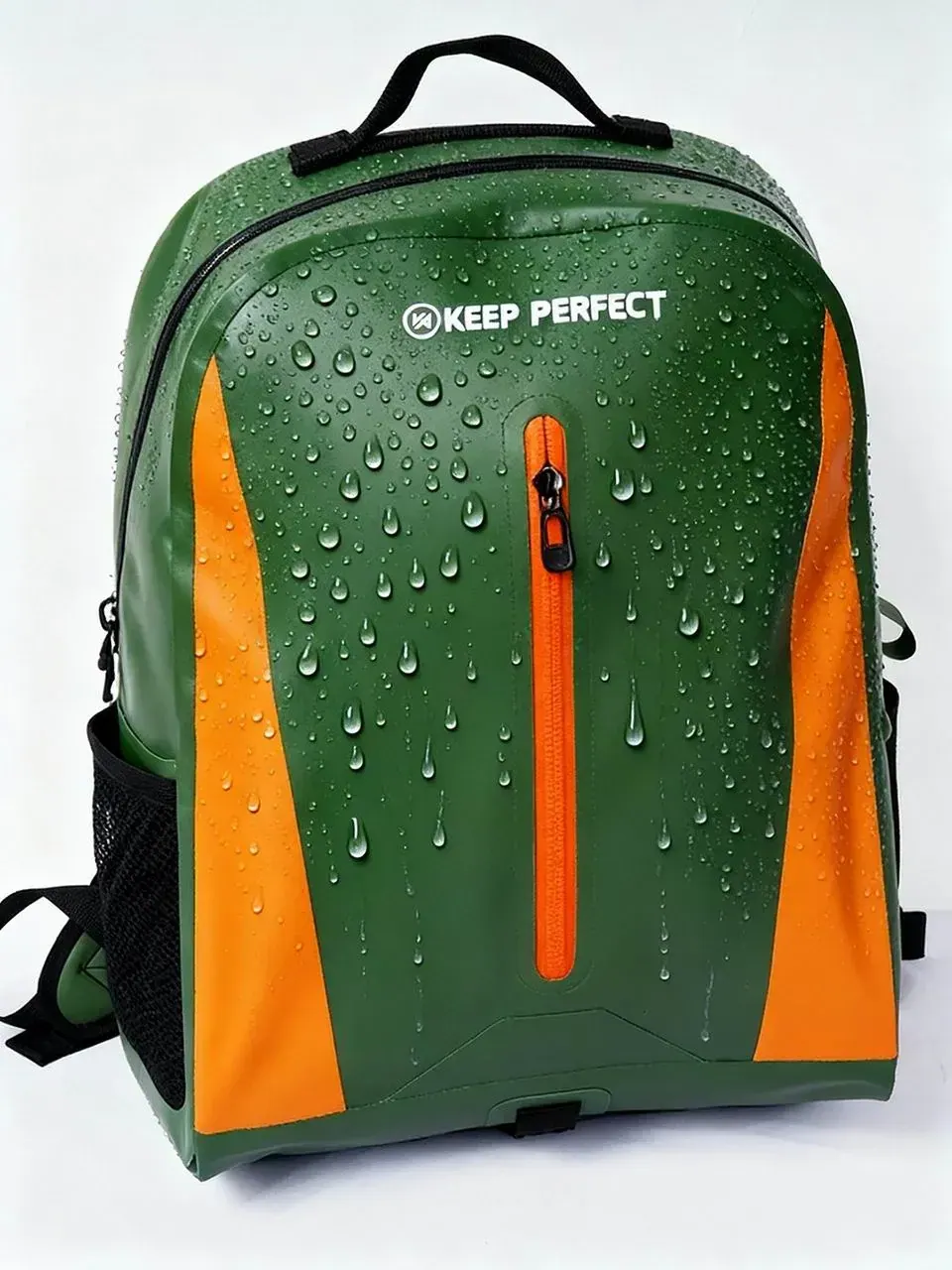
Rank 1 is the welded roll-top touring shell at 28-32 L. Its body is RF-welded from 500D or 840D TPU-laminated fabric, so the primary chamber has no needle holes, and the roll-top gives the rider a closure that can be re-made imperfectly and still hold. Rated IPX7 with three turns and 75-100 mm of clean material, it takes a 6 kg load without visible pumping at 110 km/h when the sternum strap sits at mid-chest. Typical mass is 1.1-1.4 kg, which is acceptable for the volume.
Rank 2 is the TIZIP front-panel hardshell at 24-28 L. A moulded or semi-rigid back panel keeps a 15-inch laptop flat, and the airtight zipper gives panel access without re-rolling the top. The trade-off is closure discipline: a TIZIP needs clean teeth, correct lubrication, and full seating, and a single grain of grit can open a capillary path. Scored IPX7 when maintained, it loses 6 points against rank 1 because field repair is harder and the zipper is the most expensive single component to replace.
Rank 3 is the RF-welded roll-top with an integrated helmet net at 25-30 L. It gives up 2 litres of internal space to an external capture system that holds a full-face helmet without crushing the roll or distorting the shell. Hardware is 304 stainless or coated zinc alloy at all load points. For a rider who parks and walks more than twice a day, this class is often the better daily answer even though the touring shell above it seals marginally better on the bench.
Ranks 4 to 7: Balanced Daily and Touring Bodies
Rank 4 is the roll-top soft shell with taped seams at 22-26 L. Seams are stitched then sealed with a 20-25 mm tape, which removes most leak paths while keeping the pack soft enough to compress into a top box. It reaches IPX6 but not a credible immersion claim, because tape edges are the first place to lift after 300 open and close cycles. Price lands roughly 30 percent under the top three classes.
Rank 5 is the hardshell clamshell with a gasket at 26-30 L. A compression gasket around the opening plus four cam latches gives fast, structured access for camera bodies, drones, or test instruments. The shell resists crushing at 6 kg but adds 300-500 g. It scores well on protection and poorly on walk comfort, so it suits riders who load at the bike and unload at the site rather than carrying for long distances.
Rank 6 is the fold-flat welded daypack at 18-22 L, built for riders who already run panniers or a top box and need a small body that disappears when empty. It rolls to roughly 60 mm thick and weighs 600-800 g. Rank 7 is the convertible backpack and tail roll at 20-26 L, which carries as a pack and straps to the pillion or rack with two captured webbing points. Both lose points on helmet handling but gain on system flexibility.
Ranks 8 to 10: Light, Packable, and Fleet Options
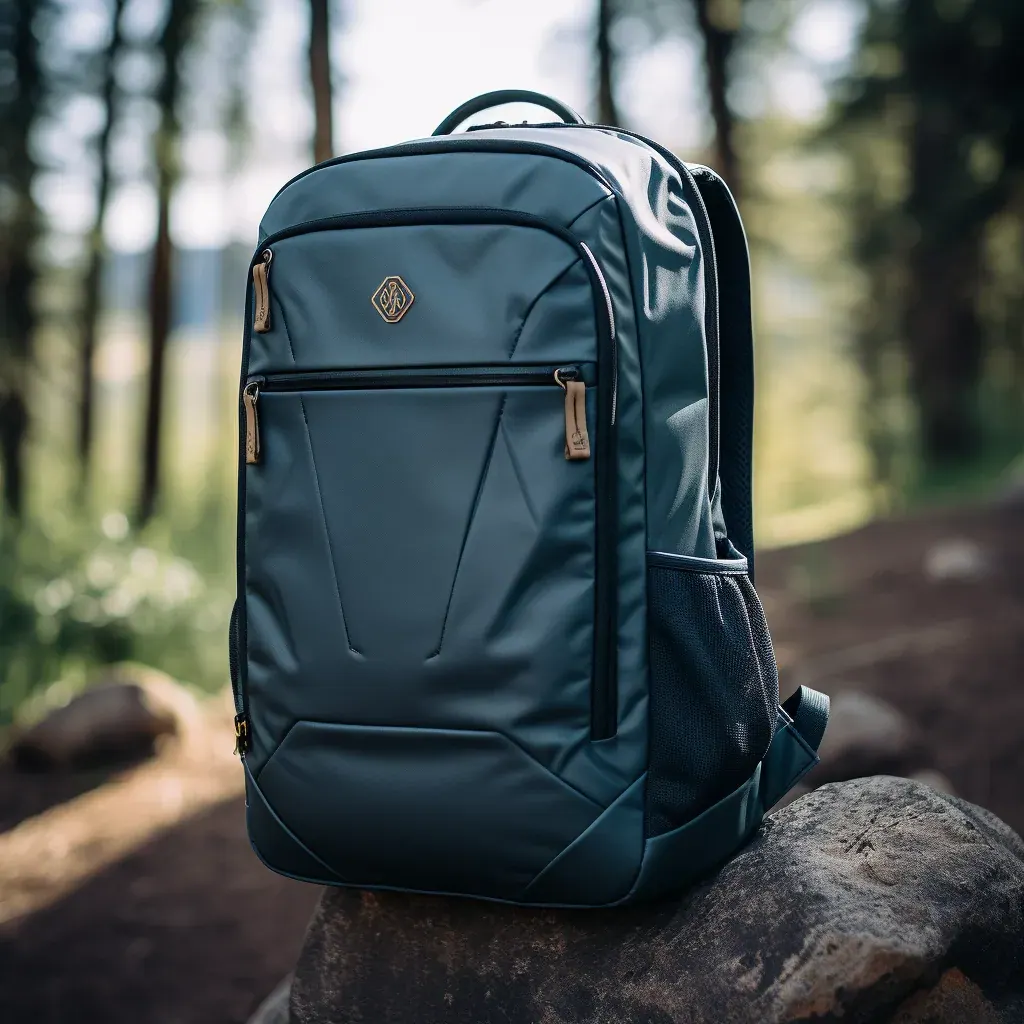
Rank 8 is the light ripstop shell with a rain cover at 20-24 L, reaching IPX4 to IPX5. A rain cover is a deployable layer that must be found, fitted, and dried, and it flaps at speed, so this class only suits occasional showers. Rank 9 is the packable 12-16 L emergency shell that compresses to about the size of a 1 L bottle and lives inside a top box for an unplanned storm.
Rank 10 is the budget welded 20 L basic aimed at fleet, rental, and delivery programmes. It uses a simpler harness, fewer reflective zones, and a single pocket, but keeps the welded body and three-turn roll. At 500 pcs per design and colour this class is where unit cost matters most, and the specification should still require the same water screen as the premium classes.
Nothing below rank 8 should be the only wet-weather carrier for a rider who leaves in the rain every day. The failure mode is rarely a dramatic soak; it is a slow damp patch behind the shoulder blade that appears after 40 minutes and quietly ruins a laptop or a set of work documents.
Helmet Carry and Load Geometry
A full-face helmet is roughly 300 mm long, 260 mm wide, and 280 mm tall, and it does not compress. Carrying one externally changes the centre of gravity backward by 80-120 mm, which is why a pack that feels fine in a shop can feel unstable at 100 km/h once the helmet is on the outside. Use a captured net or two diagonal straps, never a single loop, and keep the helmet below the top roll line so it cannot lever the closure open.
| Volume class | Helmet handling | Laptop handling | Speed comfort |
|---|---|---|---|
| 18-22 L | External net only | 13-inch sleeve maximum | Stable to 110 km/h at 4 kg |
| 24-28 L | External net or rear cradle | 15-inch flat panel fits | Stable to 110 km/h at 6 kg |
| 28-32 L | Helmet inside when pack is half full | 15-inch plus tablet | Stable to 100 km/h at 7 kg |
| 32 L and above | Helmet plus jacket inside | Two-device panel | Check yaw behaviour above 90 km/h |
Rider packs differ from hiking bodies in one important way: the load is carried in a fixed, slightly forward posture with the arms busy, so a harness that is comfortable walking can be wrong on the bike. The waterproof motorcycle backpack collection groups bodies by harness geometry and closure rather than by colour, which is the faster way to shortlist. Where the helmet must travel inside, plan the load order: helmet low and central, laptop flat against the back panel, wet rain layer outside the dry zone.
The waterproof backpack for helmet carry guide sets out strap routing and clearance checks in more detail, including the 30 mm minimum clearance between a helmet shell and the closure roll and the two-point diagonal method that stops a helmet from levering the top open.
Closure Type, IPX Target, and What the Water Test Must Cover
The number on the tag means nothing without the condition behind it. The ingress codes are defined by the IEC ingress protection framework: IPX6 covers powerful water jets, IPX7 covers temporary immersion at a stated depth and duration, and IPX8 must always be quoted with the depth and time agreed with the programme partner. A pack sold as IPX8 with no depth is not a specification.
- Roll three full turns with 75-100 mm of clean material and confirm the buckle seats under load.
- Screen the finished pack with the helmet net or laptop panel fitted, not the empty shell.
- Place dry indicator tissue at both closure corners, behind external patches, and at the base.
- Run 60 minutes of directed spray at about 20 mm per hour before any immersion screen.
- Repeat the screen after 300 open and close cycles because folds change with use.
For a rider pack, IPX6 is the working minimum and IPX7 is the sensible target when a drop into standing water or a creek crossing is credible. Do not pay for IPX8 on a commuting pack; pay instead for a better harness, more reflective area, and a closure that can be operated in winter gloves. Broader comparisons sit in the best waterproof backpacks roundup, which covers non-riding classes as well.
Harness Fit, Visibility, and Road Safety
At 6 kg and 100 km/h, a pack that moves 30 mm vertically produces a rhythm the rider reads as instability. Use 55-75 mm shoulder straps with a load-lifter angle near 45 degrees, a sternum strap at mid-chest rather than throat height, and a hip belt that stabilises without interfering with a motorcycle jacket. Test in the actual riding jacket and gloves, because a bare-shirt fitting proves nothing about road fit.
Visibility is a specification item, not a decoration. Require at least 80 square centimetres of retroreflective area distributed across the rear and both sides, plus a light-colour panel for daylight conspicuity. Reflective transfer film should survive 20 wash cycles and 500 abrasion cycles. Check weather and road conditions before departure; NOAA weather resources support that review in the United States, and local equivalents apply elsewhere.
Where Rider Packs Wear Out First
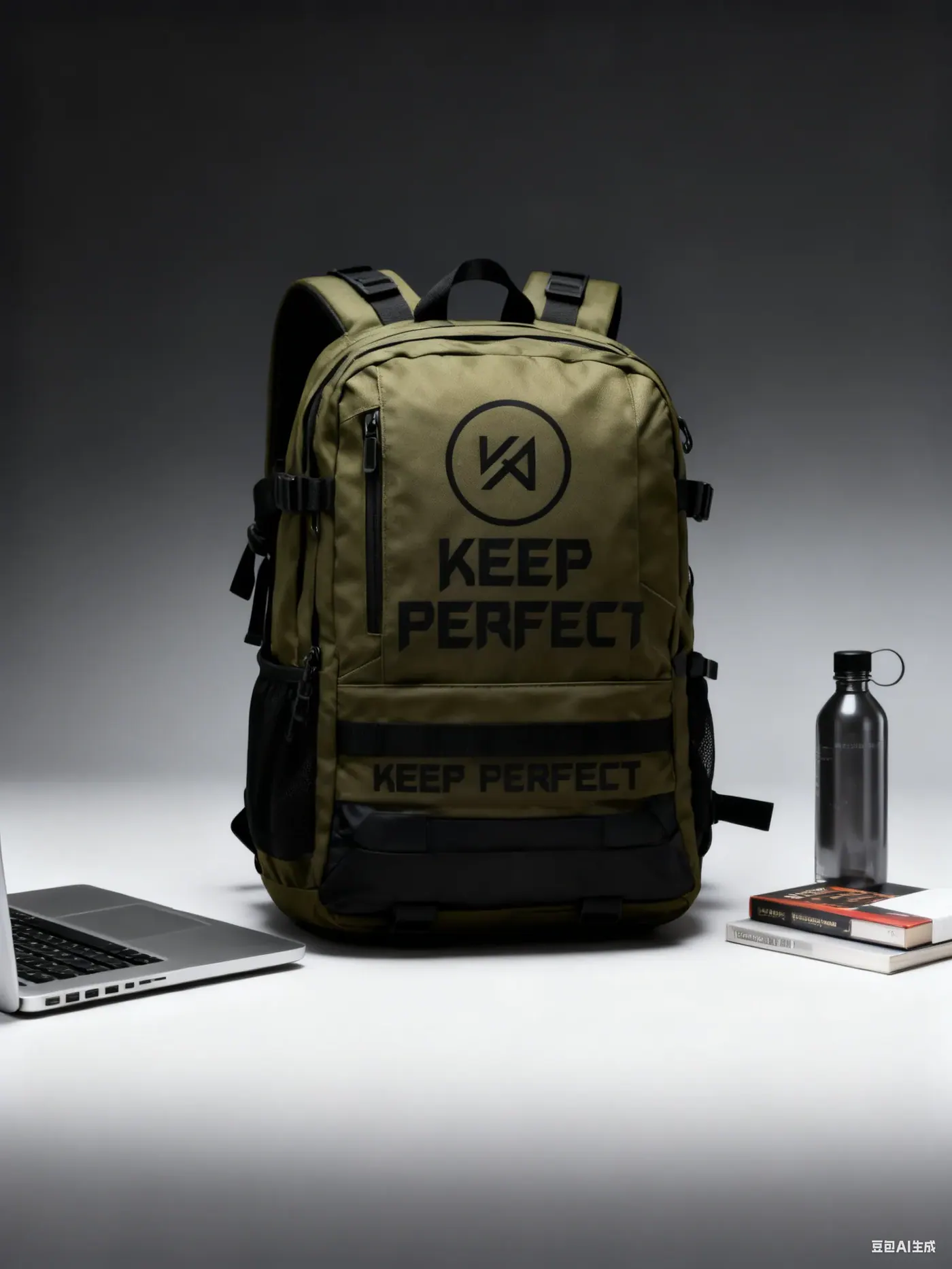
Field returns cluster around four locations: the roll-top fold line, the lower 150 mm of the base, the shoulder strap attachment islands, and the helmet net anchor points. The fold line fails first because it is creased in the same place every single ride; rotate the fold position by 20-30 mm and the crease life roughly doubles. The base fails second, because riders set the pack down on wet gravel, kerbs, and garage floors far more often than hikers do.
Abrasion is measurable. Specify a base fabric of at least 840D or a welded TPU patch of 0.5 mm, and require an abrasion screen consistent with ASTM test methods for coated fabrics. A pack that passes 500 cycles at 6 kg is a reasonable target for daily commuting; 1,000 cycles suits courier and delivery fleets. Record the cycle count in the specification rather than relying on a generic heavy duty claim.
Service life for a welded rider shell is typically four to six seasons of daily use, and the closure is usually the limiting component, not the fabric. Budget a zipper or buckle replacement at year three for TIZIP classes. Cleaning is straightforward: fresh water rinse, mild pH-neutral soap, no solvents, no machine washing, and air dry open for 8-24 hours. The waterproof backpack cleaning guide covers the full sequence, including how to clear grit from zipper teeth before storage.
Programme Baseline for Rider Packs
Write the specification as a single sheet: volume band, closure type, IPX target with condition, helmet and laptop handling, reflective area in square centimetres, hardware grade, harness dimensions, and the exact water screen. Add acceptance criteria for seam appearance, coating thickness, and colour fastness. Approve at least three samples per class because one dry result does not establish consistency across a run.
| Programme item | Baseline | Note |
|---|---|---|
| MOQ | 500 pcs per design and colour | Colour split within one design is negotiable above baseline |
| Sampling | 6-10 working days | Add 3-5 days for a hardware change |
| Bulk | 35-50 days | Starts from approved sample and deposit |
| Inspection | AQL 2.5 | Include litres, closure, anchors, reflective area |
| Compliance | REACH and California Prop 65 | Screen coatings, films, and hardware finishes |
QUANZHOU JUNYUAN BAGS has supported waterproof bag programmes since 2014, with the founding team in the industry since 2004 and monthly output of 200,000 units verified by SGS. BSCI and ISO 9001 systems support the workflow. A rider pack brief can be emailed to service@junyuanbags.com.
Include helmet dimensions, laptop size, typical load, riding speed range, and expected weather in the enquiry so the closure and harness can be specified in one pass. FOB Xiamen or DDP service to more than 100 countries follows an approved sample and a complete test record. The final rule is simple: buy the closure and the harness first, and let the badge name follow.
People Also Ask
What size waterproof backpack is best for motorcycle commuting?
Twenty to 28 L covers most daily rides, with 28-32 L needed when a full-face helmet or a jacket must travel inside. Subtract about 3-4 L from the printed figure because the roll-top consumes that space when closed correctly.
Do motorcycle backpacks need IPX7 or is IPX6 enough?
IPX6 is the working minimum for rain at speed, and IPX7 is the sensible target when standing water, creek crossings, or a drop are credible. IPX8 only matters when a specific depth and duration are written into the specification.
Can a full-face helmet fit inside a waterproof backpack?
Only in 28-32 L bodies and only when the pack is roughly half full. In smaller classes use a captured external net with two diagonal straps and keep the helmet below the top roll line.
Why does a backpack feel unstable at motorway speed?
Vertical movement above 20 mm at 90-110 km/h creates a pumping rhythm against the spine. Causes include a sternum strap at throat height, loose load lifters, and a helmet carried high on the outside of the pack.
Are hardshell motorcycle backpacks better than roll-top shells?
Hardshells protect crushable gear and give flat laptop access but add 300-500 g and walk less comfortably. Roll-top welded shells seal more consistently and are easier to re-close imperfectly in the field.
How much reflective area should a rider backpack have?
Require at least 80 square centimetres distributed across the rear and both sides, with transfer film rated for 20 wash cycles and 500 abrasion cycles. Daylight conspicuity needs a light-colour panel as well.
Frequently Asked Questions
Q1. What is the best waterproof motorcycle backpack overall?
A welded roll-top touring shell at 28-32 L with an IPX7 finished-pack result, three-turn closure, external helmet capture, and a harness holding movement under 20 mm at 110 km/h.
Q2. How many litres do I need for a daily motorcycle commute?
Twenty to 26 L handles a laptop, documents, and a light rain layer. Move to 28-32 L if a full-face helmet or a riding jacket must be carried as well.
Q3. Is a roll-top closure better than a waterproof zipper on a motorbike?
A roll-top tolerates a slightly imperfect close, which matters at the roadside in the rain. A TIZIP gives faster flat access but needs clean teeth and full seating every time to hold the same rating.
Q4. Do waterproof motorcycle backpacks stay put at high speed?
They do when the harness is right. Use 55-75 mm straps, a mid-chest sternum strap, load lifters near 45 degrees, and a stabilising belt that clears the riding jacket.
Q5. Can I carry a helmet and a 15 inch laptop in one pack?
Yes in a 28-32 L class with a flat back panel, provided the helmet sits low and central and the laptop stays against the panel. Smaller classes need an external helmet net.
Q6. What IPX rating should a rider look for?
IPX6 minimum for rain at speed, IPX7 where temporary immersion is credible. Treat any IPX8 claim without a stated depth and duration as incomplete.
Q7. How is a waterproof backpack tested before bulk approval?
Screen the finished pack with load and accessories fitted: 60 minutes of directed spray at about 20 mm per hour, then the agreed immersion condition, with dry indicator tissue at closure corners, patches, and base.
Q8. Are hardshell packs worth the extra weight?
They are worth 300-500 g when the load includes camera bodies, drones, or instruments. For documents and clothing a welded soft shell is lighter and more comfortable off the bike.
Q9. How do I stop a backpack from making my back sweat?
Use a suspended mesh back panel with 8-12 mm standoff, keep the load under 6 kg where possible, and ventilate the jacket. Full waterproofing and full airflow cannot both be maximised in one panel.
Q10. What hardware grade should be specified for wet riding?
Use 304 stainless or properly coated zinc alloy at all load points, and screen with a salt fog exposure. Plain steel fittings rust within one coastal season and stain the shell.
Q11. Can I put a rain cover on a non waterproof backpack instead?
A cover works for occasional showers but must be found, fitted, and dried, and it flaps at speed. A welded body with a real closure removes the step entirely.
Q12. What is the MOQ for a rider backpack programme?
The baseline is 500 pcs per design and colour, with samples in 6-10 working days and bulk in 35-50 days from approved sample and deposit.
Q13. How should a waterproof motorcycle backpack be dried after a wet ride?
Empty every pocket, wipe the closure, open the roll fully, and air dry for 8-24 hours away from direct heat. Inspect fold lines and hardware every five rides and re-screen the pack every six months.