An EVA tote can be carried three ways and each suits a different distance: top handles with a drop of 12 to 18 centimetres suit a hand carry of about 150 metres, a shoulder strap at 40 to 60 centimetres extends that to roughly 500, and a crossbody at 55 to 75 centimetres is the choice when one hand has to stay free. Strap width decides comfort above 10 kilograms, with 38 to 50 millimetres the working range, and the anchor rather than the webbing is the part that fails. Add 1.10 to 2.80 dollars per unit for a detachable strap with corrosion-resistant fittings.
Three Ways to Carry an Open Body
A moulded tote is made with two top handles, and everything else is an addition. That base configuration is right for a short carry and wrong for a long one, and the reason is anatomical rather than stylistic: carrying a load by handles at the hip holds the arm in a fixed position, and the limiting factor is not strength but how long that position can be held. Roughly 150 metres is where most people set the bag down and swap hands.
Adding a strap changes the load path completely. The weight moves onto the opposite shoulder or across the torso, the arm is free to swing, and the comfortable distance roughly triples. That is the whole argument for a strap, and it means the decision is made by distance rather than by appearance: a bag used from a car to a sun lounger needs no strap, and a bag walked 400 metres across a car park needs one and will be uncomfortable without it.
| Carry mode | Drop length | Comfortable distance | Hands free | Best for |
|---|---|---|---|---|
| Top handles only | 12 to 18 centimetres | Up to about 150 metres | No | Car to lounger, pool, garden |
| Shoulder strap, one shoulder | 40 to 60 centimetres | About 400 to 600 metres | Partly | Beach walks, longer carries |
| Crossbody, across the torso | 55 to 75 centimetres | 600 metres and beyond | Yes | Children, tickets, second bag |
| Handles plus strap together | Both | Any | No | Heavy loads over mixed terrain |
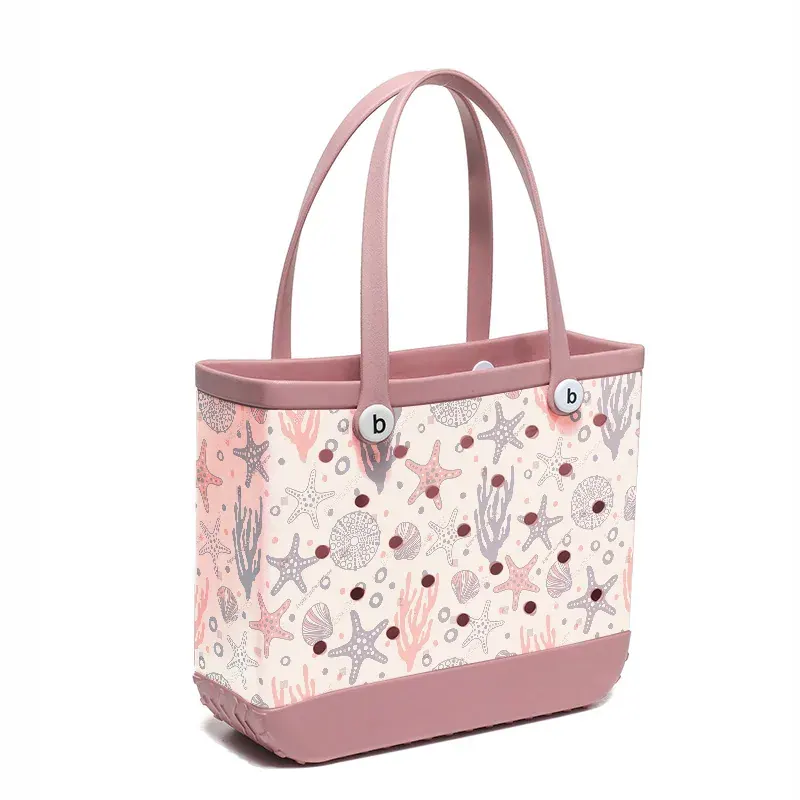
The fourth row is the one most buyers miss. A heavily loaded body is more stable and more comfortable carried by the handles and the strap together, because the strap takes the weight while the hand stops the bag swinging. It is the right mode for a 14 kilogram load across soft sand or a boat deck, and it is the reason a detachable strap is worth having even on a bag that will mostly be carried by hand.
Top Handles: Drop, Section and Grip
Handles on a moulded body are formed in the same shot as the rest of the bag, which is why they do not come off and why they cannot be replaced. The section is typically 18 to 28 millimetres wide and 8 to 14 millimetres thick at the grip, tapering into the rim over a generous radius. Two dimensions decide comfort: the drop, at 12 to 18 centimetres, and the grip width, which should be at least 20 millimetres or it cuts into a hand under a 10 kilogram load.
The radius where the handle meets the rim is the detail that determines whether a bag lasts. That junction carries the entire carried load through the smallest cross-section in the body, and a sharp radius concentrates stress exactly there. A well-designed tool puts a radius of 8 to 15 millimetres at that point and thickens the section to 5 to 8 millimetres. It is invisible in a photograph and it is the difference between a bag that lasts five seasons and one that cracks at the handle in the second.
| Handle attribute | Minimum | Good design | Failure if below |
|---|---|---|---|
| Drop | 12 centimetres | 14 to 18 centimetres | Knuckles scrape the body when loaded |
| Grip width | 18 millimetres | 20 to 28 millimetres | Cuts into the hand above 10 kilograms |
| Grip thickness | 8 millimetres | 10 to 14 millimetres | Handle flexes and feels flimsy |
| Root radius | 6 millimetres | 8 to 15 millimetres | Crack at the handle root under repeated load |
| Root section | 4 millimetres | 5 to 8 millimetres | Tears away from the rim |
Shoulder Strap: Drop and Width
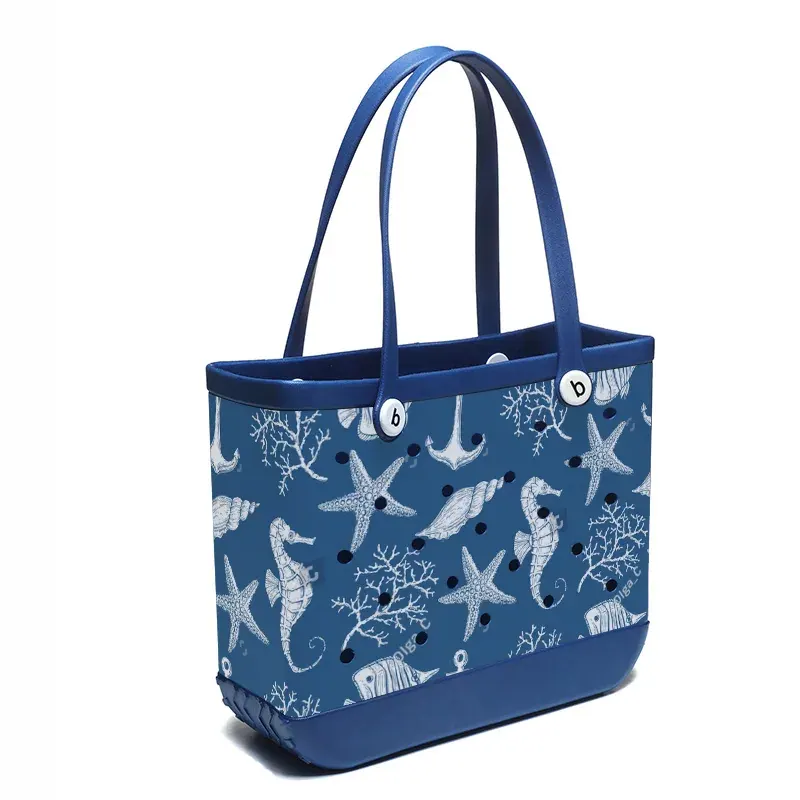
Two numbers govern a shoulder strap and they are independent of each other. The drop, measured from the top of the shoulder to the top of the bag, runs 40 to 60 centimetres and decides where the bag sits: a shorter drop puts it at the waist, a longer one at the hip. The width decides whether it is comfortable, and below about 25 millimetres a strap cuts into a shoulder once the load passes 10 kilograms. The working range for a beach or sports bag is 38 to 50 millimetres, ideally with a sliding pad.
| Strap width | Webbing type | Comfortable to | Typical use |
|---|---|---|---|
| 20 to 25 millimetres | Flat polyester webbing | 6 to 8 kilograms | Light pool and gym bags |
| 25 to 32 millimetres | Flat webbing or moulded | 8 to 11 kilograms | Standard beach totes |
| 38 millimetres | Flat webbing with a pad | 11 to 13 kilograms | Family beach and sports |
| 45 to 50 millimetres | Webbing with a sliding pad | 13 to 16 kilograms | Coach kit, boat and utility carry |
| Moulded EVA strap | Integral to the body | 10 to 14 kilograms | Programmes wanting a one-material look |
Webbing specification matters as much as width and is almost never checked. A strap that carries 15 kilograms needs a breaking strength well above that, and the figure worth asking for is a rated load of at least twice the intended carried weight, which on a 15 kilogram bag means webbing and hardware rated to 30 kilograms or more. Colour fastness on a dyed webbing is the second check, because a strap that bleeds onto a white body in a hot car produces a return that costs more than the strap. Colour fastness test methods for webbing and coloured articles are published by AATCC.
Crossbody: When It Beats a Shoulder Strap
A crossbody strap is a shoulder strap with a longer drop, and the difference in behaviour is larger than the difference in specification suggests. At 55 to 75 centimetres the bag sits across the torso rather than at the hip, which distributes the load over both shoulders and the back instead of one shoulder, and it stops the bag sliding off, which is the constant annoyance of a single-shoulder carry. For anyone who needs one hand free for a child, a ticket, a chair or a second bag, it is the only sensible option.
Three cautions apply. Crossbody carrying puts a diagonal pull on the anchors that a vertical shoulder carry never does, so the anchor specification matters more rather than less. It makes the bag harder to set down and pick up repeatedly, which is a real cost on a beach where the bag is put down every twenty metres. And it is the least comfortable option in hot weather, because the strap crosses the back and adds a warm layer. The honest recommendation is a detachable strap long enough to do both, adjusted to hip length for a shoulder carry and lengthened for a crossbody when a hand needs to be free.
Anchors and Hardware
The anchor is where a strap system fails and it is the specification most often left to chance. A strap pulls on the rim at an angle the handles never produce, and the moulded anchor takes that pull through a small section of material. Two design answers work: a moulded loop formed in the same shot as the body, which cannot come off but cannot be replaced, and a moulded eyelet that accepts a clip, which is replaceable and is the right choice for a detachable strap.
| Hardware element | Standard option | Better option | Cost difference |
|---|---|---|---|
| Clip material | Plated steel | Moulded polymer or stainless | 0.30 to 0.70 dollars per set |
| Slider | Plated | Moulded, corrosion resistant | 0.10 to 0.30 dollars |
| Anchor | Moulded loop | Moulded eyelet with a replaceable clip | Small at tooling, none per unit |
| Adjuster | None | Tri-glide slide | 0.05 to 0.15 dollars |
| Pad | None | Sliding webbing pad, 12 to 18 centimetres | 0.20 to 0.50 dollars |
Salt water is what separates the two columns and it does so decisively. A plated clip on a bag used in the sea will seize within a season, and a seized clip is the most common reason a strap gets replaced. Moulded polymer or stainless fittings survive five or more seasons for a cost measured in tens of cents per unit, which makes corrosion resistance the single best value specification on any strap. Owners who have already had a fitting seize will find the replacement guidance in the EVA tote repair guide.
Detachability is the last decision and it should nearly always be yes. A strap that cannot be removed gets in the way when the bag stands open on a deck or in a boot, catches on things during a hand carry, and stops the body nesting properly in a carton. Detachable at both ends, with a moulded clip at each anchor, costs little and converts one body between three carry modes rather than locking it into one.
Load, Comfort and Carry Distance
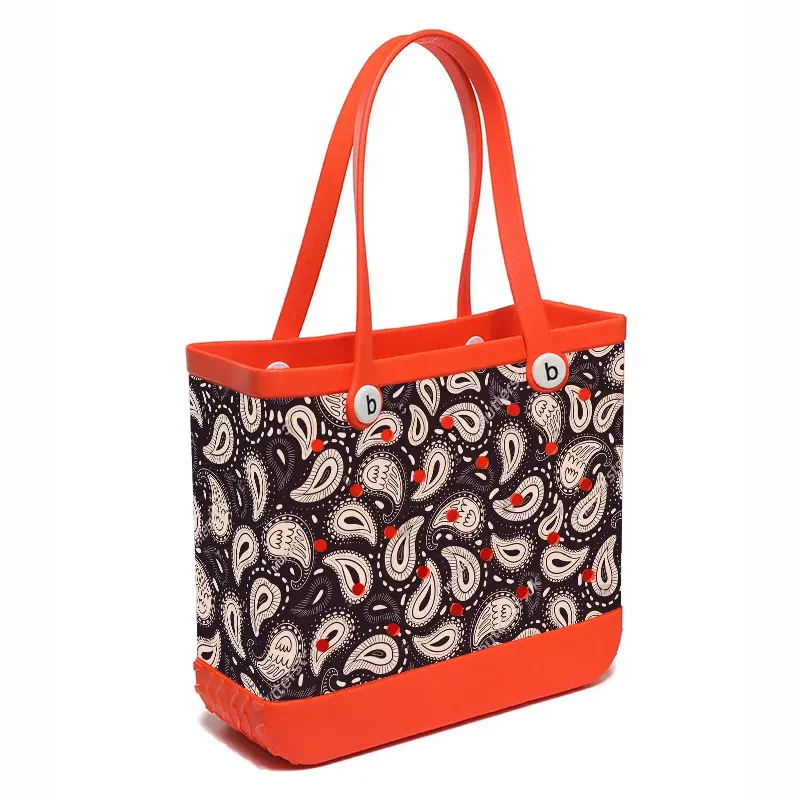
Comfort is a function of three things: the load, the width of whatever touches the body, and the distance. The table below puts the practical combinations in one place, and the pattern is that the load rather than the distance is what forces a wider strap. A 6 kilogram load is comfortable on a 25 millimetre strap for half a kilometre; a 15 kilogram load is uncomfortable on the same strap within a hundred metres.
| Load | Top handles | 25 millimetre strap | 45 millimetre strap with pad |
|---|---|---|---|
| Up to 6 kilograms | Comfortable to 200 metres | Comfortable to 600 metres | Comfortable indefinitely |
| 8 to 10 kilograms | Comfortable to 150 metres | Comfortable to 300 metres | Comfortable to 600 metres |
| 12 to 14 kilograms | Awkward beyond 100 metres | Uncomfortable beyond 150 metres | Comfortable to 400 metres |
| 16 kilograms or more | Two hands needed | Not appropriate | Comfortable to 250 metres, better with handles too |
Two practical notes follow from that table. The comfortable distances assume a flat, firm surface; on soft sand every figure drops by roughly a third, because the instability of the surface transfers into the carry. And the load figures are for a well-fitted strap: a strap adjusted so the bag bounces against the hip is uncomfortable at any weight, and the fix is to shorten it until the bag sits still rather than to widen it.
Straps Across the Size Range
Strap specification should scale with the body, and it frequently does not. A 45 millimetre strap is correct on a 42 litre coach bag and absurd on an 8 litre mini, where it overwhelms the body and costs more than the bag is worth. The table below gives the pairing that works across the range, and the principle behind it is that the strap should look proportionate and be rated for the load the body can actually hold.
| Body size | Volume | Typical load | Strap specification |
|---|---|---|---|
| Mini and kids | 5 to 10 litres | 1 to 3 kilograms | None, or a slim 20 millimetre strap |
| Personal | 10 to 18 litres | 3 to 6 kilograms | 25 millimetre detachable strap |
| Standard | 18 to 32 litres | 6 to 11 kilograms | 38 millimetre strap with a pad |
| Large utility | 32 to 42 litres | 10 to 14 kilograms | 45 to 50 millimetre strap, rated hardware |
| Extra large | 42 litres and above | 14 to 18 kilograms | 50 millimetre strap, handles and strap together |
One exception is worth naming. A mini sold to a child should have either no strap or a short one that cannot loop around the neck, and this is a safety specification rather than a comfort one. A strap long enough to catch on something while a child is wearing the bag is a hazard, and a breakaway or a short handle-only design is the correct answer for the smallest sizes.
Choosing for a Programme
A buyer specifying straps for a range has six decisions, and making them in this order produces a strap system that works without over-specifying anything. Each line is cheap to confirm at sampling and expensive to discover wrong after delivery.
- Decide on strap provision per size: none on minis, 25 millimetres on personal sizes, 38 to 50 on the larger bodies.
- Set the drop: 40 to 60 centimetres for a shoulder carry, 55 to 75 if crossbody should also be possible.
- Set the width against the intended load, using 38 to 50 millimetres for anything above 10 kilograms.
- Specify the hardware grade: moulded polymer or stainless for any programme that will see salt water.
- Specify the anchor: a moulded eyelet with a replaceable clip rather than a fixed loop, so the strap can be swapped.
- Specify a rated load of at least twice the intended carried weight, and ask for the test result in writing.
The last of those is the one that prevents disputes. Load test methods for webbing, clips and anchors are published by ASTM International, and a written result against a named method is enforceable at inspection while a claim of strong is not. Documented quality management around holding those records aligns with the International Organization for Standardization, and every bulk shipment in this programme is inspected at AQL 2.5 before release.
Carrying on Sand, Decks and Stairs
Terrain changes which carry mode works, and the differences are large enough to be worth planning for rather than discovering. On soft sand every comfortable distance in the table above drops by roughly a third, because the surface moves underfoot and the bag swings with each step; the practical answer is to shorten the strap until the bag stops bouncing, which is worth more than any change in width. On a boat deck the opposite applies: the bag should be held rather than slung, because a swinging 12 kilogram body on a moving deck is a hazard to the carrier and to everything it hits.
| Terrain | Best mode | Why | Adjustment |
|---|---|---|---|
| Soft sand | Shoulder strap, shortened | Stops the bag bouncing with each step | Shorten until the body sits still at the hip |
| Boardwalk or pavement | Handles or shoulder | Firm surface, no penalty either way | None |
| Boat deck | Handles, or handles plus strap | A swinging load on a moving deck is dangerous | Hold the bag, do not sling it |
| Stairs or a pier ladder | Crossbody | Keeps one hand free for a rail | Lengthen to 55 to 75 centimetres |
| Crowded resort or event | Crossbody | Keeps the bag in front and a hand free | Lengthen and wear it across the front |
| Car park with a second load | Crossbody | Frees a hand for a chair or a child | Lengthen, and use a padded strap |
The recurring theme is that the strap should be adjustable over a wide range rather than fixed at one length. A strap that adjusts from 40 to 75 centimetres covers every row of that table with one product, and the adjuster that makes it possible costs 5 to 15 cents. A fixed-length strap locks the buyer into one mode and is the most common reason an otherwise good bag is left at home on the day it was needed.
Straps, Packing and Freight
One commercial point belongs in a strap guide because it costs more than the strap does. Fitting straps before packing reduces the number of bodies that nest into a carton, typically from 8 to 5 or 6 on a 32 litre body, which raises freight cost per unit by roughly a third. Shipping straps detached in an inner box inside the same carton keeps the packing density, adds a two-minute assembly step at the destination and costs almost nothing. A buyer ordering above about 3,000 pieces should specify detached packing and ask for both carton quantities in writing, because the difference is invisible in a unit price and material in a landed cost.
The retail counter-argument is real and worth weighing: a bag that arrives assembled can go straight onto a shelf, while one that arrives detached needs assembly by store staff. For a small programme the shelf-readiness is worth more than the freight; for a large one the freight is worth more than the labour. The dividing line sits somewhere around 3,000 pieces, and it is a decision worth making deliberately rather than by default.
Programme Notes
The body range sits in the injection-molded EVA tote guide, strap and hardware replacement in the EVA tote repair guide, and the wider selection in the best EVA beach totes guide. Buyers comparing carry options against body size should read the EVA tote size chart alongside this page. QUANZHOU JUNYUAN BAGS has run waterproof bag programmes since 2014 with a founding team in this trade since 2004, at monthly output of 200,000 units verified by SGS, under BSCI and ISO 9001, with materials screened for REACH and California Prop 65 and every bulk shipment inspected at AQL 2.5 before release.
Send the body size, the intended load, the carry distance, the strap width and the hardware grade to service@junyuanbags.com, and ask for the rated load of the webbing and the fittings in writing, because that figure decides whether a strap lasts a season or five. Sampling runs 6 to 10 working days and bulk 35 to 50 days.
People Also Ask
Should an EVA tote have a shoulder strap?
Yes, if the carry exceeds about 150 metres. A strap moves the load to the opposite shoulder and roughly triples the comfortable distance.
What width should an EVA tote strap be?
38 to 50 millimetres for loads above 10 kilograms. Below 25 millimetres a strap cuts into the shoulder once the load passes about 10.
What is the difference between a shoulder strap and a crossbody?
Drop length. A shoulder strap runs 40 to 60 centimetres and sits at the hip; a crossbody runs 55 to 75 and sits across the torso, keeping a hand free.
How much weight can a strap carry?
A 45 millimetre strap with a pad is comfortable to 13 to 16 kilograms. Specify webbing and fittings rated to at least twice the intended load.
Should the strap be detachable?
Yes, at both ends. A fixed strap gets in the way when the bag stands open, catches during a hand carry and stops the body nesting in a carton.
What hardware is best near salt water?
Moulded polymer or stainless fittings. A plated clip on a bag used in the sea seizes within a season.
Frequently Asked Questions
Q1. Do EVA totes come with straps?
Two moulded top handles come as standard. A shoulder or crossbody strap is an addition, usually detachable, costing 1.10 to 2.80 dollars per unit.
Q2. How far can I carry a tote by its handles?
About 150 metres. Beyond that the arm is held in a fixed position and the limiting factor is posture rather than strength.
Q3. What strap drop do I need?
40 to 60 centimetres for a shoulder carry at the hip, and 55 to 75 centimetres if you also want the option of wearing it across the torso.
Q4. Is a wider strap always better?
Up to about 50 millimetres, yes. Beyond that a strap looks disproportionate on a small body and adds weight without comfort.
Q5. What breaks first on a strap?
The hardware, not the webbing. A plated clip seizes near salt water within a season, which is why corrosion-resistant fittings are worth the extra cost.
Q6. Can a strap be added to a body that has none?
Only if the body has moulded eyelets or an anchor loop. A strap cannot be fixed to a body that was moulded without a provision for one.
Q7. Should I carry by handles and strap together?
For loads above about 14 kilograms, yes. The strap takes the weight and the hand stops the bag swinging.
Q8. What rated load should I specify?
At least twice the intended carried weight. On a 15 kilogram bag that means webbing and fittings rated to 30 kilograms or more.
Q9. Should a child's tote have a strap?
Either none or a short one that cannot loop around the neck. A long strap on a small body is a safety hazard rather than a convenience.
Q10. How do I stop a shoulder strap slipping off?
Lengthen it to a crossbody drop of 55 to 75 centimetres, which puts the load across the torso rather than on one shoulder.
Q11. Does strap width affect the price much?
Modestly. A 45 millimetre strap with a pad and corrosion-resistant fittings adds 1.10 to 2.80 dollars per unit, most of which is hardware grade.