Under 100 dollars at retail, a fishing tackle bag is a series of deliberate omissions, and knowing which omissions are acceptable is the whole skill: FOB bands of 11-40 USD land on shelves at 35-99 USD once freight, duty, and margin are applied. Ten value builds were assessed for 2026 across 10-50 litres, one to four trays, 420D to 600D shells, coated coil to submersible zips, and IPX4 to IPX7 ratings. MOQ is 500 pcs per design and colour, samples take 6-10 working days, and bulk runs 35-50 days. The pick is the 32 L tray backpack at a 22-27 USD FOB band.
What a Retail Price of 100 Dollars Actually Buys
A bag retailing at 99 USD typically leaves the dock at 30-38 USD FOB Xiamen once freight, duty, and a retail multiplier of 2.6-3.2 are applied. Working backwards from the shelf price is the only honest way to brief a value product, because a buyer who starts from a FOB number and guesses the retail will either over-specify and lose the price point or under-specify and lose the customer.
Three tiers sit under 100 dollars and each one is defined by what it gives up. Between 35 and 50 dollars retail the bag gives up tray count and water protection. Between 50 and 75 dollars it gives up the closure and the base. Between 75 and 100 dollars it gives up the rating and the hardware finish, and that is the tier where a good bag still looks and performs like an expensive one.
| Retail tier | FOB band | What it keeps | What it gives up |
|---|---|---|---|
| 35-50 USD | 11-18 USD | Two trays, 420D shell, coated coil zip | Rating above IPX4, moulded base, tray rails |
| 50-75 USD | 18-27 USD | Three to four trays, 600D shell, taped seams | Submersible zip, moulded base, hip belt |
| 75-100 USD | 27-40 USD | Four trays, IPX5 or IPX6, moulded base | IPX7 liner, serviceable hardware, binder sleeves |
The Component Ladder: Where the Money Goes
Four components account for most of the cost difference between a 15 USD bag and a 40 USD bag, and understanding the ladder lets a buyer spend deliberately. The closure is the steepest step: a coated coil zip costs around 1.20 USD, a water-resistant reverse coil about 3.80 USD, and a genuine submersible zip 6-9 USD. A buyer who specifies the middle option keeps most of the performance for less than half the price.
| Component | Entry | Mid | Top | Performance jump |
|---|---|---|---|---|
| Closure | Coated coil, 1.20 USD | Reverse coil, 3.80 USD | Submersible, 6-9 USD | Showerproof to submersible |
| Shell fabric | 420D polyester, 0.90 USD/m | 600D polyester, 1.40 USD/m | 1000D PVC, 2.60 USD/m | Abrasion life roughly triples |
| Base | Fabric, 0.60 USD | Coated fabric, 1.40 USD | Moulded EVA, 2.40-4.00 USD | Stands on a wet deck |
| Trays | None | Two 3600, 2.10-3.40 USD | Four 3700, 7.00-11.00 USD | Organisation and protection |
| Hardware | Plated, 0.12 USD | Acetal, 0.45 USD | 316 stainless, 0.85 USD | Rust resistance in salt |
The pattern across the ladder is that the middle step usually delivers most of the benefit. Moving from a coated coil to a reverse coil zip buys real spray resistance for 2.60 USD, while moving from a reverse coil to a submersible zip buys a rating most buyers never use for another 3-5 USD. Spending at the middle of each row is how a value bag outperforms its price.
The Ten Builds at a Glance
Retail prices are typical shelf figures for a branded product in a large market, and FOB bands are the corresponding Xiamen prices at 500 pieces. Tray counts state what is included rather than what the chamber could swallow. Two related rankings cover the same ground from different angles: the budget tackle backpack ranking and the general tackle backpack comparison.
| Build | Retail | FOB band | Volume | Trays | Rating |
|---|---|---|---|---|---|
| Compact Backpack 22 | 39 USD | 12-15 USD | 22 L | None | IPX4 |
| Sling 10 | 35 USD | 11-14 USD | 10 L | 1 x 3500 | IPX4 |
| Tote 20 | 45 USD | 14-18 USD | 20 L | 2 x 3600 | IPX4 |
| Day Backpack 28 | 59 USD | 19-24 USD | 28 L | 2 x 3600 | IPX5 |
| Tray Backpack 32 | 69 USD | 22-27 USD | 32 L | 4 x 3600 | IPX5 |
| Waterproof Backpack 30 | 79 USD | 25-31 USD | 30 L | 3 x 3600 | IPX6 |
| Rolling 45 | 89 USD | 29-35 USD | 45 L | 4 x 3700 | IPX5 |
| Tackle Backpack 40 | 95 USD | 30-36 USD | 40 L | 4 x 3700 | IPX5 |
| Submersible Sling 12 | 85 USD | 27-33 USD | 12 L | 2 x 3600 | IPX7 |
| Convertible Duffel 50 | 99 USD | 34-40 USD | 50 L | 5 x 3600 | IPX6 |
The 35 to 50 Dollar Tier
At this tier the bag is a container with straps, and the correct expectation is a season or two of weekend use. A 420D shell with a polyurethane coating handles rain, a coated coil zip keeps spray out, and two trays come loose rather than railed. What is absent is a moulded base, so the bag cannot be set on a wet deck, and a rating above IPX4, so it cannot be dunked.
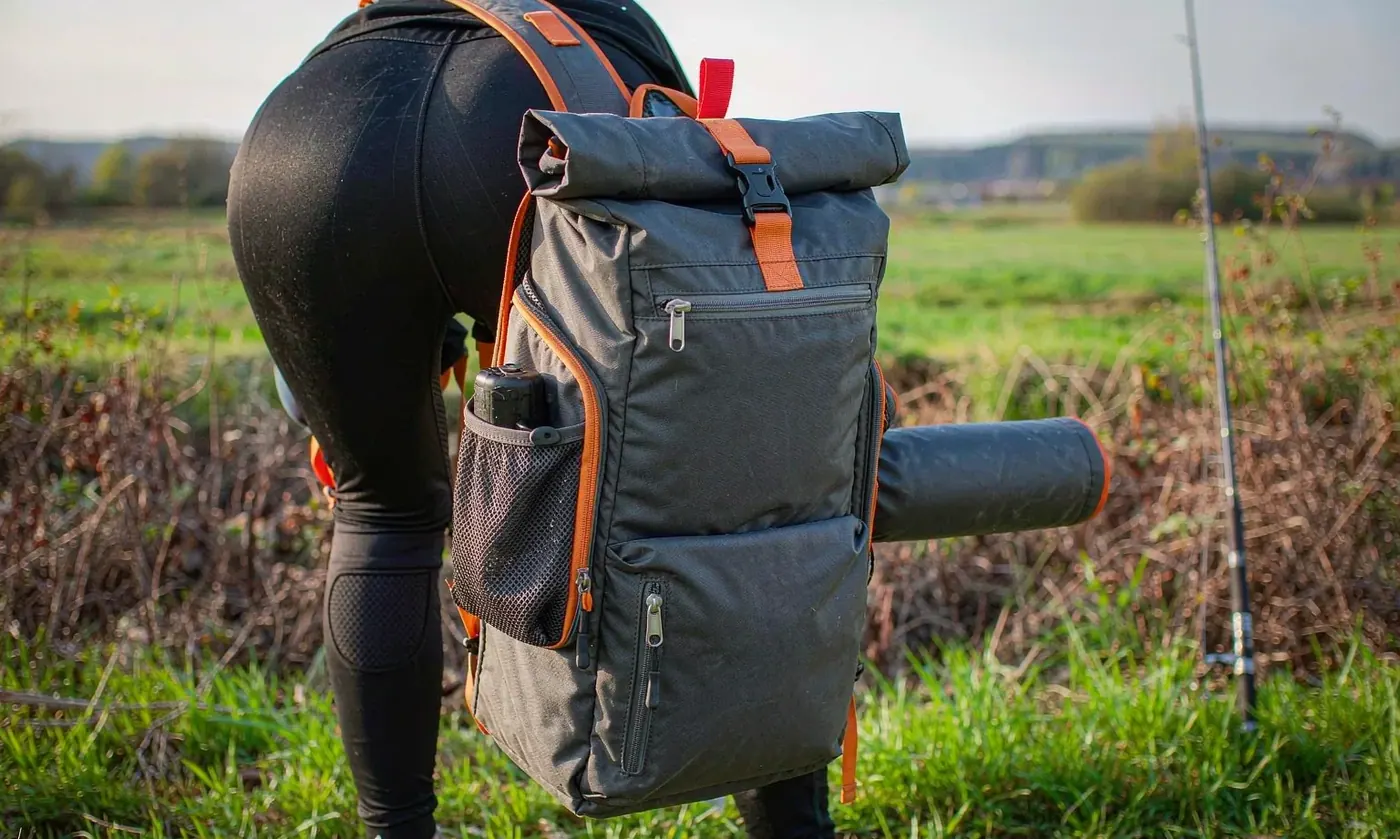
The value decision at this tier is which single feature to protect. For a bank angler it should be strap foam, since a thin strap at 5 kg is the complaint that comes back. For a boat angler it should be the base, because a fabric base on a wet deck soaks the contents on the first trip. Choosing one and cutting the rest produces a better product than shaving every line equally.
The 50 to 75 Dollar Tier
This is the tier that sells in volume, and it is where specification discipline pays. A 600D shell with taped seams, a reverse coil zip, two to four trays on soft sleeves, and a coated fabric base comes to roughly 19-27 USD FOB. The bag resists heavy rain and spray, holds a sensible kit, and survives three or four seasons of weekend use.
The omission that matters is the closure rating: a reverse coil zip handles spray and fails at a dunk. For a bank or a large boat that is fine, and for a kayak it is not. Buyers should match the tier to the platform rather than assuming a higher price buys protection it does not, which is the single most common mismatch in this price band.
The 75 to 100 Dollar Tier
At the top of the range a bag can have a moulded base, four deep trays, and a genuine IPX5 or IPX6 rating, and it looks like a premium product on the shelf. What it still lacks against a 150 USD bag is the submersible liner, serviceable hardware, and the small organisational fittings such as binder sleeves and a caddy hanger.
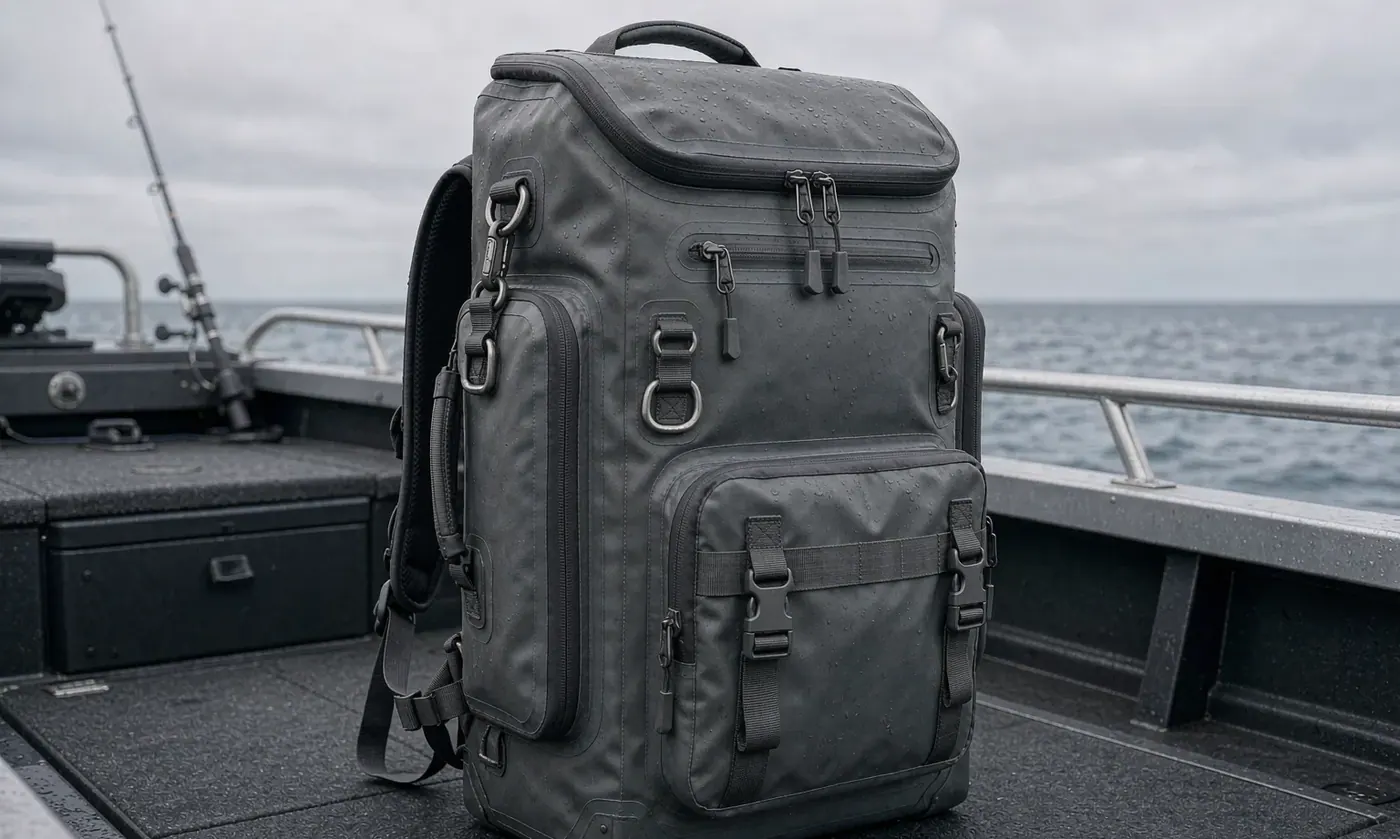
The most useful upgrade at this tier is the moulded drained base, at 2.40-4.00 USD. It is the feature a customer notices immediately, because a bag that stands upright on a wet deck and keeps trays dry solves a problem they have already had. Spending the last 3 USD of a budget on the base rather than on a brighter fabric is the decision that produces reviews rather than returns.
1. Compact Backpack 22: Best Under 40 Dollars
Twenty-two litres at 12-15 USD FOB with no included trays, a 420D shell, a coated coil zip, and an IPX4 rating. It is the honest entry bag: a chamber, two pockets, and shoulder straps, retailing at 39 USD.
What makes it a good value rather than merely cheap is that the strap specification was not cut: 45 mm straps with 8 mm foam. A bag worn at 4-5 kg with thin straps hurts within an hour, and the extra 0.70 USD is the best money in the build. Trays are bought separately, which suits an angler who already owns them.
2. Sling 10: Best Minimal Option
Ten litres at 11-14 USD FOB with one 3500 utility tray, a 65 mm strap, and an IPX4 rating, retailing at 35 USD. It suits a short session on known water where one pattern is enough.
The limitation is stated plainly: one tray, no water protection beyond spray, and a 65 mm strap that is comfortable to about 3 kg. For a two-hour session that is all correct. The acetal buckles are retained even at this price, because plated hardware would rust within a season and cost more in returns.
3. Tote 20: Best Open-Top Value
Twenty litres at 14-18 USD FOB with two 3600 trays, an open top, and a coated fabric base, retailing at 45 USD. It is the cheapest way to get two organised trays into a bag, and it works best on a boat or a bank where the bag is set down.
An open top is the right economy for stowage and the wrong one for walking, since trays need a lid or a wrap to stay put. This build includes a simple elastic tray wrap, which costs 0.80 USD and is the difference between a tote that works and one that spills in a vehicle.
4. Day Backpack 28: Best Mid-Tier All-Rounder
Twenty-eight litres at 19-24 USD FOB with two 3600 trays, a 600D shell with taped seams, a reverse coil zip, and an IPX5 rating, retailing at 59 USD.
This is the volume seller of the group and the clearest example of spending at the middle of the ladder. The 600D shell roughly triples abrasion life against 420D for about 2.50 USD per bag, and the reverse coil zip adds real spray resistance for 2.60 USD. Neither is the top option and both are the right one.
5. Tray Backpack 32: Best Overall Under 100
Thirty-two litres at 22-27 USD FOB with four 3600 trays on vertical rails, a 600D shell, a reverse coil zip, and a moulded base, retailing at 69 USD.
It leads because it delivers the two features that change daily use: railed trays that come out with the pack worn, and a moulded base that keeps them dry on a wet deck. Both sit at the middle of their cost ladders. Four shallow 3600 trays rather than deep 3700 trays is the one compromise, and it is the right one for a general angler.
6. Waterproof Backpack 30: Best Spray Protection
Thirty litres at 25-31 USD FOB with three 3600 trays, a welded seam construction on the lower half, a reverse coil zip under a storm flap, and an IPX6 rating against a 100 litre per minute jet, retailing at 79 USD.
The storm flap is the clever economy here: a flap over a reverse coil zip gets most of the performance of a submersible closure for about 2.20 USD instead of 6-9 USD. It does not survive a dunk, and the listing should say so. Water ingress codes are defined by the IEC ingress protection framework, and a condition always matters more than a code.
7. Rolling 45: Best Wheeled Value
Forty-five litres at 29-35 USD FOB with four deep 3700 trays, 90 mm polyurethane wheels with shielded bearings, and an IPX5 rating, retailing at 89 USD.
Polyurethane wheels at this price are the notable choice, since polypropylene would save 2.40 USD and crack at the hub within a season. The honest limitation is surface: 90 mm wheels suit a ramp and a car park and not soft sand, and the packaging should say so rather than the customer discovering it.
8. Tackle Backpack 40: Best Tray Capacity Under 100
Forty litres at 30-36 USD FOB with four deep 3700 trays, a moulded drained base, a 600D shell, and an IPX5 rating, retailing at 95 USD.
Four deep trays is the most organisation available under 100 dollars, and it requires 40 litres because deep trays occupy about 1.4 times the rail space of shallow ones. The moulded base is what makes it usable from a boat, and the rating is honest: heavy rain and spray, not submersion.
9. Submersible Sling 12: Best Submersible Value
Twelve litres at 27-33 USD FOB with a welded liner and a submersible zip tested to 30 minutes at 1 m, two 3600 trays, and a float panel, retailing at 85 USD.
It is the only build in this group with a genuine submersion rating, and it gets there by being small: a welded liner is priced partly by area, so 12 litres costs far less to seal than 40. For a kayak angler that trade is right, because a kayak pack does not need to be large.
10. Convertible Duffel 50: Best Large Value
Fifty litres at 34-40 USD FOB with five 3600 trays in a removable insert, a moulded drained base, a stowable harness, and an IPX6 rating, retailing at 99 USD.
Fifty litres at this price is achieved by keeping the upper body unstructured while the base is moulded, which gives the compression needed to enter a boat hatch. The harness is genuine rather than token: 45 mm straps with 8 mm foam, because a 50 L bag carried at 12 kg needs real load transfer even over 500 m.
Getting More Than One Season From a Budget Bag
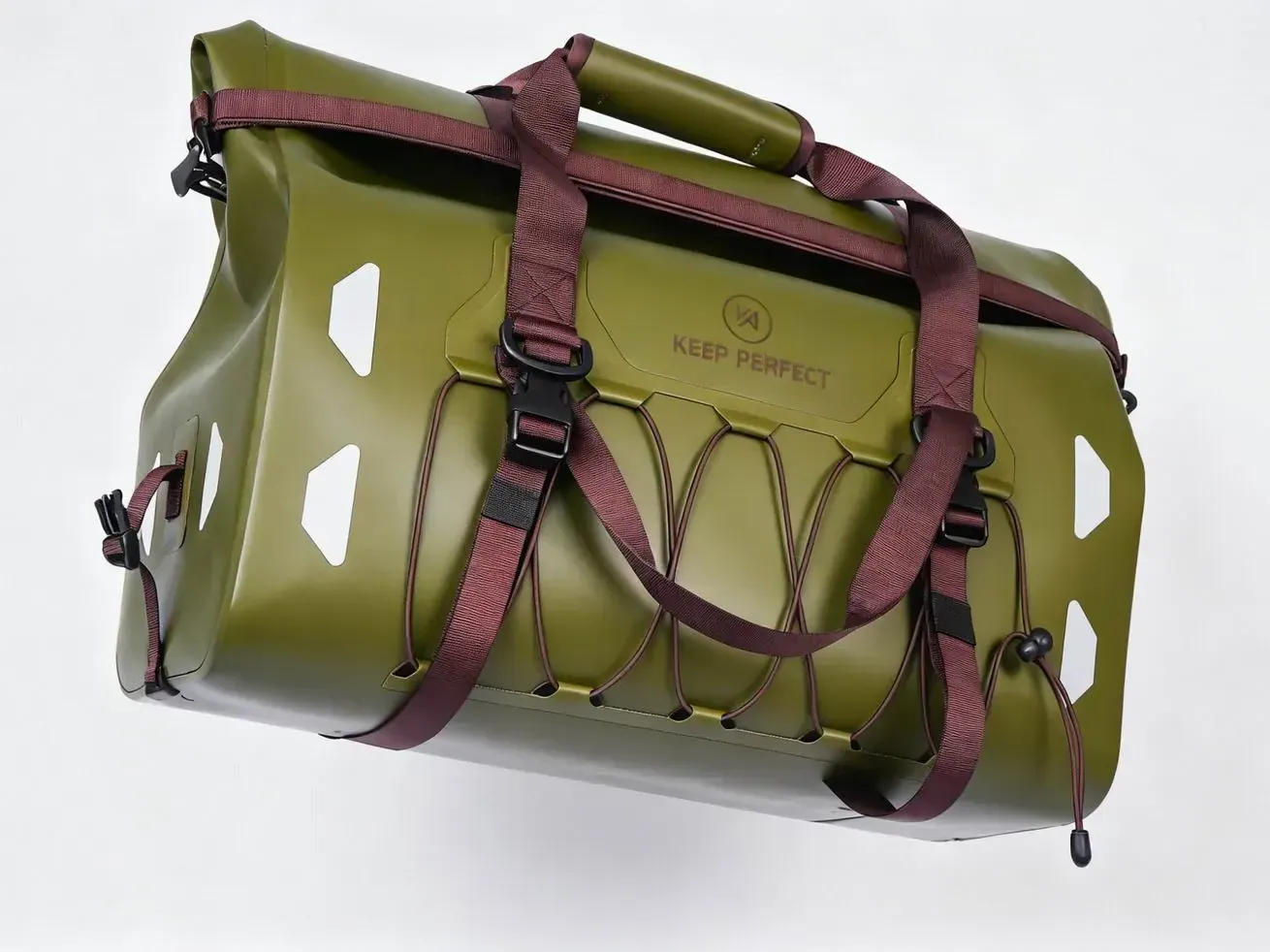
A value bag fails for predictable reasons and most of them are storage rather than design. Salt left in a seam, a bag stored wet and closed, and trays left loaded against a damp liner account for the majority of premature failures in this price band, and all three are preventable with a card in the bag.
| Habit | What it prevents | Time cost | Effect on life |
|---|---|---|---|
| Rinse after salt use | Hardware rust and seam rot | 3 minutes | Roughly doubles it |
| Dry open, chambers unzipped | Odour and coating hydrolysis | Overnight | Prevents most coating failure |
| Empty trays before storage | Latch creep and deformation | 2 minutes | Keeps trays closing true |
| Lubricate the zip twice a season | Slider wear and jam | 1 minute | Adds a season to the closure |
| Store out of direct sun | UV chalking and thread loss | None | Preserves coating and stitching |
Checks Before Approving a Value Sample
Value products need a value-specific protocol: the question is not whether the bag matches a premium specification but whether its omissions are the right ones. Five checks answer that in about an hour, and the first is the one that catches the mistake that costs the most.
| Check | Method | Pass condition | Catches |
|---|---|---|---|
| Omission audit | List what was cut and why | Every cut is deliberate | Cost shaved across the board |
| Strap test | Wear at 5 kg for 45 minutes | No pressure line | Thin foam cut to hit a price |
| Base test | Stand on a wet deck 30 minutes | Contents dry, if claimed | Fabric base sold as moulded |
| Zip cycle | Cycle the slider 1,500 times | No wear at the tape edge | Uncoated tape under a coated coil |
| Rating check | Jet or submersion test as claimed | Matches the stated condition | A code with no test behind it |
Strength and abrasion requirements should be written against published methods from ASTM International, because a value product with no written specification drifts: the next repeat order arrives 40 g lighter and nobody can point to the line item that changed. A specification is what makes a low price repeatable rather than accidental.
Programme, Pricing, and Compliance
A value brief should open with the shelf price and work backwards, because that is the only way to know what can stay in the build. Specify the two features to protect next, name the omissions explicitly, and then confirm the remaining components sit at the middle of their cost ladders rather than at the bottom.
| Programme item | Baseline | Note |
|---|---|---|
| MOQ | 500 pcs per design and colour | Colour split negotiable above the baseline |
| Sampling | 6-10 working days | Add 5-7 days if a moulded base is added |
| Bulk | 35-50 days | From approved sample and deposit |
| Inspection | AQL 2.5 | Include strap test, base test, zip cycle, rating check |
| Compliance | REACH and California Prop 65 | Screen coatings, films, inks, hardware, tray polymer |
QUANZHOU JUNYUAN BAGS has run waterproof bag programmes since 2014, with the founding team in the trade since 2004. Output of 200,000 units a month is verified by SGS, and BSCI and ISO 9001 systems structure the work. Materials are screened against REACH and California Prop 65, and bulk orders are inspected at AQL 2.5 before shipment.
A value-tier brief can be emailed to service@junyuanbags.com with target shelf price, litres, tray count, rating, and quantity. Freight, duty, and margin planning for a target market can be worked through the bulk tackle bag ordering guide, and FOB Xiamen or DDP service to more than 100 countries follows an approved sample.
People Also Ask
What is a good fishing tackle bag for under 100 dollars?
A 32 L build with four 3600 trays on vertical rails, a 600D shell, a reverse coil zip, and a moulded base, retailing around 69 USD from a 22-27 USD FOB band.
How much does a fishing tackle bag cost to import?
A bag retailing at 99 USD typically leaves port at 30-38 USD FOB, with a retail multiplier of 2.6-3.2 covering freight, duty, and margin.
What should I not compromise on in a budget fishing bag?
Strap foam and the base. A 45 mm strap with 8 mm foam costs 0.70 USD more and a moulded base 2.40-4.00 USD, and both prevent the complaints that come back.
Do cheap fishing bags survive salt water?
Only with acetal or stainless hardware and a rinse habit. Plated hardware rusts within a season, and salt left in a seam causes more damage than anything during the trip.
Is a submersible fishing bag available under 100 dollars?
Yes, if it is small. A welded liner is priced partly by area, so a 12 L sling can be sealed for 27-33 USD FOB while a 40 L shell cannot.
How long should a budget fishing bag last?
Three or four seasons of weekend use at the 50-75 USD tier, if it is rinsed after salt use and dried open. Most premature failures are storage failures rather than design failures.
Frequently Asked Questions
Q1. What is the best fishing tackle bag under 100 dollars?
A 32 L tray backpack with four 3600 trays on vertical rails, a 600D shell, a reverse coil zip, and a moulded base, at a 22-27 USD FOB band and about 69 USD retail.
Q2. What FOB price corresponds to a 99 dollar retail bag?
About 30-38 USD FOB Xiamen, once freight, duty, and a retail multiplier of 2.6-3.2 are applied to the landed cost.
Q3. What do you give up on a bag under 50 dollars?
Water protection above IPX4, a moulded base, and tray rails. A 35-50 USD retail bag is a 420D shell with a coated coil zip and two loose trays.
Q4. Is a 600D shell worth the extra cost over 420D?
Yes. It costs about 2.50 USD more per bag and roughly triples abrasion life, which is the best value step in the whole component ladder.
Q5. Do I need a submersible zip on a budget bag?
Only for kayaks and open boats. A reverse coil zip with a storm flap gets most of the spray performance for about 2.20 USD against 6-9 USD for a submersible closure.
Q6. What is the most useful upgrade under 100 dollars?
A moulded drained base, at 2.40-4.00 USD. It lets the bag stand on a wet deck and keep trays dry, which is a problem the customer has already had.
Q7. Can a wheeled tackle bag be made under 100 dollars retail?
Yes, at 29-35 USD FOB with 90 mm polyurethane wheels. The limitation is surface: that wheel size suits a ramp and a car park, not soft sand.
Q8. How many trays can I get under 100 dollars?
Four deep 3700 trays in a 40 L shell at 30-36 USD FOB, or four shallow 3600 trays in 32 L at 22-27 USD. Deep trays need about 1.4 times the rail space.
Q9. Are acetal buckles worth it on a cheap bag?
Yes. They cost 0.45 USD against 0.12 USD for plated hardware, and plated parts rust within a season, which costs more in returns than the saving.
Q10. How do I make a budget fishing bag last longer?
Rinse it after salt use, dry it open with the chambers unzipped, empty the trays before storage, and lubricate the zip twice a season. That is about six minutes per trip.
Q11. What rating should a bag under 100 dollars have?
IPX5 for rain and spray at the 50-75 USD tier and IPX6 at 75-100 USD. A genuine submersion rating is only realistic under 100 dollars on a small 12 L sling.
Q12. What is the MOQ and lead time for a value-tier programme?
MOQ is 500 pcs per design and colour, samples take 6-10 working days plus 5-7 days for a moulded base, and bulk runs 35-50 days from approved sample and deposit.