A kayak tackle bag is chosen by measuring the boat before looking at any product. Three dimensions decide everything: the clear bore of the largest hatch, which governs whether a body goes inside the hull at all, the tankwell footprint available behind the seat, and how much loaded weight the hull tolerates before it feels tender. A 203 mm round hatch accepts a compressible soft body of roughly 20-25 litres, while a 254 mm bore takes 30-35 litres, and nothing rigid passes either. Add enough leash points to secure the bag against a capsize and the choice becomes straightforward, whichever kayak is involved.
Measure Four Things Before Buying
Almost every poor purchase in this category traces back to someone buying a bag for how it looked rather than for the boat it had to fit. Four measurements take perhaps ten minutes and eliminate nearly all the guesswork.
| Measurement | How to take it | What it decides |
|---|---|---|
| Clear bore of the largest hatch | Internal diameter minus 15-20 mm of tolerance | Whether the bag can enter the hull |
| Tankwell footprint behind the seat | Length and width of usable flat area | Maximum body size that can be lashed |
| Usable waterline height | Deck upstand or rail height in mm | Whether the bag can roll out sideways |
| Loaded weight you can tolerate | Total mass you will actually carry | Stability, put-in effort, and fatigue |
The second of those needs a caution about what usable means. Most tankwells are moulded with ribs, scupper channels, and sloping sides, so the nominal dimensions printed in a hull brochure rarely match the flat area available. Measuring the flat plane where a bag can actually rest usually gives a figure 20-40 mm smaller in each direction than the brochure suggests, which is exactly enough to make a body that seemed fine refuse to sit properly.
It is also worth measuring at home with the trays you intend to use rather than estimating later. A body that accepts two 3700 size trays has a floor around 380 x 250 mm, and comparing that directly against the measured tankwell answers the question immediately instead of relying on published litre figures that include pockets and dead space.
Hatch Size Governs Hull Storage
Whether tackle goes inside the hull is the single most useful thing this measurement tells the buyer, because storing gear inside rather than on deck changes how the kayak behaves and how dry everything stays.
| Hatch bore | Largest rigid item | Largest compressible soft body | Practical use |
|---|---|---|---|
| 140 mm round | Nothing useful | 8-12 L, very soft only | Small essentials bag |
| 203 mm round | Up to 180 mm diameter | 20-25 L, no internal frame | Standard on many fishing kayaks |
| 254 mm round | About 230 mm diameter | 30-35 L, standard kayak bodies | Good all-round hatch |
| 300 x 380 mm oval | Trays flat, individually | 35-45 L with flexible sides | Large pedal hulls |
| Rectangular bow hatch | Depends on the opening | 40-55 L | Multi-day storage |
A worked example makes the tolerance figure clearer. A nominal 203 mm hatch typically measures about 198-200 mm internally, so a bag specified to 185 mm maximum cross-section passes comfortably while one at 195 mm jams halfway and then has to be cut free. Anything intended for hull storage therefore needs a stated compressed dimension rather than merely a litre figure, which is a specification most buyers never think to request.
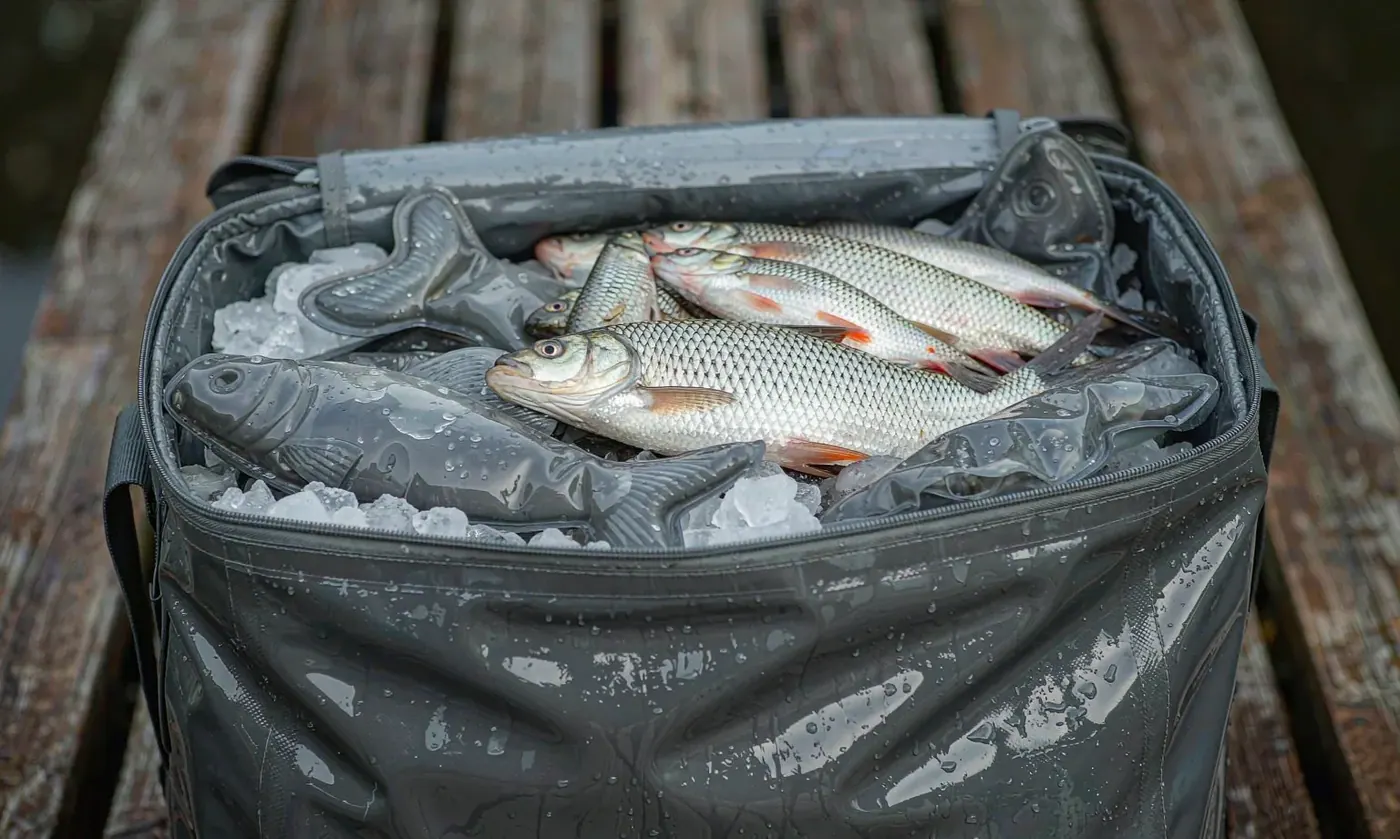
Footprint and Weight Distribution
Once the storage location is settled, the bag has to occupy space without upsetting the boat, and both footprint and centre of gravity matter more than capacity.
- Keep loaded height below 300 mm on a large pedal hull and below 250 mm on anything smaller, or the boat feels tender in a beam sea.
- A load centred 100 mm above the deck feels planted; the same load centred above 200 mm roughly doubles the roll moment.
- Heavy trays belong low and forward of the seat rather than high and behind, where they lever against the hull.
- A footprint within 20 mm of the tankwell walls prevents the body shifting, which otherwise moves the centre unpredictably.
- Total loaded weight between 12 and 18 kg is the practical band, above which both handling and put-in effort suffer noticeably.
The second point is worth restating for anyone who has not thought about it before, because it explains a confusing experience. Anglers often report a kayak feeling unstable after adding only a few kilograms of gear, and the reason is rarely the weight itself. Raising the same weight higher by 100 mm roughly doubles its roll moment, so where it sits matters more than how much there is. A practical test is to load the boat ashore and tilt it slowly to one side; if it passes about 30 degrees without feeling like it wants to keep going, the loading height is acceptable for most conditions.
Leashing, Buoyancy, and Safety
A capsize is normal rather than exceptional in kayak fishing, and every decision about securing the bag should assume one will eventually happen. This is also the section where honest advice about flotation matters most.
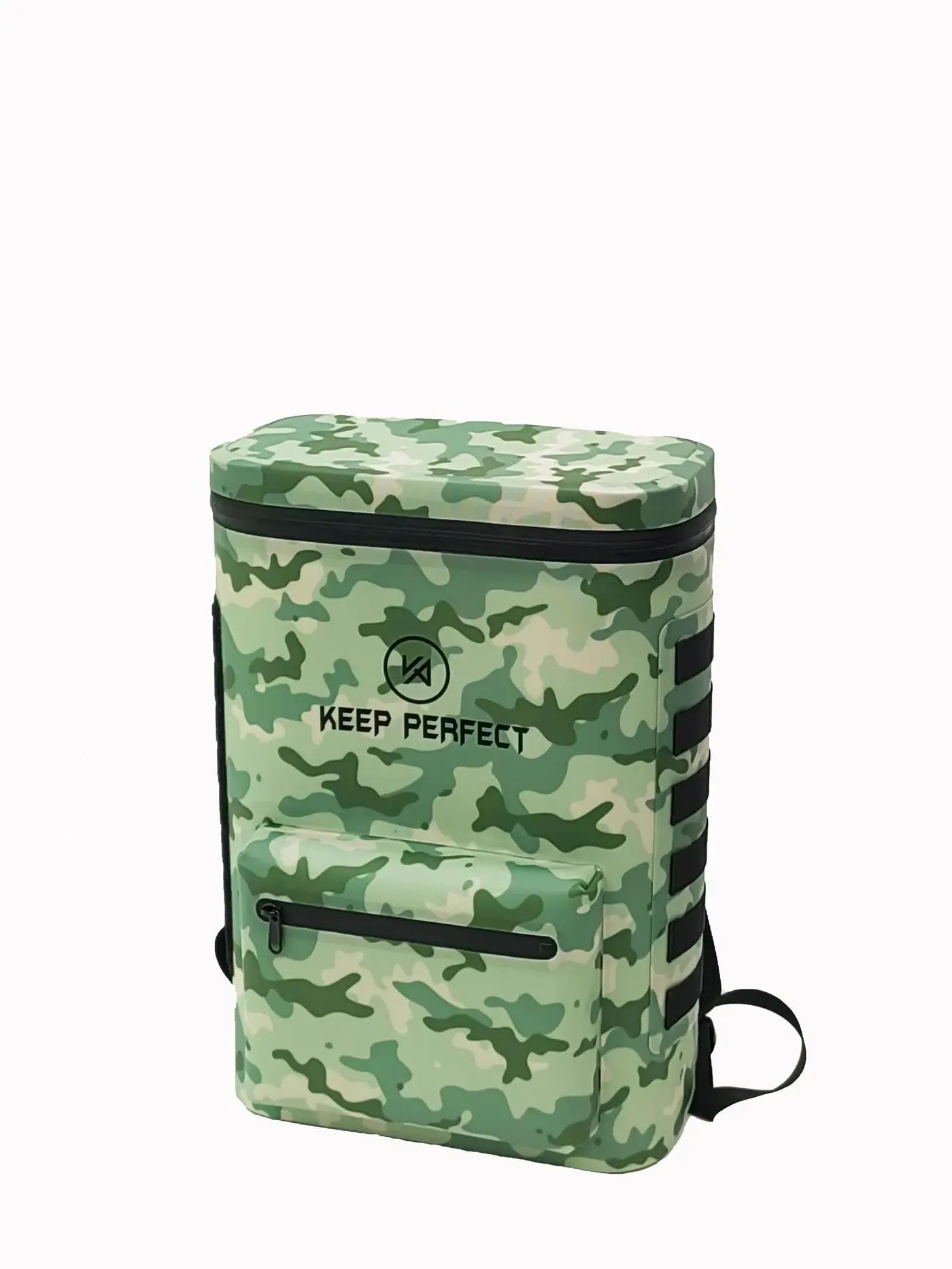
| Measure | Recommended | Reason |
|---|---|---|
| Leash points on the bag | Minimum two, use four | Single point lets the body swing and work itself free |
| Leash cord | Rated line, 600-900 mm | Short enough to prevent drift if it releases |
| Attachment hardware | 316 stainless clip | Survives 500-1,200 hours of salt exposure |
| Flotation | Closed-cell inserts or a buoyant build | Aids recovery after a capsize |
| Personal safety | Approved personal flotation device worn | Nothing else is a substitute |
That last row deserves to be unambiguous. No tackle bag, cooler, or dry body is a flotation device, and treating any item of equipment as buoyancy for a person is how kayak incidents become fatalities. Carriage requirements and approved equipment standards are published by USCG Boating, whose guidance applies alongside local rules wherever the boat is paddled.
Buoyancy in the bag itself remains genuinely useful for recovery rather than for safety. A build with closed-cell inserts typically carries 2-4 kg of positive buoyancy per 20 litres, enough to float a partly loaded bag where it can be retrieved rather than sunk. Specifying it costs about 1.80-3.60 USD and turns a capsize from a total loss into an annoyance.
Water Performance in a Wet Well
Kayak bags live partly submerged in bilge water for hours at a time, which is a harsher environment than a shower or a wave over the bow. This is where economy specifications fail first and most visibly.
| Element | Minimum for kayak duty | Why |
|---|---|---|
| Seam construction | Welded rather than taped | Standing water defeats adhesive tape |
| Fabric rating | Above 5,000 mm hydrostatic head | Long immersion rather than brief exposure |
| Base | Moulded panel or double layer | Constant abrasion against gritty decks |
| Drainage | Two grommets near every base corner | Bilge water must escape freely |
| Closure | Roll top with three folds or coated zip | Spray and partial immersion both routine |
Drainage is a specific and commonly missed point for kayak duty. A bag sitting in several centimetres of bilge water will take water over its top rail at some point, and without corner grommets it carries that water for the rest of the day, adding 1-3 kg to the load and loosening whatever it touches. Grommets cost about 0.60-1.30 USD and rank among the best value items on any kayak specification.
Fabric and film durability against abrasion in gritty bilge water is measured by methods published by ASTM International, and specifying a cycle count rather than a general claim of toughness makes acceptance checkable on arrival.
Access While Seated
Deck-stowed tackle behind the seat is reached by rotating the torso, which is easy when the boat is stable and surprisingly hard in a crosswind with a rod in one hand. Design details here decide whether an angler enjoys the session or spends it frustrated.
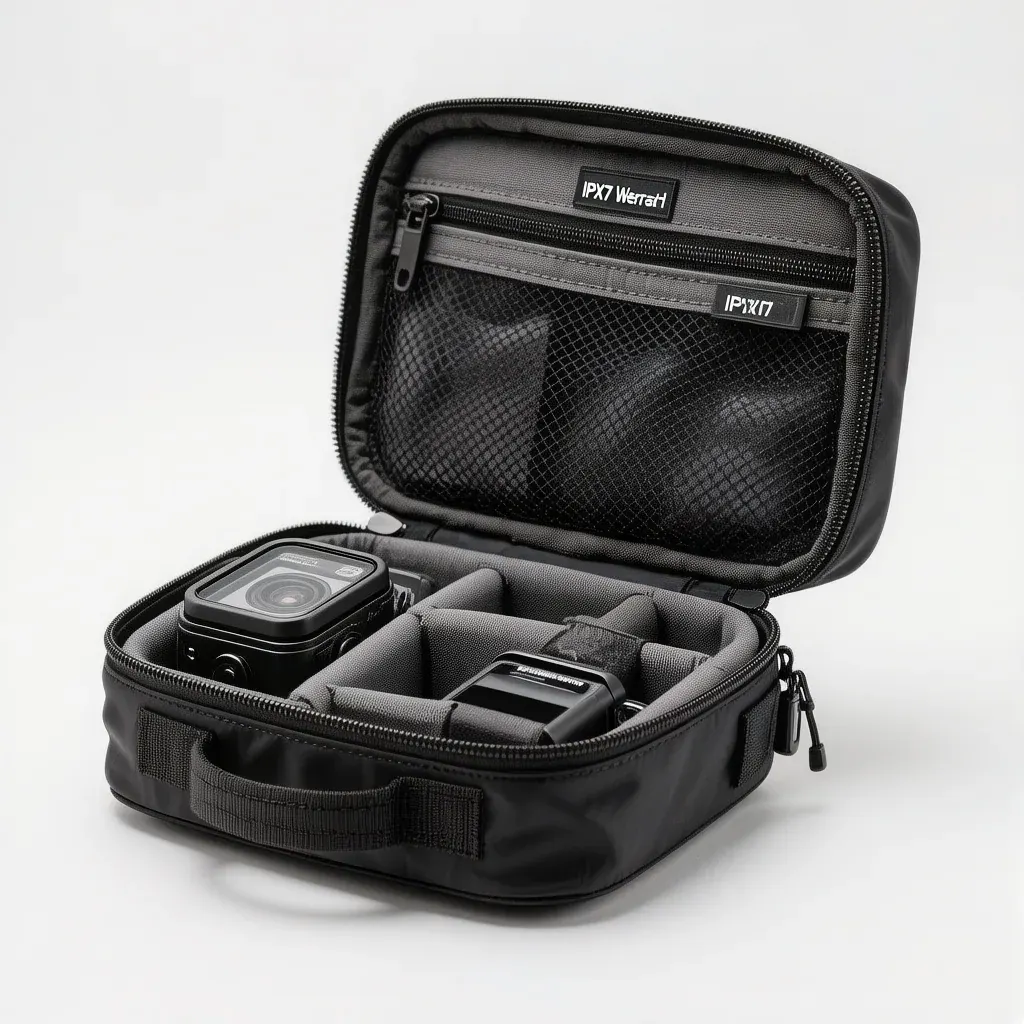
- The main lid should open away from the seat, or it cannot be raised while seated with a rod in hand.
- A one-handed opening mechanism is worth paying for, since the other hand usually holds something.
- Side pockets accessible without unstrapping save time on every single access, roughly 40-80 per day.
- A drop-down front panel that lays flat turns the bag into a work surface, which few people expect until they use one.
- Deep single cavities are harder to use than two shallower ones, since everything important sinks to the bottom.
The final point deserves emphasis because it costs nothing to get right at design stage. Splitting one deep cavity into two levels, costing perhaps 0.80-1.60 USD in added divider material, converts a bag where the tippet spool always sinks to the bottom into one where everything stays visible from a seated position.
Matching the Bag to the Kayak Class
Mapping common hulls against appropriate bodies saves most of the trial and error, and makes retail guidance considerably more useful than generic advice about looking after your gear.
| Kayak class | Typical hatch | Recommended body | Capacity |
|---|---|---|---|
| Recreational sit-on-top | 140-203 mm | 25-30 L soft body, deck stowed | Two 3600 trays |
| Mid-size fishing kayak | 203-254 mm | 30-35 L compressible body | Two 3700 trays |
| Large pedal kayak | 254 mm or oval | 35-45 L body or a crate liner | Four trays |
| Small or youth kayak | 140 mm or none | 18-22 L soft body only | One 3600 tray |
| Inflatable or folding kayak | Usually none | 8-14 L soft body strapped forward | Essentials only |
Note that only two of those five rows recommend going inside the hull, which reflects reality rather than reluctance. Many kayaks have hatches too small or too awkwardly placed for a tackle body, and a well-secured deck bag performs perfectly well for the majority of anglers. Hull storage is a bonus when it works rather than something to insist upon, and insisting on it is what drives buyers toward a bag too small for their trays or a body too rigid to pass.
Attachment Points and Gear Tracks
How the bag attaches to the boat is its own decision, and most modern kayaks offer gear tracks that make this easier than it once was. Compatibility matters because aftermarket track systems vary.
| Attachment method | Holds against | Note |
|---|---|---|
| Bungee through four eyelets | Moderate movement, shifting loads | Standard, flexible, can loosen |
| Straps to existing pad eyes | Firm hold, quick release | Check pad eye backing before loading |
| Gear track sliding mounts | Very firm, adjustable | Confirm the bolt size the track accepts |
| Cam straps over the body | Firmest hold of all | Can deform a soft body if over-tensioned |
| Leash line to a rail or pad eye | Prevents loss, not movement | Mandatory regardless of the method above |
Whatever method is used, one leash line should always connect the bag to the hull independently of the primary restraint. Restraints loosen during a session of wave flex far more often than any fitting actually fails, and a secondary line costing about 0.80 USD is what prevents losing a full tackle system into several metres of water.
Seasonal Changes and Multi-Use Boats
Kayaks rarely stay rigged the same way all year, and a bag that suited a summer setup often conflicts with winter gear. Planning for the seasonal shift avoids buying twice.
| Season | What changes | Bag implication |
|---|---|---|
| Summer, minimal layers | Deck space free, low water levels | Larger body acceptable aft |
| Shoulder season | Extra clothing plus a waterproof shell | Add 8-14 L for soft items |
| Winter, drysuit and safety kit | Much more bulk, less free deck | Choose 8-12 L less than summer |
| Different boat or a rental hull | Footprint and well shape differ | Soft body adapts, rigid does not |
| Non-fishing days | Family paddling or photography | A soft body doubles as general storage |
The rental row deserves particular attention for anyone paddling unfamiliar boats, because a soft body adapts to whatever the well offers while a rigid one either fits or does not. Anglers who paddle different hulls across the year should therefore buy soft and slightly smaller rather than rigid and perfectly sized for today's boat, accepting that the perfect fit for one hull is often the wrong choice for the next.
The Fit Checklist Buyers Can Run
Everything above reduces to six checks that can be completed with the hull in front of you, and running them before ordering prevents most unsuitable purchases.
| Check | Pass condition | If it fails |
|---|---|---|
| Clear bore measurement taken | Recorded in millimetres, tolerance applied | Do not plan on hull storage |
| Flat tankwell area measured | Body footprint within 20 mm | Reduce size or choose a soft body |
| Loaded height below limit | Under 300 mm on large hulls | Move trays lower or smaller |
| Total loaded weight known | Between 12 and 18 kg | Reduce tray count first |
| Leash points present | At least two, plus one to the hull | Add them before going afloat |
| Compressed dimension stated | In writing on the specification | Ask for it before ordering |
Those six rows also make a useful purchasing conversation with any customer, because they turn a vague request for a kayak fishing bag into a short list of numbers. Staff who ask three of them routinely reduce returns substantially, and none of the six requires any product knowledge to apply.
Cost, Sampling, and Terms
Kayak tackle bodies sit in the mid-range of the category and price predictably once the specification is fixed. The numbers below assume MOQ 500 pcs per design and colour.
| Configuration | FOB Xiamen | Note |
|---|---|---|
| Basic kayak body, taped seams | 22-32 USD | Freshwater or occasional use |
| Welded body with moulded base | 28-44 USD | Correct choice for regular kayak duty |
| Buoyant build with closed-cell inserts | 30-48 USD | Adds 1.80-3.60 USD for recovery aid |
| Full coastal kayak specification | 32-52 USD | 316 hardware and marine zip as well |
| Sampling and bulk | 6-10 working days, then 35-50 days | From approved sample and deposit |
QUANZHOU JUNYUAN BAGS has developed waterproof bag programmes since 2014, with the founding team working in the trade since 2004. Monthly output of 200,000 units is verified by SGS, and BSCI and ISO 9001 systems structure the workflow. Materials are screened for REACH and California Prop 65, every bulk order is inspected at AQL 2.5 before shipment, and compressed dimensions can be stated on every specification for hatch fit.
A kayak fitting question can be emailed to service@junyuanbags.com with hull model, hatch clear bore, tankwell footprint, rod count, and quantity. FOB Xiamen or DDP service to more than 100 countries follows an approved sample. Supporting reading includes the kayak fishing crate bag range, the hatch size guide, and the best kayak tackle bags roundup.
People Also Ask
How do I know what size kayak tackle bag fits?
Measure the hatch clear bore and subtract 15-20 mm for tolerance: a 203 mm bore takes a soft 20-25 L body, and a 254 mm bore takes 30-35 L. Then check the tankwell footprint.
Can a tackle bag fit through a kayak hatch?
Yes if it has no internal frame and no moulded base. A compressible 18-25 L body passes a 203 mm round hatch, while nothing rigid above about 180 mm diameter will go through at all.
Why does my kayak feel tippy with gear loaded?
Centre of gravity. The same weight raised from 100 mm to 200 mm above the deck roughly doubles its roll moment, so keep loaded height below 300 mm and heavy trays low.
Should a kayak tackle bag float?
It helps for recovery rather than for safety. Closed-cell inserts give 2-4 kg of buoyancy per 20 litres, costing 1.80-3.60 USD, and no tackle item substitutes for an approved flotation device.
How many leash points should a kayak bag have?
At least two and preferably four, with one independent line to the hull. Straps loosen during wave flex far more often than fittings fail.
Do I need drainage in a kayak tackle bag?
Yes. Bilge water will eventually enter over the top rail, and without corner grommets the bag carries 1-3 kg of water for the rest of the day.
Frequently Asked Questions
Q1. How do I choose a kayak tackle bag that fits?
Measure the boat first: hatch clear bore minus 15-20 mm, the flat tankwell area behind the seat, and the loaded weight you can tolerate. Then match those numbers to the bag rather than the other way round.
Q2. What size bag fits through a 203 mm hatch?
A compressible soft body of roughly 20-25 litres with no internal frame and no moulded base. Nothing rigid above about 180 mm diameter will pass a nominal 203 mm hatch.
Q3. Should tackle go inside the hull or on the deck?
Inside if the hatch allows it, since the deck stays clear for casting and landing fish. Many kayaks have hatches too small for this, and a well-secured deck bag works perfectly well.
Q4. Why does tankwell size differ from the brochure?
Wells are moulded with ribs, scuppers, and sloping sides, so the flat usable area is usually 20-40 mm smaller in each direction than the nominal dimension suggests. Always measure the flat plane.
Q5. How much weight can I safely add to my kayak?
Between 12 and 18 kg loaded is the practical band for most fishing kayaks. Above that, both handling and the effort of getting afloat suffer noticeably, regardless of boat size.
Q6. Does my tackle bag need to float?
Only for recovery, not safety. Closed-cell buoyancy inserts add 1.80-3.60 USD and help retrieve a bag after a capsize, but no tackle item replaces an approved personal flotation device.
Q7. What keeps a bag secure in a capsize?
At least two leash points, ideally four, plus one independent line to the hull. Restraints loosen during wave flex far more often than any fitting actually fails.
Q8. How important are drain holes on a kayak bag?
Very. A bag in bilge water will eventually take water over its rail, and without corner grommets it carries 1-3 kg of extra load for the rest of the day.
Q9. Which is better for kayaks, taped or welded seams?
Welded. A kayak bag sits in standing bilge water for hours, which defeats adhesive tape within two to four years and far sooner if the base panel is submerged.
Q10. How do I stop my tackle bag moving in the tankwell?
Choose a footprint within 20 mm of the well walls and restrain it at four points rather than two. A single central strap leaves the body free to rotate and work itself loose.
Q11. What price should I expect for a proper kayak bag?
FOB Xiamen runs 28-44 USD for a welded body with a moulded base, rising to 32-52 USD for a full coastal specification at MOQ 500 pcs per design and colour.
Q12. What is the MOQ and lead time?
MOQ is 500 pcs per design and colour. Samples take 6-10 working days and bulk production runs 35-50 days from approved sample and deposit, with compressed dimensions provided for hatch planning.