A speciality kayak retailer ordered a modular crate bag system built around one shell and three interchangeable inserts, so a single stock unit could be sold as a tray bag, a bait bag or a general dry bag depending on the insert fitted. The constraint that governed the whole design was the crate footprint: 330 by 330 millimetres internal, plus clearance for rod holders at the rear and for a tankwell lip at the front. Sampling took nine working days across two rounds, bulk ran thirty-eight days, and the retail result after one season was a 31 percent attach rate on new kayak sales against a 12 percent category average. This is the sequence, the dimensions, and the two decisions that made the modularity work.
Client Background
The client operates eleven paddle sport stores, selling kayaks, accessories and apparel, with a rental fleet of 40 kayaks attached to four of them. Their accessory buyers had a specific commercial problem: crate storage was selling, but as three separate products, and stock depth per store was too thin to hold all three in every size. The idea they brought was modularity, one outer shell and several inserts, which halves the inventory needed to offer three configurations.
The rental fleet mattered as much as the retail floor. Rental kit is abused, stored wet and used by people who have never rigged a crate before, so the rental configuration needed to be the most forgiving one and the retail configuration needed to be the most attractive one. Those are not the same product, and reconciling them took most of the specification work. The resolution was to let the channel decide the insert rather than the shell, which is the whole point of a modular system and the reason it was worth the development effort.
| Client parameter | Value | Effect on the brief |
|---|---|---|
| Retail stores | 11 | Stock depth per store is thin |
| Rental fleet | 40 kayaks | Abuse tolerance is a requirement |
| Products to replace | 3 separate crate bags | One shell, three inserts |
| First order | 500 shells plus 900 inserts | Inserts at two per shell average |
| Target attach rate | Above 20 percent | Configurable point-of-sale story |
| Season | March to September | Launch in March, sampling in November |
The Modularity Requirement
Modularity is easy to propose and hard to make commercially real, because the insert has to be cheaper than the difference between three finished products while still changing the function. The design that met that test uses a single moulded shell with a rectangular cavity and four internal webbing tabs, and three inserts that drop in and clip to the same tabs. Nothing about the shell changes between configurations.
| Insert | Function | Contents | Retail share of sales |
|---|---|---|---|
| Tray module | Tackle storage | Three 3600 trays on rails | 44 percent |
| Bait module | Bait and catch | Sealed liner, 12 litre, drained | 27 percent |
| Dry module | General dry storage | Roll top liner, 18 litre | 29 percent |
The sales split after one season is the interesting part, because it did not match what the client predicted. They expected the dry module to dominate and the bait module to be marginal; the tray module actually sold hardest at 44 percent, and the bait module turned out to be the one that drove repeat purchases, since it wears and is replaced. Both facts changed the second order ratio.
Crate Footprint: The Dimension That Decides Everything
A kayak crate bag is a fitted product, and fitting means millimetres. The common crate is around 330 by 330 millimetres in footprint with a height near 280 millimetres, but the variations are wide enough to matter: some crates are 300, some 360, and some have a lip or a handle that adds 15 millimetres on one face. A bag cut to one crate does not fit another, and a bag cut generously to fit all of them slides around inside all of them.
| Crate type | Footprint | Height | Bag fit note |
|---|---|---|---|
| Standard kayak crate | 330 x 330 mm | 280 mm | Nominal fit, design target |
| Compact crate | 300 x 300 mm | 240 mm | Requires a compression strap |
| Wide crate | 360 x 360 mm | 300 mm | Tolerable, slight movement |
| Crate with rear rod holders | 330 x 330 plus 90 mm | 280 mm | Rear cut-out required |
| Milk crate type | 305 x 355 mm | 280 mm | Rectangular, needs a second shell size |
The compromise reached was a shell sized for 330 by 330 with a 20 millimetre tolerance band and two compression straps, plus a rear cut-out of 90 millimetres so the bag clears rod holders on the most common crate. That covers roughly 80 percent of the crates the client sells, and the remaining 20 percent were covered by a second shell size in the following season rather than by compromising the first.
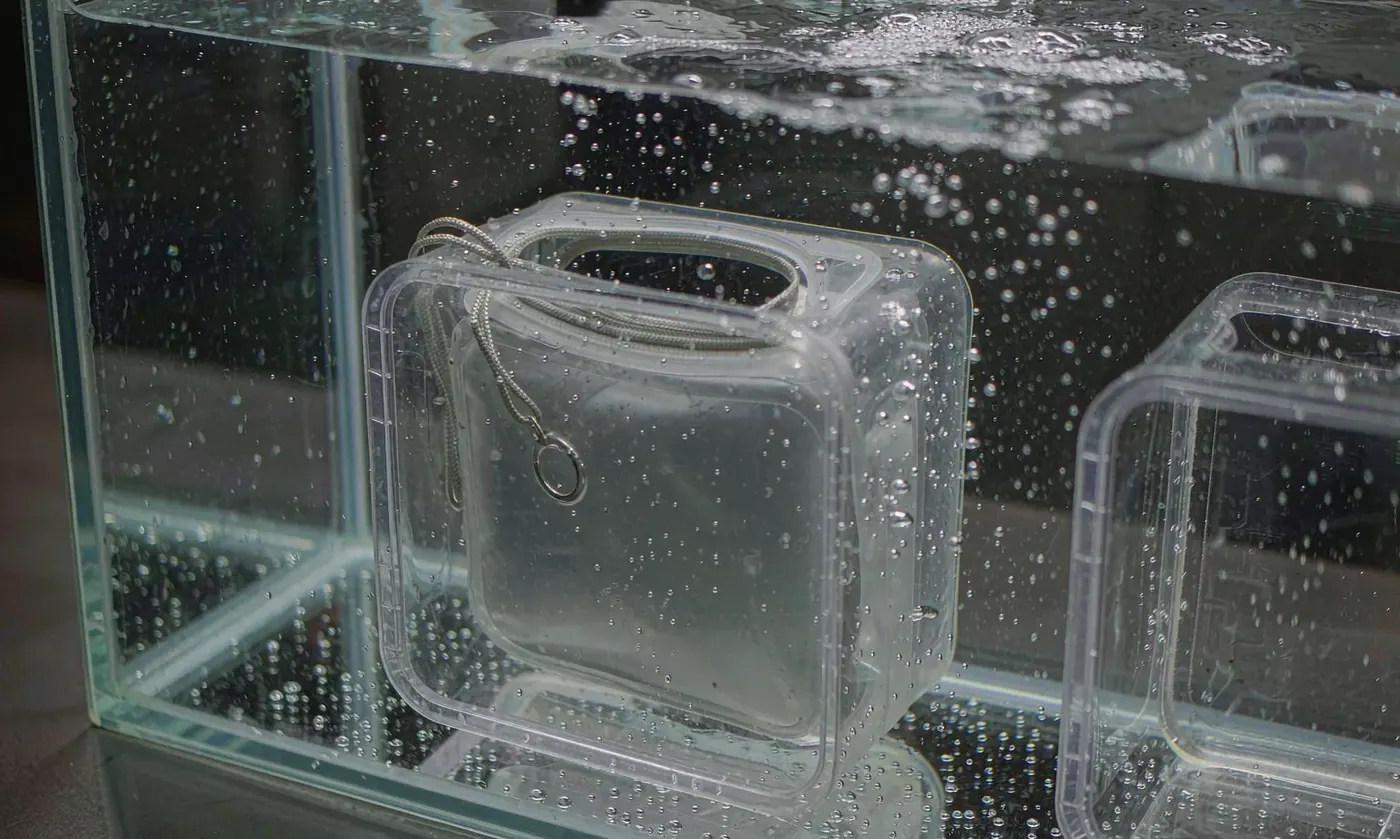
Hatch and Transport Constraints
Two constraints specific to kayaks shaped the design more than the crate did, and both were discovered by measuring rather than by asking. The first is hatch clearance: a kayak angler loads the crate through a hatch or over a tankwell lip, and a loaded crate bag that has grown 20 millimetres wider than the crate will not pass through the opening it passed through empty. The second is transport, because the crate is carried from car to water loaded, and a bag with no handle geometry becomes a two-person job.
- Overall width with an insert fitted must stay within 10 millimetres of the bare crate width, so hatch clearance is unchanged.
- Two grab handles rated to 25 kilograms each, positioned so the load stays level when carried by one person.
- A shoulder strap option for the walk from car to water, detachable so it cannot foul anything on the kayak.
- No rigid protrusions on the underside, which would catch on a tankwell lip or a scupper hole.
- A drain path that exits at the rear, so water leaving the bag does not run into the paddler's seat area.
Materials for a Bag That Lives in a Tankwell
A crate bag sits in standing water for hours, is dragged across sand and gravel, and is left in the sun between trips. That combination argues for a coated shell that welds rather than stitches, a base that does not abrade through, and UV-stable thread and webbing. It also argues against anything that traps water against the shell, which is why external pockets were kept to two and both were drained.
| Component | Specified | Reason |
|---|---|---|
| Shell | 600D PVC-coated polyester, welded | Stands in water, welds rather than wicks |
| Base | Moulded EVA, 6 mm, textured | Abrasion against sand and gravel |
| Thread | Bonded polyester, UV stable | Sun exposure between trips |
| Webbing | Solution-dyed polyester | Holds strength when wet |
| Hardware | Marine polymer and 316 stainless | Salt and freshwater kayak use |
| Inserts | Welded liners, three types | Wipe clean, replaceable |
The inserts themselves were the area where cost discipline mattered most. Each insert had to be sellable at roughly a third of the shell price, which rules out moulded trays and points to welded liners with simple stiffeners. The tray insert uses three 3600 trays on webbing rails rather than a moulded cavity, which is cheaper, lighter and lets the customer choose their own trays.
Buoyancy and What Happens If the Kayak Rolls
Kayak anglers ask one question about crate bags more than any other: will it float. The honest answer for a loaded crate bag is usually no, and it is worth stating plainly rather than implying otherwise. A loaded crate with four trays and tools weighs 9 to 14 kilograms and displaces far less than that in water, so it sinks. What can be achieved is positive buoyancy when empty, and a tether point that stops the whole assembly being lost.
Two things were specified accordingly. The shell with no insert fitted carries closed-cell foam panels that give 4 to 6 kilograms of positive buoyancy when empty, which is enough to recover a crate that goes over the side unladen. And every shell has a tether eye rated at 20 kilograms, because a tethered crate that goes in the water is recovered and an untethered one is gone. Personal flotation requirements for the paddler are separate and published by the United States Coast Guard Boating Safety Division.
Sampling: Two Rounds and a Fit Problem
The first sample was dimensionally correct and failed the fit test anyway, which is the most instructive part of the whole programme. Measured on a bench it matched the crate exactly; placed in a crate with rod holders fitted, the rear panel fouled the holder bases by 12 millimetres and the bag could not seat fully. The fix was a rear cut-out rather than a size reduction, because reducing the overall size would have introduced the movement problem the tolerance band was designed to avoid.
| Round | Issue found | Change made | Outcome |
|---|---|---|---|
| Round 1 | Rear fouled rod holder bases by 12 mm | Rear cut-out of 90 mm | Resolved |
| Round 1 | Insert tabs hard to align when wet | Tabs lengthened to 40 mm | Resolved |
| Round 2 | Drain exited into the seat area | Drain path moved to the rear | Resolved |
| Round 2 | Handles too close for one-person carry | Spacing increased to 260 mm | Resolved |
| Round 2 | No issue raised | Approved | Bulk released |
Sampling took nine working days across the two rounds, inside the six to ten working day window. The client's own observation afterwards was that the fit problem would have been caught months earlier if they had sent the crate rather than the drawing, which is a fair point and one worth generalising: send the physical constraint, not the dimension of it.
Bulk, Inspection and the Numbers
Bulk ran thirty-eight days from approved sample and deposit, within the thirty-five to fifty day range. The order was 500 shells and 900 inserts, shipped as 500 retail boxes each containing one shell and two inserts, plus 300 loose inserts for the rental fleet and for shelf sale.
| Item | Quantity | Note |
|---|---|---|
| Shells | 500 | One size, one colourway |
| Tray inserts | 380 | Highest retail demand |
| Bait inserts | 240 | Highest repeat purchase |
| Dry inserts | 280 | Rental fleet default |
| Retail boxes | 500 | Shell plus two inserts |
| Loose inserts | 300 | Shelf sale and rental replacement |
Inspection ran at AQL 2.5 under general inspection level two. Shells were inspected as one lot with a sample size of 50, acceptance 3 and rejection 4, and inserts as three lots with a sample size of 32 each. One minor was found on the shell lot, a slight webbing tab misalignment, and two across the insert lots, both trim related. Zero major and zero critical defects were recorded across all four lots.
Every configuration was immersion checked with its insert fitted rather than testing the shell alone, which is a detail worth copying. A shell that seals perfectly can leak where an insert meets a tab, and the junction is exactly where a modular design is weakest. Material and seam strength claims were checked against published methods from ASTM International.
Rod Storage on a Crate
Rod storage on a kayak crate is the accessory most often added after purchase and the one most often done badly. Two vertical tubes of 50 millimetres internal diameter, angled ten to fifteen degrees off vertical and cut to 350 millimetres, take a rod with a reel fitted and keep it clear of the paddle stroke. Anything steeper than fifteen degrees puts the rod butt through the crate floor under load.
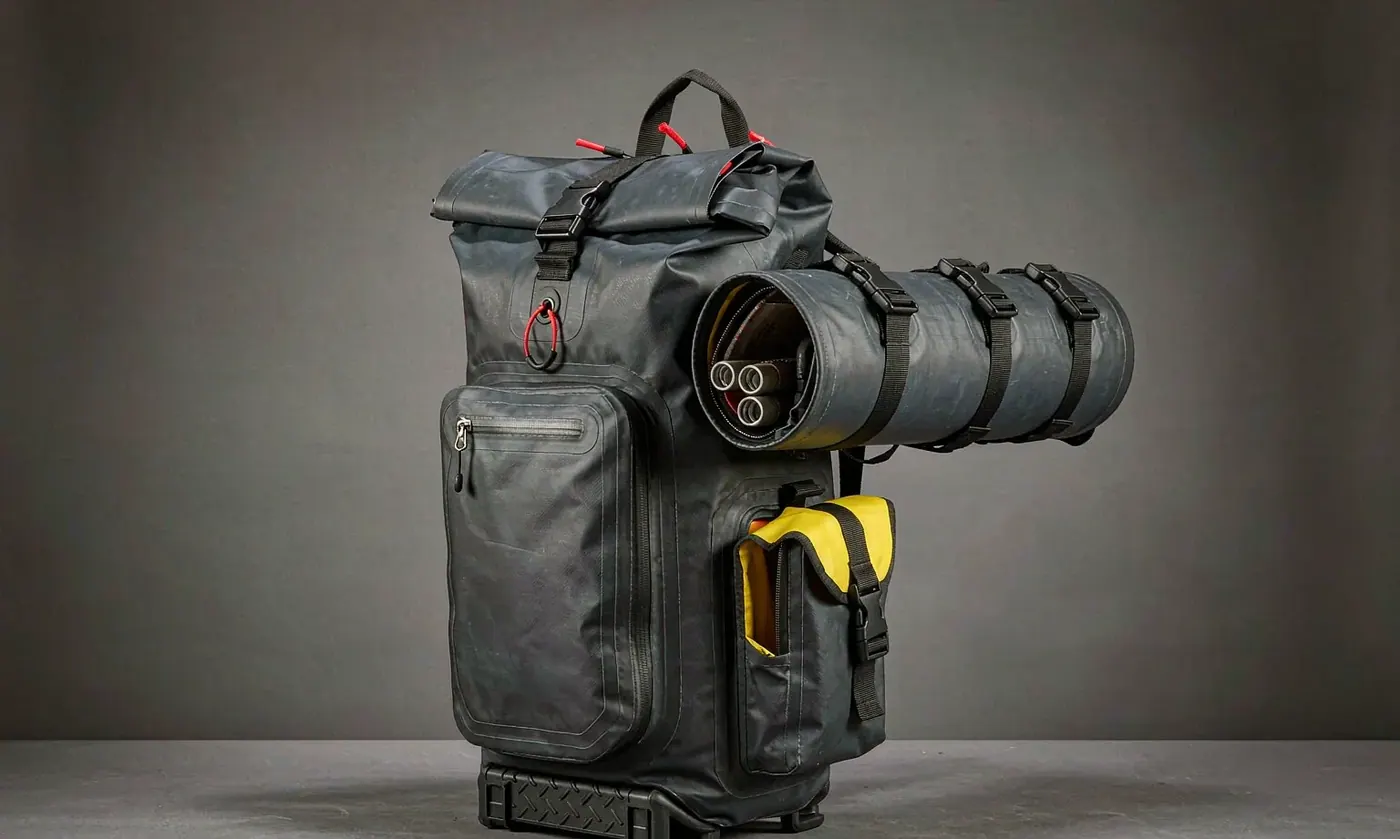
The tubes on this build were specified as removable, because the rental fleet wanted them and the retail customer did not always. That meant a webbing sleeve rather than a welded socket, which is slightly less rigid but lets one shell serve both channels. Rig geometry is covered in more depth in the kayak crate rigging guide.
Results After One Season
The commercial result was better than the client's target and the operational result was better than either party expected. Attach rate on new kayak sales reached 31 percent against a 12 percent category average and a 20 percent target, and rental fleet losses fell from nine crates a season to two, both attributable to the tether rather than to the bag.
| Metric | Target | Result |
|---|---|---|
| Attach rate on new kayak sales | Above 20 percent | 31 percent |
| Rental crate losses per season | Under 4 | 2 |
| Insert repeat purchase rate | Not set | 18 percent of shell buyers |
| Returns at 6 months | Under 3 percent | 1.4 percent |
| Second season order | Not set | 900 shells, 1,800 inserts |
The insert repeat rate is the number the client found most useful, because it turned a one-time accessory sale into a relationship. Eighteen percent of shell buyers came back for a second insert within the season, and the bait insert was the one most often replaced, which is why the second order doubled inserts relative to shells. Returns at six months came in at 1.4 percent against a 3 percent ceiling, and of those, none were attributed to the modular junction, which was the failure mode both parties had been most worried about when the programme started.
Selling Modularity at the Counter
A modular product only works commercially if the modularity can be explained in under thirty seconds, and the packaging had to be designed around that. The retail box carries a single sentence, one shell and three inserts, plus a photograph of the three configurations side by side, and the counter staff were given one scripted line about buying the second insert later. Anything longer and the advantage disappears into an explanation.
Two merchandising decisions made the difference. Inserts were displayed loose on a hook beside the boxed shell rather than inside it, because a customer who can hold an insert understands the system immediately and one who reads about it does not. And the second insert was offered at a reduced price when bought with the shell, which is what produced the 18 percent attach rate on inserts and turned a single sale into a return visit.
What the Second Season Changed
The second order was 900 shells and 1,800 inserts, and three things changed based on the first season's data. A second shell size was added at 305 by 355 millimetres for rectangular crates, covering the 20 percent the first shell missed. The bait insert was reworked with a thicker liner after it became the most replaced item in the range. And the tether eye was moved 40 millimetres forward, because two rental losses were traced to the tether pulling the crate sideways rather than holding it.
One thing was deliberately not changed: the shell pattern itself. The client's instinct was to add pockets and sleeves in year two, and the argument against was that the same pattern across two seasons lets the rental fleet interchange parts, keeps spare stock valid and avoids a second sampling round. Restraint at the revision stage is often worth more than improvement, and in this case it saved nine working days of sampling and an entire pattern change, both of which would have cost more than the improvement was worth at a 900 unit volume. The client has since adopted the same rule across the accessory range: revise the insert, never the shell, unless the shell is demonstrably wrong.
A third change deserves a mention because it came from the rental fleet rather than from retail. Rental staff asked for a high-visibility panel on the shell, so a crate that goes over the side can be spotted from the bank. A 120 square centimetre retroreflective panel was added at the rear of the second run for the rental shells only, which is a good example of a modular system serving two channels from one pattern.
Programme Notes
QUANZHOU JUNYUAN BAGS has worked on waterproof bag programmes since 2014, with a founding team in this industry since 2004. Monthly output reaches 200,000 units, verified by SGS, under BSCI and ISO 9001 governance, with materials screened for REACH and California Prop 65 and every bulk order inspected at AQL 2.5. Quality system claims reference standards published by the International Organization for Standardization.
A modular brief should open with the physical constraint being fitted, sent as a sample rather than a drawing, because that is where this programme nearly went wrong. Add the insert ratio, the tolerance band, attachment points for rod storage, closure type, hardware grade, colourway and quantity. Five hundred pieces per design and colour is the opening order size, applied here to the shell. Sampling runs six to ten working days, bulk thirty-five to fifty days from approved sample and deposit, and shipping is FOB Xiamen or DDP to upwards of one hundred nations. Order sizing detail is in the fishing bag MOQ guide, and the category sits on the kayak fishing crate bag page. Send briefs to service@junyuanbags.com.
People Also Ask
What size is a standard kayak crate?
Around three hundred and thirty by three hundred and thirty millimetres in footprint and two hundred and eighty millimetres tall, with common variants from three hundred to three hundred and sixty millimetres.
Can one crate bag fit every kayak crate?
Not exactly. A shell sized for three hundred and thirty with a twenty millimetre tolerance band and compression straps covers roughly eighty percent of crates.
Will a loaded kayak crate bag float?
Usually not. A loaded crate weighs nine to fourteen kilograms and displaces less than that. Empty, closed-cell panels can give four to six kilograms of positive buoyancy.
Why does a crate bag need a rear cut-out?
Because rod holder bases protrude about ninety millimetres at the rear of many crates, and a bag without a cut-out cannot seat fully.
How should rods be stored on a kayak crate?
In two tubes of fifty millimetres internal diameter, angled ten to fifteen degrees off vertical and cut to three hundred and fifty millimetres.
Is a modular crate bag cheaper to stock?
Yes. One shell and three inserts offers three configurations at roughly half the inventory of three finished products, which was the original commercial problem.
Frequently Asked Questions
Q1. What was ordered in this programme?
Five hundred shells and nine hundred interchangeable inserts in three types, shipped as five hundred retail boxes plus three hundred loose inserts.
Q2. Which insert sold best?
The tray module at forty-four percent of insert sales, followed by the dry module at twenty-nine and the bait module at twenty-seven.
Q3. Which insert drove repeat purchases?
The bait module. Eighteen percent of shell buyers returned for a second insert within the season, and bait inserts were the ones most often replaced.
Q4. What nearly went wrong in sampling?
The rear panel fouled rod holder bases by twelve millimetres. Sending the crate rather than the drawing would have caught it months earlier.
Q5. What crate size did the shell target?
Three hundred and thirty by three hundred and thirty millimetres with a twenty millimetre tolerance band, two compression straps and a ninety millimetre rear cut-out.
Q6. Does the bag float if the kayak rolls?
Empty, yes, with four to six kilograms of positive buoyancy from closed-cell panels. Loaded, no, which is why every shell has a twenty kilogram tether eye.
Q7. How was the modular seal tested?
Every configuration was immersion checked with its insert fitted, because a shell that seals alone can still leak at the insert junction.
Q8. How long did bulk take?
Thirty-eight days from approved sample and deposit, within the thirty-five to fifty day range, for shells and inserts together.
Q9. What did inspection find?
One minor on the shell lot and two across the insert lots, all trim or alignment related, with zero major and zero critical defects.
Q10. Did the rental fleet benefit?
Yes. Crate losses fell from nine a season to two, and the dry insert became the rental default because it is the most forgiving configuration.
Q11. What is the MOQ for a modular crate programme?
Five hundred pieces per design and colour, applied to the shell, with six to ten working days for sampling and thirty-five to fifty days for bulk.