EVA totes fall into six practical types: the open-top utility body, the strapped shoulder-carry tote, the mini and kids size, the semi-perforated body with reduced hole coverage, the zip-top or lidded variant, and the hybrid with a molded base under a fabric upper. Every type is the same one-piece injection-molded ethylene-vinyl acetate construction, and they differ in mouth width from 24 to 54 centimetres, volume from 5 to 42 litres, empty weight from 0.3 to 2.6 kilograms and in whether a closure or strap is present. The right type is decided by load and carry distance rather than by appearance.
The Six Types at a Glance
Type names in this category are used loosely by retailers, so it is worth anchoring them to dimensions rather than to labels. What actually distinguishes one type from another is a combination of mouth width, closure, strap provision and perforation coverage. Those four variables determine what the bag can carry, how far it can be carried and how it behaves in sand and water, and they are the numbers worth checking before comparing prices.
| Type | Mouth width | Usable volume | Empty weight | Closure and strap | Best for |
|---|---|---|---|---|---|
| Open-top utility | 41 to 54 centimetres | 18 to 42 litres | 1.0 to 2.6 kilograms | No closure, handles only | Beach and family loads |
| Strapped shoulder carry | 33 to 48 centimetres | 10 to 32 litres | 0.9 to 2.1 kilograms | Detachable shoulder strap | Longer walks, hands free |
| Mini and kids | 24 to 33 centimetres | 5 to 10 litres | 0.3 to 0.9 kilograms | No closure, short handles | Children, pool, gifts |
| Semi-perforated | 36 to 48 centimetres | 14 to 32 litres | 1.2 to 2.2 kilograms | Usually none | Retail, garden, messy loads |
| Zip-top or lidded | 33 to 48 centimetres | 10 to 32 litres | 1.3 to 2.4 kilograms | Zip or moulded lid | Travel, car, windy sites |
| Hybrid molded base | 36 to 48 centimetres | 16 to 34 litres | 1.1 to 2.0 kilograms | Varies with upper | Style-led retail ranges |
Read across that table and two patterns appear. Weight scales with mouth width far more steeply than with volume, because a wider mouth needs a longer rim and a heavier base to stay rigid. And closure provision is what separates the types aimed at travel and transport from the types aimed at the beach, where an open top is an advantage rather than a compromise because wet gear can be dropped in without touching anything.
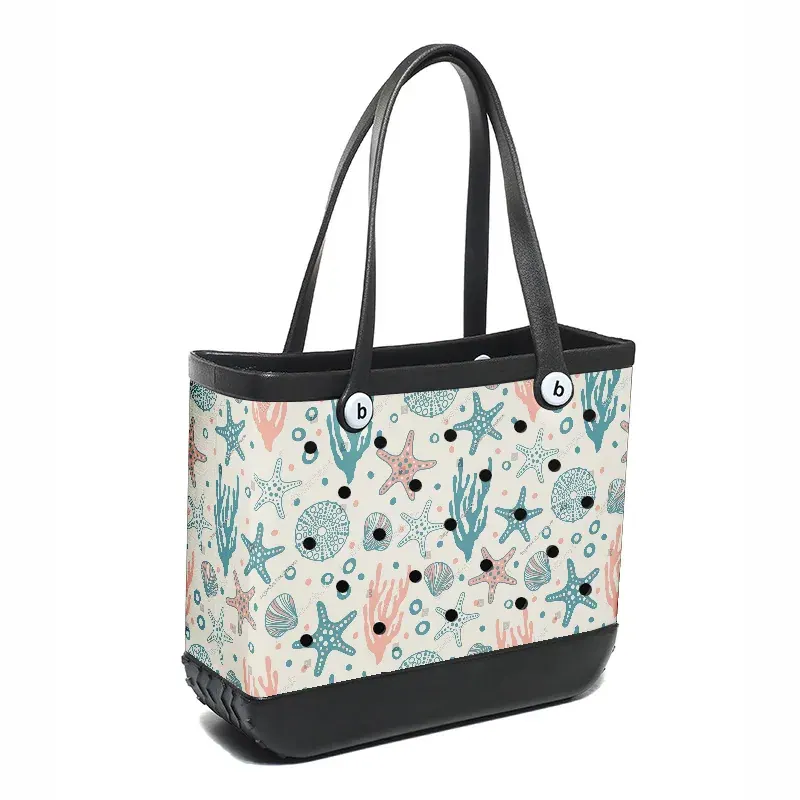
Open-Top Utility Tote
The open-top utility body is the reference design for the whole category and the one most people picture. It has no closure, no lining and no strap: two handles, perforated walls, a wide flat base and an opening that takes up the entire top of the bag. Sizes run from 41 centimetres for a medium to 54 for an extra large utility carry, with volumes between 18 and 42 litres and empty weights between 1.0 and 2.6 kilograms.
Its strength is access. Because the opening is the full footprint of the bag, a loaded tote can be searched without unpacking, wet items can be dropped straight in, and a large awkward object such as a folded chair or a ball can be carried without a struggle. Its weakness is equally obvious: there is no way to close it, so contents are visible, loose items can bounce out on a bumpy carry, and it cannot be laid on its side without spilling. For beach, pool, garden and sports use those weaknesses rarely matter, which is why this type outsells all the others combined.
Strapped and Shoulder-Carry Totes
Adding a strap changes what the bag is for. A detachable webbing or moulded strap with a drop of 40 to 60 centimetres lets a loaded body be carried on one shoulder, which frees a hand for a child, a chair or a second bag, and it changes the comfortable carry distance from roughly 150 metres to roughly 600. That turns the tote from a car-to-sand bag into a genuinely walkable one, and it is the single most useful addition for anyone whose beach or pool is more than a short walk from parking.
Two details decide whether a strapped tote works. Attachment point strength matters first: the strap pulls on the rim at an angle the handles never do, so the moulded anchor needs a generous fillet and the strap needs a rated hardware set, ideally tested to at least twice the intended load. Strap width matters second: anything under 25 millimetres digs into a shoulder once the load passes about 10 kilograms, and a 38 to 50 millimetre strap with a sliding pad is comfortable at 15. The strap should also be removable, because a strap left attached gets in the way when the bag is used as an open carry-all.
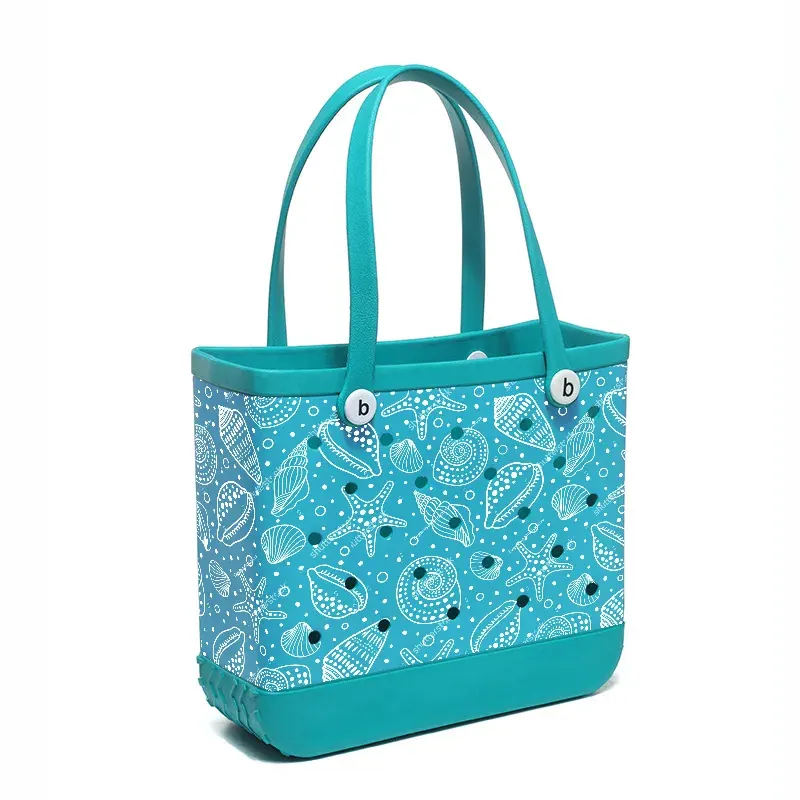
Mini, Kids and Personal Sizes
The mini and kids group covers bodies from 24 to 33 centimetres across, holding 5 to 10 litres and weighing 0.3 to 0.9 kilograms empty. This is the type bought for children, used as a pool kit bag and given as a gift, and it is where personalisation has the most value because a child will claim a specific colour and a specific charm set as their own.
The specification that governs this type is empty weight rather than capacity. A child can comfortably carry about ten percent of body weight, so a 20 kilogram child carrying a 0.4 kilogram bag has 1.6 kilograms of budget for contents, which is a towel, goggles and a drink. Raise the bag to 0.9 kilograms and the same child has almost nothing left for contents, which is why adult small sizes make poor children bags despite being only a few centimetres larger. Perforation diameter also drops to six to nine millimetres at this scale, which still passes sand but does not admit small fingers.
Charms are the accessory most associated with this type and the one most often bought twice. A charm cut for a twelve millimetre hole will spin loosely in a fourteen millimetre one and will not seat in a nine millimetre body, so the hole specification on the body determines which charm families can be sold against it. Any charm sold with a kids size is a small part and should be tested against the small-parts requirement for the destination market.
Semi-Perforated and Solid-Wall Bodies
Not every body in this category is fully perforated. Semi-perforated designs concentrate holes low on the walls and across the base while leaving the upper wall solid, which recovers usable interior surface and gives a cleaner area for printing. The trade-off is drainage: less open area means slower draining, and it means the upper wall no longer ventilates, so a damp load takes longer to dry.
| Perforation coverage | Drain time after dunk | Usable print area | Drying behaviour | Typical use |
|---|---|---|---|---|
| Full coverage, walls and base | 4 to 7 seconds | Small, between the holes | Fastest, ventilates the whole body | Beach, sand, wet kit |
| Lower wall and base only | 10 to 18 seconds | Large, upper wall is solid | Good at the base, slower above | Retail ranges with artwork |
| Base only | 20 to 35 seconds | Largest, full wall available | Slow, wet items stay damp | Garden, utility, style-led |
| Fully solid wall | Does not drain | Whole surface available | Wipes dry only | Carry-all, not water use |
The choice is genuinely application-driven. Anyone whose load includes wet swimsuits, muddy boots or sandy toys wants full coverage, and the drying difference over a season is large. Anyone building a retail range around artwork, a resort logo or a photographic print wants at least the upper wall solid, because printing across perforations produces broken edges and a visibly cheaper result. Semi-perforated bodies split the difference and are the most common choice for branded resort programmes for exactly that reason.
Zip-Top, Lidded and Insert-Ready Variants
Closing the top changes the category in an important way and is worth being sceptical about. A zip or a moulded lid keeps contents contained and out of sight, which suits travel, car use and windy sites. But the body remains perforated, so a zip-top tote is still not a dry bag: it contains rather than seals, and water entering through the holes is now held inside rather than draining. Anyone buying a zip-top expecting waterproofness will be disappointed, and the zip itself adds a failure point that the rest of the design does not have.
Where closures do make sense is transport. A zip-top body can be laid in a car boot without spilling, can be checked as hold luggage without everything escaping, and keeps small items from bouncing out on a long carry. Zips in this application should be corrosion-resistant with a moulded pull, because a metal slider on a saltwater bag seizes within a season. Inserts are the quieter winner here: a drop-in divider that separates wet from dry costs a fraction of a zip and turns one open volume into two usable ones, at the price of being size-specific to the body.
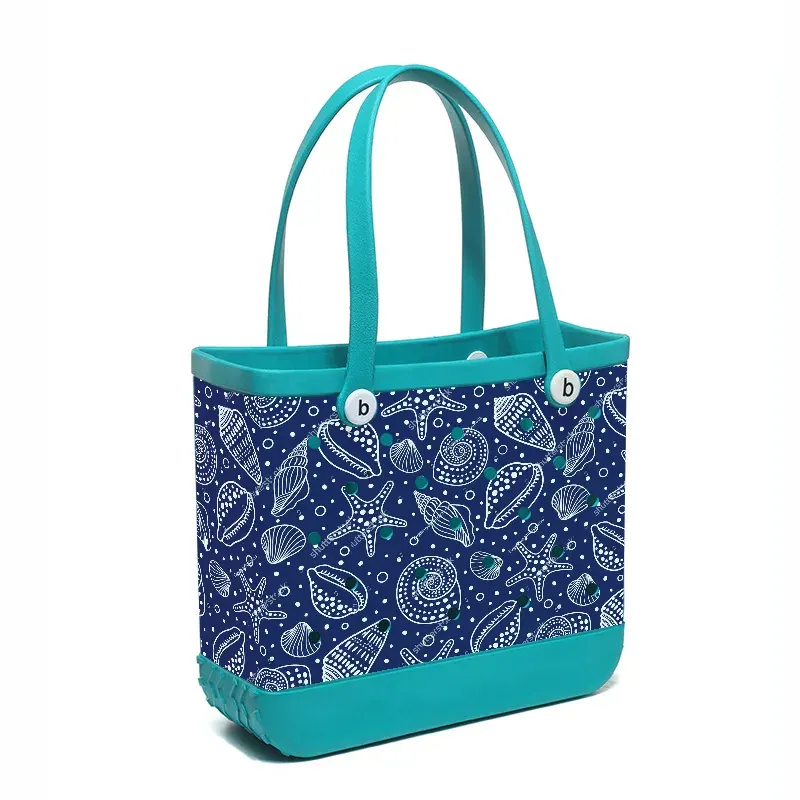
Hybrid Bodies: Molded Base Under a Fabric Upper
The hybrid type uses a moulded EVA base and lower wall with a sewn fabric upper, and it exists because it looks less like sports equipment and more like a conventional tote. The moulded lower section still delivers the two benefits that matter standing on wet ground: it keeps the base off the surface and it cannot absorb water. Everything above the join behaves like a fabric bag, which means it absorbs water, dries slowly and can stain.
| Attribute | Full molded EVA body | Hybrid molded base | Practical consequence |
|---|---|---|---|
| Water behaviour | Absorbs nothing, drains | Upper absorbs and holds water | Hybrid needs drying time after wet use |
| Cleaning | Hose and air dry, about 3 minutes | Spot clean the fabric upper | Hybrid cannot be hosed down |
| Sand behaviour | Sand falls through the perforations | Sand collects in the base corners | Hybrid needs shaking out |
| Appearance range | Limited to moulded colour and print | Any fabric, print or trim | Hybrid wins on style-led retail |
| Service life near salt water | Five to seven seasons | Two to four seasons at the join | The join is the failure point |
The honest summary is that hybrids trade the two properties that define the category for appearance. They are the right call for a fashion range where the bag will be carried to a cafe and set on a dry floor, and the wrong call for a family beach bag that will be stood on wet sand and hosed down every weekend. Buyers should be told which one they are getting, because the difference is not visible in a photograph.
Which Type Fits Which Job
Type selection resolves quickly once three things are known: what the load is, how far it has to be carried, and whether it arrives wet. The table below maps the common jobs onto a type, and the exceptions are narrow enough to be stated in a sentence each.
| Job | Load character | Carry distance | Recommended type |
|---|---|---|---|
| Family beach day | Bulky, sandy, part wet | 100 to 250 metres | Open-top utility, 32 litres or more |
| Solo pool session | Small, wet | Under 100 metres | Mini or personal, 7 to 10 litres |
| Walk to a distant beach | Bulky and heavy | 400 metres or more | Strapped shoulder carry, 18 to 32 litres |
| Car or boot organiser | Mixed, hard objects | Not carried far | Zip-top or semi-perforated |
| Junior sports kit | Muddy, wet, smelly | 100 to 200 metres | Open-top utility, full perforation |
| Resort or gift retail | Light | Short | Semi-perforated with artwork and charms |
| Style-led everyday carry | Light and dry | Short to medium | Hybrid molded base |
Two exceptions are worth naming. A family that walks a long way to the beach should buy a strapped body rather than a bigger open-top one, because the limiting factor is carry comfort rather than capacity. And anyone whose load is mostly wet should not buy a zip-top or a hybrid at all, because both hold water in rather than letting it out, which is the exact opposite of what the material is good at.
How Each Type Behaves in Sand, Salt and Heat
Six types share one material, so chemical behaviour is common across them and the differences come from geometry. Sand, salt and heat act on the areas each type exposes, and the result is predictable enough to plan around rather than discover. Heat is the one that genuinely threatens every type: surface temperature on a dark body left in direct summer sun passes sixty degrees within an hour, which is enough to deform the shape permanently regardless of construction.
| Type | Sand behaviour | Salt water behaviour | Heat sensitivity | Seasonal care |
|---|---|---|---|---|
| Open-top utility | Sand falls straight through | Rinses clean, no corrosion points | High on dark colourways | Hose, drain, store in shade |
| Strapped shoulder carry | Sand falls through, strap traps some | Hardware needs rinsing or it seizes | High, plus strap stiffness | Rinse hardware, dry strap separately |
| Mini and kids | Sand falls through, small volume | Rinses clean | Very high, thin walls creep sooner | Never leave in a car or on a deck |
| Semi-perforated | Sand collects on solid upper panels | Rinses clean, slower drying | High | Brush the solid panels, air dry |
| Zip-top or lidded | Sand falls through but stays contained | Zip needs fresh water or it seizes | High, plus zip stiffness | Rinse the zip, leave the top open |
| Hybrid molded base | Sand collects in the fabric upper | Upper absorbs salt and stains | Moderate at the base, low on fabric | Spot clean, dry fully before storage |
The practical routine is short and identical for the four fully moulded types: hose at tap pressure, tip to drain, stand open in shade for an hour. Solvents, machine washing and water above sixty degrees damage all of them. The two types that need more attention are the strapped body, whose hardware should be rinsed separately, and the hybrid, whose fabric upper cannot be hosed at all and must be dry before it is stored or it will mildew at the join.
Specification Differences Worth Confirming by Type
Each type has one specification that buyers most often fail to check, and each is cheap to confirm and expensive to discover later. Confirming all six takes a single email before sampling and prevents the majority of specification disputes that arise after delivery.
- Open-top utility: confirm the width of the solid band above the top row of holes, at least fifteen millimetres on large sizes.
- Strapped: confirm strap width, attachment method and the rated load of the hardware, ideally twice the intended carried weight.
- Mini and kids: confirm empty weight, since above 0.6 kilograms a child cannot carry a useful load in the bag.
- Semi-perforated: confirm which panels are solid and how that affects drain time, particularly for wet kit use.
- Zip-top: confirm the zip is corrosion resistant and that the buyer understands the body is not a sealed container.
- Hybrid: confirm the join method between moulded base and fabric upper, since that join is where the type fails.
Physical test methods for load, dimensional and mechanical checks are published by ASTM International, and quality-management expectations for documenting those checks come from the International Organization for Standardization. Cleaning and care guidance for consumer-facing products aligns with the safer chemical practice published by the United States Environmental Protection Agency.
Programme Notes
Full category background sits in the injection-molded EVA tote guide, the large end of the range in the large EVA tote guide and the small end in the small EVA tote guide. QUANZHOU JUNYUAN BAGS has run waterproof bag programmes since 2014 with a founding team in this trade since 2004, covering every type described here alongside sewn and welded ranges. Monthly output runs at 200,000 units verified by SGS, operations follow BSCI and ISO 9001, materials are screened for REACH and California Prop 65, and every bulk shipment is inspected at AQL 2.5 before release. Programme minimums begin at 500 pieces per design and colour, with sampling at 6 to 10 working days and bulk at 35 to 50 days from approved sample and deposit.
Send your target type, dimensions, perforation coverage, strap and closure requirement, colourway count and quantity to service@junyuanbags.com, and ask for the packed carton specification at the same time, because strap and closure hardware changes both the packing density and the freight cost per unit.
People Also Ask
What are the main types of EVA totes?
Six: open-top utility, strapped shoulder carry, mini and kids, semi-perforated, zip-top or lidded, and hybrid bodies with a molded base under a fabric upper.
Which EVA tote type is best for the beach?
The open-top utility body at 32 litres or more, with full perforation so sand falls through and wet kit drains.
Is a zip-top EVA tote waterproof?
No. A zip contains rather than seals, and the perforated walls still admit water, so the body holds water in instead of draining it.
What is a hybrid EVA tote?
A body with a molded EVA base and lower wall under a sewn fabric upper. It looks like a conventional tote but cannot be hosed down.
How wide should an EVA tote shoulder strap be?
38 to 50 millimetres. Anything under 25 millimetres digs into the shoulder once the load passes about 10 kilograms.
What size is a mini EVA tote?
Between 24 and 33 centimetres across the mouth, holding 5 to 10 litres and weighing 0.3 to 0.9 kilograms empty.
Frequently Asked Questions
Q1. What is an open-top utility EVA tote?
The reference design: no closure, no lining, two handles, perforated walls and an opening the full width of the bag, sized 41 to 54 centimetres.
Q2. What does a strapped EVA tote add?
A detachable shoulder strap with a 40 to 60 centimetre drop, which raises the comfortable carry distance from about 150 metres to about 600 metres.
Q3. Are mini EVA totes only for children?
No. Minis at 24 to 28 centimetres suit children, while personal sizes at 30 to 33 centimetres are widely used by adults for pool and gym.
Q4. What is a semi-perforated EVA tote?
A body with holes concentrated low on the walls and across the base, leaving the upper wall solid for printing. Drain time rises to 10 to 18 seconds.
Q5. Do zip-top EVA totes keep water out?
No. They keep contents contained but not dry, because the perforated walls still admit water and the closure stops it draining.
Q6. What is the point of a hybrid EVA tote?
Appearance. A molded base gives water resistance where it matters while a fabric upper allows any print or trim, at the cost of drying time.
Q7. Which type dries fastest?
A fully perforated open-top body, which drains in 4 to 7 seconds after a dunk and ventilates the whole interior rather than only the top.
Q8. Which type is best for printing a logo?
A semi-perforated or solid-upper body, because printing across perforations produces broken edges and a visibly cheaper result.
Q9. Do straps need special hardware near salt water?
Yes. Specify corrosion-resistant hardware with a moulded pull, since a metal slider on a saltwater bag seizes within a season.
Q10. How heavy is each type?
From 0.3 kilograms for a mini to 2.6 kilograms for an extra large open-top utility body, with hybrids and zip-tops slightly heavier than plain equivalents.
Q11. Can one body serve as both a beach and a travel bag?
Only a strapped or zip-top body. An open-top utility tote cannot be laid down without spilling, which rules it out for car and aircraft use.
Q12. What should a bulk buyer confirm before sampling?
Type, dimensions, perforation coverage, strap and closure specification, colourway count, and the packed carton quantity.