A waterproof backpack for winter hiking needs 32 to 45 litres rather than the 22 to 30 litres the same trail takes in summer, a TPU shell that flexes at minus 30 degrees Celsius rather than a PVC shell that stiffens below minus 10, welded seams, and an externally accessible bay of 4 to 6 litres for crampons or microspikes that must never travel inside the main compartment. Loaded weight climbs from a summer 6 to 9 kg to a winter 9 to 14 kg because of the layers, the extra food and the traction gear, and usable daylight at 45 degrees north falls from about 15 hours in June to 8 or 9 in December, which compresses the day into a hard nine-to-four window. Three failures account for most winter complaints and none of them is water coming through the shell: a zip iced shut, a hydration hose frozen solid, and a pack that carries meltwater inside because snow melted against the back and refroze. This page sets the volume, the cold behaviour of materials and hardware, the water and food plan, the sharp-gear layout and the drying routine.
What Winter Changes on the Same Trail
Winter does not just make a familiar hike colder; it changes the arithmetic of every decision on it. The same 14 kilometre loop that takes five hours in July takes seven to nine in January, because snow of 20 to 60 centimetres slows the pace to 2.0 to 3.0 kilometres per hour against a summer 4.0 to 5.0. Daylight shrinks, water sources freeze, and the pack itself has to carry the clothing that is not being worn.
| Factor | Summer value | Winter value | Effect on the pack |
|---|---|---|---|
| Walking pace | 4.0 to 5.0 km per hour | 2.0 to 3.0 km per hour | Same distance needs 40 to 60 percent more time |
| Usable daylight at 45 N | About 15 hours in June | 8 to 9 hours in December | Start before dawn, finish with a headlamp |
| Clothing carried, not worn | 0.5 to 1.5 L | 6 to 11 L | Volume floor rises by about 8 litres |
| Water carried | 1.0 to 2.0 L | 2.0 to 3.0 L, insulated | Heavier and bulkier, and it freezes |
| Food energy | 2,000 to 2,800 kcal per day | 3,000 to 4,500 kcal per day | 0.4 to 0.8 kg more food weight |
| Traction gear | None | 0.6 to 2.5 kg | Must be carried outside the pack |
| Loaded weight | 6 to 9 kg | 9 to 14 kg | Hip belt becomes mandatory, not optional |
The consequence for a buying decision is that a winter pack is rarely the same pack as a summer one. A 28 litre summer pack cannot close around 11 litres of clothing plus winter food and traction, and a pack forced shut with compression straps has a collar that no longer seals. Buyers building a year-round range should treat the winter specification as a separate volume band rather than a colourway of the summer product.
Volume: Why a Winter Day Pack Is Bigger
The volume question in winter is entirely about the clothing that is carried rather than worn. A hiker leaving a trailhead at minus 12 degrees Celsius is wearing every layer at 08:00 and half of them by 13:00, and those layers do not disappear — they go into the pack. A mid-weight insulated jacket packs to 3 to 5 litres, a fleece to 2 to 3, a spare base layer to 1.0 to 1.5, and hat, gloves and a neck gaiter to 0.5, which is 6 to 11 litres before food and water are counted.
| Trip | Volume | Loaded weight | What drives the volume |
|---|---|---|---|
| Winter day hike, low level | 32 to 38 L | 9 to 11 kg | Layers, 2 L insulated water, traction |
| Winter day hike, mountain | 38 to 45 L | 11 to 14 kg | Adds crampons, axe, bivvy, spare gloves |
| Winter hut-to-hut | 40 to 50 L | 12 to 15 kg | Adds liner, wash kit, hut shoes |
| Winter weekend with bivvy | 45 to 55 L | 14 to 18 kg | Adds a minus 10 bag of 8 to 12 L |
| Summer equivalent day hike | 22 to 30 L | 6 to 9 kg | Layers stay on the body |
Two items deserve their own line because they are what push a mountain day above 38 litres. A winter sleeping bag rated to minus 10 degrees Celsius comfort is a genuinely large object at 8 to 12 litres packed, and it only compresses to that with a compression sack of 60 to 90 grams; loose in a pack it takes 15 litres. The second is the emergency layer — a bivvy bag of 200 to 400 grams plus a closed-cell sit pad — which nobody plans to use and which no winter checklist should omit.
Volume interacts with the closure in a way that decides whether the pack is waterproof at all. A roll mouth needs three full turns to reach its rating, and it needs those turns on a collar with a stiffener, which means the pack has to be filled to a level that leaves about 150 to 200 millimetres of collar free. A winter pack filled to the brim cannot be rolled three turns, and it will leak at the collar in exactly the conditions it was bought for. Sizing guidance by volume band is set out in the size and capacity guide.
Cold and the Pack: Coatings, Seams and Zips
The two material questions in winter are whether the coating stays flexible and whether the closure can be operated. Both are testable and both are frequently unspecified, which is why winter returns cluster at the collar and the zip rather than at the seams. A PVC-coated shell stiffens below about minus 10 degrees Celsius and cracks at the fold lines of a rolled collar within a season; a TPU-laminated shell stays flexible to minus 30 and costs 2 to 4 USD more per unit at 1,000 pcs.
| Component | Behaviour in cold | Failure temperature | Specification |
|---|---|---|---|
| PVC coating | Stiffens then cracks at folds | Below about minus 10 degrees Celsius | Avoid for winter programmes |
| TPU laminate | Stiffens, recovers fully | Minus 30 to minus 40 degrees Celsius | 0.35 to 0.45 mm film |
| Welded seam | Flexes with the shell | Matches the shell | Peel at 90 percent of fabric strength |
| Taped seam | Adhesive stiffens and lifts | Below about minus 15 degrees Celsius | Avoid on a winter roll collar |
| Coated zip | Ice forms in the teeth | At or below 0 degrees Celsius | Covered garage, dry before storage |
| Plastic buckle | Becomes brittle under impact | Below about minus 25 degrees Celsius | Acetal, rated 300 to 500 N |
| Foam in straps | Hardens and loses compliance | Below about minus 15 degrees Celsius | Closed cell EVA, 8 to 12 mm |
The zip is the component that actually stops a winter pack, and the mechanism is worth understanding because the fix is behavioural. Meltwater or condensation sits in the teeth, the temperature drops below zero overnight or on a summit, and the pack becomes impossible to open without force. Forcing a frozen zip destroys the coating on the tape. The rule is to dry the zip with a cloth at the end of the day, leave the pack open overnight, and never close a collar that is wet if the temperature is going to fall below zero.
Cold exposure is also a personal safety matter and the failure mode is cumulative rather than dramatic. Shivering begins once core temperature drops to about 35 to 36 degrees Celsius, and fine motor control goes before that, which is why fumbling with a stiff buckle in wind is not merely annoying. The clinical progression and the practical first-aid steps are documented by the CDC in its guidance on hypothermia and frostbite, and wind chill figures that turn a minus 5 degree day into a minus 20 degree exposure are published by NOAA.
Water, Food and the Freeze Problem
Water is heavier and more fragile in winter. Cold air drives fluid loss and a winter hiker needs 2 to 3 litres a day against a summer 1 to 2, yet streams freeze and surface water is unreliable below about minus 5 degrees Celsius. The practical answer is a vacuum-insulated bottle of 0.75 to 1.0 litres carried inverted in an external pocket, because ice forms from the top down and the cap stays workable, plus a second bottle of 1.0 litre inside a liner.
| Item | Freeze behaviour | Time to failure | Mitigation |
|---|---|---|---|
| Hydration hose | Freezes solid | 20 to 40 min at minus 10 degrees Celsius | Do not use; carry bottles |
| Insulated bottle, inverted | Ice forms away from the cap | 4 to 8 hours | External pocket, cap down |
| Standard bottle inside pack | Freezes from the top | 1 to 3 hours | Insulate, or carry against the back |
| Alkaline batteries | Capacity falls steeply | 40 to 60 percent loss at minus 20 degrees Celsius | Use lithium cells in headlamps |
| Lithium batteries | Holds most capacity | About 20 percent loss at minus 20 degrees Celsius | Keep spares in an inner pocket |
| Phone screen and cell | Shuts down in cold | 20 to 40 min at minus 10 degrees Celsius | Inner pocket, body heat |
Food behaves better than water but needs planning. Energy requirement rises to 3,000 to 4,500 kilocalories a day in cold conditions, which is 0.4 to 0.8 kilograms more food than a summer day, and the right foods are the ones that do not freeze into a block: nuts, chocolate, dried fruit, cheese and wraps rather than gels and anything with a high water content. A vacuum flask of 0.5 to 0.75 litres holding a hot sweet drink is the single highest-value winter item after traction, and it weighs 300 to 600 grams.
Sharp Gear: Crampons, Axes and Snowshoes
Traction is the one category of winter equipment that must never travel loose inside a waterproof pack, because the points are sharper than the shell is tough. Microspikes weigh 0.6 to 1.0 kilograms, crampons 0.8 to 1.2, and both have 10 to 14 points of hardened steel that will puncture a 420D liner on the first long descent. Every winter specification should therefore include a dedicated external bay with a reinforced panel.
| Item | Weight | Carry position | Pack requirement |
|---|---|---|---|
| Microspikes | 0.6 to 1.0 kg | External bay or lid strap | 4 to 6 L bay, 840D panel |
| Crampons | 0.8 to 1.2 kg | External bay, points covered | Reinforced sleeve, 840D or moulded |
| Ice axe, 55 to 70 cm | 0.4 to 0.7 kg | Dedicated loops, shaft down | Two loops plus a shaft retainer |
| Trekking poles | 0.4 to 0.6 kg per pair | Side loops when not in use | Snow baskets of 60 to 100 mm |
| Snowshoes | 1.5 to 2.5 kg | Lashed to the lid or sides | Four lash points of 20 mm webbing |
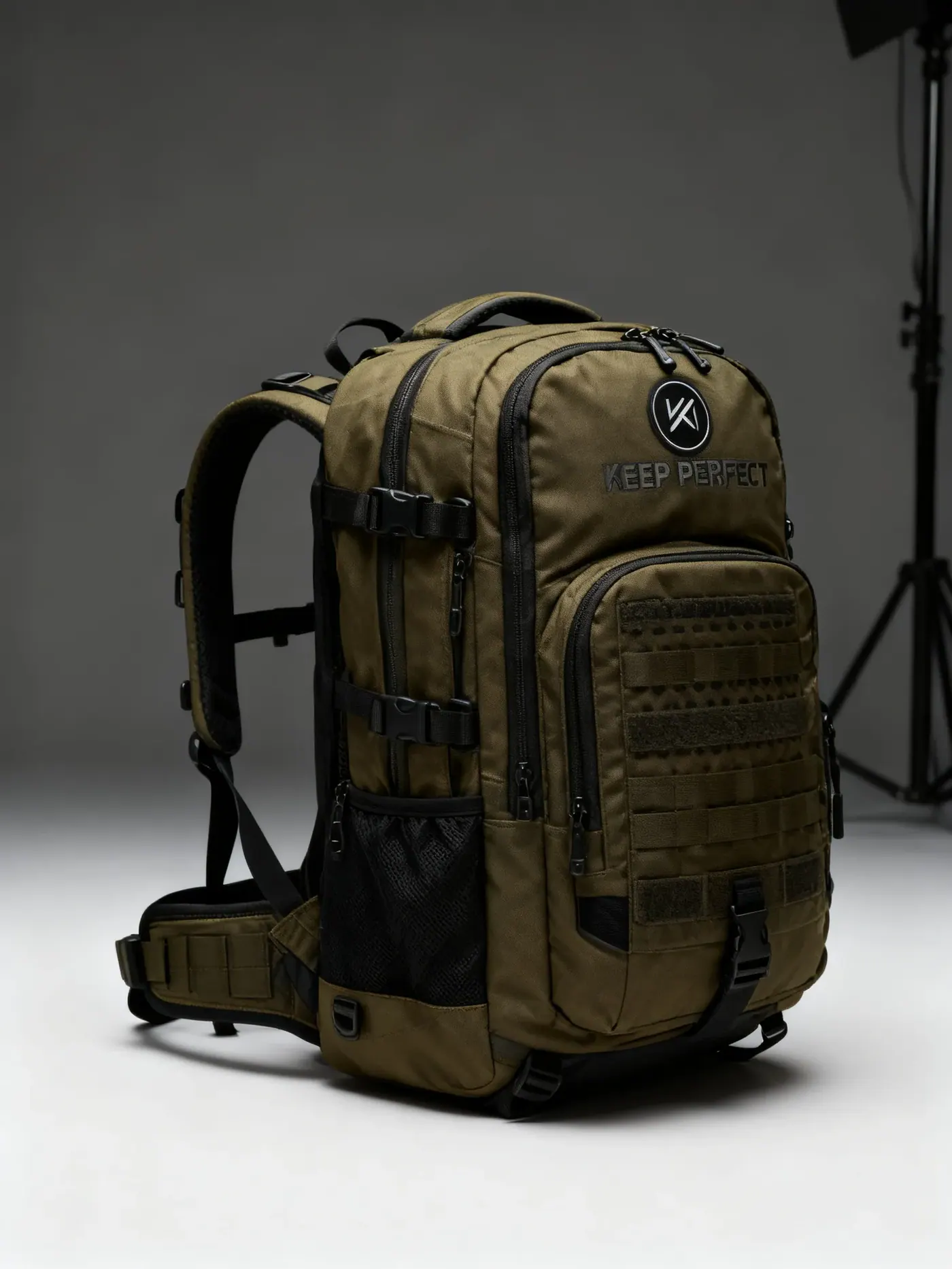
Snowshoes are the awkward case because they are large, rigid and usually carried only for part of the day. Four lash points of 20 mm webbing on the lid and the two lower sides will hold a pair of 1.5 to 2.5 kilograms securely, and they should be positioned so the frame sits flat against the back rather than standing off it, because a load that stands off the panel moves with every step. A pack with no lash points can be retrofitted with two 20 mm daisy chains, but it is better specified at the start.
Electronics, Navigation and Light
Winter walking starts and ends in the dark for a large part of the season, so light and navigation move from optional to essential. A headlamp of 300 to 600 lumens with a burn time of 4 to 8 hours on medium is the working specification, and it should be carried with a spare set of lithium cells in an inner pocket, because an alkaline cell at minus 20 degrees Celsius delivers 40 to 60 percent less capacity than the same cell at room temperature. A power bank of 10,000 milliampere-hours loses usable capacity in the cold at a similar rate and should be kept against the body.
- Headlamp of 300 to 600 lumens with a spare set of lithium cells, kept in an inner pocket rather than the lid.
- Phone carried in an inner pocket against body heat; a pocket on the hip belt is better still, because it is accessible without taking the pack off.
- Paper map in a flat sleeve and a backup compass, because a frozen screen is a real outcome and a flat battery is not the worst case.
- A whistle on the sternum strap at 90 to 110 decibels, which carries in wind where a shout does not.
- Spare gloves in a dry bag: the pair being worn will be wet within an hour of handling snow, and wet gloves at minus 10 are a hazard.
- An emergency bivvy bag of 200 to 400 grams and a closed-cell sit pad, carried on every winter outing regardless of forecast.
A tablet or a phone used for mapping deserves a protected sleeve rather than a loose pocket, because it is the item most likely to be pulled out in bad conditions and dropped into snow. A suspended sleeve of 280 by 200 millimetres with a welded liner and a covered opening keeps it dry and stops it resting on the base seam, and that same construction is what protects a laptop in the laptop protection guide. The rating scale behind every claim on this page is defined in the IEC 60529 ingress protection standard.
Snow Load, Condensation and the Wet Interior
The complaint that a winter pack is wet on the inside when the shell is demonstrably waterproof has two causes, and both are physics rather than failure. The first is melt-refreeze: snow settling on the back panel melts against body heat, wicks into the lining, and refreezes, so the pack is damp every morning even though nothing leaked. The second is condensation, because a warm humid interior against a shell below zero drives moisture to the cold surface, where it condenses and then freezes as ice crystals on the inside of the fabric.
| Cause | Where the water comes from | Evidence | Control |
|---|---|---|---|
| Melt-refreeze | Snow on the panel melted by body heat | Damp back panel, dry front | Snow-shedding panel, brush off outside |
| Condensation | Warm humid air against a sub-zero shell | Ice crystals inside the fabric | Pack liner, vent the collar briefly |
| Wet traction gear | Crampons and spikes carried inside | Punctures in the liner | External bay, points covered |
| Wet clothing | Layers stowed damp at lunch | Damp main compartment | Stuff sacks, dry bag for wet items |
| Frozen zip weep | Ice in the teeth warms and drips | Water at the zip tape | Dry the zip before it freezes |
A pack liner of 40 to 60 grams is the cheapest and most effective control for all of it, and it is worth carrying even in a pack that is fully welded. The liner keeps condensation away from the shell, isolates damp clothing, and turns the pack into a two-zone system where dry layers stay dry. The trade is access speed: a liner adds five to ten seconds to every opening, which most winter hikers accept happily in exchange for a dry sleeping bag.
Drying, Care and the End of Season
The winter care routine is short and non-negotiable, and it is the difference between a pack that lasts five seasons and one that lasts two. Brush the dry snow off outside, dry the zip and collar with a cloth, open every compartment, and leave the pack in moving air at 20 to 25 degrees Celsius for 12 to 24 hours. Never put a winter pack on a radiator or in a hot car: a TPU film distorts above about 60 degrees Celsius, and a welded seam fails well before the fabric looks damaged.
| Task | How | Interval | Never |
|---|---|---|---|
| Brush off snow | Outside, before entering a hut or car | Every stop | Carry snow indoors to melt |
| Dry the zip and collar | Cloth, then air dry fully open | After every outing | Close a wet collar below zero |
| Dry the interior | Every compartment open, 12 to 24 h | After every outing | Store damp, or store closed |
| Wash the shell | 30 degrees, mild detergent, low spin | Every 20 to 30 uses | Fabric softener or bleach |
| Re-proof | Spray or wash-in, low heat | Every 20 to 30 days | Apply to a dirty pack |
| End of season | Wash, dry, release every strap, dark | Once a season | Store compressed or tensioned |
Off-season storage is where winter packs quietly fail. Straps left tensioned for six months take a permanent set, a collar left rolled keeps a crease that will not seal, and residual moisture behind seam tape becomes mould in a dark cupboard. Ten minutes at the end of the season — wash, dry for 12 to 24 hours with everything open, release every strap, store loose in the dark — is the whole routine. The washing detail is in the cleaning guide and the specific cold-weather material behaviour in the cold flexibility guide.
A Specification Checklist for Winter Programmes
Seven checks qualify a winter hiking pack, and all seven can be run on a sample in a cold room in under an hour. The first three are about the shell and closure, the next two about carrying sharp gear, and the last two about the conditions the pack will actually meet.
- Is the shell TPU at 0.35 to 0.45 mm with a stated cold-flex limit of minus 30 degrees Celsius, and are the seams welded rather than taped?
- Can the collar be rolled three full turns on a stiffener with 11 litres of clothing inside? A pack filled to the brim cannot be sealed.
- Is there a storm collar over the mouth and a covered garage at both ends of every zip? Spindrift is driven into gaps by wind.
- Is there an external bay of 4 to 6 litres with an 840D or moulded panel for crampons and microspikes?
- Are there dedicated ice-axe loops with a shaft retainer, and four 20 mm lash points for snowshoes?
- Is the back panel snow-shedding with a minimal contact area, and is the hip belt padded to 45 to 55 mm?
- Are the buckles acetal at 300 to 500 N, operable with a winter glove of 12 to 16 mm?
Aquagrip builds winter hiking configurations to that specification: welded TPU shells with cold-flex coupons tested to minus 30 degrees Celsius, reinforced traction bays, 500 pcs per design and colour, samples in 6 to 10 working days, bulk in 35 to 50 days, FOB Xiamen or DDP to more than 100 countries, inspected at AQL 2.5 before shipment. Programme records and the cold-test archive are held. The shell and closure families behind every configuration are described in the waterproof hiking backpack overview, and the mountain-day variant of the same brief is covered in the ski and snow guide.
People Also Ask
What size backpack do I need for winter hiking?
32 to 45 litres for a winter day, against 22 to 30 litres for the same trail in summer. The clothing that comes off as the day warms occupies 6 to 11 litres, and a mountain day with crampons, an axe and a bivvy sits at the top of that range.
Why is my waterproof backpack wet inside in winter?
Usually melt-refreeze or condensation, not leakage. Snow on the back panel melts against body heat and wicks into the lining, and warm humid air condenses on a shell below zero. A 40 to 60 gram pack liner is the cheapest control for both.
Do hydration bladders work in winter hiking?
No. A hose freezes solid in 20 to 40 minutes at minus 10 degrees Celsius and stays frozen. Carry a vacuum-insulated bottle of 0.75 to 1.0 litres inverted in an external pocket, plus a second bottle inside a liner.
Should crampons go inside a backpack?
No. Microspikes and crampons carry 10 to 14 hardened steel points that puncture a 420D liner on the first descent. Specify an external bay of 4 to 6 litres with an 840D or moulded panel, and cover the points.
How cold can a waterproof backpack get before the coating cracks?
A PVC coating stiffens below about minus 10 degrees Celsius and cracks at the collar folds within a season. A TPU laminate of 0.35 to 0.45 mm stays flexible to minus 30 or minus 40 and costs 2 to 4 USD more per unit at 1,000 pcs.
How do I stop my zip freezing shut?
Dry the teeth with a cloth at the end of the day, leave the pack open overnight, and never close a wet collar if the temperature will fall below zero. Forcing a frozen zip strips the coating off the tape and ends the pack.
Frequently Asked Questions
Q1. What makes a backpack suitable for winter hiking?
32 to 45 litres, a welded TPU shell that flexes at minus 30 degrees Celsius, a storm collar over the mouth, covered zip garages, an external traction bay with a reinforced panel, and acetal buckles that work with a winter glove.
Q2. Is a winter hiking pack different from a ski pack?
Yes. A winter hiking pack prioritises volume for clothing, traction carry and a snow-shedding panel; a ski pack prioritises ski or board carry, a helmet net and a dedicated avalanche bay. They share the cold-flex shell specification and little else.
Q3. How much weight does winter add to a day pack?
Loaded weight rises from a summer 6 to 9 kg to a winter 9 to 14 kg. Traction adds 0.6 to 2.5 kg, extra clothing 1.0 to 2.0 kg, additional food 0.4 to 0.8 kg, and water carried rather than sourced 1.0 to 2.0 kg.
Q4. Why does my pack feel wet after a snow hike?
Because snow melted against the warm back panel and refroze, or because humidity condensed on a sub-zero shell. Check whether the front is damp as well: a dry front and a damp back means melt-refreeze, not a leak.
Q5. Can I use a hydration bladder if I insulate the hose?
It helps but does not solve it. An insulated sleeve extends hose life from 20 to 40 minutes to perhaps 60 to 90 at minus 10 degrees Celsius, and blowing the hose back after every drink helps more. Bottles remain the reliable answer.
Q6. What temperature damages a waterproof backpack coating?
PVC stiffens below about minus 10 degrees Celsius and cracks at folds; taped seams lift below about minus 15. TPU laminate is safe to minus 30 or minus 40. Heat is the other limit: a TPU film distorts above about 60 degrees Celsius.
Q7. How do I carry an ice axe on a waterproof backpack?
In dedicated loops with the shaft down and the pick covered, plus a shaft retainer at the base so it cannot work loose. An axe of 55 to 70 cm weighs 0.4 to 0.7 kg and should never be lashed loosely to compression straps.
Q8. Do I need a pack liner in a welded waterproof pack?
Yes, at 40 to 60 grams it is the cheapest control for condensation and for damp clothing. It isolates the wet zone, keeps ice crystals off the shell, and costs five to ten seconds of access time per opening.
Q9. How should I dry a backpack after a winter hike?
Brush the snow off outside, wipe the zip and collar, open every compartment and leave it in moving air at 20 to 25 degrees Celsius for 12 to 24 hours. Never use a radiator, a hot car or a tumble dryer.
Q10. How long should a shell keep repelling snow?
About 20 to 30 outings before the durable water-repellent finish wears and snow starts wetting out. Re-proof a clean pack only and reactivate with low heat; a worn finish leaves the shell carrying 300 to 800 grams of meltwater.
Q11. What is the MOQ and lead time for a winter pack programme?
500 pcs per design and colour, samples in 6 to 10 working days and bulk in 35 to 50 days. Cold-flex and welded-seam peel testing adds three to five working days to sampling and should be booked before the bulk run.