A waterproof motorcycle backpack has to solve two problems at once: it must not move at speed, and it must survive water driven at it rather than falling on it. That means IPX6 as the entry rating under IEC 60529, which tests a 12.5 mm nozzle at 100 L per minute for three minutes, a harness that spreads load across sternum and waist rather than shoulders, and a compact 25-40 L body that sits between the shoulder blades. Helmets are carried in an expandable 12-18 L system, total load should stay under 10 kg, and programme terms are 500 pcs per design and colourway with samples in 6-10 working days and bulk in 35-50 days from FOB Xiamen.
Why Riding Exposure Is Harder Than Rain
Rain on a motorcycle is a pressure event, not a soak. At 80 km/h raindrops arrive with enough energy to drive water through any closing that relies on gravity or a flap, and the rider also collects spray thrown up by the front wheel, traffic film from vehicles ahead, and washer spray from the rear wheel of the pack itself. That combination is why riding packs are specified at IPX6 under IEC 60529 ingress protection, whose jet test runs a 12.5 mm nozzle at 100 L per minute for three minutes from every direction.
| Riding condition | Water load | Rating that holds | Closure | Notes |
|---|---|---|---|---|
| Urban shower at 50 km/h | Moderate, intermittent | IPX5 | Coated zip with storm gutter | Enough for short city hops |
| Highway rain at 100-130 km/h | Driven, continuous | IPX6 | Roll-top over welded body | Default for touring lines |
| All-day storm riding | Sustained plus road film | IPX6 | Roll-top plus welded seams | Requires glove-friendly hardware |
| Off-road and adventure | Spray, mud, river crossings | IPX6-IPX7 | Welded body, purge valve | Add lash points and drain |
| Winter commuting | Freezing rain and grit | IPX6 | Roll-top, oversized pullers | Film must flex below -10 degrees C |
Closure choice follows from that exposure. A flap with a skirt, adequate on a hiking pack, flutters open at 90 km/h and dumps water into the main body, while a roll-top tightens under airflow and cannot fail by flapping. Coated zips are acceptable as a secondary opening for a map or toll card, but the main compartment on a riding pack should always close by rolling, because a rolled mouth has no teeth to wear and no slider to jam with grit at a fuel stop.
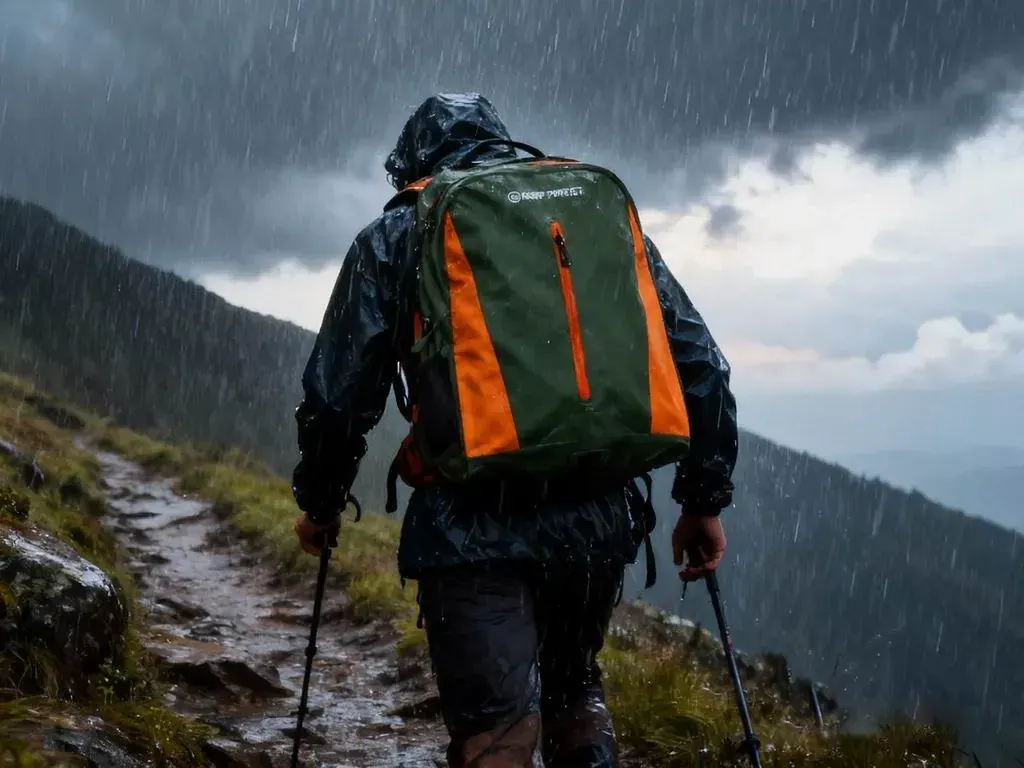
Harness Geometry: The Pack Has to Stay Put
Stability is the defining requirement and it is a geometry problem. A pack that swings at speed shifts the rider's centre of mass, loads the shoulders unevenly and becomes dangerous under braking, so the load has to be pulled high and tight against the back rather than hanging off the shoulders. The proven layout is a four-point harness: two wide shoulder straps joined by an adjustable sternum bridge, plus a waist or chest strap that stops the body rotating outward in crosswinds.
| Harness element | Specification | Why it matters | Symptom if missing |
|---|---|---|---|
| Shoulder straps | 60-75 mm wide, curved, non-slip backing | Spreads load without neck pressure | Straps slide off a textile jacket |
| Sternum bridge | Adjustable over 120 mm, 25 mm webbing | Locks shoulder straps in place | Pack swings on lane changes |
| Waist or chest strap | 25-38 mm webbing, quick-release | Stops body rotation in crosswinds | Pack lifts at 100 km/h |
| Back panel | Low-profile, 400-500 mm tall | Load sits between the shoulder blades | Pack rides on the neck |
| Strap keepers | Elastic or webbing tidy on all loose ends | No flapping webbing in the slipstream | Straps buzz against the helmet |
| Load limit | Rated to 10 kg maximum | Keeps reaction times unaffected | Shoulder fatigue after 90 minutes |
Load placement matters as much as the harness. Heavy items go high and close to the back panel, tools and hard objects never sit against the spine, and nothing is strapped outside the body where it can catch on a pillion or a pannier. A rider carrying 10 kg on the back changes braking and steering response measurably, so touring programmes should point riders above 10 kg toward tail bags and panniers; the comparison is set out in motorcycle tail bag versus backpack.
Carrying the Helmet Off the Bike
Every riding pack eventually has to carry a helmet, and a full-face helmet occupies roughly 12-15 L of awkward, crushable volume. Three systems exist: an external net or cradle that holds the helmet outside the body, an expandable rear compartment that swallows it, and a separate helmet bag clipped to the pack. Each has a distinct weight, volume and convenience profile, and the right choice depends on whether the rider walks far after parking.
| Helmet carry system | Added volume | Added weight | Best for | Trade-off |
|---|---|---|---|---|
| External net or cradle | 0 L external | 90-160 g | Short walks, café stops | Helmet swings when walking |
| Expandable rear compartment | 12-18 L | 180-320 g | City parking, office arrival | Pack depth grows past 25 cm |
| Clip-on helmet bag | 13-16 L separate | 220-350 g | Touring with pillion or panniers | Second item to lose |
| Compression strap carry | 0 L external | 40-80 g | Adventure and off-road | Helmet exposed to rain and grit |
The expandable compartment is the most requested option in retail programmes and the most often mis-specified. It needs a welded floor rated for 3-4 kg, a two-way zip that can be worked with a gloved hand, and enough compression that the collapsed compartment does not rattle at 15-20 cm depth. External nets are lighter and cheaper but they let the helmet act as a sail above 60 km/h, so they should be rated only for off-bike use and labelled accordingly.
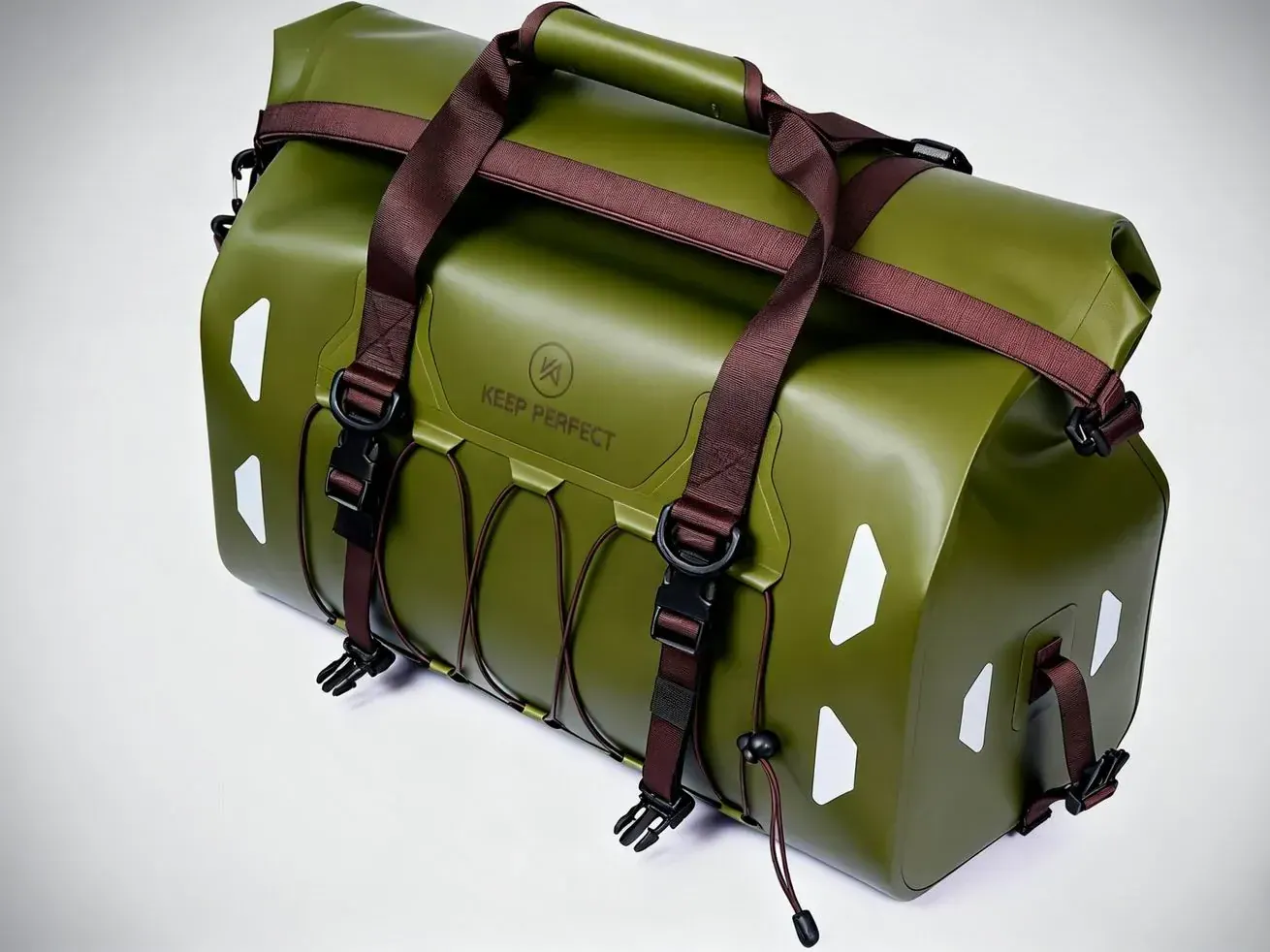
Materials, Abrasion and Slide Behaviour
Riding packs take abrasion from jacket shoulders, tank bags and asphalt in a way that hiking shells never do, so material selection leans heavier. 840D and 1000D TPU-laminated fabric is the norm at 410-610 g per square metre, versus 500D at 285 g on a hiking shell, and reinforcements at the base and shoulder contact zones are standard. The penalty is 250-450 g of extra weight, which is acceptable because a riding pack is never carried for eight hours on foot.
| Component | Riding specification | Test | Failure mode if downgraded |
|---|---|---|---|
| Shell | 840D-1000D TPU laminate | Martindale, ISO 12947-2, 20,000 cycles | Scuff-through at shoulder contact |
| Base panel | Double layer or 1000D reinforcement | Abrasion plus 80 cm drop | Puncture on set-down |
| Seams | RF welded at 27.12 MHz | Peel at 90 percent of fabric strength | Weeping along stitch lines |
| Webbing | 25-38 mm polyester, 800 N | Tensile pull at anchors | Anchor tear under crosswind load |
| Reflective | 300 cm2 retroreflective minimum | 20 wash cycles plus flex | Rider invisible in spray |
| Hardware | Acetal buckles, glove-friendly | 500 cycles with gloves at -5 degrees C | Buckles unworkable in winter |
Slide behaviour is the safety consideration that separates a riding pack from any other pack. In a fall, the pack should not snag, and it should not put a hard object against the spine. Specify no rigid external frames, no metal hardware protruding more than 8 mm, and a back panel flat enough to sit above a back protector without lifting it. Riders wearing an integrated protector should check that the pack's back panel height, typically 400-500 mm, does not overlap the protector's shoulder yoke.
Volume and Trim: How Big a Riding Pack Should Be
Volume discipline matters more on a bike than anywhere else, because every litre sits behind the rider's centre of mass. Urban commuting works at 18-25 L, day touring at 25-35 L, and multi-day touring at 35-45 L only when the load stays light and compressible. Well-known 25 L benchmarks in this class weigh around 1.3-1.6 kg with a welded body and a roll-top dry compartment, and that figure is a sensible target for any comparable specification.
| Ride type | Volume | Empty weight | Rating | Must-have features |
|---|---|---|---|---|
| City commute | 18-25 L | 1.0-1.4 kg | IPX6 | Laptop sleeve 14 in, helmet net |
| Day tour | 25-35 L | 1.3-1.7 kg | IPX6 | Waist strap, hydration sleeve 2-3 L |
| Weekend tour | 30-40 L | 1.5-1.9 kg | IPX6 | Compression, expandable helmet compartment |
| Adventure and off-road | 25-35 L | 1.4-1.8 kg | IPX6-IPX7 | Lash points, drain holes, tool roll |
| Track or race day | 15-22 L | 0.9-1.3 kg | IPX6 | Low profile, no external pockets |
Hydration is worth a line in the specification on any pack above 25 L. An internal sleeve sized for a 2-3 L bladder with the hose routed over the shoulder and clipped at 150-200 mm below the collar keeps the bite valve reachable without unfastening the helmet. Touring configurations are covered in waterproof backpack for motorcycle touring and helmet hardware detail in waterproof backpack helmet carry.
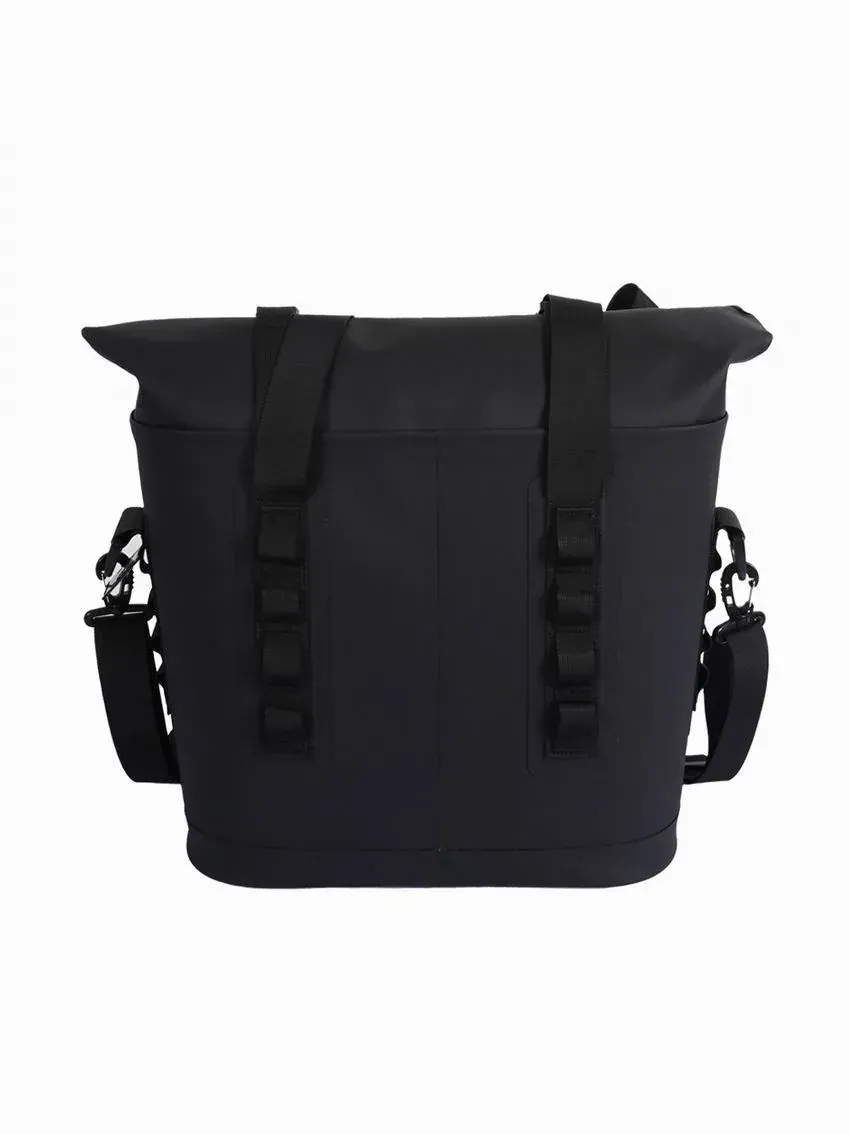
Visibility, Colour and Being Seen in Spray
Spray and low cloud cut a rider's conspicuity far more than darkness does, so a riding pack is part of the visibility system rather than luggage. Retroreflective area of 300 square centimetres or more, placed on the rear and side faces of the pack rather than on the shoulder straps where a rider's own body blocks it, is the working minimum. Fluorescent panels in yellow or orange add dusk and daytime-rain conspicuity and should be combined with retroreflective material, never substituted for it.
- Retroreflective area of 300 cm2 minimum, positioned on rear and side faces at 400-700 mm height.
- Fluorescent panel of 150-250 cm2 in yellow or orange for dusk and heavy spray.
- A light clip or loop at the top rear of the pack for a 20-30 mm strap-mounted lamp.
- Matte finishes on shoulder areas: glossy panels reflect the rider's own headlight back into the mirror.
Colour choice in retail programmes is conservative for good reason: black dominates because riders accept it on a bike, but a black pack in daytime rain is close to invisible at 100 m. The compromise that sells is a black body with fluorescent panels and retroreflective piping, which reads as understated on the shelf and conspicuous in the wet. Fleet and courier buyers, by contrast, usually specify high-visibility shells outright.
Testing a Riding Pack Before Signing Off
Riding equipment fails in the field in ways a laboratory spray test does not reveal, so the approval protocol should combine jet testing with mechanical and fit checks. A sensible first-article protocol takes about one working day per style and covers the jet test, harness stability, glove operation and a short road test with a loaded pack at 80-100 km/h.
| Check | Method | Pass criterion | Frequency |
|---|---|---|---|
| Jet resistance | 12.5 mm nozzle, 100 L/min, 3 min | No moisture on indicator paper | First article, per colourway |
| Harness stability | Loaded road test at 80-100 km/h | No shift over 20 km | First article |
| Glove operation | Open and close 20 times at -5 degrees C | Under 10 s per cycle | First article |
| Seam peel | Tensile pull on welded coupon | No lower than 90 percent of base tensile | Per production week |
| Zip cycling | 1,000 cycles then jet test | No tooth separation | Per zip lot |
| Chemical screening | REACH and Prop 65 declaration review | Signed declaration on file per lot | Per material lot |
Two practical cautions keep approvals honest. First, test the pack loaded, since an empty pack sits differently and hides harness instability that appears at 8 kg. Second, test after a night of rain rather than only in a spray booth, because the failure mode that generates returns is slow ingress through a closure that is fine under a three-minute jet and leaks during a four-hour ride.
Sourcing a Riding Line: Cost, Timing and Documentation
Riding packs sit at the top of the price range in the category because the material and hardware specifications are heavier and the harness has more components. Budget against the bands below, and remember that the harness assembly, not the shell, is usually the largest single contributor to unit cost on a riding build.
| Riding style | Volume | FOB Xiamen band | MOQ | Sample time | Bulk time |
|---|---|---|---|---|---|
| Urban roll-top | 20-25 L | USD 19.5-26.0 | 500 pcs | 7-9 working days | 38-46 days |
| Touring pack | 30-40 L | USD 23.0-32.0 | 500 pcs | 8-10 working days | 40-50 days |
| Helmet-compartment build | 28-35 L | USD 24.0-33.0 | 500 pcs | 8-10 working days | 40-50 days |
| Adventure welded build | 25-35 L | USD 21.5-29.0 | 500 pcs | 7-10 working days | 38-48 days |
Every riding programme ships with REACH and California Prop 65 declarations, and EU-bound orders can be finished with a PFAS-free water repellent; the regulatory detail behind that chemistry sits with the EPA. Bulk orders are inspected at AQL 2.5 before release with the report attached to the packing list, and standard packing is one piece per polybag at 10-20 per export carton. Category context sits in the waterproof backpack guide, ranked riding options in best waterproof backpacks, two-wheel alternatives in waterproof cycling backpack, and the full range background.
- Riding programmes start at 500 pcs per design and colourway, needing 7-10 working days for samples and 38-50 days for the run.
- Specify retroreflective area, harness load limit and helmet-carry type in the tech pack, not only volume and colour.
- Request a loaded road test at 80-100 km/h as part of first-article approval.
People Also Ask
Is IPX6 enough for riding in the rain at motorway speeds?
Yes. IPX6 tests a 12.5 mm nozzle at 100 L per minute for three minutes from all directions, which is a harder exposure than rain driven at 130 km/h. What IPX6 does not cover is a four-hour ride, so also check slow ingress through the closure after sustained exposure.
How heavy can a motorcycle backpack be before it affects riding?
Keep the load under 10 kg. Above that figure braking and steering response change measurably and shoulder fatigue appears after about 90 minutes. For loads above 10 kg, or for multi-day tours, move the cargo to a tail bag, dry bag or panniers.
Can a riding backpack carry a full-face helmet?
Yes, but it needs volume: a full-face helmet occupies 12-15 L. Choose an expandable rear compartment with a welded floor rated for 3-4 kg and glove-friendly pullers, or an external net rated only for off-bike use, since a helmet outside the body acts as a sail above 60 km/h.
Why does my backpack swing when I change lanes?
Usually a missing waist or chest strap and a load carried too low. Pull heavy items high and against the back panel, fit a sternum bridge adjustable over 120 mm, and add a 25-38 mm waist strap that stops the body rotating outward in crosswinds.
Are motorcycle backpacks safe in a crash?
They are luggage, not protection, and should be specified so they do no harm: no rigid frames, no hardware protruding more than 8 mm, and a flat back panel that does not lift a back protector. A pack on the back is never a substitute for a certified protector.
Should riders choose a backpack or a tail bag?
A backpack up to about 10 kg for commuting and day rides where the rider walks after parking; a tail bag or panniers for touring, heavy loads and anything above 12 kg. Tail bags also remove sweat and shoulder fatigue entirely on long days.
Frequently Asked Questions
Q1. What IPX rating should a waterproof motorcycle backpack have?
IPX6 is the entry point for anything ridden above 50 km/h, because the rating covers a 12.5 mm jet at 100 L per minute from every direction. IPX5 is acceptable only for low-speed urban hops, and IPX7 is worth paying for on adventure and off-road builds that involve river crossings.
Q2. Why is a roll-top better than a flap on a motorcycle pack?
A storm flap flutters open above roughly 90 km/h and then funnels water into the main body, whereas a roll-top tightens as airflow presses on it and cannot fail by flapping. Rolled closures also have no teeth to wear and no slider to jam with road grit at a fuel stop.
Q3. How much weight should I carry on a motorcycle backpack?
Keep the total under 10 kg and the pack volume under 40 L. Above 10 kg the load changes braking distance and steering input, and shoulder fatigue typically appears after 90 minutes, at which point a tail bag or panniers is the better answer.
Q4. Can a motorcycle backpack carry a 15 inch laptop safely?
Yes, with a suspended bay of about 375 x 260 mm internal clearance, 12-15 mm of closed-cell foam and 20 mm of empty space below the device. Riding adds vibration, so also require an 80 cm drop test at 8 kg and keep the device on the back-panel side of the load.
Q5. How do I stop the pack moving at speed?
Use a four-point harness: 60-75 mm shoulder straps, a sternum bridge adjustable over 120 mm, and a 25-38 mm waist or chest strap. Then pack heavy items high and close to the back panel, and tidy every loose webbing end so nothing flaps in the slipstream.
Q6. What is the best way to carry a helmet off the bike?
An expandable rear compartment of 12-18 L with a welded floor rated for 3-4 kg is the most practical for city and office use. External nets are lighter at 90-160 g but should be rated for off-bike use only, because an exposed helmet catches wind above 60 km/h.
Q7. Are reflective panels on a backpack worth specifying?
Yes, and they should be on the rear and side faces, not on the shoulder straps where the rider's own body blocks them. Specify 300 square centimetres or more of retroreflective material plus 150-250 square centimetres of fluorescent panel for spray and dusk conditions.
Q8. Will a waterproof pack keep gear dry in an all-day storm?
A welded or roll-top body rated IPX6 will, provided the closure is rolled at least three turns. The common failure is slow ingress over hours rather than sudden leakage, so verify with an overnight rain exposure as well as a three-minute jet test during approval.
Q9. What fabric denier is right for a riding pack?
840D to 1000D TPU-laminated fabric at 410-610 g per square metre, with a reinforced or double-layer base panel. That is heavier than a hiking shell by 250-450 g, but riding packs are carried for minutes rather than hours and abrasion resistance matters more.
Q10. Can riding packs be used with a back protector?
Yes, provided the pack back panel is flat and 400-500 mm tall so it sits above the protector without lifting the shoulder yoke. Avoid rigid external frames and any hardware protruding more than 8 mm, which can concentrate load in a fall.
Q11. How should a waterproof motorcycle backpack be cleaned?
Rinse off road film and salt with fresh water, keeping the temperature below 40 degrees Celsius, then use pH-neutral soap on stubborn grime; never machine wash or tumble dry. Lubricate coated zips twice a year with a silicone-free product, and dry the pack with the mouth unrolled away from direct sun.
Q12. What MOQ applies to a motorcycle backpack?
Riding builds open at 500 pcs per design and colourway, with 7-10 working days for samples and 38-50 days for production. The harness carries more components and the material specification is heavier, which is why this line sits at the upper end of the range.
Q13. Do riding packs need hydration compatibility?
On any pack above 25 L, yes. Specify an internal sleeve for a 2-3 L bladder with the hose routed over the shoulder and clipped 150-200 mm below the collar, so the bite valve is reachable without removing gloves or unfastening the helmet.
Q14. Is a tail bag safer than a backpack on a motorcycle?
For heavy loads, yes: a tail bag removes weight from the rider entirely, lowers the centre of mass and eliminates shoulder fatigue and swing. A backpack wins on convenience where the rider walks after parking and needs the cargo to come along and stay secure.