A rod holder on a tackle backpack is a geometry problem, and three numbers decide whether it works: support separation of at least 420 mm, a closed lower cup with 40 mm of depth, and enough clearance that the rod does not strike the ground when the angler kneels. Nine builds were assessed for 2026 across 26-46 usable litres, one to four rod positions, and 19-46 dollar FOB Xiamen bands at MOQ 500 pcs per design and colour. Samples take 6-10 working days and bulk runs 35-50 days. The winner is the 34 L two-point build at 1.25 kg.
Rod Carry Is a Geometry Problem
Most rod holders fail for the same reason: a single strap at the top. One support point lets the rod pivot, and the butt end swings into the angler leg on every step, which is uncomfortable at best and dangerous on a wet rock at worst. Two support points separated by at least 420 mm stop the pivot entirely, and that single change is worth more than any material upgrade.
The second number is the lower cup. A strap loop lets a rod slide straight through when the bag is set down, and a rod butt on the ground is a broken rod. A closed cup of 40 mm depth or more holds the butt at any angle, and it costs about 0.80 USD. The third number is clearance: with the bag worn, the rod tip must clear the ground when the angler kneels to land a fish, or the rod goes in the dirt every time.
| Geometry element | Minimum | Failure if below | Test |
|---|---|---|---|
| Support separation | 420 mm | Rod pivots, butt strikes the leg | Walk 200 m loaded |
| Lower cup depth | 40 mm, closed | Rod slides through when set down | Set the bag down on a slope |
| Tip clearance when kneeling | 150 mm above ground | Rod tip in the dirt every time | Kneel with the bag worn |
| Tube length, if sleeved | 600 mm minimum | Bends at the ferrule | Insert the longest rod owned |
| One-hand retrieval | Under 4 seconds | Angler puts the other rod down | Time a retrieval loaded |
The Nine Builds at a Glance
Rod positions are counted as usable rod-carrying slots, whether straps or tubes. Separation is measured between support centres, which is the number that decides whether a rod pivots. Max rod length is the longest assembled rod the build carries without the tip striking the ground when the angler kneels, and it is the figure most often overstated by 200-300 mm. The wider rod-carrying ranking is maintained in the rod holder backpack guide, and general capacity results sit in the tackle backpack comparison.
| Build | Volume | Rod positions | Separation | Max rod length | FOB band |
|---|---|---|---|---|---|
| Two-Point 34 | 34 L | Two | 450 mm | 2.10 m | 28-35 USD |
| Tube 30 Rigid | 30 L | One tube | Sleeve, 620 mm | 1.80 m in tube | 26-33 USD |
| Quad 42 | 42 L | Four | 430 mm | 2.00 m | 36-44 USD |
| Bank 28 Light | 28 L | Two | 420 mm | 1.90 m | 22-28 USD |
| Surf 38 Long | 38 L | Two | 520 mm | 2.40 m | 32-40 USD |
| Kayak 26 Low | 26 L | Two | 400 mm | 1.80 m | 25-32 USD |
| Guide 46 Heavy | 46 L | Four | 480 mm | 2.30 m | 38-46 USD |
| Travel 32 Collapsible | 32 L | Two, removable | 440 mm | 2.00 m | 30-37 USD |
| Starter 26 Value | 26 L | One | 400 mm | 1.80 m | 19-24 USD |
When the Rod Should Stay in the Hand
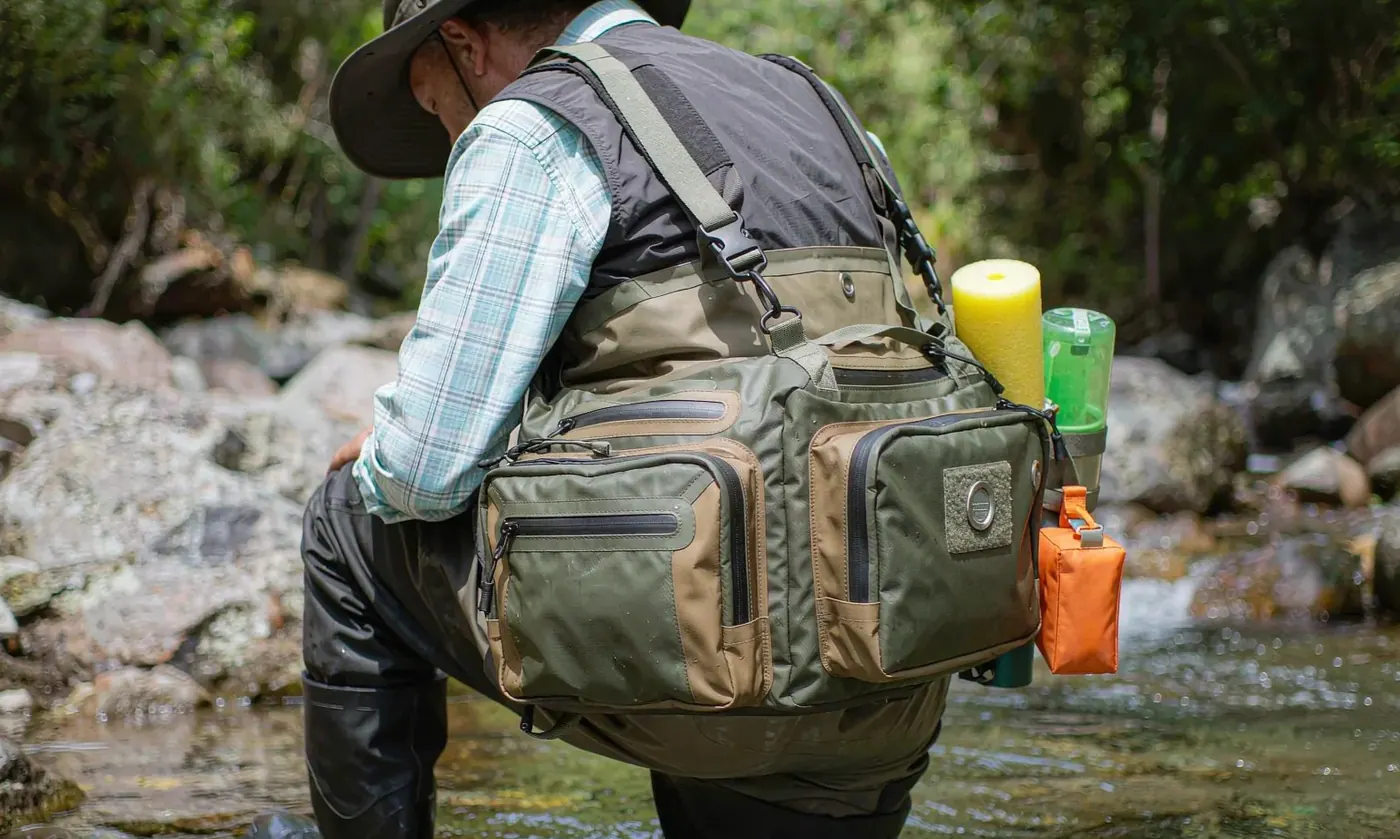
Carrying a rod on a bag is a convenience for the walk, not a way to fish. During actual fishing the rod is in the hand, and the holder only matters between spots. That distinction decides most of the specification: the holder needs to be quick to use and secure while walking, and it does not need to be reachable while casting.
The exception is the second rod. An angler who fishes two methods wants the spare held securely but retrievable in under four seconds with one hand, because putting the first rod down to get the second is exactly when rods get broken or lost. That requirement argues for a tube at the side rather than straps at the rear, and it is the single most useful upgrade in this category.
| Moment | Where the rod is | Holder requirement | Design answer |
|---|---|---|---|
| Walking between spots | On the bag | Secure, no swing | Two points 420 mm apart |
| Arriving and setting up | On the bag briefly | Stays put when set down | Closed lower cup |
| Fishing | In the hand | Nothing | Holder must not foul the cast |
| Changing method | One in hand, one on the bag | Under 4 s one-hand retrieval | Side tube, not rear straps |
| Landing a fish | In the hand | Tip clears the ground | 150 mm clearance when kneeling |
Attaching a holder to an existing build is possible and is covered in the rod holder attachment guide. The decision that matters is whether the rod is carried assembled or in a tube, because assembled rods need the two-strap geometry and tubes need a rigid sleeve, and a design attempting both usually does neither well.
1. Two-Point 34: Best Overall
Two rod positions at 450 mm separation with a closed lower cup of 45 mm depth, thirty-four litres, four 3600 slots, and 1.25 kg. It carries a 2.10 m assembled rod without the tip striking the ground when the angler kneels, and retrieval takes about three seconds with one hand. Reference band is 28-35 USD FOB Xiamen at 500 pieces.
The reason it leads is that nothing about it is over-specified. Two rods is what most anglers carry, 450 mm is comfortably above the pivot threshold, and the cup is deep enough to hold a butt on a slope. Four-rod builds exist in this ranking and they are heavier and wider without being more useful for most buyers.
2. Tube 30 Rigid: Best for Rod Protection
A rigid side sleeve of 620 mm protects a rod in a way straps cannot: it takes the impact when the bag is set down, it keeps the rod clear of scrub, and it allows a rod with a reel fitted to be carried without the reel catching on anything. Thirty litres, one tube, and 1.10 kg. Reference band is 26-33 USD.
Internal diameter is the number to check. A rod with a reel fitted needs 70-80 mm, and a tube sized for a bare blank will not accept it, which is the most common return in this configuration. This build uses 80 mm with a drain hole at the bottom, because rods go in wet and an undrained sleeve freezes or grows odour.
3. Quad 42: Best for Multi-Rod Anglers
Four rod positions at 430 mm separation, forty-two litres, six 3600 slots, and 1.60 kg. It is a tournament configuration: an angler arriving with four pre-rigged rods wants all of them held and none of them tangled. Retrieval is about four seconds, and the reels are staggered so they do not foul each other. Reference band is 36-44 USD.
Staggering is the specification that makes four rods work. Positions at the same height put the reels in a line where they catch on each other, and every retrieval disturbs the adjacent rod. Offset heights of 60-80 mm solve it for no extra cost. The trade is width: at 380 mm across, this bag is awkward in dense cover.
4. Bank 28 Light: Best for Long Walks
Twenty-eight litres, two rod positions at 420 mm, and 1.00 kg is the lightest build that still carries a rod properly. It suits an angler walking 2-4 km along a bank with a modest kit, where four rod positions and six tray slots would simply be weight carried for nothing. Reference band is 22-28 USD.
At 420 mm this is exactly at the pivot threshold, and the recommendation is to test it with the longest rod the angler owns rather than to assume. A 1.90 m rod is fine and a 2.40 m rod will swing. That is the correct trade for the weight saving, and it should be stated on the hangtag rather than discovered on a walk.
5. Surf 38 Long: Best for Long Rods
Surf rods run 2.4-3.0 m and no general fishing bag carries one properly. This build uses 520 mm of separation, a deeper 55 mm cup, and a higher upper support so the butt sits above the shoulder line, which is what keeps a long rod from striking the heel on a stride. Thirty-eight litres, 1.45 kg, and a max rod length of 2.40 m. Reference band is 32-40 USD.
The second surf-specific detail is the sand spike sleeve, because a surf angler carries a spike as well as a rod and it is long, wet, and sandy. An external drained sleeve with an open bottom takes it, and carrying it inside the bag fills the chamber with grit within one session. Both sleeves are positioned to keep the load symmetrical.
6. Kayak 26 Low: Best for Kayak Use
Kayak rod carry has a different constraint: the rod must sit low enough not to foul a paddle stroke and secure enough to survive a capsize. Twenty-six litres, two positions at 400 mm but mounted vertically rather than diagonally, with a bungee retention across the top and a leash point at each. Max rod length is 1.80 m. Reference band is 25-32 USD.
Vertical mounting is the requirement that matters. A diagonal rod on a kayak catches the paddle on every stroke and it is the most common complaint in this configuration. Vertical tubes behind the seat clear the stroke entirely, and a closed bottom plus a bungee keeps the rod in place when the boat rolls.
7. Guide 46 Heavy: Best for Guide Duty
Forty-six litres, four rod positions at 480 mm, six 3600 slots, and 1.85 kg, built for a guide who carries rods for clients as well as personal kit. The upper supports are moulded rather than webbing, because webbing loops wear through in a season of daily use, and each position has a leash point. Reference band is 38-46 USD.
Moulded upper supports are the specification that earns the price. A webbing loop carrying a rod butt abrades at the contact point, and on guide duty that is a failure within about 80 sessions. A moulded support with a smooth radius lasts the life of the bag for about 2 USD per position, which is the best value upgrade in the category.
8. Travel 32 Collapsible: Best for Travel
Thirty-two litres with two rod positions that detach entirely, so the bag packs flat at about 60 mm. The supports bolt through reinforced patches rather than being stitched, which keeps them secure in use and removable in about 30 seconds. Max rod length is 2.00 m and the reference band is 30-37 USD.
The travel detail worth specifying is that the hardware must not protrude when the supports are removed. A bag with four bolt heads sticking out of the side catches on conveyor belts and on vehicle seats, and it is the most common complaint with removable-holder designs. This build uses recessed inserts with flush caps.
9. Starter 26 Value: Best Budget Build
Twenty-six litres, one rod position at 400 mm with a closed cup, three 3600 slots, and 0.95 kg, at a 19-24 USD band. It is the entry build and the honest summary is that it carries one rod correctly rather than two badly, which is the right economy at this price.
What is missing is a second position, a moulded support, and any water protection beyond IPX5. Each of those is a reasonable saving for occasional use and each becomes a limitation with weekly use. The one thing that must not be cut is the closed cup, because an open loop lets a rod slide through and a broken rod costs more than the whole bag.
Protecting the Rest of the Kit
A bag carrying rods is a bag with less usable space, because the rod positions occupy the outside and the tubes occupy the inside. That is worth stating in a brief, since buyers are often surprised that a 34 L rod-carrying bag holds fewer boxes than a 34 L bag without rod holders. The difference is usually one box slot and about 2 L.
| Item | Space cost of rod carry | Mitigation | Note |
|---|---|---|---|
| Tray slots | Usually one fewer | Choose 3700 over 3600 | Plan box count around the rod fittings |
| Usable litres | About 2 L less | Accept it or drop a rod position | External fittings add no internal space |
| Side pockets | Occupied by supports | Move tools to the shoulder | Tool docks at the shoulder cost little |
| Small valuables | Unchanged | Sealed liner inside | 1-2 USD and sink testable |
| Balance | Asymmetrical if one rod | Alternate sides or carry two | A one-sided rod pulls rotationally |
Balance deserves a note because it is the complaint that arrives after several sessions rather than on day one. A single rod on one side creates a rotational pull that is tiring over 2 km, and the fix is either to carry two rods symmetrically or to alternate sides on long walks. A bag designed for one rod should place it as close to the spine as the geometry allows.
Testing the Rod Holder Before Ordering
Four checks catch almost every rod holder failure, and none of them needs a laboratory. Run them on the approval sample with the longest rod the target customer owns, not with a convenient short rod, because a holder that passes at 1.80 m can fail at 2.40 m. Require the results in writing rather than accepting a description.
| Check | Method | Pass condition | Catches |
|---|---|---|---|
| Walk test | 200 m loaded, on rough ground | No pivot, no butt contact with the leg | Under-separated supports |
| Set-down test | Place the bag on a 15 degree slope | Rod stays in the cup | Open loops and shallow cups |
| Kneel test | Kneel as if landing a fish | Rod tip at least 150 mm off the ground | Insufficient clearance |
| Retrieval test | Draw a rod one-handed, timed | Under 4 seconds | Rear straps instead of a side tube |
Material and strength requirements belong alongside the geometry. Abrasion resistance and strap strength can be required to stated values using published methods from ASTM International, and any water claim should carry its condition, since ingress codes are defined by the IEC ingress protection framework. A holder geometry that passes all four checks on a bag that leaks is still a bag that comes back.
Programme, Pricing, and Compliance
A rod-carrying brief should open with the rod count and the longest rod length, because those two decide the geometry and therefore the tooling. Specify separation, cup depth, and clearance next, and treat volume as a consequence. The most expensive change after sampling is a repositioned upper support, so settle the geometry before the sample is cut.
| Programme item | Baseline | Note |
|---|---|---|
| MOQ | 500 pcs per design and colour | Colour split negotiable above the baseline |
| Sampling | 6-10 working days | Add 3-5 days for a moulded rod support |
| Bulk | 35-50 days | From approved sample and deposit |
| Inspection | AQL 2.5 | Include set-down test, kneel clearance, support pull, box fit |
| Compliance | REACH and California Prop 65 | Screen coatings, films, inks, hardware |
QUANZHOU JUNYUAN BAGS has developed waterproof bag programmes since 2014, with the founding team active in the industry since 2004. Monthly output of 200,000 units is verified by SGS, and BSCI and ISO 9001 systems structure the workflow. Materials are screened for REACH and California Prop 65, and every bulk order is inspected at AQL 2.5 before shipment.
A rod-carrying brief can be emailed to service@junyuanbags.com; include rod count, longest rod length, litres, box count, market, and quantity. FOB Xiamen or DDP service to more than 100 countries follows an approved sample and a complete test record. The wider category sits in the fishing tackle backpack overview.
People Also Ask
How far apart should rod holders be on a backpack?
At least 420 mm between support centres. Below that the rod pivots and the butt strikes the leg on every step, and no material upgrade fixes a geometry problem.
What stops a rod sliding through the holder?
A closed lower cup of at least 40 mm depth. An open loop or a shallow cup lets the rod drop through when the bag is set down on a slope.
How long a rod can a tackle backpack carry?
About 2.00 m for a standard two-point build and 2.40 m for a long-rod surf build. Check tip clearance when kneeling, which is the figure most often overstated.
When is a rod tube better than straps?
A tube protects the rod from impact and accepts a reel fitted, while straps are lighter and simpler. Tubes need 70-80 mm internal diameter and a drain hole at the bottom.
Can one rod be carried on a backpack comfortably?
Only if it sits close to the spine. A single rod on one side creates a rotational pull that is tiring over 2 km, so alternate sides or carry two symmetrically.
How do I test a rod holder before ordering?
Walk 200 m loaded, set the bag on a 15 degree slope, kneel and check 150 mm of tip clearance, and time a one-handed retrieval at under 4 seconds.
Frequently Asked Questions
Q1. What is the best tackle backpack with a rod holder?
A 34 L build with two rod positions at 450 mm separation, a closed lower cup of 45 mm, four 3600 slots, and 1.25 kg, carrying a 2.10 m rod without the tip striking the ground.
Q2. How far apart should rod supports be?
At least 420 mm between centres. Below that the rod pivots and the butt end strikes the leg on every step, which is uncomfortable at best and dangerous on wet rock.
Q3. Why does my rod slide out of the holder?
The lower cup is an open loop or is shallower than 40 mm. A closed cup of 40 mm or more holds the butt when the bag is set down, even on a slope.
Q4. What rod length suits a tackle backpack?
About 2.00 m for a standard build and 2.40 m for a long-rod surf build. Always check tip clearance when kneeling, which is usually overstated by 200-300 mm.
Q5. Is a rod tube better than rod straps?
A tube protects the rod from impact and accepts a reel fitted, while straps are lighter. A tube needs 70-80 mm internal diameter and a drain hole at the bottom.
Q6. How many rods should a tackle backpack carry?
Two for most anglers and four for tournament or guide use. More positions add width and weight without being more useful for typical sessions.
Q7. Can I carry one rod without it pulling to one side?
Only if it sits close to the spine. A single rod on one side creates a rotational pull that becomes tiring over about 2 km, so alternate sides or carry two.
Q8. What suits surf fishing rods?
A build with 520 mm separation, a 55 mm cup, and a higher upper support so the butt sits above the shoulder line, giving a max rod length of about 2.40 m.
Q9. How do rods need to be carried on a kayak?
Vertically behind the seat so the rod clears the paddle stroke, with a closed bottom, a bungee across the top, and a leash point on each rod.
Q10. Does adding rod holders reduce capacity?
Yes, usually by one tray slot and about 2 L. External fittings add no internal space, so plan the box count around the rod positions rather than the litre figure.
Q11. What is the best rod holder for guide duty?
Moulded upper supports rather than webbing loops, at 480 mm separation, with a leash point per rod. Webbing loops abrade through in about 80 sessions of daily use.
Q12. What is the MOQ and lead time for a rod-carrying backpack programme?
MOQ is 500 pcs per design and colour, samples take 6-10 working days plus 3-5 for a moulded support, and bulk runs 35-50 days from approved sample and deposit.