A night fishing bag has to be organised so that everything is findable without looking, and that single requirement changes the layout more than any amount of extra light. The working setup is a compact chest or sling bag with a dedicated 100 to 300 lumen task light in a red or amber low mode, tools on tethered zingers within a 300 millimetre reach of the sternum, and a shell rated IPX5 or better because dew soaks fabric faster than rain. Reflective panels of at least 100 square centimetres and a spare battery for every light are not accessories; they are the difference between a controlled session and a walk out in the dark with a dead lamp. Programme buyers should plan on 500 pieces per design and colour, six to ten working days for a sample, and thirty-five to fifty days for bulk.
Light: How Much, What Colour, How Long
Night anglers buy too much light and too little runtime. A headlamp of 800 lumens is unpleasant near a netted fish, drains a 3.7 volt 18650 cell in about ninety minutes on high, and leaves the angler with nothing at two in the morning. What night fishing actually needs is 100 to 300 lumens for task work such as unhooking and re-rigging, 400 to 600 lumens briefly for spotting structure or a landing place, and a low mode of 10 to 30 lumens for walking and for anything that involves looking at the water.
| Task | Recommended output | Beam type | Runtime target |
|---|---|---|---|
| Unhooking and re-rigging | 100 to 300 lumens | Flood, wide and even | 6 to 8 hours |
| Spotting structure or bankside | 400 to 600 lumens | Spot with flood spill | 2 to 3 hours |
| Walking in | 30 to 80 lumens | Flood | 8 to 12 hours |
| Reading the water surface | 10 to 30 lumens | Flood, red or amber | 10 to 20 hours |
| Signalling or emergency | 200 lumens plus strobe | Wide, unfiltered | 1 hour reserve |
Runtime should be planned backwards from the session. A typical night session runs five to eight hours, and lithium cells lose roughly 20 percent of usable capacity below 10 degrees, so the light should be specified with at least 150 percent of the nominal requirement. In practice that means one primary lamp plus a backup with its own cell, carried separately rather than in the same pocket.
Why Red or Amber Light Earns Its Place
The eye needs twenty to thirty minutes to reach full dark adaptation and under ten seconds to lose it to white light. A red or amber mode at 10 to 30 lumens preserves that adaptation, which matters twice over: it keeps the angler able to see the water and the bankside, and it reduces the light thrown onto the water itself, where a bright white beam visibly suppresses feeding activity in shallow margins.
Red light has a real cost that should be stated honestly. Colour rendering is poor, so distinguishing a 6 pound from an 8 pound leader, or a brown from a grey hook, is harder under red than under warm white. The practical compromise is a lamp with both modes, used on red for walking and spotting and switched to low white for anything involving a hook, a knot or a fish. Lamps that switch modes with a single press are worth more than lamps with more output, because a mode change happens five to fifteen times a night and a menu-driven interface is unusable with cold hands in the dark.
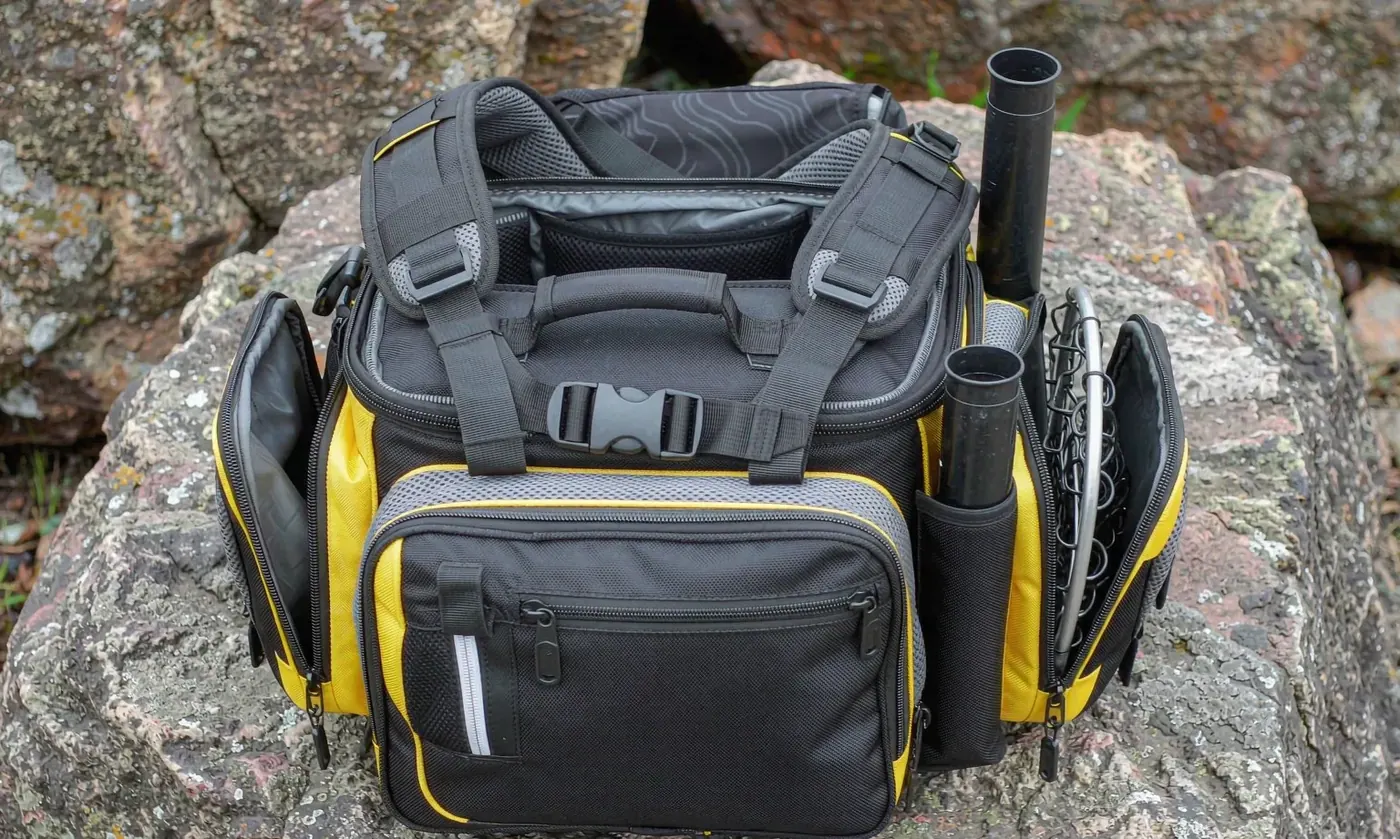
Hands-Free Layout: Reach, Not Storage
The defining property of a night bag is not how much it holds but how far the hand has to travel. Anything used more than five times a night should sit within 300 millimetres of the sternum and be reachable without moving the rod hand. That pushes forceps, nippers, a headlamp, a spare spool of leader and a knot tool onto the chest or onto the shoulder straps, and it relegates everything else to the main compartment.
- Forceps and nippers on retractable zingers clipped to the chest panel, so they return to a fixed point every time.
- The primary lamp on a head strap, and the backup in a chest pocket that can be opened one-handed.
- Leader and tippet spools in an external dock on the same side as the dominant hand.
- A small chemilight or marker light clipped to the rear of the bag, so the bag can be found if set down.
- Phone and keys in one sealed pocket, reached by feel, never mixed with tackle.
| Item | Frequency per night | Where it belongs | Reason |
|---|---|---|---|
| Forceps | 15 to 40 times | Zinger on the chest | Used with a fish in hand |
| Headlamp | 5 to 15 adjustments | Head, with backup in a chest pocket | Mode changes, not storage |
| Leader spool | 3 to 8 times | External dock, dominant side | Needed during a re-rig |
| Knot tool | 2 to 6 times | Flat chest sleeve | Small and easily lost |
| Spare battery | 0 to 2 times | Sealed top pocket | Must stay dry above all |
| Landing net | 1 to 10 times | Magnetic release at the rear | Swing clear of the casting arm |
Organising by Touch Rather Than by Sight
Night organisation is a memory problem. Every item needs a fixed position, and the bag needs tactile cues so position can be confirmed without light. Three cues work well and cost nothing: assign each item class a distinct texture or shape, keep heavier items in the lower compartments so the bag has a predictable feel when lifted, and never rotate the contents of a pocket between sessions.
One discipline is worth building in from the first night: put everything back in the same place immediately, in the dark, rather than planning to tidy up later. Night anglers who defer tidying end up with a bag whose contents are unknown, and the session after that is spent searching by torchlight for something that was dropped into the wrong pocket four hours earlier.
Dew, Damp and the Night Waterproof Question
Dew is the underrated enemy of night fishing. On a clear, still night with high humidity, condensation forms on every exposed surface and a bag left open on the bank will be soaked by two in the morning without a drop of rain having fallen. That wetting is slow, thorough and invisible, which is exactly why it catches people out: nothing appears to have happened, and then the spares and the electronics are damp.
The shell rating that answers it is IPX5 at minimum, and the closure matters more than the number. A roll-top or coated zip kept shut through the night keeps dew out entirely; a bag left open to grab things quickly does not, whatever its rating. Insulation is the other factor worth noting: a bag with a closed-cell back panel and a laminated shell resists internal condensation better than a single-layer fabric bag, because the temperature gradient across the wall is smaller.
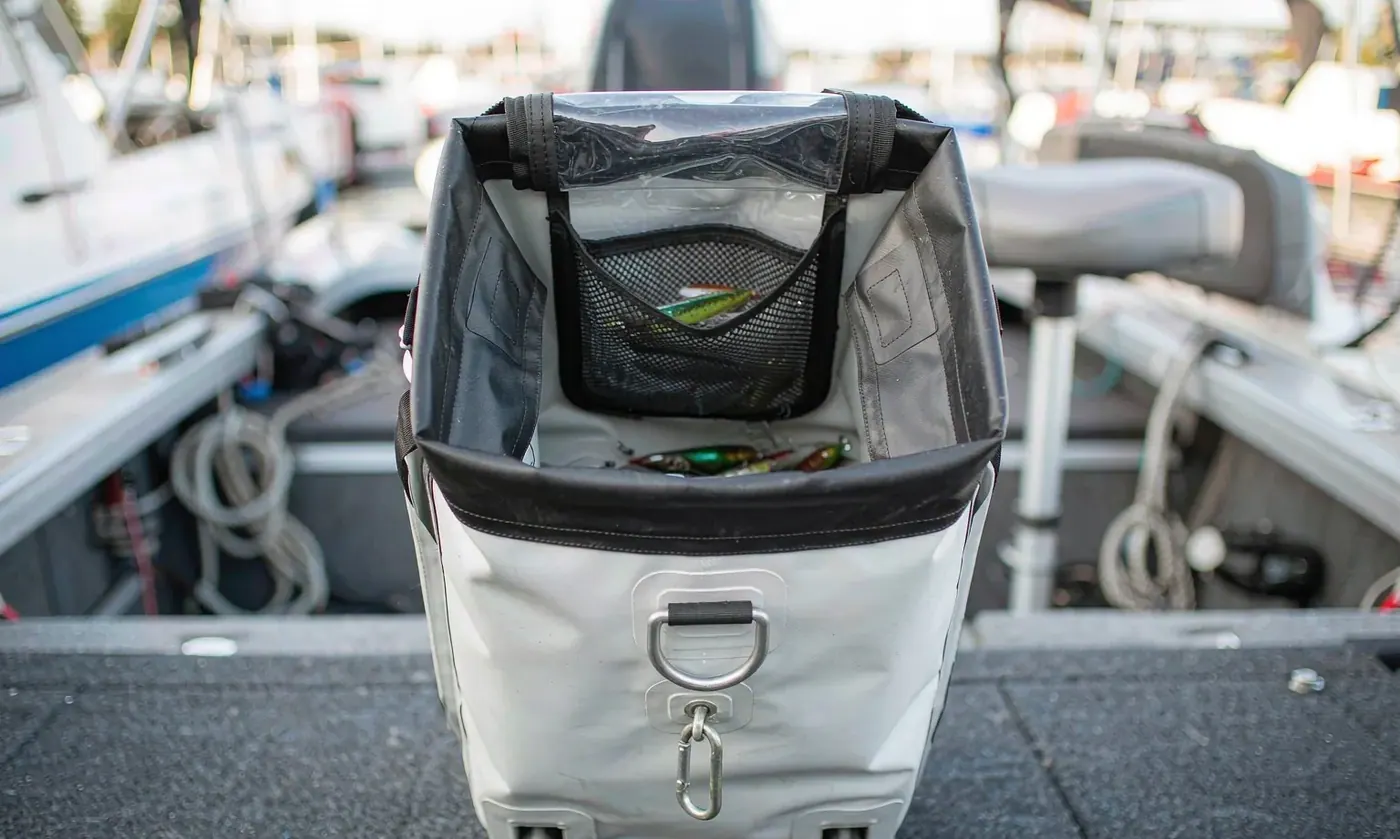
Electronics deserve separate treatment regardless of the shell. A phone, spare cells and a camera should live in a sealed pouch or a small dry bag inside the bag, because the consequences of dew reaching them are disproportionate to their volume. Detailed rating guidance sits in the IPX rating guide, and the enclosure test method is published by the International Electrotechnical Commission.
Power and Battery Management Through a Session
Every light, aerator and phone on a night session competes for the same finite energy, and the failure mode is always the same: everything dies in the last hour. Planning the load in advance takes five minutes and removes the problem. A headlamp on medium draws roughly 1.5 to 3 watts, a phone used sparingly with the screen dimmed consumes 3 to 5 watt hours over a night, and a small aerator pump runs at 0.5 to 1.5 watts continuously.
| Device | Typical draw | Eight hour consumption | Cell or pack needed |
|---|---|---|---|
| Headlamp, medium 200 lumens | 1.5 to 3 W | 12 to 24 Wh | One 18650 cell, 3000 mAh or larger |
| Headlamp on low 30 lumens | 0.3 to 0.6 W | 2.4 to 4.8 Wh | Same cell, ample margin |
| Phone with screen dimmed | 0.4 to 0.7 W average | 3 to 5 Wh | Phone cell plus a 5000 mAh pack |
| Bait aerator pump | 0.5 to 1.5 W | 4 to 12 Wh | Two D cells or a 5000 mAh pack |
| Camera or action cam | 2 to 4 W | Intermittent | Spare cell kept warm and dry |
Cold reduces lithium cell capacity by roughly 20 percent near freezing and more below it, so cells carried for a night session should be kept in an inside pocket rather than an external one. That single habit, worth nothing in cost, typically restores an hour of runtime on a winter night. It is also worth carrying cells in a small sealed case, because a loose cell in a pocket with hooks and swivels is a genuine short-circuit risk, and a cell with a damaged wrap should be retired rather than taped and reused.
Visibility and Personal Safety After Dark
Two hazards dominate night fishing and both are addressed partly by the bag. The first is being unseen by other people: boats, other anglers and vehicles. Reflective panels of at least 100 square centimetres on the back and sides of a bag make an angler visible to a torch or headlight beam at 100 metres or more, where unlit clothing is invisible beyond about 30 metres.
The second hazard is the walk out. Falls near water after dark are the most common cause of injury in night fishing, and the mitigations are unglamorous: a lamp with at least eight hours of runtime reserved for the walk, a bag that does not obstruct the feet when set down, and a phone carried on the body rather than in the bag. Where night fishing is done from a boat or a pier with water access, navigation light and safety equipment requirements published by the United States Coast Guard Boating Safety Division apply and should be checked before setting out.
Reflective and high-visibility design is treated in more depth in the waterproof bag visibility article, and rain or dew protection options in the fishing bag rain cover review.
Noise Discipline After Dark
Sound travels further and carries more consequence at night, both for the fishing and for everyone within earshot. A bag with clicking buckles, rattling zips and hard plastic panels announces every movement, and it is the detail experienced night anglers fix first. Fabric zip garages, covered buckles and soft external panels are quiet; open moulded clips and loose hardware are not.
The fix is cheap and permanent. Silicone tape or a short length of heat shrink over a buckle tongue stops the click, a small piece of closed-cell foam behind a hard panel stops the knock against a rod butt, and keeping tools on short zingers stops them swinging. None of it adds measurable weight and all of it changes how close the fish will come.
Marking the Spot and Finding the Way Back
Two navigational details separate a controlled night session from a frustrating one. The first is marking productive water: a small chemilight or a low-output marker light placed on the bank at a known bearing lets the angler return to a productive spot without a GPS fix, and it costs almost nothing. A chemical light stick lasts eight to twelve hours at useful brightness and weighs under 20 grams, which is the best ratio in the whole kit.
The second is marking the bag and the route. A bag set down in long grass at night is genuinely hard to find, so a small marker light clipped to the rear of the bag, plus the habit of setting it down on a clear patch rather than wherever the angler happens to be standing, saves ten minutes at the end of the session. Where the walk crosses rough ground, note the bearing out while it is still light rather than discovering the route in the dark.
Species and Season: What Changes After Dark
Night fishing is not one discipline. Catfish, carp, striped bass, eels and sea trout are all targeted after dark and each pulls the kit in a slightly different direction, mostly through bait volume and hook size rather than through the bag itself.
| Target | Hook range | Bait carried | Kit weight | Bag size |
|---|---|---|---|---|
| Catfish | 4/0 to 8/0 | 1 to 2 kg cut bait | 7 to 10 kg | 30 to 40 litres |
| Carp | 4 to 8 | 1 to 3 kg boilies | 8 to 12 kg | 35 to 50 litres |
| Striped bass | 2/0 to 5/0 | Live bait or lures | 6 to 9 kg | 25 to 40 litres |
| Sea trout | 1 to 4 | Lures only | 4 to 6 kg | 15 to 25 litres |
| Eels | 1/0 to 3/0 | Worms or cut bait | 5 to 7 kg | 20 to 30 litres |
The pattern across all of them is that night kits are lighter than day kits by one to three kilograms, because fewer options are carried. Choosing between two lures in the dark is slower than choosing between eight in daylight, so experienced night anglers deliberately reduce the selection rather than expand it.
End of Night: Drying Dew Before It Becomes Mould
A bag that has been out all night is damp even if it never rained, and the routine should assume that. Empty the pockets, open every compartment, and dry the bag upside down in moving air for at least twelve hours, with the electronics pouch opened separately. Dew that is left to sit in a closed bag produces the same mould and odour as a dunking, just more slowly and less obviously.
Two additions are worth making to the night routine specifically. Wipe the lamp and its contacts dry before storing it, because corrosion on a battery contact is the most common cause of a lamp that fails at switch-on. And check the reflective panels occasionally, since dew plus dirt reduces their effectiveness noticeably over a season. Full drying method is in the drying a wet fishing bag guide, and seasonal storage in the off-season storage walkthrough.
Chest, Waist or Sling for Night Work
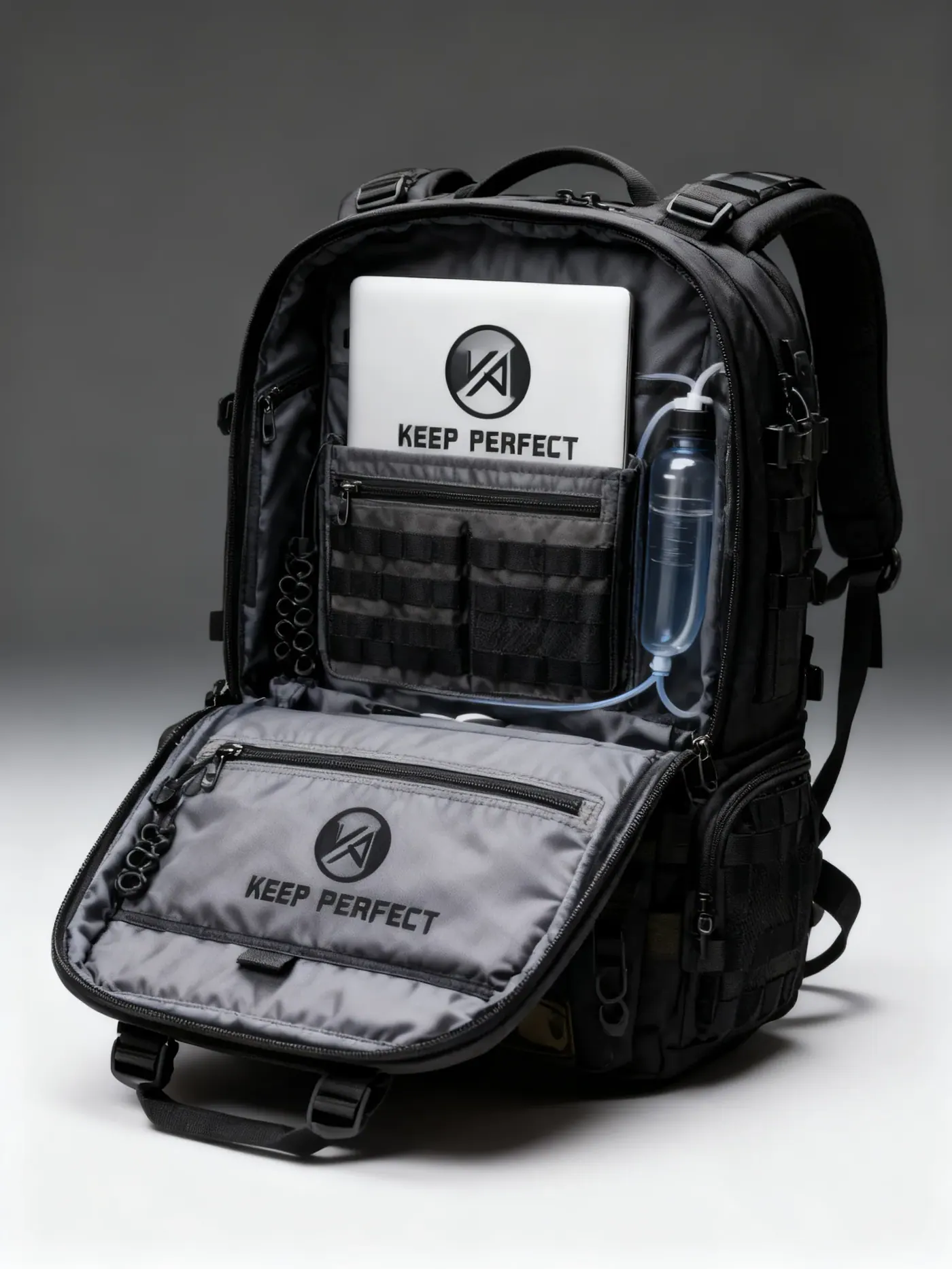
The decision is simpler at night than in daylight, because the winning property is reach rather than capacity. A chest pack puts every working item in front of the angler and within the 300 millimetre reach, and it can be worked without lowering the rod. A waist pack is close behind and cooler in summer, but anything on the belt is harder to reach while wading. A sling pack splits the difference and is the best choice when the walk in is longer than a few hundred metres.
What does not work at night is a conventional backpack that has to be removed to be opened. Every removal is a lamp-off moment, a noise, and a chance to set a bag down somewhere it will be stepped on or kicked into the water. Layout options for the two front-carrying formats sit on the fishing chest pack page and the fishing waist pack page.
Specification Notes for Programme Buyers
QUANZHOU JUNYUAN BAGS has concentrated on waterproof bag work since 2014, with a founding team in this industry since 2004. Output is 200,000 units a month, verified by SGS, under BSCI and ISO 9001 governance, with materials screened for REACH and California Prop 65 and every order inspected at AQL 2.5. A night fishing brief should open with the reach map: what has to be available one-handed, and within what distance, because that decides the chest or sling geometry before pockets are drawn.
Then specify the light mount or dock, reflective area and placement, zip type and noise treatment, shell material and coating, closure style, colourway and quantity. Retroreflective performance claims are best tied to published test methods from ASTM International so they can be checked rather than argued. Five hundred pieces per design and colour is the opening order size. Sampling runs six to ten working days, bulk thirty-five to fifty days from approved sample and deposit, and shipping is FOB Xiamen or DDP to upwards of one hundred nations. Briefs go to service@junyuanbags.com.
People Also Ask
How many lumens do I need for night fishing?
One hundred to three hundred for unhooking and re-rigging, four hundred to six hundred briefly for spotting, and ten to thirty for walking and reading the water.
Is red light better than white for night fishing?
For preserving night vision and avoiding spooking fish, yes. For colour-critical work such as knots and hooks, low warm white is safer and faster.
Do I need a waterproof bag for night fishing?
IPX5 or better, mainly because of dew. Condensation soaks an open bag by two in the morning without any rain falling.
How should a night fishing bag be organised?
By reach: anything used more than five times a night within three hundred millimetres of the sternum, and every item class in a fixed position.
How much reflective area should a night bag have?
At least one hundred square centimetres on the back and sides, which makes an angler visible at one hundred metres or more against an unlit thirty metres.
How do I keep batteries working on a cold night?
Keep cells in an inside pocket. Lithium cells lose about twenty percent of usable capacity near freezing, which is typically an hour of runtime.
Frequently Asked Questions
Q1. What makes a bag suitable for night fishing?
Reach and quiet. Working items sit within three hundred millimetres of the sternum, closures are one-handed, and buckles and zips are damped so they do not click.
Q2. Should I use a headlamp or a bag-mounted light?
A headlamp for task work, because it points where the eyes look, and a small bag-mounted marker light so the bag can be found if it is set down.
Q3. Why does my bag get wet when it has not rained?
Dew. On a clear still night, condensation forms on every exposed surface and an open bag is soaked within a few hours.
Q4. How long should a night fishing lamp run?
At least eight hours at one hundred to three hundred lumens, with a separate backup lamp. Lithium cells lose about twenty percent of capacity in the cold.
Q5. Is a chest pack better than a backpack at night?
Yes for reach. A backpack has to be removed to be opened, and every removal is a lamp-off moment and a chance to lose the bag on the bank.
Q6. How do I keep from dropping tools in the dark?
Retractable zingers clipped to a fixed point, plus the habit of returning every tool immediately rather than tidying later.
Q7. How much reflective material is enough?
One hundred square centimetres or more on the back and sides. That lifts visibility in a beam from about thirty metres to over one hundred metres.
Q8. Do fish see a bright white light?
They react to it in shallow water. Use ten to thirty lumens of red or amber for reading the surface and switch to low white only for hooks and knots.
Q9. Should electronics be kept separate at night?
Yes, in a sealed pouch inside the bag. Dew reaching a phone or spare cells is the most damaging and least visible failure on a night session.
Q10. What is the MOQ for a night fishing bag programme?
Five hundred pieces per design and colour, with six to ten working days for sampling and thirty-five to fifty days for bulk from approved sample and deposit.