A travel fishing bag has to clear three gates before it clears any water: the cabin size gate of roughly 55 by 40 by 20 centimetres, the weight gate of 7 to 10 kilograms, and the security gate that treats hooks, knives and lithium cells as separate questions. The configuration that gets through all three is a soft 35 to 45 litre bag with a compressible harness, trays removed or reduced to two, tools and blades in checked luggage, and spare cells in the cabin in a sealed case. Rods travel as sporting equipment in a hard tube with a linear limit near 158 centimetres, and reels go in the cabin because they are both valuable and fragile. Programme buyers should allow 500 pieces per design and colour, six to ten working days for a sample, and thirty-five to fifty days for bulk.
The Three Size Gates Every Fishing Bag Meets
Airlines work in three dimensions and one number: the sum of them. A standard international carry-on allowance is around 55 by 40 by 20 centimetres, a personal item around 40 by 30 by 15 centimetres, and a checked bag is usually judged on linear total, meaning length plus width plus height, with 158 centimetres the common limit. A fishing bag fails these gates in a specific way, because tackle trays are rigid rectangles that do not compress, and a bag that measures 50 by 35 by 25 centimetres empty will not squash into a 20 centimetre deep sizer no matter how soft the shell is.
| Gate | Typical limit | What fits | What fails |
|---|---|---|---|
| Personal item | 40 x 30 x 15 cm | Small sling, camera insert, documents | Any bag with a tray inside |
| Cabin carry-on | 55 x 40 x 20 cm | 35 to 45 litre soft bag, empty of trays | Tray-loaded bags over 40 litres |
| Checked, linear limit | 158 cm total | Hard rod tube, holdall, boot bag | Tubes over 200 cm, many saltwater rods |
| Checked, weight | 20 to 23 kg typical | Full kit in a holdall | Overweight fees from 24 kg |
| Cabin weight | 7 to 10 kg | Essentials and electronics | A loaded 45 litre tackle bag |
The practical conclusion is that a fishing bag flown with its owner should be one size smaller than the bag that would be bought for driving. A 35 litre soft bag with two trays instead of four clears the cabin gate on most carriers and still carries a working kit for a week, where a 50 litre tray-loaded bag becomes a checked item with all the risk and delay that implies. Low-cost carriers are the exception worth checking: several apply a personal-item-only fare with a limit near 40 by 30 by 15 centimetres, which no tray bag meets and which is the point at which rods and reels have to travel separately.
What Security Actually Stops
Security screening treats fishing kit as a mixed bag of ordinary objects, and three categories reliably cause problems. Blades stop at the checkpoint: a fillet knife, a bait knife and a hook sharpener with a blade go in checked luggage without exception. Hooks are the grey area, and the honest answer is that a tray of thirty hooked lures is usually permitted but occasionally triggers a hand search, which costs ten to twenty minutes and is avoidable by packing rigs in checked bags.
- Knives and blades of any length belong in checked luggage, including small folding bait knives.
- Lithium cells and power banks belong in the cabin, never checked, and should be in a sealed case with terminals covered.
- Fishing line is permitted but a spool of heavy braid looks like cordage on a scanner and can prompt a search.
- Scent liquids and sprays fall under the 100 millilitre liquid rule in the cabin and should travel checked.
- Speargun components, gaffs and large treble hooks are refused on some carriers and should be checked in advance.
A packing habit removes most of the friction: photograph the contents of the bag before leaving and keep the tray list on a phone. If a bag is searched and repacked, the photograph is the fastest way to confirm nothing is missing, and it settles any dispute about what was carried in the first place.
Rods, Reels and the Sports Equipment Route
Rods are the reason most fishing travellers check a bag. A four piece travel rod packs to 60 to 75 centimetres and can go in the cabin if it fits the sizer, which is why travel rods exist at all. A two piece spinning rod of 2.4 metres packs to about 1.25 metres and cannot, so it travels as checked sporting equipment in a tube.
| Rod type | Packed length | Cabin or checked | Tube requirement |
|---|---|---|---|
| Four piece travel rod | 60 to 75 cm | Cabin, if it fits the sizer | Padded sleeve inside the bag |
| Five or six piece fly rod | 55 to 70 cm | Cabin on most carriers | Hard tube recommended anyway |
| Two piece spinning rod | 120 to 130 cm | Checked | Hard tube, 158 cm linear limit |
| Surf or boat rod | 180 to 240 cm | Checked, often oversize | Oversize fees, check in advance |
| Telescopic travel rod | 40 to 60 cm | Cabin | Sleeve only |
Reels should never be checked. A reel is the most valuable and most crushable item in the kit, and baggage systems apply point loads that bend spool lips and crack frames. Carry reels in the cabin in a padded insert, with line removed if the trip is longer than three weeks, because line left under tension for a month takes a permanent set.
Packing Tackle to Survive the Baggage Belt
Checked tackle fails in predictable ways: trays crack at the latch, hooks punch through linings, and loose weights abrade everything they touch. Three packing steps prevent almost all of it. Tape trays closed along the latch line, wrap hooked lures in a folded strip of closed-cell foam or a microfibre cloth, and fill the voids in the bag with soft items so nothing can shift by more than a few millimetres during handling.
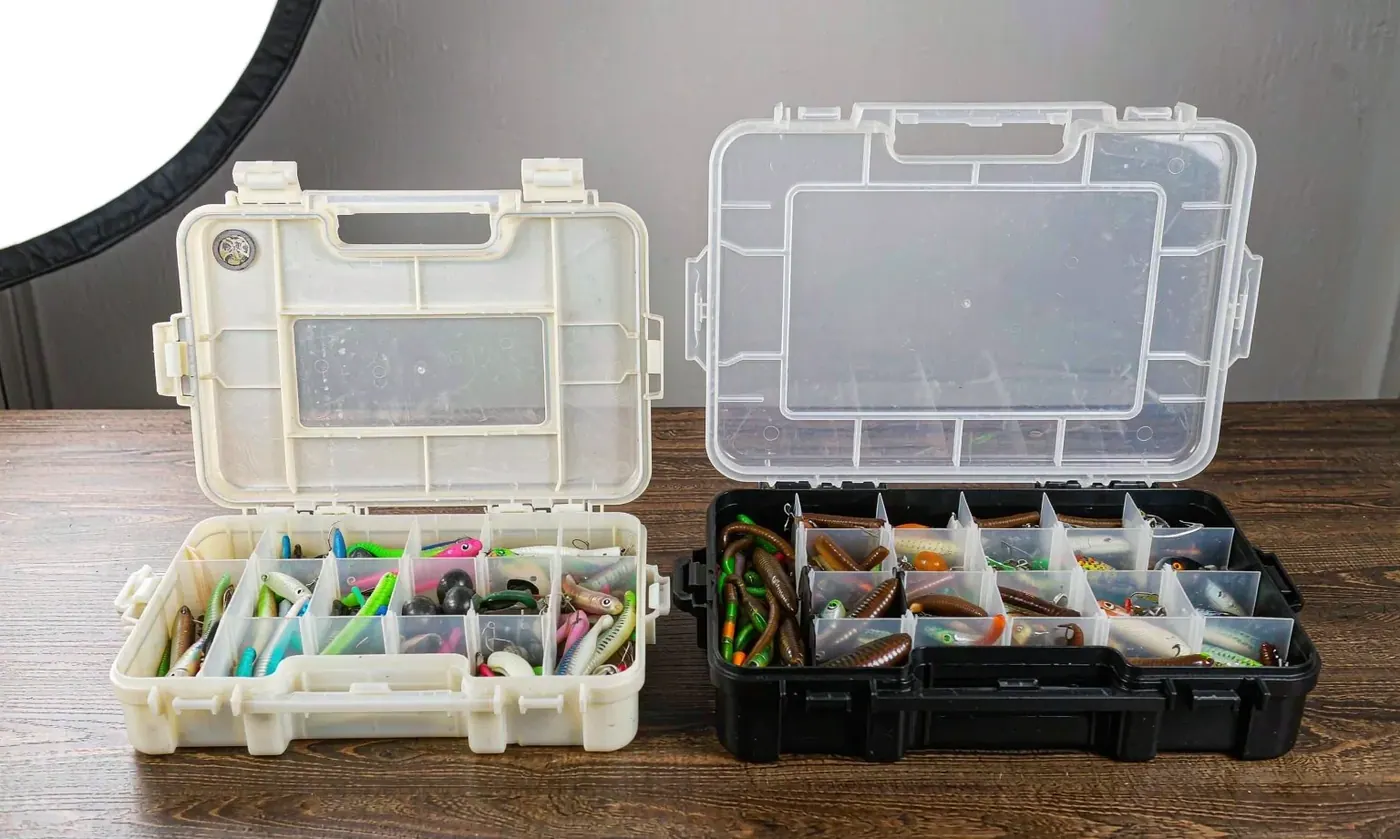
Pressure changes are the other factor worth planning for. Sealed containers of scent, oil or bait expand in a hold at altitude, so any liquid should be packed with at least 10 percent headroom and double-bagged. A bottle of bait spray that leaks at cruising altitude ruins everything it touches and cannot be dealt with until the bag is collected.
Weight: The Limit That Bites Before Size Does
Anglers watch the size gauge and forget the scale, which is a mistake because weight is where the fees are. Cabin allowances of 7 to 10 kilograms are easily exceeded by a tackle bag: four trays at 700 grams each, 2 kilograms of terminal tackle, tools at 1 kilogram and the bag itself at 1.8 kilograms already total 8.8 kilograms before clothing. Overweight cabin bag fees on many carriers exceed the cost of checking a bag.
| Kit element | Weight | Cabin or checked | Saving options |
|---|---|---|---|
| Bag shell, 40 litre | 1600 to 2000 g | Either | Choose a soft, light shell |
| Two 3600 trays loaded | 1200 to 1600 g | Cabin if space allows | Reduce to two trays |
| Terminal tackle and leads | 800 to 1500 g | Checked | Leads bought at the destination |
| Tools and pliers | 600 to 900 g | Checked | Buy or borrow at the destination |
| Reels, two | 500 to 900 g | Cabin | Never check reels |
| Clothing and shell layer | 1200 to 2000 g | Cabin or worn | Wear the heaviest layer |
The single largest saving available is leads. A set of sinkers weighing 1 to 1.5 kilograms is cheap, universally available and heavy, so buying them at the destination frees more cabin weight than any other single decision. The same argument applies to bulk bait and to bottled water. Where the destination is a lodge or a guided operation, it is worth asking in advance what tackle is provided, because many lodges supply leads, flies and terminal tackle and will tell guests not to bring them at all.
Liquids, Scent and Bait When Flying
Liquids are governed by a rule that has not changed in years and still catches people out: containers of 100 millilitres or less in the cabin, in a single transparent bag of about one litre capacity. Scent sprays, line conditioner, reel oil and sun lotion all fall under it, and a 250 millilitre bottle of attractant is refused even if it is half empty. Anything larger goes in checked luggage with the headroom noted above.
Bait is a different question again and it is the one most likely to be answered by refusal. Fresh and frozen bait crosses borders under animal and plant health rules that vary by country, and many destinations prohibit importing bait outright. The safe approach is to buy bait locally, which is cheaper, fresher and avoids a biosecurity declaration, and to carry only artificial lures and terminal tackle across the border. Where a declaration is required, declaring is faster than being found out: a declared item is usually confiscated without penalty, while an undeclared one discovered at inspection costs a fine and a delay.
Keeping Wet Gear Separate in Transit
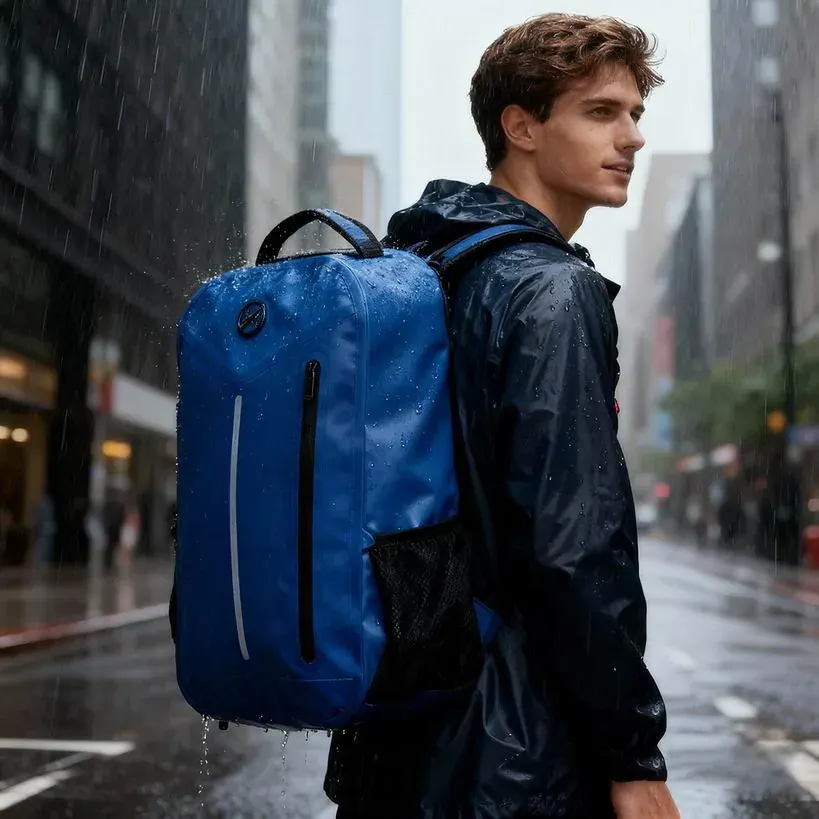
Fishing trips end with wet kit and flights rarely wait for it to dry. A wet wader, a damp rain shell or a towel packed with clothing produces a bag that smells within two days and can damage anything paper or electronic nearby. The answer is a dedicated sealed compartment: either a lined wet pocket built into the bag or, better, a separate roll top dry bag of 10 to 20 litres carried inside or strapped to the main bag.
Two numbers make the case for a separate dry bag. A pair of damp waders holds 300 to 600 millilitres of water, none of which evaporates inside closed luggage. And a sealed dry bag of 15 litres weighs about 250 grams empty, which is less than the weight of the towel needed to manage the same problem badly. Pack silica sachets of 10 grams with wet gear as well, since they absorb what condensation produces overnight in a warm hotel room.
Destination Kits: Salt, Fresh and Remote
Travel fishing splits into three destination types, and the bag should follow the destination rather than the traveller. A salt destination means corrosion management: rinse equipment daily, dry thoroughly, and accept that any plated fitting will show wear within two weeks. A freshwater destination is simpler and mostly about volume and tray count. A remote lodge destination is about redundancy, because nothing can be replaced and a broken zip becomes a trip-ending event.
| Destination type | Bag volume | Key requirement | Spares to carry |
|---|---|---|---|
| Saltwater, guided | 35 to 45 litres | Rinse access, corrosion-resistant hardware | Zip lubricant, spare reel |
| Freshwater, self-drive | 40 to 50 litres | Tray capacity, comfortable harness | Spare trays, leader material |
| Remote lodge | 45 to 60 litres | Redundancy and repairability | Tape, cord, spare buckles |
| Urban or short break | 25 to 35 litres | Cabin compliance above all | Minimal, buy at destination |
For anyone choosing a travel bag on a budget, current small-format options are reviewed in the best small fishing backpack guide, value-focused designs in the fishing tackle bags under one hundred dollars round-up, and the wider category sits on the fishing tackle backpack page.
Insurance, Loss and What to Do When the Bag Does Not Arrive
Checked fishing bags go missing at the same rate as any other luggage, roughly 5 to 9 bags per thousand passengers on most reporting systems, and the consequence is worse for anglers because the kit is specialised. Three mitigations are worth the effort. Photograph everything before departure. Carry reels, electronics and any irreplaceable item in the cabin. And keep a minimal fishable kit, leader material, a few hooks and a small lure, in the cabin bag so a delayed holdall does not end the trip.
If the bag does not arrive, the claim has to be filed before leaving the airport, and the value declared at that point is what the settlement is based on. Receipts on a phone are enough in most cases. What cannot be recovered is the first two days of the trip, which is the real argument for carrying the minimal kit in the cabin.
Multi-Destination Trips: One Bag, Three Waters
The hardest travel brief is the trip that covers two or three different fisheries in one ticket, because each wants a different kit and only one bag is flying. The workable approach is modular: build two or three small kit modules that swap in and out of the same bag, rather than packing one large undifferentiated load. A saltwater module of two trays, a freshwater module of two trays and a shared core of tools and terminal tackle covers most combinations at around 9 kilograms.
Modularity only works if the modules are physically distinct. Colour-coded packing cubes or pouches, one per fishery and one for the shared core, make the swap a two minute job in a hotel room instead of a twenty minute sort, and they stop the slow drift where saltwater lures end up in the freshwater module and corrode everything around them. Labelling each pouch with its contents rather than its destination is the version that survives contact with reality.
Travel Features Worth Paying For
Not every travel feature earns its cost, and a few are actively counterproductive. A compression harness that flattens the bag to under 20 centimetres genuinely helps at the sizer. A removable tray sleeve does as well, because it lets the same bag be a cabin bag one way and a checked bag the other. Decorative MOLLE webbing, extra external straps and rigid frames do not, and all three add weight and catch on baggage belts.
| Feature | Effect on travel | Worth it |
|---|---|---|
| Compression harness | Flattens the bag to clear the sizer | Yes |
| Removable tray sleeve | Converts cabin bag to checked bag | Yes |
| Lined wet compartment | Carries damp kit without wetting clothes | Yes |
| Lockable main zip | Deters casual pilfering in transit | Yes, with a small padlock |
| Rigid internal frame | Adds 400 to 700 g and catches on belts | No |
| External MOLLE webbing | Snags on conveyor edges | No |
One feature is worth singling out because it is cheap and disproportionately useful: a luggage pass-through panel or strap on the back of the bag. Sliding a fishing bag over the handle of a rolling suitcase removes 8 to 10 kilograms from the shoulder for the whole walk through an airport terminal, and that is where most travel fatigue actually comes from.
Cleaning and Resetting Between Trips
A travel bag needs one job done before it goes into storage and one before it flies again. Before storage, empty it completely, rinse off salt if the trip was coastal, and dry it open for twenty-four hours, because a bag closed for six weeks with salt residue inside comes out with seized zips and mildew. Before the next flight, check the zips, the harness stitching and the base, since a failure mid-trip is far harder to deal with than one at home.
Drying routine matters more for travel than for day fishing, because a bag is often packed the night before it flies and never fully dry. The method is in the drying a wet fishing bag guide, and the longer-term routine in the seasonal maintenance walkthrough.
Specification Notes for Programme Buyers
QUANZHOU JUNYUAN BAGS has worked on waterproof bag programmes since 2014, with a founding team in this industry since 2004. Output stands at 200,000 units a month, verified by SGS, under BSCI and ISO 9001 governance, with materials screened for REACH and California Prop 65 and every bulk order inspected at AQL 2.5. A travel brief should open with the target airline dimension and weight gate, because those two numbers set the pattern and everything else follows from them.
Then specify the compressibility of the harness, whether trays are removable, the wet compartment construction, closure type, hardware grade, colourway and quantity. Any claim about lithium cell safety should reference the published cell standard from the International Electrotechnical Commission, and fabric and seam durability claims to test methods from ASTM International. Five hundred pieces per design and colour is the opening order size. Sampling runs six to ten working days, bulk thirty-five to fifty days from approved sample and deposit, and shipping is FOB Xiamen or DDP to upwards of one hundred nations. Send briefs to service@junyuanbags.com.
People Also Ask
Can I take fishing hooks on a plane?
Usually yes in checked luggage and often in the cabin, though a tray of hooked lures can trigger a hand search. Packing rigs checked avoids the delay.
What size fishing bag is carry-on compliant?
Around 55 by 40 by 20 centimetres, which points to a soft 35 to 45 litre bag with the trays removed or reduced to two.
Can fishing rods go in the cabin?
Four piece and telescopic travel rods packing to under 75 centimetres usually can. Two piece rods over 120 centimetres must be checked in a tube.
Should reels be checked or carried?
Always carried. Reels are the most valuable and most crushable item in the kit, and baggage systems bend spool lips and crack frames.
How do I stop a tackle tray cracking in transit?
Tape the latch line, wrap hooked lures in foam or cloth, and fill every void with soft items so nothing shifts more than a few millimetres.
Can I fly with bait?
Rarely. Fresh and frozen bait is governed by animal and plant health rules that vary by country, so buying bait locally is safer and cheaper.
Frequently Asked Questions
Q1. What is the best carry-on size for a fishing bag?
Around 55 by 40 by 20 centimetres, which in practice means a soft 35 to 45 litre bag with two trays rather than four.
Q2. Do fishing knives have to go in checked luggage?
Yes, without exception, including small folding bait knives and hook sharpeners with a blade.
Q3. Are lithium batteries for headlamps allowed in the cabin?
Yes, and they should be in the cabin rather than checked, in a sealed case with the terminals covered.
Q4. How heavy can a carry-on fishing bag be?
Seven to ten kilograms on most carriers. Four loaded trays plus tools typically exceed that before any clothing is added.
Q5. What is the linear limit for a checked rod tube?
Around 158 centimetres on most international carriers, calculated as length plus width plus height. Longer tubes attract oversize fees.
Q6. Should I buy leads at the destination?
Yes. Leads weigh one to one and a half kilograms, are cheap and are available everywhere, which frees more cabin weight than any other choice.
Q7. Can scent liquids go in hand luggage?
Only in containers of one hundred millilitres or less inside a single transparent bag. Anything larger goes in checked luggage with headroom for expansion.
Q8. How do I carry wet waders on a flight?
In a separate roll top dry bag of ten to twenty litres, with silica sachets. Damp waders hold three hundred to six hundred millilitres of water.
Q9. What should never be checked on a fishing trip?
Reels, electronics, cameras and any irreplaceable item. Baggage systems apply point loads that crush spool lips and crack frames.
Q10. How often does checked luggage go missing?
Roughly five to nine bags per thousand passengers on most reporting systems, which is why a minimal fishable kit belongs in the cabin.
Q11. What is the MOQ for a travel fishing bag programme?
Five hundred pieces per design and colour, with six to ten working days for sampling and thirty-five to fifty days for bulk from approved sample and deposit.