A soft tackle backpack and a hard tackle box are not two sizes of the same product but two incompatible approaches to the same problem, and the deciding factor is almost always transport distance. A soft backpack weighs 1.3-1.8 kg empty, carries 10-14 kg on the hips for a genuine walk, and costs 22-48 USD. A hard case weighs 2.4-3.6 kg before a single item goes in, must be carried by hand, becomes impractical beyond roughly 200 m, and costs 18-55 USD. Each wins decisively in its own territory and each is a poor substitute for the other, which is why most settled anglers eventually own one of each.
Six Dimensions, Sortable in One Sentence Each
Comparisons in this category tend to wander because the two products differ across several axes at once. Sorting each axis separately gives a clearer answer than any overall verdict, and it also explains why the decision differs between two anglers who fish the same water.
| Dimension | Soft tackle backpack | Hard tackle box | Winner |
|---|---|---|---|
| Empty weight | 1.3-1.8 kg | 2.4-3.6 kg | Backpack |
| Carry distance | Several kilometres | About 200 m practical | Backpack |
| Crush protection | Poor without a frame | Excellent | Hard box |
| Organisation style | Removable trays you can leave behind | Fixed slots you cannot lighten | Depends on habit |
| Sealing potential | Welded body reaching IPX6-IPX7 | Gasket around the lid, latches fail | Backpack |
| Collapses for storage | Yes, roughly one third | No | Backpack |
Three dimensions to the backpack and three to the box, which is why the argument never settles in general terms. It settles instantly once the angler states how far the kit must travel, because that single answer already determines three of the six rows.
Transport Distance Decides Almost Everything
Distance is the axis that dominates, and it does so in a sharply non-linear way. Up to about 50 m anything works, including dragging a case by its handle. Between 50 m and 200 m a case is workable but uncomfortable. Beyond roughly 200 m hand-carry stops being practical entirely, regardless of how strong the angler is, because grip fatigue rather than muscle strength sets the limit.
| Distance | Hard box practical | Backpack practical | Note |
|---|---|---|---|
| Up to 50 m | Yes | Yes | Either works, choose on protection |
| 50-200 m | Tiring | Comfortable | Case handle digs into the palm |
| 200-500 m | No | Comfortable | Grip fatigue sets the hard limit |
| 500 m to 3 km | No | Comfortable to 10 kg | Hip belt takes eighty percent of load |
| More than 3 km | No | Requires a proper harness | Multi-day bank fishing only |
Grip fatigue deserves explaining rather than asserting. A typical case handle is roughly 25 mm of hard plastic across the palm, and a loaded case of five trays reaches 9-12 kg, producing contact pressure high enough to cramp the hand within about five minutes. A backpack hip belt spreads the same load across perhaps 400 square centimetres, which is why distance rather than strength decides this.
Where the Hard Case Genuinely Wins
There is a reason the hard case persists despite being heavier and less portable, and it is not nostalgia. Three capabilities are simply unavailable in any soft body, and each matters enormously in specific situations.
- Crush protection for fragile items, where anything breakable survives in a case and does not survive in a bag dropped onto gravel.
- A rigid work surface, since the lid of a case doubles as a seat, a table, or a stable platform for rigging in wind.
- Stacking in a vehicle or a boat locker, which lets several cases sit securely without anything sliding or crushing anything else.
- Rod and reel storage in dedicated formed slots, so expensive reels do not rub against each other in transit.
- A defined load-out that never gets reorganised, which suits anglers who want one known inventory every time they go out.
The work-surface point is underrated and it decides more purchases than any specification. An angler rigging in wind on a jetty with the case lid open under their hands is doing something no soft bag permits, and that single capability keeps hard cases selling to boat and pier anglers indefinitely.
Organisation Philosophy Differs
The deeper distinction is philosophical rather than physical. A hard case contains fixed internal slots, so its inventory is defined by the case itself and everything always comes along. A soft backpack holds removable trays, so an angler can leave two behind for a quick session and lighten the load substantially.
| Habit | Hard case | Soft backpack | Better fit |
|---|---|---|---|
| Take everything every time | Natural, nothing to decide | Requires deliberate packing | Hard case |
| Lighten the load for a short session | Not possible, slots are fixed | Leave two trays behind | Backpack |
| Swap a whole category for another water | Awkward | Swap one tray | Backpack |
| Never reorganise anything | Guaranteed by the slots | Depends on discipline | Hard case |
| Sit down and work from a surface | Lid serves as a platform | Nothing stable available | Hard case |
The fourth row explains something buyers repeatedly observe and struggle to explain. Anglers who genuinely keep their tackle organised tend to prefer cases, because a case makes disorder impossible, while creative anglers who improvise constantly tend to prefer bags, because the bag accommodates whatever the day requires.
Water Behaviour Reverses the Intuition
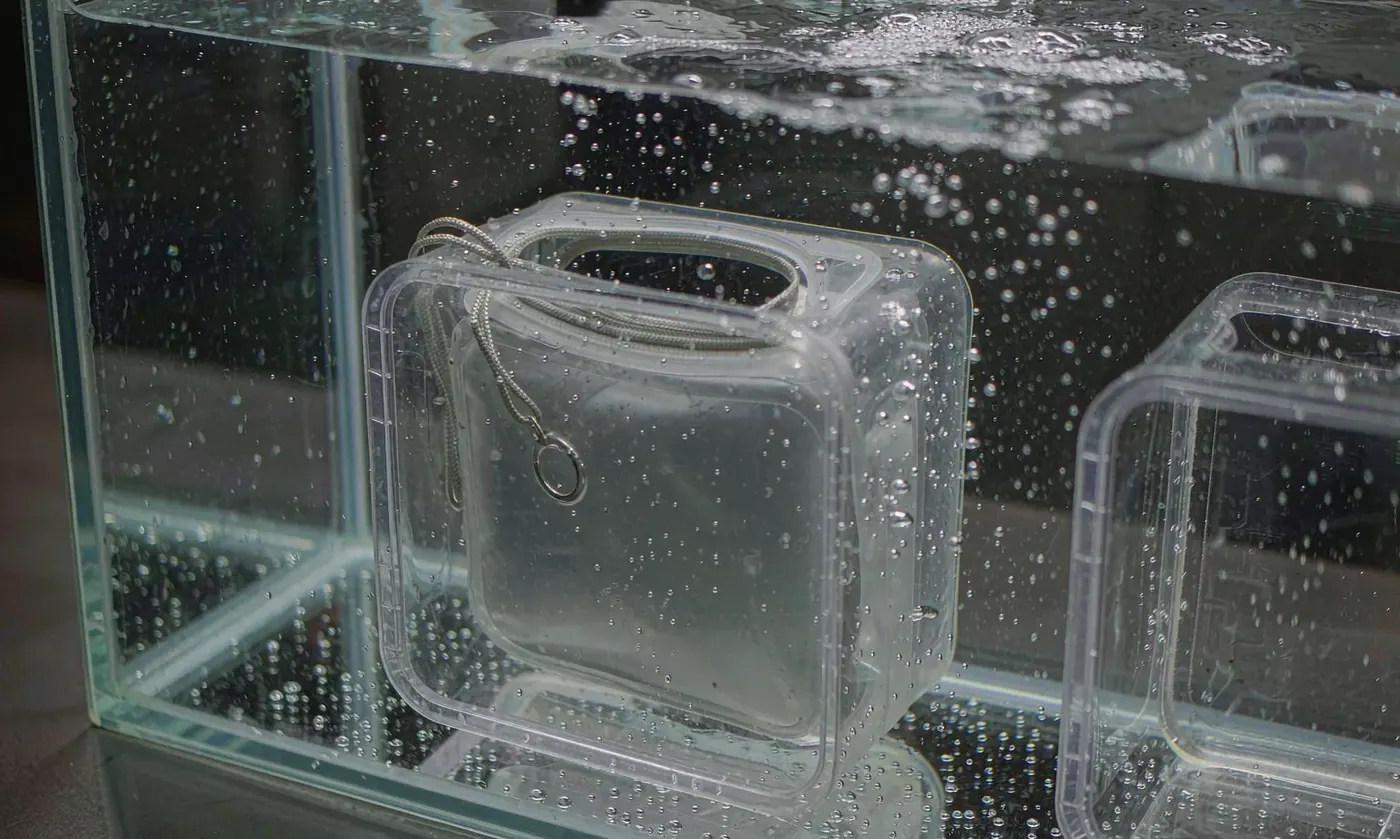
Conventional wisdom says a rigid case protects better against everything including water, and against immersion it simply does not. A soft body made from welded film can be sealed at every seam and tested to a defined depth and duration, whereas a hard case depends on a perimeter gasket held in compression by latches that inevitably loosen.
| Water scenario | Soft backpack | Hard case | Why |
|---|---|---|---|
| Heavy rain in the open | Excellent to IPX4-IPX6 | Good if the lip resists | Fabrics shed, lid lips collect |
| Spray over the bow | Excellent to IPX5-IPX6 | Poor at the lid seam | Spray finds the gasket line |
| Set down in standing water | Poor unless the base is welded | Excellent, rigid shell above it | A case floats clear of the base |
| Full immersion | Rated bodies pass to IPX7 | Usually fails past a few minutes | Latch pressure is uneven |
| Wet ground transport | Excellent | Excellent | Neither has an issue |
Notice that the case actually wins one row clearly, and it is a common one. A rigid shell set down in water keeps everything well above the level of the puddle, while a soft body wicks through its base within minutes unless that base is moulded or welded. That single row explains most of the intuition that cases are better in wet conditions, even though the case loses every row involving spray or immersion.
Carrying Rods With Either Option
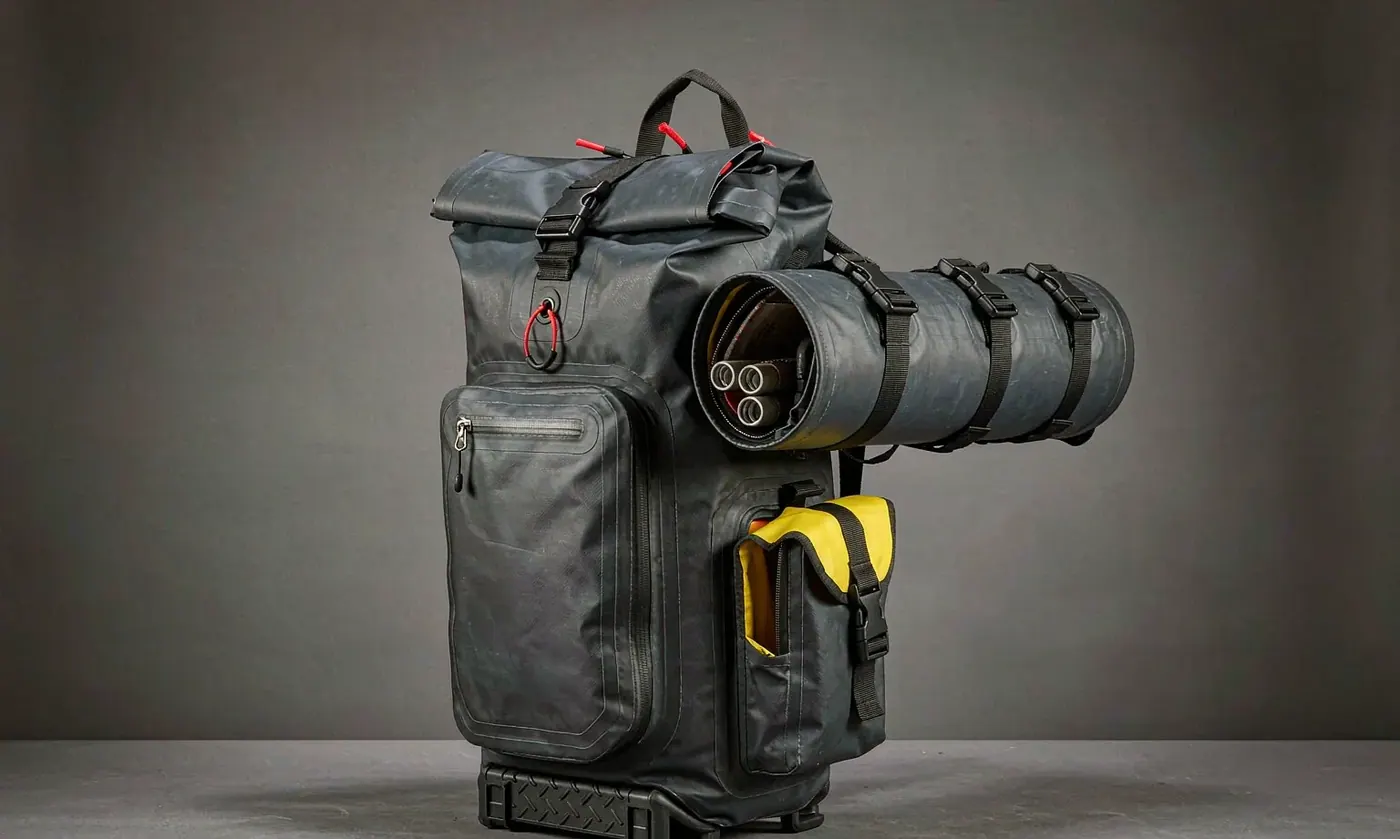
Rod carriage splits the two options rather cleanly. A soft backpack can integrate a tube along its flank taking a two-piece rod broken down to 700-900 mm, which is the only rod storage that survives being dropped and still allows the angler to walk hands-free. A hard case has nowhere to put a rod, so rods travel separately in one hand, which occupies the hand that would otherwise carry anything else.
- An integrated tube needs an internal diameter near 50 mm to accept a rod with the reel fitted, and a closed bottom plus a bungee to retain it.
- Tube length should be 780 mm or more for two-piece rods up to about 8 ft broken down, and 900 mm for longer models.
- A case-based angler needs a separate rod holdall at roughly 14-26 USD, which closes most of the price gap between the two systems.
- Ready-to-fish rod storage either way requires the rod to be rigged, which is the version that gets damaged in transport.
- For car-to-boat transport specifically, a case plus a separate rod tube works well enough that neither party should feel shortchanged.
The third point matters when comparing total cost rather than headline price. A case at 18-25 USD plus a rod holdall at 14-26 USD totals 32-51 USD, which overlaps the full price of a good backpack with an integrated tube. Buyers comparing two systems rather than two products usually reach a different conclusion than those comparing line items.
Lifespan and Failure Modes
The two formats fail in entirely different places, and knowing where each one gives out is worth more than a general durability claim. Neither lasts forever, and neither should be expected to.
| Failure mode | Soft backpack | Hard case | Typical onset |
|---|---|---|---|
| Primary wear point | Base fabric and zip tape | Lid hinge and latches | Three to five seasons either way |
| Catastrophic failure | Seam opening or zip separation | Hinge cracking through the wall | Usually sudden |
| Environmental weakness | Ultraviolet exposure on face fabric | Cold-impact brittleness below -10 C | Depends on storage |
| Repairability | Patchable, sometimes resealable | Rarely practical to repair | Case usually replaced |
| End of useful life | Fabric thins, coating cracks | Hinge fails, case will not close | Often a full replacement |
Cold-impact brittleness in cases is worth specifying explicitly because it is easy to prevent and expensive to discover. Impact behaviour should be tested to methods published by ASTM International, with a stated drop height and temperature, since a case that survives a summer drop can shatter from the same height at -10 C. Abrasion and coating expectations for the soft side, as well as plastics methods generally, follow standards maintained by the International Organization for Standardization.
Where Neither Option Wins
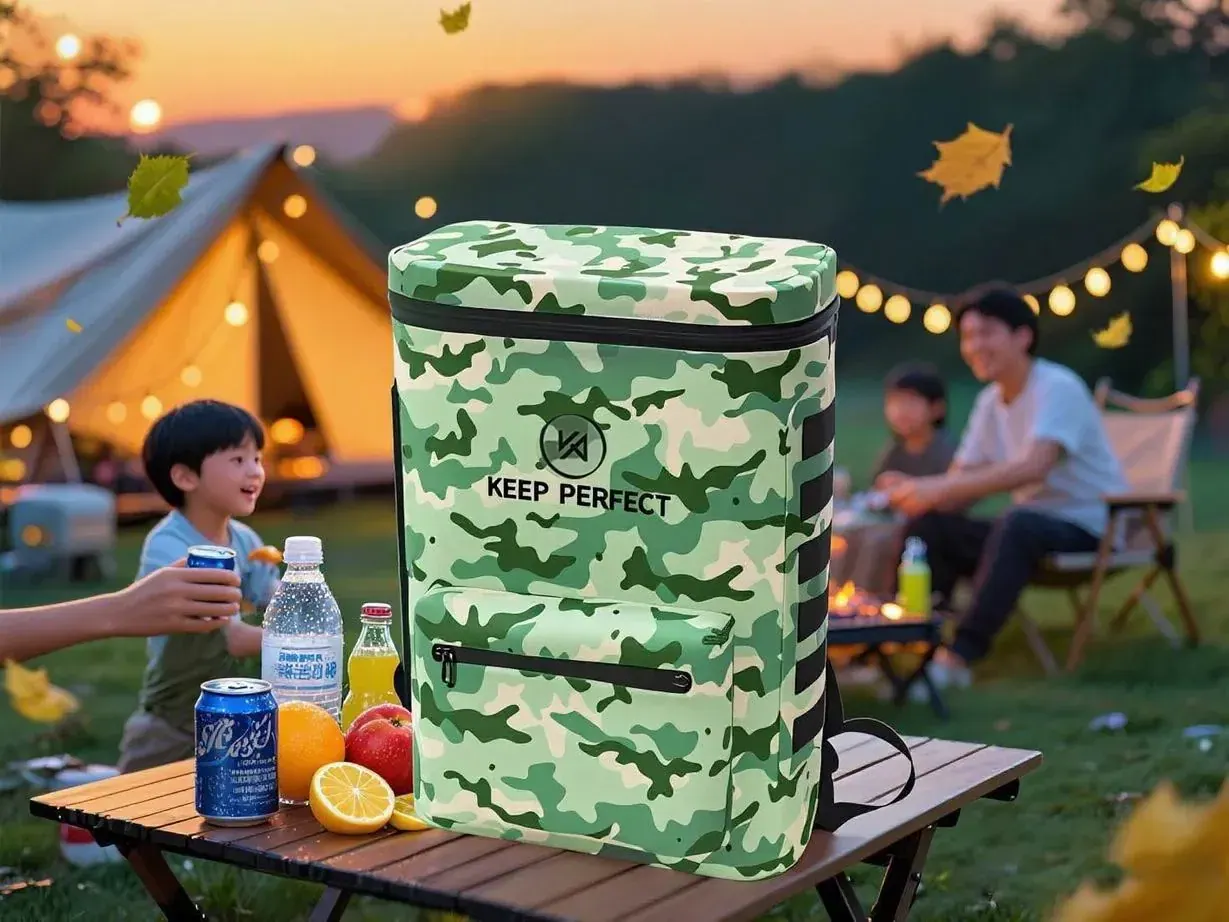
A complete description of this decision includes acknowledging what neither format handles. Bait, food, water, and harvested fish need insulation and drainage, and putting any of them into either tackle system tends to end badly for everything else in there.
- Insulated bodies of 10-35 L with a 4-8 mm foam liner and a heat-welded inner seam cost 12-42 USD and do what neither format can.
- A drain plug at the lowest point matters more than insulation thickness, because melt water otherwise pools in the base.
- Raw bait should never share storage with gear that later touches open hands or food, which is a hygiene rather than a convenience issue.
- Neither system should hold anything wet from the end of a session, which is how both formats end up mildewed by the following week.
The consequence for buyers is that a range should treat insulation as its own separate category rather than as a feature bolted onto either storage format. Attempting to combine them produces a compromise that does both jobs worse, and it is consistently one of the weaker-selling products in any tackle range.
Storage Aboard Changes Three Rules
Mounting gear to a hull or a deck rewires three of the assumptions made above, and buyers serving boat or kayak anglers should restate them rather than let the bank-fishing conclusion carry across. The first change is that carry distance becomes zero, which hands the advantage straight back to the case. The second is that anything loose must be restrained, because a wave will move it.
| Factor afloat | Soft backpack | Hard case | Practical note |
|---|---|---|---|
| Restraint in a seaway | Needs two lash points minimum | Rigid body resists movement | Cases move less, but anything loose still shifts |
| Footprint in a locker | Conforms to the space | Fixed shape wastes volume | Soft wins in an irregular locker |
| Access while seated | Requires setting down and opening | Lid opens in one motion | Cases genuinely faster on a boat |
| Exposure to bilge water | Needs a welded lower shell | Shell stays above the water | Case wins the standing-water row again |
| After a capsize | Floats if built with foam panels | Floats empty, sinks loaded | Leash either to the hull |
The access row is where the case takes something back decisively, and it mirrors the bank conclusion in reverse. Sitting in a boat with the case at the angler's feet, one motion opens the lid and every slot is presented, whereas a soft body has to be lifted, opened, and propped, which is awkward in a moving hull. Kayak anglers in particular often settle on a hybrid arrangement, and the reasoning is set out in the kayak crate against tackle backpack comparison, which covers the same trade-off where legroom rather than storage volume is the scarce resource.
Theft and casual loss deserve a final mention for anyone specifying for charter fleets. Nothing about either format deters opportunistic loss, but a rigid case with a hasp takes a small padlock while a soft zip does not without adding hardware. For fleets running unsupervised boats overnight, that single feature decides purchases more often than any performance consideration.
The Decision Table
All of this reduces to four answerable questions, and answering them in order produces a clear recommendation without further analysis. The order matters, because the first question resolves most cases before the rest are reached.
| If this is true | Choose | Reason |
|---|---|---|
| Kit walks more than 200 m | Soft backpack | Hand-carry beyond this distance is grip-limited |
| Kit is carried from a vehicle to a boat | Either, then hard case | Protection and stacking matter, distance does not |
| Fragile items must not be crushed | Hard case | No soft body matches formed internal slots |
| A work surface is needed on a jetty | Hard case | The lid is genuinely useful, not incidental |
| Immersion risk is real | Welded soft backpack | Testable sealing beats a lid gasket |
| Session length varies a lot day to day | Soft backpack | Leave trays behind rather than carry everything |
| Rods must travel on foot too | Soft backpack with a tube | A case needs a second item for rods |
Buyers should note that the honest answer for most serious anglers is both, bought years apart and used for different water. Stocking the pair as a system rather than framing them as rivals produces better outcomes for the customer and better average order value for the retailer, and it reflects how these products are actually used.
Programme, Pricing, and Compliance
The two formats rarely share tooling or process, so a range covering both is two development programmes rather than one. Soft sewn bodies take 6-10 working days to sample, while a new case requires injection or rotational tooling adding 15-25 days before the first shot is produced.
| Programme item | Soft backpack | Hard case |
|---|---|---|
| MOQ | 500 pcs per design and colour | 500 pcs per design and colour |
| Tooling | Cutting patterns only | New injection or rotational tool |
| Sampling | 6-10 working days | Add 15-25 days before the first shot |
| Unit cost band | 22-48 USD | 18-55 USD depending on size |
| Bulk | 35-50 days | 35-50 days from approved sample and deposit |
| Inspection | AQL 2.5 plus spray or immersion protocol | AQL 2.5 plus cold-impact drop test |
QUANZHOU JUNYUAN BAGS has developed waterproof bag programmes since 2014, with the founding team working in the trade since 2004. Monthly output of 200,000 units is verified by SGS, and BSCI and ISO 9001 systems structure the workflow. Materials are screened for REACH and California Prop 65, and every bulk order is inspected at AQL 2.5 before shipment.
A dual-format brief can be emailed to service@junyuanbags.com with format, carry distance, tray count, water rating, and quantity. FOB Xiamen or DDP service to more than 100 countries follows an approved sample and a complete test record. Buyers narrowing further should compare the tackle backpack range and read the wider hard shell against soft shell discussion, particularly when storage on a kayak rather than a bank is the deciding factor.
People Also Ask
Is a soft tackle backpack better than a hard tackle box?
Past about 200 m of carrying, yes, because grip fatigue sets a hard limit on hand-carry. Below that distance the case wins on crush protection and giving you a work surface.
Why do anglers still buy hard tackle boxes?
Formed internal slots protect fragile items, the lid works as a table or seat, and cases stack securely in a vehicle or boat locker. None of those is available in a soft body.
Which is more waterproof, a soft bag or a hard case?
A welded soft body tested to IPX6-IPX7 is more waterproof than a case with a lid gasket. A case wins only when set down in standing water, where its rigid shell keeps contents clear of the base.
How heavy is a loaded hard tackle box?
About 9-12 kg with five trays, having started at 2.4-3.6 kg empty. That concentrates through a 25 mm handle, which cramps the hand within about five minutes.
Can I carry rods with a tackle backpack?
Yes, with an integrated 700-900 mm side tube taking a broken-down two-piece rod. A hard case needs a separate holdall at 14-26 USD, which closes much of the price gap.
Should I own both a soft bag and a hard box?
Usually yes, eventually. Most settled anglers buy one format first, then the other years later for water with different requirements, and rarely regret owning both.
Frequently Asked Questions
Q1. What is the difference between a soft tackle backpack and a hard tackle box?
A backpack holds removable trays in a fabric body weighing 1.3-1.8 kg empty and carried on the hips, while a case has formed slots in a rigid shell weighing 2.4-3.6 kg empty and carried by hand.
Q2. Which is better for walking to a fishing spot?
A backpack, without question. Hand-carry becomes impractical beyond roughly 200 m because grip fatigue rather than strength sets the limit.
Q3. Do hard tackle boxes protect tackle better?
They protect against crushing and impacts, yes. They do not protect better against spray or immersion, where a lid gasket performs worse than a welded soft shell.
Q4. How much does a hard tackle box weigh empty?
Typically 2.4-3.6 kg before anything goes in, rising to about 9-12 kg with five loaded trays. That is why cases are carried short distances only.
Q5. Can a hard tackle box go in the rain?
Yes for light to moderate rain, since the shell sheds water well. Spray reaching the lid seam is where it struggles, and latches loosen over time.
Q6. Which lasts longer, a soft bag or a hard case?
Three to five seasons each in regular use. The soft body fails at the base fabric or zip tape, and the case at its hinge or latches, which usually means replacement rather than repair.
Q7. Why did my hard case crack in winter?
Cold-impact brittleness below about -10 C. Specify a temperature-rated impact test rather than a room-temperature drop, since a case that survives one can shatter in the other.
Q8. Can I add rod storage to a tackle backpack?
Yes, with an integrated side tube of internal diameter around 50 mm and length 780 mm or more, which takes a two-piece rod broken down with the reel still fitted.
Q9. Is a hard case worth it for boat fishing?
Usually yes, because distance is effectively zero, protection matters more, and the lid gives a rigging surface. Cases also stack securely in a locker.
Q10. Do I need a separate insulated bag either way?
Yes. Bait, food, and harvested fish need insulation and a drain, and neither tackle format provides either. Budget 12-42 USD for a dedicated body.
Q11. Which costs more to develop as a product?
A case, because new injection or rotational tooling adds 15-25 days before the first shot. A soft body needs cutting patterns only and samples in 6-10 working days.
Q12. What is the MOQ for either format?
500 pcs per design and colour for both, with bulk production running 35-50 days from an approved sample and deposit.